October 25

What was advertised in a colonial American newspaper 250 years ago today?
Oct 25 - 10:25:1768 South-Carolina Gazette and Country Journal
South-Carolina Gazette and Country Journal (October 25, 1768).

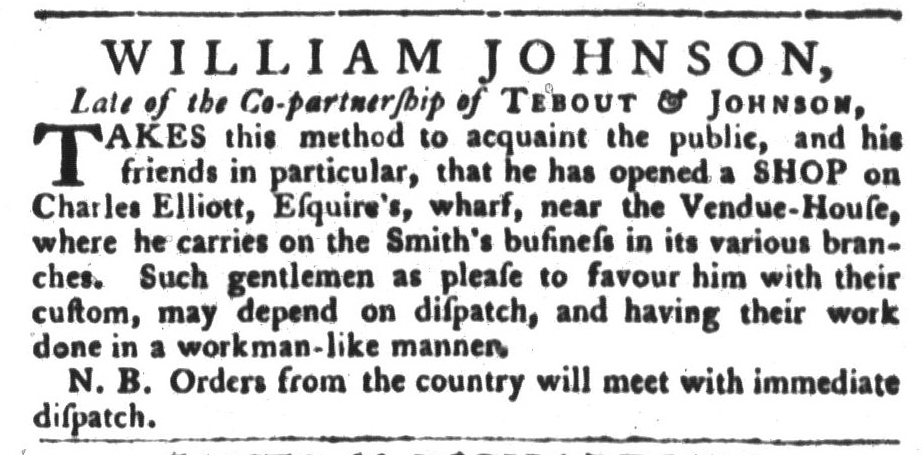
“WILLIAM JOHNSON, Late of the Co-partnership of TEBOUT & JOHNSON.”

To inform residents of Charleston and its hinterlands that “he carries on the Smith’s business in its various branches,” William Johnson placed an advertisement in the October 25, 1768, edition of the South-Carolina Gazette and Country Journal. He had recently opened his own shop near the city’s “Vendue-House” (or auction room), but Johnson was not a novice to the business. He introduced himself as “Late of the Co-partnership of TEBOUT & JOHNSON.”

In so doing, Johnson’s advertisement differed from many others placed by artisans and others who provided services for consumers. Those advertisers frequently indicated their trade and place of origin in an introductory line that served as a secondary headline for their advertisements. For instance, one column over from Johnson’s advertisement, Thomas Booth’s notice included his name, centered and in a larger font, as the primary headline along with “COACH, SIGN, and HOUSE PAINTER, / from LONDON” as further introduction before describing the services he offered. On the following page, another advertisement promoted the services of “GEORGE WOOD, / BOOK-BINDER and STATIONER, in Elliott-street.”

Johnson could have followed this format, but he may have reasoned that he would attract more business by taking advantage of his record of serving residents of Charleston and the surrounding area. Presumably the partnership of Tebout and Johnson had built a clientele or established a reputation in the busy port. Johnson sought to leverage his prior experience to draw former customers to his shop. Even those who had never engaged his services could have been familiar with the former partnership, making it more valuable for Johnson to list that affiliation than his occupation as the secondary headline for his advertisement. After all, anyone familiar with the “Co-partnership of TEBOUT & JOHNSON” would have known that they were smiths. Deviating from the standard format for advertisements placed by artisans allowed Johnson to place greater emphasis on an aspect of his business likely to resonate with prospective customers.

Slavery Advertisements Published October 25, 1768

GUEST CURATOR: Jose Garcia

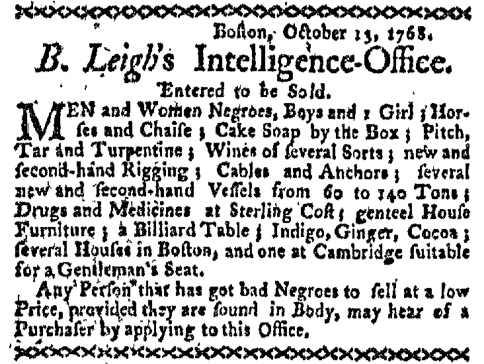
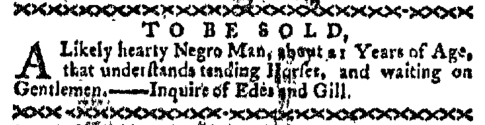
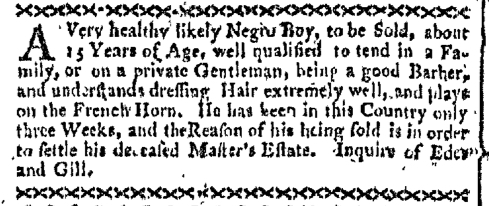
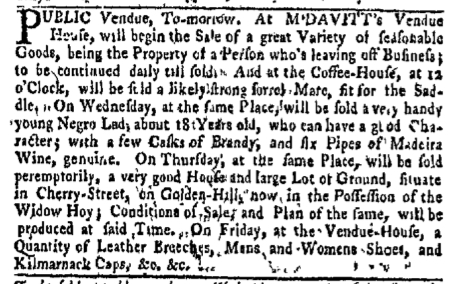
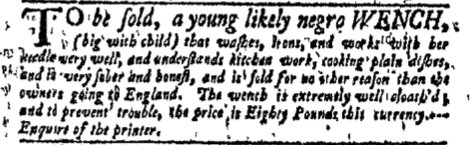
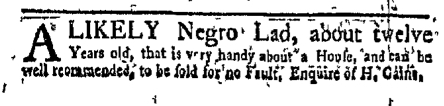
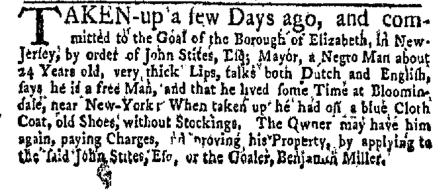
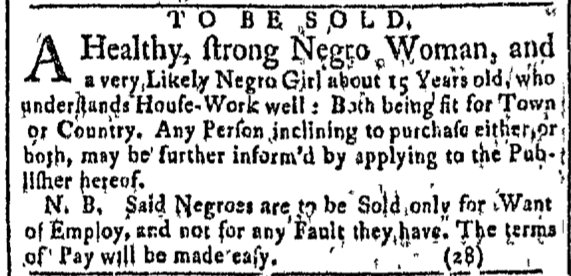
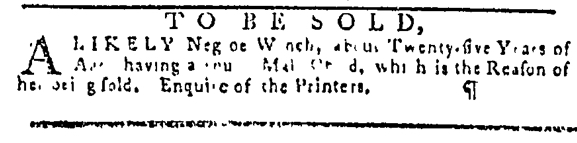
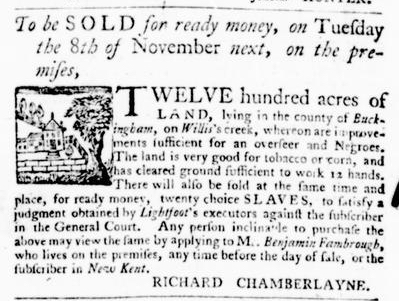
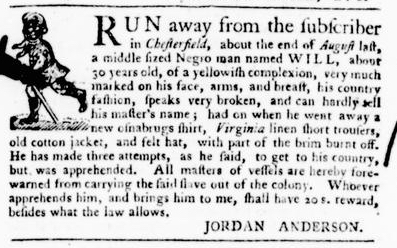
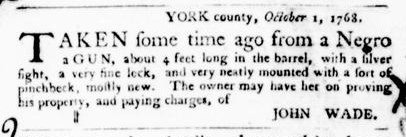
The Slavery Adverts 250 Project chronicles the role of newspaper advertising in perpetuating slavery in the era of the American Revolution. The project seeks to reveal the ubiquity of slavery in eighteenth-century life from New England to Georgia by republishing advertisements for slaves – for sale, wanted to purchase, runaways, captured fugitives – in daily digests on this site as well as in real time via the @SlaveAdverts250 Twitter feed, utilizing twenty-first-century media to stand in for the print media of the eighteenth century.

The project aims to provide modern audiences with a sense of just how often colonists encountered these advertisements in their daily lives. Enslaved men, women, and children appeared in print somewhere in the colonies almost every single day. Those advertisements served as a constant backdrop for social, cultural, economic, and political life in colonial and revolutionary America. Colonists who did not own slaves were still confronted with slavery as well as invited to maintain the system by purchasing slaves or assisting in the capture of runaways. The frequency of these newspaper advertisements suggests just how embedded slavery was in colonial and revolutionary American culture in everyday interactions beyond the printed page.

These advertisements also testify to the experiences of enslaved men, women, and children, though readers must consider that those experiences have been remediated through descriptions offered by slaveholders rather than the slaves themselves. Often unnamed in the advertisements, enslaved men, women, and children were not invisible or unimportant in early America.

During the week of October 21-27, 2018, the Slavery Adverts 250 Project is guest curated by Jose Garcia (2019), a History major at Assumption College in Worcester, Massachusetts.

These advertisements appeared in colonial American newspapers 250 years ago today.

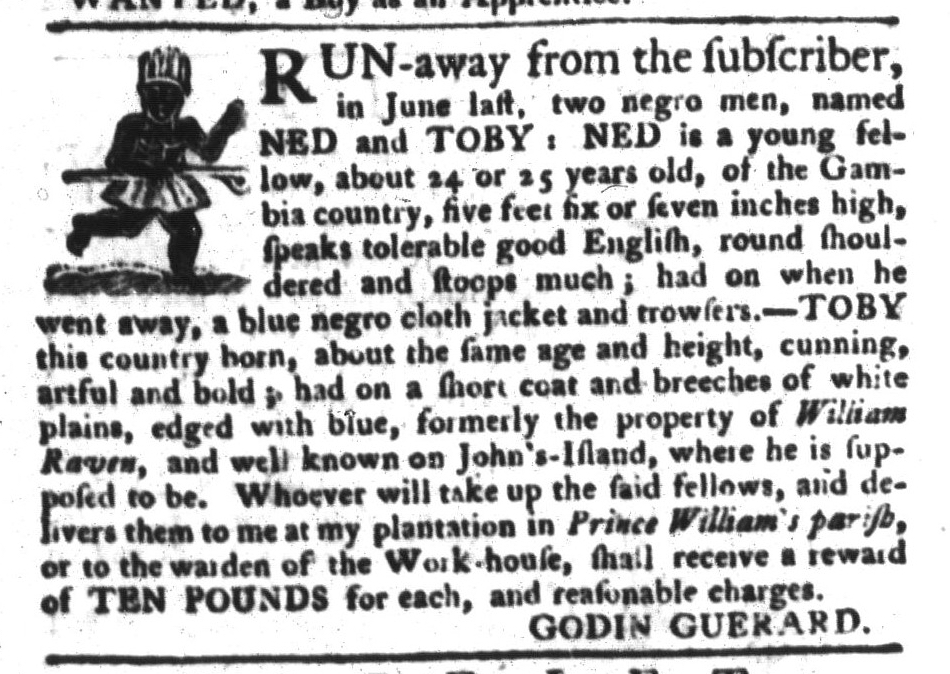
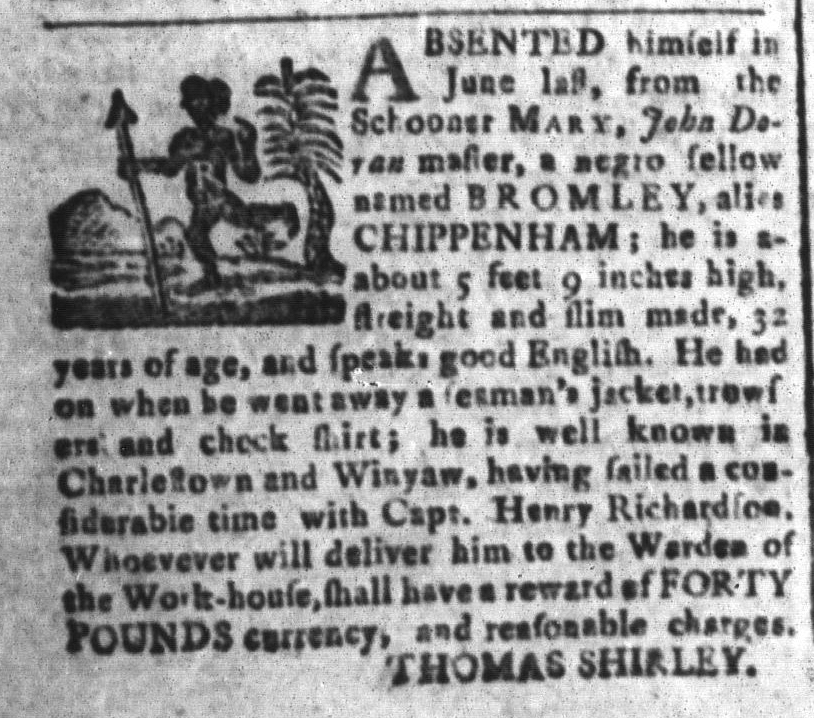
Oct 25 - South-Carolina Gazette and Country Journal Slavery 1
South-Carolina Gazette and Country Journal (October 25, 1768).

**********

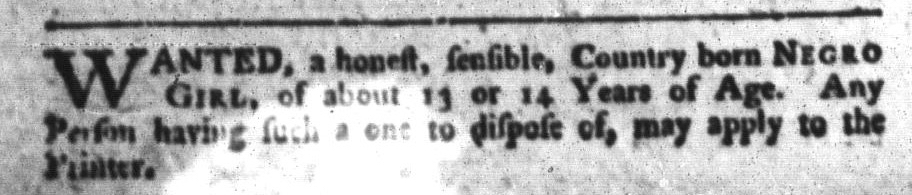
Oct 25 - South-Carolina Gazette and Country Journal Slavery 2
South-Carolina Gazette and Country Journal (October 25, 1768).

**********

Oct 25 - South-Carolina Gazette and Country Journal Slavery 3
South-Carolina Gazette and Country Journal (October 25, 1768).

**********

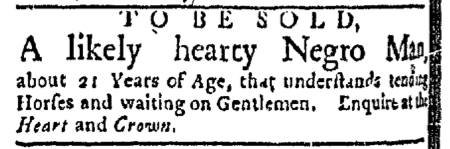
Oct 25 - South-Carolina Gazette and Country Journal Slavery 4
South-Carolina Gazette and Country Journal (October 25, 1768).

**********

Oct 25 - South-Carolina Gazette and Country Journal Slavery 5
South-Carolina Gazette and Country Journal (October 25, 1768).

**********

Oct 25 - South-Carolina Gazette and Country Journal Slavery 6
South-Carolina Gazette and Country Journal (October 25, 1768).

**********

Oct 25 - South-Carolina Gazette and Country Journal Slavery 7
South-Carolina Gazette and Country Journal (October 25, 1768).

**********

Oct 25 - South-Carolina Gazette and Country Journal Supplement Slavery 1
Supplement to the South-Carolina Gazette and Country Journal (October 25, 1768).

**********

Oct 25 - South-Carolina Gazette and Country Journal Supplement Slavery 2
Supplement to the South-Carolina Gazette and Country Journal (October 25, 1768).

**********

Oct 25 - South-Carolina Gazette and Country Journal Supplement Slavery 3
Supplement to the South-Carolina Gazette and Country Journal (October 25, 1768).

**********

Oct 25 - South-Carolina Gazette and Country Journal Supplement Slavery 4
Supplement to the South-Carolina Gazette and Country Journal (October 25, 1768).

**********

Oct 25 - South-Carolina Gazette and Country Journal Supplement Slavery 5
Supplement to the South-Carolina Gazette and Country Journal (October 25, 1768).


October 24

What was advertised in a colonial American newspaper 250 years ago today?

Oct 24 - 10:24:1768 Boston Evening-Post
Boston Evening-Post (October 24, 1768).

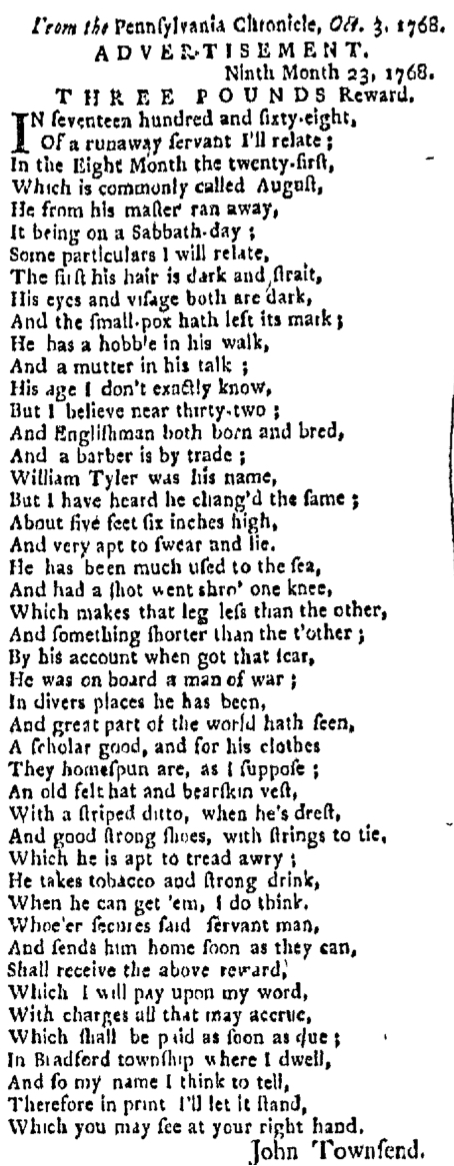
“IN seventeen hundred and sixty-eight, / Of a runaway servant I’ll relate.”

A curious advertisement appeared in the October 24, 1768, edition of the Boston Evening-Post. It offered “THREE POUNDS Reward” for the capture and return of William Tyler, an indentured servant who ran away from John Townsend. Yet Townsend had not paid to have this advertisement inserted in the Boston Evening-Post. Instead, the printers, Thomas Fleet and John Fleet, had made an editorial decision to reprint the advertisement as a novelty to entertain their subscribers and other readers. A brief note indicated that they reprinted it from the October 3 issue of the Pennsylvania Chronicle.

The subject of the advertisement was hardly unusual, but the method of delivering the content certainly deviated from that of most other advertisements in colonial newspapers. Rather than writing a brief narrative about the runaway servant, Townsend composed a poem. In nearly two dozen rhyming couplets, he delivered the usual information about Tyler’s age, appearance, occupation, clothing, personality, and other distinguishing characteristics. “He has a hobble in his walk, / And a mutter in his talk,” Townsend reported. Furthermore, the runaway “takes tobacco and strong drink, / When he can get ‘em, I do think.” Many of the rhymes were rather labored, but Townsend managed to insert all the pertinent information. The Fleets apparently considered his efforts worthy of sharing with a larger audience, though likely more for amusement than edification.

Colonial newspapers regularly included items reprinted from other newspapers, some published in the colonies and others in England and other parts of Europe. Modern concepts of plagiarism did not apply; networks of printers exchanged their publications and then borrowed extensively, usually word-for-word, from other newspapers when they compiled news and editorial content for inclusion in their own newspapers. However, they did not usually reprint advertisements. After all, advertisements meant revenues. In most instances printers expected others to pay to have their advertisements inserted in newspapers, but on occasion certain advertisements possessed such entertainment value that printers selected them without concern for collecting fees. In June 1768, for example, the printers of both the New-York Journal and the Providence Gazette inserted an advertisement for a show featuring “HORSEMANSHIP, performed on one, two, and three horses, by Mr. WOLTON.” That advertisement first ran in the London Gazetteer in March 31. Both newspapers acknowledged its origins. The New-York Journal explained that it “is inserted as a Curiosity.”

Advertisements had the capacity to entertain as well to inform or to shape consumer demand. That the Fleets reprinted Townsend’s advertisement that relayed the story of a runaway servant in a poem demonstrates that they perused more than just the news in other publications when identifying content to appropriate and share with their own readers.

Slavery Advertisements Published October 24, 1768

GUEST CURATOR: Jose Garcia

The Slavery Adverts 250 Project chronicles the role of newspaper advertising in perpetuating slavery in the era of the American Revolution. The project seeks to reveal the ubiquity of slavery in eighteenth-century life from New England to Georgia by republishing advertisements for slaves – for sale, wanted to purchase, runaways, captured fugitives – in daily digests on this site as well as in real time via the @SlaveAdverts250 Twitter feed, utilizing twenty-first-century media to stand in for the print media of the eighteenth century.

The project aims to provide modern audiences with a sense of just how often colonists encountered these advertisements in their daily lives. Enslaved men, women, and children appeared in print somewhere in the colonies almost every single day. Those advertisements served as a constant backdrop for social, cultural, economic, and political life in colonial and revolutionary America. Colonists who did not own slaves were still confronted with slavery as well as invited to maintain the system by purchasing slaves or assisting in the capture of runaways. The frequency of these newspaper advertisements suggests just how embedded slavery was in colonial and revolutionary American culture in everyday interactions beyond the printed page.

These advertisements also testify to the experiences of enslaved men, women, and children, though readers must consider that those experiences have been remediated through descriptions offered by slaveholders rather than the slaves themselves. Often unnamed in the advertisements, enslaved men, women, and children were not invisible or unimportant in early America.

During the week of October 21-27, 2018, the Slavery Adverts 250 Project is guest curated by Jose Garcia (2019), a History major at Assumption College in Worcester, Massachusetts.

These advertisements appeared in colonial American newspapers 250 years ago today.

Oct 24 - Boston Evening-Post Slavery 1
Boston Evening-Post (October 24, 1768).

**********

Oct 24 - Boston-Gazette Slavery 1
Boston-Gazette (October 24, 1768).

**********

Oct 24 - Boston-Gazette Slavery 2
Boston-Gazette (October 24, 1768).

**********

Oct 24 - Boston-Gazette Slavery 3
Boston-Gazette (October 24, 1768).

**********

Oct 24 - Boston-Gazette Slavery 4
Boston-Gazette (October 24, 1768).

**********

Oct 24 - New-York Gazette Weekly Mercury Slavery 1
New-York Gazette and Weekly Mercury (October 24, 1768).

**********

Oct 24 - New-York Gazette Weekly Mercury Slavery 2
New-York Gazette and Weekly Mercury (October 24, 1768).

**********

Oct 24 - New-York Gazette Weekly Mercury Supplement Slavery 1
Supplement to the New-York Gazette and Weekly Mercury (October 24, 1768).

**********

Oct 24 - New-York Gazette Weekly Mercury Supplement Slavery 2
Supplement to the New-York Gazette and Weekly Mercury (October 24, 1768).

**********

Oct 24 - New-York Gazette Weekly Mercury Supplement Slavery 3
Supplement to the New-York Gazette and Weekly Mercury (October 24, 1768).

**********

Oct 24 - New-York Gazette Weekly Post-Boy Slavery 1
New-York Gazette: Or, the Weekly Post-Boy (October 24, 1768).

**********

Oct 24 - Newport Mercury Slavery 1
Newport Mercury (October 24, 1768).

**********

Oct 24 - Newport Mercury Slavery 2
Newport Mercury (October 24, 1768).

**********

Oct 24 - South-Carolina Gazette Slavery 1
South-Carolina Gazette (October 24, 1768).

**********

Oct 24 - South-Carolina Gazette Slavery 2
South-Carolina Gazette (October 24, 1768).

**********

Oct 24 - South-Carolina Gazette Slavery 3
South-Carolina Gazette (October 24, 1768).

October 23

What was advertised in a colonial American newspaper 250 years ago this week?

Oct 23 - 10:20:1768 New-York Journal
New-York Journal (October 20, 1768).

Imported by him in the last Vessels from Europe.”

Peter T. Curtenius sold a variety of goods “At the Sign of the Golden Anvil” in New York in the fall of 1768. He advertised “a fresh Assortment” of textiles and hardware in the New-York Journal, advising that they had been “imported by him in the last Vessels from Europe.” The timing was important. The September 8 edition reported that the city’s merchants had met on August 27 to adopt a series of resolutions concerning imported goods. Until Parliament repealed duties on paper and glassware, the merchants vowed to cease trading with Great Britain … yet this nonimportation agreement had certain parameters. The merchants stated that they “will not send for … any other Goods than what we have already ordered.” This allowed for the arrival of merchandise that had been ordered prior to August 27 and the stockpiling of those goods. Merchants made a political statement while simultaneously stockpiling goods and minimizing the effects on their own finances.

Almost two months had passed when Curtenius’s advertisement appeared in the October 20 edition of the New-York Journal, but it had first been published three weeks earlier in the September 29 issue. Given the amount of time required for ships to transmit orders across the Atlantic and return with their cargoes, any items imported “in the last Vessels from Europe” at the end of September must have been ordered before merchants in New York adopted their nonimportation agreement.

Demonstrating that he had abided by those resolutions may have been particularly important for Curtenius. After listing his imported wares, he devoted a paragraph to goods “made at the New-York Air Furnace,” including “Pots, kettles, pie pans and baking ovens.” Even as he sold imported goods, Curtenius joined a movement that promoted production and consumption of “domestic manufactures” as a means of asserting greater economic independence from Great Britain. He would have undermined the political meaning of ironmongery produced in New York if he had marketed goods that departed from the provisions of the nonimportation agreement. To make those items even more attractive to prospective customers, Curtenius also underscored the quality of some of them. When it came to hammers made at the New-York Air Furnace, for instance, he asserted that they “have been found upon proof to be superior to the English hammers.” Customers did not have to sacrifice quality when choosing to buy products that made a political statement.

Elsewhere in the October 20 edition of the New-York Journal, “A CITIZEN’ lamented the landing of troops in Boston and other measures intended “to humble and molify our refactor, (or as they will be stiled) rebellious Spirits.” Colonists could hardly read advertisements for consumer goods and services without thinking of the political ramifications associated with their own habits and decisions concerning consumption. Even as Curtenius deployed formulaic language about the vessels that transported his goods, that language took on new meaning for readers in the wake of new developments in the realm of politics.

October 22

What was advertised in a colonial American newspaper 250 years ago today?

Oct 22 - 10:22:1768 Providence Gazette
Providence Gazette (October 22, 1768).

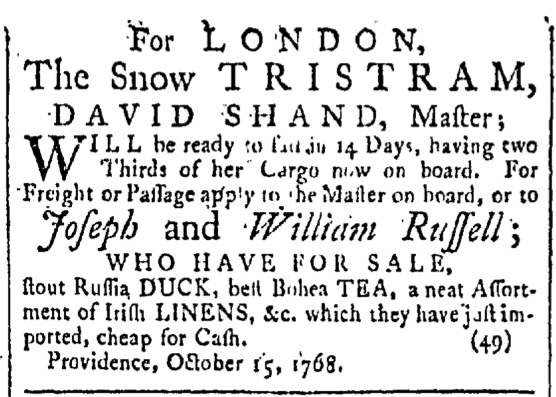
“The Snow TRISTRAM … WILL be ready to sail in 14 Days.”

In the late 1760s Joseph Russell and William Russell advertised frequently in the Providence Gazette. Unlike most advertisers throughout the colonies, they sometimes ran multiple advertisements in a single issue, a tactic that enhanced their prominence as local merchants and gave their enterprises even greater visibility. Such was the case in October 1768. On October 1 they placed a new advertisement for “a neat and fresh Assortment of GOODS” that they had just imported “in the Ship Cleopatra.” It appeared in all five issues published in October. On October 15 they inserted a new advertisement that solicited passengers and cargo for the Tristram, scheduled to sail for London in fourteen days. In the same advertisement the Russells seized the opportunity to hawk their “stout Russia DUCK, best Bohea TEA, [and] an neat Assortment of Irish LINENS.”

That advertisement appeared in the Providence Gazette on two more occasions, but never with updated copy. It ran in the October 22 edition, still proclaiming that the Tristram “WILL be ready to sail in 14 Days.” Anyone interested in arranging “Freight or Passage” needed to pay attention to the date listed at the end of the advertisement: “October 15, 1768.” The advertisement made one final appearance on October 29 – the day the Tristram was supposed to set sail – still stating that the ship would depart in fourteen days. It may have still been possible to book passage, but unlikely that Captain David Shand took on additional cargo at that time. The Russells, however, continued to peddle textiles and tea along with the assortment of other merchandise promoted in the companion advertisement published elsewhere in the issue.

The Russells provided enough information for prospective clients to determine the sailing date of the Tristram even though they did not revise the copy as the date approached. Listing the date they submitted the advertisement to the printing office was an imperative component because once the type had been set the notice would run without changes until it was discontinued. Very rarely did advertisements undergo any sort of revision in colonial America. Instead, they were eventually replaced with new advertisements comprised of completely different copy, if advertisers wished to continue at all. This meant that advertisements that ran for any length of time might include outdated portions, an aspect that likely contributed to skepticism of marketing efforts by readers.

October 21

What was advertised in a colonial American newspaper 250 years ago today?

Oct 21 - 10:21:1768 Page 3 New-Hampshire Gazette
New-Hampshire Gazette (October 21, 1768).

“BLANKS of all sorts sold at the Printing Office in Portsmouth.”

Like almost every other colonial printer who published a newspaper, Daniel Fowle and Robert Fowle, printers of the New-Hampshire Gazette, regularly inserted advertisements for their own goods and services. Although they sometimes promoted books they sold at the printing office, including John Dickinson’s popular “LETTERS from a FARMER in PENNSYLVANIA, to the INHABITANTS of the BRITISH COLONIES,” they most often ran short notices that informed readers they sold printed blanks (better known as forms today). Blanks included a variety of common legal and commercial devices, such as bills of sale, indentures, and powers of attorney. They were stock-in-trade for printers throughout the colonies.

I have previously argued that advertisements for blanks in particular (and goods sold by printers more generally) had a dual purpose in colonial newspapers. Selling blanks certainly generated revenues for printers. In that regard, advertisements for blanks appeared for the same reason as advertisements for any other consumer goods and services. Advertisements for blanks, however, also served as filler when the rest of the issue fell short of content to fill the pages.

Oct 21 - 10:21:1768 Page 4 New-Hampshire Gazette
New-Hampshire Gazette (October 21, 1768).

The October 21, 1768, edition of the New-Hampshire Gazette makes this especially clear. It was a standard four-page issue created by printing on both sides of a broadsheet and then folding it in half. The first two pages consisted entirely of the masthead and news items, but the final two pages featured a mixture of news and advertising. A short advertisement, just five lines, appeared in the lower right corner of the third page: “BLANKS of most sorts, and a great variety of BOOKS, Pamphlets, &c. sold at the Printing Office, which is kept near the State House, in the Street leading to the Market. And Ferry.—Where Isle Shoals and Newmarket Lottery Tickets are sold.” Another short advertisement, this one only two lines, appeared as the final item on the fourth page, immediately above the colophon. “BLANKS of all sorts sold at the Printing Office in Portsmouth,” it starkly announced. In both cases, the placement at the bottom of the last column on the page indicates that the compositor inserted these advertisements only after including other content, both news and advertising. Advertising their own wares benefitted newspaper printers, but those short notices also played a role in meeting other goals in the publication process.

Slavery Advertisements Published October 21, 1768

GUEST CURATOR: Jose Garcia

The Slavery Adverts 250 Project chronicles the role of newspaper advertising in perpetuating slavery in the era of the American Revolution. The project seeks to reveal the ubiquity of slavery in eighteenth-century life from New England to Georgia by republishing advertisements for slaves – for sale, wanted to purchase, runaways, captured fugitives – in daily digests on this site as well as in real time via the @SlaveAdverts250 Twitter feed, utilizing twenty-first-century media to stand in for the print media of the eighteenth century.

The project aims to provide modern audiences with a sense of just how often colonists encountered these advertisements in their daily lives. Enslaved men, women, and children appeared in print somewhere in the colonies almost every single day. Those advertisements served as a constant backdrop for social, cultural, economic, and political life in colonial and revolutionary America. Colonists who did not own slaves were still confronted with slavery as well as invited to maintain the system by purchasing slaves or assisting in the capture of runaways. The frequency of these newspaper advertisements suggests just how embedded slavery was in colonial and revolutionary American culture in everyday interactions beyond the printed page.

These advertisements also testify to the experiences of enslaved men, women, and children, though readers must consider that those experiences have been remediated through descriptions offered by slaveholders rather than the slaves themselves. Often unnamed in the advertisements, enslaved men, women, and children were not invisible or unimportant in early America.

During the week of October 21-27, 2018, the Slavery Adverts 250 Project is guest curated by Jose Garcia (2019), a History major at Assumption College in Worcester, Massachusetts.

These advertisements appeared in colonial American newspapers 250 years ago today.

Oct 21 - New-London Gazette Slavery 1
New-London Gazette (October 21, 1768).

**********

Oct 21 - New-London Gazette Slavery 2
New-London Gazette (October 21, 1768).

**********

Oct 21 - South-Carolina and American General Gazette Slavery 1
South-Carolina and American General Gazette (October 21, 1768).

**********

Oct 21 - South-Carolina and American General Gazette Slavery 2
South-Carolina and American General Gazette (October 21, 1768).

**********

Oct 21 - South-Carolina and American General Gazette Slavery 3
South-Carolina and American General Gazette (October 21, 1768).

**********

Oct 21 - South-Carolina and American General Gazette Slavery 4
South-Carolina and American General Gazette (October 21, 1768).

**********

Oct 21 - South-Carolina and American General Gazette Slavery 5
South-Carolina and American General Gazette (October 21, 1768).

**********

Oct 21 - South-Carolina and American General Gazette Slavery 6
South-Carolina and American General Gazette (October 21, 1768).

Slavery Advertisements Published October 20, 1768

GUEST CURATOR: Marny Fappiano

The Slavery Adverts 250 Project chronicles the role of newspaper advertising in perpetuating slavery in the era of the American Revolution. The project seeks to reveal the ubiquity of slavery in eighteenth-century life from New England to Georgia by republishing advertisements for slaves – for sale, wanted to purchase, runaways, captured fugitives – in daily digests on this site as well as in real time via the @SlaveAdverts250 Twitter feed, utilizing twenty-first-century media to stand in for the print media of the eighteenth century.

The project aims to provide modern audiences with a sense of just how often colonists encountered these advertisements in their daily lives. Enslaved men, women, and children appeared in print somewhere in the colonies almost every single day. Those advertisements served as a constant backdrop for social, cultural, economic, and political life in colonial and revolutionary America. Colonists who did not own slaves were still confronted with slavery as well as invited to maintain the system by purchasing slaves or assisting in the capture of runaways. The frequency of these newspaper advertisements suggests just how embedded slavery was in colonial and revolutionary American culture in everyday interactions beyond the printed page.

These advertisements also testify to the experiences of enslaved men, women, and children, though readers must consider that those experiences have been remediated through descriptions offered by slaveholders rather than the slaves themselves. Often unnamed in the advertisements, enslaved men, women, and children were not invisible or unimportant in early America.

During the week of October 14-20, 2018, the Slavery Adverts 250 Project is guest curated by Marny Fappiano (2019), a History major at Assumption College in Worcester, Massachusetts.

These advertisements appeared in colonial American newspapers 250 years ago today.

Oct 20 - Boston Weekly News-Letter Slavery 1
Boston Weekly News-Letter (October 20, 1768).

**********

Oct 20 - Boston Weekly News-Letter Slavery 2
Boston Weekly News-Letter (October 20, 1768).

**********

Oct 20 - New-York Journal Slavery 1
New-York Journal (October 20, 1768).

**********

Oct 20 - New-York Journal Slavery 2
New-York Journal (October 20, 1768).

**********

Oct 20 - Pennsylvania Gazette Slavery 1
Pennsylvania Gazette (October 20, 1768).

**********

Oct 20 - Pennsylvania Gazette Supplement Slavery 1
Supplement to the Pennsylvania Gazette (October 20, 1768).

**********

Oct 20 - Pennsylvania Journal Slavery 1
Pennsylvania Journal (October 20, 1768).

**********

Oct 20 - Virginia Gazette Purdie and Dixon Slavery 1
Virginia Gazette [Purdie & Dixon] (October 20, 1768).

**********

Oct 20 - Virginia Gazette Purdie and Dixon Slavery 2
Virginia Gazette [Purdie & Dixon] (October 20, 1768).

**********

Oct 20 - Virginia Gazette Purdie and Dixon Slavery 3
Virginia Gazette [Purdie & Dixon] (October 20, 1768).

**********

Oct 20 - Virginia Gazette Purdie and Dixon Slavery 4
Virginia Gazette [Purdie & Dixon] (October 20, 1768).

**********

Oct 20 - Virginia Gazette Purdie and Dixon Slavery 5
Virginia Gazette [Purdie & Dixon] (October 20, 1768).

**********

Oct 20 - Virginia Gazette Purdie and Dixon Slavery 6
Virginia Gazette [Purdie & Dixon] (October 20, 1768).

**********

Oct 20 - Virginia Gazette Purdie and Dixon Slavery 7
Virginia Gazette [Purdie & Dixon] (October 20, 1768).

**********

Oct 20 - Virginia Gazette Purdie and Dixon Slavery 8
Virginia Gazette [Purdie & Dixon] (October 20, 1768).

**********

Oct 20 - Virginia Gazette Purdie and Dixon Slavery 9
Virginia Gazette [Purdie & Dixon] (October 20, 1768).

**********

Oct 20 - Virginia Gazette Purdie and Dixon Slavery 10
Virginia Gazette [Purdie & Dixon] (October 20, 1768).

**********

Oct 20 - Virginia Gazette Purdie and Dixon Slavery 11
Virginia Gazette [Purdie & Dixon] (October 20, 1768).