The Slavery Adverts 250 Project chronicles the role of newspaper advertising in perpetuating slavery in the era of the American Revolution. The project seeks to reveal the ubiquity of slavery in eighteenth-century life from New England to Georgia by republishing advertisements for slaves – for sale, wanted to purchase, runaways, captured fugitives – in daily digests on this site as well as in real time via the @SlaveAdverts250 Twitter feed, utilizing twenty-first-century media to stand in for the print media of the eighteenth century.
The project aims to provide modern audiences with a sense of just how often colonists encountered these advertisements in their daily lives. Enslaved men, women, and children appeared in print somewhere in the colonies almost every single day. Those advertisements served as a constant backdrop for social, cultural, economic, and political life in colonial and revolutionary America. Colonists who did not own slaves were still confronted with slavery as well as invited to maintain the system by purchasing slaves or assisting in the capture of runaways. The frequency of these newspaper advertisements suggests just how embedded slavery was in colonial and revolutionary American culture in everyday interactions beyond the printed page.
These advertisements also testify to the experiences of enslaved men, women, and children, though readers must consider that those experiences have been remediated through descriptions offered by slaveholders rather than the slaves themselves. Often unnamed in the advertisements, enslaved men, women, and children were not invisible or unimportant in early America.
During the week of December 9-15, 2018, the Slavery Adverts 250 Project is guest curated by Nicholas Sears (2019), a History major at Assumption College in Worcester, Massachusetts.
These advertisements appeared in colonial American newspapers 250 years ago today.
What was advertised in a colonial American newspaper 250 years ago today?
Georgia Gazette (December 14, 1768).
“STOLEN out of the subscriber’s shop, A SILVER LANCET CASE.”
Readers of the Georgia Gazette encountered several means for acquiring consumer goods in the December 14, 1768, edition. They could make choices from among the inventory of merchants and shopkeepers. William Belcher, for instance, advertised a variety of textiles, housewares, and hardware imported from London and Boston. For those inclined to purchase secondhand goods rather than new, David Moses Vallotton, the administrator of the estate of Paul Dubois, offered “HOUSEHOLD GOODS, WEARING APPAREL, some TOOLS and TANNED LEATHERS, and sundry other articles.” Several others executors also announced estate sales and auctions.
Lewis Johnson’s advertisement, however, testified to other ways of obtaining goods in colonial America: theft and purchase of stolen goods. “STOLEN out of the subscriber’s shop,” his advertisement proclaimed, “A SILVER LANCET CASE with five lancets. Ten shillings will be given for returning it, and no questions will be asked. If it should be offered for sale he begs it may be stopt.” Similar advertisements regularly appeared in newspapers throughout the colonies, reporting thefts and describing stolen items in hopes of recovering them. Most offered rewards. Many expressed interest in punishing the perpetrators, though Johnson seemed more interested in recovering the stolen lancet case.
Such advertisements encouraged readers to engage in surveillance of other colonists and their belongings. In particular, they called on the community to be on the lookout for particular items and to assess the possessions of others to determine if they matched those described in the public prints and thus might have been acquired in an unscrupulous fashion. Advertisements for stolen goods cultivated attitudes and behaviors similar to those encouraged in many advertisements that encouraged readers to purchase goods. Both prompted colonists to evaluate the character and status of others by taking into account the goods they possessed, their comportment, and other factors. Both suggest that consumer goods played an integral role in shaping interactions between colonists. Whether the new textiles sold by Belcher, the secondhand housewares from Dubois’s estate, or the lancet case stolen from Johnson, consumer goods were more than mere things. They possessed meaning that played into the appraisals colonists made of others.
The Slavery Adverts 250 Project chronicles the role of newspaper advertising in perpetuating slavery in the era of the American Revolution. The project seeks to reveal the ubiquity of slavery in eighteenth-century life from New England to Georgia by republishing advertisements for slaves – for sale, wanted to purchase, runaways, captured fugitives – in daily digests on this site as well as in real time via the @SlaveAdverts250 Twitter feed, utilizing twenty-first-century media to stand in for the print media of the eighteenth century.
The project aims to provide modern audiences with a sense of just how often colonists encountered these advertisements in their daily lives. Enslaved men, women, and children appeared in print somewhere in the colonies almost every single day. Those advertisements served as a constant backdrop for social, cultural, economic, and political life in colonial and revolutionary America. Colonists who did not own slaves were still confronted with slavery as well as invited to maintain the system by purchasing slaves or assisting in the capture of runaways. The frequency of these newspaper advertisements suggests just how embedded slavery was in colonial and revolutionary American culture in everyday interactions beyond the printed page.
These advertisements also testify to the experiences of enslaved men, women, and children, though readers must consider that those experiences have been remediated through descriptions offered by slaveholders rather than the slaves themselves. Often unnamed in the advertisements, enslaved men, women, and children were not invisible or unimportant in early America.
During the week of December 9-15, 2018, the Slavery Adverts 250 Project is guest curated by Nicholas Sears (2019), a History major at Assumption College in Worcester, Massachusetts.
These advertisements appeared in colonial American newspapers 250 years ago today.
What was advertised in a colonial American newspaper 250 years ago today?
South-Carolina Gazette and Country Journal (December 13, 1768).
“Be early in sending their Advertisements for Insertion, and not to exceed Monday Noon.”
Just as Mein and Fleeming marked the first anniversary of publishing the Boston Chronicle by placing a notice in their own newspaper, a day later Charles Crouch celebrated three years of publishing the South-Carolina Gazette and Country Journal with his own advertisement. Like his counterparts in Boston, Crouch addressed advertisers as well as subscribers, encouraging them to place notices in his publication. In the process, he provided details about the mechanism for publishing advertisements that did not often appear in the pages of eighteenth-century newspapers.
To entice advertisers, Crouch first underscored the popularity of the South-Carolina Gazette and Country, a necessary step considering that it competed with Peter Timothy’s South-Carolina Gazette and Robert Wells’s South-Carolina and American General Gazette. Crouch did not mention either by name, but when he addressed “the Friends to this Gazette” he did note that their “Number are as great as any other in the Place.” In other words, his newspaper had as many subscribers and advertisers as the others. Advertisers could not go wrong by placing notices in his South-Carolina Gazette and Country Journal “as the Circulation of his Papers are very numerous.”
Crouch distributed the South-Carolina Gazette and Country Journal on Tuesdays. To keep to that schedule, he requested that advertisers “be early in sending their Advertisements for Insertion, and not to exceed Monday Noon.” Despite the time required to set type and print the newspaper on a hand-operated press, advertisers could submit their notices as late as a day prior to publication, though Crouch probably limited the number of last-minute submissions out of practicality. He aimed to keep to his schedule for the benefit of his readers, but also to adhere to what seems to have been an informal agreement among Charleston’s printers to stagger publication throughout the week. Until recently, the South-Carolina Gazette appeared on Mondays, the South-Carolina Gazette and Country Journal on Tuesdays, and the South-Carolina and American General Gazette on Thursday. Crouch asserted that he was “fully determined to CONTINUE always punctual to his Day,” perhaps rebuking other printers in the city for recently deviating from the usual schedule and potentially infringing on his circulation and sales as a result.
Crouch did not offer much commentary on the other contents of his newspaper, other than noting that “Letters of Intelligence, Speculative Pieces, &c. are kindly received” and considered for publication. In promoting the South-Carolina Gazette and Country Journal as it “begins the fourth Year of its Publication,” he called on subscribers to pay their bills and assured prospective advertisers that he could place their notices before the eyes of numerous readers. He asserted that his circulation was as large as that of any other newspaper printed in South Carolina, making it the ideal venue for advertising.
The Slavery Adverts 250 Project chronicles the role of newspaper advertising in perpetuating slavery in the era of the American Revolution. The project seeks to reveal the ubiquity of slavery in eighteenth-century life from New England to Georgia by republishing advertisements for slaves – for sale, wanted to purchase, runaways, captured fugitives – in daily digests on this site as well as in real time via the @SlaveAdverts250 Twitter feed, utilizing twenty-first-century media to stand in for the print media of the eighteenth century.
The project aims to provide modern audiences with a sense of just how often colonists encountered these advertisements in their daily lives. Enslaved men, women, and children appeared in print somewhere in the colonies almost every single day. Those advertisements served as a constant backdrop for social, cultural, economic, and political life in colonial and revolutionary America. Colonists who did not own slaves were still confronted with slavery as well as invited to maintain the system by purchasing slaves or assisting in the capture of runaways. The frequency of these newspaper advertisements suggests just how embedded slavery was in colonial and revolutionary American culture in everyday interactions beyond the printed page.
These advertisements also testify to the experiences of enslaved men, women, and children, though readers must consider that those experiences have been remediated through descriptions offered by slaveholders rather than the slaves themselves. Often unnamed in the advertisements, enslaved men, women, and children were not invisible or unimportant in early America.
During the week of December 9-15, 2018, the Slavery Adverts 250 Project is guest curated by Nicholas Sears (2019), a History major at Assumption College in Worcester, Massachusetts.
These advertisements appeared in colonial American newspapers 250 years ago today.
South-Carolina Gazette and Country Journal (December 13, 1768).
**********
South-Carolina Gazette and Country Journal (December 13, 1768).
**********
South-Carolina Gazette and Country Journal (December 13, 1768).
**********
South-Carolina Gazette and Country Journal (December 13, 1768).
**********
Supplement to the South-Carolina Gazette and Country Journal (December 13, 1768).
**********
Supplement to the South-Carolina Gazette and Country Journal (December 13, 1768).
What was advertised in a colonial American newspaper 250 years ago today?
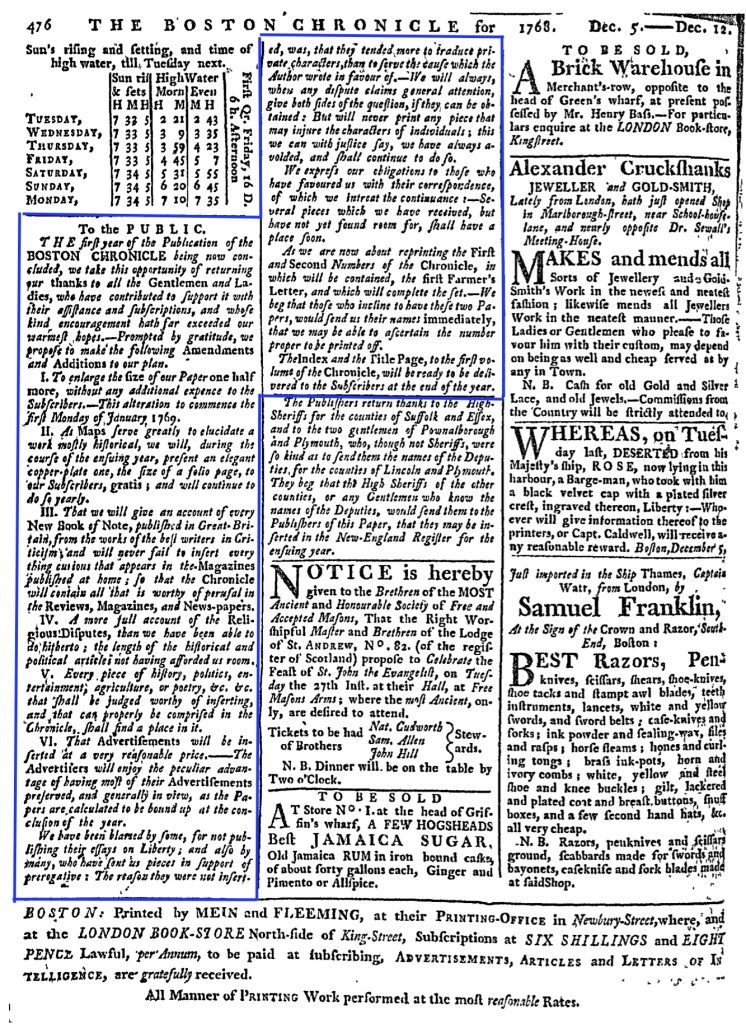
Boston Chronicle (December 12, 1768).
“The peculiar advantage of having most of their Advertisements preserved and generally in view.”
The masthead of the December 12, 1768, Boston Chronicle proclaimed that it was “VOL. I. NO. 52.” John Mein and John Fleeming, the publishers acknowledged the milestone in a notice that they inserted immediately before the other advertisements at the end of the issue. “THE first year of the Publication of the BOSTON CHRONICLE being now concluded,” the publishers proclaimed, “we take this opportunity of returning our thanks to all the Gentlemen and Ladies, who have contributed to support it.” Partly out of appreciation and partly out of enthusiasm for commencing another year of publication, Mein and Fleeming then outlined several “Amendments and Additions” to the plan for their newspaper.
Each of the six enumerated “Amendments and Additions” marketed the Boston Chronicle in one way or another. The first, for instance, stated that they would enlarge the size of the newspaper by half “without any additional expence to the Subscribers.” The change would commence with the first issue of 1769. This change would make space for the third, fourth, and fifth improvements to the newspaper: reviews of “every New Book of Note, published in Great-Britain,” more comprehensive reporting of “Religious Disputes,” and, most ambitiously, “Every piece of history, politics, entertainment, agriculture, or poetry, &c. &c. that shall be judged worthy of inserting.” Space constraints and “the length of the historical and political articles” had previously prevented Mein and Fleeming from including all the content they considered valuable to subscribers, but enlarged editions would remedy that. If all of this was not enough, the publishers also offered a premium to subscribers: “an elegant copper-plate [map], the size of a folio page.” The second of the “Amendments and Additions” stated that subscribers would receive this gift gratis sometime within the coming year. Mein and Fleeming envisioned it as an annual tradition.
The sixth and final improvement addressed advertising: “Advertisements will be inserted at a very reasonable price.—The Advertisers will enjoy the peculiar advantage of having most of their Advertisements preserved and generally in view, as the Papers are calculated to be bound up at the conclusion of the year.” Mein and Fleeming imagined that subscribers collected every issue of the Boston Chronicle throughout the year, with the intention of taking them to bookbinder to be bound into a single volume. Subscribers could then consult the “historical and political articles” later, but that was not the only content they would peruse. They would also encounter advertisements as they once again consulted the pages of the Boston Chronicle. According to Mein and Fleeming, the newspaper was not disposable. The advertisements were not ephemeral. Instead, both would continue to inform, educate, and influence people long after first published.
When they announced their “Amendments and Additions” to mark the first complete year of publishing he Boston Chronicle, Mein and Fleeming focused primarily on the benefits to subscribers, but not exclusively. They also promoted their newspaper as a mechanism for distributing advertisements, aiming to increase the number of paid notices as well as the number of subscribers.
The Slavery Adverts 250 Project chronicles the role of newspaper advertising in perpetuating slavery in the era of the American Revolution. The project seeks to reveal the ubiquity of slavery in eighteenth-century life from New England to Georgia by republishing advertisements for slaves – for sale, wanted to purchase, runaways, captured fugitives – in daily digests on this site as well as in real time via the @SlaveAdverts250 Twitter feed, utilizing twenty-first-century media to stand in for the print media of the eighteenth century.
The project aims to provide modern audiences with a sense of just how often colonists encountered these advertisements in their daily lives. Enslaved men, women, and children appeared in print somewhere in the colonies almost every single day. Those advertisements served as a constant backdrop for social, cultural, economic, and political life in colonial and revolutionary America. Colonists who did not own slaves were still confronted with slavery as well as invited to maintain the system by purchasing slaves or assisting in the capture of runaways. The frequency of these newspaper advertisements suggests just how embedded slavery was in colonial and revolutionary American culture in everyday interactions beyond the printed page.
These advertisements also testify to the experiences of enslaved men, women, and children, though readers must consider that those experiences have been remediated through descriptions offered by slaveholders rather than the slaves themselves. Often unnamed in the advertisements, enslaved men, women, and children were not invisible or unimportant in early America.
During the week of December 9-15, 2018, the Slavery Adverts 250 Project is guest curated by Nicholas Sears (2019), a History major at Assumption College in Worcester, Massachusetts.
These advertisements appeared in colonial American newspapers 250 years ago today.
Boston Evening-Post (December 12, 1768).
**********
Boston-Gazette (December 12, 1768).
**********
Boston-Gazette (December 12, 1768).
**********
Connecticut Courant (December 12, 1768).
**********
Massachusetts Gazette [Green and Russell] (December 12, 1768).
**********
Massachusetts Gazette [Green and Russell] (December 12, 1768).
**********
Newport Mercury (December 12, 1768).
**********
New-York Gazette and Weekly Mercury (December 12, 1768).
**********
Supplement to the New-York Gazette and Weekly Mercury (December 12, 1768).
**********
Supplement to the New-York Gazette and Weekly Mercury (December 12, 1768).
**********
Supplement to the New-York Gazette and Weekly Mercury (December 12, 1768).
**********
New-York Gazette: Or, the Weekly Post-Boy (December 12, 1768).
**********
Pennsylvania Chronicle (December 12, 1768).
**********
Pennsylvania Chronicle (December 12, 1768).
**********
South-Carolina and American General Gazette (December 12, 1768).
**********
South-Carolina and American General Gazette (December 12, 1768).
**********
South-Carolina and American General Gazette (December 12, 1768).
**********
South-Carolina and American General Gazette (December 12, 1768).
**********
South-Carolina and American General Gazette (December 12, 1768).
What was advertised in a colonial American newspaper 250 years ago this week?
Massachusetts Gazette [Draper] (December 8, 1768).“New-England FLOUR MUSTARD … superior in Strength and Flavor to any IMPORTED.”
Although he carried some imported goods at his store on Dock Square in Boston, Thomas Walley emphasized locally produced goods in his advertisement in the December 8, 1768, edition of Richard Draper’s Massachusetts Gazette. Indeed, even the headline in a larger font than most of the rest of his advertisement proclaimed that many of his wares had local origins: “New-England Flour of Mustard.” Ever since learning of the Townshend Act and new duties placed on certain imported goods, colonists in Boston and throughout Massachusetts had vowed to limit their purchases of English goods as a means of protest. This coincided with concerns about an imbalance of trade that favored Britain over the colonies, prompting interest in encouraging “domestic manufactures” whenever possible as alternatives to imported goods. Some advertisers explicitly promoted the politics of consumption, but others made such arguments implicitly, realizing that declarations that their wares had been produced in the colonies would resonate with prospective customers already primed to recognize the political meanings of their decisions as consumers.
Still, advertisers like Walley made it clear that customers did not have to sacrifice quality for their principles. For most of the “domestic manufactures” in his advertisement, he included some sort of explanation concerning its quality. The “much-admired New-England FLOUR MUSTARD,” for instance, had been “found by repeated Trials of the best Judges to be superior in Strength and Flavor to any IMPORTED.” Walley did not provide further details about these “best Judges,” but he did offer assurances that this product was not unknown or new to the market. Customers could purchase it with confidence that others had already enjoyed and endorsed it. When it came to “PIGTAIL TOBACCO” and “Choice SNUFF,” Walley indicated that his inventory “manufactured in Boston” met the same standards as a well-known brand. The tobacco was “equal to Kippin’s” and the snuff “equal to Kippen’s best.” Similarly, Walley sold “STARCH, manufactured in Boston” that was “the best Sort” and “equal to [imports from] Poland,” known for their quality. Readers may have greeted such proclamations with skepticism, but such assurances may have helped to convince prospective customers to give these products a chance. Walley did not allow the political ramifications of consumer choices to stand alone in marketing his wares. Instead, he paired politics and quality to enhance the appeal of several “domestic manufactures” he made available to consumers in Boston.
What was advertised in a colonial American newspaper 250 years ago today?
Providence Gazette (December 10, 1768).
“The Sign of the Black Boy and Butt.”
No advertisements for enslaved men, women, and children happened to appear in the December 10, 1768, edition of the Providence Gazette, but that did not mean that the black body was absent from the commercial landscape of the port city that newspaper served. Jonathan Russell inserted an advertisement for his “large and fresh Assortment of ENGLISH and INDIA GOODS,” noting that readers would easily recognize his store “on the West Side of the Great Bridge” because “the Sign of the Black Boy and Butt” marked its location. It was not the first time that he invoked his shop sign when giving directions to prospective customers, though he had previously referred to it simply as “the Sign of the BLACK-BOY.” Perhaps he had acquired a new sign, but it may have always included a depiction of a butt, a large cask. Russell’s description of it could have shifted over time.
Even when Russell was not advertising in the local newspaper, his sign was constantly on display in Providence, reminding residents and visitors alike of the connections between black bodies and colonial commerce. Nor was Russell the only merchant or shopkeeper to adopt such iconography. Two years earlier Augustus Deley placed an advertisement in the Connecticut Courant to proclaim that he “CONTINUES to carry on the Business of manufacturing TOBACCO … for chewing or smoaking.” Interested parties could find him “At the Sign of the Black Boy, Near the North Meeting-House in Hartford.” Signs depicting black boys had a long history in New England. More than thirty years earlier, Jonathan Williams placed an advertisement for imported wine and New England rum sold “at the Black Boy and Butt.”[1] In some instances, the youths represented enslaved workers closely associated with the products sold. Such was the case for Deley’s tobacco, grown on plantations in other colonies, and Williams’s rum, produced from molasses acquired as a byproduct of sugar cultivation on Caribbean plantations. The connection between Russell’s “Black Boy” and his “ENGLISH and INDIA GOODS” was not as immediate. Instead, it offered a shorthand description of the networks of trade, production, and consumption that crisscrossed the Atlantic in the eighteenth century. Commercial exchange in Providence was part of a larger system that included the transatlantic slave trade and forced labor at sites of cultivation and production. Residents of Providence did not need “the Sign of the Black Boy and Butt” to inform them of that. Instead, it testified to a reality that was familiar to consumers throughout the Atlantic world.
What was advertised in a colonial American newspaper 250 years ago today?
New-London Gazette (December 9, 1768).
“[B]OSTON Nov. 20. An Advertisement.”
The December 9, 1768, edition of the New-London Gazette included an advertisement reprinted from one of the Boston newspapers. Or did it? In their effort to acquire sufficient content to fill the pages of newspapers, colonial printers liberally reprinted news and other content that previously appeared in other newspapers. This usually did not include advertisements. After all, printers expected to be paid to insert those in their newspapers. Yet sometimes printers considered an advertisement so entertaining that they reprinted them as novelties to amuse their readers.
At a glance, that appears to have been the case with “An Advertisement” for a concert in Boston. It featured an awkward poem, one even more poorly constructed than most rhymes used to promote consumer goods and services in eighteenth-century advertisements. In the New-London Gazette, it appeared immediately after news (including news from Boston) and before an assortment of paid notices, acting as a transition between the two types of content. The advertisement carried a dateline that attributed it to an unnamed newspaper published in “[B]OSTON Nov. 20.” That date, however, was impossible. November 20, 1768, was a Sunday. No printers anywhere in the colonies published newspapers on Sundays. The date was not merely an error. The “Advertisement” had not appeared in any of the newspapers printed in Boston in the past month. The missing “B” in “[B]OSTON” may have been a wink and a nod to readers of the New-London Gazette that the purported advertisement was actually a piece with another purpose, some sort of political or satirical commentary on current events.
What was its purpose? That may have been readily apparent to readers in 1768, but it has not remained clear with the passage of time. Colonial newspapers are peppered with quips considered humorous at the time that do not translate well for subsequent generations. The opening line of this “Advertisement” invited “all Ladies who paint” to attend a concert and a ball. “Ladies who paint” may have referred to those of such status that they could spend leisure time learning arts like painting, but it may have also been a jibe at women perceived to be promiscuous because they wore cosmetics. It very well could have been a conflation of the two. The invitation to a concert by “various Masters of some sort” followed by a dancing at a ball suggested close interactions with the opposite sex, as did the ambiguous suggestion that “they may retire to their Bed, or their Fire” at the end of the evening.
The advertisement never specified where concert or ball would take place or the exact time, but it did direct those interested to acquire “your Tickets near Liberty Tree.” Did that reference inject politics into the poem? Or did it merely reference a well-known Boston landmark that could complete the final rhyme. The final two lines stated that “In Lawful or Sterling, it heeds not a Farthing, / If you give a JOAN, as a Fee.” What did the author mean by that last reference? Except for the first word of the poem, which was capitalized by convention, only the words “JOAN” and “CHASE” appeared in all capitals, suggesting that readers were to take note of them. Did the “Advertisement” name an individual? Did it imply that “all Ladies who paint” should instead “CHASE JOAN?” Did it make some other sort of quip?
The Oxford English Dictionary includes two definitions for “joan,” both in use at the time the poem was written: “a generic name for a female rustic” and the “name for a close-fitting cap worn by women in the latter half of the 18th century.” Perhaps “JOAN” meant a cap of liberty, an increasingly popular symbol as the imperial crisis continued. (The same day this “Advertisement” appeared in the New-London Gazette an advertisement for an almanac on the front page of the New-Hampshire Gazette proclaimed that it included “eight curious Plates,” but described the one that depicted the “celebrated Patron of Liberty JOHN WILKES” with a “Cupid, with the Cap of LIBERTY.”) Perhaps the poem that masqueraded as an advertisement was meant to offer instruction to the women of Boston and elsewhere that they should concern themselves less with overcoming their anxieties that they were rustics who needed to resort to painting, music, and dance to secure their status and instead concern themselves with activities that advanced the cause of liberty for the colonies.
Either the printer or someone else went to some trouble to make a point to the readers of the New-London Gazette, especially the female readers. The poem in the counterfeit advertisement may have merely made some sort of jest, but it also could have delivered trenchant political or social commentary that readers would not have missed.