November 24

What was advertised in a colonial American newspaper 250 years ago today?
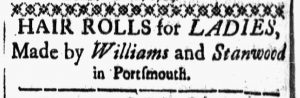
Nov 24 - 11:24:1769 New-Hampshire Gazette
New-Hampshire Gazette (November 24, 1769).

“HAIR ROLLS for LADIES.”

A very short advertisement in the November 24, 1769, edition of the New-Hampshire Gazette informed readers of “HAIR ROLLS for LADIES, Made by Williams and Stanwood in Portsmouth.” Although brief, this advertisement demonstrated the reach of fashion beyond the major port cities to smaller towns in the colonies on the eve of the American Revolution. In “Fashion and the Culture Wars of Revolutionary Philadelphia,” Kate Haulman documents clothing and hairstyles favored by the elite in the largest urban port, but such styles were not confined solely to places like Charleston, New York, and Philadelphia. Williams and Stanwood made “HAIR ROLLS for LADIES” available to the better sorts (and anyone else willing to pay their fees) in Portsmouth and its hinterlands.

Haulman offers a description of styles adopted by ladies in Philadelphia. “At tea tables, assemblies, and even in city streets, ladies’ hoops grew wider, and heads appeared larger with high rolls. Fashionable hairstyles for women began to grow in the late 1760s, and with them rose the ire of social critics.”[1] The high roll became popular at the same time that many colonists participated in nonimportation agreements as a means of resisting the duties that Parliament imposed on imported paper, glass, tea, and other good in the Townshend Acts. Women who chose high rolls to express themselves emulated fashions “that English ladies all too eagerly copied from their French counterparts.”[2] For many, the high roll became a symbol of luxury that contradicted the spirit of sacrifice that patriots practiced when they abided by nonimportation agreements. Furthermore, the high roll testified to continued cultural dependence on and deference to England. As Haulman notes, residents of Philadelphia “asserted the city’s, and their own, stylish, cosmopolitan character through fashion even as the imperial ties that engendered those cultural forms began to unravel.”[3]

Such inconsistencies did not occur only in Philadelphia, though they may have been most visible in large port cities. Hairdressers, wigmakers, and others did not limit their efforts to market high rolls and other fashionable styles to the gentry in urban centers. Instead, colonists in Portsmouth as well as nearby towns and villages had access to “HAIR ROLLS for LADIES, Made by Williams and Stanwood.” Opportunities to purchase (or not) such items as well as other garments and goods allowed them to express their own personal style and political principles while grappling with any incongruities between the two.

**********

[1] Kate Haulman, “Fashion and the Culture Wars of Revolutionary Philadelphia,” William and Mary Quarterly, 3rd ser., 62, no. 4 (October 2005): 638.

[2] Haulman, “Fashion and the Culture Wars,” 638.

[3] Haulman, “Fashion and the Culture Wars,” 640.

Slavery Advertisements Published November 23, 1769

The Slavery Adverts 250 Project chronicles the role of newspaper advertising in perpetuating slavery in the era of the American Revolution. The project seeks to reveal the ubiquity of slavery in eighteenth-century life from New England to Georgia by republishing advertisements for slaves – for sale, wanted to purchase, runaways, captured fugitives – in daily digests on this site as well as in real time via the @SlaveAdverts250 Twitter feed, utilizing twenty-first-century media to stand in for the print media of the eighteenth century.

The project aims to provide modern audiences with a sense of just how often colonists encountered these advertisements in their daily lives. Enslaved men, women, and children appeared in print somewhere in the colonies almost every single day. Those advertisements served as a constant backdrop for social, cultural, economic, and political life in colonial and revolutionary America. Colonists who did not own slaves were still confronted with slavery as well as invited to maintain the system by purchasing slaves or assisting in the capture of runaways. The frequency of these newspaper advertisements suggests just how embedded slavery was in colonial and revolutionary American culture in everyday interactions beyond the printed page.

These advertisements also testify to the experiences of enslaved men, women, and children, though readers must consider that those experiences have been remediated through descriptions offered by slaveholders rather than the slaves themselves. Often unnamed in the advertisements, enslaved men, women, and children were not invisible or unimportant in early America.

These advertisements appeared in colonial American newspapers 250 years ago today.

Nov 23 - Massachusetts Gazette and Boston Weekly News-Letter Slavery 1
Massachusetts Gazette and Boston Weekly News-Letter (November 23, 1769).

**********

Nov 23 - Massachusetts Gazette and Boston Weekly News-Letter Slavery 2
Massachusetts Gazette and Boston Weekly News-Letter (November 23, 1769).

**********

Nov 23 - Pennsylvania Gazette Slavery 1
Pennsylvania Gazette (November 23, 1769).

**********

Nov 23 - South-Carolina Gazette Additional Supplement Slavery 1
Additional Supplement to the South-Carolina Gazette (November 23, 1769).

**********

Nov 23 - South-Carolina Gazette Additional Supplement Slavery 2
Additional Supplement to the South-Carolina Gazette (November 23, 1769).

**********

Nov 23 - South-Carolina Gazette Additional Supplement Slavery 3
Additional Supplement to the South-Carolina Gazette (November 23, 1769).

**********

Nov 23 - South-Carolina Gazette Additional Supplement Slavery 4
Additional Supplement to the South-Carolina Gazette (November 23, 1769).

**********

Nov 23 - South-Carolina Gazette Slavery 1
South-Carolina Gazette (November 23, 1769).

**********

Nov 23 - South-Carolina Gazette Slavery 2
South-Carolina Gazette (November 23, 1769).

**********

Nov 23 - South-Carolina Gazette Slavery 3
South-Carolina Gazette (November 23, 1769).

**********

Nov 23 - South-Carolina Gazette Supplement Slavery 1
Supplement to the South-Carolina Gazette (November 23, 1769).

**********

Nov 23 - Virginia Gazette Purdie and Dixon Slavery 1
Virginia Gazette [Purdie and Dixon] (November 23, 1769).

**********

Nov 23 - Virginia Gazette Purdie and Dixon Slavery 2
Virginia Gazette [Purdie and Dixon] (November 23, 1769).

**********

Nov 23 - Virginia Gazette Purdie and Dixon Slavery 3
Virginia Gazette [Purdie and Dixon] (November 23, 1769).

**********

Nov 23 - Virginia Gazette Purdie and Dixon Slavery 4
Virginia Gazette [Purdie and Dixon] (November 23, 1769).

**********

Nov 23 - Virginia Gazette Purdie and Dixon Slavery 5
Virginia Gazette [Purdie and Dixon] (November 23, 1769).

**********

Nov 23 - Virginia Gazette Purdie and Dixon Slavery 6
Virginia Gazette [Purdie and Dixon] (November 23, 1769).

**********

Nov 23 - Virginia Gazette Purdie and Dixon Slavery 7
Virginia Gazette [Purdie and Dixon] (November 23, 1769).

**********

Nov 23 - Virginia Gazette Purdie and Dixon Slavery 8
Virginia Gazette [Purdie and Dixon] (November 23, 1769).

**********

Nov 23 - Virginia Gazette Purdie and Dixon Slavery 9
Virginia Gazette [Purdie and Dixon] (November 23, 1769).

**********

Nov 23 - Virginia Gazette Purdie and Dixon Slavery 10
Virginia Gazette [Purdie and Dixon] (November 23, 1769).

**********

Nov 23 - Virginia Gazette Purdie and Dixon Slavery 11
Virginia Gazette [Purdie and Dixon] (November 23, 1769).

**********

Nov 23 - Virginia Gazette Purdie and Dixon Slavery 12
Virginia Gazette [Purdie and Dixon] (November 23, 1769).

**********

Nov 23 - Virginia Gazette Purdie and Dixon Slavery 13
Virginia Gazette [Purdie and Dixon] (November 23, 1769).

**********

Nov 23 - Virginia Gazette Purdie and Dixon Slavery 14
Virginia Gazette [Purdie and Dixon] (November 23, 1769).

**********

Nov 23 - Virginia Gazette Rind Slavery 1
Virginia Gazette [Rind] (November 23, 1769).

**********

Nov 23 - Virginia Gazette Rind Slavery 2
Virginia Gazette [Rind] (November 23, 1769).

**********

Nov 23 - Virginia Gazette Rind Slavery 3
Virginia Gazette [Rind] (November 23, 1769).

**********

Nov 23 - Virginia Gazette Rind Slavery 4
Virginia Gazette [Rind] (November 23, 1769).

**********

Nov 23 - Virginia Gazette Rind Slavery 5
Virginia Gazette [Rind] (November 23, 1769).

**********

Nov 23 - Virginia Gazette Rind Slavery 6
Virginia Gazette [Rind] (November 23, 1769).

**********

Nov 23 - Virginia Gazette Rind Slavery 7
Virginia Gazette [Rind] (November 23, 1769).

**********

Nov 23 - Virginia Gazette Rind Slavery 8
Virginia Gazette [Rind] (November 23, 1769).

**********

Nov 23 - Virginia Gazette Rind Slavery 9
Virginia Gazette [Rind] (November 23, 1769).

**********

Nov 23 - Virginia Gazette Rind Slavery 10
Virginia Gazette [Rind] (November 23, 1769).

**********

Nov 23 - Virginia Gazette Rind Slavery 11
Virginia Gazette [Rind] (November 23, 1769).

**********

Nov 23 - Virginia Gazette Rind Slavery 12
Virginia Gazette [Rind] (November 23, 1769).

**********

Nov 23 - Virginia Gazette Rind Slavery 13
Virginia Gazette [Rind] (November 23, 1769).

**********

Nov 23 - Virginia Gazette Rind Slavery 14
Virginia Gazette [Rind] (November 23, 1769).

November 22

What was advertised in a colonial American newspaper 250 years ago today?

Nov 22 - 11:22:1769 Georgia Gazette
Georgia Gazette (November 22, 1769).

“These pills are an infallible cure.”

An unnamed advertiser placed a notice for “Dr. HAMMOND’s SPECIFICK PILL” in the November 22, 1769, edition of the Georgia Gazette, informing prospective customers that “Any person may be informed where these pills are to be sold by applying to the printer of this paper.” The advertisement listed a variety of maladies that the pills cured, including leprosy, scurvy, yaws, venereal disease, and even “pimpled faces.” The remedy was gentle, safe for “women with child, or persons of the most delicate constitutions.” The advertiser described this “new Medicine” as “one of the greatest ever offered to the Publick” and promised that they provided a “CERTAIN cure.”

All of this probably sounded too good to be true to many colonists. After all, readers regularly encountered advertisements for patent medicines in newspapers published throughout the colonies. Those who marketed pills and potions often claimed that they cured all kinds of diseases, deploying the most hyperbolic language in making their promises. To address some of the concerns of skeptics, this advertisement reported that the pills came with “printed directions, and signed by the author, Thomas Hammond, M.M. Bristol.” Furthermore, the advertisement directed “the dubious” to take into account “the great success this medicine has met with in Barbados, Jamaica, St. Kitts, and Granada,” apparently expecting that word of mouth recommendations from the Caribbean had reached colonists in Georgia. If that were not convincing enough, readers could also take into consideration “many great cures” attributed to Dr. Hammond’s pills in England “which have been continually inserted in the newspapers. Even if skeptical customers could not check those newspapers, the advertisement suggested that merely stating that such evidence existed should satisfy any concerns. Savvy customers likely remained suspicious of the claims made in the advertisement, despite the purported proof of the efficacy of Dr. Hammond’s pills, but some may have been eager enough to find some sort of relief for their symptoms that they allowed themselves to be convinced, or at least experience some hope, that the pills would indeed work for them. The many layers of claims made in the advertisement served to wear down any distrust by “the dubious,” just as similar repetitions of claims about miracle drugs sold via infomercials in the twenty-first century attempt to do for modern consumers.

Slavery Advertisements Published November 22, 1769

The Slavery Adverts 250 Project chronicles the role of newspaper advertising in perpetuating slavery in the era of the American Revolution. The project seeks to reveal the ubiquity of slavery in eighteenth-century life from New England to Georgia by republishing advertisements for slaves – for sale, wanted to purchase, runaways, captured fugitives – in daily digests on this site as well as in real time via the @SlaveAdverts250 Twitter feed, utilizing twenty-first-century media to stand in for the print media of the eighteenth century.

The project aims to provide modern audiences with a sense of just how often colonists encountered these advertisements in their daily lives. Enslaved men, women, and children appeared in print somewhere in the colonies almost every single day. Those advertisements served as a constant backdrop for social, cultural, economic, and political life in colonial and revolutionary America. Colonists who did not own slaves were still confronted with slavery as well as invited to maintain the system by purchasing slaves or assisting in the capture of runaways. The frequency of these newspaper advertisements suggests just how embedded slavery was in colonial and revolutionary American culture in everyday interactions beyond the printed page.

These advertisements also testify to the experiences of enslaved men, women, and children, though readers must consider that those experiences have been remediated through descriptions offered by slaveholders rather than the slaves themselves. Often unnamed in the advertisements, enslaved men, women, and children were not invisible or unimportant in early America.

These advertisements appeared in colonial American newspapers 250 years ago today.

Nov 22 - Georgia Gazette Slavery 1
Georgia Gazette (November 22, 1769).

**********

Nov 22 - Georgia Gazette Slavery 2
Georgia Gazette (November 22, 1769).

**********

Nov 22 - Georgia Gazette Slavery 3
Georgia Gazette (November 22, 1769).

**********

Nov 22 - Georgia Gazette Slavery 4
Georgia Gazette (November 22, 1769).

**********

Nov 22 - Georgia Gazette Slavery 5
Georgia Gazette (November 22, 1769).

**********

Nov 22 - Georgia Gazette Slavery 6
Georgia Gazette (November 22, 1769).

November 21

What was advertised in a colonial American newspaper 250 years ago today?

Nov 21 - 11:21:1769 Essex Gazette
Essex Gazette (November 21, 1769).

“Meet at the King’s-Arms Tavern in Salem.”

The King’s Arms Tavern in Salem was more than just a place for colonists to eat, drink, and socialize. It was also a place for men to gather to conduct business of various sorts, sometimes mercantile but other times political.   Two advertisements in the November 21, 1769, edition of the Essex Gazette called on colonists to attend meetings at the King’s Arms Tavern.

The first concerned a meeting to be held that day. Dated November 13, it originally ran in the previous issue, giving a week’s notice about a meeting for the “Gentlemen of the Committees, chosen by the Towns of Salem, Marblehead and Gloucester, on the Affair of the Fishermen, paying to Greenwich Hospital.” This matter concerned “allowances” of six pence a month that according to laws passed by Parliament in the early eighteenth century seamen were expected to pay to support the Greenwich Hospital in England. Since that institution provided for the widows and children of seamen, Parliament deemed it only fair that seamen should provide the funds for its operation. It was sometimes possible, however, to receive exemptions.[1] For the maritime communities of Salem, Marblehead, and Gloucester, this represented an important political issue, one that predated the Stamp Act, the Townshend Acts, and other legislation passed by Parliament after the Seven Years War,

The second advertisement announcing a meeting at the King’s Arms Tavern gave only one day’s notice. It informed the “Merchants and Traders of this Town, who are Importers of British Manufactures, &c. from Great Britain” of a gathering at the tavern in the evening of the following day. Presumably this meeting concerned nonimportation agreements enacted in protest of the duties imposed on paper, glass, tea, and other goods imported from Britain.

Both of these meetings had political overtones, indicating that colonists gathered at the King’s Arms Tavern, like so many other taverns in colonial America, to practice politics. Taverns were not establishments devoted solely to entertainment. Instead, they were places for exchanging information and formulating plans to take political action. As the events that led to the American Revolution unfolded, meetings in taverns played a significant role, rivaling those gatherings held in colonial assemblies. Power emanated from both venues, not just the one with elected representatives.

**********

[1] Allyn B. Forbes, “Greenwich Hospital Money,” New England Quarterly 3, no. 3 (July 1930): 519-526.

November 20

What was advertised in a colonial American newspaper 250 years ago today?

Nov 20 - 11:20:1769 Boston-Gazette
Supplement to the Boston-Gazette (November 20, 1769).

“TO BE SOLD BY Harbottle Dorr …”

Harbottle Dorr is not a household name today, but Dorr remains well known among historians of early America, especially those who study either the role of the press in the American Revolution or the participation of ordinary people in efforts to resist the various abuses perpetrated by Parliament.

Dorr placed an advertisement for nails and “a good Assortment of Braziery, Ironmongery and Pewter Ware” in the supplement that accompanied the November 20, 1769, edition of the Boston-Gazette. At the time, Dorr, a merchant and a member of the Sons of Liberty was doing far more than just advertising in the Boston-Gazette and other newspapers. He was also collecting, annotating, and indexing them as a means of constructing his own narrative of the imperial crisis. As the Massachusetts Historical Society notes in its online collection of those newspapers, Dorr sought “to form a political history.” (Visit The Annotated Newspapers of Harbottle Dorr, Jr. to explore the newspapers and indexes that Dorr arranged into four volumes.) “Dorr was well-versed in the heated politics of the day,” the Massachusetts Historical Society continues, “and he annotated many newspaper pages with his opinions, cross-references to articles elsewhere in his collection, and sometimes noted the identity of anonymous contributors to the newspapers.” His index filled 133 pages and included 4,969 terms.

Dorr’s index included advertisements, including this entry: “Advertisement of H.D., about discouraging the Importers &c.” That entry referenced an advertisement that Dorr placed in the Boston Evening-Post on September 3, 1770. Much more extensive than the brief notice that ran nearly nine months earlier in the Boston-Gazette, it offered political commentary that encouraged consumers to encourage production of goods in the colonies by choosing them over imported alternatives. “It is presumed,” Dorr declared, “preference will be given to NAILS manufactured here, (not only on patriotic Principles, and to discourage the PRESENT Importers,— but) as they really are better in Quality than most English Nails, being far tougher.”

In chronicling the advertising landscape in colonial America in 1769, I have frequently chosen advertisements that implicitly or explicitly commented on the Townshend Acts and the nonimportation agreements adopted in Boston and other cities and towns. I have argued that both advertisers and readers looked beyond news items and editorials when considering the politics of the period. In his annotations and index, Dorr confirms that he did indeed view advertisements for consumer goods as a political tool, not just a means of marketing his wares. His “political history” of the imperial crisis that culminated in the American Revolution included advertisers and the messages they communicated to colonial consumers.

Slavery Advertisements Published November 20, 1769

The Slavery Adverts 250 Project chronicles the role of newspaper advertising in perpetuating slavery in the era of the American Revolution. The project seeks to reveal the ubiquity of slavery in eighteenth-century life from New England to Georgia by republishing advertisements for slaves – for sale, wanted to purchase, runaways, captured fugitives – in daily digests on this site as well as in real time via the @SlaveAdverts250 Twitter feed, utilizing twenty-first-century media to stand in for the print media of the eighteenth century.

The project aims to provide modern audiences with a sense of just how often colonists encountered these advertisements in their daily lives. Enslaved men, women, and children appeared in print somewhere in the colonies almost every single day. Those advertisements served as a constant backdrop for social, cultural, economic, and political life in colonial and revolutionary America. Colonists who did not own slaves were still confronted with slavery as well as invited to maintain the system by purchasing slaves or assisting in the capture of runaways. The frequency of these newspaper advertisements suggests just how embedded slavery was in colonial and revolutionary American culture in everyday interactions beyond the printed page.

These advertisements also testify to the experiences of enslaved men, women, and children, though readers must consider that those experiences have been remediated through descriptions offered by slaveholders rather than the slaves themselves. Often unnamed in the advertisements, enslaved men, women, and children were not invisible or unimportant in early America.

These advertisements appeared in colonial American newspapers 250 years ago today.

Nov 20 - Boston Evening-Post Slavery 1
Boston Evening-Post (November 20, 1769).

**********

Nov 20 - Boston Evening-Post Slavery 2
Boston Evening-Post (November 20, 1769).

**********

Nov 20 - Boston Evening-Post Slavery 3
Boston Evening-Post (November 20, 1769).

**********

Nov 20 - Boston-Gazette Slavery 1
Boston-Gazette (November 20, 1769).

**********

Nov 20 - Boston-Gazette Slavery 2
Boston-Gazette (November 20, 1769).

**********

Nov 20 - Boston-Gazette Slavery 3
Boston-Gazette (November 20, 1769).

**********

Nov 20 - Boston-Gazette Supplement Slavery 1
Supplement to the Boston-Gazette (November 20, 1769).

**********

Nov 20 - Boston-Gazette Supplement Slavery 2
Supplement to the Boston-Gazette (November 20, 1769).

**********

Nov 20 - New-York Gazette and Weekly Mercury Slavery 1
New-York Gazette and Weekly Mercury (November 20, 1769).

**********

Nov 20 - New-York Gazette and Weekly Mercury Slavery 2
New-York Gazette and Weekly Mercury (November 20, 1769).

**********

Nov 20 - New-York Gazette and Weekly Mercury Slavery 3
New-York Gazette and Weekly Mercury (November 20, 1769).

**********

Nov 20 - New-York Gazette and Weekly Mercury Slavery 4
New-York Gazette and Weekly Mercury (November 20, 1769).

**********

Nov 20 - New-York Gazette and Weekly Mercury Slavery 5
New-York Gazette and Weekly Mercury (November 20, 1769).

**********

Nov 20 - New-York Gazette and Weekly Mercury Slavery 6
New-York Gazette and Weekly Mercury (November 20, 1769).

**********

Nov 20 - New-York Gazette and Weekly Mercury Slavery 7
New-York Gazette and Weekly Mercury (November 20, 1769).

**********

Nov 20 - New-York Gazette or Weekly Post-Boy Slavery 1
New-York Gazette or Weekly Post-Boy (November 20, 1769).

**********

Nov 20 - Newport Mercury Slavery 1
Newport Mercury (November 20, 1769).

**********

Nov 20 - Pennsylvania Chronicle Slavery 1
Pennsylvania Chronicle (November 20, 1769).

**********

Nov 20 - Pennsylvania Chronicle Slavery 2
Pennsylvania Chronicle (November 20, 1769).

**********

Nov 20 - South-Carolina and American General Gazette Slavery 1
South-Carolina and American General Gazette (November 20, 1769).

**********

Nov 20 - South-Carolina and American General Gazette Slavery 2
South-Carolina and American General Gazette (November 20, 1769).

**********

Nov 20 - South-Carolina and American General Gazette Slavery 3
South-Carolina and American General Gazette (November 20, 1769).

**********

Nov 20 - South-Carolina and American General Gazette Slavery 4
South-Carolina and American General Gazette (November 20, 1769).

**********

Nov 20 - South-Carolina and American General Gazette Slavery 5
South-Carolina and American General Gazette (November 20, 1769).

**********

Nov 20 - South-Carolina and American General Gazette Slavery 6
South-Carolina and American General Gazette (November 20, 1769).

**********

Nov 20 - South-Carolina and American General Gazette Slavery 7
South-Carolina and American General Gazette (November 20, 1769).


November 19

What was advertised in a colonial American newspaper 250 years ago this week?

Nov 19 - 11:16:1769 Advert 1 South-Carolina Gazette
South-Carolina Gazette (November 16, 1769).

No Subscriber can purchase any NEGROES, or OTHER GOODS, or MERCHANDIZE WHATEVER.”

On July 22, 1769, colonists who attended “a GENERAL MEETING of the Inhabitants of Charles-Town, and of the Places adjacent … unanimously agreed” to an “ASSOCIATION” for the purpose of “encourage[ing] and promot[ing] the Use of NORTH-AMERICAN MANUFACTURES” as an alternative to imported goods. They did so in protest of “the abject and wretched condition to which the BRITISH COLONIES are reduced by several Acts of Parliament lately passed.” In particular, residents of Charleston had the Townshend Acts in mind, objecting to attempts to regulate trade and impose duties on imported paper, tea, glass, and other products. Like their counterparts in Boston, New York, and Philadelphia, they adopted several resolutions that disrupted trade, seeking to use commerce as a toll to achieve political ends. In one resolution, they proclaimed that they would not “import into this Province any of the Manufacturers of GREAT-BRITAIN.” The Association and its resolutions received front page coverage in the August 3, 1769, edition of the South-Carolina Gazette.

Several months later, the “General Committee” charged with oversight of the resolutions published reminders in the South-Carolina Gazette, inserting their own notices alongside the multitude of advertisements that regularly appeared in that newspaper. Peter Timothy, the printer of the South-Carolina Gazette, showed his support from the start by making subscription papers available “to be signed” at his printing office. As various deadlines specified in the resolutions passed, he further aided the cause by giving one of the notices from the General Committee a privileged place in the November 16, 1769, edition of the South-Carolina Gazette. Under the headline “New Advertisements,” it was the first to appear in that issue, serving as a reminder and setting the tone for the other advertisements on the following three pages. The General Committee proclaimed that it gave “Notice that agreeable to the Resolutions entered into by the Inhabitants of this Province on the 22d of July last, no Subscriber can purchase any NEGROES, or OTHER GOODS, or MERCHANDIZE WHATEVER, of or belonging to any resident that has REFUSED or NEGLECTED to sign the said Resolutions within ONE MONTH after the Date thereof: Of which it is expected all Persons concerned, will take due Notice.” This particular measure put pressure on colonists who did not join the movement.

Nov 19 - 11:16:1769 Advert 2 South-Carolina Gazette
South-Carolina Gazette (November 16, 1769).

The General Committee posted another notice on the following page. This time, Timothy positioned it in the middle of the page, surrounded by other advertisements. In it, the General Committee asserted “that the time is expired, during which the Subscribers, to the Resolutions of this Province, could purchase any Kind of European or East-India Goods, excepting COALS and SALT, from any Master of Vessel, transient Person, or Non-Subscriber: And that the time is also expired, for purchasing or selling NEGROES from any Place except such as may arrive directly from the Coast of Africa: And it is hoped, that every Person concerned, will strictly adhere to the Resolutions.” The final line was both reminder and threat. Merchants and shopkeepers as well as consumers needed to exercise care in their commercial transactions. Advertisers who promoted merchandise “just imported … from BRITAIN” (as William Simpson stated in his advertisement on the same page) faced a new commercial landscape in which they needed to demonstrate when they had ordered and acquired their goods or else face consequences for not abiding by the resolutions adopted by the Association. The inventory in shops and the goods colonists wore and used came under new scrutiny, but so did advertisements for those items since anything inserted in the public prints allowed for easy surveillance by concerned colonists interested in whether merchants and shopkeepers violated the nonimportation resolutions.

November 18

What was advertised in a colonial American newspaper 250 years ago today?

Nov 18 - 11:18:1769 Providence Gazette
Providence Gazette (November 18, 1769).

“Containing, an accurate Ephemeris … Containing likewise, a beautiful Poem …”

In the fall of 1769, John Carter launched his marketing campaign for “THE NEW-ENGLAND ALMANACK, OR, Lady’s and Gentleman’s DIARY, For the Year of our Lord CHRIST 1770” with a full-page advertisement in the Providence Gazette. He likely posted a broadside around town as well. In subsequent weeks, Carter followed up the full-page advertisement with additional notices in the Providence Gazette; these included all of the same copy, but compressed to fit in a single column. Almanacs generated sufficient revenue for colonial printers to merit allocating considerable space in their newspapers to advertising them.

The contents of almanacs included reference items for information and other items for entertainment. Carter adopted a similar approach in his advertisements, publishing a poem for the enjoyment of prospective customers while also listing the contents of the almanac. Those contents included the usual astronomical data, such as the “Sun, Moon, and Seven Stars Rising and Setting; for every Day on the Year” and “Eclipses of the Luminaries,” as well as the tides. Other useful reference material included dates for the “Courts in the New-England Government,” “Times of the Stage-Coaches and Passage-Boats going and returning,” “a Table of Roads, enlarged and corrected.” Items intended for entertainment included “a beautiful Poem on Creation,” “a List of portentous Eclipses, with the remarkable Events that followed them,” and “a curious Essay on Comets, with some Remarks on the extraordinary one that appeared in August and September last.” Carter attempted to leverage potential ongoing interest in a recent event to spur sales of the almanac.

When it comes to retailing books, one modern marketing strategy harkens back to a method already in use by Carter and other printers in the eighteenth century. New technologies allow consumers to examine the table of contents online when considering whether to purchase a book, but publishing a table of contents as a means of bolstering interest in a book does not itself qualify as innovative. Modern marketers merely use new technologies to replicate a technique already in use for centuries. Certainly the strategy has been adopted more widely, given that the internet allows retailers more space than their counterparts could purchase in eighteenth-century newspapers, but the basic idea remains the same. Show consumers what a book contains and let the contents aid in selling the book. Carter and printers throughout the colonies regularly used that strategy for almanacs, books, and pamphlets in the eighteenth century.