Slavery Advertisements Published December 1, 1769

The Slavery Adverts 250 Project chronicles the role of newspaper advertising in perpetuating slavery in the era of the American Revolution. The project seeks to reveal the ubiquity of slavery in eighteenth-century life from New England to Georgia by republishing advertisements for slaves – for sale, wanted to purchase, runaways, captured fugitives – in daily digests on this site as well as in real time via the @SlaveAdverts250 Twitter feed, utilizing twenty-first-century media to stand in for the print media of the eighteenth century.

The project aims to provide modern audiences with a sense of just how often colonists encountered these advertisements in their daily lives. Enslaved men, women, and children appeared in print somewhere in the colonies almost every single day. Those advertisements served as a constant backdrop for social, cultural, economic, and political life in colonial and revolutionary America. Colonists who did not own slaves were still confronted with slavery as well as invited to maintain the system by purchasing slaves or assisting in the capture of runaways. The frequency of these newspaper advertisements suggests just how embedded slavery was in colonial and revolutionary American culture in everyday interactions beyond the printed page.

These advertisements also testify to the experiences of enslaved men, women, and children, though readers must consider that those experiences have been remediated through descriptions offered by slaveholders rather than the slaves themselves. Often unnamed in the advertisements, enslaved men, women, and children were not invisible or unimportant in early America.

These advertisements appeared in colonial American newspapers 250 years ago today.
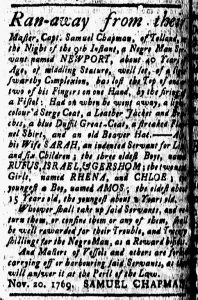
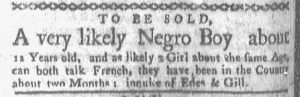
Dec 1 - New-London Gazette Slavery 1
New-London Gazette (December 1, 1769).

**********

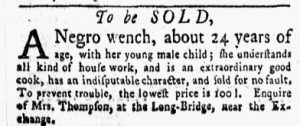
Dec 1 - New-London Gazette Slavery 2
New-London Gazette (December 1, 1769).

November 30

What was advertised in a colonial American newspaper 250 years ago today?

Nov 30 - 11:30:1769 New-York Journal
New-York Journal (November 30, 1769).

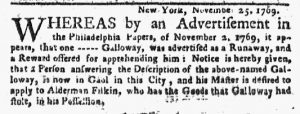
“WHEREAS by an Advertisement in the Philadelphia Papers …”

Did colonists read all of those advertisements that appeared in the pages of early American newspapers? Occasionally some of the advertisements help to answer that question. Consider an advertisement that ran in the November 27, 1769, edition of the New-York Gazette or Weekly Post-Boy and, later that week, in the November 30 edition of the New-York Journal. The notice acknowledged “an Advertisement in the Philadelphia Papers, of November 2, 1769” that described a runaway named Galloway and offered a reward for apprehending him. According to the notice in the New York newspapers, “a Person answering the Description of the above-named Galloway” had been jailed in the city. The notice instructed Galloway’s master to contact one of the aldermen, “who has the Goods that Galloway had stole, in his Possession.” Someone had indeed read the advertisements, at least those concerning runaway apprentices and indentured servants and their counterparts about enslaved people who escaped from those who held them in bondage. Such advertisements usually included a fair amount of detail, in this case enough to identify Galloway and the stolen goods. In addition to disseminating that information, this advertisement served as a testimonial to the effectiveness of inserting such notices in the public prints.

It also demonstrated that newspapers circulated far beyond the cities and towns where they were printed. This notice concerning a runaway described “in the Philadelphia Papers” appeared in two newspapers in New York, describing a suspected runaway jailed in New York. Newspapers from Pennsylvania found their way to New York … and residents of New York had a reasonable expectation that their newspapers circulated in Pennsylvania. Someone considered it effective to respond to an advertisement that originated “in the Philadelphia Papers” by placing a notice in the New-York Gazette or Weekly Post-Boy and the New-York Journal. Thanks to exchange networks devised by printers and abundant reprinting from one newspaper to another, the news items and editorials in colonial newspapers created a public discourse that extended from New England to Georgia. Yet conversations in those newspapers were not confined to news and editorials selected by printers. Advertisers sometimes engaged in their own conversations that moved back and forth from one newspaper to another, further contributing to the creation of imagined communities among readers in faraway places.

Slavery Advertisements Published November 30, 1769

The Slavery Adverts 250 Project chronicles the role of newspaper advertising in perpetuating slavery in the era of the American Revolution. The project seeks to reveal the ubiquity of slavery in eighteenth-century life from New England to Georgia by republishing advertisements for slaves – for sale, wanted to purchase, runaways, captured fugitives – in daily digests on this site as well as in real time via the @SlaveAdverts250 Twitter feed, utilizing twenty-first-century media to stand in for the print media of the eighteenth century.

The project aims to provide modern audiences with a sense of just how often colonists encountered these advertisements in their daily lives. Enslaved men, women, and children appeared in print somewhere in the colonies almost every single day. Those advertisements served as a constant backdrop for social, cultural, economic, and political life in colonial and revolutionary America. Colonists who did not own slaves were still confronted with slavery as well as invited to maintain the system by purchasing slaves or assisting in the capture of runaways. The frequency of these newspaper advertisements suggests just how embedded slavery was in colonial and revolutionary American culture in everyday interactions beyond the printed page.

These advertisements also testify to the experiences of enslaved men, women, and children, though readers must consider that those experiences have been remediated through descriptions offered by slaveholders rather than the slaves themselves. Often unnamed in the advertisements, enslaved men, women, and children were not invisible or unimportant in early America.

These advertisements appeared in colonial American newspapers 250 years ago today.

Nov 30 - Massachusetts Gazette and Boston Weekly News-Letter Slavery 1
Massachusetts Gazette and Boston Weekly News-Letter (November 30, 1769).

**********

Nov 30 - Massachusetts Gazette and Boston Weekly News-Letter Slavery 2
Massachusetts Gazette and Boston Weekly News-Letter (November 30, 1769).

**********

Nov 30 - South-Carolina Gazette Additional Supplement Slavery 1
Additional Supplement to the South-Carolina Gazette (November 30, 1769).

**********

Nov 30 - South-Carolina Gazette Slavery 1
South-Carolina Gazette (November 30, 1769).

**********

Nov 30 - South-Carolina Gazette Slavery 2
South-Carolina Gazette (November 30, 1769).

**********

Nov 30 - South-Carolina Gazette Slavery 3
South-Carolina Gazette (November 30, 1769).

**********

Nov 30 - South-Carolina Gazette Slavery 4
South-Carolina Gazette (November 30, 1769).

**********

Nov 30 - South-Carolina Gazette Slavery 5
South-Carolina Gazette (November 30, 1769).

**********

Nov 30 - South-Carolina Gazette Supplement Slavery 1
Supplement to the South-Carolina Gazette (November 30, 1769).

**********

Nov 30 - South-Carolina Gazette Supplement Slavery 2
Supplement to the South-Carolina Gazette (November 30, 1769).

**********

Nov 30 - South-Carolina Gazette Supplement Slavery 3
Supplement to the South-Carolina Gazette (November 30, 1769).

**********

Nov 30 - South-Carolina Gazette Supplement Slavery 4
Supplement to the South-Carolina Gazette (November 30, 1769).

**********

Nov 30 - South-Carolina Gazette Supplement Slavery 5
Supplement to the South-Carolina Gazette (November 30, 1769).

**********

Nov 30 - South-Carolina Gazette Supplement Slavery 6
Supplement to the South-Carolina Gazette (November 30, 1769).

**********

Nov 30 - South-Carolina Gazette Supplement Slavery 7
Supplement to the South-Carolina Gazette (November 30, 1769).

**********

Nov 30 - Virginia Gazette Rind Slavery 1
Virginia Gazette [Rind] (November 30, 1769).

**********

Nov 30 - Virginia Gazette Rind Slavery 2
Virginia Gazette [Rind] (November 30, 1769).

**********

Nov 30 - Virginia Gazette Rind Slavery 3
Virginia Gazette [Rind] (November 30, 1769).

**********

Nov 30 - Virginia Gazette Rind Slavery 4
Virginia Gazette [Rind] (November 30, 1769).

**********

Nov 30 - Virginia Gazette Rind Slavery 5
Virginia Gazette [Rind] (November 30, 1769).

**********

Nov 30 - Virginia Gazette Rind Slavery 6
Virginia Gazette [Rind] (November 30, 1769).

**********

Nov 30 - Virginia Gazette Rind Slavery 7
Virginia Gazette [Rind] (November 30, 1769).

**********

Nov 30 - Virginia Gazette Rind Slavery 8
Virginia Gazette [Rind] (November 30, 1769).

**********

Nov 30 - Virginia Gazette Rind Slavery 9
Virginia Gazette [Rind] (November 30, 1769).

**********

Nov 30 - Virginia Gazette Rind Slavery 10
Virginia Gazette [Rind] (November 30, 1769).

**********

Nov 30 - Virginia Gazette Rind Slavery 11
Virginia Gazette [Rind] (November 30, 1769).

**********

Nov 30 - Virginia Gazette Rind Slavery 12
Virginia Gazette [Rind] (November 30, 1769).

November 29

What was advertised in a colonial American newspaper 250 years ago today?

Nov 29 - 11:29:1769 Georgia Gazette
Georgia Gazette (November 29, 1769).

“A large and compleat Assortment of well chosen GOODS.

Cowper & Telfairs and Rae & Somerville both sold imported goods, but adopted very different marketing strategies when they placed advertisements in the November 29, 1769, edition of the Georgia Gazette. Rae & Somerville inserted a notice that read, in its entirety, “JUST IMPORTED, in the Ship Georgia Packet, from London, and to be sold by RAE and SOMERVILLE, A NEAT ASSORTMENT of EUROPEAN and EAST-INDIA GOODS, suitable for the present and approaching season.” In so doing, they made an appeal to consumer choice, informing customers of the “NEAT ASSORTMENT” now in stock.

Yet the copy for Rae & Somerville’s advertisement merely served as an introduction when adapted for an advertisement published their competitors. Consider how another partnership opened their notice: “COWPER & TELFAIRS HAVE IMPORTED, in the Wolfe, Capt. Henry Kemp, from London, and the Britannia, Capt. John Dennison, from Glasgow, via Charleston, A large and compleat Assortment of well chosen GOODS, Which they will dispose of on reasonable Terms.” Incorporating appeals to price and consumer choice, that could have stood alone as a complete advertisement. Cowper & Telfairs continued, however, with an extensive list of their merchandise, divided in two columns to allow prospective customers to peruse their wares easily. Cowper & Telfairs carried everything from textiles and garments to a “large quantity of tin ware” and an “assortment of earthen ware” to “Neat Italian chairs” and an “assortment of Glasgow saddlery.” They strategically deployed capitals to draw attention to certain goods, including “GLASS WARE,” “CHINA WARE,” “PEWTER,” and “STATIONARY.”

Cowper & Telfairs’s advertisement extended two-thirds of a column, occupying significantly more space than Rae & Somerville’s advertisement printed immediately below it. Rae & Somerville ran a second advertisement on the following page, that one a bit longer but still only a fraction of the length of Cowper & Telfairs’s notice. In that second advertisement, Rae & Somerville listed approximately two dozen items, but did so in a dense paragraph that did not lend itself to skimming as well as Cowper & Telfairs’s neatly organized columns. They concluded their list with “&c. &c. &c.” (the eighteenth-century abbreviation for et cetera) to indicate that they had many more items in their inventory.

Cowper & Telfairs made a more significant investment in their advertisement, both in terms of the expense incurred for publishing such a lengthy notice and in terms of the strategies they deployed in hopes of gaining a better return on that investment. They did more to entice readers to become customers after encountering their advertisements.

Slavery Advertisements Published November 29, 1769

The Slavery Adverts 250 Project chronicles the role of newspaper advertising in perpetuating slavery in the era of the American Revolution. The project seeks to reveal the ubiquity of slavery in eighteenth-century life from New England to Georgia by republishing advertisements for slaves – for sale, wanted to purchase, runaways, captured fugitives – in daily digests on this site as well as in real time via the @SlaveAdverts250 Twitter feed, utilizing twenty-first-century media to stand in for the print media of the eighteenth century.

The project aims to provide modern audiences with a sense of just how often colonists encountered these advertisements in their daily lives. Enslaved men, women, and children appeared in print somewhere in the colonies almost every single day. Those advertisements served as a constant backdrop for social, cultural, economic, and political life in colonial and revolutionary America. Colonists who did not own slaves were still confronted with slavery as well as invited to maintain the system by purchasing slaves or assisting in the capture of runaways. The frequency of these newspaper advertisements suggests just how embedded slavery was in colonial and revolutionary American culture in everyday interactions beyond the printed page.

These advertisements also testify to the experiences of enslaved men, women, and children, though readers must consider that those experiences have been remediated through descriptions offered by slaveholders rather than the slaves themselves. Often unnamed in the advertisements, enslaved men, women, and children were not invisible or unimportant in early America.

These advertisements appeared in colonial American newspapers 250 years ago today.

Nov 29 - Georgia Gazette Slavery 1
Georgia Gazette (November 30, 1769).

**********

Nov 29 - Georgia Gazette Slavery 2
Georgia Gazette (November 30, 1769).

**********

Nov 29 - Georgia Gazette Slavery 3
Georgia Gazette (November 30, 1769).

**********

Nov 29 - Georgia Gazette Slavery 4
Georgia Gazette (November 30, 1769).

**********

Nov 29 - Georgia Gazette Slavery 10
Georgia Gazette (November 30, 1769).

**********

Nov 29 - Georgia Gazette Slavery 5
Georgia Gazette (November 30, 1769).

**********

Nov 29 - Georgia Gazette Slavery 6
Georgia Gazette (November 30, 1769).

**********

Nov 29 - Georgia Gazette Slavery 7
Georgia Gazette (November 30, 1769).

**********

Nov 29 - Georgia Gazette Slavery 8
Georgia Gazette (November 30, 1769).

**********

Nov 29 - Georgia Gazette Slavery 9
Georgia Gazette (November 30, 1769).


November 28

What was advertised in a colonial American newspaper 250 years ago today?

Nov 28 - 11:28:1769 Essex Gazette
Essex Gazette (November 28, 1770).

“Low’s Almanack, for 1770, is to be sold by the Printer hereof.”

With a little over a month until the new year arrived, the number of advertisements for almanacs in colonial newspapers increased in late November 1769. Some printers and booksellers published elaborate notices, including a full-page advertisement for the New-England Almanack in the Providence Gazette, but others opted instead for brief notices. Samuel Hall, printer of the Essex Gazette, chose the second method. The final advertisement in the November 28, 1769, edition of the Essex Gazette announced that “Low’s Almanack, for 1770, is to be sold by the Printer hereof.”

By “Low’s Almanack” Hall meant An Astronomical Diary: or, Almanack for the year of Christian Æra, 1770 … Calculated for the Meridian of Boston, in New-England … but May Indifferently Serve Any Part of New-England, written by Nathanael Low, a “Student in Physic.” Hall did not produce the almanac in his printing office. The imprint indicated that it was “Printed and sold by Kneeland & Adams, in Milk-Street” in Boston, yet “Sold also by the printers and booksellers.” Hall served as a local agent and retailer for “Low’s Almanack, for 1770.”

Kneeland and Adams pursued their own advertising campaign, inserting a notice in the Massachusetts Gazette and Boston Weekly News-Letter on October 26 to inform prospective customers that the almanac would soon be available. “TO-MORROW will be Published,” they proclaimed, “An ASTRONOMICAL DIARY; Or, ALMANACK … By NATHANIEL LOW.” Their advertisement provided a preview of the contents as a means of enticing consumers to choose this almanac rather than the any of the others published in Boston. It contained the usual astronomical information, such as “Sun and Moon’s rising and setting” and “Moon’s Place,” as well as guides to “Roads, with the best Stages or Houses to put up at” and “Courts in the four New-England Governments” and other useful reference information for the region. Other items were calculated to be both “very entertaining and instructive,” such as a “Dialogue between Heraclitus and Democritus, suited as near as possible to the Complexion of the Times” and a “brief Essay on Comets.” Yet Kneeland and Adams promised even more, concluding their list with a promise of “many other Things useful and entertaining” in the almanac.

Hall did not go to nearly the same lengths to promote “Low’s Almanack, for 1770” in his newspaper. Given the networks of exchange among newspaper printers, he would have seen advertisements for other almanacs, even if he did not happen to notice Kneeland and Adams’s advertisement for this particular almanac. In general, advertisements in the Essex Gazette, whether inserted by the printer or placed by others, tended to be streamlined compared to many that appeared in other newspapers. This may have made them easier for readers to navigate, but it limited the amount of information available to consumers.

November 27

What was advertised in a colonial American newspaper 250 years ago today?

Nov 27 - 11:27:1769 New-York Gazette and Weekly Mercury
New-York Gazette and Weekly Mercury (November 27, 1769).

“The above Agreement was signed by almost all the Merchants in this City.”

Eighteenth-century newspapers regularly carried several types of content. Most included news, editorials, and advertisements. Some often included a poem on the final page. Others included shipping news from the customs house or a list of prices current for commodities among the news items. Some items, however, did not neatly fit in any particular category. This notice that ran in the November 27, 1769, edition of the New-York Gazette and Weekly Mercury was part news, part editorial, and part advertisement.

The notice offered an overview of recent developments concerning nonimportation agreements adopted by many colonists in an effort “to defeat the iniquitous Purposes of the oppressive Act of Parliament, imposing Duties on Paper, Glass, [and] Tea.” Such measures had been adopted widely in “all the middle Colonies of America, except the Colony of Rhode-Island.” This so angered that merchants of New York that most signed an additional agreement, that one targeting “any Person or Persons dwelling and residing in the said Colony of Rhode-Island,” pledging not to do business with them “until they shall fully come into the Agreement subscribed by the Merchants of Boston, New-York and Philadelphia, not to import Goods from Great-Britain until the Act imposing Duties on Paper, Glass, Tea, &c. is repealed.” In addition, New York’s merchants demanded that their counterparts in Rhode Island place in storage goods they recently imported and not sell them until after new goods arrived in the wake of the repeal of the Townshend Acts. Not only did they seek to compel Rhode Island to fall in line with the nonimportation agreement, they also sought to level the playing field when it came time to return to business as usual if they managed to make Parliament relent.

Usually such items appeared among the news and editorials in the New-York Gazette and Weekly Mercury, but for some reason it was situated among the advertisements in the November 27, 1769, edition. News and editorials filled the first two pages and spilled over to the third. The remainder of the third page and the entire fourth page consisted entirely of advertisements, with the exception of this notice sandwiched between two advertisements for real estate. The compositor could have just as easily placed it among or at the end of the news that ran on the same page, but instead chose to transition from the news to a dozen advertisements before inserting this notice. Why? Was it a paid notice? Did the printer not consider it news? Did the printer suspect that it would garner greater attention in the section of the newspaper intended primarily for advertisements? Its place in the issue deviated from the order otherwise imposed on the various contents. Whatever the explanation, this notice demonstrates that even in newspapers that usually adhered to a particular structure or organization for news items, editorials, and advertisements, colonists sometimes encountered news among the paid notices. Advertising often served as an important supplement to news and editorials when it came to staying informed about current events in the era of the American Revolution.

Slavery Advertisements Published November 27, 1769

The Slavery Adverts 250 Project chronicles the role of newspaper advertising in perpetuating slavery in the era of the American Revolution. The project seeks to reveal the ubiquity of slavery in eighteenth-century life from New England to Georgia by republishing advertisements for slaves – for sale, wanted to purchase, runaways, captured fugitives – in daily digests on this site as well as in real time via the @SlaveAdverts250 Twitter feed, utilizing twenty-first-century media to stand in for the print media of the eighteenth century.

The project aims to provide modern audiences with a sense of just how often colonists encountered these advertisements in their daily lives. Enslaved men, women, and children appeared in print somewhere in the colonies almost every single day. Those advertisements served as a constant backdrop for social, cultural, economic, and political life in colonial and revolutionary America. Colonists who did not own slaves were still confronted with slavery as well as invited to maintain the system by purchasing slaves or assisting in the capture of runaways. The frequency of these newspaper advertisements suggests just how embedded slavery was in colonial and revolutionary American culture in everyday interactions beyond the printed page.

These advertisements also testify to the experiences of enslaved men, women, and children, though readers must consider that those experiences have been remediated through descriptions offered by slaveholders rather than the slaves themselves. Often unnamed in the advertisements, enslaved men, women, and children were not invisible or unimportant in early America.

These advertisements appeared in colonial American newspapers 250 years ago today.

Nov 27 - Boston Evening-Post Slavery 1
Boston Evening-Post (November 27, 1769).

**********

Nov 27 - Boston Evening-Post Slavery 2
Boston Evening-Post (November 27, 1769).

**********

Nov 27 - Boston-Gazette Slavery 1
Boston-Gazette (November 27, 1769).

**********

Nov 27 - Boston-Gazette Slavery 2
Boston-Gazette (November 27, 1769).

**********

Nov 27 - Boston-Gazette Slavery 3
Boston-Gazette (November 27, 1769).

**********

Nov 27 - New-York Gazette and Weekly Mercury Slavery 1
New-York Gazette and Weekly Mercury (November 27, 1769).

**********

Nov 27 - New-York Gazette and Weekly Mercury Slavery 2
New-York Gazette and Weekly Mercury (November 27, 1769).

**********

Nov 27 - New-York Gazette and Weekly Mercury Slavery 3
New-York Gazette and Weekly Mercury (November 27, 1769).

**********

Nov 27 - New-York Gazette and Weekly Mercury Slavery 4
New-York Gazette and Weekly Mercury (November 27, 1769).

**********

Nov 27 - New-York Gazette and Weekly Mercury Slavery 5
New-York Gazette and Weekly Mercury (November 27, 1769).

**********

Nov 27 - New-York Gazette and Weekly Mercury Slavery 6
New-York Gazette and Weekly Mercury (November 27, 1769).

**********

Nov 27 - New-York Gazette and Weekly Mercury Slavery 7
New-York Gazette and Weekly Mercury (November 27, 1769).

**********

Nov 27 - Newport Mercury Slavery 1
Newport Mercury (November 27, 1769).

**********

Nov 27 - Pennsylvania Chronicle Slavery 1
Pennsylvania Chronicle (November 27, 1769).

**********

Nov 27 - Pennsylvania Chronicle Slavery 2
Pennsylvania Chronicle (November 27, 1769).

**********

Nov 27 - South-Carolina and American General Gazette Slavery 1
South-Carolina and American General Gazette (November 27, 1769).

**********

Nov 27 - South-Carolina and American General Gazette Slavery 2
South-Carolina and American General Gazette (November 27, 1769).

**********

Nov 27 - South-Carolina and American General Gazette Slavery 3
South-Carolina and American General Gazette (November 27, 1769).

**********

Nov 27 - South-Carolina and American General Gazette Slavery 4
South-Carolina and American General Gazette (November 27, 1769).

**********

Nov 27 - South-Carolina and American General Gazette Slavery 5
South-Carolina and American General Gazette (November 27, 1769).

**********

Nov 27 - South-Carolina and American General Gazette Slavery 6
South-Carolina and American General Gazette (November 27, 1769).

**********

Nov 27 - South-Carolina and American General Gazette Slavery 7
South-Carolina and American General Gazette (November 27, 1769).

**********

Nov 27 - South-Carolina and American General Gazette Slavery 8
South-Carolina and American General Gazette (November 27, 1769).

**********

Nov 27 - South-Carolina and American General Gazette Slavery 9
South-Carolina and American General Gazette (November 27, 1769).

**********

Nov 27 - South-Carolina and American General Gazette Slavery 10
South-Carolina and American General Gazette (November 27, 1769).

**********

Nov 27 - South-Carolina and American General Gazette Slavery 11
South-Carolina and American General Gazette (November 27, 1769).

November 26

What was advertised in a colonial American newspaper 250 years ago this week?

Nov 26 - 11:23:1769 South-Carolina Gazette Additional Supplement
Additional Supplement to the South-Carolina Gazette (November 23, 1769).

“New Advertisements.”

In the fall of 1769 Peter Timothy did good business when it came to publishing advertisements in the South-Carolina Gazette. Consider the November 23 edition. Advertising appeared on every page. Indeed, the space devoted to advertising eclipsed the space for news items. A headline directing readers to “New Advertisements” appeared at the top of the first column of the first page. The other two columns consisted of news items. The second page also delivered news, but two “New Advertisements” ran at the bottom of the last column. Timothy divided the third page evenly between news items (including a list of prices current in Charleston and the shipping news from the customs house, branded as “Timothy’s Marine List”) and more “New Advertisements.” The final page consisted entirely of advertisements. Overall, paid notices compromised half of the standard issue, which likely suited Timothy just fine since advertising usually generated greater revenue than selling subscriptions.

Yet even giving over that much space to advertising in the standard issue did not allow Timothy to disseminate all of the advertisements submitted to his printing office. A two-page Supplement to the South-Carolina Gazette accompanied the November 23 edition. Except for the masthead, it consisted entirely of advertisements, though the “New Advertisements” headline that ran three times in the standard issue did not appear in the supplement. Timothy may have made a concerted effort to give new content, whether news or advertising, a privileged place in the standard issue. Still, even by publishing the supplement Timothy did not gain sufficient space to include all of the advertisements for the week. He went to the extraordinary step of printing and distributing an Additional Supplement to the South-Carolina Gazette. Printed on a smaller sheet, this two-page supplement featured only two columns per page. It still allowed Timothy to circulate an additional sixteen advertisements. The “New Advertisements” headline ran at the top of the first column on the first page, though the notices were repeats from previous editions. Did Timothy deploy that headline indiscriminately? Or did he use it strategically in an attempt to draw readers weary of advertisements into the Additional Supplement rather than dismiss it as content they had already perused in recent weeks?

Timothy very nearly had more advertisements than he could publish in the South-Carolina Gazette. Assuming that advertisers actually settled accounts in a timely manner, Timothy operated a booming business at his printing office. The volume of paid notices testified to both the extensive circulation of the newspaper and colonists’ confidence in the effectiveness of advertising. Some colonial newspapers, such as the Massachusetts Gazette and Boston Post-Boy and Advertiser, the New-York Journal or General Advertiser, the Pennsylvania Chronicle and Universal Advertiser, and the Pennsylvania Journal and Weekly Advertiser, positioned their purpose as twofold right in the masthead. Timothy very well could have billed the South-Carolina Gazette as an Advertiser.