June 18

What was advertised in a colonial American newspaper 250 years ago today?

Jun 18 - 6:18 1770 Pennsylvania Chronicle
Pennsylvania Chronicle (June 18, 1770).

“Sam-Mill SAWS … By BENJAMIN HUMPHREYS.”

Visual images were relatively rare in eighteenth-century newspapers.  Mastheads often, but not always, incorporated images that became familiar to readers, but otherwise when images did appear in newspapers, they tended to accompany advertisements.  Among those images, most depicted vessels at sea, houses, horses, runaway indentured servants, or enslaved people for sale or escaping from those who held them in bondage.  Variation among these images was minor, allowing printers to use them interchangeably in advertisements.  Readers easily recognized them as stock images supplied by printers, images related to the content of advertisements but not created to adorn any particular advertisements.  When it came to ships seeking passengers and cargo, real estate, horses “to cover” (or breed), runaway servants, and the slave trade, printers did steady business selling advertisements, making it worth their investment in stock images.

The familiarity of those images made others all the more striking when they accompanied advertisements.  Even images with fairly simple designs distinguished the few advertisements that incorporated them from others that consisted entirely of text, often dense paragraphs that did not even deploy typography to allow for white space or other visual variations. When Benjamin Humphreys placed an advertisement for “Saw-Mill SAWS, Made in the NEATEST Manner” in the June 18, 1770, edition of the Pennsylvania Chronicle, an image of a saw made it all the more noticeable to readers.  Unlike the stock images that belonged to the printer, Humphreys had to commission this woodcut.  Tied directly to his business, it could not be used elsewhere in the newspaper, especially since Humphreys had his name included in the image.  Even among advertisers who arranged for unique images to accompany their newspaper notices, relatively few incorporated their names into the woodcuts.

Jun 18 - 6:18:1770 Bartram Detail Pennsylvania Chronicle
Pennsylvania Chronicle (June 18, 1770).

The image in another advertisement in the same issue of the Pennsylvania Chronicle just happened to do so.  For nearly three years, George Bartram had occasionally published advertisements that included a depiction of his “sign of the NAKED BOY,” complete with his name.  Much more ornate than Humphrey’s woodcut of a saw, Bartram’s woodcut featured a naked child inspecting a roll of cloth in a cartouche in the center, flanked by Bartram’s merchandise on either side.  Garments on rolls of cloth appeared above the name “GEORGE” on the left and a glove draped over more rolls of cloth appeared above the name “BARTRAM” on the right.  The advertising copy changed from advertisement to advertisement over the years, but Bartram’s woodcut remained consistent in identifying his business to readers.

Although clustered in a single issue of the Pennsylvania Chronicle, these woodcuts were exceptional visual images that not only represented particular businesses but also incorporated the names of the advertisers.  Humphreys and Bartram experimented with creating logos that combined words and images to make them all the more distinctive and memorable for prospective customers.
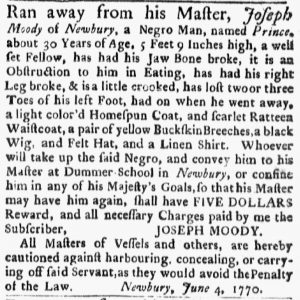
Slavery Advertisements Published June 18, 1770

Guest Curator: Jenna Smith

The Slavery Adverts 250 Project chronicles the role of newspaper advertising in perpetuating slavery in the era of the American Revolution. The project seeks to reveal the ubiquity of slavery in eighteenth-century life from New England to Georgia by republishing advertisements for slaves – for sale, wanted to purchase, runaways, captured fugitives – in daily digests on this site as well as in real time via the @SlaveAdverts250 Twitter feed, utilizing twenty-first-century media to stand in for the print media of the eighteenth century.

The project aims to provide modern audiences with a sense of just how often colonists encountered these advertisements in their daily lives. Enslaved men, women, and children appeared in print somewhere in the colonies almost every single day. Those advertisements served as a constant backdrop for social, cultural, economic, and political life in colonial and revolutionary America. Colonists who did not own slaves were still confronted with slavery as well as invited to maintain the system by purchasing slaves or assisting in the capture of runaways. The frequency of these newspaper advertisements suggests just how embedded slavery was in colonial and revolutionary American culture in everyday interactions beyond the printed page.

These advertisements also testify to the experiences of enslaved men, women, and children, though readers must consider that those experiences have been remediated through descriptions offered by slaveholders rather than the slaves themselves. Often unnamed in the advertisements, enslaved men, women, and children were not invisible or unimportant in early America.

From compiling an archive of digitized eighteenth-century newspapers to identifying advertisements about enslaved men, women, and children in those newspapers to preparing images of each advertisement to posting this daily digest, Jenna Smith served as guest curator for this entry. Working on this project fulfilled her senior capstone requirement for completing the major in History at Assumption College in Worcester, Massachusetts.

These advertisements appeared in colonial American newspapers 250 years ago today.

Jun 18 - Boston Evening-Post Slavery 1
Boston Evening-Post (June 18, 1770).

**********

Jun 18 - Boston Evening-Post Slavery 2
Boston Evening-Post (June 18, 1770).

**********

Jun 18 - Boston Evening-Post Supplement Slavery 1
Boston Evening-Post (June 18, 1770).

**********

Jun 18 - Boston Gazette and Country Journal Supplement Slavery 1
Boston Gazette and Country Journal (June 18, 1770).

**********

Jun 18 - Boston Gazette and Country Journal Supplement Slavery 2
Boston Gazette and Country Journal (June 18, 1770).

**********

Jun 18 - Boston Gazette and Country Journal Supplement Slavery 3
Boston Gazette and Country Journal (June 18, 1770).

**********

Jun 18 - New-York Gazette and the Weekly Mercury Slavery 1
New-York Gazette and Weekly Mercury (June 18, 1770).

**********

Jun 18 - New-York Gazette and the Weekly Mercury Slavery 2
New-York Gazette and Weekly Mercury (June 18, 1770).

**********

Jun 18 - New-York Gazette or Weekly Post-Boy Slavery 1
New-York Gazette or Weekly Post-Boy (June 18, 1770).

**********

Jun 18 - Pennsylvania Chronicle and Universal Advertiser Slavery 1
Pennsylvania Chronicle and Universal Advertiser (June 18, 1770).

**********

Jun 18 - Pennsylvania Chronicle and Universal Advertiser Slavery 2
Pennsylvania Chronicle and Universal Advertiser (June 18, 1770).

June 17

What was advertised in a colonial American newspaper 250 years ago this week?

Jun 17 - 6:14:1770 Pennsylvania Gazette
Pennsylvania Gazette (June 14, 1770).

“Proposes to return as soon as the Importation is opened.”

Although many colonists promoted “domestic manufactures” as alternative to imported goods in the late 1760s and early 1770s, many consumers and purveyors of goods embraced those products only temporarily.  Items produced in the colonies gained popularity when nonimportation agreements were in effect as a means of economic resistance to Parliament imposing duties on certain imported goods, but many colonists anticipated repeal of such odious legislation and looked forward to resuming business as usual.  For some, domestic manufactures represented a temporary measure; merchants and shopkeepers intended to import goods from England once again when the political situation calmed, just as consumers intended to purchase those items as soon as they became available once again.

In the summer of 1770, Anne Pearson, a milliner in Philadelphia, was among those purveyors of goods who expressed enthusiasm about acquiring and selling imported merchandise once again.  She placed an advertisement in the June 14, 1770, edition of the Pennsylvania Gazette to announce that she sought to liquidate her current inventory before traveling to London in the fall.  She offered a “LARGE and general Assortment of Millinery and Linen-drapery Goods” at low prices.  Yet Pearson did not plan to relocate to London; instead, she would stay for only a short time and then “return as soon as the Importation is opened” in the wake of the repeal of the duties on imported paper, glass, paint, and lead that had been established in the Townshend Acts.  Some colonists continued to argue for the importance of domestic manufactures even after Parliament capitulated, but they did not sway purveyors or consumers to continue to abstain completely from imported goods.  Recognizing the demand for such goods, Pearson attempted to put herself in the best position to serve customers in Philadelphia.  Not only would she “return as soon as the Importation is opened,” she would bring with her “a fresh Assortment of the very best and most fashionable Goods.”  In journeying to London to select those goods herself, Pearson seized an advantage over competitors who relied on English merchants and correspondents to supply them with goods.  Pearson would not have to rely on the judgment of others, judgment that might be compromised by their desire to rid themselves of wares unlikely to sell in England.  Instead, she could inspect the merchandise before placing her order and observe the current trends in London in order to make her case to prospective customers that she did indeed stock “the very best and most fashionable Goods” upon her return to Philadelphia.

June 16

What was advertised in a colonial American newspaper 250 years ago today?

Jun 16 - 6:16:1770 Providence Gazette
Providence Gazette (June 16, 1770).

They may depend on having their Commands executed after the newest and most genteel Fashions.”

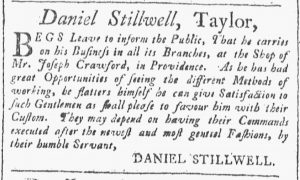
When Daniel Stillwell, a tailor, placed an advertisement in the June 16, 1770, edition of the Providence Gazette, he made one of the most common and important appeals deployed by colonists who followed his trade.  He pledged that clients “may depend on having their Commands executed after the newest and most genteel Fashions.”  Tailors and others in the garment trades often made appeals to price, quality, and fashion in their advertisements.  Stillwell, like other tailors, believed that price and quality might not have mattered much to those who wished for their clothing to communicate their gentility if their garments, trimmings, and accessories did not actually achieve the desired purpose.  Reasonable prices and good quality were no substitute for making the right impression.  Stillwell’s work as a tailor required a special kind of expertise beyond measuring, cutting, and sewing.  He had to be a keen observer of changing tastes and trends so he could deliver “the newest and most genteel Fashions” to his clients.

To that end, Stillwell informed prospective customers that he “has had great Opportunities of seeing the different Methods of working.”  Although he did not elaborate on those experiences, this statement suggested to readers that Stillwell refused to become stagnant in his trade.  Rather than learning one method or technique and then relying on it exclusively, he consulted with other tailors and then incorporated new and different techniques, further enhancing his skill.  In so doing, he joined the many artisans who asserted that their skill and experience prepared them to “give Satisfaction” to those who employed them or purchased the wares they produced.  Stillwell was no novice; instead, he “carries on his Business in all its Branches,” proficiently doing so because of the care he had taken in “seeing the different Methods of working.” Simply observing current fashions was not sufficient for someone in his trade who was unable to replicate them.  Stillwell sought to assure prospective clients that he possessed two kinds of knowledge necessary for serving them, a discerning knowledge of the latest styles and a thorough knowledge of the methods of his trade that would allow him to outfit customers accordingly.

June 15

What was advertised in a colonial American newspaper 250 years ago today?

Jun 15 - 6:15:1770 New Hampshire Gazette
New-Hampshire Gazette (June 15, 1770).

“If Rats could speak, they would declare their Sentiments.”

As spring turned to summer in 1770, the rivalry between watchmakers John Simnet and Nathaniel Sheaff Griffith got even more heated.  In the June 8 edition of the New-Hampshire Gazette, Griffith escalated their feud by publishing an advertisement calling Simnet a mountebank as well as a novice and stranger to the trade.  He had shown some restraint in taking several weeks to respond to an earlier advertisement in which Simnet had disparaged Griffith’s skill and stated that the watches he returned to customers “never had been properly repaired.”  Simnet, usually the more aggressive of the two competitors, published his response in the next issue of the New-Hampshire Gazette, once again escalating the war of words.

In that advertisement, Simnet did not promote his own proficiency but instead leveled two attacks at Griffith.  In the first, he compared Griffith to a rat scrounging for survival and expecting others to provide the sustenance he needed for no other reason that he needed it.  “[I]f Rats could speak,” Simnet proclaimed, “they would declare their Sentiments, say they must eat, and we live by gnawing down what you endeavour to rear.”  Simnet then declared that he tolerated his rival, “this Creature … with few Cloaths to cover his Flesh, and but very little Flesh to cover his Bones.”  In this metaphor, Griffith was not even a good rat who managed “to eat the Fruits of others Labour.”  All the same, Siment warned others to “take care” in their dealings with his competitor.

To that point in the advertisement, Simnet had not yet named Griffith, though readers of the New-Hampshire Gazettewould have been very familiar with the enmity the two watchmakers felt for each other.  The compositor also helped readers make the connection by once again placing the two advertisements one after another.  In the previous issue Simnet’s earlier advertisement came first, followed immediately by Griffith’s response.  In the June 15 edition, Griffith’s advertisement appeared once again, this time with a response from Griffith underneath it so readers moved directly from to the other.

In making his second attack, Simnet did name the “rough Clockmaker” that readers already knew Simnet compared to a rat.”  Simnet published a “Copy of a Bill by Nath’l. Sheaff Griffith, on Mr. Samuel Pickering of Greenland, for repairing his Watch.”  Simnet asserted that “Mr. Pickering desires the Watch may be inspected by Judges, before he pays for it,” but “Griffith refuses, and now keeps it in his Possession.”  Whatever the accuracy of that account, it suggested to readers of the New-Hampshire Gazette that Griffith did not want his lack of skill exposed to even greater scrutiny.  To that end, he was in a standoff with a customer over the price he charged for repairing a watch.  According to Simnet, Griffith expected Pickering to pay £1.4.11 without independent confirmation that he made appropriate repairs.  He demanded that Pickering pay before he would return the watch.  By publicizing that Pickering wished for “Judges” to examine Griffith’s work as well as the charges that appeared on the bill, Simnet further escalated his own dispute with the rival watchmaker by encouraging others to intervene.

Did this help or hurt Simnet in an era when advertisers rarely mentioned their competitors by name?  It was bold enough that Simnet declared that “Most of those who profess this Employ in this Country, are rough Clockmakers.”  Most artisans emphasized their own skill, stating that they were as proficient or better than others who followed their trade, but they usually did not denigrate the work performed by others as a means of enhancing their own status.  Ever since he arrived in New Hampshire after pursuing his trade for more than two decades in London, Simnet had disparaged local clock- and watchmakers, starting with general comments and eventually targeting Griffith in particular.  Readers of the New-Hampshire Gazette may have considered the ongoing feud between Simnet and Griffith amusing, but was it effective or ultimately too unseemly at a time when advertisements did not often incorporate insults and barbs directed at the competition?  The true beneficiary of this series of advertisements may very well have been the printers of the New-Hampshire Gazette who earned additional revenues every time that Griffith or Simnet chose to publish a new volley.

Slavery Advertisements Published June 15, 1770

Guest Curator: Jenna Smith

The Slavery Adverts 250 Project chronicles the role of newspaper advertising in perpetuating slavery in the era of the American Revolution. The project seeks to reveal the ubiquity of slavery in eighteenth-century life from New England to Georgia by republishing advertisements for slaves – for sale, wanted to purchase, runaways, captured fugitives – in daily digests on this site as well as in real time via the @SlaveAdverts250 Twitter feed, utilizing twenty-first-century media to stand in for the print media of the eighteenth century.

The project aims to provide modern audiences with a sense of just how often colonists encountered these advertisements in their daily lives. Enslaved men, women, and children appeared in print somewhere in the colonies almost every single day. Those advertisements served as a constant backdrop for social, cultural, economic, and political life in colonial and revolutionary America. Colonists who did not own slaves were still confronted with slavery as well as invited to maintain the system by purchasing slaves or assisting in the capture of runaways. The frequency of these newspaper advertisements suggests just how embedded slavery was in colonial and revolutionary American culture in everyday interactions beyond the printed page.

These advertisements also testify to the experiences of enslaved men, women, and children, though readers must consider that those experiences have been remediated through descriptions offered by slaveholders rather than the slaves themselves. Often unnamed in the advertisements, enslaved men, women, and children were not invisible or unimportant in early America.

From compiling an archive of digitized eighteenth-century newspapers to identifying advertisements about enslaved men, women, and children in those newspapers to preparing images of each advertisement to posting this daily digest, Jenna Smith served as guest curator for this entry. Working on this project fulfilled her senior capstone requirement for completing the major in History at Assumption College in Worcester, Massachusetts.

These advertisements appeared in colonial American newspapers 250 years ago today.

Jun 15 - New Hampshire Gazette Slavery 1
New-Hampshire Gazette (June 15, 1770).

**********

Jun 15 - New-London Gazette Slavery 1
New-London Gazette (June 15, 1770).

**********

Jun 15 - South-Carolina and American General Gazette Slavery 1
South-Carolina and American General Gazette (June 15, 1770).

**********

Jun 15 - South-Carolina and American General Gazette Slavery 2
South-Carolina and American General Gazette (June 15, 1770).

**********

Jun 15 - South-Carolina and American General Gazette Slavery 3
South-Carolina and American General Gazette (June 15, 1770).

**********

Jun 15 - South-Carolina and American General Gazette Slavery 4
South-Carolina and American General Gazette (June 15, 1770).

**********

Jun 15 - South-Carolina and American General Gazette Slavery 5
South-Carolina and American General Gazette (June 15, 1770).

**********

Jun 15 - South-Carolina and American General Gazette Slavery 6
South-Carolina and American General Gazette (June 15, 1770).


June 14

What was advertised in a colonial American newspaper 250 years ago today?

Jun 14 - 6:14:1770 Virginia Gazette Rind
Virginia Gazette [Rind] (June 14, 1770).
“This mill was erected principally with a view of encouraging our own manufactures.”

Although advertisements promoting local industry and encouraging “domestic manufactures” most often appeared in newspapers published in New England and the Middle Atlantic in the era of the imperial crisis that culminated in the American Revolution, advertisements that made similar appeals also appeared, though less frequently, in newspapers published in the Chesapeake and Lower South.  William Rind’s Virginia Gazette ran just such an advertisement as spring turned to summer in 1770.  Benjamin Brooks operated a fulling mill, cleansing and dyeing cloth for his customers.  He pledged that clients “may depend upon having their cloth finished with the utmost expedition, and in the neatest manner.”  Brooks also rehearsed many of the same appeals linking his enterprise to politics and current events that artisans and others incorporated into advertisements in New England, New York, and Pennsylvania.

Brooks proclaimed that his mill “was erected principally with a view of encouraging our own manufactures at this time, when the use of British is utterly destructive of our liberty.”  In so doing, he invoked disputes between Parliament and the colonies concerning taxation and regulation of commerce as well as the nonimportation agreements first adopted in response to the Stamp Act and later renewed when the Townshend Acts imposed duties on imported paper, glass, lead, paint, and tea.  Colonists vowed to cease importing a vast assortment of goods, not just those enumerated in the Townshend Acts.  As an alternative to imported goods, many called for increased production in the colonies while simultaneously asserting that consumers had a duty to purchase those items.  When it came to domestic manufactures, production and consumption both constituted acts of resistance.  Realizing that some consumers would be skeptical of the quality of goods produced in the colonies, many producers offered reassurances.  In addition to stating that his mill finished cloth “in the neatest manner,” Brooks also declared that he and his workers “dye and dress jeans and fustians to look as well as those from England.”  Producers and retailers often made such pronouncements to convince prospective customers that they would not be disappointed when they acted on their political principles when making choices about consumption.

Brooks also made a less common observation in his advertisement, one that further mobilized colonists to do their part to support American interests.  He noted that “It is impossible to make good work, un less the cloth has been properly managed before it is sent to the mill.”  To that end, he inserted directions that “if complied with, will enable me to give … satisfaction to my customers.”  The fuller encouraged the production of homespun, but also noted that the quality of his finishing work depended in part on the quality of the untreated cloth delivered to him.  He provided a brief primer on spinning and other parts of the process customers undertook on their own before delivering cloth to the mill.  If colonists hoped to produce cloth that rivaled English imports, they all had to do their part.

Politics were not confined to the news items and letters published in the Virginia Gazette and other newspapers in the late 1760s and early 1770s.  Instead, politics overflowed into other parts of newspapers, inflecting advertisements for consumer goods and services with additional meaning.  Brooks did not need to elaborate on what he meant when he stated that “the use of British [manufactures] is utterly destructive of our liberty.”  That simple phrase allowed him to connect his fulling mill to a larger project of American industry that required the active support of all who read his advertisement.

Slavery Advertisements Published June 14, 1770

Guest Curator: Jenna Smith

The Slavery Adverts 250 Project chronicles the role of newspaper advertising in perpetuating slavery in the era of the American Revolution. The project seeks to reveal the ubiquity of slavery in eighteenth-century life from New England to Georgia by republishing advertisements for slaves – for sale, wanted to purchase, runaways, captured fugitives – in daily digests on this site as well as in real time via the @SlaveAdverts250 Twitter feed, utilizing twenty-first-century media to stand in for the print media of the eighteenth century.

The project aims to provide modern audiences with a sense of just how often colonists encountered these advertisements in their daily lives. Enslaved men, women, and children appeared in print somewhere in the colonies almost every single day. Those advertisements served as a constant backdrop for social, cultural, economic, and political life in colonial and revolutionary America. Colonists who did not own slaves were still confronted with slavery as well as invited to maintain the system by purchasing slaves or assisting in the capture of runaways. The frequency of these newspaper advertisements suggests just how embedded slavery was in colonial and revolutionary American culture in everyday interactions beyond the printed page.

These advertisements also testify to the experiences of enslaved men, women, and children, though readers must consider that those experiences have been remediated through descriptions offered by slaveholders rather than the slaves themselves. Often unnamed in the advertisements, enslaved men, women, and children were not invisible or unimportant in early America.

From compiling an archive of digitized eighteenth-century newspapers to identifying advertisements about enslaved men, women, and children in those newspapers to preparing images of each advertisement to posting this daily digest, Jenna Smith served as guest curator for this entry. Working on this project fulfilled her senior capstone requirement for completing the major in History at Assumption College in Worcester, Massachusetts.

These advertisements appeared in colonial American newspapers 250 years ago.

Jun 14 - Massachusetts Gazette and Boston News-Letter Supplement Slavery 1
Boston News-Letter (June 14, 1770).

**********

Jun 14 - Massachusetts Gazette and Boston News-Letter Supplement Slavery 2
Boston News-Letter (June 14, 1770).

**********

Jun 14 - Massachusetts Gazette and Boston News-Letter Supplement Slavery 3
Boston News-Letter (June 14, 1770).

**********

Jun 14 1770 - Maryland Gazette Slavery 1
Maryland Gazette (June 14, 1770).

**********

Jun 14 1770 - Maryland Gazette Slavery 2
Maryland Gazette (June 14, 1770).

**********

Jun 14 1770 - Maryland Gazette Slavery 3
Maryland Gazette (June 14, 1770).

**********

Jun 14 1770 - Maryland Gazette Slavery 4
Maryland Gazette (June 14, 1770).

**********

Jun 14 - New-York Journal Slavery 1
New-York Journal (June 14, 1770).

**********

Jun 14 - New-York Journal Slavery 2
New-York Journal (June 14, 1770).

**********

Jun 14 - New-York Journal Slavery 3
New-York Journal (June 14, 1770).

**********

Jun 14 - Pennsylvania Gazette Slavery 1
Pennsylvania Gazette (June 14, 1770).

**********

Jun 14 - Pennsylvania Gazette Slavery 2
Pennsylvania Gazette (June 14, 1770).

**********

Jun 14 - Pennsylvania Gazette Supplement Slavery 1
Pennsylvania Gazette (June 14, 1770).

**********

Jun 14 - Pennsylvania Gazette Supplement Slavery 2
Pennsylvania Gazette (June 14, 1770).

**********

Jun 14 - Pennsylvania Gazette Supplement Slavery 3
Pennsylvania Gazette (June 14, 1770).

**********

Jun 14 - Pennsylvania Gazette Supplement Slavery 4
Pennsylvania Gazette (June 14, 1770).

**********

Jun 14 - Virginia Gazette Purdie and Dixon Slavery 1
Virginia Gazette [Purdie and Dixon] (June 14, 1770).

**********

Jun 14 - Virginia Gazette Purdie and Dixon Slavery 2
Virginia Gazette [Purdie and Dixon] (June 14, 1770).

**********

Jun 14 - Virginia Gazette Purdie and Dixon Slavery 3
Virginia Gazette [Purdie and Dixon] (June 14, 1770).

**********

Jun 14 - Virginia Gazette Purdie and Dixon Slavery 4
Virginia Gazette [Purdie and Dixon] (June 14, 1770).

**********

Jun 14 - Virginia Gazette Purdie and Dixon Slavery 5
Virginia Gazette [Purdie and Dixon] (June 14, 1770).

**********

Jun 14 - Virginia Gazette Purdie and Dixon Slavery 6
Virginia Gazette [Purdie and Dixon] (June 14, 1770).

**********

Jun 14 - Virginia Gazette Purdie and Dixon Slavery 7
Virginia Gazette [Purdie and Dixon] (June 14, 1770).

**********

Jun 14 - Virginia Gazette Purdie and Dixon Slavery 8
Virginia Gazette [Purdie and Dixon] (June 14, 1770).

**********

Jun 14 - Virginia Gazette Rind Slavery 1
Virginia Gazette [Rind] (June 14, 1770).

**********

Jun 14 - Virginia Gazette Rind Slavery 2
Virginia Gazette [Rind] (June 14, 1770).

**********

Jun 14 - Virginia Gazette Rind Slavery 3
Virginia Gazette [Rind] (June 14, 1770).

**********

Jun 14 - Virginia Gazette Rind Slavery 4
Virginia Gazette [Rind] (June 14, 1770).

**********

Jun 14 - Virginia Gazette Rind Slavery 5
Virginia Gazette [Rind] (June 14, 1770).

**********

Jun 14 - Virginia Gazette Rind Slavery 6
Virginia Gazette [Rind] (June 14, 1770).

**********

Jun 14 - Virginia Gazette Rind Slavery 7
Virginia Gazette [Rind] (June 14, 1770).

**********

Jun 14 - Virginia Gazette Rind Slavery 8
Virginia Gazette [Rind] (June 14, 1770).

**********

Jun 14 - Virginia Gazette Rind Slavery 9
Virginia Gazette [Rind] (June 14, 1770).

June 13

What was advertised in a colonial American newspaper 250 years ago this week?

Jun 13 - 6:11:170 Boston Evening-Post
Boston Evening-Post (June 11, 1770).

“The Coach-Making Business in all its Branches is carried on as usual.”

Adino Paddock, a coachmaker in Boston, regularly placed newspaper advertisements in the late 1760s and early 1770s.  He often promoted secondhand coaches, chaises, and other sorts of carriages as an alternative to purchasing new ones, anticipating marketing strategies that became standard in the automobile industry two centuries later.  He also provided maintenance and carried accessories and equipment, such as reins and whips, realizing that ancillary services and smaller sales supplemented the revenues he earned from carriages.

As part of his marketing efforts, Paddock inserted his advertisements in multiple newspapers published in Boston.  While this increased his expenses, it also placed his notice before greater numbers of potential customers.  During the week of June 11, 1770, for instance, Paddock placed the same advertisement in three of the five newspapers printed in Boston at the time.  It appeared in the Boston Evening-Post, the Boston-Gazette, and the Massachusetts Gazette and Boston Post-Boy on the same day at the beginning of the week.  It did not, however, appear in the issue of the Boston Chroniclepublished that same day or the subsequent issue distributed later in the week, but Paddock may not have considered running it there worth the investment.  Relatively few advertisements ran in the Chronicle, perhaps due to the newspaper’s outspoken Tory sympathies.  (Less than two weeks later that newspaper permanently ceased publication, though Paddock would not have known that the end was near for the Chronicle when he submitted his advertisements to the various printing offices in town.)  Paddock also declined to place his notice in the Massachusetts Gazette and Boston Weekly News-Letter.  Perhaps running notices in the other three newspapers exhausted his budget.

Whatever his reasons for choosing some newspapers over others, Paddock did submit identical copy to the Evening-Post, Gazette, and Post-Boy, multiplying the number of readers who would encounter his advertisements.  For readers who perused more than one publication, his advertisement likely became more memorable due to its familiarity.  Paddock was not alone in adopting this strategy.  Artisans, merchants, and shopkeepers in cities with multiple newspapers often sought to increase their visibility by placing identical notices in more than one publication.

June 12

What was advertised in a colonial American newspaper 250 years ago today?

Jun 12 - 6:12:1770 Essex Gazette
Essex Gazette (June 12, 1770).

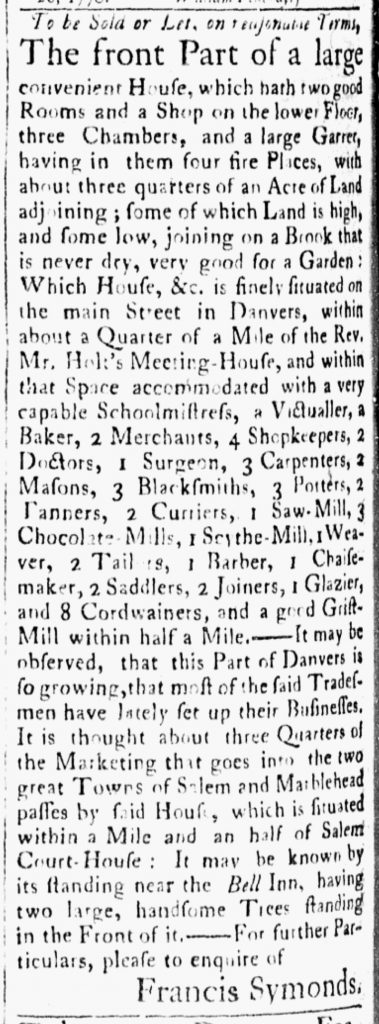
“A large convenient House … finely situated on the main Street.”

Location!  Location!  Location!  Francis Symonds highlighted the location of the “front Part of a large convenient House” that he offered for sale or rent in the June 12, 1770, edition of the Essex Gazette.  He noted that the property was “finely situated on the main Street in Danvers, within about a Quarter of a Mile of the Rev. Mr. Holt’s Meeting-House.”  Symonds also reported an array of goods and services available in close proximity to the house, inserting a census that was not a standard feature of eighteenth-century real estate notices.  Within a quarter mile, buyers or renters would be “accommodated with a very capable Schoolmistress, a Victualler, a Baker, 2 Merchants, 4 Shopkeepers, 2 Doctors, 1 Surgeon, 3 Carpenters, 2 Masons, 3 Blacksmiths, 3 Potters, 2 Tanners, 2 Curriers, 1 Saw-Mill, 1 Weaver, 2 Tailors, 1 Barber, 1 Chaisemaker, 2 Saddlers, 2 Joiners, 1 Glazier, and 8 Cordwainers.”  In addition, they had access to “a good Grist-Mill within half a Mile.”  Although not nearly as bustling as nearby Boston, the town of Danvers was “so growing, that most of the said Tradesmen have lately set up their Businesses.”  Symonds suggested that buyers or renters would reside in an up-and-coming neighborhood.

While that made daily life more comfortable, it also contributed to the prospects of earning a livelihood in the area, especially for anyone interested in the “Shop on the lower Floor” of the house.  In addition to prospective customers who lived nearby, Symonds declared, “It is thought about three Quarters of the Marketing that goes into the two great Towns of Salem and Marblehead passes by said House.”  Furthermore, the house was “situated within a Mile and an half of Salem Court-House” as well as “near the Bell Inn.”  Anyone who intended to operate a business in the shop would not lack for foot traffic.  Prospective customers passed by on their way to market, court, and a popular tavern.

Unlike others who advertised real estate, Symonds offered only a brief description of the house and land.  He focused primarily on the location and the businesses located nearby, his extensive account of the area conjuring images of a lively neighborhood where residents could readily access services and entrepreneurs could easily engage customers.  Considering that many of the local “Tradesmen have lately set up their Businesses,” he may have considered this necessary to attract buyers or renters unaware of the recent growth in the town of Danvers.