November 19

Who placed an advertisement in a colonial American newspaper 250 years ago today?

Essex Gazette (November 19, 1771).

“Priscilla Manning, At her Shop a few Doors above Capt. WEST’s Corner.”

Advertising accounted for one-third of the contents of the November 19, 1771, edition of the Essex Gazette.  A substantial number of notices promoted consumer goods and services available in Salem, Massachusetts.  George Deblois advertised “excellent BOHEA TEA” as well as “English & Hard-Ware GOODS.”  Similarly, John Appleton carried “the very best Bohea Tea” and a “fine Assortment of English and India, Scotch and Irish GOODS.”  In an advertisement that extended almost an entire column, Nathaniel Sparhawk, Jr., listed dozens of items from among the “large and general Assortment of English and India Goods” that he imported “in the last Ships.”  He called special attention to “Bohea TEA, (warranted good).”  John Andrew informed prospective customers that he stocked an “Assortment of ENGLISH GOODS” at his shop “At the Sign of the Gold Cup,” though he did not mention tea.

Priscilla Manning joined these merchants and shopkeepers in advertising the merchandise she sold to consumers.  Her inventory included “Bohea, Hyson & Souchong TEAS” as well as a “general Assortment of English and India GOODS.”  Manning had been operating a shop “a few Doors above Capt. WEST’s Corner” for at least two years, according to advertisements in the Essex Gazette, but her name would disappear from the pages of that newspaper in 1772 when she married George Abbot.  Historian Donna Seger has traced Manning’s life and career, noting that Abbot apparently took over Manning’s shop.  Advertisements in the Essex Gazette bore his name and made reference to “his shop a little above Capt. West’s Corner.”  When Abbot died in 1784, Manning “re-opened her shop … and built a big new house—both in her name.”  She almost certainly continued to work in the shop during those twelve years that her husband’s name appeared in the public prints, eclipsing her contributions to the family business.  Given that Manning was a woman of business in her right before her marriage and after the death of her husband, it raises questions about how many wives, daughters, sisters, aunts, and other female relations worked in the shops advertised by Deblois, Appleton, Sparhawk, and Andrew.  Which women, known to customers and the community but unnamed in the notices, came to mind when eighteenth-century readers perused those advertisements?

Slavery Advertisements Published November 19, 1771

GUEST CURATOR: Chloe Amour
with contributions from Kaden McSheffrey

The Slavery Adverts 250 Project chronicles the role of newspaper advertising in perpetuating slavery in the era of the American Revolution. The project seeks to reveal the ubiquity of slavery in eighteenth-century life from New England to Georgia by republishing advertisements about enslaved people – for sale as individuals or in groups, wanted to purchase or for hire for short periods, runaways who liberated themselves, and those who were subsequently captured and confined in jails and workhouses – in daily digests on this site as well as in real time via the @SlaveAdverts250 Twitter feed, utilizing twenty-first-century media to stand in for the print media of the eighteenth century.

The project aims to provide modern audiences with a sense of just how often colonists encountered these advertisements in their daily lives. Enslaved men, women, and children appeared in print somewhere in the colonies almost every single day. Those advertisements served as a constant backdrop for social, cultural, economic, and political life in colonial and revolutionary America. Colonists who did not purport to own enslaved people were still confronted with slavery as well as invited to maintain the system by purchasing enslaved men, women, and children or assisting in the capture of so-called “runaways” who sought to free themselves from bondage. The frequency of these newspaper advertisements suggests just how embedded slavery was in colonial and revolutionary American culture in everyday interactions beyond the printed page.

These advertisements also testify to the experiences of enslaved men, women, and children, though readers must consider that those experiences have been remediated through descriptions offered by enslavers rather than enslaved people themselves. Often unnamed in the advertisements, enslaved men, women, and children were not invisible or unimportant in early America.

From compiling an archive of digitized eighteenth-century newspapers to identifying advertisements about enslaved men, women, and children in those newspapers to preparing images of each advertisement to posting this daily digest, Chloe Amour served as guest curator for this entry.  She completed this work while enrolled in an independent study for HIS 390 – Digital Humanities Practicum at Assumption University in Worcester, Massachusetts, in Spring 2021.

These advertisements appeared in colonial American newspapers 250 years ago today.

Essex Gazette (November 19, 1771).

**********

South-Carolina Gazette and Country Journal (November 19, 1771).

**********

South-Carolina Gazette and Country Journal (November 19, 1771).

**********

South-Carolina Gazette and Country Journal (November 19, 1771).

**********

South-Carolina Gazette and Country Journal (November 19, 1771).

**********

South-Carolina Gazette and Country Journal (November 19, 1771).

**********

South-Carolina Gazette and Country Journal (November 19, 1771).

**********

South-Carolina Gazette and Country Journal (November 19, 1771).

**********

South-Carolina Gazette and Country Journal (November 19, 1771).

**********

South-Carolina Gazette and Country Journal (November 19, 1771).

**********

South-Carolina Gazette and Country Journal (November 19, 1771).

**********

South-Carolina Gazette and Country Journal (November 19, 1771).

**********

South-Carolina Gazette and Country Journal (November 19, 1771).

**********

South-Carolina Gazette and Country Journal (November 19, 1771).

November 18

GUEST CURATOR:  Kaden McSheffrey

Who was the subject of an advertisement in a colonial American newspaper 250 years ago today?

Boston-Gazette (November 18, 1771).

“Ran-away … a Negro Man Servant named CROMARTE.”

This advertisement from the Boston-Gazette in November 1771 offers a reward for “Negro Man Servant named CROMARTE, commonly called CRUM” who “Ran-away” from Samuel Fitch.  At first, Fitch calls Cromarte a “Negro Man Servant” and does not mention the word “slave.” At the end of the advertisement, however, he calls Cromarte a “Slave for Life” when he warns “Masters of Vessels and others” not to help him. This is interesting because many people are not aware that slavery was present in the northern colonies in the eighteenth century; most people assume that slavery happened only in the southern colonies. It is clear that this is an advertisement about an enslaved man in Boston in 1771. Cromarte’s experience was part of a longer story. According to the Massachusetts Historical Society, “John Winthrop (the founder of Boston) … recorded on 26 February 1638 that the Massachusetts ship Desire had returned from the West Indies carrying ‘some cotton, and tobacco, and negroes, etc.’”  Slavery was part of Massachusetts history from the earliest days of English settlement.

**********

ADDITIONAL COMMENTARY:  Carl Robert Keyes

In Slavery and American History: The Tough Stuff of Memory (2006), James Oliver Horton tells a story of a tourist in Boston shocked to learn about slavery and the slave trade in New England.  “I thought we were better than that,” the tourist lamented.  Reflecting on this encounter, Horton notes that “confronting the contradiction between the American ideal and the reality of American history can be disturbing.”  He continues with an assertion: “The first task for the public historian is to attempt to address popular ignorance of slavery’s diversity, longevity, complexity, and centrality.”[1]  Fifteen years later, historians and others continue to work toward that goal.  They have made some progress, especially in the wake of the 1619 Project, though that work has also met with backlash.

I teach at a regional university.  Most of my students grew up in New England.  They arrive in my classes assuming, as many Americans do, that slavery was limited to southern colonies and states.  When they serve as guest curators for the Adverts 250 Project and the Slavery Adverts 250 Project, they see for themselves the extent that slavery thrived throughout the colonies, including in New England, during the era of the American Revolution.  They do not merely read an article or listen to a lecture about slavery in the region; instead, they encounter accounts of enslaved people repeatedly as they examine newspapers from the period.  My students must grapple with the diversity, complexity, and centrality of slavery in the era of the Revolution, intensively examining a relatively short period does not necessarily address the longevity of slavery in New England.  In doing independent research to identify primary and secondary sources to help him analyze his selected advertisement, however, Kaden incorporated the longevity of slavery in Massachusetts into his work as guest curator, identifying the first documented reference to the sale of enslaved people in the colony more than 130 years before Cromarte, a “Slave for Life,” liberated himself from Samuel Fitch in Boston in the fall of 1771.

**********

[1] James Oliver Horton, “Slavery in American History: An Uncomfortable National Dialogue,” in Slavery and Public History: The Tough Stuff of American Memory, eds. James Oliver Horton and Lois E. Horton (New York: New Press, 2006): 37-38.

Welcome, Guest Curator Kaden McSheffrey

Kaden McSheffrey is a senior majoring in History and minoring in Marketing at Assumption University in Worcester, Massachusetts. Kaden grew up on the South Shore of Boston, in Duxbury, Massachusetts, and spends a lot of his time in Vermont, where some of his family lives. His main historical interests include the American Revolution, the American Civil War, and World War II. Outside of the classroom, Kaden has an obsession with sports and a love for music as well.

Welcome, guest curator Kaden McSheffrey!

Slavery Advertisements Published November 18, 1771

GUEST CURATOR: Chloe Amour
with contributions from Kaden McSheffrey

The Slavery Adverts 250 Project chronicles the role of newspaper advertising in perpetuating slavery in the era of the American Revolution. The project seeks to reveal the ubiquity of slavery in eighteenth-century life from New England to Georgia by republishing advertisements about enslaved people – for sale as individuals or in groups, wanted to purchase or for hire for short periods, runaways who liberated themselves, and those who were subsequently captured and confined in jails and workhouses – in daily digests on this site as well as in real time via the @SlaveAdverts250 Twitter feed, utilizing twenty-first-century media to stand in for the print media of the eighteenth century.

The project aims to provide modern audiences with a sense of just how often colonists encountered these advertisements in their daily lives. Enslaved men, women, and children appeared in print somewhere in the colonies almost every single day. Those advertisements served as a constant backdrop for social, cultural, economic, and political life in colonial and revolutionary America. Colonists who did not purport to own enslaved people were still confronted with slavery as well as invited to maintain the system by purchasing enslaved men, women, and children or assisting in the capture of so-called “runaways” who sought to free themselves from bondage. The frequency of these newspaper advertisements suggests just how embedded slavery was in colonial and revolutionary American culture in everyday interactions beyond the printed page.

These advertisements also testify to the experiences of enslaved men, women, and children, though readers must consider that those experiences have been remediated through descriptions offered by enslavers rather than enslaved people themselves. Often unnamed in the advertisements, enslaved men, women, and children were not invisible or unimportant in early America.

From compiling an archive of digitized eighteenth-century newspapers to identifying advertisements about enslaved men, women, and children in those newspapers to preparing images of each advertisement to posting this daily digest, Chloe Amour served as guest curator for this entry.  She completed this work while enrolled in an independent study for HIS 390 – Digital Humanities Practicum at Assumption University in Worcester, Massachusetts, in Spring 2021.

These advertisements appeared in colonial American newspapers 250 years ago today.

Boston Evening-Post (November 18, 1771).

**********

Boston-Gazette (November 18, 1771).

**********

Boston-Gazette (November 18, 1771).

**********

Massachusetts Gazette and Boston Post-Boy (November 18, 1771).

**********

New-York Gazette and Weekly Mercury (November 18, 1771).

**********

New-York Gazette and Weekly Mercury (November 18, 1771).

**********

New-York Gazette and Weekly Mercury (November 18, 1771).

**********

New-York Gazette and Weekly Mercury (November 18, 1771).

**********

New-York Gazette and Weekly Mercury (November 18, 1771).

**********

New-York Gazette and Weekly Mercury (November 18, 1771).

**********

Newport Mercury (November 18, 1771).

**********

Newport Mercury (November 18, 1771).

**********

Pennsylvania Packet (November 18, 1771).

**********

South-Carolina and American General Gazette (November 18, 1771).

**********

South-Carolina and American General Gazette (November 18, 1771).

**********

South-Carolina and American General Gazette (November 18, 1771).

November 17

What was advertised in a colonial American newspaper 250 years ago this week?

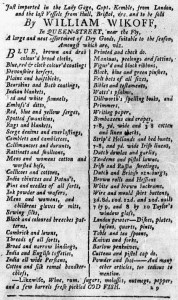
New-York Journal (November 14, 1771).

A large and neat assortment of Dry Goods.”

William Wikoff advertised a “large a neat assortment of Dry Goods, suitable to the season” in the November 14, 1771, edition of the New-York Journal.  He attempted to entice prospective customers to his shop by demonstrating the range of choices he made available to them, listing everything from “Devonshire kerseys” to “Mens and womens, and childrens gloves & mits” to “Wire and mould shirt buttons” to “Table and tea spoons.”  His inventory appeared in two columns with one or two items per line, arranged in two columns, to make it easier to peruse.  It looked quite different than most of the advertisements for imported consumer goods that ran in the Providence Gazette the same week.  Several advertisers in that town declared that they stocked too much merchandise “to be particularly mentioned in an Advertisement,” deploying a different strategy for invoking choice as a reason to visit their stores.

Even though he concluded his list by claiming that he has “many other articles, too tedious to mention,” Wikoff decided on a more common means of making an appeal about consumer choice in his advertisement, one that many of his competitors used in their advertisements in the same issue of the New-York Journal.  On the same page as his notice, John Morton, John J. Roosevelt, and George Webster all ran advertisements that listed dozens of items arrayed in two columns.  Henry Remsen and Company and Abeel and Byvanck also listed their wares, though they did not resort to columns but instead published dense paragraphs that required even more active reading on the part of prospective customers.  Elsewhere, John Amiel, Hallett and Hazard, Robert Needham, Thomas Pearsall, Daniel Phoenix, Robert Sinclair, Samuel Tuder, and Kelly, Lott, and Company all inserted lists of goods arranged as columns, while William Neilson and Henry Wilmot opted for paragraphs that took up less space (and cost less since advertisers paid by the amount of space rather than the number of word).  Gerardus Duyckinck placed two advertisements for his “UNIVERSAL STORE,” also known as the “Medley of Goods,” that listed his inventory and deployed unique formats.

In yesterday’s entry, I argued that many merchants and shopkeepers in Providence simultaneously deployed an uncommon strategy for suggesting consumer choice in the fall of 1771.  They proclaimed that they carried “a Variety of well assorted GOODS” but asserted that the choices were so vast that they could not print them in newspaper advertisements.  Today, I offer examples of more common formats that traders in other cities used to catalog their merchandise to demonstrate the choices consumers would encounter in their shops.  In each case, advertisers did more than announce they had goods on hand and expect that was sufficient to attract customers.

November 16

What was advertised in a colonial American newspaper 250 years ago today?

Providence Gazette (November 16, 1771).

“The Articles are too many to be particularly mentioned in an Advertisement.”

Nicholas Tillinghast and William Holroyd stocked their store on King Street in Providence with “a Variety of well assorted GOODS … just imported in the last Ships from London.”  Their inventory included “a fine Assortment of Queen’s Ware,” but the partners declined to list other items, stating that the “Articles are too many to be particularly mentioned in an Advertisement.”  They made an appeal to consumer choice by suggesting that the choices were too extensive to do justice to them in a newspaper notice.  Prospective customers would have to visit their store to see for themselves what might strike their fancy.

Tillinghast and Holroyd were not the only advertisers who adopted that strategy in the November 16, 1771, edition of the Providence Gazette.  Nicholas Brown and Company informed readers that “[t]o enumerate the particular Articles” among their “compleat Assortment of English, India and Hard Ware GOODS” would “require much more room than can well be afforded in a News-Paper.”  They sweetened the deal by asserting that their inventory included “a great Number [of goods] not usually imported into this Town,” another means of leveraging curiosity to draw prospective customers into their store.  Stewart and Taylor selected a couple of dozen items from their “Variety of ENGLISH and INDIA GOODS” to list in their advertisement, but insisted that they carried “a variety of other articles, too tedious to mention.”  Jabez Brown cataloged an even greater number of items from his “neat Assortment of Fall and Winter GOODS,” bit concluded with “&c. &c. &c.”  He repeated the eighteenth-century abbreviation for et cetera three times to underscore the range of choices available.

Such advertisements gave the Providence Gazette a different appearance than many of the newspapers published in Boston, New York, and Philadelphia that same week.  Publications in those cities included many advertisements that incorporated extensive lists of merchandise, many of them extending half a column or more.  Similar advertisements sometimes ran in the Providence Gazette, but, at least for the moment, the merchants and shopkeepers in town opted for an economy of prose.  In general, advertising practices were not regionally distinctive in eighteenth-century America, but the number of merchants and shopkeepers who declared they sold “too many [items] to be particularly mentioned in an Advertisement” represents a trend toward a particularly strategy in Providence in the fall of 1771.  It suggests that advertisers did take note of the methods deployed by their competitors and adjusted their own notices accordingly.

Slavery Advertisements Published November 16, 1771

GUEST CURATOR: Chloe Amour
with contributions from Kaden McSheffrey

The Slavery Adverts 250 Project chronicles the role of newspaper advertising in perpetuating slavery in the era of the American Revolution. The project seeks to reveal the ubiquity of slavery in eighteenth-century life from New England to Georgia by republishing advertisements about enslaved people – for sale as individuals or in groups, wanted to purchase or for hire for short periods, runaways who liberated themselves, and those who were subsequently captured and confined in jails and workhouses – in daily digests on this site as well as in real time via the @SlaveAdverts250 Twitter feed, utilizing twenty-first-century media to stand in for the print media of the eighteenth century.

The project aims to provide modern audiences with a sense of just how often colonists encountered these advertisements in their daily lives. Enslaved men, women, and children appeared in print somewhere in the colonies almost every single day. Those advertisements served as a constant backdrop for social, cultural, economic, and political life in colonial and revolutionary America. Colonists who did not purport to own enslaved people were still confronted with slavery as well as invited to maintain the system by purchasing enslaved men, women, and children or assisting in the capture of so-called “runaways” who sought to free themselves from bondage. The frequency of these newspaper advertisements suggests just how embedded slavery was in colonial and revolutionary American culture in everyday interactions beyond the printed page.

These advertisements also testify to the experiences of enslaved men, women, and children, though readers must consider that those experiences have been remediated through descriptions offered by enslavers rather than enslaved people themselves. Often unnamed in the advertisements, enslaved men, women, and children were not invisible or unimportant in early America.

From compiling an archive of digitized eighteenth-century newspapers to identifying advertisements about enslaved men, women, and children in those newspapers to preparing images of each advertisement to posting this daily digest, Chloe Amour served as guest curator for this entry.  She completed this work while enrolled in an independent study for HIS 390 – Digital Humanities Practicum at Assumption University in Worcester, Massachusetts, in Spring 2021.

These advertisements appeared in colonial American newspapers 250 years ago today.

Providence Gazette (November 16, 1771).

November 15

What was advertised in a colonial American newspaper 250 years ago today?

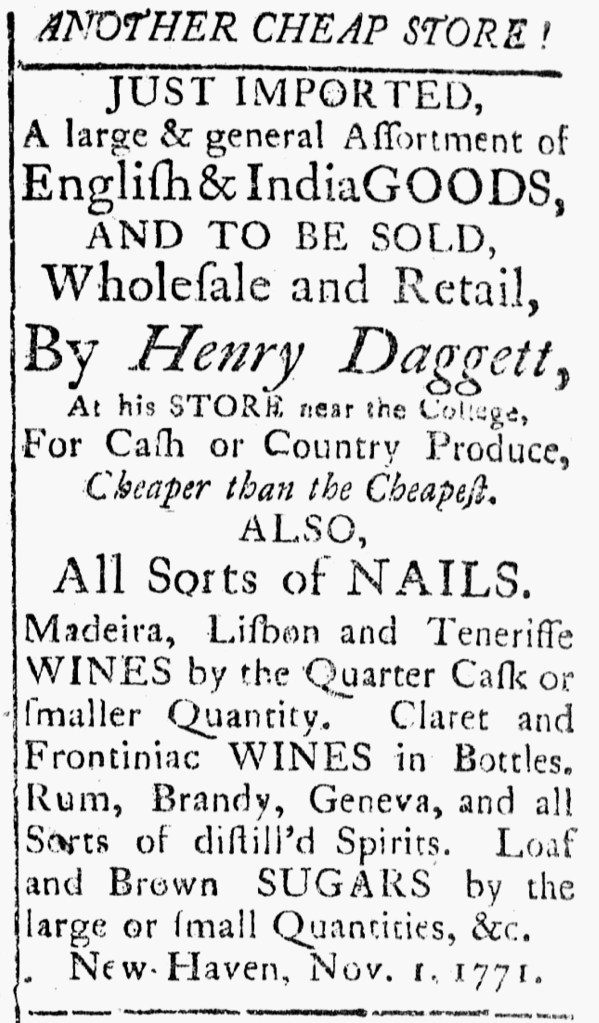
Connecticut Journal (November 15, 1771).

Cheaper than the Cheapest.”

In the fall of 1771, Henry Daggett advertised a “large & general Assortment of English & India GOODS” in the Connecticut Journal.  His advertisement in the November 15 edition also listed several different kinds of wines and spirits as well as “Loaf and Brown SUGARS by the large or small Quantities” available at his store near Yale College in New Haven.  He offered all of his inventory “Wholesale and Retail,” supplying shopkeepers and selling directly to consumers.

Most purveyors of goods and services made appeals to price when they placed advertisements in eighteenth-century newspapers, but Daggett emphasized low prices to an extent not seen in most other notices in the Connecticut Journal and other publications.  John Sherman informed prospective customers that he sold his “large Assortment of GOODS … very reasonably.”  Similarly, John Atwater stocked a “general Assortment of English Goods” that readers could acquire “very cheap.”  Sherman and Atwater embedded appeals to price within their notices; in comparison, Daggett crafted a headline that presented his establishment as “ANOTHER CHEAP STORE!”  He deployed price as a means of framing the rest of his advertisement.  In the middle of the advertisement, he further elaborated, proclaiming that he set prices “Cheaper than the Cheapest.”  Customers might have found some of the same imported goods at Sherman’s store or Atwater’s store, but Daggett suggested that his competitors did not match the bargains he offered.

Eighteenth-century newspaper advertisements might not appear very sophisticated compared to marketing campaigns of the twentieth and twenty-first centuries, but those notices should not be dismissed as mere announcements.  Daggett attempted to incite demand for his goods by emphasizing low prices, hoping that the promise of good deals would convince customers to make purchases and buy in greater quantities if he could convince them that they were getting the better end of the transaction.  Even the wording and format incorporated innovation as Daggett deviated from standardized language concerning prices to promote “Cheaper than the Cheapest” goods and inserted a headline describing his “CHEAP STORE!”  At a glance, Daggett’s advertisement may look like all the others to modern readers, but on closer examination it becomes clear that Daggett sought to create a distinctive notice that would garner greater attention.

November 14

What was advertised in a colonial American newspaper 250 years ago today?

Pennsylvania Journal (November 14, 1771).

“WATCHES made in Philadelphia.”

When Parliament imposed duties on certain imported goods – glass, lead, paint, paper, and tea – in the Townshend Acts in 1767, colonists responded by adopting nonimportation agreements.  In so doing, they resumed a strategy that helped win repeal of the Stamp Act, using economic leverage in the service of political goals.  At the same time that merchants vowed not to import and sell a wide assortment of items, many colonists also advocated that consumers support “domestic manufactures” by purchasing goods produced in the colonies as alternatives to their imported counterparts.  When Parliament eventually relented and repealed all of the duties except the one on tea, colonial merchants and others resumed trade with Britain.  Imported goods flooded American markets.

Even as consumers eagerly embraced imported goods once again, some American entrepreneurs continued to promote domestic manufactures.  John Sprogell, Jr., for instance, marketed “WATCHES made in Philadelphia” in an advertisement in the November 14, 1771, edition of the Pennsylvania Journal.  Like others who advertised goods made in the colonies, Sprogrell promised prospective customers that they would not sacrifice quality.  To that end, he declared that he had “employed journeymen from London” so his shop would produce “the best of WATCHES.”  He offered a guarantee, proclaiming that he would “insure [the watches] for one, two, or three years.”  They would not need any maintenance that would incur “expense to the purchaser,” with the exception of routine cleaning.

As the proprietor of the shop, Sprogell understood that his reputation was on the line.  “The public may be assured,” he asserted, “that he will use his utmost endeavour to give general satisfaction” because “the character of the maker lays at stake.”  Even though the journeymen who labored in the shop did much or all of the work, ultimately the watches were Sprogell’s products.  Inferior work would have an effect on his standing in the marketplace, so even as he arranged a means of providing the same quality as found in London he provided additional security for customers who chose his “WATCHES made in Philadelphia” in hopes that his various pledges and promises would entice them into his shop.