A notice in the March 4, 1773, edition of the Maryland Gazette called on “Members of the LUNATICK CLUB” to gather for a meeting “at the Coffee-House” in Annapolis on March 8. The club convened for dinner on the evening of the full moon. That lunar phenomenon gave members an excuse to engage in revelries together.
The organizers apparently did not rely on newspaper notices alone to alert members about the gathering. A nota benedeclared that “Circular Letters are sent to the Members,” but surmised that they may have been overlooked. What were circular letters? In this case, they would have been similar to printed invitations. Rather than write the same message by hand over and over, one of the organizers wrote it once, submitted it to the printing office, and ordered multiple copies. The letter may have included space at the top to write a salutation to the recipient and space at the bottom for the organizer to sign it. If the club used the same circular letter each month, it likely resembled a form with blanks to fill in the date (as well as the time and location if they changed from month to month). After writing anything that needed to be added to the printed letter, the organizer folded it, sealed it with wax, wrote the name and address of the recipient on the exterior, and arranged for delivery via the post or messenger. This certainly saved time compared to writing out the entire invitation each time, especially if the club had many members.
Merchants, shopkeepers, and other entrepreneurs also distributed circular letters when they wished to contact associates or prospective customers. Again, rather than invest the time in writing the same letter multiple times, they instead had copies printed, personalized each copy for the intended recipient, and sent them through the post. When they did so, they relied on an eighteenth-century version of junk mail. Relatively few printed circular letters survive compared to other forms of early American advertising, but notices like the one the Lunatick Club placed in the Maryland Gazette imply that circular letters were more common than the examples in research libraries and historical societies suggest.
What was advertised in a colonial American newspaper 250 years ago today?
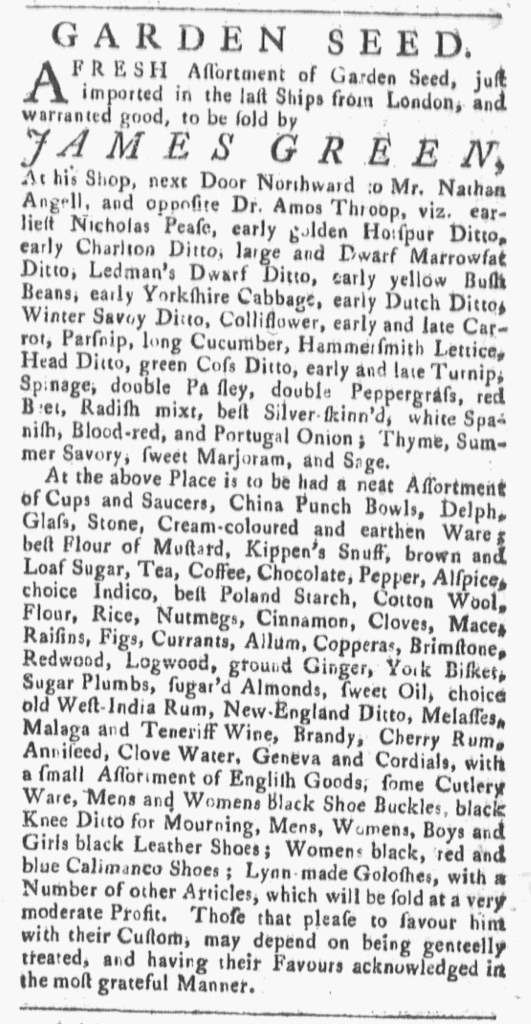
Providence Gazette (March 6, 1773).
“GARDEN SEED … At the above Place is to be had a neat Assortment of Cups and Saucers.”
In Boston, advertisements for garden seeds continued to fill the pages of newspapers as spring approached in 1773. On March 1, Elizabeth Greenleaf, Ebenezer Oliver, and Susanna Renken placed notices in the Boston Evening-Post, John Adams, Elizabeth Clark and Nowell, Elizabeth Dyar, Elizabeth Greenleaf, Ebenezer Oliver, and Susanna Renken placed notices in the Boston-Gazette, and Elizabeth Greenleaf and Susanna Renken placed notices in the Massachusetts Gazette and Boston Post-Boy. On March 4, John Adams, Elizabeth Greenleaf, Ebenezer Oliver, and Susanna Renken ran advertisements in the Massachusetts Gazette and Boston Weekly News-Letter and Lydia Dyar, Elizabeth Greenlead, Anna Johnson, and Susanna Renken ran advertisements in the Massachusetts Spy.
Such advertisements did not saturate newspapers published in other towns in New England to the same extent, but they did appear. For instance, Nathan Beers informed residents of New Haven that he sold a “Quantity of GARDEN-SEEDS” in a notice in the Connecticut Journal on March 5. He stated that his seeds were “cultivated according to the rules of the best English Gardiners.” The following day, James Green ran his own advertisement for a “FRESH Assortment of Garden Seed, just imported in the last Ships from London,” in the Providence Gazette. Like other seed sellers, he provided an extensive list of his wares.
Unlike most others, however, Green did not focus exclusively on seeds. He used seasonal merchandise to introduce prospective customers to other goods available at his shop. Indeed, he devoted just more than half the space in his advertisement to a catalog of housewares, groceries, and garments, including “a neat Assortment of Cups and Saucers,” “best Flour of Mustard,” and “Mens, Womens, Boys and Girls black Leather Shoes.” He promised “a Number of other Articles.” To further entice consumers, Green stated that he sold those goods “at a very moderate Profit.” In other words, he did not mark up the retail prices extravagantly but instead offered good bargains for his customers.
Eighteenth-century advertisers frequently described their merchandise as “suitable for the season.” Sometimes they used headlines with similar sentiments, such as “WINTER GOODS” in a notice Frazier and Geyer ran in the March 1 edition of the Boston Evening-Post. In contrast, Green experimented with another marketing strategy. He focused one particular season item, garden seeds, in the first portion of his advertisement and then directed attention to the rest of his inventory after capturing the attention of prospective customers.
The Slavery Adverts 250 Project chronicles the role of newspaper advertising in perpetuating slavery in the era of the American Revolution. The project seeks to reveal the ubiquity of slavery in eighteenth-century life from New England to Georgia by republishing advertisements about enslaved people – for sale as individuals or in groups, wanted to purchase or for hire for short periods, runaways who liberated themselves, and those who were subsequently captured and confined in jails and workhouses – in daily digests on this site as well as in real time via the @SlaveAdverts250 Twitter feed, utilizing twenty-first-century media to stand in for the print media of the eighteenth century.
The project aims to provide modern audiences with a sense of just how often colonizers encountered these advertisements in their daily lives. Enslaved men, women, and children appeared in print somewhere in the colonies almost every single day. Those advertisements served as a constant backdrop for social, cultural, economic, and political life in colonial and revolutionary America. Colonizers who did not purport to own enslaved people were still confronted with slavery as well as invited to maintain the system by purchasing enslaved men, women, and children or assisting in the capture of so-called “runaways” who sought to free themselves from bondage. The frequency of these newspaper advertisements suggests just how embedded slavery was in colonial and revolutionary American culture in everyday interactions beyond the printed page.
These advertisements also testify to the experiences of enslaved men, women, and children, though readers must consider that those experiences have been remediated through descriptions offered by enslavers rather than enslaved people themselves. Often unnamed in the advertisements, enslaved men, women, and children were not invisible or unimportant in early America.
These advertisements appeared in colonial American newspapers 250 years ago today.
What was advertised in a colonial American newspaper 250 years ago today?
New-Hampshire Gazette (March 5, 1773).
“Instruct their Scholars in those Rules of Decorum and Politeness.”
Monsieur de Viart, a dancing master, sought to cultivate a sense of anxiety among prospective clients when he offered his services in an advertisement in the March 5, 1773, edition of the New-Hampshire Gazette. In particular, he suggested that parents needed to tend to the best interests of their children by enrolling them in classes taught by an expert who emphasized comportment as well as learning the steps of “Minuets, French Jiggs, Horn-Pipes, Rigadoons, and English Country Dances of all Kinds.” His students, he promised, would exhibit grace in their interactions as well as in their movements.
In making that pitch, Viart asserted that he “has always endeavoured to merit the Approbation of those who have hitherto favoured him with their Custom,” especially parents of his young students, “by having at all Times obliged himself to instruct his PUPIULS in those Principles which he received in that Profession himself.” The dancing master declared that he incorporated “Rules of Decorum and Politeness” into his curriculum, recognizing that dancing was part of much more extensive social interactions. He cautioned parents of prospective pupils that their children needed such lessons, “which are absolutely necessary to be known, begore Young Persons can step abroad into the World with Elegance and Ease.”
Viart claimed that other dancing masters did not focus on the relationship between dancing and manners that he did, leaving their students to clumsily stumble through encounters with others. He lamented that “not every one who pretends to teach this delicate Art … will take the Pains to instruct their Scholars” in manners. As a result, parents had reason to fear that their children might embarrass themselves. “[I]t often happens that Scholars,” Viart confided, “through the Ignorance of the Masters, are guilty of great Rudeness and commit gross Blunders on their first going into Company.” Viart prepared his pupils for much more than moving across the dance floor, helping them avoid various kinds of awkwardness and difficulties when they gathered for social events.
Dancing masters in the largest cities in the colonies – Charleston, New York, Philadelphia – made similar appeals to prospective pupils and their parents. They touted the gentility that their “Scholars” would exhibit upon taking lessons. Viart suggested that this was not merely a concern for colonizers who resided in urban ports. Instead, he encouraged students and, especially, their parents in Portsmouth, New Hampshire, to experience a sense of apprehension that they did not meet the standards expected in cosmopolitan society.
What was advertised in a colonial American newspaper 250 years ago today?
Massachusetts Gazette and Boston Weekly News-Letter (March 4, 1773).
“AN ESSAY Concerning the true original Extent and End of CIVIL GOVERNMENT.”
In 1773, Benjamin Edes and John Gill, printers of the Boston-Gazette, published an American edition of John Locke’s Essay Concerning the True Original Extent and End of Civil Government, the second of the political philosopher’s Two Treatises of Government. The printers promoted the book in their own newspaper and in the Massachusetts Gazette and Boston Weekly News-Letter.
Edes and Gill exercised their prerogative as printers to give their advertisement a privileged place in the Boston-Gazette. It appeared as the first item in the first column on the first page of the March 1 edition, immediately below the masthead. The lengthy advertisement filled the entire column and overflowed into the next. Even as Edes and Gill proclaimed that studying Locke’s treatise “will give to every Intelligent Reader a better View of the Rights of Men and of Englishmen” they published an advertisement offering an enslaved woman for sale in the lower right corner of the same page. In addition to generating revenue from that advertisement, they served as brokers. The anonymous advertiser instructed interested parties to “Inquire of Edes & Gill.” Their advertisement in the March 4 edition of the Massachusetts Gazette and Boston Weekly News-Letter did not benefit from so prime a placement, running in the center column on the fourth page. Consisting of the same copy that ran in the Boston-Gazette, it extended nearly an entire column.
In their efforts to convince colonizers to purchase the book, Edes and Gill asserted, “IT is well known among the Learned, that Mr. Locke’s two Treatise’ on Government, of which this is the Principal and by far the most Valuable, contributed more essentially to the establishing the Throne of our Great Deliverer King William, and consequently to the securing the Protestant Succession, than the Battle of the Boyne, or indeed all the Victories since obtained.” They acknowledged that Locke’s “first Discourse has also been of great Use, as it is a most thorough Refutation of the Errors of Sir Robert Filmer,” known for defending the divine right of kings. In a postscript, the printers explained why they opted not to publish both treatises. Even though both had been “lately published together in England, and universally read and admired by all Lovers of Liberty there,” Edes and Gill did not consider the first treatise as essential for colonizers, in part because “few of [Filmer’s disciples] are yet to be found in this Country.” That decision also made the book less expensive and more accessible to consumers since the second treatise was not “incumbered with the prolix Confutation of Filmer.”
Edes and Gill argued that all colonizers had a duty to read Locke’s work and discuss it with others. They declared, “It should be early and carefully explained by every Father to his Son, by every Preceptor to his Pupils, and by every Mother to her Daughter.” Just as many colonizers encouraged women to participate in politics through the decisions they made as consumers, the printers envisioned a role for women in educating their children about civic virtue. In so doing, they drew upon the example of “Roman Ladies, especially those of the first Rank and Fashion” who “not only taught their Daughters, but their Sones, the first Rudiments of Learning.” They achieved significant results; those “noble Matrons by their Sense and Virtue, contributed in this and a Thousand other Instances, no less toward the building up their glorious Republic than the Wisdom and Valour of the greatest Captain’s.” Edes and Gill anticipated the notion of republican motherhood that citizens, male and female, embraced during the era of the early republic that followed the American Revolution.
Why did Edes and Gill publish and promote Locke’s Essay Concerning the True Original Extent and End of Civil Government? Historians disagree about the motivations of printers, publishers, and booksellers who produced and sold political treatises during the imperial crisis. Did they align with the ideology in the books and pamphlets they published and sold, hoping to convert other colonizers to share their perspective? Or did they merely seek to generate revenues? Such motivations are not necessarily mutually exclusive. By the time they published an American edition of Locke’s Essay, Edes and Gill already established their reputation as patriot printers. They very likely considered printing, promoting, and selling this treatise a political act … but that did not mean they did not also seek to make money. For Richard Draper, the printer of the Massachusetts Gazette and Boston Weekly News-Letter, running an advertisement for Locke’s Essay may have been more about generating revenues, especially considering that he tended to support British officials. Edes and Gill may have chosen to advertise in his newspaper as a means of reaching readers less likely to peruse newspapers published by patriot printers, exposing them to some of Locke’s reasoning in the lengthy advertisement even if they opted not to purchase or read the Essay.
The Slavery Adverts 250 Project chronicles the role of newspaper advertising in perpetuating slavery in the era of the American Revolution. The project seeks to reveal the ubiquity of slavery in eighteenth-century life from New England to Georgia by republishing advertisements about enslaved people – for sale as individuals or in groups, wanted to purchase or for hire for short periods, runaways who liberated themselves, and those who were subsequently captured and confined in jails and workhouses – in daily digests on this site as well as in real time via the @SlaveAdverts250 Twitter feed, utilizing twenty-first-century media to stand in for the print media of the eighteenth century.
The project aims to provide modern audiences with a sense of just how often colonizers encountered these advertisements in their daily lives. Enslaved men, women, and children appeared in print somewhere in the colonies almost every single day. Those advertisements served as a constant backdrop for social, cultural, economic, and political life in colonial and revolutionary America. Colonizers who did not purport to own enslaved people were still confronted with slavery as well as invited to maintain the system by purchasing enslaved men, women, and children or assisting in the capture of so-called “runaways” who sought to free themselves from bondage. The frequency of these newspaper advertisements suggests just how embedded slavery was in colonial and revolutionary American culture in everyday interactions beyond the printed page.
These advertisements also testify to the experiences of enslaved men, women, and children, though readers must consider that those experiences have been remediated through descriptions offered by enslavers rather than enslaved people themselves. Often unnamed in the advertisements, enslaved men, women, and children were not invisible or unimportant in early America.
These advertisements appeared in colonial American newspapers 250 years ago today.
What was advertised in a colonial American newspaper 250 years ago today?
Pennsylvania Journal (March 3, 1773).
“ALL kinds of ribbons, which he will sell for cash at 65 per cent, on sterling cost.”
David Shakespear marketed “ALL kinds of ribbons” and “sundry other dry Goods, hardware, jewellery,” and other merchandise in advertisements that ran in the Pennsylvania Journal in February and March 1773. He did not, however, invite consumers to browse his wares and make purchases. Instead, he made clear that he restricted his commercial activities to wholesale transactions. He addressed “City and Country Shopkeepers” in his notice.
In promoting his selection of ribbons, an especially popular accessory for enhancing garments, millinery, and women’s elaborate hairstyles, Shakespear informed prospective buyers that he “will sell for cash at 65 per cent, on sterling cost.” He apparently believed that such transparency would entice “City and Country Shopkeepers” to do business with him, provided that they had the cash to take advantage of the bargain prices he charged. Given the discount, it made sense that Shakespear wished to sell by volume to retailers rather than deal directly with consumers who made smaller purchases.
He outlined his business model, stating that he “purposes to continue importing to sell by wholesale only” and “hopes that the small advance put on [his wares], will recommend him to the custom of the City and Country Shopkeepers.” Shakespear envisioned distributing his inventory throughout Philadelphia, a bustling urban port and the largest city in the colonies, and towns in Pennsylvania, Delaware, New Jersey, and Maryland. He provided an alternative to doing business with English merchants in London, positioning himself as a middleman who offered deals that allowed retailers who made wholesale purchases from him to pass along the savings to their own customers.
Although Shakespear mentioned the discount only in relation to ribbons, he may have anticipated that prospective customers would associate bargain rates with his other merchandise. Even if those deals for dry goods, hardware, and other items were not as generous as his prices for ribbons, some of those “City and Country Shopkeepers” may have anticipated that they could negotiate with Shakespear for favorable prices. His advertisement signaled that he was open to such overtures.
The Slavery Adverts 250 Project chronicles the role of newspaper advertising in perpetuating slavery in the era of the American Revolution. The project seeks to reveal the ubiquity of slavery in eighteenth-century life from New England to Georgia by republishing advertisements about enslaved people – for sale as individuals or in groups, wanted to purchase or for hire for short periods, runaways who liberated themselves, and those who were subsequently captured and confined in jails and workhouses – in daily digests on this site as well as in real time via the @SlaveAdverts250 Twitter feed, utilizing twenty-first-century media to stand in for the print media of the eighteenth century.
The project aims to provide modern audiences with a sense of just how often colonizers encountered these advertisements in their daily lives. Enslaved men, women, and children appeared in print somewhere in the colonies almost every single day. Those advertisements served as a constant backdrop for social, cultural, economic, and political life in colonial and revolutionary America. Colonizers who did not purport to own enslaved people were still confronted with slavery as well as invited to maintain the system by purchasing enslaved men, women, and children or assisting in the capture of so-called “runaways” who sought to free themselves from bondage. The frequency of these newspaper advertisements suggests just how embedded slavery was in colonial and revolutionary American culture in everyday interactions beyond the printed page.
These advertisements also testify to the experiences of enslaved men, women, and children, though readers must consider that those experiences have been remediated through descriptions offered by enslavers rather than enslaved people themselves. Often unnamed in the advertisements, enslaved men, women, and children were not invisible or unimportant in early America.
These advertisements appeared in colonial American newspapers 250 years ago today.
What was advertised in a colonial American newspaper 250 years ago today?
South-Carolina Gazette and Country Journal (March 2, 1773).
“She carries on the MILLINARY BUSINESS in all its branches, and will be much obliged to her FRIENDS for a continuance of their favours.”
The Bowers continued their advertising efforts in the South-Carolina Gazette and Country Journal in March 1773. William gave directions to the new location for his shop and advised readers that he “continues to carry on the CLOCK and WATCH-MAKING BUSINESS in all its branches.” Katharine, a milliner and shopkeeper, promoted the “very neat ASSORTMENT of MILLINARY GOODS” she recently imported and sold at the same location that William made and repaired clocks and watches.
The two previously placed a joint advertisement with the primary purpose of informing current customers and the general public of their new location. William’s portion of the original notice was a little longer than Katharine’s portion, mostly as a result of providing more extensive directions to the new shop at “the fourth corner of Tradd-street and the Bay, lately possessed by Messrs. Mackenzie & Tunno, and next door to The Great Stationary and Book Store.” In terms of describing the goods and services they provided, William and Katharine occupied similar amounts of space in that earlier notice.
Such was not the case with the new notice. William’s portion of the advertisement repeated, the type still set from the previous iteration, but Katharine submitted entirely new copy that required twice as much space as William’s portion. That made her business the focal point of the shared advertisement, especially since her headline for “MILLINARY GOODS,” in a larger font than anything else in the notice (including their names), appeared in the center of the advertisement. In addition, Katharine adopted a strategy deployed by many merchants and shopkeepers. She listed a “Neat assortment of fashionable CAPS, … a great variety of sash and other RIBBONS, fashionable FANS, women and girls white and coloured GLOVES,” and various other items. In a nota bene, Katharine declared that she “carries on the MILLINARY BUSINESS in all its branches, and will be much obliged to her FRIENDS for a continuance of their favours.” In other words, she hoped the clientele she cultivated would follow her to her new location.
Although William and his endeavors had a privileged place at the beginning of the shared advertisement, the length and format of their respective sections made Katharine’s business more prominent in this variation. That may have been an indication that she contributed as much to the household income through her entrepreneurial activities as he did. William’s name appeared first, but not in a way that overshadowed Mary’s business.
The Slavery Adverts 250 Project chronicles the role of newspaper advertising in perpetuating slavery in the era of the American Revolution. The project seeks to reveal the ubiquity of slavery in eighteenth-century life from New England to Georgia by republishing advertisements about enslaved people – for sale as individuals or in groups, wanted to purchase or for hire for short periods, runaways who liberated themselves, and those who were subsequently captured and confined in jails and workhouses – in daily digests on this site as well as in real time via the @SlaveAdverts250 Twitter feed, utilizing twenty-first-century media to stand in for the print media of the eighteenth century.
The project aims to provide modern audiences with a sense of just how often colonizers encountered these advertisements in their daily lives. Enslaved men, women, and children appeared in print somewhere in the colonies almost every single day. Those advertisements served as a constant backdrop for social, cultural, economic, and political life in colonial and revolutionary America. Colonizers who did not purport to own enslaved people were still confronted with slavery as well as invited to maintain the system by purchasing enslaved men, women, and children or assisting in the capture of so-called “runaways” who sought to free themselves from bondage. The frequency of these newspaper advertisements suggests just how embedded slavery was in colonial and revolutionary American culture in everyday interactions beyond the printed page.
These advertisements also testify to the experiences of enslaved men, women, and children, though readers must consider that those experiences have been remediated through descriptions offered by enslavers rather than enslaved people themselves. Often unnamed in the advertisements, enslaved men, women, and children were not invisible or unimportant in early America.
These advertisements appeared in colonial American newspapers 250 years ago today.
South-Carolina Gazette and Country Journal (March 2, 1773).
**********
South-Carolina Gazette and Country Journal (March 2, 1773).
**********
South-Carolina Gazette and Country Journal (March 2, 1773).
**********
South-Carolina Gazette and Country Journal (March 2, 1773).
**********
South-Carolina Gazette and Country Journal (March 2, 1773).
**********
South-Carolina Gazette and Country Journal (March 2, 1773).
**********
South-Carolina Gazette and Country Journal (March 2, 1773).
**********
South-Carolina Gazette and Country Journal (March 2, 1773).
**********
South-Carolina Gazette and Country Journal (March 2, 1773).