April 7

What was advertised in a colonial American newspaper 250 years ago today?
Pennsylvania Gazette (April 7, 1773).

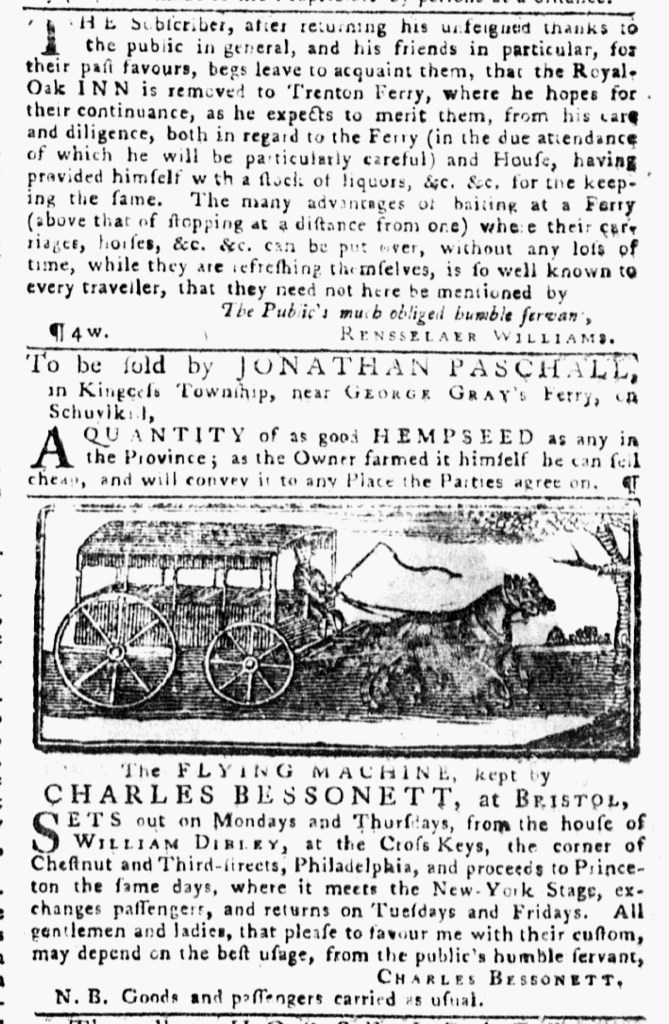
“The Royal-Oak INN is removed to Trenton Ferry.”

“The FLYING MACHINE … SETS out on Mondays and Thursdays.”

Several kinds of documents testify to the transportation infrastructure in the colonies during the era of the American Revolution.  Almanacs often included information about roads and ferries that connected cities and towns.  Newspaper advertisements gave details about the stagecoaches that transported passengers and packages from town to town as well as the inns and taverns that provided services along the way.

Such was the case in the April 7, 1773, edition of the Pennsylvania Gazette.  In one advertisement, Rensselaer Williams promoted the “Royal-Oak INN” near the Trenton Ferry that connected the New Jersey and Pennsylvania sides of the Delaware River.  Williams previously operated the inn at another location, but recently “removed” to a new location for the convenience of his guests.  He hoped that “the public in general, and his friends in particular” would express their appreciation for this new arrangement by continuing their patronage.  He pledged his “care and diligence” in operating both the inn (“with a stock of liquors”) and the ferry.  Williams asked prospective customers to consider the “many advantages of baiting at a Ferry.”  Modern readers may not be familiar with the term that Williams used, but eighteenth-century readers would have known that “to bait” referred to travelers, as the Oxford English Dictionary indicates, “to stop at an inn, originally to feed the horses, but later also to rest and refresh themselves; hence, to make a brief stay or sojourn.”  By “baiting at a Ferry,” Williams declared, travelers saved time compared to making additional stops to refresh themselves and take care of horses and carriages elsewhere.

In another advertisement, Charles Bessonett similarly emphasized efficiency in marketing the stage service he operated for passengers and goods.  He named his stage the “FLYING MACHINE” to suggest how quickly it covered the distance between Philadelphia and Princeton.  Bessonnett also provided a schedule to demonstrate the speed of the journey to prospective customers.  The stage departed from Philadelphia on Mondays and Thursdays and returned from Princeton on Tuesdays and Fridays.  In Princeton, the Flying Machine met a stagecoach from New York and exchanged passengers.  Bessonnett collaborated with another operator in connecting the two cities.

Colonial printers did not usually organize or classify newspaper advertisements.  That an advertisement for the Royal Oak Inn and Trenton appeared in close proximity to an advertisement for the Flying Machine, separated only by a notice offering hempseed for sale, happened more by coincidence than by design.  Still, the two advertisements gave readers of the Pennsylvania Gazette information about some of the options available to them if they wished to travel to New Jersey or New York or even continue on to New England.

Slavery Advertisements Published April 7, 1773

The Slavery Adverts 250 Project chronicles the role of newspaper advertising in perpetuating slavery in the era of the American Revolution. The project seeks to reveal the ubiquity of slavery in eighteenth-century life from New England to Georgia by republishing advertisements about enslaved people – for sale as individuals or in groups, wanted to purchase or for hire for short periods, runaways who liberated themselves, and those who were subsequently captured and confined in jails and workhouses – in daily digests on this site as well as in real time via the @SlaveAdverts250 Twitter feed, utilizing twenty-first-century media to stand in for the print media of the eighteenth century.

The project aims to provide modern audiences with a sense of just how often colonizers encountered these advertisements in their daily lives. Enslaved men, women, and children appeared in print somewhere in the colonies almost every single day. Those advertisements served as a constant backdrop for social, cultural, economic, and political life in colonial and revolutionary America. Colonizers who did not purport to own enslaved people were still confronted with slavery as well as invited to maintain the system by purchasing enslaved men, women, and children or assisting in the capture of so-called “runaways” who sought to free themselves from bondage. The frequency of these newspaper advertisements suggests just how embedded slavery was in colonial and revolutionary American culture in everyday interactions beyond the printed page.

These advertisements also testify to the experiences of enslaved men, women, and children, though readers must consider that those experiences have been remediated through descriptions offered by enslavers rather than enslaved people themselves. Often unnamed in the advertisements, enslaved men, women, and children were not invisible or unimportant in early America.

These advertisements appeared in colonial American newspapers 250 years ago today.

Pennsylvania Gazette (April 7, 1773).

**********

Pennsylvania Gazette (April 7, 1773).

**********

Pennsylvania Gazette (April 7, 1773).

**********

Supplement to the Pennsylvania Gazette (April 7, 1773).

**********

Supplement to the Pennsylvania Gazette (April 7, 1773).

**********

Supplement to the Pennsylvania Gazette (April 7, 1773).

April 6

What was advertised in a colonial American newspaper 250 years ago today?

Essex Gazette (April 6, 1773).

An ORATION … to COMMEMORATE THE BLODDY TRAGEDY of the FIFTH of MARCH, 1770.”

On the occasion of the third anniversary of the Boston Massacre, Dr. Benjamin Church delivered an address “upon the dangerous Tendency of Standing Armies, and in Commemoration of the horrid Massacre perpetrated by a Party of the 29th Regiment on the Fifth of March 1770.”  According to coverage in the Boston Evening-Post and the Boston-Gazette on March 8 and reprinted in the Essex Gazette the next day, Church “had the universal Applause of his Audience; and his Fellow Citizens voted him their Thanks, and unanimously requested a Copy of his Oration for the Press.”  John Greenleaf quickly printed Church’s Oration, followed by Benjamin Edes and John Gill, printers of the Boston-Gazette, promoting a “THIRD EDITION, corrected by the AUTHOR.”  Commodification of the Boston Massacre occurred simultaneously with commemoration of it, as had been the case with the first and second anniversaries.

Samuel Hall and Ebenezer Hall, printers of the Essex Gazette in Salem, participated in both the commemoration and the commodification of the Boston Massacre.  In addition to reprinting coverage of the events that marked the anniversary in Boston, they ran an editorial from Marblehead in the March 23 edition.  “THE respectable metropolis of this province,” the anonymous author began, “has certainly acted worthy of itself in establishing, as a monument against ‘the foul oppression of quartering troops in populous cities, in times of peace,’ the MASSACRE ANNIVERSARY.  It must ever do it honour, and serve to convince relentless oppressors, that such measures will produce disgrace to themselves, as well as distress to an injured people.”  The author concluded with a call for colonizers beyond Boston to commemorate the Boston Massacre and remember its significance.  “And while the city solemnizes the fifth of Marchwith its yearly oration,” the author asserted, “may every town in the province observe it in some suitable way; and by keeping up a memento of measures the most cruel and oppressive, be ever guarding its inhabitants against the intriguing designs of Pensioners, Despots, and Tyrants.”

Elsewhere on the same page, the Halls presented an opportunity for consumers to do their part in guarding against “cruel and oppressive” measures by doing their part to commemorate the Boston Massacre through purchasing Church’s Oration.  They apparently sold the correct edition printed by Edes and Gill, declaring that “To-Morrow Morning will be published, and sold by the Printers hereof, An ORATION … to COMMEMORATE THE BLODDY TRAGEDY of the FIFTH of MARCH, 1770.  By DR. BENJAMIN CHURCH.”  The anonymous author from Marblehead gave an endorsement for Church’s Oration as well as the addresses delivered in 1771 and 1772 in the editorial.  “The Gentlemen who exhibited on the two first of these anniversaries,” the author noted, “gave great satisfaction to their hearers, as was evident from the applause they received; and the last performance [by Church] expresses so much true sense, and this conceived in such a delicate stile, that no one can read it without respect for the celebrated author.”  The editorialist from Marblehead likely had a copy of Church’s Oration printed by Greenleaf, allowing for extensive quotations and reflections on how they accurately described the crisis the colonies faced.

That editorial bolstered the advertisement for Church’s Oration that the Halls inserted in that issue and subsequent advertisements that appeared in the next three issues of the Essex Gazette.  More than a month after the anniversary, the Halls continued to hawk the pamphlet, extending the commemoration and helping to keep the dangers of quartering soldiers in Boston visible to their readers who resided outside that city.

Slavery Advertisements Published April 6, 1773

The Slavery Adverts 250 Project chronicles the role of newspaper advertising in perpetuating slavery in the era of the American Revolution. The project seeks to reveal the ubiquity of slavery in eighteenth-century life from New England to Georgia by republishing advertisements about enslaved people – for sale as individuals or in groups, wanted to purchase or for hire for short periods, runaways who liberated themselves, and those who were subsequently captured and confined in jails and workhouses – in daily digests on this site as well as in real time via the @SlaveAdverts250 Twitter feed, utilizing twenty-first-century media to stand in for the print media of the eighteenth century.

The project aims to provide modern audiences with a sense of just how often colonizers encountered these advertisements in their daily lives. Enslaved men, women, and children appeared in print somewhere in the colonies almost every single day. Those advertisements served as a constant backdrop for social, cultural, economic, and political life in colonial and revolutionary America. Colonizers who did not purport to own enslaved people were still confronted with slavery as well as invited to maintain the system by purchasing enslaved men, women, and children or assisting in the capture of so-called “runaways” who sought to free themselves from bondage. The frequency of these newspaper advertisements suggests just how embedded slavery was in colonial and revolutionary American culture in everyday interactions beyond the printed page.

These advertisements also testify to the experiences of enslaved men, women, and children, though readers must consider that those experiences have been remediated through descriptions offered by enslavers rather than enslaved people themselves. Often unnamed in the advertisements, enslaved men, women, and children were not invisible or unimportant in early America.

These advertisements appeared in colonial American newspapers 250 years ago today.

South-Carolina Gazette and Country Journal (April 6, 1773).

**********

South-Carolina Gazette and Country Journal (April 6, 1773).

**********

South-Carolina Gazette and Country Journal (April 6, 1773).

**********

South-Carolina Gazette and Country Journal (April 6, 1773).

**********

South-Carolina Gazette and Country Journal (April 6, 1773).

**********

South-Carolina Gazette and Country Journal (April 6, 1773).

**********

South-Carolina Gazette and Country Journal (April 6, 1773).

April 5

What was advertised in a colonial American newspaper 250 years ago today?

Boston Evening-Post (April 5, 1773).

“No Good will be received by him of any Servants or Minors.”

Martin Bicker launched a new enterprise in Boston in the early 1770s.  He offered his services as a broker who “receive[s] in all sorts of English and Scotch Goods, Houshold Furniture,” and other items and “does engage to raise the Cash for such Goods delivered [to] him for Sale.”  In so doing, he put himself in competition most directly with auctioneers in the city, though he also gave consumers another alternative to buying from shopkeepers.  Retailers also had the option to purchase wares from Bicker rather than from merchants.  Still, Bicker positioned him services primarily as an alternative to those provided by auctioneers in the city.  In an advertisement in the April 5, 1773, edition of the Boston Evening-Post, he declared that he paid cash for goods that clients entrusted to him “with as quick Dispatch and to good Advantage as can be done at any Auction whatever.”  In addition, he concluded with a nota bene directed at buyers, declaring that he “has for Sale a Variety of English and other Goods, which may be had as cheap as at any VENDUE” or auction.  Bicker noted that he ran his brokerage “At the RED FLAG,” a symbol usually associated with auctions but appropriated here for his own purposes.

Given that the broker offered secondhand goods for sale, he aimed to reassure the public that he did not peddle stolen items.  Bicker stopped short of allowing others to examine his ledgers, but he did promise that “no Goods will be received by him of any Servants or Minors.”  That meant that he did not accept items delivered by all sorts of free and unfree laborers who fell within the category of servants, including indentured servants, apprentices, and enslaved men and women.  Bicker realized that these subordinates sometimes stole goods from their employers, masters, or enslavers and then sold or traded them.  He also refused items from children and youth who similarly lacked authority when it came to disposing of goods.  In his efforts to make his brokerage a success, Bicker pursued two strategies in his advertisement.  He presented his services as equal to those in the auction houses already familiar to residents of Boston while simultaneously encouraging confidence in his integrity as an honest dealer who did not accept any and all merchandise sent his way.  Instead, he exercised appropriate discretion that testified to his overall trustworthiness.

Slavery Advertisements Published April 5, 1773

The Slavery Adverts 250 Project chronicles the role of newspaper advertising in perpetuating slavery in the era of the American Revolution. The project seeks to reveal the ubiquity of slavery in eighteenth-century life from New England to Georgia by republishing advertisements about enslaved people – for sale as individuals or in groups, wanted to purchase or for hire for short periods, runaways who liberated themselves, and those who were subsequently captured and confined in jails and workhouses – in daily digests on this site as well as in real time via the @SlaveAdverts250 Twitter feed, utilizing twenty-first-century media to stand in for the print media of the eighteenth century.

The project aims to provide modern audiences with a sense of just how often colonizers encountered these advertisements in their daily lives. Enslaved men, women, and children appeared in print somewhere in the colonies almost every single day. Those advertisements served as a constant backdrop for social, cultural, economic, and political life in colonial and revolutionary America. Colonizers who did not purport to own enslaved people were still confronted with slavery as well as invited to maintain the system by purchasing enslaved men, women, and children or assisting in the capture of so-called “runaways” who sought to free themselves from bondage. The frequency of these newspaper advertisements suggests just how embedded slavery was in colonial and revolutionary American culture in everyday interactions beyond the printed page.

These advertisements also testify to the experiences of enslaved men, women, and children, though readers must consider that those experiences have been remediated through descriptions offered by enslavers rather than enslaved people themselves. Often unnamed in the advertisements, enslaved men, women, and children were not invisible or unimportant in early America.

These advertisements appeared in colonial American newspapers 250 years ago today.

Boston Evening-Post (April 5, 1773).

**********

Boston Evening-Post (April 5, 1773).

**********

Boston-Gazette (April 5, 1773).

**********

Newport Mercury (April 5, 1773).

**********

Newport Mercury (April 5, 1773).

**********

Pennsylvania Chronicle (April 5, 1773).

**********

Pennsylvania Packet (April 5, 1773).

**********

South-Carolina Gazette (April 5, 1773).

**********

South-Carolina Gazette (April 5, 1773).

**********

South-Carolina Gazette (April 5, 1773).

**********

South-Carolina Gazette (April 5, 1773).

**********

South-Carolina Gazette (April 5, 1773).

**********

South-Carolina Gazette (April 5, 1773).

**********

South-Carolina Gazette (April 5, 1773).

**********

South-Carolina Gazette (April 5, 1773).

**********

South-Carolina Gazette (April 5, 1773).

**********

Supplement to the South-Carolina Gazette (April 5, 1773).

**********

Supplement to the South-Carolina Gazette (April 5, 1773).

**********

Supplement to the South-Carolina Gazette (April 5, 1773).

**********

Supplement to the South-Carolina Gazette (April 5, 1773).

**********

Supplement to the South-Carolina Gazette (April 5, 1773).

**********

Supplement to the South-Carolina Gazette (April 5, 1773).

**********

Supplement to the South-Carolina Gazette (April 5, 1773).

**********

Supplement to the South-Carolina Gazette (April 5, 1773).

**********

Supplement to the South-Carolina Gazette (April 5, 1773).

**********

Supplement to the South-Carolina Gazette (April 5, 1773).

**********

Supplement to the South-Carolina Gazette (April 5, 1773).

April 4

What was advertised in a colonial American newspaper 250 years ago this week?

New-York Journal (April 1, 1773).

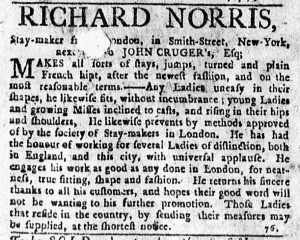
“Any Ladies uneasy in their shapes, he likewise fits, without incumbrance.”

Richard Norris billed himself as a “Stay-maker from London” even though he had resided and worked in New York for several years by the time he published his advertisement in the April 1, 1773, edition of the New-York Journal.  He considered his connection to the largest and most cosmopolitan city in the empire a selling point.  Norris informed readers that he previously served the best sorts of clients on both sides of the Atlantic, declaring that he “has had the honour of working for several Ladies of distinction, both in England, and this city.”  The quality of his stays (or corsets) and his skill in producing them yielded “universal applause” from his clients.

Although Norris had been in New York for some time, he also suggested that he maintained his connection to London.  For instance, he made stays “after the newest fashion” in that city.  In another advertisement, he described how he “acquires the first fashions of the court of London by a correspondent he has settled there.”  Furthermore, he adhered to “methods approved of by the society of Stay-makers in London” in designing and making his stays, especially those for “young Ladies and growing Misses inclined to casts, and rising in their hips and shoulders.”

Norris frequently coupled appeals to the latest fashions from London with attempts to make women feel anxious about their bodies.  “Any Ladies uneasy in their shapes, he likewise fits, without incumbrance,” the staymaker asserted in 1768 and reiterated in 1770 and 1773.  In return for helping them address purported physical shortcomings that he helped them to overcome (or at least disguise) with his stays, Norris asked his clients to recommend him to others.  He extended “his sincere thanks to all his customers, and hopes their good word will not be wanting to his further promotion.  Not unlike modern marketing for clothing and beauty products, Norris encouraged “young Ladies and growing Misses” to feel uncomfortable with their bodies, purchase his product to ease their anxieties, and reward him for his part in addressing a supposed shortcoming that he highlighted and did not allow them to overlook.

April 3

What was advertised in a colonial American newspaper 250 years ago today?

Providence Gazette (April 3, 1773).

“Not having lost more than six or eight Patients, out of Hundreds whom he has attended in a great Variety of Disease.”

In the spring of 1773, Ebenezer Richmond took to the pages of the Providence Gazette to inform readers that he “proposes to attend to the Practice of Physic and Surgery in this Town.”  When they advertised in colonial newspapers, physicians often included an overview of their training and credentials as a means of demonstrating their competence and expertise to prospective patients.  Richmond did so, yet did not provide many details.  “Respecting his Qualifications,” Richmond declared, “he will only observe, that the Cultivation of medical Knowledge, and of the Languages and Sciences, preparatory to, or connected therewith, has been the Business of his Life.”

Rather than offer further clarification, Richmond emphasized his experience as a physician.  He asserted that “for several Years past [he] practised with uncommon Success, not having lost more than six or eight Patients, out of Hundred whom he attended in a great Variety of Disease.”  With that record, prospective patients could trust that they were in good hands when they sought treatment from Richmond.  Once again, however, he glossed over details that may have been important to prospective patients, such as where he practiced during those “several Years” and whether anyone in Providence, especially colleagues or former patients, could vouch for him.  When Thomas Truman advertised that he planned to “continue the Practice of Physic and Surgery” in Providence the previous December, he positioned himself as the successor to Dr. Samuel Carew, recently deceased, and reminded residents of the city, especially Carew’s former patients, that he served an apprenticeship with the doctor.  Richmond, on the other hand, did not invoke any such connections.

Richmond apparently hoped that his description of his medical knowledge and record of success during several years of experience would be enough to convince prospective patients to seek his services.  For those who needed more, he also stated that he charged “very moderate Fees.”  In addition, he pledged to given them the care and attention they expected, promising that his patients “may depend upon his attending his Business with utmost Assiduity.”  Some readers may have assumed that quality contributed to the record of “uncommon Success” that Richmond reported in his advertisement.

April 2

What was advertised in a colonial American newspaper 250 years ago today?

Connecticut Journal (April 2, 1773).

They shall be under the necessity of reducing it to its original size and price, unless the Subscribers for it, are more punctual in their payments.”

On April 17, 1772, Thomas Green and Samuel Green began printing the Connecticut Journal on larger sheets.  That allowed them to deliver more content to their subscribers, meeting the demand of “many of our Customers, and others, … desirous of having [the newspaper] enlarged.”  When they did so, they also noted that the previous edition “completed Four Years and an Half since the first Publication” of the newspaper, yet many of the subscribers “paid not a single Farthing” during that time and others were “indebted for Two or Three Year’s Papers.”  The printers called on anyone who owed for newspapers, advertisements, printed blanks, or anything else “to make speedy Payment.”

Almost a year later, the Greens made similar pleas.  On April 2, 1773, they declared, “The Printers are sorry, they can with truth inform the Public, That they have not for this year past, received from all the Customers for this Journal, so much money as they have expended for the blank paper, on which it has been printed.”  Colonial printers often lamented that subscribers and others did not pay their bills, but few did so in such stark terms.  The Greens noted that the “next week’s paper … completes one year since its enlargement,” a benefit to subscribers that accrued even greater expenses for the printers.  That benefit would not continue, the Greens warned, if subscribers did not settle accounts.  They proclaimed that “they shall be under the necessity of reducing it to its original size and price, unless the Subscribers for it, are more punctual in their payments.”  Other printers often threatened to take legal action against recalcitrant subscribers to force them to pay what they owed.  The Greens, on the other hand, threatened other consequences that would have an impact on all readers, not just those taken to court.

Whether it involved suing subscribers or publishing the names of those who refused to pay, printers usually did not follow through on their threats.  Whether or not the Greens’ notice prompted some subscribers to submit payment, the printers did not opt to revert to the original size of the newspaper.  Through experience, many readers likely believed that they could ignore such notices from the printers without suffering any consequences.  Printers wished to maintain robust circulations so they could sell advertising, a factor that played a role in their decisions about how to handle difficult subscribers.

Slavery Advertisements Published April 2, 1773

The Slavery Adverts 250 Project chronicles the role of newspaper advertising in perpetuating slavery in the era of the American Revolution. The project seeks to reveal the ubiquity of slavery in eighteenth-century life from New England to Georgia by republishing advertisements about enslaved people – for sale as individuals or in groups, wanted to purchase or for hire for short periods, runaways who liberated themselves, and those who were subsequently captured and confined in jails and workhouses – in daily digests on this site as well as in real time via the @SlaveAdverts250 Twitter feed, utilizing twenty-first-century media to stand in for the print media of the eighteenth century.

The project aims to provide modern audiences with a sense of just how often colonizers encountered these advertisements in their daily lives. Enslaved men, women, and children appeared in print somewhere in the colonies almost every single day. Those advertisements served as a constant backdrop for social, cultural, economic, and political life in colonial and revolutionary America. Colonizers who did not purport to own enslaved people were still confronted with slavery as well as invited to maintain the system by purchasing enslaved men, women, and children or assisting in the capture of so-called “runaways” who sought to free themselves from bondage. The frequency of these newspaper advertisements suggests just how embedded slavery was in colonial and revolutionary American culture in everyday interactions beyond the printed page.

These advertisements also testify to the experiences of enslaved men, women, and children, though readers must consider that those experiences have been remediated through descriptions offered by enslavers rather than enslaved people themselves. Often unnamed in the advertisements, enslaved men, women, and children were not invisible or unimportant in early America.

These advertisements appeared in colonial American newspapers 250 years ago today.

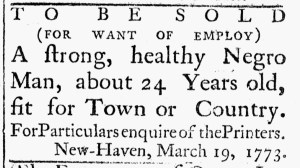
Connecticut Journal (April 2, 1773).