What was advertised in a colonial American newspaper 250 years ago today?
Essex Gazette (April 13, 1773).
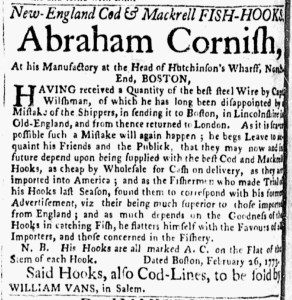
“Said Hooks, also Cod-Lines, to be sold by WILLIAM VANS, in Salem.”
In the early 1770s, Abraham Cornish made “New-England Cod & Mackrell FISH-HOOKS … At his Manufactory” in Boston’s North End. To promote his product, he placed advertisements in the Massachusetts Spy, printed in Boston, and in the Essex Gazette, printed in Salem in March and April 1773, hoping to capture the attention of fishermen in both maritime communities. He presented his hooks as an alternative to those imported to the colonies, describing them as “the best Cod and Mackrell Hooks,” yet he did not ask prospective buyers to take his word for it. Instead, he declared that “Fishermen who made Trial of his Hooks last Season, found them to correspond with his former Advertisement” in which he presented his hooks as “much superior to those imported from England.”
Cornish did not address solely the fisherman who would use his hooks. He also called on those who supplied them to stock his hooks made in Boston in addition to those they acquired from England. He set prices “as cheap by Wholesale for Cash on delivery” as imported hooks, hoping that the combination of price and quality would prompt retailers to add them to their inventory. Cornish believed that various members of the community should demonstrate their interest in supporting the production of fish hooks in Boston, calling on “all Importers, and those concerned in the Fishery” to purchase his product. To cultivate brand recognition, he noted that his hooks “are all marked A.C. on the Flat of the Stem of each Hook.” In an earlier advertisement, he also noted that he packaged them in “paper … marked ABRHAM CORNISH” and called attention to his initials on each hook in order to “prevent deception” or counterfeit products.
To aid in distributing his wares, Cornish recruited a local agent in Salem. His advertisement in the Essex Gazette stated that William Vans, a merchant who frequently placed his own advertisements, sold “Said Hooks.” Vans, however, did not generate the copy for the notice about Cornish’s hooks. The text replicated what appeared in the advertisement in the Massachusetts Spy, with the addition of a nota bene about the marks on each hook and an additional sentence identifying Vans as the local distributor. The version in the Essex Gazette lacked the characteristic woodcut depicting a fish that adorned Cornish’s advertisements in the Massachusetts Spy. Like most other advertisers who incorporated visuals images, Cornish apparently invested in only one woodcut. He depended on the strength of the advertising copy when hawking his hooks in a second market.
The Slavery Adverts 250 Project chronicles the role of newspaper advertising in perpetuating slavery in the era of the American Revolution. The project seeks to reveal the ubiquity of slavery in eighteenth-century life from New England to Georgia by republishing advertisements about enslaved people – for sale as individuals or in groups, wanted to purchase or for hire for short periods, runaways who liberated themselves, and those who were subsequently captured and confined in jails and workhouses – in daily digests on this site as well as in real time via the @SlaveAdverts250 Twitter feed, utilizing twenty-first-century media to stand in for the print media of the eighteenth century.
The project aims to provide modern audiences with a sense of just how often colonizers encountered these advertisements in their daily lives. Enslaved men, women, and children appeared in print somewhere in the colonies almost every single day. Those advertisements served as a constant backdrop for social, cultural, economic, and political life in colonial and revolutionary America. Colonizers who did not purport to own enslaved people were still confronted with slavery as well as invited to maintain the system by purchasing enslaved men, women, and children or assisting in the capture of so-called “runaways” who sought to free themselves from bondage. The frequency of these newspaper advertisements suggests just how embedded slavery was in colonial and revolutionary American culture in everyday interactions beyond the printed page.
These advertisements also testify to the experiences of enslaved men, women, and children, though readers must consider that those experiences have been remediated through descriptions offered by enslavers rather than enslaved people themselves. Often unnamed in the advertisements, enslaved men, women, and children were not invisible or unimportant in early America.
These advertisements appeared in colonial American newspapers 250 years ago today.
Essex Gazette (April 13, 1773).
**********
South-Carolina Gazette and Country Journal (April 13, 1773).
**********
South-Carolina Gazette and Country Journal (April 13, 1773).
**********
South-Carolina Gazette and Country Journal (April 13, 1773).
**********
South-Carolina Gazette and Country Journal (April 13, 1773).
**********
South-Carolina Gazette and Country Journal (April 13, 1773).
**********
South-Carolina Gazette and Country Journal (April 13, 1773).
**********
South-Carolina Gazette and Country Journal (April 13, 1773).
**********
South-Carolina Gazette and Country Journal (April 13, 1773).
What was advertised in a colonial American newspaper 250 years ago today?
Supplement to the New-York Gazette and Weekly Mercury (April 12, 1773).
“He intreats those who are so obliging as to intend advertising in the first Number of the New-York Gazetteer, to favour him with their Advertisements as soon as convenient.”
As he prepared to launch his New-York Gazetteer, James Rivington placed a notice in the April 12, 1773, edition of the New-York Gazette and Weekly Mercury to announce that he published and distributed “AN ADDRESS TO THE SUBSCRIBERS” for his newspaper. He worried, however, that not every subscriber actually received their copy. He arranged for each of them to “have the Address left at their Houses,” but discovered that “thro’ Inadvertency, [some] may have been hitherto neglected.” To remedy the situation, he offered that they “may be furnished sans Expence with as many Copies of it as may be required for themselves or for their Friends” upon sending a request to the printing office.
Why might subscribers have been interested in obtaining multiple free copies of this address and sharing them with others? It was not an extended subscription proposal. Instead, Rivington explained that it “contains the Speeches in Parliament, subsequent to that from the Throne at the opening of the present Session,” made by nearly twenty politicians and other dignitaries, including “the truly eloquent Mr. Edmund Burke, Agent for our Colony.” Those speeches elaborated on “the most important Subjects, in which the Inhabitants of this Continent are very materially interested.” Rivington devised a premium or gift that he gave to subscribers before the first issue of his newspaper went to press. He likely hoped that any of the additional copies that subscribers ordered to share with their friends might also induce others to subscribe as well.
The printer had another purpose, however, in placing this notice in the New-York Gazette and Weekly Mercury. Between his offer to distribute additional copies of the “ADDRESS TO THE SUBSCRIBERS” and his explanation of the contents, he made a pitch to prospective advertisers. Rivington “intreats those who are so obliging as to intend advertising in the first Number of the New-York Gazetteer, to favour him with their Advertisements as soon as convenient.” He explained that advertisements “will be inserted on the usual terms,” though he did not specify the rates, and promised that the newspaper “will have a very extensive Circulation.” Colonizers familiar with the full name of the newspaper, Rivington’s New-York Gazetteer; or the Connecticut, New-Jersey, Hudson’s-River, and Quebec Weekly Advertiser, already anticipated that would be the case. Furthermore, Rivington previously disseminated subscription proposals in New York, Pennsylvania, and New England. Merchants, shopkeepers, artisans, and others could depend on prospective customers near and far glimpsing their advertisements as they perused Rivington’s newspaper.
This notice appeared in the New-York Gazette and Weekly Mercury ten days before Rivington published the first issue of his new newspaper on April 22, 1773. He presented a gift to his subscribers and offered additional free copies of speeches delivered in Parliament in hopes of inciting more interest among prospective subscribers. At the same time, he positioned a call for advertisers in the middle of his description of the premium his subscribers and their friends received. When the first issue went to press, advertising filled five of the twelve columns. Through his various efforts, Rivington convinced advertisers to take a chance on placing notices in his new publication.
The Slavery Adverts 250 Project chronicles the role of newspaper advertising in perpetuating slavery in the era of the American Revolution. The project seeks to reveal the ubiquity of slavery in eighteenth-century life from New England to Georgia by republishing advertisements about enslaved people – for sale as individuals or in groups, wanted to purchase or for hire for short periods, runaways who liberated themselves, and those who were subsequently captured and confined in jails and workhouses – in daily digests on this site as well as in real time via the @SlaveAdverts250 Twitter feed, utilizing twenty-first-century media to stand in for the print media of the eighteenth century.
The project aims to provide modern audiences with a sense of just how often colonizers encountered these advertisements in their daily lives. Enslaved men, women, and children appeared in print somewhere in the colonies almost every single day. Those advertisements served as a constant backdrop for social, cultural, economic, and political life in colonial and revolutionary America. Colonizers who did not purport to own enslaved people were still confronted with slavery as well as invited to maintain the system by purchasing enslaved men, women, and children or assisting in the capture of so-called “runaways” who sought to free themselves from bondage. The frequency of these newspaper advertisements suggests just how embedded slavery was in colonial and revolutionary American culture in everyday interactions beyond the printed page.
These advertisements also testify to the experiences of enslaved men, women, and children, though readers must consider that those experiences have been remediated through descriptions offered by enslavers rather than enslaved people themselves. Often unnamed in the advertisements, enslaved men, women, and children were not invisible or unimportant in early America.
These advertisements appeared in colonial American newspapers 250 years ago today.
Supplement to the Boston-Gazette (April 12, 1773).
**********
Newport Mercury (April 12, 1773).
**********
Newport Mercury (April 12, 1773).
**********
New-York Gazette and Weekly Mercury (April 12, 1773).
**********
New-York Gazette and Weekly Mercury (April 12, 1773).
**********
New-York Gazette and Weekly Mercury (April 12, 1773).
**********
Supplement to the New-York Gazette and Weekly Mercury (April 12, 1773).
**********
Pennsylvania Chronicle (April 12, 1773).
**********
South-Carolina Gazette (April 12, 1773).
**********
South-Carolina Gazette (April 12, 1773).
**********
South-Carolina Gazette (April 12, 1773).
**********
South-Carolina Gazette (April 12, 1773).
**********
South-Carolina Gazette (April 12, 1773).
**********
South-Carolina Gazette (April 12, 1773).
**********
South-Carolina Gazette (April 12, 1773).
**********
South-Carolina Gazette (April 12, 1773).
**********
South-Carolina Gazette (April 12, 1773).
**********
South-Carolina Gazette (April 12, 1773).
**********
South-Carolina Gazette (April 12, 1773).
**********
South-Carolina Gazette (April 12, 1773).
**********
South-Carolina Gazette (April 12, 1773).
**********
South-Carolina Gazette (April 12, 1773).
**********
Supplement to the South-Carolina Gazette (April 12, 1773).
**********
Supplement to the South-Carolina Gazette (April 12, 1773).
**********
Supplement to the South-Carolina Gazette (April 12, 1773).
**********
Supplement to the South-Carolina Gazette (April 12, 1773).
**********
Supplement to the South-Carolina Gazette (April 12, 1773).
**********
Supplement to the South-Carolina Gazette (April 12, 1773).
**********
Supplement to the South-Carolina Gazette (April 12, 1773).
**********
Supplement to the South-Carolina Gazette (April 12, 1773).
**********
Supplement to the South-Carolina Gazette (April 12, 1773).
**********
Supplement to the South-Carolina Gazette (April 12, 1773).
**********
Supplement to the South-Carolina Gazette (April 12, 1773).
**********
Supplement to the South-Carolina Gazette (April 12, 1773).
**********
Supplement to the South-Carolina Gazette (April 12, 1773).
What was advertised in a colonial American newspaper 250 years ago this week?
Massachusetts Gazette and Boston Weekly News-Letter (April 8, 1773).
“He will open a Place for Sale of Goods to be known by the Name of The Silent Auction-Room.”
When he established the “Silent Auction-Room” in Boston in the spring of 1773, A. Bowman did not even pretend politeness toward his competitors in his advertisements. In a notice that he placed in the April 8 edition of the Massachusetts Gazette and Boston Weekly News-Letter, he mocked the advertisements placed by three of his competitors. All three advertisements appeared in that issue, making for easy reference for readers, though Bowman previously encountered them in other newspapers.
The auctioneer stated that he would “receive and sell all Sorts of Merchandise, House-Furniture,” and other goods. However, “‘Houses, Lands and Shipping,’ he does not pretend to sell,” he snidely comments, “because he is apprehensive it would be very difficult to get them up Stairs.” Bowman quoted directly from William Greenleaf’s advertisement. His rival stated, “In the Sale of Houses, Lands, Shipping, Merchandize, Household Furniture, &c. &c. my Employers may depend on my exerting myself for their Interest.”
The cantankerous auctioneer then declared that “Goods from ‘Servants and Minors’ will be received if they are properly authorized to deliver them.” In this instance, he taunted Martin Bicker, a broker who handled “all sorts of English and Scotch Goods [and] Household Furniture … to as good Advantage as can be done at any Auction whatever.” Bicker proclaimed that “the Public may rest assured, that no Goods will be received by him of any Servants or Minors.” Bowman established a different policy for his “Silent Auction-Room.” He took another jab at Bicker when he asserted that “His ‘Books’ shall be kept in good Order, so that it gives him no Concern whether they are ‘liable to Inspection,’ or not.” Before noting that he did not accept goods from servants or minors, presumably to avoid peddling stolen items, Bicker confided that “his Books are not liable to Inspection.” Bowman treated such lack of transparency with skepticism.
The final portion of Bowman’s advertisement, a short poem, most directly addressed the source of his anger and frustration. Joseph Russell, the proprietor of an auction room on Queen Street, previously published an advertisement that concluded with a poem that promoted his own business and mocked the demise of Bowman’s auction house. In addition to the poem, Russell announced that he “received a License from the Gentlemen Select-Men, to be an Auctioneer for the Town of Boston, conformable to the late Act for that Purpose.” Similarly, Greenleaf trumpeted that the “Gentlemen Select-Men … approbated me to officiate as one of the Vendue-Masters [or auctioneers] for this Town.” Bicker carefully described himself as a broker and made clear to prospective clients that his services rivaled those offered by auctioneers.
Boston Evening-Post (March 29, 1773).
Bowman apparently did not receive a license. In advertisements in the Boston Evening-Post and the Boston-Gazette on March 22 and in the Massachusetts Gazette and Boston Weekly News-Letter on March 25, he referred to his business as “BOWMAN’s Dying Auction-Room.” His advertisement in the March 29 edition of the Boston Evening-Post featured a thick black border, a symbol of death and mourning in early American print culture. Bowman lamented that his auction room “is soon to be sacrificed for the Good of the Province” and that he will be legally dead, (the taking away a Man’s Bread or his Life being synonymous) before another News-Paper comes out.” That advertisement appeared in the Boston-Gazette on the same day, though without the mourning border that clearly indicated how Bowman felt about the situation. That explains why Bowman described himself as the “late Auctioneer” at the “Dead Auction-Room” in his advertisement in the Massachusetts Gazette and Boston Weekly News-Letter on April 8. That he proposed opening a “Silent Auction-Room” suggests he identified some sort of loophole to defy the licensing act, perhaps as a broker rather than an auctioneer. In subsequent advertisements, he noted that he sold goods on commission.
Russell observed Bowman’s commentary in his advertisements, prompting him to allude to it in the poem he included in his own notice: “While some this Stage of Action quit, / And Dying advertise; / For Cash the Buyers here may meet / With constant fresh Supplies.” Not done with his own editorializing about his competitor, Russell added another stanza: “For Favors past, due Thanks return’d; / New Bargains, cheap and dear, / At the Old Place may still be found / J. RUSSELL, Auctioneer.” Russell pointedly declared that his business continued at a location familiar to residents of Boston.
In response, Bowman published his own poem at the end of his advertisement. “A License granted! pray for what? / To show their Parts in Rhyme; / But hear the Tale the Dead will rise, / And that in proper Time.” Bowman did not think much of Russell’s poetry nor his abilities as an auctioneer. At the same time, he pledged to revive his business, a footnote indicating that the public could anticipate that happening “When the expected Ships discharge their Cargoes.” Bowman critiqued the licensing act in a final stanza: “Fair LIBERTY thou Idol great, / How narrow is thy Sphere! / Ye Men of Sense say where she dwells, / For sure she reigns not here.” As colonizers in Boston debated the extent that Parliament infringed on their liberties, Bowman asserted that the new act, a local ordinance, curtailed liberty in the city.
By and large, auctioneers and other advertisers usually ignored their competitors. The angry and defiant Bowman, however, did not do so. Instead, he mocked several of the auctioneers and brokers who advertised in Boston’s newspapers, parroting their notices when he taunted them. He also continued to protest the new licensing act that caused him to close his auction room. In addition to promoting his next endeavor, the “Silent Auction-Room,” he used advertisements as a means of disseminating his commentary on the state of affairs in Boston.
What was advertised in a colonial American newspaper 250 years ago today?
Providence Gazette (April 10, 1773).
“An Assortment of choice Medicines.”
Nearly four months had passed since Thomas Truman first placed a notice in the Providence Gazette to request that “all Persons who have Accounts unsettled with Doctor SAMUEL CAREW, late of Providence, deceased,” visit Truman at the “House and Shop lately occupied by Doctor CAREW” to make or receive payment. He also informed the public that he “proposes to tarry in Providence, and continue the Practice of Physic and Surgery,” reminding “all those Gentlemen and Ladies who have kindly favoured him in the Way of his Business” that he served an apprenticeship under Carew’s supervision. Truman positioned himself as Carew’s successor, hoping to inherit the physician’s patients.
On April 10, Truman inserted a new notice in which he “once more” directed “those who have hitherto neglected to bring in their Accounts against the Estate of Doctor SAMUEL CAREW” to so do “directly, that they may be settled.” Similarly, he asked that those “indebted to said Estate … make Payment immediately … that the Books may be closed, and the Debts paid off with Honour.” In a nota bene, Truman stated that he no longer occupied Carew’s former house and shop. He had “removed … two Doors further down Street,” where he sold “an Assortment of choice Medicines.” He offered the lowest prices for the quality of the medicines he peddled.
The timing of Truman’s new advertisement may have been a coincidence, but it happened to appear a week after Ebenezer Richmond placed his own notice that he “proposes to attend to the Practice of Physic and Surgery in this Town” and boasted of his extraordinary record of success caring for patients over several years. Truman no doubt wished to close the books on Carew’s estate, but he may have also noticed the presence of a rival in the public prints. Given that advertisements usually ran for three weeks or more, Truman may not have wanted Richmond to enjoy the benefits of being the sole physician to advertise in the city’s only newspaper. That competition may have played as much of a role in convincing Truman to place a new notice as his desire to bring a conclusion to Carew’s estate.
What was advertised in a colonial American newspaper 250 years ago today?
New-Hampshire Gazette (April 9, 1773).
“The Partnership Of JAMES & MATHEW HASLETT is dissolv’d.”
The partnership of James Haslett and Mathew Haslett came to an end with little fanfare in the public prints. The leather dressers inserted a short notice in the April 9, 1773, edition of the New-Hampshire Gazette, just two lines that announced, “The Partnership Of JAMES & MATHEW HASLETT is dissolv’d.” They did not call on customers and other associates to settle accounts, nor did one or the other of them indicate that he intended to continue in the trade and would appreciate the continued patronage of former customers.
The quiet conclusion to this partnership differed from some of the flashy advertisements that the Hasletts previously placed in the New-Hampshire Gazette. When they relocated to Portsmouth from Boston seven years earlier, they informed “Town and Country, That they have set up their Business at their Factory at the Sign of the BUCK and GLOVE … Where they carry on the [leather dressing] Business, in all its Branches, in the neatest and best Manner.” The Hasletts deployed formulaic language, but doing so signaled that they were familiar with the advertising conventions of the era. In the late 1760s and early 1770s, they placed advertisements of various lengths, though their longer advertisements coincided with the years that they were new to Portsmouth and still building their reputations in the region.
During that time, they commissioned woodcuts that depicted the “Sign of the BUCK and GLOVE” (and included breeches for good measure). Those woodcuts all bore the date 1766, the year that the Hasletts established their workshop or “Factory” in Portsmouth. Some, but not all, featured some variation of their names. Although their shop sign no longer exists, the woodcuts in their newspaper advertisements testify to its likely appearance, like so many other woodcuts that depicted signs displayed by artisans and shopkeepers in eighteenth-century America.
For the Hasletts, their final notice in the New-Hampshire Gazette belied the visual feast and extensive copy that they previously presented to prospective customers. On the other hand, they had been in business in Portsmouth long enough that merely glimpsing their names in the newspaper may have conjured images of the “Sign of the BUCK and GLOVE” for many readers.
The Slavery Adverts 250 Project chronicles the role of newspaper advertising in perpetuating slavery in the era of the American Revolution. The project seeks to reveal the ubiquity of slavery in eighteenth-century life from New England to Georgia by republishing advertisements about enslaved people – for sale as individuals or in groups, wanted to purchase or for hire for short periods, runaways who liberated themselves, and those who were subsequently captured and confined in jails and workhouses – in daily digests on this site as well as in real time via the @SlaveAdverts250 Twitter feed, utilizing twenty-first-century media to stand in for the print media of the eighteenth century.
The project aims to provide modern audiences with a sense of just how often colonizers encountered these advertisements in their daily lives. Enslaved men, women, and children appeared in print somewhere in the colonies almost every single day. Those advertisements served as a constant backdrop for social, cultural, economic, and political life in colonial and revolutionary America. Colonizers who did not purport to own enslaved people were still confronted with slavery as well as invited to maintain the system by purchasing enslaved men, women, and children or assisting in the capture of so-called “runaways” who sought to free themselves from bondage. The frequency of these newspaper advertisements suggests just how embedded slavery was in colonial and revolutionary American culture in everyday interactions beyond the printed page.
These advertisements also testify to the experiences of enslaved men, women, and children, though readers must consider that those experiences have been remediated through descriptions offered by enslavers rather than enslaved people themselves. Often unnamed in the advertisements, enslaved men, women, and children were not invisible or unimportant in early America.
These advertisements appeared in colonial American newspapers 250 years ago today.
What was advertised in a colonial American newspaper 250 years ago today?
Massachusetts Gazette and Boston Weekly News-Letter (April 8, 1773).
“The American Alarm or the Bostonian Pleas for the Rights and Liberties of the People.”
The headline proclaimed, “THE ALARM.” As readers of the Massachusetts Gazette and Boston Weekly News-Letterexamined the advertisement more closely, they learned that David Kneeland and Nathaniel Davis published and sold a pamphlet by an author who referred to himself as the “BRITISH BOSTONIAN” and that many residents of Boston knew was John Allen. In December 1772, Allen and the printers published a subscription notice calling on colonizers to reserve copies of “The AMERICAN ALARM, Or, a Confirmation of the Boston Plea. For the Rights and Liberties of the People.”
In the original notice, Allen stated that the pamphlet was “Humbly addressed to the King and Council, and to the Constitutional sons of Liberty in America.” While that dedication appeared on the title page, the author and the printers updated the advertisement to include “His Most Sacred Majesty George the Third, … his Excellency the Governor of the Province of the Massachusetts-Bay, … the Honorable the People’s Council, … the Honorable House of Representatives, and … the worthy Sons of Freedom throughout America.” In both instances, the promoters suggested that a broad audience would benefit from perusing the pamphlet, not just those who already agreed with the British Bostonian’s arguments and conclusions. Still, addressing “the Constitutional sons of Liberty in America” and “the worthy Sons of Freedom throughout America” targeted the audiences that Allen and the printers considered most likely to purchase the pamphlet.
The advertisement instructed subscribers “to call or send for their Books,” suggesting that customers had indeed submitted their names to Kneeland and Adams after seeing the notice in the newspaper four months earlier. In the time that elapsed since then, Allen disseminated another political pamphlet, that one also printed by Kneeland and Adams. Allen’s Oration on the Beauties of Liberty or the Essential Rights of the Americans garnered greater attention in Boston and beyond than the first pamphlet he advertised. As John M. Bumsted and Charles E. Clark note, the Oration “proved to be one of the best-selling pamphlets of the pre-Revolutionary crisis, passing through seven editions in four cities between 1773 and 1775.”[1] By the time The American Alarm went to press, colonizers had access to two editions of the Oration. Even though The American Alarm did not become as popular as the Oration, its publication likely contributed to debates underway in the colonies and, eventually, the decision to declare independence. Allen advanced a novel argument in The American Alarm in 1773. According to Bumsted and Clark, “The important point was not that Allen denied the applicability of English law in America, but that he did so with a simple, direct statement of fact rather than through a long rehearsal of legal arguments. He assumed as given what others in America sought to prove.”[2] The more moderate tone of the Oration, in contrast, may have made it more popular among readers prior to the skirmishes at Lexington and Concord since it aligned more closely with public opinion in the early 1770s.
**********
[1] John M. Bumsted and Charles E. Clark, “New England’s Tom Paine: John Allen and the Spirit of Liberty,” William and Mary Quarterly, 3rd ser., 21, no. 4 (October 1964): 561.
[2] Bumstead and Clark, “New England’s Tom Paine,” 568.
The Slavery Adverts 250 Project chronicles the role of newspaper advertising in perpetuating slavery in the era of the American Revolution. The project seeks to reveal the ubiquity of slavery in eighteenth-century life from New England to Georgia by republishing advertisements about enslaved people – for sale as individuals or in groups, wanted to purchase or for hire for short periods, runaways who liberated themselves, and those who were subsequently captured and confined in jails and workhouses – in daily digests on this site as well as in real time via the @SlaveAdverts250 Twitter feed, utilizing twenty-first-century media to stand in for the print media of the eighteenth century.
The project aims to provide modern audiences with a sense of just how often colonizers encountered these advertisements in their daily lives. Enslaved men, women, and children appeared in print somewhere in the colonies almost every single day. Those advertisements served as a constant backdrop for social, cultural, economic, and political life in colonial and revolutionary America. Colonizers who did not purport to own enslaved people were still confronted with slavery as well as invited to maintain the system by purchasing enslaved men, women, and children or assisting in the capture of so-called “runaways” who sought to free themselves from bondage. The frequency of these newspaper advertisements suggests just how embedded slavery was in colonial and revolutionary American culture in everyday interactions beyond the printed page.
These advertisements also testify to the experiences of enslaved men, women, and children, though readers must consider that those experiences have been remediated through descriptions offered by enslavers rather than enslaved people themselves. Often unnamed in the advertisements, enslaved men, women, and children were not invisible or unimportant in early America.
These advertisements appeared in colonial American newspapers 250 years ago today.
Massachusetts Gazette and Boston Weekly News-Letter (April 8, 1773).
**********
Supplement to the Massachusetts Gazette and Boston Weekly News-Letter (April 8, 1773).
**********
Supplement to the Massachusetts Gazette and Boston Weekly News-Letter (April 8, 1773).