July 19

What was advertised in a colonial American newspaper 250 years ago today?

Massachusetts Gazette and Boston Post-Boy (July 19, 1773).

“THE ROYAL American MAGAZINE, Or UNIVERSAL REPOSITORY.  [To be published monthly.]”

Nearly three weeks after Isaiah Thomas inserted “PROPOSALS For printing by SUBSCRIPTION, A NEW Periodical Production, entitled, THE ROYAL American MAGAZINE, Or UNIVERSAL REPOSITORY,” in his own newspaper, the Massachusetts Spy, those proposals appeared in the July 12, 1773, edition of the Massachusetts Gazette and Boston Post-Boy and continued throughout the rest of the month.  In those iterations, the proposals did not benefit from the same privileged place.  Thomas ran the lengthy advertisement in the first two columns on the first page of the Massachusetts Spy.  Nathaniel Mills and John Hicks, in contrast, used smaller type and condensed the proposals to a single column on the final page of their newspaper.  The proposals ran alongside all sorts of other advertisements.  Still, they appeared in their entirety.

That included an address “To the PUBLIC” in which Thomas encouraged prospective subscribers to contemplate the value, not just the utility, of the magazine.  He contrasted magazines with newspapers, “only noticed for a day; and then thrown neglected,” asserting that magazines contained literature, a category that encompassed all manner of inquiry, that merited preserving and passing down from generation to generation.  Thomas lamented, “Before the art of printing was known, the sons of science suffered greatly; and it is beyond a doubt that for the want of that useful vehicle the PRINTING PRESS, in those days, many very valuable essays of the ancients have been buried in oblivion.”  In his role as printer, Thomas could play a part in preventing that from happening again, but he needed subscribers as partners in that endeavor.  He explained to prospective subscribers that “In this polite age when printing flourishes, the man of genius may hand his performances to the public, who may give them to their children, and so transmit them down to posterity.”  Subscribers thus played as important a role as any “man of genius” who composed essays and the printer who served as a broker in disseminating them.

Thomas also asserted that the colonies had a particular need for a “NEW Periodical Publication” in the form of a magazine so “the productions of men of genius might be more universally known.”  Colonial printers produced other periodicals – weekly newspapers and annual almanacs – but the lack of monthly magazines, according to Thomas, “has long been complained of by men of the greatest ingenuity in the American world.”  The printer imagined that those men “would undoubtedly much oftner favour the public with essays, instructive and entertaining to all classes of men, if there was a suitable periodical publication for their insertion.”  Booksellers imported magazines from London that featured works by European authors, but those magazines rarely included essays composed by colonizers in North America and the West Indies.  For the most part, they did not capture distinctively American perspectives or experiences.

The Royal American Magazine provided a forum for both American and European authors.  “Several gentlemen of know abilities,” Thomas announced, “have kindly promised to favour the public through THIS channel, with essays on various subjects for instruction and amusement.”  He pledged that “Their productions will no doubt fill a considerable part of this work,” but also acknowledged that he would draw content from “British Magazines, [and] Reviews.”  Thomas emphasized that this involved “selecting from the labours of our European brethren,” but he wished to prioritize American content.  To that end, he requested “the assistance of the learned, the witty, the curios and the candid of both sexes throughout this extensive continent, and hopes they will favour him with their correspondence for the public benefit.”  Thomas apparently imagined a place for women as both readers and contributors to “this American performance” or magazine.

The call for subscribers and contributors eventually radiated out from Boston, appearing in newspapers published in other cities.  The Adverts 250 Project will examine other aspects of the lengthy subscription proposals while tracing their dissemination in American newspapers.  Thomas expected the proposals to circulate so widely that “printers and booksellers in AMERICA,” from New England to Georgia, would compile lists of local subscribers on his behalf.

Slavery Advertisements Published July 19, 1773

The Slavery Adverts 250 Project chronicles the role of newspaper advertising in perpetuating slavery in the era of the American Revolution. The project seeks to reveal the ubiquity of slavery in eighteenth-century life from New England to Georgia by republishing advertisements about enslaved people – for sale as individuals or in groups, wanted to purchase or for hire for short periods, runaways who liberated themselves, and those who were subsequently captured and confined in jails and workhouses – in daily digests on this site as well as in real time via the @SlaveAdverts250 Twitter feed, utilizing twenty-first-century media to stand in for the print media of the eighteenth century.

The project aims to provide modern audiences with a sense of just how often colonizers encountered these advertisements in their daily lives. Enslaved men, women, and children appeared in print somewhere in the colonies almost every single day. Those advertisements served as a constant backdrop for social, cultural, economic, and political life in colonial and revolutionary America. Colonizers who did not purport to own enslaved people were still confronted with slavery as well as invited to maintain the system by purchasing enslaved men, women, and children or assisting in the capture of so-called “runaways” who sought to free themselves from bondage. The frequency of these newspaper advertisements suggests just how embedded slavery was in colonial and revolutionary American culture in everyday interactions beyond the printed page.

These advertisements also testify to the experiences of enslaved men, women, and children, though readers must consider that those experiences have been remediated through descriptions offered by enslavers rather than enslaved people themselves. Often unnamed in the advertisements, enslaved men, women, and children were not invisible or unimportant in early America.

These advertisements appeared in colonial American newspapers 250 years ago today.

Boston Evening-Post (July 19, 1773).

**********

Boston Evening-Post (July 19, 1773).

**********

Boston Evening-Post (July 19, 1773).

**********

Boston-Gazette (July 19, 1773).

**********

Boston-Gazette (July 19, 1773).

**********

Boston-Gazette (July 19, 1773).

**********

Massachusetts Gazette and Boston Post-Boy (July 19, 1773).

**********

New-York Gazette and Weekly Mercury (July 19, 1773).

**********

New-York Gazette and Weekly Mercury (July 19, 1773).

**********

New-York Gazette and Weekly Mercury (July 19, 1773).

**********

Pennsylvania Packet (July 19, 1773).

**********

South-Carolina Gazette (July 19, 1773).

**********

South-Carolina Gazette (July 19, 1773).

**********

South-Carolina Gazette (July 19, 1773).

**********

South-Carolina Gazette (July 19, 1773).

**********

South-Carolina Gazette (July 19, 1773).

**********

South-Carolina Gazette (July 19, 1773).

**********

South-Carolina Gazette (July 19, 1773).

**********

South-Carolina Gazette (July 19, 1773).

**********

Supplement to the South-Carolina Gazette (July 19, 1773).

**********

Supplement to the South-Carolina Gazette (July 19, 1773).

**********

Supplement to the South-Carolina Gazette (July 19, 1773).

**********

Supplement to the South-Carolina Gazette (July 19, 1773).

**********

Supplement to the South-Carolina Gazette (July 19, 1773).

**********

Supplement to the South-Carolina Gazette (July 19, 1773).

**********

Supplement to the South-Carolina Gazette (July 19, 1773).

**********

Supplement to the South-Carolina Gazette (July 19, 1773).

**********

Supplement to the South-Carolina Gazette (July 19, 1773).

**********

Supplement to the South-Carolina Gazette (July 19, 1773).

**********

Supplement to the South-Carolina Gazette (July 19, 1773).

**********

Supplement to the South-Carolina Gazette (July 19, 1773).

July 18

What was advertised in a colonial American newspaper 250 years ago this week?

Virginia Gazette (July 15, 1773).

“He hath provided every Thing for the Accommodation of Gentlemen, their Servants, and Horses.”

Daniel Grant, the proprietor of the “INN and TAVERN, at the Sign of the Fountain” in Baltimore, expanded his advertising campaign.  That city did not yet have a newspaper, though subscriptions proposals circulated in hopes of establishing one, so the proprietor of the inn and tavern resorted to advertising in newspapers published in Annapolis and Philadelphia.  Even if Baltimore did have a newspaper at the time that Grant opened his doors to “the Publick,” he likely would have placed notices in newspapers published in other cities in the region.  Colonizers in and near Baltimore would have learned of the new inn and tavern as they traversed the streets of the city and conversed with friends and acquaintances.  Advertisements in newspapers published in Annapolis and Philadelphia, on the other hand, helped to entice readers who might travel to Baltimore.  In addition, Grant previously “kept TAVERN at the Sign of the BUCK, near PHILADELPHIA.”  Advertisements in the Pennsylvania Packet likely reached former patrons familiar with his reputation.

Prospective patrons in Williamsburg and throughout the rest of Virginia may not have been familiar with the tavern at the Sign of the Buck, unless they had happened to travel to Philadelphia, but Grant likely expected that the fact that he had experience operating a tavern would resonate with colonizers in Virginia who might have cause to venture to Baltimore.  His expression of “grateful Thanks to the Gentlemen who did him the Honour to frequent his former House” doubled as a testimonial to his experience.  Noting that he had regulars at the Sign of the Buck suggested that he provided satisfactory service that convinced patrons to return.  In his new establishment, he needed to cultivate a new clientele, both locals and travelers.  To thatend, the innkeeper and tavernkeeper invested in an advertisement in Purdie and Dixon’s Virginia Gazette, extending the reach of his marketing to readers served by that newspaper.  The copy matched what already appeared in the Maryland Gazette and the Pennsylvania Packet, promising that Grant “hath provided every Thing for the Accommodation of Gentlemen, their Servants, and Horses, in the best Manner.”  Rather than seek out food and lodging when they arrived in Baltimore, Grant wanted travelers from Virginia to anticipate staying at the Sign of the Fountain.

July 17

What was advertised in a colonial American newspaper 250 years ago today?

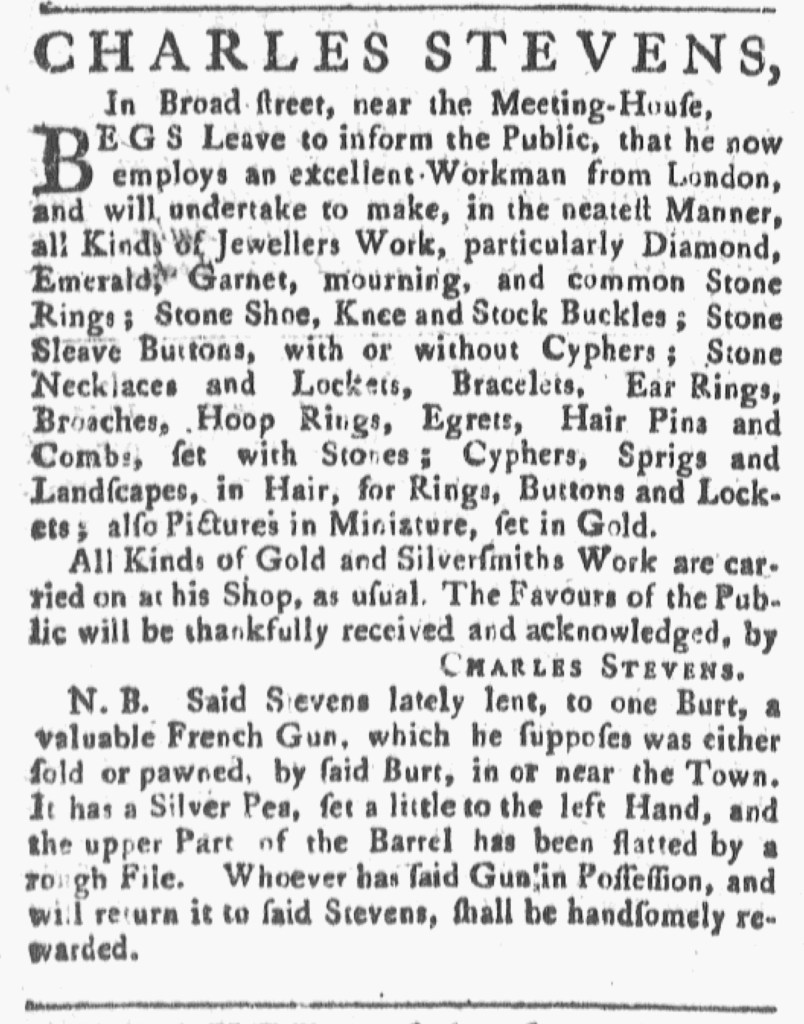
Providence Gazette (July 17, 1773).

“He now employs an excellent Workman from London.”

Charles Stevens, a goldsmith and jeweler, occasionally advertised in the Providence Gazette in the late 1760s and early 1770s.  A new development in his workshop prompted each of his advertisements.  On September 24, 1768, for instance, Stevens advised the public, “particularly those who have hitherto kindly favoured him with their Custom,” that he moved to a new location “in the main Street of Providence, where he continues to carry on his Business, in all its various Branches, and engages to execute his Work in the best and most elegant Manner.”  The goldsmith and jeweler made the same appeals as other artisans, yet they appeared in the public prints only when Stevens wanted to make sure that former clients knew about his new location.  Similarly, when he “removed to BROAD-STREET” in the summer of 1771, Stevens placed an advertisement to inform the public, “particularly his old Customers,” that he “carries on his Business in all its Branches, as usual.”

The goldsmith and jeweler had other news to share two years later.  In July 1773, he placed an advertisement to announce that “he now employs an excellent Workman from London, and will undertake to make, in the neatest Manner, all Kinds of Jewellers Work.”  Artisans who placed newspaper advertisements rarely gave credit to employees and relations who labored in their workshops.  Those who did so usually emphasized one or more of three specific reasons.  Sometimes an employee or associate possessed expertise that the proprietor did not, expanding the offerings available at the shop.  Sometimes their connections to London or other cities suggested greater familiarity with current fashions and tastes as well as superior training in their craft.  Sometimes an additional employee testified to the popularity of a workshop, suggesting that the artisan who ran it required assistance to keep up with orders.  All three reasons may have applied to the “excellent Workman from London” who produced “all Kinds of Jewellers Work” in Stevens’s shop.  The proprietor noted, “All Kinds of Gold and Silversmith’s Work are carried on at his Shop, as usual.”  Stevens may have shifted his focus to that work, leaving jewelry orders to his new employee.  He had already established his reputation in Providence, accepting jobs “as usual,” yet the addition of an employee with specialized skills merited an advertisement to keep existing customers and the public aware of new developments that benefited his patrons.

July 16

What was advertised in a colonial American newspaper 250 years ago today?

New-Hampshire Gazette (July 16, 1773).

“DANCING SCHOOL For Young GENTLEMEN and LADIES.”

Edward Hacket (sometimes Hackett) announced that he “Has open’d his DANCING SCHOOL For Young GENTLEMEN and LADIES” in Portsmouth in the July 16, 1773, edition of the New-Hampshire Gazette.  The advertisements he previously placed in that newspaper may have helped the dancing master recruit enough students to make the endeavor viable.  He first advertised in March, four months earlier, placing himself in competition with Monsieur De Viart, another dancing master who advertised in the New-Hampshire Gazette at about the same time.  Hacket initially hoped to open his school “At the New ASSEMBLY HOUSE” in three weeks “on the First Tuesday in APRIL,” but he may not have acquired enough students to do so.  He envisioned offering lessons at the school on “Tuesdays in the Afternoon, and Wednesdays in the Forenoon” as well as private lessons for “Gentlemen or Ladies, either at the Assembly Houses, at such Hours as may be agreed on.”  He eventually gave lessons “On Thursdays in the Afternoon, and Fridays in the Forenoon,” perhaps choosing those times to match the preferences of his pupils.

By the time he opened his dancing school in July, Hacket apparently believed that prospective students and their families were familiar with his approach and his background.  He published a much shorter advertisement than the one in which he introduced himself in March.  Hacket initially described himself as “From EUROPE,” suggesting he passed along the same level of sophistication to his students as the French dancing master, Monsieur de Viart, did for his pupils.  He also listed other credentials, stating that he “has taught Dancing in many of the principal Towns in England, Ireland, and America.”  In addition, he confided to parents and guardians that those “who send their Children, may depend that great Care will be taken of their Education, and good Order observed.”  Hacket tended to developing appropriate personal comportment beyond learning the steps of the dances he taught.  By the time he opened his school, however, he did not consider it necessary to provide any of those details in his new advertisement.  The previous advertisement circulated widely over the course of several weeks, plus Hacket had opportunities to meet prospective students and their families to make overtures in person.  He may have considered a brief announcement in the colony’s only newspaper enough to rally any prospective pupils who had not yet committed.  Instead of a hard sell, this light tough may have suggested that his students needed his services more than he needed their patronage.

Slavery Advertisements Published July 16, 1773

The Slavery Adverts 250 Project chronicles the role of newspaper advertising in perpetuating slavery in the era of the American Revolution. The project seeks to reveal the ubiquity of slavery in eighteenth-century life from New England to Georgia by republishing advertisements about enslaved people – for sale as individuals or in groups, wanted to purchase or for hire for short periods, runaways who liberated themselves, and those who were subsequently captured and confined in jails and workhouses – in daily digests on this site as well as in real time via the @SlaveAdverts250 Twitter feed, utilizing twenty-first-century media to stand in for the print media of the eighteenth century.

The project aims to provide modern audiences with a sense of just how often colonizers encountered these advertisements in their daily lives. Enslaved men, women, and children appeared in print somewhere in the colonies almost every single day. Those advertisements served as a constant backdrop for social, cultural, economic, and political life in colonial and revolutionary America. Colonizers who did not purport to own enslaved people were still confronted with slavery as well as invited to maintain the system by purchasing enslaved men, women, and children or assisting in the capture of so-called “runaways” who sought to free themselves from bondage. The frequency of these newspaper advertisements suggests just how embedded slavery was in colonial and revolutionary American culture in everyday interactions beyond the printed page.

These advertisements also testify to the experiences of enslaved men, women, and children, though readers must consider that those experiences have been remediated through descriptions offered by enslavers rather than enslaved people themselves. Often unnamed in the advertisements, enslaved men, women, and children were not invisible or unimportant in early America.

These advertisements appeared in colonial American newspapers 250 years ago today.

New-Hampshire Gazette (July 16, 1773).

**********

New-London Gazette (July 16, 1773).

**********

New-London Gazette (July 16, 1773).

July 15

What was advertised in a colonial American newspaper 250 years ago today?

Maryland Gazette (July 15, 1773).

“Catalogues both of the library and the books he has for sale to be had at his shop.”

On July 15, 1773, William Aikman once again took to the pages of the Maryland Gazette to promote the circulating library that the bookseller and stationer recently opened in Annapolis.  He inserted the same advertisement that appeared in the previous issue, seeking subscribers for the library and hawking books, stationery, and writing supplies.  In addition to deploying the newspaper notice, Aikman used other forms of advertising.

For instance, he concluded his notice with a nota bene that advised, “Catalogues both of the library and the books he has for sale to be had at his shop.”  According to Robert Winans in A Descriptive Checklist of Book Catalogues Separately Printed in America, 1639-1800, the Maryland Historical Society has the only known copy of a book catalog that may have been the one that Aikman mentioned in his newspaper advertisement.  It contains “854 consecutively numbered medium and full author and title entries, arranged alphabetically,” falling short of the “1200 volumes” that Aikman tallied in his newspaper advertisement.  However, that sole copy lacks a title page and other evidence suggests that additional pages may have been lost as well.

Trade Card for William Aikman’s Circulating Library (Annapolis, 1773). Courtesy American Antiquarian Society.

In addition to publishing at least one book catalog, Aikman also distributed an item that may have served as a trade card, a bookplate, or membership card.  The copperplate engraving features an ornate border that encloses the words “W. AIKMAN’S Circulating Library” in the upper portion of the cartouche and an advertisement for his book and stationery shop in the lower portion: “All kinds of Books, Letter Cases, Message Cards, Gilt &Plain Paper, Wax, &c. Sold at his Shop, Annapolis, at the British Prices, for Cash Only.  Paper rul’d, Books bound in the neatest manner.”  The final portion of that advertisement echoed the services that Aikman listed in his newspaper advertisement.  Images of a globe and a pen and inkpot resting on two books outside the border testified to both the world of knowledge and the products available at Aikman’s circulating library and bookshop.  The upper portion of the cartouche also included “No” with space to write in a number.  The number “474” appears in manuscript on the copy in the collections of the American Antiquarian Society.  That number may have been associated with a book in the numbered catalog or a subscriber to the circulating library, depending on whether Aikman used the engraved card as a bookplate or a membership card.

Aikman’s marketing efforts extended beyond newspaper advertisements.  He also distributed book catalogs and engraved cards to draw attention to his bookshop and circulating library, joining other entrepreneurs who diversified the kinds of advertisements that circulated in the colonies during the era of the American Revolution.

Slavery Advertisements Published July 15, 1773

The Slavery Adverts 250 Project chronicles the role of newspaper advertising in perpetuating slavery in the era of the American Revolution. The project seeks to reveal the ubiquity of slavery in eighteenth-century life from New England to Georgia by republishing advertisements about enslaved people – for sale as individuals or in groups, wanted to purchase or for hire for short periods, runaways who liberated themselves, and those who were subsequently captured and confined in jails and workhouses – in daily digests on this site as well as in real time via the @SlaveAdverts250 Twitter feed, utilizing twenty-first-century media to stand in for the print media of the eighteenth century.

The project aims to provide modern audiences with a sense of just how often colonizers encountered these advertisements in their daily lives. Enslaved men, women, and children appeared in print somewhere in the colonies almost every single day. Those advertisements served as a constant backdrop for social, cultural, economic, and political life in colonial and revolutionary America. Colonizers who did not purport to own enslaved people were still confronted with slavery as well as invited to maintain the system by purchasing enslaved men, women, and children or assisting in the capture of so-called “runaways” who sought to free themselves from bondage. The frequency of these newspaper advertisements suggests just how embedded slavery was in colonial and revolutionary American culture in everyday interactions beyond the printed page.

These advertisements also testify to the experiences of enslaved men, women, and children, though readers must consider that those experiences have been remediated through descriptions offered by enslavers rather than enslaved people themselves. Often unnamed in the advertisements, enslaved men, women, and children were not invisible or unimportant in early America.

These advertisements appeared in colonial American newspapers 250 years ago today.

Maryland Gazette (July 15, 1773).

**********

Maryland Gazette (July 15, 1773).

**********

Maryland Gazette (July 15, 1773).

**********

Maryland Gazette (July 15, 1773).

**********

Maryland Gazette (July 15, 1773).

**********

Rivington’s New-York Gazetteer (July 15, 1773).

**********

Rivington’s New-York Gazetteer (July 15, 1773).

**********

Virginia Gazette [Purdie and Dixon] (July 15, 1773).

**********

Virginia Gazette [Purdie and Dixon] (July 15, 1773).

**********

Virginia Gazette [Purdie and Dixon] (July 15, 1773).

**********

Virginia Gazette [Purdie and Dixon] (July 15, 1773).

**********

Virginia Gazette [Purdie and Dixon] (July 15, 1773).

**********

Virginia Gazette [Purdie and Dixon] (July 15, 1773).

**********

Virginia Gazette [Purdie and Dixon] (July 15, 1773).

**********

Virginia Gazette [Purdie and Dixon] (July 15, 1773).

**********

Virginia Gazette [Purdie and Dixon] (July 15, 1773).

**********

Virginia Gazette [Purdie and Dixon] (July 15, 1773).

**********

Virginia Gazette [Rind] (July 15, 1773).

**********

Supplement to the Virginia Gazette [Rind] (July 15, 1773).

**********

Supplement to the Virginia Gazette [Rind] (July 15, 1773).

July 14

What was advertised in a colonial American newspaper 250 years ago today?

Pennsylvania Gazette (July 14, 1773).

“He is determined to sell as low as any person can sell in Philadelphia, Lancaster, or elsewhere.”

At a glance, readers of the Pennsylvania Gazette may have thought that Frederick Hubley was a distiller.  After all, the woodcut that adorned his advertisement in the July 14, 1773, edition depicted a still.  On closer examination, however, they discovered that Hubley was a coppersmith who plied his trade in Lancaster.  He advised prospective customers in and near that town that he “MAKES all sorts of COPPER and BRASS WARE, in the neatest and best manner.”  In particular, he made “STILLS, brewers, hatters, wash, fish and tea kettles, bake-pans, [and] sauce-pans,” though repeating “&c.” (an abbreviation for et cetera) indicated that he accepted orders for other items.

To entice prospective customers, Hubley advanced some of the appeals most commonly deployed by colonial artisans who placed newspaper advertisements.  He offered assurances about the quality of the items he produced in his shop, declaring that he made them “in the neatest and best manner.”  Such declarations simultaneously testified to his skill as a coppersmith.  Hubley also leveraged price as a means of attracting customers.  He did not merely mention low prices or reasonable prices.  Instead, he compared his prices to those charged by his competitors, both coppersmiths and shopkeepers, near and far, stating that he “is determined to sell as low as any person can sell in Philadelphia, Lancaster, or elsewhere.”  Prospective customers, Hubley asserted, would not find better deals, not even in Philadelphia, the largest city and busiest port in the colonies.

Hubley advertised in a newspaper published in that city because Lancaster did not yet have its own newspaper in 1773.  The Pennsylvania Gazette and several other newspapers published in Philadelphia, as well as Germantowner Zeitung, served the entire colony and portions of Delaware, Maryland, and New Jersey.  Lancaster would not have its own newspaper until late November 1777 when John Dunlap temporarily moved the Pennsylvania Packet to town when the Continental Congress briefly relocated there during the British occupation of Philadelphia.  Although the Continental Congress quickly moved to York in hopes that even more distance meant more safety from the British, Dunlap and his press remained in Lancaster.  For six months, he printed the Pennsylvania Packet in Lancester, but ceased when he returned to Philadelphia to resume the newspaper there on July 4, 1778.  The war disrupted publication of several newspapers.  In addition, some folded completely, while printers established others.  In the summer of 1773, however, Hubley and others in Lancaster who wished to advertise did so within a fairly stable media environment, one with a center of gravity in Philadelphia.

Slavery Advertisements Published July 14, 1773

The Slavery Adverts 250 Project chronicles the role of newspaper advertising in perpetuating slavery in the era of the American Revolution. The project seeks to reveal the ubiquity of slavery in eighteenth-century life from New England to Georgia by republishing advertisements about enslaved people – for sale as individuals or in groups, wanted to purchase or for hire for short periods, runaways who liberated themselves, and those who were subsequently captured and confined in jails and workhouses – in daily digests on this site as well as in real time via the @SlaveAdverts250 Twitter feed, utilizing twenty-first-century media to stand in for the print media of the eighteenth century.

The project aims to provide modern audiences with a sense of just how often colonizers encountered these advertisements in their daily lives. Enslaved men, women, and children appeared in print somewhere in the colonies almost every single day. Those advertisements served as a constant backdrop for social, cultural, economic, and political life in colonial and revolutionary America. Colonizers who did not purport to own enslaved people were still confronted with slavery as well as invited to maintain the system by purchasing enslaved men, women, and children or assisting in the capture of so-called “runaways” who sought to free themselves from bondage. The frequency of these newspaper advertisements suggests just how embedded slavery was in colonial and revolutionary American culture in everyday interactions beyond the printed page.

These advertisements also testify to the experiences of enslaved men, women, and children, though readers must consider that those experiences have been remediated through descriptions offered by enslavers rather than enslaved people themselves. Often unnamed in the advertisements, enslaved men, women, and children were not invisible or unimportant in early America.

These advertisements appeared in colonial American newspapers 250 years ago today.

Pennsylvania Gazette (July 14, 1773).

**********

Pennsylvania Gazette (July 14, 1773).

**********

Pennsylvania Gazette (July 14, 1773).

**********

Pennsylvania Journal (July 14, 1773).

**********

Pennsylvania Journal (July 14, 1773).

**********

Pennsylvania Journal (July 14, 1773).

**********

Supplement to the Pennsylvania Journal (July 14, 1773).

**********

Supplement to the Pennsylvania Journal (July 14, 1773).

**********

Supplement to the Pennsylvania Journal (July 14, 1773).