February 29

What was advertised in a colonial American newspaper 250 years ago this month?

Massachusetts Spy (February 3, 1774).

“NUMBER I. of The Royal AMERICAN MAGAZINE.”

February 1774 was an important month for Isaiah Thomas and the Royal American Magazine.  The enterprising printer of the Massachusetts Spy first announced his intention to publish a magazine in May the previous year.  At the time, no other magazines were published in the colonies.  Instead, colonizers purchased and read magazines that printers and booksellers imported from England.  Over the past several decades, American printers attempted to establish magazines, but most lasted about a year before folding.  Hoping for better results, Thomas marketed the Royal American Magazine in newspapers from New Hampshire to Maryland.  The Adverts 250 Project has traced his advertising campaign throughout June, July, August, September, October, November, and December 1773 and January 1774.  This entry provides an overview of advertisements for the Royal American Magazine published in February 1774.

All the advertisements for that month ran in newspapers published in Boston or the Essex Journal, the newspaper that Thomas recently began publishing in partnership with Henry-Walter Tinges in Newburyport.  During the months that Thomas attempted to drum up sufficient demand to make publishing the Royal American Magazine a viable endeavor, the subscription proposals and other notices appeared in newspapers far and wide.  Once he took the magazine to press, however, he apparently did not consider it necessary to advertise as widely.  Perhaps he was satisfied, for the most part, with the number of subscribers, though his advertisements did continue to encourage others to subscribe or risk missing out on the first issue.

In the February 2 edition of the Essex Journal, Thomas repeated, for the last time, an advertisement that explained the delay in publication of the first issue, originally planned for January.  The next day, he announced in his own newspaper that the magazine would be published the following Monday.  On that day, February 7, variant notices appeared in the Boston-Gazette and the Massachusetts Gazette and Boston Post-Boy, both announcing that Thomas had indeed published the first issue of the Royal American Magazine.  The same notice ran in the Boston-Gazette a week later, the last time that newspaper carried an advertisement about the new magazine that month.
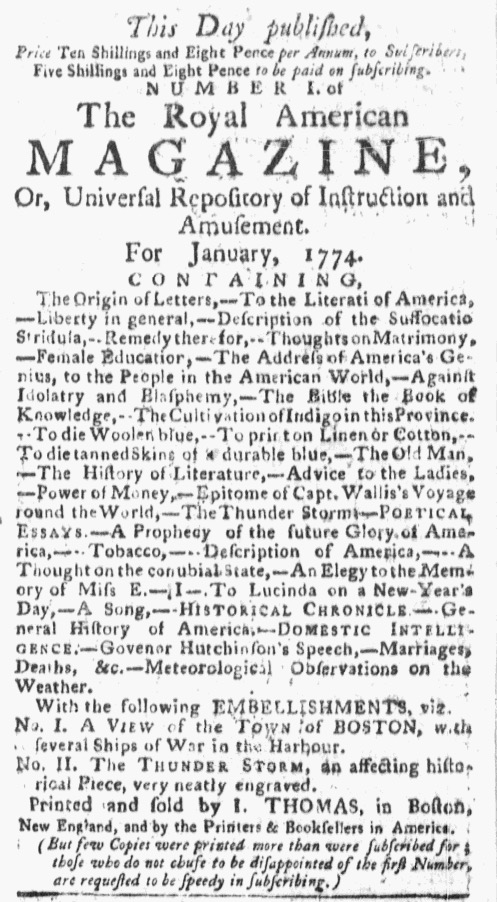
Boston Evening-Post (February 14, 1774).

A few days later, the first two of four variants of longer advertisements ran in the Massachusetts Spy and the Massachusetts Gazette and Boston Weekly News-Letter.  The version in Thomas’s own newspaper led with the price, promoted the copperplate engravings that accompanied the issue, listed the contents, and warned those who had not yet subscribed that they risked missing out on the inaugural issue.  A shorter version in the Massachusetts Gazette and Boston Weekly News-Letter included the contents and listed the engravings, but did not carry the other material.  That was the only appearance of that variant.  As the month progressed, that newspaper published a third variant that first ran in the Boston Evening-Post on February 14.  It made all the same appeals as the one in the Massachusetts Spy, but in a different order.  The Massachusetts Gazette and Boston Post-Boy, on the other hand, used the same copy as the Massachusetts Spy, perhaps as early as February 14 (that issue is missing) and in subsequent issues.  On February 16, the Essex Journal carried its own variant, with the headline, “Lately PUBLISHED,” the only primary difference from the version in the Massachusetts Spy.  Thomas likely dispatched the copy he used in Boston to his partner in Newburyport.  Those two newspapers were the only ones that carried excerpts from the Royal American Magazine to entice readers.  Except for the Boston-Gazette, each of the newspapers published in Boston carried one of the longer advertisements more than once in February.

Massachusetts Spy (February 17, 1774).

Midway through the month, in an advertisement in the Massachusetts Spy, Thomas ran yet another advertisement, that one asking “Gentlemen” to submit essays for the magazine because “Numb. II. is now in the Press.”  There was still time for new submissions to appear, but only if they were “sent with all speed” to Thomas’s printing office.  That February issue would not be available until March.  Thomas continued disseminating newspapers advertisements via the public prints, seeking to enhance the visibility of the new magazine, secure its reputation, and attract additional subscribers.

**********

“Types are now arrived” Update

  • February 2 – Essex Journal (fifth appearance)

“MONDAY next will be published”

  • February 3 – Massachusetts Spy (first appearance)

“THIS DAY PUBLISHED” (shorter variant)

  • February 7 – Boston-Gazette (first appearance)
  • February 14 – Boston-Gazette (second appearance)

This Day published” (variant promoting engravings)

  • February 7 – Massachusetts Gazette and Boston Post-Boy (first appearance)

“NUMBER I” (contents and engravings variant)

  • February 10 – Massachusetts Gazette and Boston Weekly News-Letter (first appearance)

“NUMBER I” (price, engravings, contents, and subscribers variant)

  • February 10 – Massachusetts Spy (first appearance)
  • February 14 – Massachusetts Gazette and Boston Post-Boy (possible first appearance)
  • February 17 – Massachusetts Spy (second appearance)
  • February 21 – Massachusetts Gazette and Boston Post-Boy (first known appearance; possible second appearance)
  • February 24 – Massachusetts Spy (third appearance), accompanied by excerpt
  • February 28 – Massachusetts Gazette and Boston Post-Boy (second known appearance; possible third appearance)

“NUMBER I” (price, contents, engravings, and subscribers variant)

  • February 14 – Boston Evening-Post (first appearance)
  • February 17 – Massachusetts Gazette and Boston Weekly News-Letter (first appearance)
  • February 21 – Boston Evening-Post (second appearance)
  • February 24 – Massachusetts Gazette and Boston Weekly News-Letter (second appearance)

“NUMBER I” (“Lately PUBLISHED” variant)

  • February 16 – Essex Journal (first appearance)
  • February 23 – Essex Journal (second appearance), accompanied by excerpt

“Numb. II. is now in the Press”

  • February 17 – Massachusetts Spy (first appearance)
February 28

What was advertised in a colonial American newspaper 250 years ago today?

Boston Evening-Post (February 28, 1774).

“I the Subscriber intend leaving off the Baking Business very soon.”

“The Baking Business will be carried on as usual by the Subscriber.”

Mary Surcomb and William Flagg worked together in placing advertisements in the February 28, 1774, edition of the Boston Evening-Post.  Surcomb took to the pages of that newspaper to advise the public that she “intend[s] leaving off the Baking Business very soon.”  She wished to express her “hearty Thanks to those Gentlemen and Ladies who have favoured me with the Custom since my late Husband’s decease.”  She had not previously advertised her services in any of Boston’s newspapers, though she had placed estate notices in both the Boston-Gazette and the Massachusetts Gazette and Boston Weekly News-Letter following the death of her husband in the fall of 1773.[1]  Those notices indicated that Richard had been a baker as well.  As widows in early America often did, Surcomb continued operating the family business.  In Williamsburg, for instance, Clementina Rind printed the Virginia Gazette after her husband passed away in August 1773, about the same time that Surcomb’s husband died.  For Surcomb, assuming responsibility for the business may have been an extension of her previous responsibilities.  She likely assisted her husband in all kinds of ways, including baking and interacting with customers.

Surcomb appended a nota bene to her advertisement, informing readers that the “Business will be carried on as usual by Mr. William Flagg.  Perhaps Flagg had previously been affiliated with the business as an employee and continued working with the widow.  Whatever his history with the Surcombs, Flagg took over their business and aimed, with Mary’s blessing, to maintain their clientele.  In his own note, he declared that “the Baking Business will be carried on as usual by the Subscriber, who is determined to give universal Satisfaction.”  Rather than the full line that separated other paid notices from each other, a half line demarcated where Surcomb’s portion of the advertisement ended and Flagg’s portion began.  Visually, the format presented a narrative consistent with the copy.  Surcomb and Flagg carefully communicated the transition from one proprietor to the other, including an endorsement from Surcomb for her successor.

**********

[1] See Boston-Gazette (October 25, 1773) and Massachusetts Gazette and Boston Weekly News-Letter (October 7, 1773).

Slavery Advertisements Published February 28, 1774

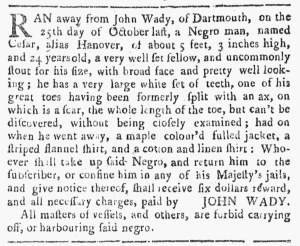
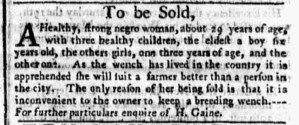
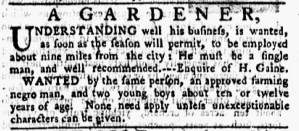
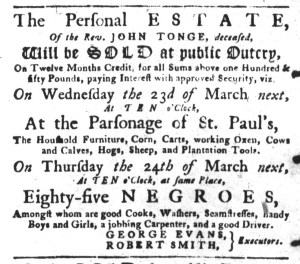
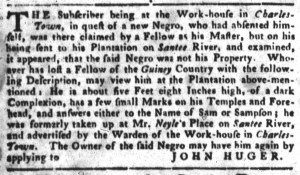
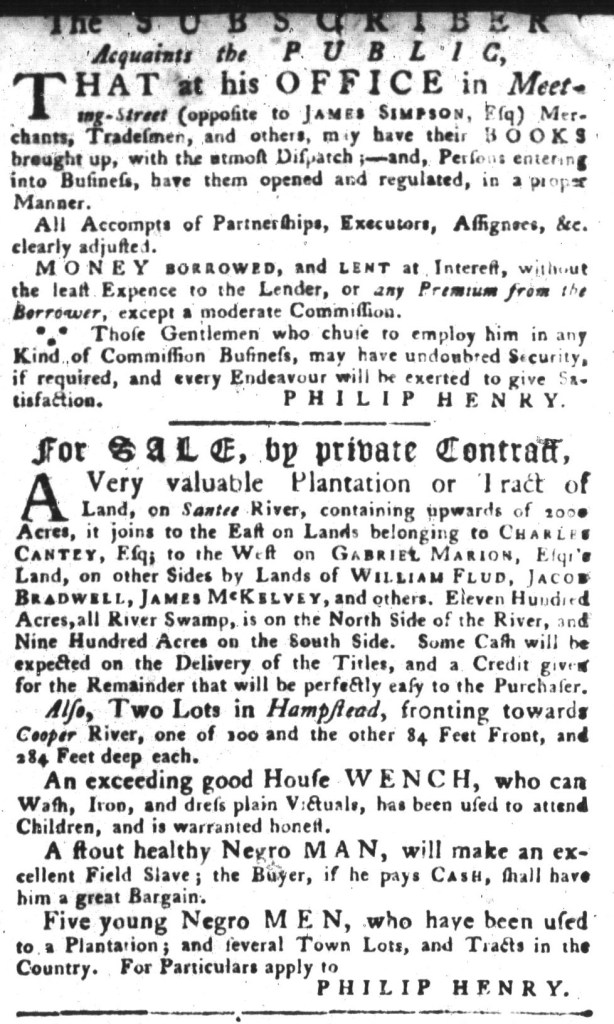
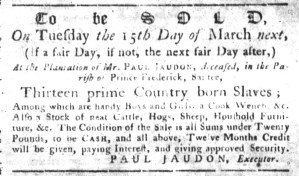
The Slavery Adverts 250 Project chronicles the role of newspaper advertising in perpetuating slavery in the era of the American Revolution. The project seeks to reveal the ubiquity of slavery in eighteenth-century life from New England to Georgia by republishing advertisements about enslaved people – for sale as individuals or in groups, wanted to purchase or for hire for short periods, runaways who liberated themselves, and those who were subsequently captured and confined in jails and workhouses – in daily digests on this site as well as in real time via the @SlaveAdverts250 Twitter feed, utilizing twenty-first-century media to stand in for the print media of the eighteenth century.

The project aims to provide modern audiences with a sense of just how often colonizers encountered these advertisements in their daily lives. Enslaved men, women, and children appeared in print somewhere in the colonies almost every single day. Those advertisements served as a constant backdrop for social, cultural, economic, and political life in colonial and revolutionary America. Colonizers who did not purport to own enslaved people were still confronted with slavery as well as invited to maintain the system by purchasing enslaved men, women, and children or assisting in the capture of so-called “runaways” who sought to free themselves from bondage. The frequency of these newspaper advertisements suggests just how embedded slavery was in colonial and revolutionary American culture in everyday interactions beyond the printed page.

These advertisements also testify to the experiences of enslaved men, women, and children, though readers must consider that those experiences have been remediated through descriptions offered by enslavers rather than enslaved people themselves. Often unnamed in the advertisements, enslaved men, women, and children were not invisible or unimportant in early America.

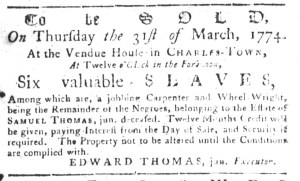
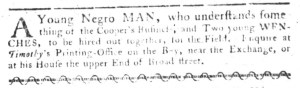
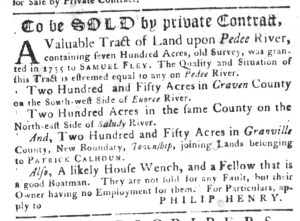
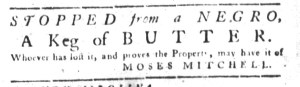
These advertisements appeared in colonial American newspapers 250 years ago today.

Boston Evening-Post (February 28, 1774).

**********

Boston-Gazette (February 28, 1774).

**********

Boston-Gazette (February 28, 1774).

**********

Dunlap’s Pennsylvania Packet (February 28, 1774).

**********

Dunlap’s Pennsylvania Packet (February 28, 1774).

**********

Dunlap’s Pennsylvania Packet (February 28, 1774).

**********

Massachusetts Gazette and Boston Post-Boy (February 28, 1774).

**********

Massachusetts Gazette and Boston Post-Boy (February 28, 1774).

**********

Newport Mercury (February 28, 1774).

**********

Newport Mercury (February 28, 1774).

**********

New-York Gazette and Weekly Mercury (February 28, 1774).

**********

Supplement to the New-York Gazette and Weekly Mercury (February 28, 1774).

**********

South-Carolina Gazette (February 28, 1774).

**********

South-Carolina Gazette (February 28, 1774).

**********

South-Carolina Gazette (February 28, 1774).

**********

South-Carolina Gazette (February 28, 1774).

**********

South-Carolina Gazette (February 28, 1774).

**********

South-Carolina Gazette (February 28, 1774).

**********

South-Carolina Gazette (February 28, 1774).

**********

South-Carolina Gazette (February 28, 1774).

**********

South-Carolina Gazette (February 28, 1774).

**********

South-Carolina Gazette (February 28, 1774).

**********

South-Carolina Gazette (February 28, 1774).

**********

Supplement to the South-Carolina Gazette (February 28, 1774).

**********

Supplement to the South-Carolina Gazette (February 28, 1774).

**********

Supplement to the South-Carolina Gazette (February 28, 1774).

**********

Supplement to the South-Carolina Gazette (February 28, 1774).

**********

Supplement to the South-Carolina Gazette (February 28, 1774).

**********

Supplement to the South-Carolina Gazette (February 28, 1774).

**********

Supplement to the South-Carolina Gazette (February 28, 1774).

February 27

What was advertised in a colonial American newspaper 250 years ago this week?

Massachusetts Spy (February 27, 1774).

“GARDEN SEEDS … SOLD by SUSANNA RENKEN.”

Susanna Renken was not the first entrepreneur to advertise seeds in Boston’s newspapers as the spring of 1774 approached, though she had been on several occasions in the past decade.  That distinction went to John White, “Gardner, and Seeds-Man, in SEVEN-STAR LANE,” with his advertisement in the February 17 edition of the Massachusetts Spy, yet within a week Renken she activated her advertising campaign.  Fittingly, Renken placed an advertisement for “GARDEN SEEDS” in the next issue, serving as a counterpoint to White’s repeated notice.

Unlike the approach White had taken so far, Renken did not confine her marketing efforts to a single newspaper.  When she ran her first advertisement on February 24, she placed it in both the Massachusetts Gazette and Boston Weekly News-Letter and the Massachusetts Spy.  That made her among the first of the sorority of female seed sellers to advertise in 1774.  Her competitors Elizabeth Clark and Elizabeth Nowell also ran a notice in the Massachusetts Gazette and Boston Weekly News-Letter.  It appeared immediately to the left of Renken’s advertisement.

So began the annual contest to woo customers to purchase seeds.  As had been her practice in the past, Renken continued expanding her advertising campaign, seeking to reach more prospective customers by inserting her notice in multiple newspapers.  On February 28, she ran it in the Boston Evening-Post, immediately above Elizabeth Greenleaf’s advertisement for “GARDEN-SEEDS.”  The appropriately named Greenleaf was part of the sisterhood of seed sellers who advertised extensively each spring.  On the same day, her advertisement appeared immediately above Renken’s advertisement in the Boston-Gazette.  Perhaps having noticed that Renken and Clark and Nowell commenced their advertising Greenleaf determined that it was time to invest in her own marketing efforts for 1774.

For whatever reason, none of them or their competitors placed advertisements in the Massachusetts Gazette and Boston Post-Boy on February 28, but the March 3 edition of the Massachusetts Gazette and Boston Weekly News-Letter once again featured advertisements from Renken and Clark and Nowell, joined by Greenleaf.  As had been common in previous years, the compositor arranged them one after the other in a single column.  Printers did not usually arrange advertisements by purpose or category, but they often made an exception for women who sold seeds in Boston.  Renken and White once again placed their notices in the Massachusetts Spy on March 3.

For newspaper readers in and near Boston, this flurry of advertising was an annual ritual.  It signaled that spring was on its way.  Perhaps for modern readers who regularly visit the Adverts 250 Project, these advertisements serve a similar purpose, a sign of the changing seasons as days become longer even if not necessarily warmer.

February 26

What was advertised in a colonial American newspaper 250 years ago today?

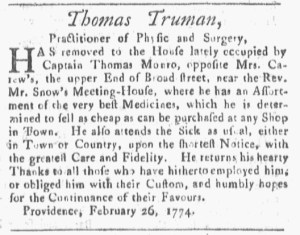
Providence Gazette (February 26, 1774).

“He also attends the Sick as usual, either in Town or Country, upon the shortest Notice, with the greatest Care and Fidelity.”

More than a year after he first positioned himself as the successor to “Doctor SAMUEL CAREW, late of Providence, deceased,” Thomas Truman, “Practitioner of Physic and Surgery,” continued to practice in that town.  As February 1774 came to an end, he once again took to the pages of the Providence Gazette, this time to announce that he “removed” to a new location.  In directing prospective patients to “the House lately occupied by Captain Thomas Munro, opposite Mrs. Carew’s, the upper End of Broad-street, near the Rev. Mr. Snow’s Meeting-House,” he reminded readers of his former affiliation with the deceased doctor.  Mentioning the widow may have jogged the memories of some who had known Truman “during his Apprenticeship with Doctor CAREW.”  When he first sought to establish himself in Providence, Truman faced competition from others who advertised their services as physicians, including Ebenezer Richmond and Daniel Hewes.

Truman’s advertisements may have helped him secure his place.  He expressed “his hearty Thanks to all those who have hitherto employed him … and humbly hopes for the Continuance of their Favours.”  He apparently considered advertising effective enough to justify subsequent investments.  Upon moving to his new location, he advised that he stocked “an Assortment of the very best Medicines, which he is determined to sell as cheap as can be purchased at any Shop in Town.”  Truman realized that for one segment of his business he competed not only with other practitioners but also with apothecaries who compounded medicines and even merchants and shopkeepers who imported patent medicines.  In addition, he “attends the Sick as usual, either in Town or Country, upon the shortest Notice, with the greatest Care and Fidelity.”  Truman wanted readers to remember him when they fell ill.  No matter where they happened to reside, he pledged to provide exemplary care as quickly as possible.  An occasion advertisement in the Providence Gazette enhanced his visibility among prospective patients beyond the reputation he earned through word of mouth.

February 25

What was advertised in a colonial American newspaper 250 years ago today?

Norwich Packet (February 24, 1774).

“CLOCKS and WATCHES, if left with Mr. JOHN CHAMPLIN, in New-London, will be carefully forwarded to the said HARLAND, and returned with all Expedition.”

In February 1774, Thomas Harland, “WATCH & CLOCK MAKER, From LONDON,” ran an advertisement in the Norwich Packet “to acquaint the public, that he has opened a Shop … in Norwich.”  In it, he incorporated some of the appeals commonly advanced by artisans who migrated across the Atlantic.  In particular, Harland emphasized the quality of his work, declaring that he “makes, in the neatest manner, and on the most improved principles, horizontal, repeating, and plain watches.”  Like others in his trade, he also “cleans and repairs watches and clocks with the greatest care and dispatch.”  Harland devoted a nota bene to engraving and finishing clock faces and cutting and finishing parts, such as watch wheels and fusees, as “neat as in LONDON and at the same price.”  Harland suggested that he offered the sort of superior workmanship available in the largest and most cosmopolitan city in the empire.

Connecticut Gazette (February 25, 1774).

Residents of Norwich and surrounding towns were not the only prospective customers that Harland sought to attract.  He simultaneously ran the same advertisement, with a few modifications, in the Connecticut Gazette, published in New London.  His notice appeared on the front page of the February 25, 1774, edition, supplemented with a short paragraph that informed readers, “CLOCKS and WATCHES, if left with Mr. JOHN CHAMPLIN, in New-London, will be carefully forwarded to the said HARLAND, and returned with all Expedition.”  In his own advertisement on the fourth page of that issue, Champlin, a “GOLDSMITH and JEWELLER,” promoted the work he undertook in his shop and “likewise informs his Customers and others that they may have Clocks and Watches repaired at his Shop as usual.”  Harland’s advertisement suggests that those repairs did not take place in Champlin’s shop, that he instead sent them to Norwich.  Champlin had a history of partnering with associates to provide ancillary services to attract customers to his shop.  The previous fall, Champlin and Daniel Jennings jointly advertised in the New-London Gazette.  In April 1772, Champlin placed a notice in which he stated that he “employed a Person well acquainted” with “Clock and Watch making, mending, cleaning and repairing.”  In December 1769, James Watson advertised that he moved from one silversmith’s shop to Champlin’s shop “where he makes, mends and repairs all kinds of clocks and watches.”  Harland and Champlin mutually benefited from their partnership.  Harland, a newcomer, had an established artisan generating business for him, while Champlin continued providing the same array of services to current and prospective customers.

Champlin may have also played a role in Harland’s marketing efforts.  The watch- and clockmaker in Norwich may have sent his advertising copy to Champlin as part of their regular correspondence rather than directly to the printing office in New London.  An advertisement that had a rather plain appearance in the Norwich Packet featured a variety of embellishments in the Connecticut Gazette.  That version had greater variation in fonts as well as a decorative border.  Champlin’s advertisement also had a decorative border, while most paid notices in the Connecticut Gazette did not.  The compositor could have been responsible for sprucing up Harland’s advertisement, but the connection between Champlin and Harland suggests that the changes may have resulted from specific instructions from one of the advertisers.

February 24

What was advertised in a colonial American newspaper 250 years ago today?

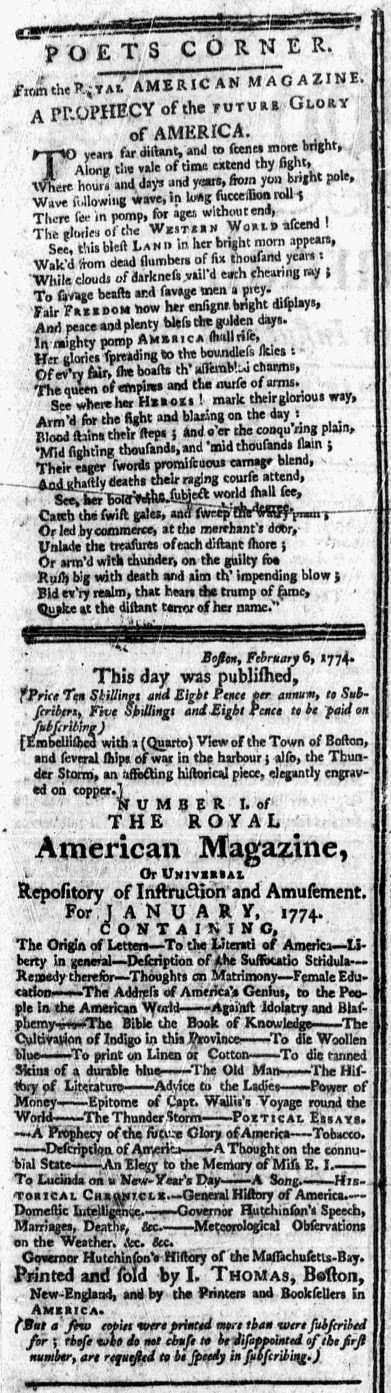
Massachusetts Spy (February 24, 1774).

“POETS CORNER.  From the ROYAL AMERICAN MAGAZINE.”

Isaiah Thomas, printer of the Massachusetts Spy, continued promoting a new venture, the Royal American Magazine, in the February 24, 1774, edition of his newspaper.  He once again ran an advertisement announcing that “This day was published … NUMBER I. of THE ROYAL American Magazine,” noting the price, promoting the two copperplate engravings that accompanied the inaugural issue, listing the contents, and encouraging “those who do not chuse to be disappointed of the first number … to be speedy in subscribing.”  That was not the extent of Thomas’s efforts to market the Royal American Magazine in that issue of the Massachusetts Spy.  The “POETS CORNER,” a regular feature in the upper left corner of the final page, featured a poem entitled, “A PROPHECY of the FUTURE GLORY of AMERICA.”  A note of introduction indicated that the verses came “From the ROYAL AMERICAN MAGAZINE.”  Thomas conveniently placed the advertisement for the magazine immediately below the poem, guiding readers toward subscribing.

That was not the only instance of the industrious printer publishing an excerpt from the magazine in his efforts to increase its visibility and gain new subscribers.  On February 23, the Essex Journal, a newspaper that Thomas recently launched in Newburyport in partnership with Henry-Walter Tinges, carried the advertisement on the final page and an excerpt “From the Royal American Magazine” on the first page.  In this instance, the excerpt was a short essay “Against IDOLATRY and BLASPHEMY” that critiqued the practice of using “epithets” including “Most gracious Sovereign” and “Most excellent Majesty” because they “can justly be applied to none but GOD; and therefore, applying them to men, is idolatry.”  The author, identified only as “A CHRISTIAN,” took the opportunity to take a swipe at “Roman catholics … paying divine honours to a vain empty Pope.”  Yet they were not much better than “protestants and Englishmen” who were “in some degree partakers of the same guilt.”  Americans, on the other hand, could avoid “this sin” by “pay[ing] honour to whom honour is due, among men” and “pay[ing] supreme honour to none by the SUPREME.”  In selecting that piece to excerpt, Thomas played to the prejudices of Protestants in New England, many of them descended from Puritans who first colonized the region.  The excerpt on the first page and the advertisement on the last page bookended the contents of that issue of the Essex Journal, the reiterating reminding readers to subscribe and read the new magazine.

In both newspapers, Thomas inserted excerpts to create a buzz around the Royal American Magazine.  He offered previews to prospective subscribers, both in the list of contents and the excerpts themselves, in hopes of inciting curiosity and demand for the new publication.

Slavery Advertisements Published February 24, 1774

GUEST CURATOR:  Elizabeth “Ellie” Chaclas

The Slavery Adverts 250 Project chronicles the role of newspaper advertising in perpetuating slavery in the era of the American Revolution. The project seeks to reveal the ubiquity of slavery in eighteenth-century life from New England to Georgia by republishing advertisements about enslaved people – for sale as individuals or in groups, wanted to purchase or for hire for short periods, runaways who liberated themselves, and those who were subsequently captured and confined in jails and workhouses – in daily digests on this site as well as in real time via the @SlaveAdverts250 Twitter feed, utilizing twenty-first-century media to stand in for the print media of the eighteenth century.

The project aims to provide modern audiences with a sense of just how often colonizers encountered these advertisements in their daily lives. Enslaved men, women, and children appeared in print somewhere in the colonies almost every single day. Those advertisements served as a constant backdrop for social, cultural, economic, and political life in colonial and revolutionary America. Colonizers who did not purport to own enslaved people were still confronted with slavery as well as invited to maintain the system by purchasing enslaved men, women, and children or assisting in the capture of so-called “runaways” who sought to free themselves from bondage. The frequency of these newspaper advertisements suggests just how embedded slavery was in colonial and revolutionary American culture in everyday interactions beyond the printed page.

These advertisements also testify to the experiences of enslaved men, women, and children, though readers must consider that those experiences have been remediated through descriptions offered by enslavers rather than enslaved people themselves. Often unnamed in the advertisements, enslaved men, women, and children were not invisible or unimportant in early America.

These advertisements appeared in colonial American newspapers 250 years ago today.

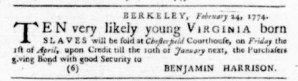
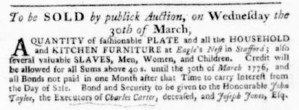
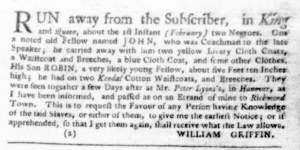
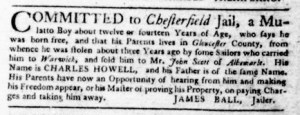
Maryland Gazette (February 24, 1774).

**********

Maryland Journal (February 24, 1774).

**********

Maryland Journal (February 24, 1774).

**********

Massachusetts Spy (February 24, 1774).

**********

Virginia Gazette [Purdie and Dixon] (February 24, 1774).

**********

Virginia Gazette [Purdie and Dixon] (February 24, 1774).

**********

Virginia Gazette [Purdie and Dixon] (February 24, 1774).

**********

Virginia Gazette [Purdie and Dixon] (February 24, 1774).

**********

Virginia Gazette [Purdie and Dixon] (February 24, 1774).

**********

Virginia Gazette [Purdie and Dixon] (February 24, 1774).

**********

Virginia Gazette [Purdie and Dixon] (February 24, 1774).

**********

Virginia Gazette [Purdie and Dixon] (February 24, 1774).

**********

Virginia Gazette [Purdie and Dixon] (February 24, 1774).

**********

Virginia Gazette [Purdie and Dixon] (February 24, 1774).

**********

Virginia Gazette [Purdie and Dixon] (February 24, 1774).

**********

Virginia Gazette [Purdie and Dixon] (February 24, 1774).

**********

Virginia Gazette [Purdie and Dixon] (February 24, 1774).

**********

Virginia Gazette [Purdie and Dixon] (February 24, 1774).

**********

Virginia Gazette [Purdie and Dixon] (February 24, 1774).

February 23

What was advertised in a colonial American newspaper 250 years ago today?

Pennsylvania Journal (February 23, 1774).

“A RIDER between Philadelphia and that place.”

William Stenson played a part in establishing and maintaining the communication infrastructure that connected Baltimore and Philadelphia and points in between in the mid 1770s.  Though it had not displaced Annapolis, Baltimore became an increasingly significant urban port on the eve of the American Revolution.  In August 1773, William Goddard launched the Maryland Journal, the city’s first newspaper.  At about the same time, Joseph Rathell attempted to establish a subscription library, but could not manage to generate sufficient interest to compete with William Aikman’s circulating library in Annapolis.  For a small fee, Aikman delivered books to subscribers in Baltimore.

Still, Baltimore was becoming an increasingly important commercial center, a place of interest for merchants and others in Philadelphia.  That created an opportunity for Stenson.  On February 23, 1774, he informed readers of the Pennsylvania Journal that he was “employed by a number of Gentlemen in Baltimore, &c. as a RIDER between Philadelphia and that place” and offered his services during his weekly transit.  He left Philadelphia “early every Thursday morning” and arrived in Baltimore “on Friday evening.”  He stayed until Monday morning and returned to Philadelphia “on Tuesday evenings.”

Stenson attempted to hire his services by the year, suggesting how regularly he believed some prospective clients in Philadelphia wished to contact correspondents in Baltimore and towns on the way.  He offered a “yearly subscription,” pledging that “whatever affairs may be committed to the care of the subscriber, will be performed with all possible fidelity and dispatch.”  For those not ready to pay for his services for an entire year, the rider promised that they “may have their business done at reasonable rates.”  Clients could contact him or leave orders “at Mr. WILLIAM GRAHAM’s, at the sign of the Black Horse” on Market Street.  Alternately, a “subscription paper now lies at the London Coffee-House,” a popular gathering place for Philadelphia’s merchants to conduct business.  Stenson aimed to make procuring his services as convenient as possible for his prospective clients.

Slavery Advertisements Published February 23, 1774

GUEST CURATOR:  Elizabeth “Ellie” Chaclas

The Slavery Adverts 250 Project chronicles the role of newspaper advertising in perpetuating slavery in the era of the American Revolution. The project seeks to reveal the ubiquity of slavery in eighteenth-century life from New England to Georgia by republishing advertisements about enslaved people – for sale as individuals or in groups, wanted to purchase or for hire for short periods, runaways who liberated themselves, and those who were subsequently captured and confined in jails and workhouses – in daily digests on this site as well as in real time via the @SlaveAdverts250 Twitter feed, utilizing twenty-first-century media to stand in for the print media of the eighteenth century.

The project aims to provide modern audiences with a sense of just how often colonizers encountered these advertisements in their daily lives. Enslaved men, women, and children appeared in print somewhere in the colonies almost every single day. Those advertisements served as a constant backdrop for social, cultural, economic, and political life in colonial and revolutionary America. Colonizers who did not purport to own enslaved people were still confronted with slavery as well as invited to maintain the system by purchasing enslaved men, women, and children or assisting in the capture of so-called “runaways” who sought to free themselves from bondage. The frequency of these newspaper advertisements suggests just how embedded slavery was in colonial and revolutionary American culture in everyday interactions beyond the printed page.

These advertisements also testify to the experiences of enslaved men, women, and children, though readers must consider that those experiences have been remediated through descriptions offered by enslavers rather than enslaved people themselves. Often unnamed in the advertisements, enslaved men, women, and children were not invisible or unimportant in early America.

These advertisements appeared in colonial American newspapers 250 years ago today.

Essex Journal (February 23, 1774).

**********

Pennsylvania Journal (February 23, 1774).

**********

Pennsylvania Journal (February 23, 1774).