Elizabeth “Ellie” Chaclas is a senior majoring in History and minoring in Art History at Assumption University in Worcester, Massachusetts. She has loved reading her whole life and reads prolifically in her free time. She specializes in many different art forms, including, but not limited to, costuming, painting, mixed media illustration, writing, sculpture, analog photography, and film. Her work has appeared in art shows. On occasion, she performs on stage. Ellie is an equestrian on the university’s equestrian team. She has won several first places for the team and recently graduated to pre-novice class in shows. She has worked as a classroom learning assistant and has plans to a master’s program in Special Education as well as pursue her interests in art history and fashion history. Ellie made her contributions to the Adverts 250 Project and the Slavery Adverts 250 Project while enrolled in HIS 401 Revolutionary America, 1763-1815, in Fall 2023.
What was advertised in a colonial American newspaper 250 years ago today?
Connecticut Courant (February 22, 1774).
“Three Dollars Reward [for] one of the said books.”
A headline offering “Three Dollars Reward” usually opened an advertisement about a runaway apprentice, livestock that escaped, an indentured servant who departed without permission, or enslaved people who liberated themselves. On occasion, such a headline appeared in advertisements for lost items that the owners wished to recover. In this instance, however, Benjamin Trumbull, a minister and historian, sought a copy of a book that had been published more than a century earlier.
Trumbull explained that in 1656 “the colony of New Haven, printed a code of laws, introduced with an account of the settlement of New Haven, in New England, by Governor Eaton.” He asserted that “Five hundred of those books were distributed in the towns of New Haven, Milford, Guilford, Stanford, Branford, and Southold, on Long-Island.” Trumbull imagined that with “so large a number it is not improvable that some remain legible,” so he put out a call for copies to his fellow colonizers, hoping that the reward would encourage them to “convey one of the said books” to him within two months. The historian was “very desirous of obtaining” the book because “much light may probably be reflected on the history of New Haven.”
He was so eager to acquire a copy that he advertised in both the Connecticut Journal and New-Haven Post-Boy, starting on February 18, 1774, and the Connecticut Courant, published in Hartford, starting on February 22. Despite disseminating his notice throughout much of the colony in those newspapers, this apparently did not have the intended results as quickly as Trumbull wished. On March 11, three weeks after the notice first appeared, he inserted it in the Connecticut Gazette, published in New London, expanding the reach of his plea. He did not, however, advertise in the colony’s other newspaper, the Norwich Packet, during that “term of two months.” Perhaps he did not consider it worth the investment, that newspaper being less than six months old at the time and likely having less circulation than the others.
Whether or not Trumbull managed to acquire a copy of the book, he eventually published the first volume of A Complete History of Connecticut, Civil and Ecclesiastical, from the Emigration of Its First Planters from England, in MDCXXX, to MDCCXXIII in 1797. According to the historical background in the American Antiquarian Society’s catalog, that book “took over twenty years to complete but remained the best work on Connecticut for a century.” One of the historians of the founding generation, he also published the first volume of A General History of the United States of America in 1810. It spanned the period “from the discovery of North America, to the year 1765.” Trumbull died before completing the intended second and third volumes.
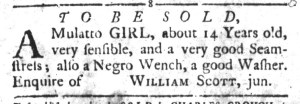
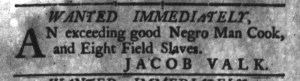
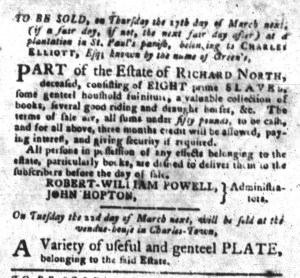
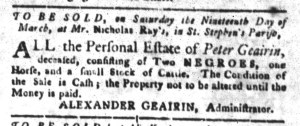
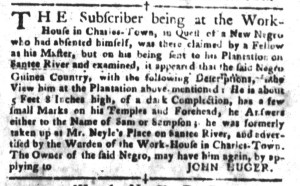
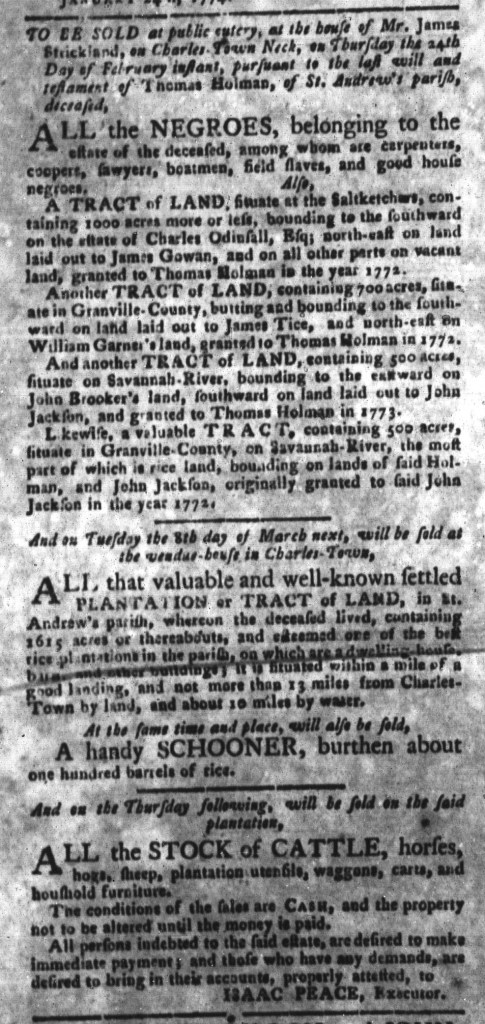
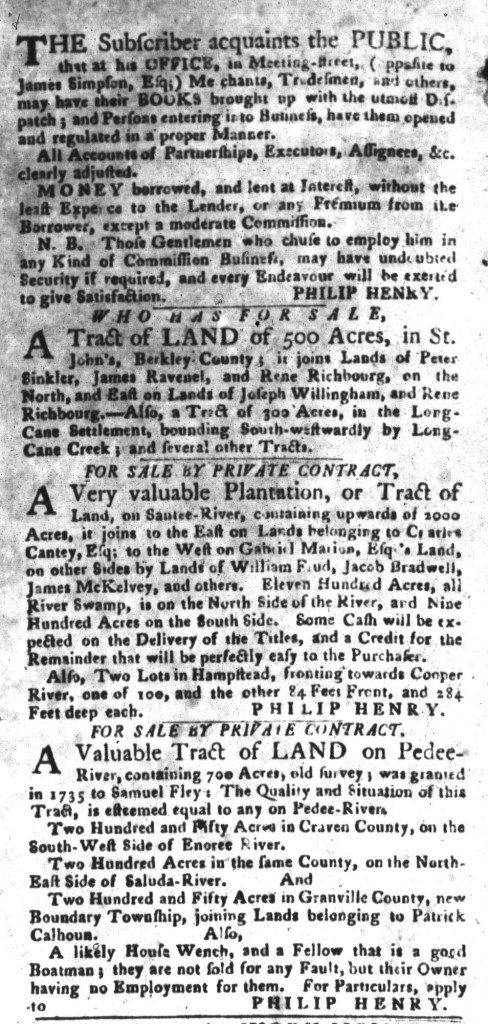
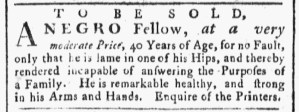
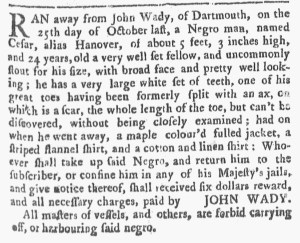
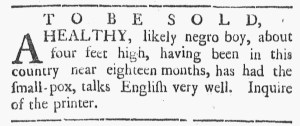
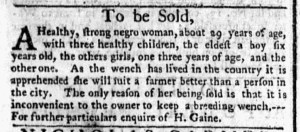
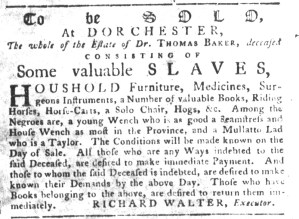
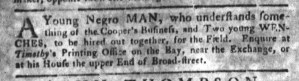
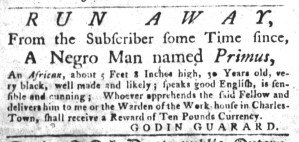
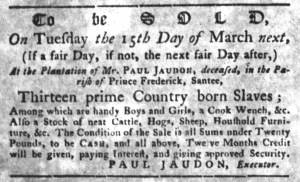
The Slavery Adverts 250 Project chronicles the role of newspaper advertising in perpetuating slavery in the era of the American Revolution. The project seeks to reveal the ubiquity of slavery in eighteenth-century life from New England to Georgia by republishing advertisements about enslaved people – for sale as individuals or in groups, wanted to purchase or for hire for short periods, runaways who liberated themselves, and those who were subsequently captured and confined in jails and workhouses – in daily digests on this site as well as in real time via the @SlaveAdverts250 Twitter feed, utilizing twenty-first-century media to stand in for the print media of the eighteenth century.
The project aims to provide modern audiences with a sense of just how often colonizers encountered these advertisements in their daily lives. Enslaved men, women, and children appeared in print somewhere in the colonies almost every single day. Those advertisements served as a constant backdrop for social, cultural, economic, and political life in colonial and revolutionary America. Colonizers who did not purport to own enslaved people were still confronted with slavery as well as invited to maintain the system by purchasing enslaved men, women, and children or assisting in the capture of so-called “runaways” who sought to free themselves from bondage. The frequency of these newspaper advertisements suggests just how embedded slavery was in colonial and revolutionary American culture in everyday interactions beyond the printed page.
These advertisements also testify to the experiences of enslaved men, women, and children, though readers must consider that those experiences have been remediated through descriptions offered by enslavers rather than enslaved people themselves. Often unnamed in the advertisements, enslaved men, women, and children were not invisible or unimportant in early America.
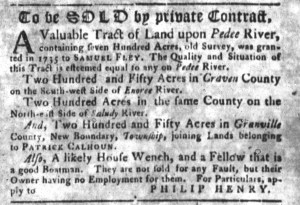
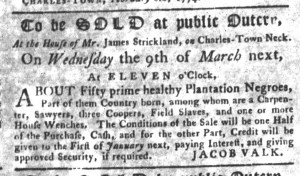
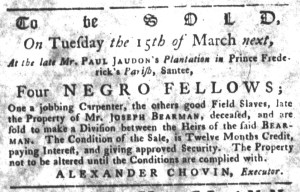
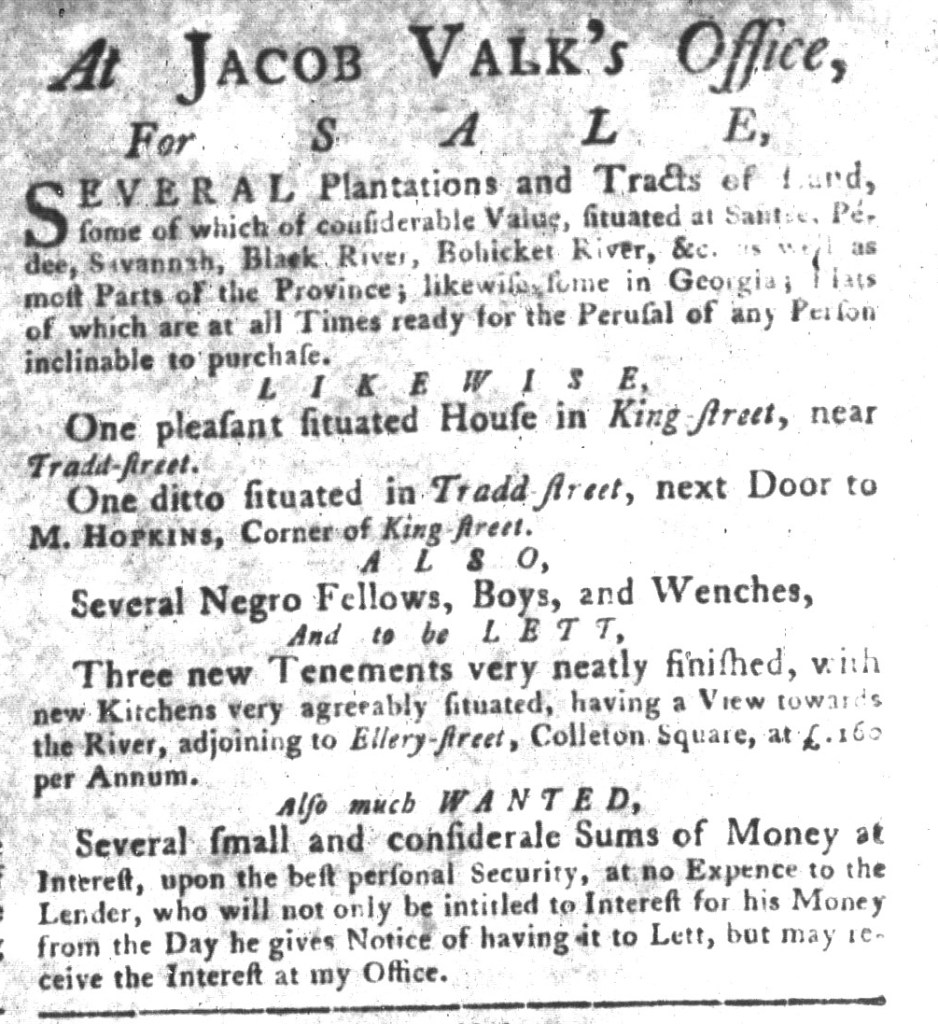
These advertisements appeared in colonial American newspapers 250 years ago today.
South-Carolina Gazette and Country Journal (February 22, 1774).
**********
South-Carolina Gazette and Country Journal (February 22, 1774).
**********
South-Carolina Gazette and Country Journal (February 22, 1774).
**********
South-Carolina Gazette and Country Journal (February 22, 1774).
**********
South-Carolina Gazette and Country Journal (February 22, 1774).
**********
South-Carolina Gazette and Country Journal (February 22, 1774).
**********
South-Carolina Gazette and Country Journal (February 22, 1774).
**********
South-Carolina Gazette and Country Journal (February 22, 1774).
**********
South-Carolina Gazette and Country Journal (February 22, 1774).
What was advertised in a colonial American newspaper 250 years ago today?
New-York Gazette and Weekly Mercury (February 21, 1774).
“☛K ☛E ☛Y ☛S ☛E ☛R’s Famous Pills.”
Hugh Gaine, “PRINTER, BOOKSELLER, and STATIONER” (as he described himself in the masthead of the New-York Gazette and Weekly Mercury), continued marketing “KEYSER’s Famous Pills,” a remedy for syphilis, in the February 21, 1774, edition of his newspaper. He gave his advertisement a privileged place. It was the first item in the first column on the first page, making it difficult for readers to miss. The advertisement consisted of several portions, collectively extending half a column. The first two portions, enclosed within a border composed of decorative type, provided a description of the efficacy of the pills in “eradicating every Degree of a certain DISEASE” and curing other maladies and offered an overview of “a Letter from the Widow Keyser, and a Certificate from under her own Hand” testifying to the “Genuineness” of the pills Gaine sold. In recent months, both apothecaries and printers in New York and Philadelphia engaged in public disputes about who stocked authentic pills and who peddled counterfeits. Even though Gaine invited the public to examine the letter and certificate at his store in Hanover Square (where they could shop for “Books and Stationary Ware”), the final two portions of his advertisement consisted of transcriptions of those items and a representation of the widow’s “Seal of my Arms.”
The decorative border, the only one in that issue of the New-York Gazette and Weekly Mercury, made Gaine’s advertisement more visible among the contents of the newspaper, yet that was not his only innovative use of graphic design. For several weeks he had been playing with manicules as a means of drawing attention to his advertisements. In this instance, a manicule appeared before each letter of “KEYSER,” pointing to the right. Such had been the case when the advertisement ran on January 24 and 31 and February 7 and 14. The first time he incorporated manicules into his advertisement for “KEYSER’s FAMOUS PILLS,” however, he had twelve pairs pointing at each other, six pairs above the name of the product and six pairs below the name of the product. That version appeared just once, on November 1, 1773. Subsequently, Gaine positioned manicules above each letter of “KEYSER,” pointing down, in six issues. That arrangement ran on November 8, 15, and 22 and December 6 and 13, each time with a border. When Gaine used it again on January 17, 1774, he did not include a border but once again had six manicules pointing down, one above each letter of “KEYSER.” He apparently did not expect the appeals in his advertisements to do all the work of marketing the patent medicine. Instead, Gaine believed that graphic design aided his efforts to reach prospective customers who much preferred fingers literally pointing at the name of the pills in advertisements over fingers figuratively pointing at them by others who suspected them of being afflicted with “a certain DISEASE.”
New-York Gazette and Weekly Mercury (November 1, 1773).
**********
New-York Gazette and Weekly Mercury (January 17, 1774).
The Slavery Adverts 250 Project chronicles the role of newspaper advertising in perpetuating slavery in the era of the American Revolution. The project seeks to reveal the ubiquity of slavery in eighteenth-century life from New England to Georgia by republishing advertisements about enslaved people – for sale as individuals or in groups, wanted to purchase or for hire for short periods, runaways who liberated themselves, and those who were subsequently captured and confined in jails and workhouses – in daily digests on this site as well as in real time via the @SlaveAdverts250 Twitter feed, utilizing twenty-first-century media to stand in for the print media of the eighteenth century.
The project aims to provide modern audiences with a sense of just how often colonizers encountered these advertisements in their daily lives. Enslaved men, women, and children appeared in print somewhere in the colonies almost every single day. Those advertisements served as a constant backdrop for social, cultural, economic, and political life in colonial and revolutionary America. Colonizers who did not purport to own enslaved people were still confronted with slavery as well as invited to maintain the system by purchasing enslaved men, women, and children or assisting in the capture of so-called “runaways” who sought to free themselves from bondage. The frequency of these newspaper advertisements suggests just how embedded slavery was in colonial and revolutionary American culture in everyday interactions beyond the printed page.
These advertisements also testify to the experiences of enslaved men, women, and children, though readers must consider that those experiences have been remediated through descriptions offered by enslavers rather than enslaved people themselves. Often unnamed in the advertisements, enslaved men, women, and children were not invisible or unimportant in early America.
These advertisements appeared in colonial American newspapers 250 years ago today.
Boston Evening-Post (February 21, 1774).
**********
Boston Evening-Post (February 21, 1774).
**********
Boston-Gazette (February 21, 1774).
**********
Massachusetts Gazette and Boston Post-Boy (February 21, 1774).
**********
Massachusetts Gazette and Boston Post-Boy (February 21, 1774).
**********
Newport Mercury (February 21, 1774).
**********
Newport Mercury (February 21, 1774).
**********
New-York Gazette and Weekly Mercury (February 21, 1774).
**********
South-Carolina Gazette (February 21, 1774).
**********
South-Carolina Gazette (February 21, 1774).
**********
South-Carolina Gazette (February 21, 1774).
**********
South-Carolina Gazette (February 21, 1774).
**********
South-Carolina Gazette (February 21, 1774).
**********
South-Carolina Gazette (February 21, 1774).
**********
South-Carolina Gazette (February 21, 1774).
**********
South-Carolina Gazette (February 21, 1774).
**********
South-Carolina Gazette (February 21, 1774).
**********
Supplement to the South-Carolina Gazette (February 21, 1774).
**********
Supplement to the South-Carolina Gazette (February 21, 1774).
**********
Supplement to the South-Carolina Gazette (February 21, 1774).
**********
Supplement to the South-Carolina Gazette (February 21, 1774).
**********
Supplement to the South-Carolina Gazette (February 21, 1774).
What was advertised in a colonial American newspaper 250 years ago this week?
Massachusetts Spy (February 17, 1774).
“Pointing out the names of several persons concerned in destroying the Tea.”
Two months after what has become known as the Boston Tea Party, tea continued to occupy the minds of colonizers in that port city and beyond. In the February 17, 1774, edition of the Massachusetts Spy, Joseph P. Palmer once again ran his advertisement for “GRANADA RUM” with a nota bene that emphatically proclaimed, “NO TEA.” Immediately above it, Jeremiah Cronin placed a notice in which he attempted to disassociate himself from any sort of political position concerning the recent dumping of tea into the harbor, hoping to reduce unwanted and, he claimed, unwarranted attention.
Cronin reported that on a morning early in February he discovered that “an Advertisement appeared posted up at the North-End of this town, signifying that I the subscriber, have been active in taking minutes, and pointing out the names of several persons concerned in destroying the Tea, and tarring and feathering.” He likely feared the ire of patriots who believed that he undermined their cause and planned to inform on them to the authorities. Yet, Cronin declared, he had no such intentions! “I hereby beg leave to inform the Public,” he pleaded, “that so far from being active and busy on any such occasions, I have neither directly or indirectly concerned myself with public affairs.” Instead, he promised, “I have always kept myself within doors when any disturbance happened in the town.” Just as he did not want patriots looking too closely at him, Cronin aimed to avoid trouble with the authorities and the loyalists who supported them. He ran his advertisement to declare his neutrality. To buttress his effort to convince the public that was the case, he appended a declaration by a justice of the peace, Joseph Gardner, who affirmed that Cronin “made solemn oath to the whole of the above declaration.”
Massachusetts Spy (February 17, 1774).
The politics of tea also received attention in the upper left corner of the page that carried Cronin’s notice and Palmer’s advertisement. The “POETS CORNER” for that issue featured “A Lady’s Adieu to her TEA-TABLE.” Perhaps written by a woman, perhaps not, the poem said “FArewel [to] the tea board and its equipage” and the “many a joyous moment” of “Hearing the girls tattle” and “the old maids talk scandal” while drinking “hyson, congo, and best double fine” tea. “No more shall I dish out the once lov’d liquor,” the lady asserted, considering tea “now detestable.” Consuming tea was no longer a diversion or a treat, but instead a vice: “Its use will fasten slavish chains upon my country, / And Liberty’s the goddess I would choose / To reign triumphant in AMERICA.” The lady’s “Adieu to her TEA-TABLE” suggested, even more forcefully than Palmer’s proclamation of “NO TEA,” that Cronin might not much longer have the luxury of taking a neutral position in “public affairs.” When it came down to tea or liberty, when decisions about consumption had political meaning, when neighbors and acquaintances observed decisions that fellow colonizers made in the marketplace, Cronin would find it increasingly difficult to avoid taking a side in the trouble that was brewing.
What was advertised in a colonial American newspaper 250 years ago today?
Providence Gazette (February 19, 1774).
“He has procured an European Dyer.”
Stephen Potter, a clothier in Coventry, Rhode Island, gave the public advance notice about a service he would soon offer. In an advertisement that first appeared in the February 12, 1774, edition of the Providence Gazette and then continued on February 19 and 26, he advised “his old Customers, and all others” that he “begins colouring the first of March next.”
That expanded the range of services that the fuller provided when he processed woolen cloth “at his Clothier’s Works,” but Potter did not do so on his own. Instead, he hired an employee (or perhaps acquired an indentured servant) who possessed skills that he did not. As he explained to prospective customers, Potter “procured an European Dyer” who could “dye any Colour in Cloth or Yarn.” The clothier highlighted the fact that his new dyer produced “a compleat Green.”
Entrepreneurs did not usually credit others who worked in their shops when they ran advertisements in colonial newspapers, but a few did so when they believed that acknowledging those who labored beside them or on their behalf helped in marketing the goods and services they sold. In this instance, Potter’s “old Customers,” in particular, “and all others,” in general, likely knew that dying woolen goods was not a skill that he possessed. As he sought to expand his business, Potter deemed it necessary to credit the “European Dyer” who recently joined “his Clothier’s Works.”
That did not prevent Potter from promoting his own contributions to the business, declaring that he “engages to dress his Work in the neatest Manner.” Customers could expect the highest quality of both the fulling and the dying of cloth entrusted to Potter. That Potter offered dying as an ancillary service distinguished his operation from other clothiers in the area. That included John Waterman, a competitor who simultaneously ran advertisements in the Providence Gazette.
What was advertised in a colonial American newspaper 250 years ago today?
Connecticut Gazette (February 18, 1774).
“HATS … both Bever and Castor.”
Ellie Chaclas, a student in my Revolutionary America class, and I worked together in selecting today’s advertisement. Ellie has an interest in the history of fashion, completing her capstone research project on the politics of fashion during the era of the American Revolution. She was drawn to this advertisement for “HATS, Manufactured by … DAVID NEVINS” that ran on the front page of the February 18, 1774, edition of the Connecticut Gazette. Ellie noted that Nevins marketed the hats that he made as “warranted to be of the best Quality” as well as “as cheap and as fashionable as can be purchased in Boston and New-York.” Nevins “Manufactured” hats in Norwich and marketed them to readers of a newspaper published in New London, reaching prospective customers in towns throughout Connecticut. Colonizers did not have to live in urban ports like Boston and New York to participate in the consumer revolution of the eighteenth century.
Ellie also noted that Nevins made “Bever” or beaver hats but did not immediately recognize what he meant by “Castor.” That gave us an opportunity to consult a resource that we frequently used in our class, the Oxford English Dictionary. That yielded this definition: “a hat, originally either of beaver’s fur, or intended to be taken as such; in the end of the 17th and beginning of 18th cent. distinguished from ‘beaver’, and said to be of rabbit’s fur.” We also discovered that “Bever” did not refer only to the material for “Manufactur[ing]” hats but in the eighteenth century was the name commonly used for a style of hat: “a hat made of beaver’s fur, or some imitation of it; formerly worn by both sexes, but chiefly by men.” This underscored our conversations in class about eighteenth-century consumers speaking a language that they shared across the colonies yet much of their vocabulary no longer resonates with modern consumers. To understand their experiences, we had to learn how to “translate” eighteenth-century English.
In addition, Ellie noted that even though the advertisement mentioned Boston and New York, Nevins likely had connections, even if indirect ones, with Detroit and the Great Lakes region and the trade in beaver fur. As a class, we read and discussed Tiya Miles’s Dawn of Detroit: A Chronicle of Slavery and Freedom in the City of the Straits, shifting our examination of the era of the Revolution from the thirteen colonies on the Atlantic coast to the interior of the continent. Miles’s book helped Ellie and her classmates (and their professor!) achieve a more complete understanding of the scope of Indigenous and African slavery in the Great Lakes region. While not visible in Nevins’s advertisement, enslaved people likely played a part of in processing and transporting the fur he used in making his hats.
What was advertised in a colonial American newspaper 250 years ago today?
Massachusetts Spy (February 17, 1774).
“GARDEN SEEDS.”
It was a sign of the changing seasons for colonizers in Boston. Each year several female entrepreneurs who sold seeds took to the pages of the several newspapers published in the urban port. Among them, Lydia Dyar, Elizabeth Greenleaf, and Susanna Renken usually began running notices by the end of February, alerting readers that they sold a variety of seeds. Renken had been the first to do so in 1768, 1770, and 1773. On occasion, men joined the women, including John Adams and Ebenezer Oliver, who took up the trade following the death of his mother, Bethiah Oliver.
Renken was not the first to advertise seeds and announce that spring was on its way in 1774. Instead, that distinction went to John White, “Gardner, and Seeds-Man, in SEVEN-STAR LANE.” White first advertised in the Massachusetts Spy on February 3 and then again on February 10 and 17. No other seed sellers, male or female, joined the chorus in the Massachusetts Spy or any of the other newspapers in Boston in that time, not even Renken. For a few weeks, White was alone in hawking a “large assortment of GARDEN SEEDS” imported from London and an “assortment of AMERICAN SEEDS.”
His female competitors tended to run their advertisements in multiple newspapers, but White confined his initial efforts to the Massachusetts Spy. He did, however, experiment with a format that differed from the dense paragraphs that listed all sorts of seeds that Renken and her sorority of seed sellers usually inserted in the public prints. White organized his advertisement as a catalog, dividing it into two columns. In each column, he included only one type of seed per line and the price for either a bushel or a pound. That likely made it easier for prospective customers to peruse his notice and spot items of interest. In addition, Renken and others did not usually include their prices. White’s method allowed readers to spot bargains without needing to visit his shop.
White was the first to herald the arrival of spring in 1774, making his notices memorable with a format that differed from what Dyar, Greenleaf, Renken, and others published in previous years. He may have hoped that a head start and providing prices in his advertisement would give him an edge in what would become a very competitive market in the coming months.
The Slavery Adverts 250 Project chronicles the role of newspaper advertising in perpetuating slavery in the era of the American Revolution. The project seeks to reveal the ubiquity of slavery in eighteenth-century life from New England to Georgia by republishing advertisements about enslaved people – for sale as individuals or in groups, wanted to purchase or for hire for short periods, runaways who liberated themselves, and those who were subsequently captured and confined in jails and workhouses – in daily digests on this site as well as in real time via the @SlaveAdverts250 Twitter feed, utilizing twenty-first-century media to stand in for the print media of the eighteenth century.
The project aims to provide modern audiences with a sense of just how often colonizers encountered these advertisements in their daily lives. Enslaved men, women, and children appeared in print somewhere in the colonies almost every single day. Those advertisements served as a constant backdrop for social, cultural, economic, and political life in colonial and revolutionary America. Colonizers who did not purport to own enslaved people were still confronted with slavery as well as invited to maintain the system by purchasing enslaved men, women, and children or assisting in the capture of so-called “runaways” who sought to free themselves from bondage. The frequency of these newspaper advertisements suggests just how embedded slavery was in colonial and revolutionary American culture in everyday interactions beyond the printed page.
These advertisements also testify to the experiences of enslaved men, women, and children, though readers must consider that those experiences have been remediated through descriptions offered by enslavers rather than enslaved people themselves. Often unnamed in the advertisements, enslaved men, women, and children were not invisible or unimportant in early America.
These advertisements appeared in colonial American newspapers 250 years ago today.