April 30

What was advertised in a revolutionary American newspaper 250 years ago this month?
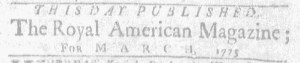
Massachusetts Gazette and Boston Weekly News-Letter (April 13, 1775).

THIS DAY PUBLISHED, The Royal American Magazine; FOR MARCH, 1775.”

On April 28, 1775, Daniel Fowle, printer of the New-Hampshire Gazette, reported that the “Boston News Papers … are all stopt, and no more will be printed for the present” following the outbreak of hostilities at Lexington and Concord.  He could have also mentioned that the Royal American Magazine, published by Joseph Greenleaf in Boston, had been suspended as well.  Although some of the newspapers eventually resumed, the Royal American Magazine did not.  The March 1775 issue, distributed in the second week of April, was the last one for that ambitious project that had repeatedly met with mishaps.  Isaiah Thomas, the original publisher, delayed the first issue when the ship carrying new types ran aground in January 1774 and then fell several issues behind because of the “Distresses” that Boston experienced when the Boston Port Act closed the harbor in June 1774 in retaliation for the destruction of tea the previous December.  Shortly after Thomas advised the public that he had suspended the magazine, he announced that he transferred it to Greenleaf.  The new publisher worked diligently to compile, print, and circulate the overdue issues and get back on schedule.

Massachusetts Gazette and Boston Weekly News-Letter (April 20, 1775).

Despite the challenges, he managed to do so, especially considering that eighteenth-century subscribers expected the issue for a month either at the very end of that month or early in the following month.  Accordingly, when Greenleaf first announced publication of the February 1775 issue on March 13 the new issue was on time, especially given the circumstances.  A month later, he ran a brief notice in the April 13 edition of the Massachusetts Gazette and Boston Weekly News-Letter: “THIS DAY PUBLISHED, The Royal American Magazine; FOR MARCH, 1775.”  A week later, he placed a more extensive advertisement in the same newspaper.  That one promoted the “elegant Engraving” that “Embellished” the magazine, though he did not reveal that it was a political cartoon depicting “America in Distress” engraved by Paul Revere.  (See the American Antiquarian Society’s illustrated inventory of “Royal American Magazine Plates” for images and descriptions of Revere’s engravings that accompanied the magazine.)  As he sometimes did in advertisements in previous months, Greenleaf stated that “Subscriptions continue to be taken in.”  That advertisement appeared on April 20, the day after the battles at Lexington and Concord.  Almost certainly Greenleaf composed the advertisement before such momentous events; very likely the type had already been set when word arrived in Boston.  The Massachusetts Gazette and Boston Weekly News-Letter covered the “unhappy Affair” in a single paragraph that ran on the same page as the advertisement for the Royal American Magazine.  It would be the last issue of that newspaper until May 19.  On April 24, the final issue of the Boston Evening-Post carried only three advertisements, one of them announcing publication of the March issue of the Royal American Magazine.
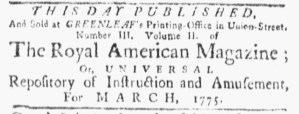
Boston Evening-Post (April 24, 1775).

That brought to conclusion an advertising campaign that lasted nearly two years when Thomas first declared that he would distribute subscription proposals.  For several months, he advertised widely in newspapers in New England, New York, Pennsylvania, and Maryland, seeking subscribers in distant cities for what was the only magazine published in the colonies at the time.  (Robert Aitken eventually launched the Pennsylvania Magazine in January 1775, a year after the Royal American Magazine commenced.)  Thomas scaled back the advertising once he took the first issue of the magazine to press.  In turn, Greenleaf also confined his advertising to Boston’s newspapers.  The ambitious project ended up a casualty of the imperial crisis when resistance became revolution.

This entry concludes an ongoing series in which the Adverts 250 Project has tracked advertisements for the Royal American Magazine from Thomas’s first notice, in May 1773, that he planned to distribute subscription proposals to newspapers advertisements in JuneJulyAugustSeptemberOctoberNovember, and December 1773 and JanuaryFebruaryMarchAprilMay, and June 1774.  No magazine advertisements for the magazine appeared in July 1774 because of the “Distresses,” yet they resumed in AugustSeptemberOctoberNovember, and December 1774 and JanuaryFebruary, and March 1775.

**********

THIS DAY PUBLISHED, The Royal American Magazine; FOR MARCH, 1775”

  • April 13 – Massachusetts Gazette and Boston Weekly News-Letter (first appearance)

JUST PUBLISHED … The Royal American Magazine … For MARCH, 1775”

  • April 20 – Massachusetts Gazette and Boston Weekly News-Letter (first appearance)

“THIS DAY PUBLISHED … The Royal American Magazine … For MARCH, 1775.”

  • April 24 – Boston Evening-Post (first appearance)
April 29

Who was the subject of an advertisement in a revolutionary American newspaper 250 years ago today?

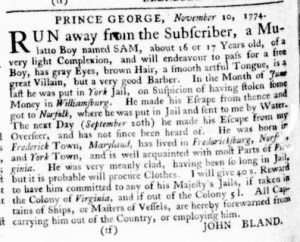
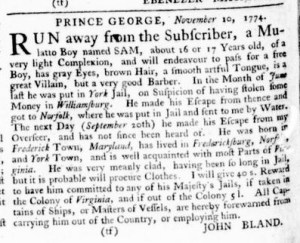
Supplement to the Virginia Gazette [Dixon and Hunter] (April 29, 1775).

“RUN away … a Mulatto Boy named SAM … will endeavour to pass for a free Boy.”

As the imperial crisis intensified in 1774 and erupted into a war in 1775, Sam, an enslaved youth, had his own concerns and fought his own battle for independence.  Like so many other enslaved people, Sam did not author his own story; instead, it was recorded by an enslaver in a newspaper advertisement that offered a reward for the capture and return of the young man after he had liberated himself by running away.

John Bland’s efforts to recover Sam and return him to bondage stretched over many months.  His advertisement indicated that he composed it on November 10, 1774, three weeks before the Continental Association, a nonimportation agreement enacted in response to the Coercive Acts, went into effect.  It ran regularly, including in the supplement that accompanied the April 29, 1775, edition of John Dixon and William Hunter’s Virginia Gazette.  That supplement included the first reports of the battles at Lexington and Concord that appeared in newspapers published in Virginia.  What did Sam think of those events?  Perhaps he welcomed the distraction they provided, shifting attention away from efforts to discover his whereabouts as he “endeavour[ed] to pass for a free Boy.”

Bland offered a brief biography of Sam, likely not emphasizing the details that the youth would have chosen had he written his own narrative.  The enslaver stated that Sam was a mulatto “born in Frederick Town, Maryland,” but did not say anything about his parents or other relations.  Bland considered Sam a “great Villain” with a “smooth artful Tongue,” but acknowledged that he was “a very good Barber,” a rare note of praise in an advertisement of that type.  Bland reported that in June 1774 Sam had been imprisoned in Yorktown “on Suspicion of having stolen some Money in Williamsburg,” but escaped and made his way to Norfolk.  He had been captured and jailed there before being sent back to Bland.  On September 20, Sam once again made a bid for freedom, escaping from Bland’s overseer and “has not since been heard of.”  Having lived in Fredericksburg, Norfolk, and Yorktown, Sam was “well acquainted with most Parts of Virginia,” a factor that likely aided in eluding Bland.  In addition, the enslaver considered it “probable” that Sam “will procure Clothes” to disguise himself.  Bland warned “Captains of Ships” and “Masters of Vessel” against employing Sam or transporting him out of the colony.

Where was Sam?  Did he manage to get aboard a ship?  What other strategies did he deploy to make good on his escape?  Did he have assistance from other enslaved people, free Black men and women, or even sympathetic white colonizers?  What kind of freedom had he experienced in the months since he fled from Bland?  Was he aware that Bland published an advertisement and offered a reward for him?  What was Sam thinking and feeling over those many months?  Bland’s advertisement does not answer those questions, but it does chronicle Sam’s courage and resilience as well as his commitment to seizing his own liberty during an era when colonizers claimed that Parliament and the king perpetrated acts of tyranny against them.  Like so many other fugitives seeking freedom advertised in newspapers from New England to Georgia, Sam made a declaration of independence.

Slavery Advertisements Published April 29, 1775

The Slavery Adverts 250 Project chronicles the role of newspaper advertising in perpetuating slavery in the era of the American Revolution. The project seeks to reveal the ubiquity of slavery in eighteenth-century life from New England to Georgia by republishing advertisements about enslaved people – for sale as individuals or in groups, wanted to purchase or for hire for short periods, runaways who liberated themselves, and those who were subsequently captured and confined in jails and workhouses – in daily digests on this site as well as in real time via the @SlaveAdverts250 Twitter feed, utilizing twenty-first-century media to stand in for the print media of the eighteenth century.

The project aims to provide modern audiences with a sense of just how often colonizers encountered these advertisements in their daily lives. Enslaved men, women, and children appeared in print somewhere in the colonies almost every single day. Those advertisements served as a constant backdrop for social, cultural, economic, and political life in colonial and revolutionary America. Colonizers who did not purport to own enslaved people were still confronted with slavery as well as invited to maintain the system by purchasing enslaved men, women, and children or assisting in the capture of so-called “runaways” who sought to free themselves from bondage. The frequency of these newspaper advertisements suggests just how embedded slavery was in colonial and revolutionary American culture in everyday interactions beyond the printed page.

These advertisements also testify to the experiences of enslaved men, women, and children, though readers must consider that those experiences have been remediated through descriptions offered by enslavers rather than enslaved people themselves. Often unnamed in the advertisements, enslaved men, women, and children were not invisible or unimportant in early America.

These advertisements appeared in colonial American newspapers 250 years ago today.

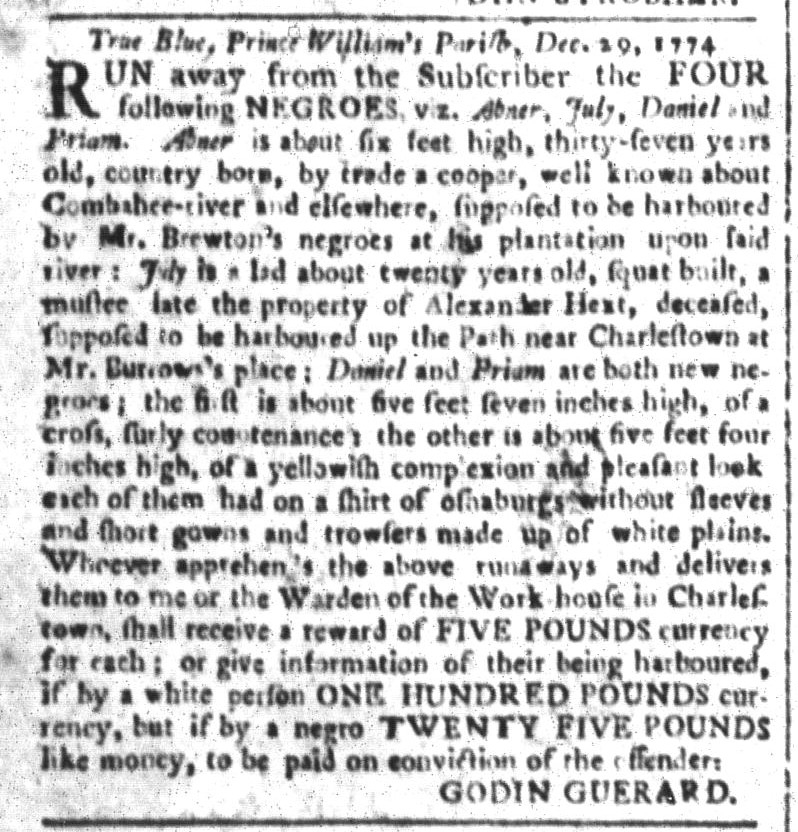
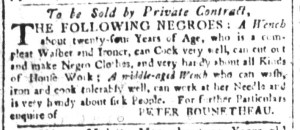
Pennsylvania Ledger (April 29, 1775).

**********

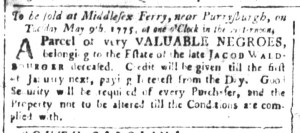
Virginia Gazette [Dixon and Hunter] (April 29, 1775).

**********

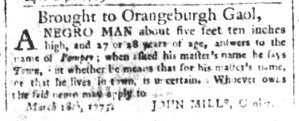
Virginia Gazette [Dixon and Hunter] (April 29, 1775).

**********

Virginia Gazette [Dixon and Hunter] (April 29, 1775).

**********

Virginia Gazette [Dixon and Hunter] (April 29, 1775).

**********

Virginia Gazette [Dixon and Hunter] (April 29, 1775).

**********

Supplement to the Virginia Gazette [Dixon and Hunter] (April 29, 1775).

**********

Supplement to the Virginia Gazette [Dixon and Hunter] (April 29, 1775).

**********

Supplement to the Virginia Gazette [Dixon and Hunter] (April 29, 1775).

April 28

What was advertised in a revolutionary American newspaper 250 years ago today?

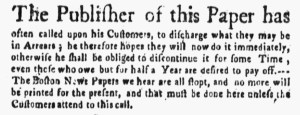
New-Hampshire Gazette (April 28, 1775).

“The Boston News Papers we hear are all stopt.”

It was the sort of notice that printers throughout the colonies regularly inserted in their newspapers, though Daniel Fowle, the printer of the New-Hampshire Gazette in Portsmouth, may have done so with greater frequency than some of his counterparts in other towns.  “The Publisher of this Paper,” he declared on April 28, 1775, “has often called upon his Customers, to discharge what they may be in Arrears.”  This time, however, he did not threaten to stop sending copies to delinquent subscribers who did not pay their bills.  Instead, he suggested that the entire enterprise was at stake, that if he did not receive those payments “immediately” then “he shall be obliged to discontinue [the newspaper] for some Time.”  In other instances, printers addressed subscribers who had not paid in several years, but, again, this time was different.  Fowle proclaimed that “even those who owe but for half a Year are desired to pay off.”

To demonstrate the gravity of the situation, he reported that the “Boston News Papers we hear are all stopt, and no more will be printed for the present.”  Indeed, Fowle had heard correctly.  Five newspapers were published in Boston at the beginning of the month, but none continued uninterrupted by the end of April.  Isaiah Thomas removed the Massachusetts Spy to Worcester before the battles at Lexington and Concord on April 19.  Other printers suspended publication of their newspapers, believing that they would do so only “till Matters are in a more settled State.”  Yet it was the end for the Boston Evening-Post and the Massachusetts Gazette and Boston Post-Boy.  The Boston-Gazette and the Massachusetts Gazette and Boston Weekly News-Letter did eventually resume publication, though only the Boston-Gazette survived the Revolutionary War.

At that moment, neither Fowle nor his subscribers knew the fate of Boston’s newspapers or the New-Hampshire Gazette.  The printer asserted that he would cease publication “unless the Customers attend to this call.”  He did so on the same page that carried more extensive coverage of the events at Lexington and Concord than he had been able to publish in the previous issue because of the “different and contrary Accounts of the late Bloody Scene” received in the printing office in the hours immediately after something momentous happened.  When news about those engagements appeared in the April 28 edition, Fowle used thick black borders, usually associated with mourning, to draw attention.  He also inserted a note at the bottom of the first page: “See the other Side of the Paper an Account of the late Battle.”  In addition, instead of the usual four pages, that issue consisted of only two, an indication to readers that Fowle had limited resources.  If they wanted to continue receiving coverage in print to supplement what they heard by word of mouth, subscribers needed to “discharge what they may be in Arrears” and “do it immediately.”

Slavery Advertisements Published April 28, 1775

The Slavery Adverts 250 Project chronicles the role of newspaper advertising in perpetuating slavery in the era of the American Revolution. The project seeks to reveal the ubiquity of slavery in eighteenth-century life from New England to Georgia by republishing advertisements about enslaved people – for sale as individuals or in groups, wanted to purchase or for hire for short periods, runaways who liberated themselves, and those who were subsequently captured and confined in jails and workhouses – in daily digests on this site as well as in real time via the @SlaveAdverts250 Twitter feed, utilizing twenty-first-century media to stand in for the print media of the eighteenth century.

The project aims to provide modern audiences with a sense of just how often colonizers encountered these advertisements in their daily lives. Enslaved men, women, and children appeared in print somewhere in the colonies almost every single day. Those advertisements served as a constant backdrop for social, cultural, economic, and political life in colonial and revolutionary America. Colonizers who did not purport to own enslaved people were still confronted with slavery as well as invited to maintain the system by purchasing enslaved men, women, and children or assisting in the capture of so-called “runaways” who sought to free themselves from bondage. The frequency of these newspaper advertisements suggests just how embedded slavery was in colonial and revolutionary American culture in everyday interactions beyond the printed page.

These advertisements also testify to the experiences of enslaved men, women, and children, though readers must consider that those experiences have been remediated through descriptions offered by enslavers rather than enslaved people themselves. Often unnamed in the advertisements, enslaved men, women, and children were not invisible or unimportant in early America.

These advertisements appeared in colonial American newspapers 250 years ago today.

New-Hampshire Gazette (April 28, 1775).

**********

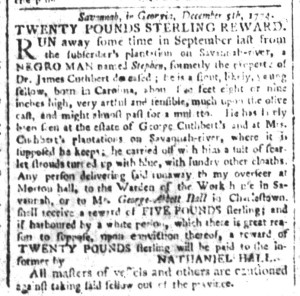
South-Carolina and American General Gazette (April 28, 1775).

**********

South-Carolina and American General Gazette (April 28, 1775).

**********

South-Carolina and American General Gazette (April 28, 1775).

**********

South-Carolina and American General Gazette (April 28, 1775).

**********

South-Carolina and American General Gazette (April 28, 1775).

**********

South-Carolina and American General Gazette (April 28, 1775).

**********

South-Carolina and American General Gazette (April 28, 1775).

**********

South-Carolina and American General Gazette (April 28, 1775).

**********

South-Carolina and American General Gazette (April 28, 1775).

**********

South-Carolina and American General Gazette (April 28, 1775).

**********

South-Carolina and American General Gazette (April 28, 1775).

**********

South-Carolina and American General Gazette (April 28, 1775).

**********

South-Carolina and American General Gazette (April 28, 1775).

**********

South-Carolina and American General Gazette (April 28, 1775).

**********

South-Carolina and American General Gazette (April 28, 1775).

**********

South-Carolina and American General Gazette (April 28, 1775).

**********

South-Carolina and American General Gazette (April 28, 1775).

**********

South-Carolina and American General Gazette (April 28, 1775).

**********

South-Carolina and American General Gazette (April 28, 1775).

**********

South-Carolina and American General Gazette (April 28, 1775).

**********

South-Carolina and American General Gazette (April 28, 1775).

**********

South-Carolina and American General Gazette (April 28, 1775).

**********

South-Carolina and American General Gazette (April 28, 1775).

**********

South-Carolina and American General Gazette (April 28, 1775).

**********

South-Carolina and American General Gazette (April 28, 1775).

**********

South-Carolina and American General Gazette (April 28, 1775).

**********

South-Carolina and American General Gazette (April 28, 1775).

**********

South-Carolina and American General Gazette (April 28, 1775).

**********

Story and Humphreys’s Pennsylvania Mercury (April 28, 1775).

**********

Virginia Gazette [Pinkney] (April 28, 1775).

**********

Virginia Gazette [Purdie] (April 28, 1775).

**********

Virginia Gazette [Purdie] (April 28, 1775).

**********

Virginia Gazette [Purdie] (April 28, 1775).

**********

Virginia Gazette [Purdie] (April 28, 1775).

**********

Virginia Gazette [Purdie] (April 28, 1775).

**********

Virginia Gazette [Purdie] (April 28, 1775).

**********

Virginia Gazette [Purdie] (April 28, 1775).

**********

Virginia Gazette [Purdie] (April 28, 1775).

**********

Virginia Gazette [Purdie] (April 28, 1775).

**********

Virginia Gazette [Purdie] (April 28, 1775).

April 27

What was advertised in a revolutionary American newspaper 250 years ago today?

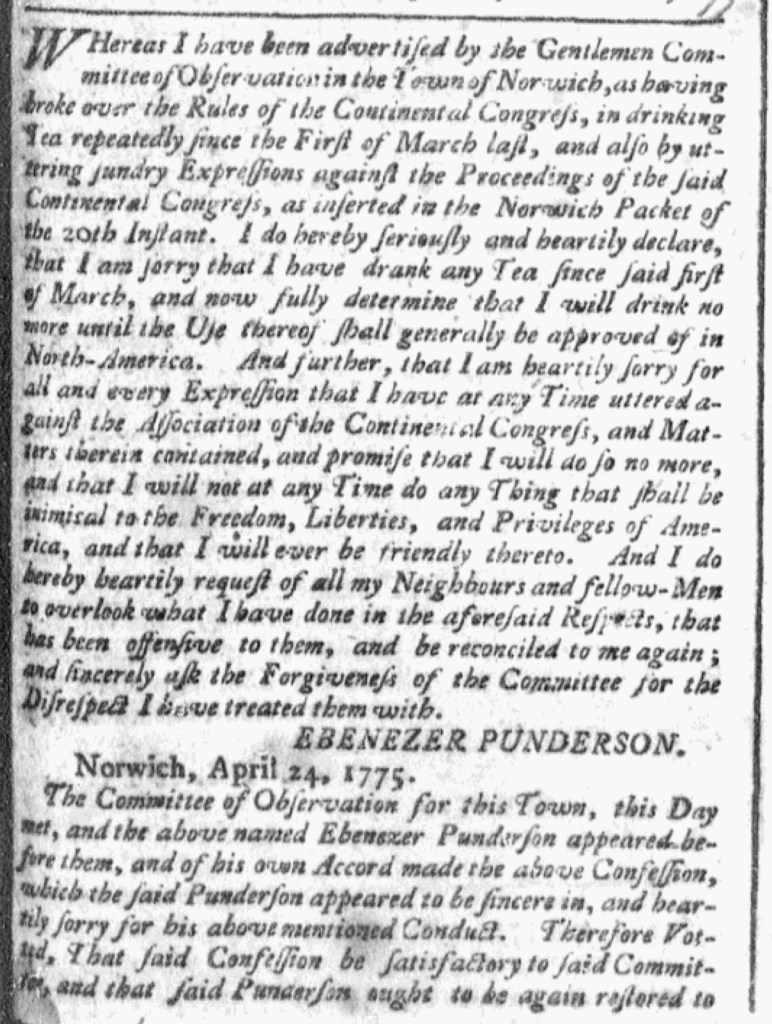
Norwich Packet (April 27, 1775).

I am sorry that I have drank any Tea.”

Ebenezer Punderson had the misfortune of appearing in an advertisement placed in the Norwich Packet by the local Committee of Inspection in the issue that carried the first newspaper coverage of the battles of Lexington and Concord.  The committee accused him of drinking tea in violation of the Continental Association, disparaging the First Continental Congress, and refusing to meet with the committee to discuss his conduct.  In turn, the committee advised the public not to carry on any “Trade, Commerce, Dealings or Intercourse” with Punderson.

Perhaps Punderson would have weathered that sort of public shaming under other circumstances, but news of events at Lexington and Concord made his politics even more unpalatable and his situation more dire.  From what ran in the newspaper, it did not take him long to change his tune, meet with the committee, and publish an apology for his behavior.  In a missive dated four days after the committee’s advertisement, Punderson reiterated the charges against him and “seriously and heartily” declared the he was “sorry I have drank any Tea since the first of March” and “will drink no more until the Use thereof shall generally be approved in North-America.”  In addition, he apologized for “all and every Expression that I have at any Time uttered against the Association of the Continental Congress.”  Furthermore, Punderson pledged that he “will not at any Time do any Thing that shall be inimical to the Freedom, Liberties, and Privileges of America, and that I will ever be friendly thereto.”  He requested that his “Neighbours and fellow-Men to overlook” his transgression and “sincerely ask[ed] the Forgiveness of the Committee for the Disrespect I have treated them with.”

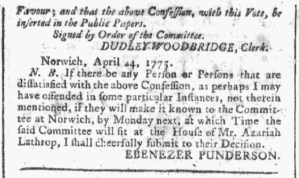
Norwich Packet (April 27, 1775).

Punderson apparently convinced the committee to give him another chance.  Dudley Woodbridge, the clerk, reported that Punderson “appeared before them, and of his own Accord made the above Confession” and seemed “heartily sorry for his … conduct.”  In turn, the committee voted to find Punderson’s confession “satisfactory” and recommended that he “be again restored to Favour” in the community.  The committee also determined that “the above Confession, with this Vote, be inserted in the Public Papers,” perhaps less concerned with restoring Punderson’s good name than the example his recantation set for other Tories.  When the notice appeared in the Norwich Packet, Punderson inserted an additional note that extended an offer to meet with anyone “dissatisfied with the above Confession” and asserted that he would “cheerfully submit” to any further decisions the Committee of Inspection made in response.

Yet what appeared in the Norwich Packet did not tell the whole story.  According to Steve Fithian, Punderson “attempted to flee to New York but was captured and returned to Norwich where he spent eight days in jail and only released after signing a confession admitting to his loyalist sympathies.”  He did not stay in Norwich long after that.  “Several weeks later he fled to Newport, Rhode Island and boarded a ship which took him to England where he remained for the entire Revolutionary War.”  Apparently, he convincly feigned the sincerity he expressed, well enough that the committee accepted it.  While imprisoned, Punderson wrote a letter to his wife about his ordeal.  After arriving in England, he published an account with a subtitle that summarized what he had endured: The Narrative of Mr. Ebenezer Punderson, Merchant; Who Was Drove Away by the Rebels in America from His Family and a Very Considerable Fortune in Norwich, in Connecticut.  Just as the Committee of Inspection used print to advance a version of events that privileged the patriot cause, Punderson disseminated his own rendering once he arrived in a place where he could safely do so.

**********

The Committee of Inspection’s notice appeared with the advertisements in the April 20, 1775, edition of the Norwich Packet.  Punderson’s confession, however, ran interspersed with news items in the April 27 edition.  It may or may not have been a paid notice, but it was certainly an “advertisement” in the eighteenth-century meaning of the word.  At the time, according to the Oxford English Dictionary, an advertisement was a “(written) statement calling attention to anything” and “an act of informing or notifying.”  Advertisements often delivered local news in early American newspapers.  Punderson definitely made news as the imperial crisis became a war.
Slavery Advertisements Published April 27, 1775

The Slavery Adverts 250 Project chronicles the role of newspaper advertising in perpetuating slavery in the era of the American Revolution. The project seeks to reveal the ubiquity of slavery in eighteenth-century life from New England to Georgia by republishing advertisements about enslaved people – for sale as individuals or in groups, wanted to purchase or for hire for short periods, runaways who liberated themselves, and those who were subsequently captured and confined in jails and workhouses – in daily digests on this site as well as in real time via the @SlaveAdverts250 Twitter feed, utilizing twenty-first-century media to stand in for the print media of the eighteenth century.

The project aims to provide modern audiences with a sense of just how often colonizers encountered these advertisements in their daily lives. Enslaved men, women, and children appeared in print somewhere in the colonies almost every single day. Those advertisements served as a constant backdrop for social, cultural, economic, and political life in colonial and revolutionary America. Colonizers who did not purport to own enslaved people were still confronted with slavery as well as invited to maintain the system by purchasing enslaved men, women, and children or assisting in the capture of so-called “runaways” who sought to free themselves from bondage. The frequency of these newspaper advertisements suggests just how embedded slavery was in colonial and revolutionary American culture in everyday interactions beyond the printed page.

These advertisements also testify to the experiences of enslaved men, women, and children, though readers must consider that those experiences have been remediated through descriptions offered by enslavers rather than enslaved people themselves. Often unnamed in the advertisements, enslaved men, women, and children were not invisible or unimportant in early America.

These advertisements appeared in colonial American newspapers 250 years ago today.

Maryland Gazette (April 27, 1775).

**********

Maryland Gazette (April 27, 1775).

**********

Maryland Gazette (April 27, 1775).

**********

Maryland Gazette (April 27, 1775).

**********

Maryland Gazette (April 27, 1775).

**********

Maryland Gazette (April 27, 1775).

**********

Maryland Gazette (April 27, 1775).

**********

Rivington’s New-York Gazetteer (April 27, 1775).

April 26

What was advertised in a revolutionary American newspaper 250 years ago today?

Pennsylvania Journal (April 26, 1775).

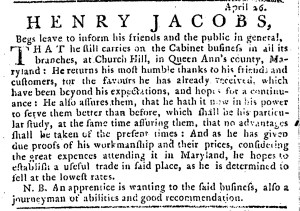
“He still carries on the Cabinet business … no advantages shall be taken of the present times.”

Henry Jacobs had confidence in the circulation of the Pennsylvania Journal when he placed an advertisement in the spring of 1775.  Addressing “his friends and the public in general,” he declared that he “still carries on the Cabinet business in all its branches, at Church Hill, in Queen Ann’s county, Maryland.”  That small town on the colony’s eastern shore was approximately eighty miles from Philadelphia, the bustling port where William Bradford and Thomas Bradford printed the Pennsylvania Journal, yet Jacobs considered advertising in that newspaper a sound investment.  He may not have expected to gain any customers in Philadelphia, but he realized that the Pennsylvania Journal served an extensive readership in Pennsylvania, New Jersey, Delaware, and Maryland.  That meant that “the public in general” in Queen Anne’s County might see his advertisement as copies of the Pennsylvania Journal circulated there.

Yet some of the language in his advertisement suggests that Jacobs did not yet have friends and customers in Maryland.  Near the end of his notice, he stated that he “hopes to establish a useful trade in said place,” indicating that he may have been a newcomer there.  Perhaps Jacobs relocated from Philadelphia.  When he announced that he “still carries on the Cabinet business … at Church Hill,” the “still” may have referred to pursuing his trade but not the location.  Jacobs’s advertisement might have been a moving notice, alerting customers that he left one town and opened a workshop in another.  He hoped to maintain at least some of his former clientele.  If that was the case, it also helps to explain why he chose to advertise in a newspaper published in Philadelphia rather than the Maryland Gazette printed in Annapolis.  Furthermore, he sought an apprentice and a journeyman “of abilities and good recommendation,” possibly seeking staff to assist him at his workshop in a new town.

Like many other colonizers who advertised goods and services, Jacobs expressed gratitude to “his friends and customers, for the favours he has already received.”  Doing so signaled to readers not familiar with him or his furniture that he was an established artisan.  He underscored his skill and experience when he trumpeted that he “has given due proofs of his workmanship.”  Jacobs intended to bolster his reputation, especially when he stated that customers previously placed orders “beyond his expectations.”  Such appeals could have resonated with customers in both Philadelphia and Queen Anne’s County.  The primary purpose of his advertisement, after all, was not to proclaim “his most humble thanks” but instead to drum up new business.  To that end, he asserted that he “hath it now in his power to serve [his customers] better than before,” though he did not explain what he meant when he gave those assurances.  If he had been in Church Hill for some time, perhaps he made improvements to his workshop or acquired new tools.  If he was new to town, he may have referred to his new workshop.  Whatever the case, he promised that “no advantages shall be taken of the present times.”  Jacobs likely had not heard about events at Lexington and Concord on April 19 when he composed his advertisement and submitted it to the printing office.  The “present times” became more complicated as the imperial crisis became a war.

Slavery Advertisements Published April 26, 1775

The Slavery Adverts 250 Project chronicles the role of newspaper advertising in perpetuating slavery in the era of the American Revolution. The project seeks to reveal the ubiquity of slavery in eighteenth-century life from New England to Georgia by republishing advertisements about enslaved people – for sale as individuals or in groups, wanted to purchase or for hire for short periods, runaways who liberated themselves, and those who were subsequently captured and confined in jails and workhouses – in daily digests on this site as well as in real time via the @SlaveAdverts250 Twitter feed, utilizing twenty-first-century media to stand in for the print media of the eighteenth century.

The project aims to provide modern audiences with a sense of just how often colonizers encountered these advertisements in their daily lives. Enslaved men, women, and children appeared in print somewhere in the colonies almost every single day. Those advertisements served as a constant backdrop for social, cultural, economic, and political life in colonial and revolutionary America. Colonizers who did not purport to own enslaved people were still confronted with slavery as well as invited to maintain the system by purchasing enslaved men, women, and children or assisting in the capture of so-called “runaways” who sought to free themselves from bondage. The frequency of these newspaper advertisements suggests just how embedded slavery was in colonial and revolutionary American culture in everyday interactions beyond the printed page.

These advertisements also testify to the experiences of enslaved men, women, and children, though readers must consider that those experiences have been remediated through descriptions offered by enslavers rather than enslaved people themselves. Often unnamed in the advertisements, enslaved men, women, and children were not invisible or unimportant in early America.

These advertisements appeared in colonial American newspapers 250 years ago today.

Maryland Journal (April 26, 1775).

**********

Maryland Journal (April 26, 1775).

**********

Maryland Journal (April 26, 1775).

**********

Pennsylvania Gazette (April 26, 1775).

**********

Pennsylvania Journal (April 26, 1775).

April 25

What was advertised in a revolutionary American newspaper 250 years ago today?

Essex Gazette (April 25, 1775).

“MEDICINES … at the Sign of the Lion and Mortar.”

Jonathan Waldo placed an advertisement for imported “DRUGS and MEDICINES” available at his shop on King Street in Salem, Massachusetts, in the Essex Gazette on April 11, 1775.  He presumably paid a fee that included setting the type and running the notice in three consecutive issues before discontinuing it, a standard arrangement according to the pricing schemes in the colophons of several early American newspapers.  That meant that his advertisement appeared again on April 18, the eve of the skirmishes at Lexington and Concord that started the Revolutionary War, and finally on April 25.  That issue included coverage of “the Troops of his Britannick Majesty commenc[ing] Hostilities upon the People of this Province.”  Samuel Hall and Ebenezer Hall would print only one more issue of the Essex Gazette in Salem before moving to Cambridge and continuing the newspaper as the New-England Chronicle.  What happened to Waldo during the war?  According to Donna Seger, the apothecary served as a major in the Salem Militia and his business “survived through the Revolution through a dual strategy of continuing to import apparently-contraband British medicine and concocting his own American substitutions.”

Seger describes Waldo as a savvy entrepreneur who diversified his business after the war, noting that “the Revolution seems to have inspired ‘innovation’ and reaped more profits” for the apothecary once he began marketing less expensive American versions of popular British patent medicines.  His advertisement from the spring of 1775 indicates that he also made shrewd decisions before the war began, including setting up shop “at the Sign of the Lion and Mortar, lately improved by Dr. KAST.”  Philip Godrid Kast was a well-known and successful apothecary who had marked his shop with “the Sign of the Lyon and Mortarfor many years.  It almost certainly became a familiar sight for residents of Salem as they traversed the streets of the town and attracted notice from visitors.  Kast even included an image of the sign on an engraved trade card dated to 1774, further associating the “Sign of the Lyon & Mortar” with his business when he distributed it to current and prospective customers.  Waldo apparently took possession of the sign when he moved into the shop previously occupied by Kast.  He could have commissioned a new device to represent his business.  Nathaniel Dabney, for instance, sold medicines “at the Head of HIPPOCRATES, in Salem,” and included an illustration of the bust of the physician from ancient Greece in some of his advertisements.  Yet the “Sign of the Lion and Mortar” was both appropriate for Waldo’s occupation and had a reputation associated with it that he wished to leverage.  Waldo likely hoped to gain some of Kast’s customers when he took over the shop.  Keeping the “Sign of the Lion and Mortar” on display testified to the continuity of service that he provided.