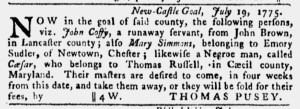
August 20

What was advertised in a revolutionary American newspaper 250 years ago this week?
South-Carolina and American General Gazette (August 18, 1775).

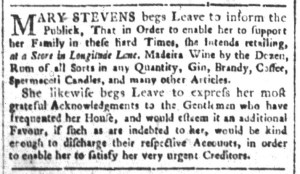
“In Order to enable her to support her Family in these hard Time, she intends retailing … Gin, Brandy, Coffee.”

Women regularly advertised goods and services in early American newspapers.  Mrs. Miller, a milliner, for instance, ran an advertisement in the August 18, 1775, edition of the South-Carolina and American General Gazette.  Like many advertisements placed by female entrepreneurs, it did not differ from others placed by their male counterparts.  Mary Stevens also placed an advertisement in the same issue of that newspaper, though she deployed a marketing strategy more often used by women than by men.  She announced that she planned to open a store to retail wine, rum, gin, brandy, coffee, candles, and “many other Article.”  She did so, she declared, “in Order to enable her to support her Family in these hard Times.”  Rather than promote the quality or variety of her wares or promise exemplary customer service, some of the most common marketing strategies of the era, Stevens made her ability to support her family the primary reason that prospective customers should visit her store.  Many readers would have known more details than Stevens revealed in her advertisement, details that would have made her even more sympathetic.

Whatever her circumstances, Stevens had apparently conducted another sort of business for some time.  She devoted the second half of her advertisement to expressing “her most grateful Acknowledgments to the Gentlemen who have frequented her House.”  Again, many readers would have known whether Stevens took in boarders or prepared meals or served coffee in the parlor while her patrons discussed business and current events.  She served those “Gentlemen” on credit, but “these hard Times” made it necessary to ask them to “discharge their respective Accounts, in order to enable her to satisfy her very urgent Creditors.”  Men very often placed newspaper notices that called on associates to settle accounts, but rarely did they invoke the urgency that Stevens conveyed in her advertisement.  Even more rarely did they refer to supporting their families.  As a woman in business, Stevens may have been able to exercise a small amount of privilege in framing her advertisement in this manner, though the necessity that led her to do so did not suggest that she benefited from many advantages when it came to participating in the marketplace.
August 19

What was advertised in a revolutionary American newspaper 250 years ago today?

Pennsylvania Ledger (August 19, 1775).

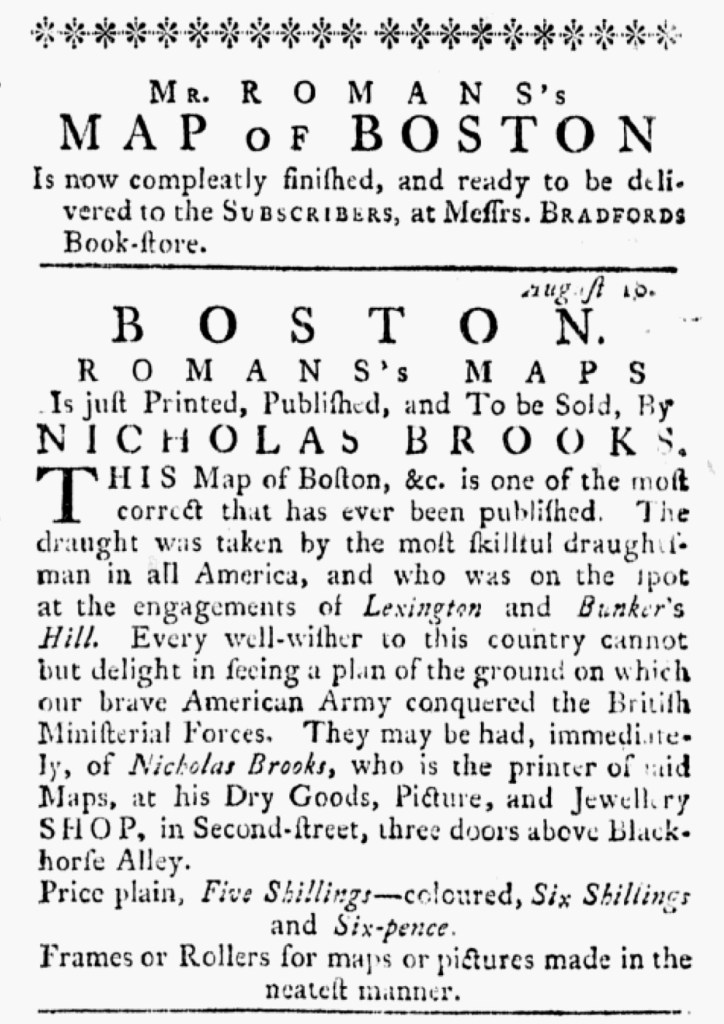
“Map of Boston … the engagements of Lexington and Bunker’s Hill.”

More advertisements for “MR. ROMANS’s MAP OF BOSTON” appeared in the August 19, 1774, edition of the Pennsylvania Ledger.  Bernard Romans, the cartographer who created a “MAP, FROM BOSTON TO WORCESTER, PROVIDENCE AND SALEM. Shewing the SEAT of the present unhappy CIVIL WAR in NORTH-AMERICA,” and Nicholas Brooks, the publisher, previously promoted the project with a broadside subscription proposal that began circulating in the middle of July and scattered references to the map at the end of advertisements in the Pennsylvania Ledger.  Two weeks earlier, for instance, Brooks ran an advertisement that featured an extensive list of merchandise available at his shop and added a nota bene of a single line: “Romans’s map of the seat of war near Boston, &c.”  Robert Aitken mentioned the map in a slightly longer nota bene when he advertised Military Instructions for Officers Detached in the Field.  An advertisement in Rivington’s New-York Gazetteer replicated the copy from the broadside.

Once the map was “completely finished, and ready to be delivered to the SUBSCRIBERS,” as William Bradford and Thomas Bradford put it in their advertisement, or “just Printed, Published, and To be Sold,” as Brooks proclaimed in his own notice, it received greater attention in newspaper notices.  Although many similar projects utilized subscription proposals in newspapers to generate demand attract orders in advance of publication, Romans and Brooks relied on their broadside subscription proposal during their first round of marketing and later added newspaper advertisements once the map was available for sale.

Just four months after the battles at Lexington and Concord, a remarkably short interval for such an endeavor, Brooks advertised copies of Romans’s map of Boston for sale at his “Dry Goods, Picture, and Jewellery SHOP” in Philadelphia.  He touted the quality of the map, declaring it “one of the most correct that has ever been published” and emphasiziong that the “draught was taken by the most skillful draughtsman in all America.”  As if that was not enough to sell it, Romans “was on the spot at the engagements of Lexington and Bunker’s Hill.”  Brooks marketed an eyewitness account of those important battles.  Furthermore, he asserted that consumers had a patriotic duty to examine the map, which they could do by purchasing it.  “Every well-wisher to this country,” Brooks trumpeted, “cannot but delight in seeing a plan of the ground on which our brave American Army conquered the British Ministerial Forces.”  Commemoration and commodification of the American Revolution occurred before the Continental Congress declared independence.

Slavery Advertisements Published August 19, 1775

GUEST CURATORS:  Connor Harris, Chris Tocci, and Olivia Tocci

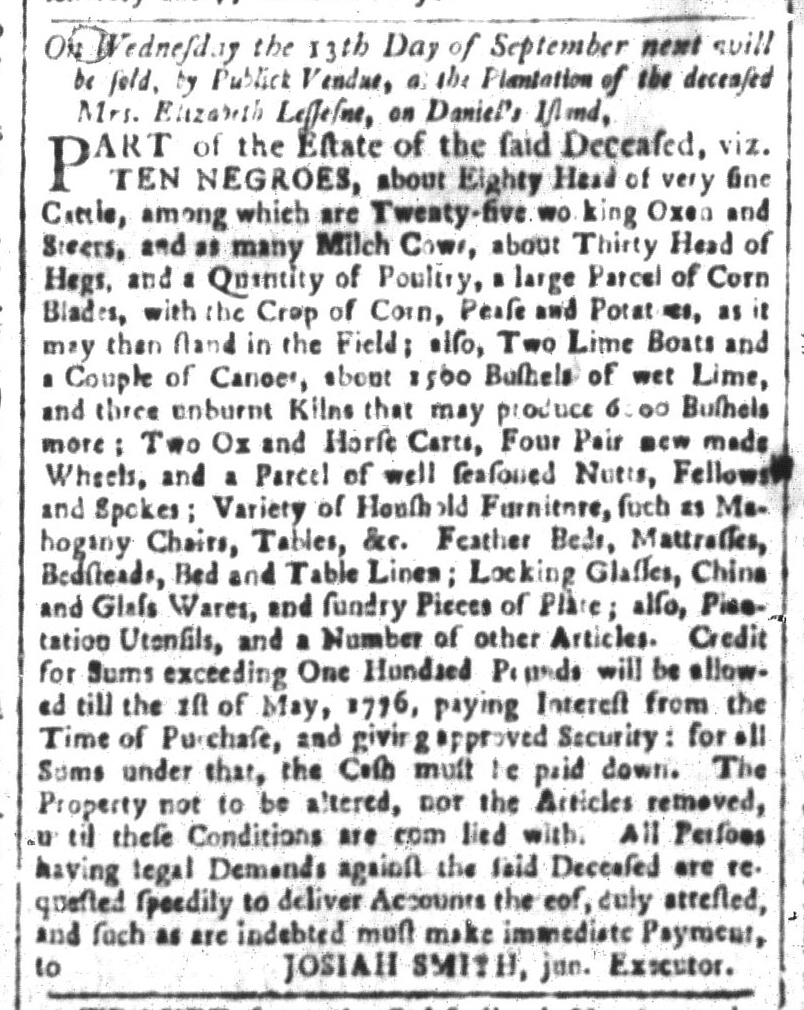
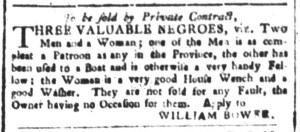
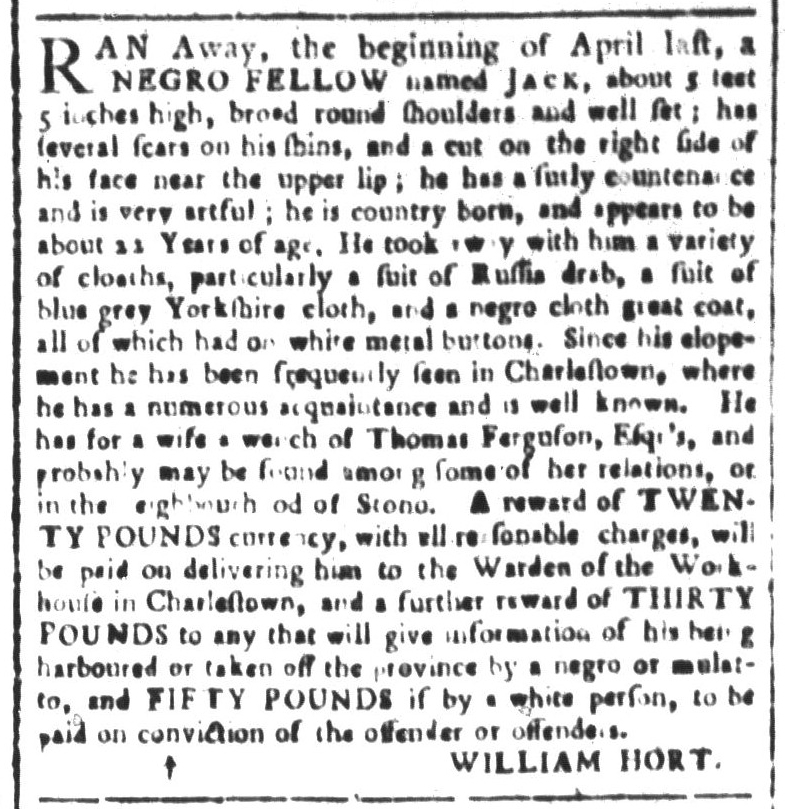
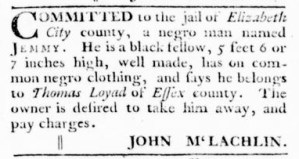
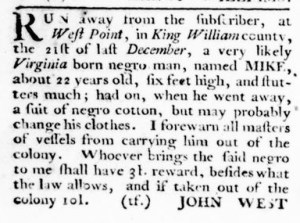
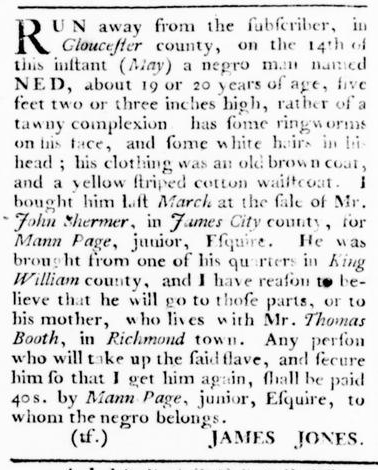
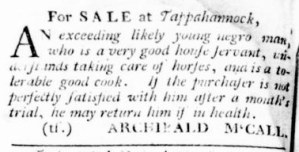
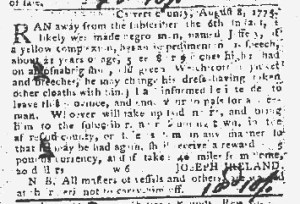
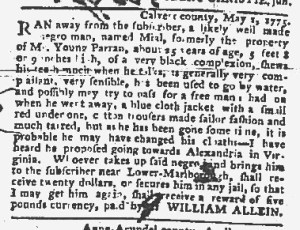
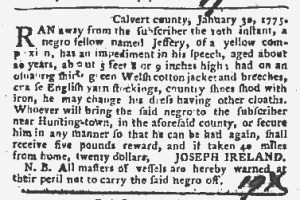
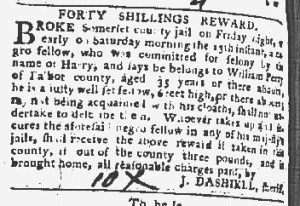
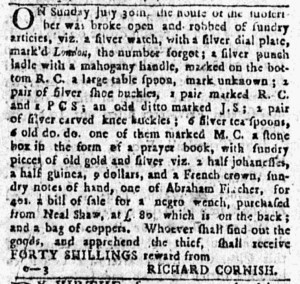
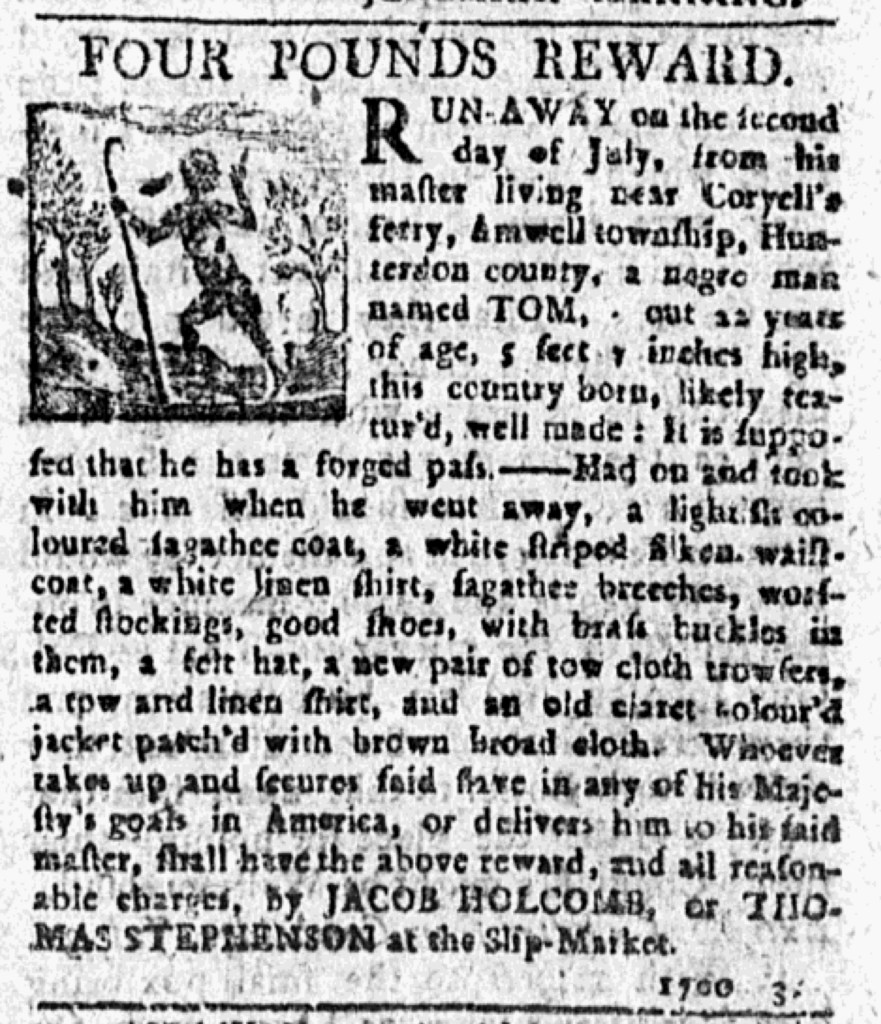
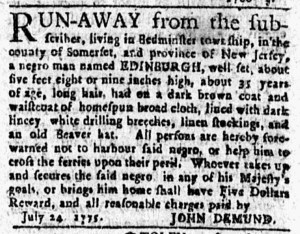
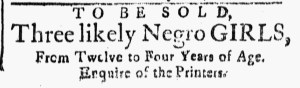
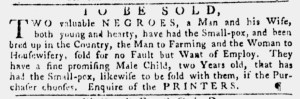
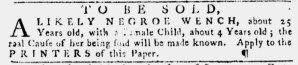
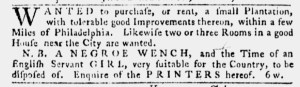
The Slavery Adverts 250 Project chronicles the role of newspaper advertising in perpetuating slavery in the era of the American Revolution. The project seeks to reveal the ubiquity of slavery in eighteenth-century life from New England to Georgia by republishing advertisements about enslaved people – for sale as individuals or in groups, wanted to purchase or for hire for short periods, runaways who liberated themselves, and those who were subsequently captured and confined in jails and workhouses – in daily digests on this site as well as in real time via the @SlaveAdverts250 Twitter feed, utilizing twenty-first-century media to stand in for the print media of the eighteenth century.

The project aims to provide modern audiences with a sense of just how often colonizers encountered these advertisements in their daily lives. Enslaved men, women, and children appeared in print somewhere in the colonies almost every single day. Those advertisements served as a constant backdrop for social, cultural, economic, and political life in colonial and revolutionary America. Colonizers who did not purport to own enslaved people were still confronted with slavery as well as invited to maintain the system by purchasing enslaved men, women, and children or assisting in the capture of so-called “runaways” who sought to free themselves from bondage. The frequency of these newspaper advertisements suggests just how embedded slavery was in colonial and revolutionary American culture in everyday interactions beyond the printed page.

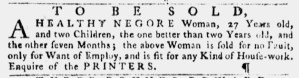
These advertisements also testify to the experiences of enslaved men, women, and children, though readers must consider that those experiences have been remediated through descriptions offered by enslavers rather than enslaved people themselves. Often unnamed in the advertisements, enslaved men, women, and children were not invisible or unimportant in early America.

These advertisements appeared in colonial American newspapers 250 years ago today.

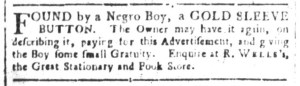
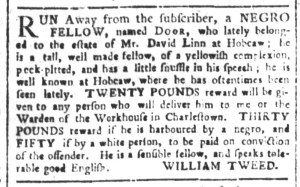
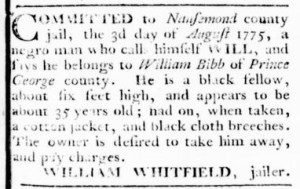
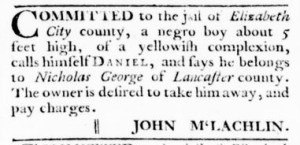
Virginia Gazette [Dixon and Hunter] (August 19, 1775).

August 18

What was advertised in a revolutionary American newspaper 250 years ago today?

South-Carolina and American General Gazette (August 18, 1775).

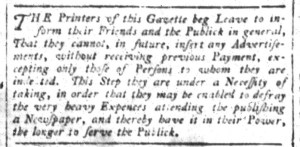
They cannot … insert any Advertisements, without receiving previous Payment.”

The August 18, 1775, edition of the South-Carolina and American General Gazette included an update about how Robert Wells and Son would conduct business.  “THE Printers of this Gazette,” they stated, “beg Leave to inform their Friends and the Publick in general, That they cannot, in future, insert any Advertisements, without receiving Payments” in advance.  Wells and Son did make an exception for “persons to whom they are indebted.”  Why did they change their policy?  “This Stop they are under a Necessity of taking,” the printers explained, “in order that they may be enabled to defray the very heavy Expences attending the publishing a Newspaper, and therevy have it in their Power, the longer to serve the Publick.”  That warning carried even more weight when readers and “the Publick in general” considered that the South-Carolina Gazette and Country Journal, one of three newspapers published in Charleston during the last decade, “discontinued” publication just a few weeks earlier.

This notice indicates that a common assumption about how printers managed their newspapers may be more complex than historians of the early American press previously realized.  The usual narrative asserts that printers extended generous credit to subscribers, allowing them to go years without paying for their newspapers because the printers wanted to bolster their circulation numbers.  In turn, that meant that they could attract more advertisers … and advertisements provided the most important revenue stream, especially since printers supposedly required advertisers to pay for their newspaper notices in advance.  For several years, the Adverts 250 Project has tracked notices that seem to contradict that narrative, though references to “advertisements” in some of those notices may have referred to handbills, broadsides, and other media distributed separately rather than newspaper notices.  In this notice, however, Wells and Son clearly referred to inserting advertisement in their newspaper.  While they adopted a new policy of requiring payment for advertisements in advance, they previously extended credit to advertisers.  More printers mya have done so than historians have realized.

Slavery Advertisements Published August 18, 1775

GUEST CURATORS:  Connor Harris, Chris Tocci, and Olivia Tocci

The Slavery Adverts 250 Project chronicles the role of newspaper advertising in perpetuating slavery in the era of the American Revolution. The project seeks to reveal the ubiquity of slavery in eighteenth-century life from New England to Georgia by republishing advertisements about enslaved people – for sale as individuals or in groups, wanted to purchase or for hire for short periods, runaways who liberated themselves, and those who were subsequently captured and confined in jails and workhouses – in daily digests on this site as well as in real time via the @SlaveAdverts250 Twitter feed, utilizing twenty-first-century media to stand in for the print media of the eighteenth century.

The project aims to provide modern audiences with a sense of just how often colonizers encountered these advertisements in their daily lives. Enslaved men, women, and children appeared in print somewhere in the colonies almost every single day. Those advertisements served as a constant backdrop for social, cultural, economic, and political life in colonial and revolutionary America. Colonizers who did not purport to own enslaved people were still confronted with slavery as well as invited to maintain the system by purchasing enslaved men, women, and children or assisting in the capture of so-called “runaways” who sought to free themselves from bondage. The frequency of these newspaper advertisements suggests just how embedded slavery was in colonial and revolutionary American culture in everyday interactions beyond the printed page.

These advertisements also testify to the experiences of enslaved men, women, and children, though readers must consider that those experiences have been remediated through descriptions offered by enslavers rather than enslaved people themselves. Often unnamed in the advertisements, enslaved men, women, and children were not invisible or unimportant in early America.

These advertisements appeared in colonial American newspapers 250 years ago today.

South-Carolina and American General Gazette (August 18, 1775).

**********

South-Carolina and American General Gazette (August 18, 1775).

**********

South-Carolina and American General Gazette (August 18, 1775).

**********

South-Carolina and American General Gazette (August 18, 1775).

**********

South-Carolina and American General Gazette (August 18, 1775).

**********

Supplement to the Virginia Gazette [Purdie] (August 18, 1775).

**********

Supplement to the Virginia Gazette [Purdie] (August 18, 1775).

**********

Supplement to the Virginia Gazette [Purdie] (August 18, 1775).

**********

Supplement to the Virginia Gazette [Purdie] (August 18, 1775).

**********

Supplement to the Virginia Gazette [Purdie] (August 18, 1775).

**********

Supplement to the Virginia Gazette [Purdie] (August 18, 1775).

August 17

What was advertised in a revolutionary American newspaper 250 years ago today?

New-England Chronicle (August 17, 1775).

“Cash given … for homespun Cloth … and for yarn Stockings.”

Stephen Hall III placed an advertisement in the August 17, 1775, edition of the New-England Chronicle to inform “the Publick” that he “has again opened his Shop” in Medford, Massachusetts, and offered a variety of textiles, “Gloves and Mitts,” “handsome Fans and Ribbons,” and other items for sale.  The shopkeeper did not indicate when he had acquired these imported items, whether they had arrived in the colony before the Continental Association went into effect on December 1, 1774.

He did, however, state that he paid cash for “homespun Cloth” and “yarn Stockings” produced locally rather than imported from Britain.  The Continental Association called on colonizers to “encourage Frugality, Economy, and Industry; and promote Agriculture, Arts, and the Manufactures of this Country” as alternatives to imported goods.  That gave textiles and garments made from them political meaning beyond testifying to taste and status as consumers deployed their choices in the marketplace as leverage in their contest with Parliament.  In response to the Stamp Act in 1765, the duties levied in the Townshend Acts in the late 1760s, and the provisions of the Coercive Acts in 1774, colonizers participated in boycotts – nonimportation and nonconsumption agreements – to pressure Parliament to repeal offensive legislation.  Each round of boycotts came with renewed efforts to produce and to consume “domestic manufactures.”

This also presented women with opportunities to participate in politics.  They did so when they made choices as consumers, such as selecting homespun cloth over the “Shalloons,” “Serges,” “Ginghams,” “Poplins,” “Calimancoes,” and other fabrics that Hall and other merchants and shopkeepers imported.  Yet their role as producers gained political significance as well.  They undertook carding and spinning with new purpose, sometimes holding spinning bees in public spaces rather than the usual domestic settings to make their contributions to the American cause more visible and to inspire others to join them.  Similarly, weaving and making clothing also became political acts.  Although Hall did not mention women as producers in his newspaper advertisement, readers knew that women produced the “homespun Cloth” and “yarn Stockings” he sought.  They participated in the American Revolution in their own way.

Slavery Advertisements Published August 17, 1775

GUEST CURATORS:  Connor Harris, Chris Tocci, and Olivia Tocci

The Slavery Adverts 250 Project chronicles the role of newspaper advertising in perpetuating slavery in the era of the American Revolution. The project seeks to reveal the ubiquity of slavery in eighteenth-century life from New England to Georgia by republishing advertisements about enslaved people – for sale as individuals or in groups, wanted to purchase or for hire for short periods, runaways who liberated themselves, and those who were subsequently captured and confined in jails and workhouses – in daily digests on this site as well as in real time via the @SlaveAdverts250 Twitter feed, utilizing twenty-first-century media to stand in for the print media of the eighteenth century.

The project aims to provide modern audiences with a sense of just how often colonizers encountered these advertisements in their daily lives. Enslaved men, women, and children appeared in print somewhere in the colonies almost every single day. Those advertisements served as a constant backdrop for social, cultural, economic, and political life in colonial and revolutionary America. Colonizers who did not purport to own enslaved people were still confronted with slavery as well as invited to maintain the system by purchasing enslaved men, women, and children or assisting in the capture of so-called “runaways” who sought to free themselves from bondage. The frequency of these newspaper advertisements suggests just how embedded slavery was in colonial and revolutionary American culture in everyday interactions beyond the printed page.

These advertisements also testify to the experiences of enslaved men, women, and children, though readers must consider that those experiences have been remediated through descriptions offered by enslavers rather than enslaved people themselves. Often unnamed in the advertisements, enslaved men, women, and children were not invisible or unimportant in early America.

These advertisements appeared in colonial American newspapers 250 years ago today.

Maryland Gazette (August 17, 1775).

**********

Maryland Gazette (August 17, 1775).

**********

Maryland Gazette (August 17, 1775).

**********

Maryland Gazette (August 17, 1775).

**********

Maryland Gazette (August 17, 1775).

**********

New-York Journal (August 17, 1775).

**********

New-York Journal (August 17, 1775).

**********

New-York Journal (August 17, 1775).

**********

New-York Journal (August 17, 1775).

**********

New-York Journal (August 17, 1775).

**********

Pennsylvania Evening Post (August 17, 1775).

**********

Rivington’s New-York Gazetteer (August 17, 1775).

**********

Rivington’s New-York Gazetteer (August 17, 1775).

**********

Virginia Gazette [Pinkney] (August 17, 1775).

**********

Virginia Gazette [Pinkney] (August 17, 1775).

**********

Virginia Gazette [Pinkney] (August 17, 1775).

**********

Virginia Gazette [Pinkney] (August 17, 1775).

**********

Virginia Gazette [Pinkney] (August 17, 1775).

August 16

What was advertised in a revolutionary American newspaper 250 years ago today?

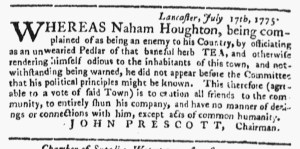
Massachusetts Spy (August 16, 1775).

“An unwearied Pedlar of that baneful herb TEA.”

Naham Houghton of Lancaster, Massachusetts, went too far and there had to be consequences.  An advertisement in the August 16, 1775, edition of the Massachusetts Spy gave an abbreviated account of what occurred.  According to John Prescott, chairman of the local Committee of Inspection, there had been complaints that Houghton behaved as “enemy to his Country, by officiating as an unwearied Pedlar of that baneful herb TEA, and otherwise rendering himself odious to the inhabitants of this town.”  Prescott did not elaborate on the other infractions.  Selling tea was enough to get Houghton into hot water.

That violated the Continental Association, a nonimportation agreement devised by the First Continental Congress in response to the Coercive Acts imposed by Parliament in retribution for the Boston Tea Party.  The eleventh article outlined an enforcement mechanism, stating that a “Committee be chosen in every County, City, and Town” to monitor compliance with the pact.  When a majority determined that someone committed a violation, they would “cause the truth of the case to be published in the Gazette, to the End that all such foes to the rights of British America may be publickly known and universally condemned as Enemies.”  In turn, the rest of the community would “break off all Dealings with him, or her.”

The committee in Lancaster apparently sought to work with Houghton in seeking an explanation for his actions, but to no avail.  Prescott reported that Houghton refused to “appear before the Committee that his political principles might be known” even though he had been warned.  Neither the committee nor the town tolerated such defiance.  The town voted “to caution all friends to the community, to entirely shun his company,” as the Continental Association instructed, “and have no manner of dealings or connections with him, except acts of common humanity.”  Selling tea continued to resonate as a political act, yet it was only one of many offenses that made Houghton “odious” to his neighbors.  At the same time that others suspected of Tory sympathies confessed their errors and used newspaper advertisements to rehabilitate their reputations, Houghton steadfastly refused to bow to such pressure exerted by the Committee of Inspection.  He instead became the subject of an advertisement that made clear, far and wide, that he was not in good standing in his community.

Slavery Advertisements Published August 16, 1775

GUEST CURATORS:  Ryan Forrester, Conrad Miller-Fabregas and Angelo Rodrigues

The Slavery Adverts 250 Project chronicles the role of newspaper advertising in perpetuating slavery in the era of the American Revolution. The project seeks to reveal the ubiquity of slavery in eighteenth-century life from New England to Georgia by republishing advertisements about enslaved people – for sale as individuals or in groups, wanted to purchase or for hire for short periods, runaways who liberated themselves, and those who were subsequently captured and confined in jails and workhouses – in daily digests on this site as well as in real time via the @SlaveAdverts250 Twitter feed, utilizing twenty-first-century media to stand in for the print media of the eighteenth century.

The project aims to provide modern audiences with a sense of just how often colonizers encountered these advertisements in their daily lives. Enslaved men, women, and children appeared in print somewhere in the colonies almost every single day. Those advertisements served as a constant backdrop for social, cultural, economic, and political life in colonial and revolutionary America. Colonizers who did not purport to own enslaved people were still confronted with slavery as well as invited to maintain the system by purchasing enslaved men, women, and children or assisting in the capture of so-called “runaways” who sought to free themselves from bondage. The frequency of these newspaper advertisements suggests just how embedded slavery was in colonial and revolutionary American culture in everyday interactions beyond the printed page.

These advertisements also testify to the experiences of enslaved men, women, and children, though readers must consider that those experiences have been remediated through descriptions offered by enslavers rather than enslaved people themselves. Often unnamed in the advertisements, enslaved men, women, and children were not invisible or unimportant in early America.

These advertisements appeared in colonial American newspapers 250 years ago today.

Connecticut Journal (April 16, 1775).

**********

Pennsylvania Gazette (April 16, 1775).

**********

Pennsylvania Gazette (April 16, 1775).

**********

Supplement to the Pennsylvania Gazette (April 16, 1775).

**********

Supplement to the Pennsylvania Gazette (April 16, 1775).

**********

Supplement to the Pennsylvania Gazette (April 16, 1775).

**********

Supplement to the Pennsylvania Gazette (April 16, 1775).

**********

Supplement to the Pennsylvania Gazette (April 16, 1775).

**********

Supplement to the Pennsylvania Gazette (April 16, 1775).

August 15

What was advertised in a revolutionary American newspaper 250 years ago today?

Pennsylvania Evening Post (August 15, 1775).

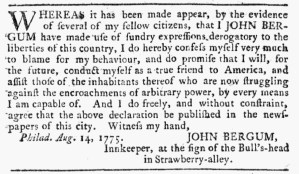
“I will, for the future, conduct myself as a true friend to America.”

It was another confession accompanied with an apology.  John Bergum, an “Innkeeper, at the sign of the Bull’s-head in Strawberry-alley” in Philadelphia, acknowledged his infraction and promised that he had reformed.  Such items had been appearing among the advertisements in newspapers in Massachusetts for some time.  For the past year, colonizers who signed an address to the former governor, Thomas Hutchinson, when he departed for England had reconsidered their position … or been pressured into recanting by Patriots who did not care for their Tory stance.  More recently, similar advertisements appeared in newspapers outside of New England, especially after hostilities commenced at Lexington and Concord in April 1775.

Bergum inserted his advertisement in the August 15, 1775, edition of the Pennsylvania Evening Post.  “WHEREAS it has been made appear, by the evidence of several of my fellow citizens,” he declared, “that I JOHN BERGUM have made use of sundry expressions derogatory to the liberties of this country, I do hereby confess myself very much to blame for my behaviour.”  Bergum did not reveal any of those “sundry expressions” but instead focused on assuring the public that he would not utter anything like them again.  He promised, “I will, for the future, conduct myself as a true friend to America, and assist those of the inhabitants thereof who are now struggling against the encroachments of arbitrary power, by every means I am capable of.”  Bergum claimed would comport himself as a Patriot in both word and deed as the crisis continued to consume the colonies.

“I do freely, and without constraint,” the innkeeper added, “agree that the above declaration be published in the newspapers of this city.”  That made it sound like someone else had a hand in convincing Bergum of his error and running the advertisement.  William Huntting Howell posits that local Committees of Safety in Massachusetts pressured signatories of the address to Hutchinson into public confessions that concluded with an endorsement of the Patriot position.  The wording in Bergum’s advertisement – “I do freely … agree that the above declaration be published in the newspapers” – suggests that maybe he had an encounter with a local committee that convinced him that it was in his best interests to recant his previous statements and pledge his support in defending “the liberties of this country.”