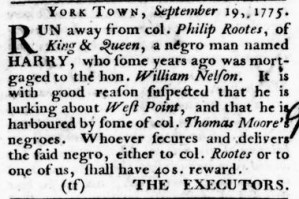
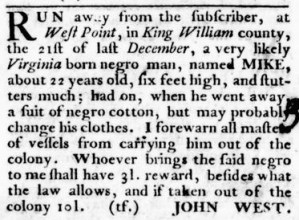
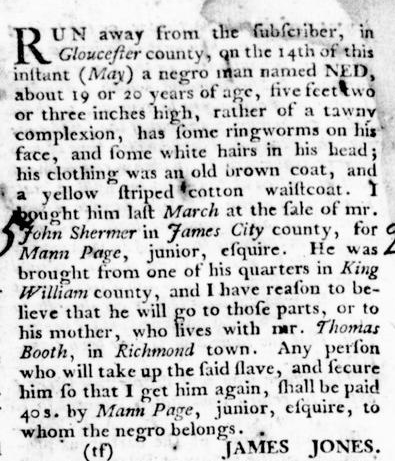
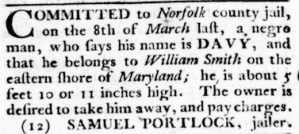
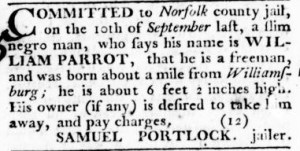
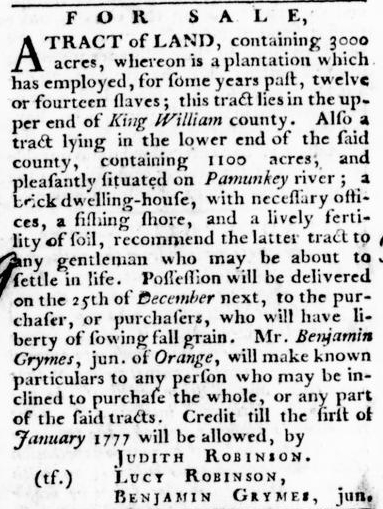
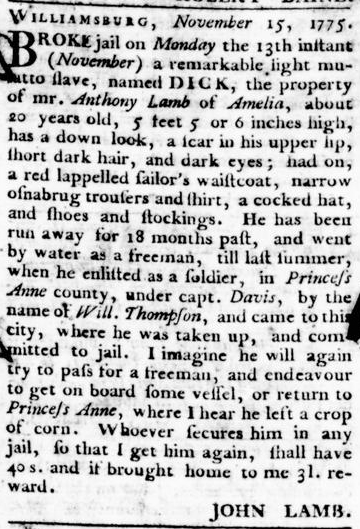
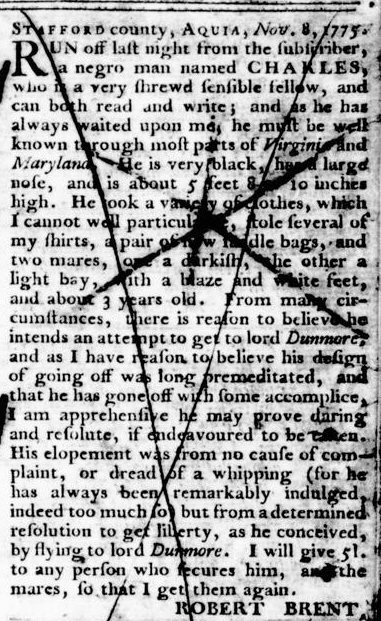
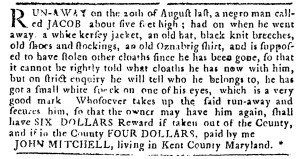
Slavery Advertisements Published November 20, 1775

GUEST CURATOR: Massimo Sgambati

The Slavery Adverts 250 Project chronicles the role of newspaper advertising in perpetuating slavery in the era of the American Revolution. The project seeks to reveal the ubiquity of slavery in eighteenth-century life from New England to Georgia by republishing advertisements about enslaved people – for sale as individuals or in groups, wanted to purchase or for hire for short periods, runaways who liberated themselves, and those who were subsequently captured and confined in jails and workhouses – in daily digests on this site as well as in real time via the @SlaveAdverts250 Twitter feed, utilizing twenty-first-century media to stand in for the print media of the eighteenth century.

The project aims to provide modern audiences with a sense of just how often colonizers encountered these advertisements in their daily lives. Enslaved men, women, and children appeared in print somewhere in the colonies almost every single day. Those advertisements served as a constant backdrop for social, cultural, economic, and political life in colonial and revolutionary America. Colonizers who did not purport to own enslaved people were still confronted with slavery as well as invited to maintain the system by purchasing enslaved men, women, and children or assisting in the capture of so-called “runaways” who sought to free themselves from bondage. The frequency of these newspaper advertisements suggests just how embedded slavery was in colonial and revolutionary American culture in everyday interactions beyond the printed page.

These advertisements also testify to the experiences of enslaved men, women, and children, though readers must consider that those experiences have been remediated through descriptions offered by enslavers rather than enslaved people themselves. Often unnamed in the advertisements, enslaved men, women, and children were not invisible or unimportant in early America.

From compiling an archive of digitized eighteenth-century newspapers to identifying advertisements about enslaved men, women, and children in those newspapers to preparing images of each advertisement to posting this daily digest, Massimo Sgambati served as guest curator for this entry. He completed this work as part of the Summer Scholars Program, funded by a fellowship from the D’Amour College of Liberal Arts and Sciences at Assumption University in Worcester, Massachusetts, in Summer 2025.

These advertisements appeared in colonial American newspapers 250 years ago today.
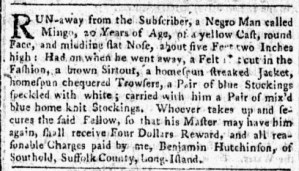
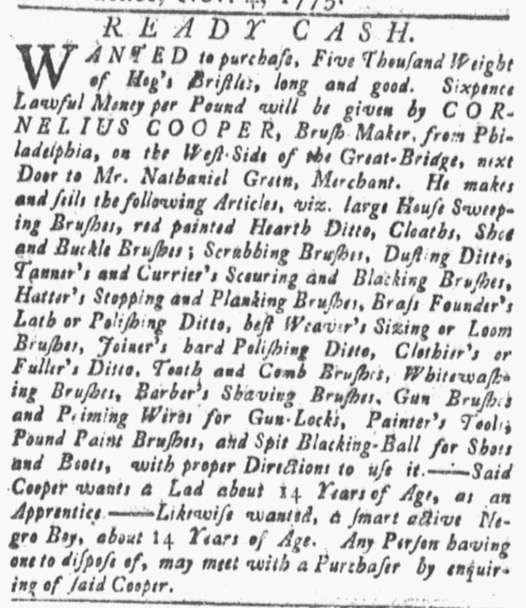
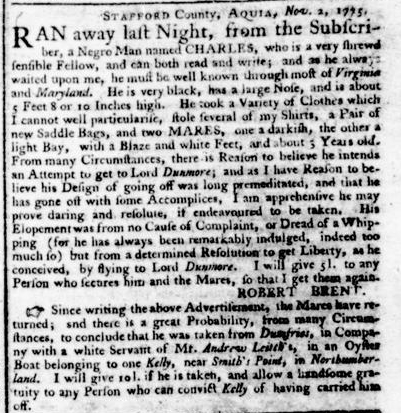
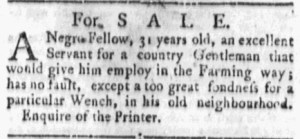
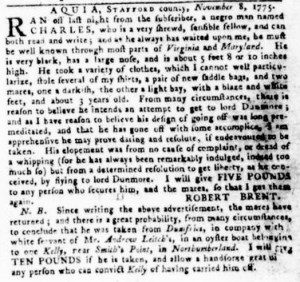
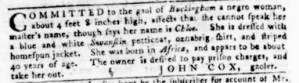
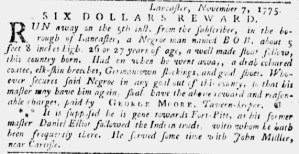
Connecticut Courant (November 20, 1775)

**********

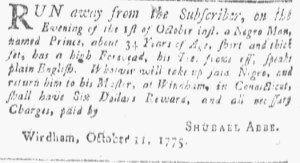
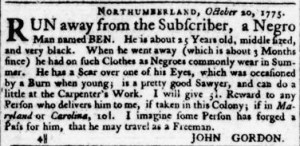
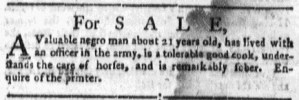
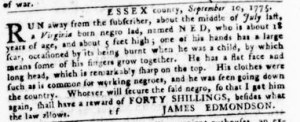
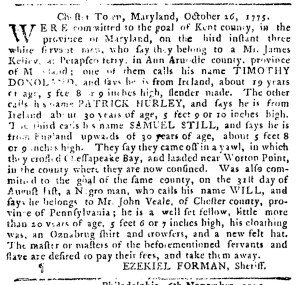
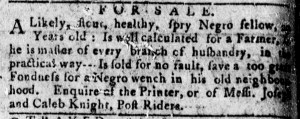
Dunlap’s Pennsylvania Packet (November 20, 1775)

**********
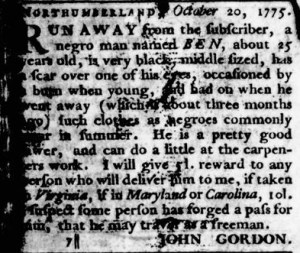
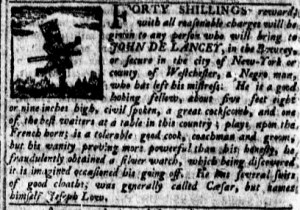
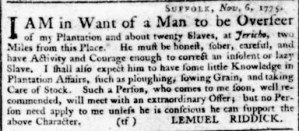
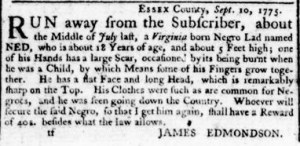
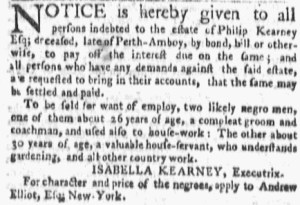
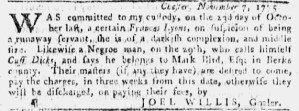
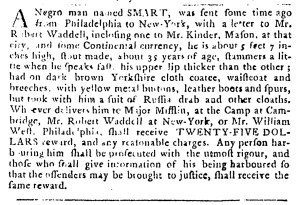
New-York Gazette and Weekly Mercury (November 20, 1775)

**********

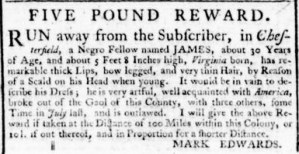
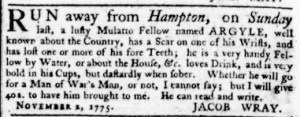
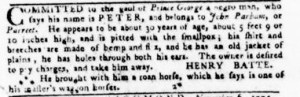
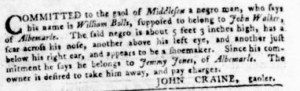
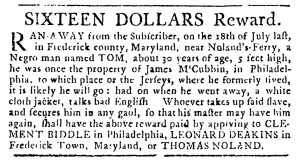
New-York Gazette and Weekly Mercury (November 20, 1775)

**********
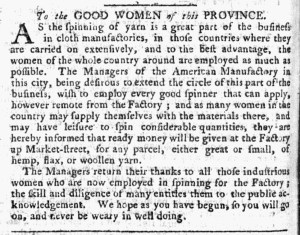
New-York Gazette and Weekly Mercury (November 20, 1775)

November 19

What was advertised in a revolutionary American newspaper 250 years ago this week?

Rivington’s New-York Gazetteer (November 16, 1775).

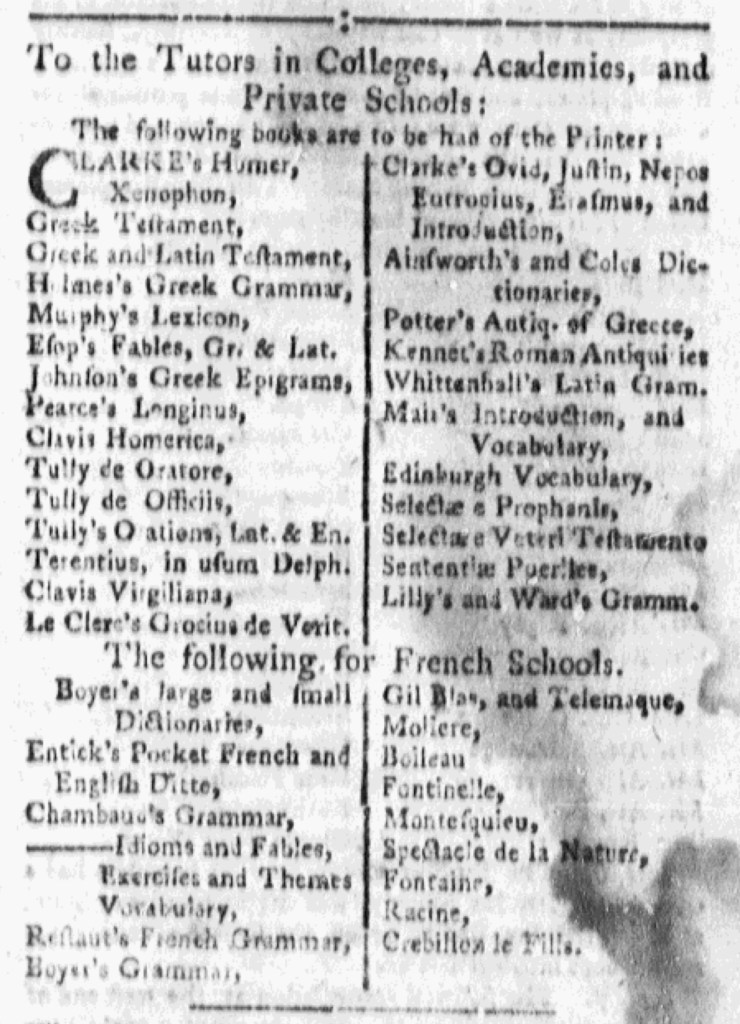
“To the Tutors in Colleges, Academies, and Private Schools.”

James Rivington, the printer of Rivington’s New-York Gazetteer, sold books as an additional revenue stream rather than relying solely on subscriptions and advertisements.  Such was the case with other printers throughout the colonies, their printing offices doubling as bookstores.  Rivington’s newspaper often carried advertisements for books, pamphlets, and almanacs that he stocked.  He printed some of them, acquired others from other colonial printers, and imported most of them from England.  Some advertisements featured a single title.  The November 16, 1775, edition, for instance, featured an advertisement for “A DICTIONARY OF THE Holy Bible” that included the prints, size, and number of volumes along with a description of the contents.  Other advertisements listed multiple titles without providing additional information.

On occasion, Rivington ran advertisements that promoted books and pamphlets with a common theme.  With a headline proclaiming, “The American Controversy,” an advertisement published in February 1775 listed ten pamphlets “published on both sides, in the unhappy dispute with Great-Britain.”  He deployed the same strategy in another notice that ran on November 16, this time addressing “the Tutors in Colleges, Academies, and Private Schools.”  He then gave the titles of more than two dozen books he considered suitable for classrooms, such as “CLARKE’s Homer,” “Greek and Latin Testament,” “Esop’s Fable, Gr[eek] & Lat[in],” “Tully’s Orations, Lat[in] & En[glish],” “Ainsworth’s and Coles Dictionaries,” “Whittenhall’s Latin Gram[mar],” and “Lilly’s and Wards Gramm[ar].”  Rivington implied that those books should have been familiar to tutors.  In addition to those titles, he devoted the final third of the advertisement to books “for French Schools,” including “Boyer’s large and small Dictionaries,” “Entick’s Pocket French and English [Dictionary],” “Chambaud’s Grammar,” “[Chambaud’s] Exercises and Themes,” “Moliere,” and “Montesquieu.”  While Rivington usually marketed most books and pamphlets to general audiences and prospective customers of all backgrounds, especially when his advertisements consisted of catalogs of books available at his printing office, he occasionally attempted to boost sales by directing particular kinds of readers to carefully curated lists of titles.  In this case, tutors and schoolmasters did not need to pore over lengthy lists of books and pamphlets not relevant or not appropriate to their lessons when Rivington presented a specialized catalog for their convenience.

November 18

What was advertised in a revolutionary American newspaper 250 years ago today?

Pennsylvania Evening Post (November 18, 1775).

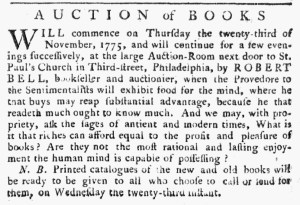
“The Provedore to the Sentimentalists will exhibit food for the mind.”

Readers of the November 18, 1775, edition of the Pennsylvania Evening Post encountered two advertisements promoting an “AUCTION of BOOKS,” one placed by Charles Mouse, “auctionier,” and the other by Robert Bell, “bookseller and auctionier.”  Mouse operated a “vendue store,” a combination of an auction house and a flea market, where he had a “large and choice collection of the most useful and entertaining [books].”  He invited those who had books to sell and “will[ing] to take their chance by auction” to deliver them to his vendue store on Second Street in Philadelphia.  The auctions would begin “precisely at six each evening” and “continue till the whole are sold.”  Mouse provided a straightforward account of this endeavor.

Robert Bell, on the other hand, crafted a more elaborate advertisement.  One of the most prominent American booksellers in the second half of the eighteenth century, Bell already established a reputation throughout the colonies by the time he advertised an auction “at the large Auction-Room next door to St. Paul’s Church in Third-street, Philadelphia,” scheduled for November 23.  He colorfully referred to himself in the third person as “the Provedore to the Sentimentalists” who would “exhibit food for the mind” to bidders and curious observers.  Those who made purchases, Bell declared, “may reap substantial advantage, because he that readeth much ought to know much.”  He further mused that “we may, with propriety, ask the sages of antient and modern times, What is it that riches can afford equal to the profit and pleasure of books?  Are they not the most rational and lasting enjoyment the human mind is capable of possessing?”  Mouse’s description of his “large and choice collection of the most useful and entertaining [books]” paled in comparison to the appeals that Bell made to readers.

Bell deployed another strategy to entice prospective bidders.  In a nota bene, he informed them that “[p]rinted catalogues of the new and old books will be ready to be given to all who choose to call or send for them.”  Those catalogues gave a preview of the sale and allowed Bell to disseminate information about the books up for bids more widely.  Those who visited his “Auction-Room” to collect a catalogue likely had an opportunity to browse the books, yet they could take their time going through the entries in the catalogue in the comfort of their own homes or offices or even at a coffeehouse with friends.  Those who sent for catalogues enjoyed the same benefit.  By distributing catalogs, Bell encouraged interest and prompted readers to imagine themselves bidding on the books they selected in advance.  He may have believed that prospective bidders were more likely to bid higher prices if they had spent time with the catalogue in advance and, as a result, became more committed to acquiring the books that interested them.

Slavery Advertisements Published November 18, 1775

GUEST CURATOR: Massimo Sgambati

The Slavery Adverts 250 Project chronicles the role of newspaper advertising in perpetuating slavery in the era of the American Revolution. The project seeks to reveal the ubiquity of slavery in eighteenth-century life from New England to Georgia by republishing advertisements about enslaved people – for sale as individuals or in groups, wanted to purchase or for hire for short periods, runaways who liberated themselves, and those who were subsequently captured and confined in jails and workhouses – in daily digests on this site as well as in real time via the @SlaveAdverts250 Twitter feed, utilizing twenty-first-century media to stand in for the print media of the eighteenth century.

The project aims to provide modern audiences with a sense of just how often colonizers encountered these advertisements in their daily lives. Enslaved men, women, and children appeared in print somewhere in the colonies almost every single day. Those advertisements served as a constant backdrop for social, cultural, economic, and political life in colonial and revolutionary America. Colonizers who did not purport to own enslaved people were still confronted with slavery as well as invited to maintain the system by purchasing enslaved men, women, and children or assisting in the capture of so-called “runaways” who sought to free themselves from bondage. The frequency of these newspaper advertisements suggests just how embedded slavery was in colonial and revolutionary American culture in everyday interactions beyond the printed page.

These advertisements also testify to the experiences of enslaved men, women, and children, though readers must consider that those experiences have been remediated through descriptions offered by enslavers rather than enslaved people themselves. Often unnamed in the advertisements, enslaved men, women, and children were not invisible or unimportant in early America.

From compiling an archive of digitized eighteenth-century newspapers to identifying advertisements about enslaved men, women, and children in those newspapers to preparing images of each advertisement to posting this daily digest, Massimo Sgambati served as guest curator for this entry. He completed this work as part of the Summer Scholars Program, funded by a fellowship from the D’Amour College of Liberal Arts and Sciences at Assumption University in Worcester, Massachusetts, in Summer 2025.

These advertisements appeared in colonial American newspapers 250 years ago today.

Providence Gazette (November 18, 1775)

**********
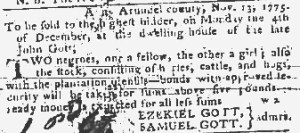
Providence Gazette (November 18, 1775)

**********
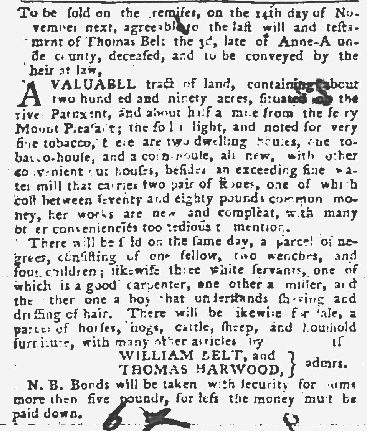
Virginia Gazette [Dixon and Hunter] (November 18, 1775)

**********
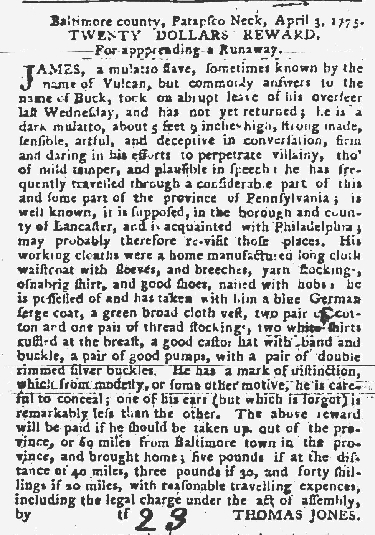
Virginia Gazette [Dixon and Hunter] (November 18, 1775)

**********
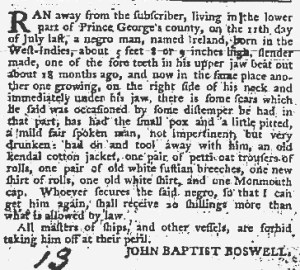
Virginia Gazette [Dixon and Hunter] (November 18, 1775)

**********
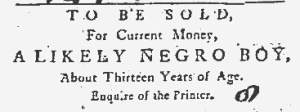
Virginia Gazette [Dixon and Hunter] (November 18, 1775)

**********
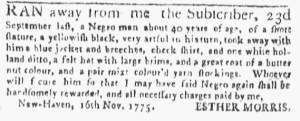
Virginia Gazette [Dixon and Hunter] (November 18, 1775)

**********
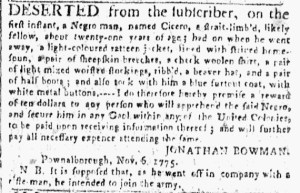
Virginia Gazette [Dixon and Hunter] (November 18, 1775)

**********
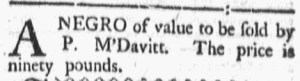
Virginia Gazette [Dixon and Hunter] (November 18, 1775)

**********

Virginia Gazette [Dixon and Hunter] (November 18, 1775)

November 17

What was advertised in a revolutionary American newspaper 250 years ago today?

Thomas’s Massachusetts Spy (November 17, 1775).

“A CONSTITUTIONAL POST-OFFICE is established in this town.”

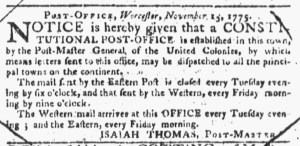
Isaiah Thomas, the printer of Thomas’s Massachusetts Spy, gained a new title in the fall of 1775.  He became the postmaster for the “CONSTITUTIONAL POST-OFFICE” in Worcester.  In an advertisement in the November 17 edition of his newspaper, he informed the public that “the Post-Mater General of the United Colonies” established the post office in Worcester.  That meant that “letters sent to this office, may be dispatched to all the principal towns on the continent” via a network of post offices and riders authorized by the Second Continental Congress as an alternative to the imperial postal system.  Thomas provided a schedule.  Outgoing mail “sent by the Eastern Post is closed every Tuesday evening by six o’clock.”  For outgoing mail, the post office dispatched letter received “Friday morning by nine o’clock.”  That corresponded with the arrival of new mail: “The Western mail arrives at this OFFICE every Tuesday evening; and the Eastern, every Friday morning.”  Patrons who planned accordingly could use the new postal system to correspond with friends, relatives, and associates throughout the colonies.

Thomas gave this advertisement a prominent place when he published it, placing it immediately below a notice that the Second Continental Congress created a committee to compile a “just and well authenticated account of the hostilities committed by the ministerial troops and navy in America since March last,” including “proper evidence of the truth of the facts related.”  In documenting buildings destroyed, vessels seized, and stock taken, they justified their resistance and engaged in public relations to demonstrate that colonizers had legitimate grievances.  Thomas could have placed any number of other advertisements below that notice, yet he opted for one that promoted another effort undertaken by the Second Continental Congress to protect American liberties.  It was a fitting editorial decision for a newspaper with American Oracle of Liberty as its secondary title.  In this instance, Thomas deployed an advertisement as a continuation of news about current events, keeping readers updated not only about what occurred but also about how they could support the American cause.

Slavery Advertisements Published November 17, 1775

GUEST CURATOR: Massimo Sgambati

The Slavery Adverts 250 Project chronicles the role of newspaper advertising in perpetuating slavery in the era of the American Revolution. The project seeks to reveal the ubiquity of slavery in eighteenth-century life from New England to Georgia by republishing advertisements about enslaved people – for sale as individuals or in groups, wanted to purchase or for hire for short periods, runaways who liberated themselves, and those who were subsequently captured and confined in jails and workhouses – in daily digests on this site as well as in real time via the @SlaveAdverts250 Twitter feed, utilizing twenty-first-century media to stand in for the print media of the eighteenth century.

The project aims to provide modern audiences with a sense of just how often colonizers encountered these advertisements in their daily lives. Enslaved men, women, and children appeared in print somewhere in the colonies almost every single day. Those advertisements served as a constant backdrop for social, cultural, economic, and political life in colonial and revolutionary America. Colonizers who did not purport to own enslaved people were still confronted with slavery as well as invited to maintain the system by purchasing enslaved men, women, and children or assisting in the capture of so-called “runaways” who sought to free themselves from bondage. The frequency of these newspaper advertisements suggests just how embedded slavery was in colonial and revolutionary American culture in everyday interactions beyond the printed page.

These advertisements also testify to the experiences of enslaved men, women, and children, though readers must consider that those experiences have been remediated through descriptions offered by enslavers rather than enslaved people themselves. Often unnamed in the advertisements, enslaved men, women, and children were not invisible or unimportant in early America.

From compiling an archive of digitized eighteenth-century newspapers to identifying advertisements about enslaved men, women, and children in those newspapers to preparing images of each advertisement to posting this daily digest, Massimo Sgambati served as guest curator for this entry. He completed this work as part of the Summer Scholars Program, funded by a fellowship from the D’Amour College of Liberal Arts and Sciences at Assumption University in Worcester, Massachusetts, in Summer 2025.

These advertisements appeared in colonial American newspapers 250 years ago today.

Connecticut Gazette (November 17, 1775)

**********

Connecticut Gazette (November 17, 1775)

**********

Virginia Gazette [Purdie] (November 17, 1775)

**********

Virginia Gazette [Purdie] (November 17, 1775)

**********

Virginia Gazette [Purdie] (November 17, 1775)

**********

Virginia Gazette [Purdie] (November 17, 1775)

**********

Virginia Gazette [Purdie] (November 17, 1775)

**********

Virginia Gazette [Purdie] (November 17, 1775)

**********

Virginia Gazette [Purdie] (November 17, 1775)

**********

Virginia Gazette [Purdie] (November 17, 1775)

**********

Virginia Gazette Supplement [Purdie] (November 17, 1775)

**********

Virginia Gazette Supplement [Purdie] (November 17, 1775)

**********

Virginia Gazette Supplement [Purdie] (November 17, 1775)

**********

Virginia Gazette Supplement [Purdie] (November 17, 1775)

**********

Virginia Gazette Supplement [Purdie] (November 17, 1775)

**********

Virginia Gazette Supplement [Purdie] (November 17, 1775)

November 16

What was advertised in a revolutionary American newspaper 250 years ago today?

Pennsylvania Evening Post (November 16, 1775).

“The Managers of the American Manufactory … wish to employ every good spinner that can apply.”

The proprietors of the American Manufactory in Philadelphia periodically took to the public prints to encourage the public to support their enterprise.  In the March 1775, they called a general meeting at Carpenters’ Hall, the site where the First Continental Congress held its meetings the previous fall.  They invited prospective investors to attend as well as sign subscription papers already circulating.  A month later, the proprietors ran a brief advertisement, that one seeking both materials (“A Quantity of WOOL, COTTON, FLAX, and HEMP”) and workers “(a number of spinners and flax dressers”).  That notice happened to appear in the Pennsylvania Journal on April 19, 1775, the day of the battles at Lexington and Concord, though it would take a while for residents of Philadelphia to learn about the outbreak of hostilities near Boston.  The mission of the American Manufactory to produce an alternative to imported textiles became even more urgent.  In August, the proprietors once again sought workers, publishing an address “To the SPINNERS in thisCITY and the SUBURBS.”  They offered women an opportunity to participate in politics and “help to save the state from ruin.”

In November 1775, the proprietors or “Managers of the American Manufactory” made another appeal “To the GOOD WOMEN of this PROVINCE.”  They explained that “the spinning of year is a great part of the business in cloth manufactories” and “in those countries where they are carried on extensively, and to the best advantage, the women of the whole country are employed as much as possible.”  Having already engaged women “in this CITY and the SUBURBS” who responded to their previous advertisement and apparently needing even more yarn to make into textiles, the managers found themselves “desirous to extend the circle … to employ every good spinner than can apply, however remote from the Factory.”  They believed that women in the countryside “may supply themselves with the materials there” and had “leisure to spin considerable quantities.”  They may have been right on the first count, but perhaps overestimated how many other responsibilities wives, mothers, sisters, and daughters had in their households.  For those who made the time, the managers offered “ready money … for any parcel, either great or small, of hemp, flax, or woollen yarn.”

The managers also lauded the contributions of “those industrious women who are now employed in spinning for the Factory,” declaring that “the skill and diligence of many entitles them to the public acknowledgement.”  They served the American cause in their own way according to their own abilities, just as the delegates to the Second Continental Congress did and just as the soldiers and officers participating in the siege of Boston did.  “We hope as you have begun,” the managers encouraged, “so you will go on, and never be weary in well doing.”

Slavery Advertisements Published November 16, 1775

GUEST CURATOR: Massimo Sgambati

The Slavery Adverts 250 Project chronicles the role of newspaper advertising in perpetuating slavery in the era of the American Revolution. The project seeks to reveal the ubiquity of slavery in eighteenth-century life from New England to Georgia by republishing advertisements about enslaved people – for sale as individuals or in groups, wanted to purchase or for hire for short periods, runaways who liberated themselves, and those who were subsequently captured and confined in jails and workhouses – in daily digests on this site as well as in real time via the @SlaveAdverts250 Twitter feed, utilizing twenty-first-century media to stand in for the print media of the eighteenth century.

The project aims to provide modern audiences with a sense of just how often colonizers encountered these advertisements in their daily lives. Enslaved men, women, and children appeared in print somewhere in the colonies almost every single day. Those advertisements served as a constant backdrop for social, cultural, economic, and political life in colonial and revolutionary America. Colonizers who did not purport to own enslaved people were still confronted with slavery as well as invited to maintain the system by purchasing enslaved men, women, and children or assisting in the capture of so-called “runaways” who sought to free themselves from bondage. The frequency of these newspaper advertisements suggests just how embedded slavery was in colonial and revolutionary American culture in everyday interactions beyond the printed page.

These advertisements also testify to the experiences of enslaved men, women, and children, though readers must consider that those experiences have been remediated through descriptions offered by enslavers rather than enslaved people themselves. Often unnamed in the advertisements, enslaved men, women, and children were not invisible or unimportant in early America.

From compiling an archive of digitized eighteenth-century newspapers to identifying advertisements about enslaved men, women, and children in those newspapers to preparing images of each advertisement to posting this daily digest, Massimo Sgambati served as guest curator for this entry. He completed this work as part of the Summer Scholars Program, funded by a fellowship from the D’Amour College of Liberal Arts and Sciences at Assumption University in Worcester, Massachusetts, in Summer 2025.

These advertisements appeared in colonial American newspapers 250 years ago today.

Maryland Gazette (November 16, 1775)

**********

Maryland Gazette (November 16, 1775)

**********

Maryland Gazette (November 16, 1775)

**********

Maryland Gazette (November 16, 1775)

**********

Maryland Gazette (November 16, 1775)

**********

New-England Chronicle (November 16, 1775)

**********

New-England Chronicle (November 16, 1775)

**********

Rivington’s New-York Gazetteer (November 16, 1775)

**********

Rivington’s New-York Gazetteer (November 16, 1775)

**********

Rivington’s New-York Gazetteer (November 16, 1775)

**********

Rivington’s New-York Gazetteer (November 16, 1775)

**********

Virginia Gazette [Pinkney] (November 16, 1775)

**********

Virginia Gazette [Pinkney] (November 16, 1775)

**********

Virginia Gazette [Pinkney] (November 16, 1775)

**********

Virginia Gazette [Pinkney] (November 16, 1775)

**********

Virginia Gazette [Pinkney] (November 16, 1775)

**********

Virginia Gazette [Pinkney] (November 16, 1775)

**********

Virginia Gazette [Pinkney] (November 16, 1775)

**********

Virginia Gazette [Pinkney] (November 16, 1775)

November 15

What was advertised in a revolutionary American newspaper 250 years ago today?

Constitutional Gazette (November 15, 1775).

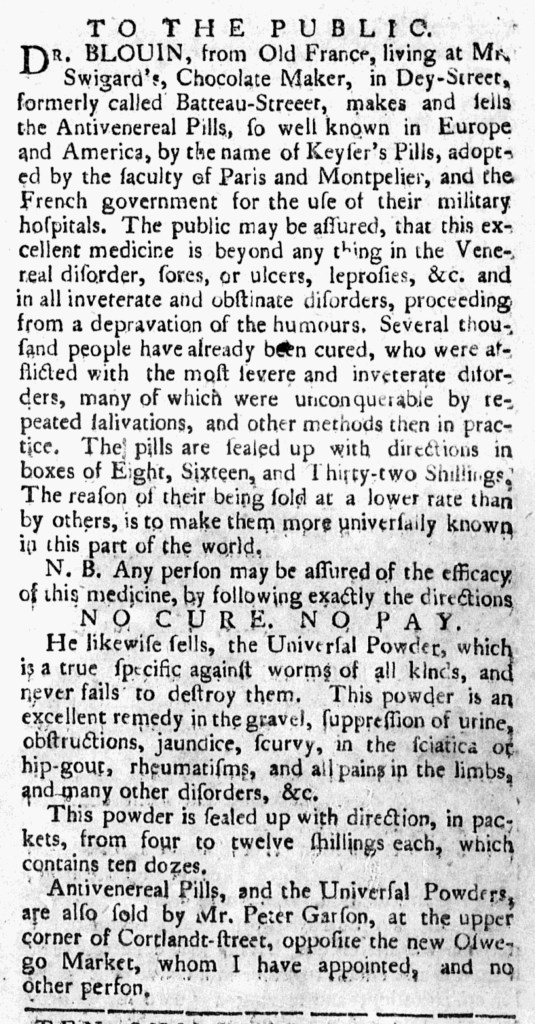
“DR. BLOUIN … makes and sells the Antivenereal Pills, so well known … by the name of Keyser’s Pills.”

It was the eighteenth-century version of offering a generic medication at a lower price than the name brand in hopes of attracting customers.  An entrepreneur who identified himself as “DR. BLOUIN, from Old France,” placed an advertisement in the November 15, 1775, edition of the Constitutional Gazette to inform readers in New York that he makes and sells the Antivenereal Pills, so well known in Europe and America, by the name of Keyser’s Pills.”  Indeed, that medication was popular in the colonies, advertised frequently by apothecaries, shopkeepers, and even printers who sold patent medicines as an alternate revenue stream.  At the same time that Blouin ran his advertisement, James Rivington, the printer of Rivington’s New-York Gazetteer, continued running his notice that proclaimed, “EVERY ONE THEIR OWN PHYSICIAN, By THE USE OF Dr. KEYSER’s PILLS.”  Rivington had been using that familiar refrain in his advertisements for years.

Blouin offered a brief history of the original medication as a means of marketing his generic version, noting that Keyser’s Pills had been “adopted by the faculty of Paris and Montpelier, and the French government for the use of their military hospitals.”  Furthermore, “[s]everal thousand people have already been cured, many of which were unconquerable by … other methods” of treatment.  Prospective customers, Blouin claimed, could not find a more effective remedy: “The public may be assured, that this excellent medicine is beyond any thing in the Venereal disorder, sores, or ulcers, leprosies, &c. and in all inveterate and obstinate disorders, proceeding from a depravation of the humours.”  He was so certain that he offered a guarantee: “NO CURE.  NO PAY.”

Readers interested in purchasing the pills that Blouin made in New York rather than imported ones would receive printed directions and could choose among boxes costing eight, sixteen, and thirty-two shillings.  The efficacy of the cure, he cautioned, depended on “following exactly the directions.”  Rivington sold Keyser’s Pills for ten, twenty, and forty shillings.  Blouin explained that he gave a discount “to make [his generic pills] more universally known in this part of the world.”  For those who wavered in choosing his pills over the name brand version, he hoped that the lower price would help convince them.  Blouin also noted that an associate, Peter Garson, “at the upper corner of Cortlandt-street, opposite the new Oswego Market,” sold the pills, but “no other person.”  Many advertisements for Keyser’s Pills warned prospective customers about counterfeits.  Blouin freely admitted that he “makes and sells” his own version … and advised readers to avoid any attributed to him but not sold by him or his appointed agent.

Slavery Advertisements Published November 15, 1775

GUEST CURATOR: Massimo Sgambati

The Slavery Adverts 250 Project chronicles the role of newspaper advertising in perpetuating slavery in the era of the American Revolution. The project seeks to reveal the ubiquity of slavery in eighteenth-century life from New England to Georgia by republishing advertisements about enslaved people – for sale as individuals or in groups, wanted to purchase or for hire for short periods, runaways who liberated themselves, and those who were subsequently captured and confined in jails and workhouses – in daily digests on this site as well as in real time via the @SlaveAdverts250 Twitter feed, utilizing twenty-first-century media to stand in for the print media of the eighteenth century.

The project aims to provide modern audiences with a sense of just how often colonizers encountered these advertisements in their daily lives. Enslaved men, women, and children appeared in print somewhere in the colonies almost every single day. Those advertisements served as a constant backdrop for social, cultural, economic, and political life in colonial and revolutionary America. Colonizers who did not purport to own enslaved people were still confronted with slavery as well as invited to maintain the system by purchasing enslaved men, women, and children or assisting in the capture of so-called “runaways” who sought to free themselves from bondage. The frequency of these newspaper advertisements suggests just how embedded slavery was in colonial and revolutionary American culture in everyday interactions beyond the printed page.

These advertisements also testify to the experiences of enslaved men, women, and children, though readers must consider that those experiences have been remediated through descriptions offered by enslavers rather than enslaved people themselves. Often unnamed in the advertisements, enslaved men, women, and children were not invisible or unimportant in early America.

From compiling an archive of digitized eighteenth-century newspapers to identifying advertisements about enslaved men, women, and children in those newspapers to preparing images of each advertisement to posting this daily digest, Massimo Sgambati served as guest curator for this entry. He completed this work as part of the Summer Scholars Program, funded by a fellowship from the D’Amour College of Liberal Arts and Sciences at Assumption University in Worcester, Massachusetts, in Summer 2025.

These advertisements appeared in colonial American newspapers 250 years ago today.

Pennsylvania Gazette (November 15, 1775)

**********

Pennsylvania Gazette (November 15, 1775)

**********

Pennsylvania Journal (November 15, 1775)

**********

Pennsylvania Journal (November 15, 1775)

**********

Pennsylvania Journal (November 15, 1775)

**********

Pennsylvania Journal (November 15, 1775)

**********

Pennsylvania Journal (November 15, 1775)