November 14

What was advertised in a revolutionary American newspaper 250 years ago today?
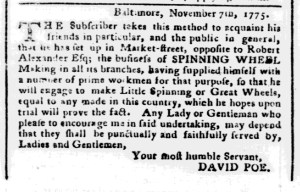
Dunlap’s Maryland Gazette (November 14, 1775).

“He has set up … the business of SPINNING WHEEL Making.”

David Poe established a workshop for making spinning wheels in Baltimore in the fall of 1775.  To attract the attention of prospective customers, he placed an advertisement in the November 14 edition of Dunlap’s Maryland Gazette, advising “his friends in particular, and the public in general, that he has set up … the business of SPINNING WHEEL Making in all its branches.”  Rather than make one spinning wheel at a time, he could produce them in quantity, “having supplied himself with a number of prime workmen for that purpose.”  Poe did not specify whether those “prime workmen” were free, indentured, or enslaved.  He instead emphasized that he “will engage to make Little Spinning or Great Wheels, equal to any made in this country.”  Furthermore, he invited readers to see for themselves, stating that he “hopes upon trial” spinning wheels made in his workshop “will prove the fact.”

Poe advertised spinning wheels at a time that they became political symbols.  In response to the Coercive Acts that Parliament passed to punish Boston after the destruction of imported tea during a protest now known as the Boston Tea Party, the First Continental Congress devised the Continental Association, a nonimportation, nonconsumption, and nonexportation pact that called on colonizers to abstain from purchasing goods, including textiles, imported from England.  The agreement also included a call for colonizers to “encourage Frugality, Economy, and Industry; and promote Agriculture, Arts, and the Manufactures of this Country, especially that of Wool.”  Poe heeded that call as homespun cloth produced in the colonies became a fashionable political statement.  Newspapers carried reports of women participating in politics by holding spinning bees in public spaces.  Rather than a useful tool operated in domestic settings, the spinning wheel became a symbol of public commitment to the American cause, a visible demonstration to friends, neighbors, and the rest of the community that industrious women hoped would inspire others to follow their lead.  Poe did his part, aiming to provide “Any Lady or Gentleman” with spinning wheels for their households.  He did not make direct reference to the Continental Association or the events that had unfolded in the seven months since the battles at Lexington and Concord, but he did not need to do so.  Readers certainly understood the connection between spinning wheels and current events.
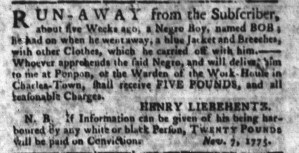
Slavery Advertisements Published November 14, 1775

GUEST CURATOR: Massimo Sgambati

The Slavery Adverts 250 Project chronicles the role of newspaper advertising in perpetuating slavery in the era of the American Revolution. The project seeks to reveal the ubiquity of slavery in eighteenth-century life from New England to Georgia by republishing advertisements about enslaved people – for sale as individuals or in groups, wanted to purchase or for hire for short periods, runaways who liberated themselves, and those who were subsequently captured and confined in jails and workhouses – in daily digests on this site as well as in real time via the @SlaveAdverts250 Twitter feed, utilizing twenty-first-century media to stand in for the print media of the eighteenth century.

The project aims to provide modern audiences with a sense of just how often colonizers encountered these advertisements in their daily lives. Enslaved men, women, and children appeared in print somewhere in the colonies almost every single day. Those advertisements served as a constant backdrop for social, cultural, economic, and political life in colonial and revolutionary America. Colonizers who did not purport to own enslaved people were still confronted with slavery as well as invited to maintain the system by purchasing enslaved men, women, and children or assisting in the capture of so-called “runaways” who sought to free themselves from bondage. The frequency of these newspaper advertisements suggests just how embedded slavery was in colonial and revolutionary American culture in everyday interactions beyond the printed page.

These advertisements also testify to the experiences of enslaved men, women, and children, though readers must consider that those experiences have been remediated through descriptions offered by enslavers rather than enslaved people themselves. Often unnamed in the advertisements, enslaved men, women, and children were not invisible or unimportant in early America.

From compiling an archive of digitized eighteenth-century newspapers to identifying advertisements about enslaved men, women, and children in those newspapers to preparing images of each advertisement to posting this daily digest, Massimo Sgambati served as guest curator for this entry. He completed this work as part of the Summer Scholars Program, funded by a fellowship from the D’Amour College of Liberal Arts and Sciences at Assumption University in Worcester, Massachusetts, in Summer 2025.

These advertisements appeared in colonial American newspapers 250 years ago today.

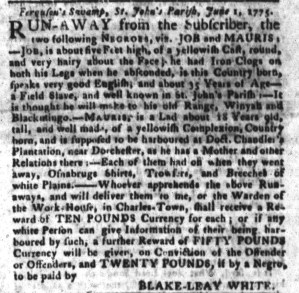
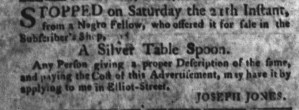
South-Carolina Gazette (November 14, 1775)

**********

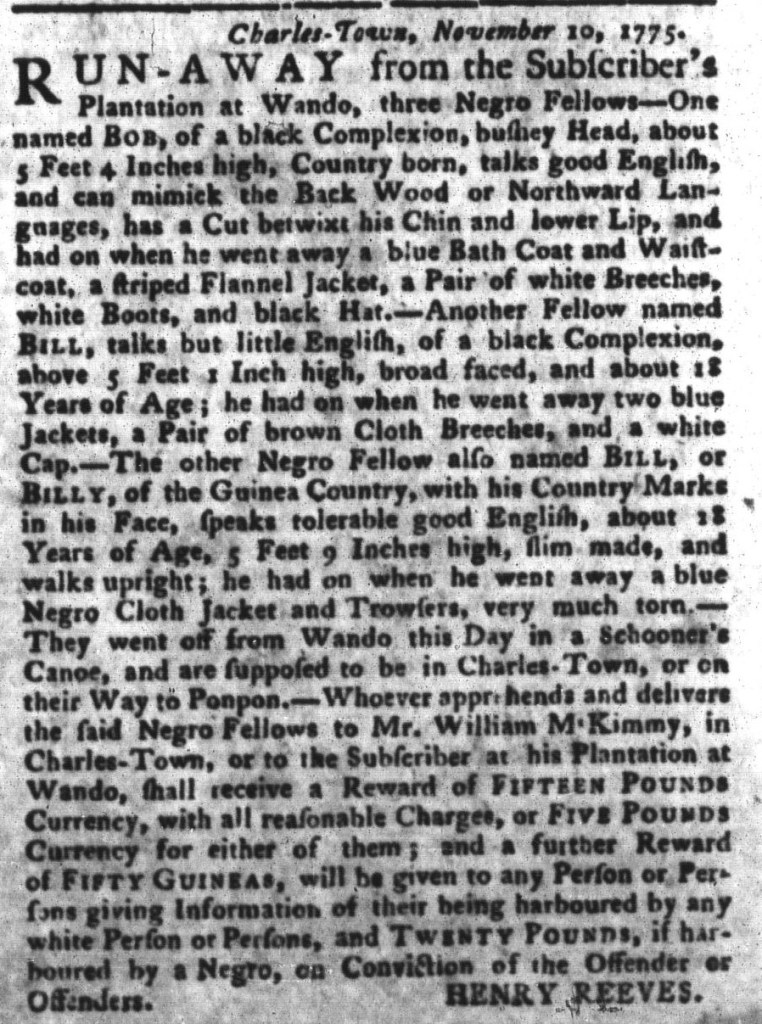
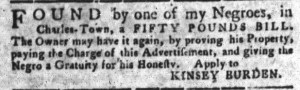
South-Carolina Gazette (November 14, 1775)

**********

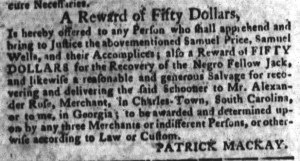
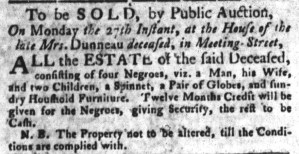
South-Carolina Gazette (November 14, 1775)

**********

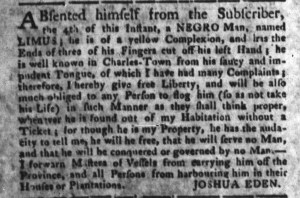
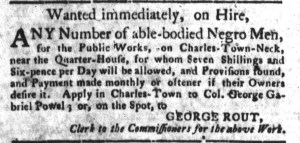
South-Carolina Gazette (November 14, 1775)

**********

South-Carolina Gazette (November 14, 1775)

**********

South-Carolina Gazette (November 14, 1775)

**********

South-Carolina Gazette (November 14, 1775)

**********

South-Carolina Gazette (November 14, 1775)

**********

South-Carolina Gazette (November 14, 1775)

**********

South-Carolina Gazette (November 14, 1775)

**********

South-Carolina Gazette (November 14, 1775)

November 13

What was advertised in a revolutionary American newspaper 250 years ago today?

Norwich Packet (November 13, 1775).

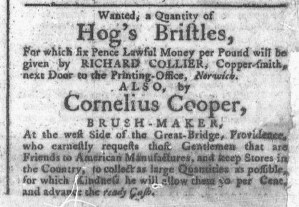
“Wanted, a Quantity of Hog’s Bristles [from] Friends to American Manufactures.”

Cornelius Cooper, a brushmaker who had relocated from Philadelphia to Providence, needed materials to continue operating his business in the fall of 1775.  He ran an advertisement to that effect in the Providence Gazette, but his efforts did not end there.  He also enlisted the help of Richard Collier, a coppersmith, in Norwich, Connecticut.  An advertisement in the November 13, 1775, edition of the Norwich Packet proclaimed, “Wanted, a Quantity of Hog’s Bristles, For which six Pence Lawful Money per Pound will be given.”  The notice listed Collier as the local agent who collected the bristles and paid the premium, yet it did not end there.

Instead, it also advised that “Cornelius Cooper,” his name in a font as large as “Hog’s Bristles,” offered the same price.  After giving directions to his shop on “the west Side of the Great-Bridge, Providence,” the “BRUSH-MAKER” declared that he “earnestly requests those Gentlemen that are Friends to American Manufactures, and keep Stores in the Country, to collect as large Quantities as possible.”  In his advertisement that simultaneously ran in the Providence Gazette, he indicated that he wished to acquire “Five Thousand Weight of Hog’s Bristles,” a considerable quantity.  In making an appeal to “Friends to American Manufactures,” he invoked the Continental Association and efforts to replace goods imported from England with items produced in the colonies.  That became more important than ever after the battles at Lexington and Concord.  Decisions in the marketplace, including collecting hog’s bristles and purchasing brushes made from them, had political implications.  Collier supported the cause by serving as a local agent for Cooper; the brushmaker presented an opportunity for others to do the same, especially shopkeepers in the countryside who collected bristles from their patrons.  In return for that “Kindness,” Cooper not only paid “ready Cash” but also “allow[ed] them 30 per Cent.”  It seems that he offered a discount to retailers who collected bristles if they purchased his brushes to stock in their stores.  That strategy meant acquiring supplies and making sales at the same time, a neat arrangement for a brushmaker seeking to establish himself in New England.

Slavery Advertisements Published November 13, 1775

GUEST CURATOR: Massimo Sgambati

The Slavery Adverts 250 Project chronicles the role of newspaper advertising in perpetuating slavery in the era of the American Revolution. The project seeks to reveal the ubiquity of slavery in eighteenth-century life from New England to Georgia by republishing advertisements about enslaved people – for sale as individuals or in groups, wanted to purchase or for hire for short periods, runaways who liberated themselves, and those who were subsequently captured and confined in jails and workhouses – in daily digests on this site as well as in real time via the @SlaveAdverts250 Twitter feed, utilizing twenty-first-century media to stand in for the print media of the eighteenth century.

The project aims to provide modern audiences with a sense of just how often colonizers encountered these advertisements in their daily lives. Enslaved men, women, and children appeared in print somewhere in the colonies almost every single day. Those advertisements served as a constant backdrop for social, cultural, economic, and political life in colonial and revolutionary America. Colonizers who did not purport to own enslaved people were still confronted with slavery as well as invited to maintain the system by purchasing enslaved men, women, and children or assisting in the capture of so-called “runaways” who sought to free themselves from bondage. The frequency of these newspaper advertisements suggests just how embedded slavery was in colonial and revolutionary American culture in everyday interactions beyond the printed page.

These advertisements also testify to the experiences of enslaved men, women, and children, though readers must consider that those experiences have been remediated through descriptions offered by enslavers rather than enslaved people themselves. Often unnamed in the advertisements, enslaved men, women, and children were not invisible or unimportant in early America.

From compiling an archive of digitized eighteenth-century newspapers to identifying advertisements about enslaved men, women, and children in those newspapers to preparing images of each advertisement to posting this daily digest, Massimo Sgambati served as guest curator for this entry. He completed this work as part of the Summer Scholars Program, funded by a fellowship from the D’Amour College of Liberal Arts and Sciences at Assumption University in Worcester, Massachusetts, in Summer 2025.

These advertisements appeared in colonial American newspapers 250 years ago today.

Dunlap’s Pennsylvania Packet (November 13, 1775)

**********

Dunlap’s Pennsylvania Packet (November 13, 1775)

**********

New-York Gazette and Weekly Mercury (November 13, 1775)

**********

New-York Gazette and Weekly Mercury (November 13, 1775)

**********

New-York Gazette and Weekly Mercury (November 13, 1775)

**********

Newport Mercury (November 13, 1775)

**********

Norwich Packet (November 13, 1775)

November 12

What was advertised in a revolutionary American newspaper 250 years ago this week?

Providence Gazette (November 11, 1775).

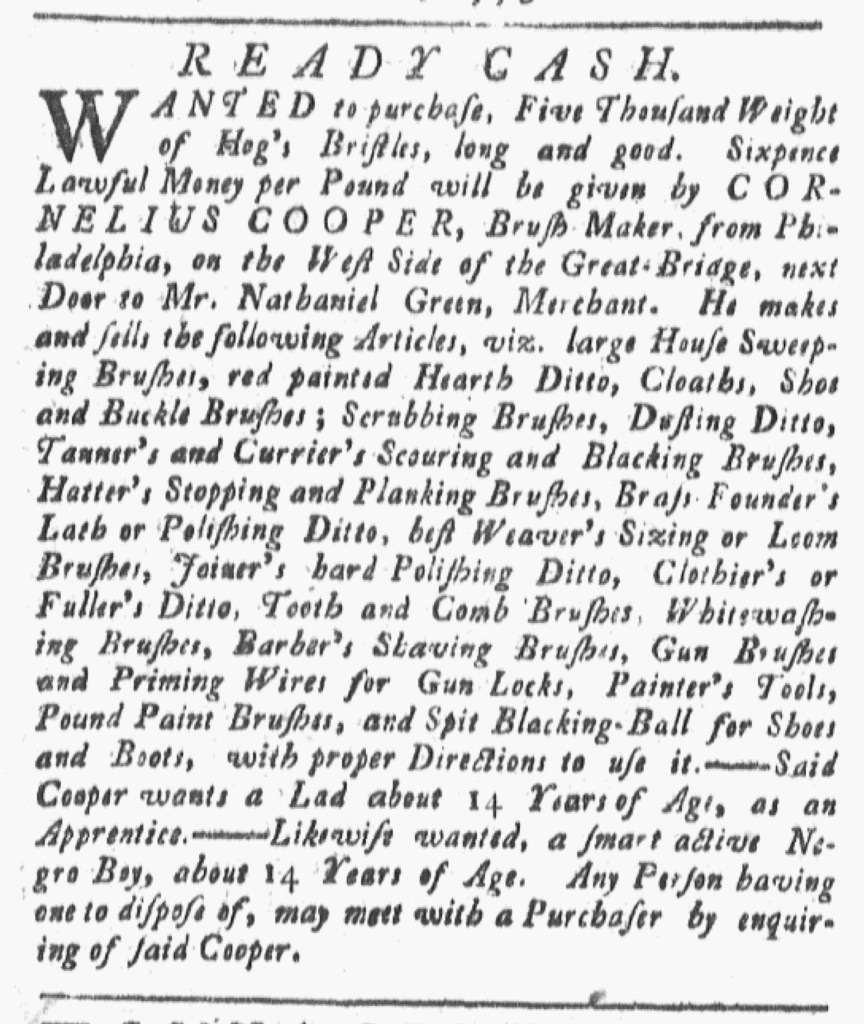
“WANTED to purchase, Five Thousand Weight of Hog’s Bristles, long and good.”

Cornelius Cooper, a “Brush Maker, from Philadelphia,” experimented with various marketing strategies when he relocated to Providence and placed advertisements in the Providence Gazette in the fall of 1775.  In an advertisement that ran for several weeks, he announced that the “makes and sells, Wholesale and Retail, Sweeping, Hearth, Cloaths, Shoe and Buckle-Brushes, and every other Article in the Brush Way.”  In other words, he produced every sort of brush for any sort of purpose that his customers needed.  He also made a pitch for local consumers to “Buy American,” asking that “every Friend to America, both in Town and Country, will encourage him occasionally” by making a purchase from his shop.  Only in the nota bene that concluded his advertisement did Cooper issue a call that “People will be careful to save their Hogs Bristles,” an essential material for making brushes, “for which he will give a good Price in Cash.”

In a subsequent advertisement, Cooper put his request for hog bristles front and center.  A headline in capital letters proclaimed, “READY CASH.”  The brushmaker explained that he sought to purchase “Five Thousand Weight of Hog’s Bristles, long and good,” and would pay six pence per pound.  Only after he caught readers’ attention with that offer did he list the inventory available at his shop in Providence.  Rather than name general categories of brushes, he made a display of the many kinds of brushes that he made and sold, including “Tanner’s and Currier’s Scouring and Blacking Brushes, Hatter’s Stopping and Planking Brushes, [and] best Weaver’s Sizing or Look Brushes.”  In addition to supplying consumers with brushes to use in their homes, Cooper aimed to supply artisans with brushes specific to their trades.  He also renewed his appeal for “a Lad about 14 Years of Age” to serve as an apprentice, but added that he “wanted, a smart active Negro Boy, about 14 Years of Age.”  Whether the enslaved youth would also learn how to make brushes or instead do other tasks in the workshop, Cooper did not specify.  He dropped the appeal to “every Friend in America,” though likely not because he noticed any discrepancy in advocating for the liberties of white colonizers and seeking to purchase an enslaved youth.  After all, acquiring bristles so he could stay in business seemed to be Cooper’s primary focus in his new advertisement.

November 11

What was advertised in a revolutionary American newspaper 250 years ago today?

Pennsylvania Ledger (November 11, 1775).

“AN ORATION … to Commemorate the Bloody Tragedy … By the Hon. JOHN HANCOCK.”

In addition to printing The Prussian Evolutions for Thomas Hanson in the fall of 1775, John Douglass McDougall published and sold “AN ORATION, Delivered March 6, 1774, at the Request of the Inhabitants of the Town of Boston, to Commemorate the Bloody Tragedy of the fifth of March, 1770.  By the Hon. JOHN HANCOCK, Esquire.”  The bookbinder, bookseller, and stationer had only recently added printer to the occupations he pursued at his shop in Philadelphia.  For his first forays, he focused on works supporting the American cause, either because doing so aligned with his political principles or because he spotted an opportunity to enhance his earnings.  Such motivations were not necessarily mutually exclusive.

In 1771, the residents of Boston marked the first anniversary of the “Bloody Tragedy,” now known as the Boston Massacre, with an oration delivered by James Lovell.  It did not take long for local printers to market copies.  So began an annual tradition.  Each year, a prominent figure delivered an “ORATION” and printers published and marketed those addresses.  Following Lovell, Joseph Warren spoke in 1772, Benjamin Church in 1773, John Hancock in 1774, and Joseph Warren again in 1775, just a few months before being killed in action at the Battle of Bunker Hill.  The annual oration became a ritual in Boston, as did the marketing of copies of the latest address in Boston’s newspapers each spring.  Printers outside of Boston, however, did not publish local editions, nor did booksellers outside of New England advertise copies they acquired from Boston.  The “Bloody Tragedy” and the trials of the soldiers involved had certainly been reported far and wide in newspapers throughout the colonies, but the subsequent commemorations did not receive as much notice, at least not in terms advertisements encouraging consumers beyond New England to purchase their own copies of the most recent oration.

That made McDougall’s new edition of Hancock’s oration from 1774 an innovation in the local market.  Why did he opt to publish Hancock’s address rather than the one more recently delivered by Warren?  As president of the Second Continental Congress, Hancock achieved recognition throughout the colonies, whereas Warren, even though he had died for the American cause, may have been considered a figure associated primarily with Massachusetts and thus not having the same appeal in Philadelphia, where the Second Continental Congress met and McDougall printed and advertised Hancock’s oration.  Whatever the reason, the publication and marketing of Hancock’s oration in Pennsylvania testified to a transition taking place throughout the colonies in the wake of the Coercive Acts and the battles at Lexington and Concord.  More colonizers began to think of themselves as sharing a common cause rather than having interests aligned with their own province.  They began to think of themselves as an imagined community of Americans despite the local and regional differences that distinguished each colony from the others.

Slavery Advertisements Published November 11, 1775

GUEST CURATOR: Massimo Sgambati

The Slavery Adverts 250 Project chronicles the role of newspaper advertising in perpetuating slavery in the era of the American Revolution. The project seeks to reveal the ubiquity of slavery in eighteenth-century life from New England to Georgia by republishing advertisements about enslaved people – for sale as individuals or in groups, wanted to purchase or for hire for short periods, runaways who liberated themselves, and those who were subsequently captured and confined in jails and workhouses – in daily digests on this site as well as in real time via the @SlaveAdverts250 Twitter feed, utilizing twenty-first-century media to stand in for the print media of the eighteenth century.

The project aims to provide modern audiences with a sense of just how often colonizers encountered these advertisements in their daily lives. Enslaved men, women, and children appeared in print somewhere in the colonies almost every single day. Those advertisements served as a constant backdrop for social, cultural, economic, and political life in colonial and revolutionary America. Colonizers who did not purport to own enslaved people were still confronted with slavery as well as invited to maintain the system by purchasing enslaved men, women, and children or assisting in the capture of so-called “runaways” who sought to free themselves from bondage. The frequency of these newspaper advertisements suggests just how embedded slavery was in colonial and revolutionary American culture in everyday interactions beyond the printed page.

These advertisements also testify to the experiences of enslaved men, women, and children, though readers must consider that those experiences have been remediated through descriptions offered by enslavers rather than enslaved people themselves. Often unnamed in the advertisements, enslaved men, women, and children were not invisible or unimportant in early America.

From compiling an archive of digitized eighteenth-century newspapers to identifying advertisements about enslaved men, women, and children in those newspapers to preparing images of each advertisement to posting this daily digest, Massimo Sgambati served as guest curator for this entry. He completed this work as part of the Summer Scholars Program, funded by a fellowship from the D’Amour College of Liberal Arts and Sciences at Assumption University in Worcester, Massachusetts, in Summer 2025.

These advertisements appeared in colonial American newspapers 250 years ago today.

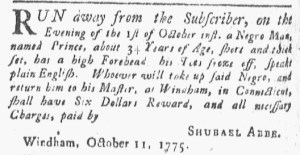
Providence Gazette (November 11, 1775)

**********

Providence Gazette (November 11, 1775)

**********

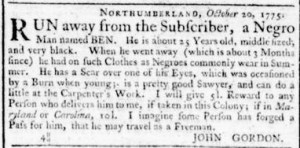
Virginia Gazette [Dixon and Hunter] (November 11, 1775)

**********

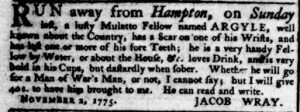
Virginia Gazette [Dixon and Hunter] (November 11, 1775)

**********

Virginia Gazette [Dixon and Hunter] (November 11, 1775)

**********

Virginia Gazette [Dixon and Hunter] (November 11, 1775)

**********

Virginia Gazette [Dixon and Hunter] (November 11, 1775)

**********

Virginia Gazette [Dixon and Hunter] (November 11, 1775)

November 10

What was advertised in a revolutionary American newspaper 250 years ago today?

Virginia Gazette (November 10, 1775).

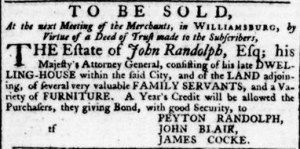
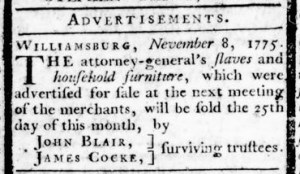
“JOHN BLAIR, JAMES COCKE, surviving trustees.”

An advertisement about the upcoming sale of the “attorney-general’s slaves and household furniture” in the November 10, 1775, edition of Alexander Purdie’s Virginia Gazette was signed by John Blair and James Cocke, the “surviving trustees.”  Upon learning of the death of Peyton Randolph, one of the original trustees, they had updated an advertisement that had been running in that newspaper as well as John Pinkney’s Virginia Gazette and John Dixon and William Hunter’s Virginia Gazette for several weeks.  John Randolph, the King’s Attorney General for the colony and a loyalist, had departed for England, leaving his brother, Peyton, along with Blair and Cocke as trustees to oversee and sell his estate. Peyton, a patriot and the president of the First Continental Congress, was in Philadelphia representing Virginia in the Second Continental Congress when he unexpectedly died, leaving Blair and Cocke as the “surviving trustees.”

Among the printers in Williamsburg, Purdie published the news of Randolph’s death first, nearly a week ahead of the other two newspapers.  Given that each published a new issue once a week, the news spread ahead of it appearing in print.  All the same, Purdie supplemented the brief notice that he ran in the November 3 edition with extensive coverage in the next issue on November 10.  “LAST sunday died of an apoplectick stroke,” the report began, “the hon. PEYTON RANDOLPH, Esq; of Virginia, late President of the Continental Congress, and Speaker of the House of Burgesses of that colony.”  On the following Tuesday, “his remains were removed … to Christ church, where an excellent sermon on the mournful occasion was preached … after which the corpse was carried to the burial ground, and deposited in a vault until it can be conveyed to Virginia.”  The dignitaries in the funeral procession included John Hancock, then serving as president of the Second Continental Congress, other “members of the Congress,” members of the Pennsylvania Assembly, and the mayor of Philadelphia.  Elsewhere in that issue, Purdie printed a memorial to Randolph, an eighteenth-century version of an obituary.  He also inserted a notice from Williamsburg’s Masonic Lodge: “Ordered, THAT the members of this Lodge go into mourning, for six weeks, for the late honourable and worthy provincial grand master, Peyton Randolph, esquire.”  To honor Randolph, Purdie enclosed the contents of the entire issue within thick black borders that signaled mourning.  Those borders ran on either side of the updated advertisement placed by the “surviving trustees” of John Randolph’s estate.

Slavery Advertisements Published November 10, 1775

GUEST CURATOR: Massimo Sgambati

The Slavery Adverts 250 Project chronicles the role of newspaper advertising in perpetuating slavery in the era of the American Revolution. The project seeks to reveal the ubiquity of slavery in eighteenth-century life from New England to Georgia by republishing advertisements about enslaved people – for sale as individuals or in groups, wanted to purchase or for hire for short periods, runaways who liberated themselves, and those who were subsequently captured and confined in jails and workhouses – in daily digests on this site as well as in real time via the @SlaveAdverts250 Twitter feed, utilizing twenty-first-century media to stand in for the print media of the eighteenth century.

The project aims to provide modern audiences with a sense of just how often colonizers encountered these advertisements in their daily lives. Enslaved men, women, and children appeared in print somewhere in the colonies almost every single day. Those advertisements served as a constant backdrop for social, cultural, economic, and political life in colonial and revolutionary America. Colonizers who did not purport to own enslaved people were still confronted with slavery as well as invited to maintain the system by purchasing enslaved men, women, and children or assisting in the capture of so-called “runaways” who sought to free themselves from bondage. The frequency of these newspaper advertisements suggests just how embedded slavery was in colonial and revolutionary American culture in everyday interactions beyond the printed page.

These advertisements also testify to the experiences of enslaved men, women, and children, though readers must consider that those experiences have been remediated through descriptions offered by enslavers rather than enslaved people themselves. Often unnamed in the advertisements, enslaved men, women, and children were not invisible or unimportant in early America.

From compiling an archive of digitized eighteenth-century newspapers to identifying advertisements about enslaved men, women, and children in those newspapers to preparing images of each advertisement to posting this daily digest, Massimo Sgambati served as guest curator for this entry. He completed this work as part of the Summer Scholars Program, funded by a fellowship from the D’Amour College of Liberal Arts and Sciences at Assumption University in Worcester, Massachusetts, in Summer 2025.

These advertisements appeared in colonial American newspapers 250 years ago today.

Connecticut Gazette (November 10, 1775)

**********

Virginia Gazette [Purdie] (November 10, 1775)

**********

Virginia Gazette [Purdie] (November 10, 1775)

**********

Virginia Gazette Supplement [Purdie] (November 10, 1775)

**********

Virginia Gazette Supplement [Purdie] (November 10, 1775)

**********

Virginia Gazette Supplement [Purdie] (November 10, 1775)

**********

Virginia Gazette Supplement [Purdie] (November 10, 1775)

**********

Virginia Gazette Supplement [Purdie] (November 10, 1775)

**********

Virginia Gazette Supplement [Purdie] (November 10, 1775)

**********

Virginia Gazette Supplement [Purdie] (November 10, 1775)

**********

Virginia Gazette Supplement [Purdie] (November 10, 1775)

**********

Virginia Gazette Supplement [Purdie] (November 10, 1775)

**********

Virginia Gazette Supplement [Purdie] (November 10, 1775)

**********

Virginia Gazette Supplement [Purdie] (November 10, 1775)

**********

Virginia Gazette Supplement [Purdie] (November 10, 1775)

November 9

What was advertised in a revolutionary American newspaper 250 years ago today?

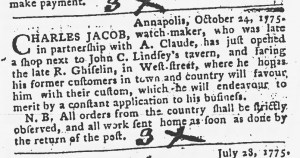
Maryland Gazette (November 9, 1775).

“All work sent home as soon as done by the return of post.”

After his partnership with Abraham Claude ended, watchmaker Charles Jacob opened his own shop in Annapolis in the fall of 1775.  He placed an advertisement in the Maryland Gazette in hopes that “his former customers in town and country will favour him with their custom,” though he also intended for the notice to draw the attention of new customers.  Mentioning both his partnership with Claude and the clientele they had established demonstrated to prospective new customers that Jacob had the experience to serve them well.  In addition, he pledged “constant application to his business” or, in other words, an industriousness that customers would find more than satisfactory.

For the convenience of customers who lived outside Annapolis, Jacob provided an eighteenth-century version of mail order service.  In a nota bene, he stated that “orders from the country shall be strictly observed, and all work sent home as soon as done by the return of the post.”  In other words, he gave the same attention to watches sent to him to clean or repair as if the customer had visited his shop.  He did not give priority to customers who resided in Annapolis, nor did he delay returning watches to their owners when he finished working on them.  Prospective customers did not need to worry that their watches might end up sitting on a workbench or tucked away in a drawer and forgotten while Jacob attended to other projects.  Instead, he ran an orderly shop.
Jacob may have occupied the same location where he and Claude previously kept shop.  In their earlier advertisements, including one in the October 1, 1773, edition of the Maryland Gazette, they gave their address as “opposite Mr. Ghiselin’s, in West-Street.  In his new advertisement, Jacob declared that he “has just opened a shop next to John C. Lindsey’s tavern, and facing the late R. Ghiselin, in West-street.”  A familiar location may have helped him retain some of the customers that frequented the shop when he ran it in partnership with Claude.