November 6

What was advertised in a revolutionary American newspaper 250 years ago today?
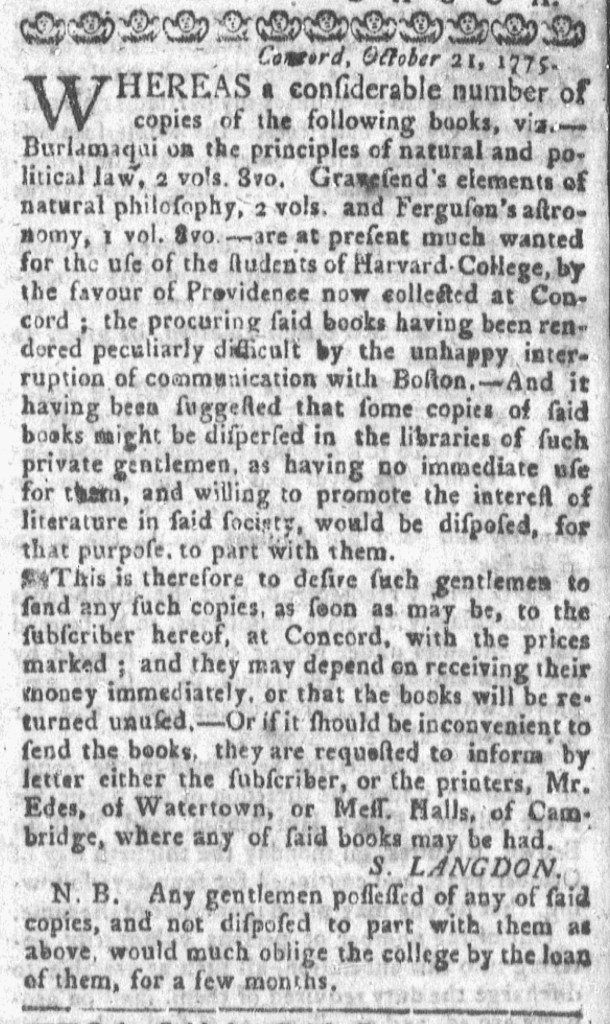
Boston-Gazette (November 6, 1775).

“The following books … are at present much wanted for the use of the students of Harvard College.”

Samuel Langdon, the president of Harvard College, issued a plea in the fall of 1775.  His students needed books!  As he explained in his advertisement in the November 6, 1775, edition of the Boston-Gazette, the college held classes in Concord while the siege of Boston continued … yet students could not acquire many of the texts that they needed because of “the unhappy interruption of communication” and trade with booksellers (and other purveyors of goods and services) in Boston.  Similarly, Benjamin Edes had moved the Boston-Gazette to Watertown following the battles at Lexington and Concord.

Langdon sought “a considerable number of copies” of “Burlamaqui on the principles of natural and political law, 2 vols. 8vo. Gravesend’s elements of natural philosophy, 2 vols. And Ferguson’s astronomy, 1 vol. 8vo.”  In specifying both the number of volumes and the size (“8vo” or octavo) of the books, Langdon made clear that the college preferred certain editions.  He reported that others “suggested” to him “that some copies of said books might be dispersed in the libraries of such private gentlemen” who did not have immediate use for them and thus might be willing to “part with them” to “promote the interest of literature” among the youth attending Harvard College.

Langdon requested that “such gentleman” who did have those books “send any such copies, as soon as may be … with the prices marked.”  They could “depend on receiving their money immediately, or that the books will be returned unused.”  Langdon understood that some readers might not wish to part with volumes from their personal libraries.  Alternately, he suggested that that it would “much oblige the college” if they would loan those volumes “for a few months.”  With classes continuing despite the disruptions caused by the outbreak of hostilities at Lexington and Concord the previous spring, Langdon engaged in an eighteenth-century version of crowdsourcing in his effort to procure books for his students.  The college survived a fire in its library a decade earlier, requesting donations of books to recover.  Now Harvard faced other obstacles and once again turned to the public to provide the books that the college needed.
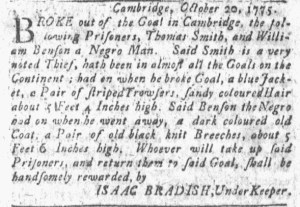
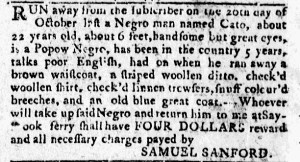
Slavery Advertisements Published November 6, 1775

GUEST CURATOR: Massimo Sgambati

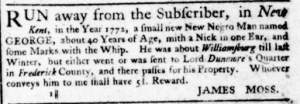
The Slavery Adverts 250 Project chronicles the role of newspaper advertising in perpetuating slavery in the era of the American Revolution. The project seeks to reveal the ubiquity of slavery in eighteenth-century life from New England to Georgia by republishing advertisements about enslaved people – for sale as individuals or in groups, wanted to purchase or for hire for short periods, runaways who liberated themselves, and those who were subsequently captured and confined in jails and workhouses – in daily digests on this site as well as in real time via the @SlaveAdverts250 Twitter feed, utilizing twenty-first-century media to stand in for the print media of the eighteenth century.

The project aims to provide modern audiences with a sense of just how often colonizers encountered these advertisements in their daily lives. Enslaved men, women, and children appeared in print somewhere in the colonies almost every single day. Those advertisements served as a constant backdrop for social, cultural, economic, and political life in colonial and revolutionary America. Colonizers who did not purport to own enslaved people were still confronted with slavery as well as invited to maintain the system by purchasing enslaved men, women, and children or assisting in the capture of so-called “runaways” who sought to free themselves from bondage. The frequency of these newspaper advertisements suggests just how embedded slavery was in colonial and revolutionary American culture in everyday interactions beyond the printed page.

These advertisements also testify to the experiences of enslaved men, women, and children, though readers must consider that those experiences have been remediated through descriptions offered by enslavers rather than enslaved people themselves. Often unnamed in the advertisements, enslaved men, women, and children were not invisible or unimportant in early America.

From compiling an archive of digitized eighteenth-century newspapers to identifying advertisements about enslaved men, women, and children in those newspapers to preparing images of each advertisement to posting this daily digest, Massimo Sgambati served as guest curator for this entry. He completed this work as part of the Summer Scholars Program, funded by a fellowship from the D’Amour College of Liberal Arts and Sciences at Assumption University in Worcester, Massachusetts, in Summer 2025.

These advertisements appeared in colonial American newspapers 250 years ago today.

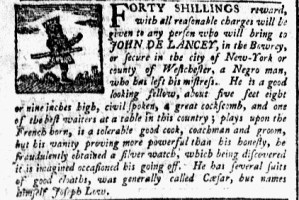
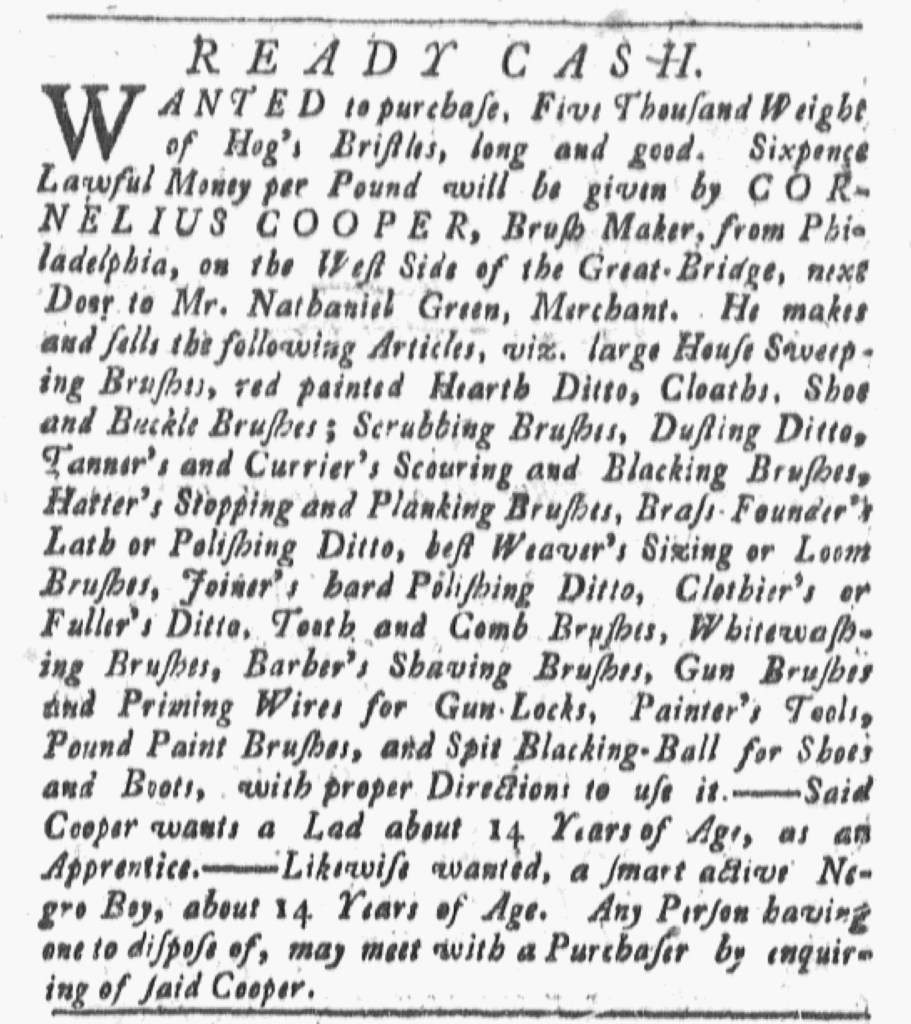
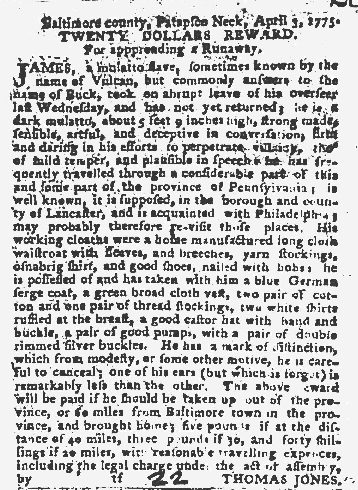
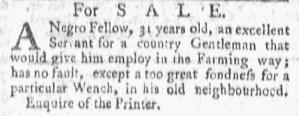
Boston Gazette (November 6, 1775)

**********

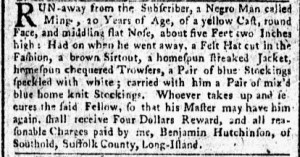
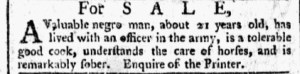
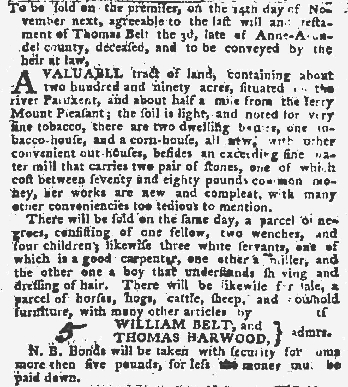
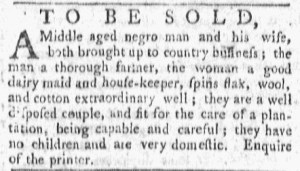
Connecticut Courant (November 6, 1775)

**********

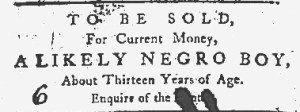
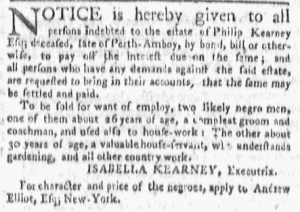
Connecticut Courant (November 6, 1775)

**********

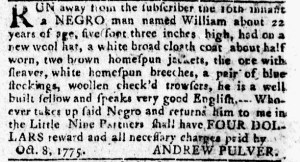
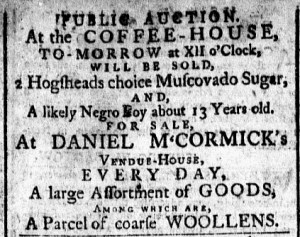
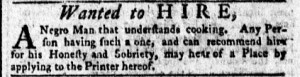
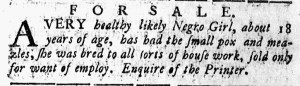
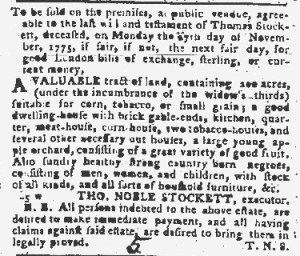
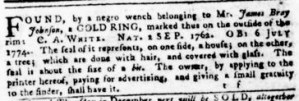
New-York Gazette and Weekly Mercury (November 6, 1775)

**********

New-York Gazette and Weekly Mercury (November 6, 1775)

**********

New-York Gazette and Weekly Mercury (November 6, 1775)

**********

New-York Gazette and Weekly Mercury (November 6, 1775)

**********

New-York Gazette and Weekly Mercury (November 6, 1775)

**********

New-York Gazette and Weekly Mercury (November 6, 1775)

**********

New-York Gazette and Weekly Mercury (November 6, 1775)

**********

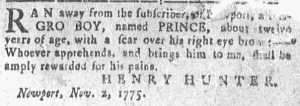
Newport Mercury (November 6, 1775)

**********

Norwich Packet (November 6, 1775)

November 5

What was advertised in a revolutionary American newspaper 250 years ago this week?

Pennsylvania Evening Post (November 4, 1775).

“A NIGHT SCHOOL.”

“FRENCH ACADEMY.”

Two advertisements in the November 4, 1775, edition of the Pennsylvania Evening Post and its supplement offered opportunities for learning and self-improvement.  In the first notice, Matthew Maguire announced that he had opened a “NIGHT SCHOOL” for “youth of both sexes.”  The curriculum included “the various branches of READING, WRITING and ARITHMETIC,” subjects that both boys and girls typically learned.  Maguire also indicated that he taught “ACCOMPTS [or accounts] in all their different forms, after the latest and most approved methods,” though he did not mention whether he reserved that subject for male students.  Learning how to keep daybooks and ledgers may have been useful for some of the girls and young women who attended Maguire’s school, especially those that attended in the evening because they assisted in running the family business during the day.  Maguire also provided lessons during the day “as usual,” but he specified in a nota bene that he continued admitting “Young ladies only.”  In addition to giving female students a homosocial setting with fewer chances of disruptions, he may he reasoned that most boys and young men who would attend the school he kept in his house in Carter’s Alley did indeed have apprenticeships and other responsibilities during the day.
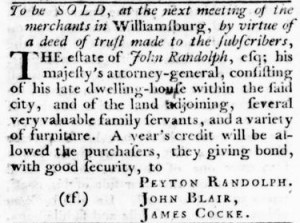
Supplement to the Pennsylvania Evening Post (November 4, 1775).

In the other advertisement, Francis Daymon, “MASTER of the French and Latin Languages” and “LIBRARIAN of the Philadelphia Public Library” (or the Library Company of Philadelphia), advised prospective pupils that he “HAS opened his FRENCH ACADEMY for the winter season.”  Classes began “punctually at seven o’clock every evening (Saturday excepted),” though it went without saying that he did not give lessons on Sundays.  Daymon delivered lessons “in the Library Room in Carpenters Hall,” the Library Company having moved to the second floor of that building from the Pennsylvania State House when it was completed in 1773.  He presumably admitted students of both sexes since he did not indicate otherwise in his advertisement.  He did note that “Ladies and Gentlemen may be instructed at their places of abode as usual,” an arrangement that allowed his pupils or their parents to determine who would be present.  Unlike Maguire, Daymon offered private lessons, likely setting rates for his students for the convenience of learning in their homes accordingly.

While some of the students who learned reading, writing, arithmetic, and accounts from Maguire could have also sought out French lessons from Daymon, the two schoolmasters cultivated different clienteles.  Maguire emphasized basic skills for everyday use by a wide range of colonizers, while Daymon’s French lessons appealed to genteel residents of Philadelphia and those aspiring to gentility.  With the Continental Association, a nonimportation and nonconsumption agreement, in effect, discourses about fashion had shifted.  Learning French gave some colonizers an alternate way to assert their status.
November 4

What was advertised in a revolutionary American newspaper 250 years ago today?

Supplement to the Pennsylvania Evening Post (November 4, 1775).

“Those gentlemen who have taken subscriptions … are requested to return the lists speedily.”

A notice in the Supplement to the Pennsylvania Evening Post for November 4, 1775, advised that “THOSE gentlemen who intend to subscribe for HANSON’s EVOLUTIONS, and have not sent in their names, are requested to be speedy in forwarding them.”  Thomas Hanson, “Adjutant to the 2d Battalion” and author of the work, expected that the readers he addressed knew that he referred to The Prussian Evolutions in Actual Engagements; Both in Platoons, Sub, and Grand-Divisions; Explaining, all the Different Evolutions, and Manoeuvres, in Firing, Standing, Advancing, and Retreating, Which Were Exhibitted before His Present Majesty, May 8, 1769; and before John Duke of Argyle , on the Links, near Edenburgh, in 1771; with Some Additions, Since that Time, Explained with Thirty Folio Copper-Plates; To Which Is Added, the Prussian Manual Exercise; Also the Theory and Practices of Gunnery.  To include the entire title of the book would have doubled the length of the advertisement!  An advertisement published in July had included most of the title as a means of inciting interest among prospective subscribers.

Hanson had been marketing the book since early May, apparently embarking on the project almost as soon as residents of Philadelphia learned of the battles at Lexington and Concord that took place on April 19.  When he ran the newspaper advertisement in July, he anticipated that the “said work will be completed in three or four weeks from this date,” but it took longer than expected since more than three months later he ran a new advertisement that indicated the “first edition” had not yet been printed.  Subscribers needed to submit their names quickly, Hanson asserted, or else their names would not appear in the subscription list incorporated into the book with the other content.  That subscription list eventually filled five pages and included prominent military officers, such as “His Excellency George Washington” and “His Excellency Philip Schuyler,” and members of the Second Continental Congress, such as “The Honourable Benjamin Franklin” and “The Hon. John Hancock.”  Peyton Randolph also appeared among the list of subscribers, though he died before Hanson published the book.  In his newest advertisement, he once again instructed prospective subscribers to submit their names because “otherwise a list of them cannot be printed.”

In the earlier advertisement, Hanson listed about a dozen local subscription agents who collected orders, including merchants and printers.  This time, he told prospective subscribers that they could submit their names directly to him or “to the bar of the London Coffee-house,” a popular place for gathering to socialize, conduct business, and discuss politics.  Hanson did acknowledge those “gentlemen who have taken subscriptions” and requested that they “return the lists speedily” so he could compile them for publication.  It seemed to be the last chance to submit orders before the book was published.  The title page did not include a date, but historians believe it was printed in late 1775.

Slavery Advertisements Published November 4, 1775

GUEST CURATOR: Massimo Sgambati

The Slavery Adverts 250 Project chronicles the role of newspaper advertising in perpetuating slavery in the era of the American Revolution. The project seeks to reveal the ubiquity of slavery in eighteenth-century life from New England to Georgia by republishing advertisements about enslaved people – for sale as individuals or in groups, wanted to purchase or for hire for short periods, runaways who liberated themselves, and those who were subsequently captured and confined in jails and workhouses – in daily digests on this site as well as in real time via the @SlaveAdverts250 Twitter feed, utilizing twenty-first-century media to stand in for the print media of the eighteenth century.

The project aims to provide modern audiences with a sense of just how often colonizers encountered these advertisements in their daily lives. Enslaved men, women, and children appeared in print somewhere in the colonies almost every single day. Those advertisements served as a constant backdrop for social, cultural, economic, and political life in colonial and revolutionary America. Colonizers who did not purport to own enslaved people were still confronted with slavery as well as invited to maintain the system by purchasing enslaved men, women, and children or assisting in the capture of so-called “runaways” who sought to free themselves from bondage. The frequency of these newspaper advertisements suggests just how embedded slavery was in colonial and revolutionary American culture in everyday interactions beyond the printed page.

These advertisements also testify to the experiences of enslaved men, women, and children, though readers must consider that those experiences have been remediated through descriptions offered by enslavers rather than enslaved people themselves. Often unnamed in the advertisements, enslaved men, women, and children were not invisible or unimportant in early America.

From compiling an archive of digitized eighteenth-century newspapers to identifying advertisements about enslaved men, women, and children in those newspapers to preparing images of each advertisement to posting this daily digest, Massimo Sgambati served as guest curator for this entry. He completed this work as part of the Summer Scholars Program, funded by a fellowship from the D’Amour College of Liberal Arts and Sciences at Assumption University in Worcester, Massachusetts, in Summer 2025.

These advertisements appeared in colonial American newspapers 250 years ago today.

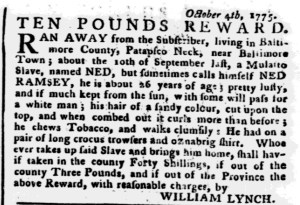
Constitution Gazette (November 4, 1775)

**********

Dunlap’s Maryland Gazette (November 4, 1775)

**********

Pennsylvania Evening Post (November 4, 1775)

**********

Providence Gazette (November 4, 1775)

**********

Providence Gazette (November 4, 1775)

**********

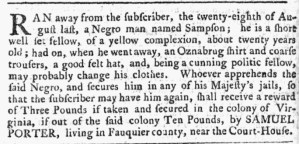
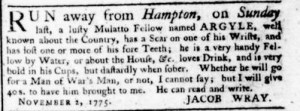
Virginia Gazette [Dixon and Hunter] (November 4, 1775)

**********

Virginia Gazette [Dixon and Hunter] (November 4, 1775)

**********

Virginia Gazette [Dixon and Hunter] (November 4, 1775)

**********

Virginia Gazette [Dixon and Hunter] (November 4, 1775)

**********

Virginia Gazette [Dixon and Hunter] (November 4, 1775)

November 3

What was advertised in a revolutionary American newspaper 250 years ago today?

Virginia Gazette [Purdie] (November 3, 1775).

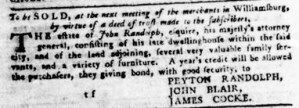
“To be SOLD … THE estate of John Randolph, esq; his majesty’s attorney-general.”

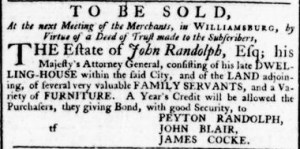
The advertisement for the “Estate of John Randolph” that ran in John Dixon and William Hunter’s Virginia Gazette in the fall of 1775 also appeared in the other newspapers published in Williamsburg, John Pinkney’s Virginia Gazette and Alexander Purdie’s Virginia Gazette.  When the Loyalist departed for England, either he left instructions to advertise widely or the trustees – Peyton Randolph (his brother), John Blair, and James Cocke – decided that they wanted news of the upcoming sale of Randolph’s house, furniture, and enslaved “family servants” to circulate as widely as possible.

Virginia Gazette [Purdie] (November 3, 1775).

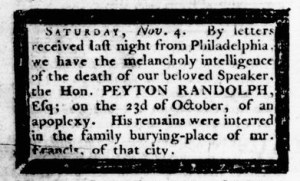
When the advertisement ran on the final page in the November 3 edition of Purdie’s Virginia Gazette, it contradicted news that appeared on the second page.  Thick black borders that indicated mourning surrounded a short article that informed readers, “By letter received last night from Philadelphia, we have the melancholy intelligence of the death of our beloved Speaker, the Hon. PEYTON RANDOLPH, Esq; on the 23d of October, of an apoplexy.  His remains were interred in the family burying-place of mr. Francis, of that city.”  Randolph had served as speaker of the colony’s House of Burgesses.  He also held very different political views than his brother, having served as president of the First Continental Congress when it met in Philadelphia in the fall of 1774 and, briefly, as president of the Second Continental Congress when it convened after the battles at Lexington and Concord the following year.  He had been in Philadelphia as one of Virginia’s delegates when he died.

Blair and Cocke, the “surviving trustees,” ran an updated advertisement the following week, but there had not been time to revise the notice that had been running for several weeks.  The side of the broadsheet that carried the advertisement may even have been printed already when Purdie’s printing office received word of Randolph’s death.  In addition, the report, dated “SATURDAY, Nov. 4,” introduces some confusion about when the news arrived and when Purdie printed and distributed the November 3 edition of his newspaper.  Purdie scooped the other two newspapers.  Pinkney delivered the news in his next edition on November 9 (along with the updated advertisement).  Dixon and Hunter inserted a news report and an extensive memorial on November 11.  Either they did not have the news in time for their November 4 edition, or the type had been set and the printing already commenced when it arrived.  That still does not describe the discrepancy in the dates for Purdie’s newspaper, though he may have been a day late in publishing it but listed November 3, the anticipated date of publication for the weekly newspaper, in the masthead as a polite fiction.

Not only did Purdie publish the news first with a brief article, but the following week he ran both a news article about Randolph’s death and funeral and a memorial to Randolph in his November 10 edition.  The text matched the memorial in Dixon and Hunter’s November 11 edition, but the compositor made different choices for the format.  Purdie also honored Randolph with thick black borders around the content on all four pages, not just enclosing the memorial.  That issue included the updated notice about John Randolph’s estate sale as the first of the advertisements on the final page, though the two-page supplement that accompanied it carried the original advertisement.  The news and an advertisement continued delivering contradictory information, suggesting that Purdie and others in his printing office were not attentive to every detail in every advertisement they published.  The original advertisement may have appeared again as filler to complete the page rather than as an intentional insertion by the trustees who oversaw the sale it announced.

Slavery Advertisements Published November 3, 1775

GUEST CURATOR: Massimo Sgambati

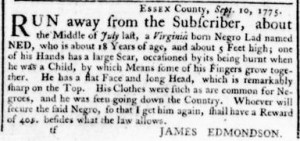
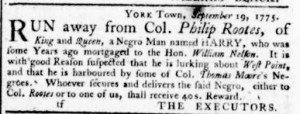
The Slavery Adverts 250 Project chronicles the role of newspaper advertising in perpetuating slavery in the era of the American Revolution. The project seeks to reveal the ubiquity of slavery in eighteenth-century life from New England to Georgia by republishing advertisements about enslaved people – for sale as individuals or in groups, wanted to purchase or for hire for short periods, runaways who liberated themselves, and those who were subsequently captured and confined in jails and workhouses – in daily digests on this site as well as in real time via the @SlaveAdverts250 Twitter feed, utilizing twenty-first-century media to stand in for the print media of the eighteenth century.

The project aims to provide modern audiences with a sense of just how often colonizers encountered these advertisements in their daily lives. Enslaved men, women, and children appeared in print somewhere in the colonies almost every single day. Those advertisements served as a constant backdrop for social, cultural, economic, and political life in colonial and revolutionary America. Colonizers who did not purport to own enslaved people were still confronted with slavery as well as invited to maintain the system by purchasing enslaved men, women, and children or assisting in the capture of so-called “runaways” who sought to free themselves from bondage. The frequency of these newspaper advertisements suggests just how embedded slavery was in colonial and revolutionary American culture in everyday interactions beyond the printed page.

These advertisements also testify to the experiences of enslaved men, women, and children, though readers must consider that those experiences have been remediated through descriptions offered by enslavers rather than enslaved people themselves. Often unnamed in the advertisements, enslaved men, women, and children were not invisible or unimportant in early America.

From compiling an archive of digitized eighteenth-century newspapers to identifying advertisements about enslaved men, women, and children in those newspapers to preparing images of each advertisement to posting this daily digest, Massimo Sgambati served as guest curator for this entry. He completed this work as part of the Summer Scholars Program, funded by a fellowship from the D’Amour College of Liberal Arts and Sciences at Assumption University in Worcester, Massachusetts, in Summer 2025.

These advertisements appeared in colonial American newspapers 250 years ago today.

Connecticut Gazette (November 3, 1775)

**********

Essex Journal (November 3, 1775)

**********

Virginia Gazette [Purdie] (November 3, 1775)

**********

Virginia Gazette [Purdie] (November 3, 1775)

**********

Virginia Gazette [Purdie] (November 3, 1775)

**********

Virginia Gazette [Purdie] (November 3, 1775)

**********

Virginia Gazette [Purdie] (November 3, 1775)

**********

Virginia Gazette [Purdie] (November 3, 1775)

**********

Virginia Gazette [Purdie] (November 3, 1775)

**********

Virginia Gazette [Purdie] (November 3, 1775)

**********

Virginia Gazette [Purdie] (November 3, 1775)

**********

Virginia Gazette [Purdie] (November 3, 1775)

**********

Virginia Gazette [Purdie] (November 3, 1775)

**********

Virginia Gazette [Purdie] (November 3, 1775)

**********

Virginia Gazette [Purdie] (November 3, 1775)

**********

Virginia Gazette [Purdie] (November 3, 1775)

November 2

Who was the subject of an advertisement in a revolutionary American newspaper 250 years ago today?

New-Hampshire Gazette (November 2, 1775).

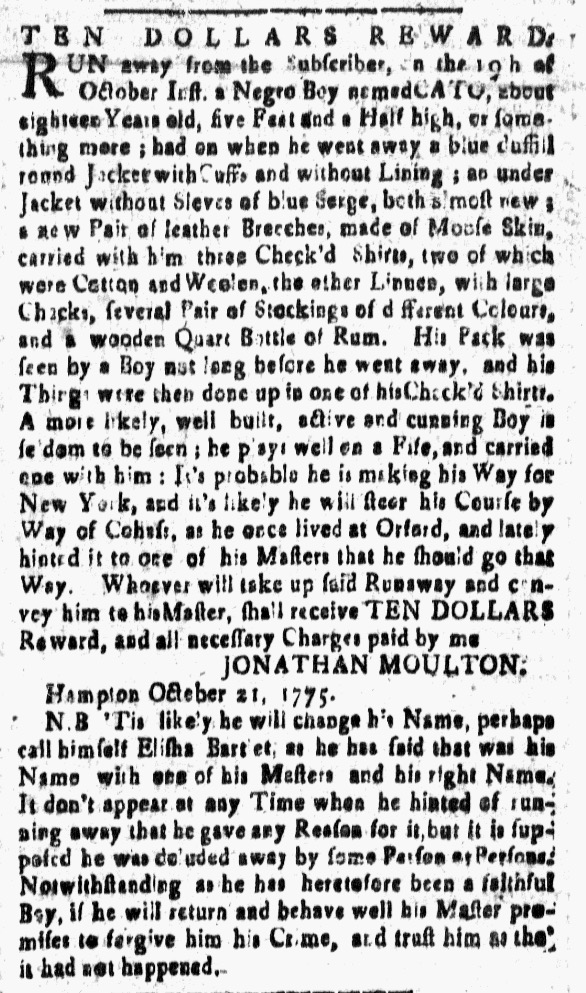
“’Tis likely he will change his Name, perhaps call himself Elisha Bartlet, as he has said that was … his right Name.”

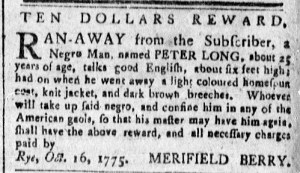
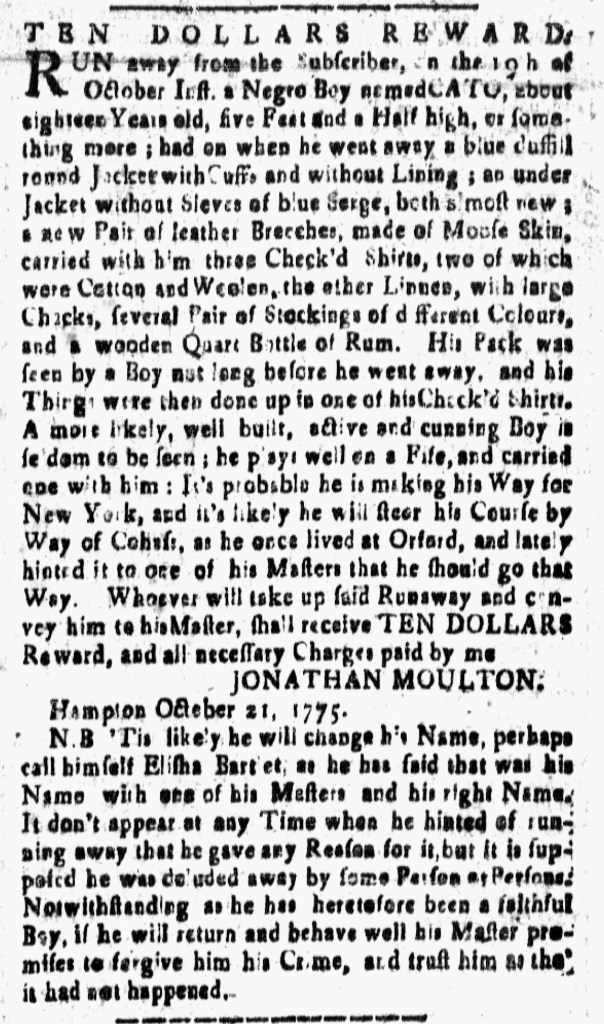
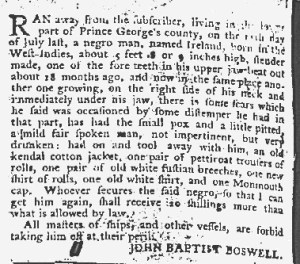
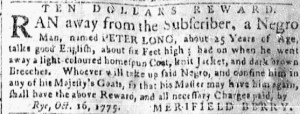
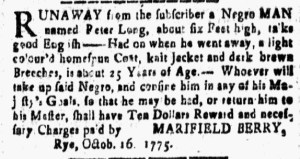
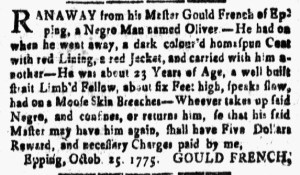
Even though the disruption in the paper supply once again meant that the New-Hampshire Gazette consisted of only two pages instead of the usual four, Daniel Fowle, the printer, found space to publish three advertisements about enslaved men who liberated themselves by running away from their enslavers in the November 2, 1775, edition.  They appeared one after the other in the final column on the first page.  All three men – Cato (also known as Elisha Bartlet), Peter Long, and Oliver – made their escape in October, perhaps taking advantage of the turmoil caused by the outbreak of hostilities at Lexington and Concord the previous spring and the ongoing siege of Boston.

Jonathan Moulton’s advertisement describing Bartlet was about three times the length of Marifield Berry’s advertisement about Peter Long and Gould French’s advertisement about Oliver.  Moulton reported on the clothes that Bartlet wore when he departed, noting that he “carried with him three Check’d Shirts [and] several Pair of Stockings of different Colours.”  Apparently, Bartlet had been spotted by a boy who observed that “his Things were then done up in one of Check’d Shirts” as a pack that he carried.  Moulton suspected that the man he called Cato would “change his Name, perhaps call himself Elisha Bartlet, as he has said that was his Name with one of his Masters and his right Name.” Although not his intention in placing the advertisement, Moulton revealed Bartlet’s commitment to self-determination in naming himself.  It did not matter to Bartlet what Moulton or any other enslaver called him at their own whim.  He considered Elisha Bartlet his true name, though Moulton did not share enough of the enslaved man’s story to explain why that was the case.

The enslaver did indicate that Bartlet had suggested on more than one occasion that he planned to escape.  He thought it “probable [Bartlet] is making his Way for New York,” having “lately hinted it to one of his Masters.”  In addition, Moulton stated, “It don’t appear at any Time when he hinted of running away that he gave any Reason for it.”  Given the circumstances, Moulton conjectured that Bartlet had been “deluded away by some Person or Persons.”  The enslaver seemingly did not entertain the notion that the man he insisted on calling Cato had the same aspirations for freedom that animated so much of the news and editorials about current events that ran alongside his advertisement in the New-Hampshire Gazette.  Instead, Moulton asserted that since Bartlet “has heretofore been a faithful Boy, if he will return and behave well his Master promises to forgive him his Crime, and trust him as tho’ it had not happened.”  Considering that Bartlet planned his escape from slavery for some time and chose an opportune moment to flee, he likely had little interest in any promises that his enslaver published in the public prints.

Slavery Advertisements Published November 2, 1775

GUEST CURATOR: Massimo Sgambati

The Slavery Adverts 250 Project chronicles the role of newspaper advertising in perpetuating slavery in the era of the American Revolution. The project seeks to reveal the ubiquity of slavery in eighteenth-century life from New England to Georgia by republishing advertisements about enslaved people – for sale as individuals or in groups, wanted to purchase or for hire for short periods, runaways who liberated themselves, and those who were subsequently captured and confined in jails and workhouses – in daily digests on this site as well as in real time via the @SlaveAdverts250 Twitter feed, utilizing twenty-first-century media to stand in for the print media of the eighteenth century.

The project aims to provide modern audiences with a sense of just how often colonizers encountered these advertisements in their daily lives. Enslaved men, women, and children appeared in print somewhere in the colonies almost every single day. Those advertisements served as a constant backdrop for social, cultural, economic, and political life in colonial and revolutionary America. Colonizers who did not purport to own enslaved people were still confronted with slavery as well as invited to maintain the system by purchasing enslaved men, women, and children or assisting in the capture of so-called “runaways” who sought to free themselves from bondage. The frequency of these newspaper advertisements suggests just how embedded slavery was in colonial and revolutionary American culture in everyday interactions beyond the printed page.

These advertisements also testify to the experiences of enslaved men, women, and children, though readers must consider that those experiences have been remediated through descriptions offered by enslavers rather than enslaved people themselves. Often unnamed in the advertisements, enslaved men, women, and children were not invisible or unimportant in early America.

From compiling an archive of digitized eighteenth-century newspapers to identifying advertisements about enslaved men, women, and children in those newspapers to preparing images of each advertisement to posting this daily digest, Massimo Sgambati served as guest curator for this entry. He completed this work as part of the Summer Scholars Program, funded by a fellowship from the D’Amour College of Liberal Arts and Sciences at Assumption University in Worcester, Massachusetts, in Summer 2025.

These advertisements appeared in colonial American newspapers 250 years ago today.

Maryland Gazette (November 2, 1775)

**********

Maryland Gazette (November 2, 1775)

**********

Maryland Gazette (November 2, 1775)

**********

Maryland Gazette (November 2, 1775)

**********

Maryland Gazette (November 2, 1775)

**********

Maryland Gazette (November 2, 1775)

**********

Maryland Gazette (November 2, 1775)

**********

New-England Chronicle (November 2, 1775)

**********

New-England Chronicle (November 2, 1775)

**********

New-Hampshire Gazette (November 2, 1775)

**********

New-Hampshire Gazette (November 2, 1775)

**********

New-Hampshire Gazette (November 2, 1775)

**********

New-York Journal (November 2, 1775)

**********

New-York Journal (November 2, 1775)

**********

Rivington’s New-York Gazetteer (November 2, 1775)

**********

Rivington’s New-York Gazetteer (November 2, 1775)

**********

Rivington’s New-York Gazetteer (November 2, 1775)

**********

Rivington’s New-York Gazetteer (November 2, 1775)

**********

Virginia Gazette [Pinkney] (November 2, 1775)

**********

Virginia Gazette [Pinkney] (November 2, 1775)

**********

Virginia Gazette [Pinkney] (November 2, 1775)

**********

Virginia Gazette [Pinkney] (November 2, 1775)

**********

Virginia Gazette [Pinkney] (November 2, 1775)

**********

Virginia Gazette [Pinkney] (November 2, 1775)

**********

Virginia Gazette [Pinkney] (November 2, 1775)

**********

Virginia Gazette [Pinkney] (November 2, 1775)

November 1

What was advertised in a revolutionary American newspaper 250 years ago today?

Pennsylvania Journal (November 1, 1775).

“A NEAT Mezzotinto print of the Hon. JOHN HANCOCK.”

“A large and exact VIEW of the late BATTLE at CHARLESTOWN.”

“An accurate map of the present seat of CIVIL WAR.”

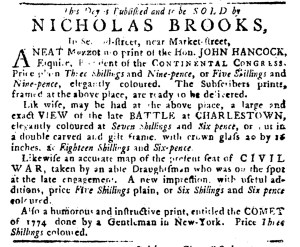
Nicholas Brooks produced and marketed items that commemorated the American Revolution before the colonies declared independence.  In an advertisement in the November 1, 1775, edition of the Pennsylvania Journal, for instance, he packaged together three prints previously advertised separately, each of them related to imperial crisis that had boiled over into a war.  For this notice, Brooks presented them as a collection of prints for consumers who wished to demonstrate their support for the American cause by purchasing and displaying one or more of them.

Brooks announced that a “NEAT Mezzotinto print of the Hon JOHN HANCOCK, Esquire, President of the CONTINENTAL CONGRESS,” that had previously been proposed in other advertisements had been published and was now for sale at his shop on Second Street in Philadelphia.  The subscribers who had reserved copies in advance could pick up their framed copies or arrange for delivery.  Others who had not placed advanced orders could acquire the print for three shillings and nine pence or pay two extra shillings for one “elegantly coloured.”

“Likewise, may be had at the above place,” Brooks reported, “a large and exact VIEW of the late BATTLE at CHARLESTOWN,” depicting what has become known as the Battle of Bunker Hill.  This print competed with an imitation bearing a similar title, “a neat and correct VIEW of the late BATTLE at CHARLESTOWN,” that Robert Aitken inserted in the Pennsylvania Magazine and sold separately.  Brooks, who had long experience selling framed prints, offered choices for his “exact VIEW.”  Customers could opt for an “elegantly coloured” version for seven shillings and six pence” or have it “put in a double carved and gilt frame, with glass 20 by 16 inches,” for eighteen shillings and six pence.  The eleven shillings for the frame, half again the cost of the print, indicated that Brooks anticipated that customers would display the “exact VIEW” proudly in their homes or offices.

He also promoted “an accurate map of the present seat of CIVIL WAR, taken by an able Draughtsman,” Bernard Romans, “who was on the spot of the late engagement.”  Brooks revised copy from earlier advertisements: “The draught was taken by the most skillful draughtsman in all America, and who was on the spot at the engagements of Lexington and Bunker’s Hill.”  The map showed a portion of New England that included Boston, Salem, Providence, and Worcester.   This print, he declared, was a “new impression, with useful additions,” though he did not specify how it differed from the one he previously marketed and sold.  As with the others, customers had a choice of a plain version for five shillings or a “coloured” one for six shillings and six pence.

Brooks added one more item, “a humorous and instructive print, entitled the COMET of 1774, done by a Gentleman in New-York.”  Did this print offer some sort of satirical commentary on current events?  Or was it unrelated to the prints of Hancock, the Battle of Bunker Hill, and the “CIVIL WAR” in New England?  Whatever the additional print depicted, Brooks made the prints that commemorated the American Revolution the focus of his advertisement, gathering together three items previously promoted individually.  In so doing, he not only offered each print to customers as separate purchases but also suggested that they could consider them part of a collection.  Consumers who really wanted to demonstrate their patriotism could easily acquire all three at his shop.