November 11

What was advertised in a revolutionary American newspaper 250 years ago today?

Pennsylvania Ledger (November 11, 1775).

“AN ORATION … to Commemorate the Bloody Tragedy … By the Hon. JOHN HANCOCK.”

In addition to printing The Prussian Evolutions for Thomas Hanson in the fall of 1775, John Douglass McDougall published and sold “AN ORATION, Delivered March 6, 1774, at the Request of the Inhabitants of the Town of Boston, to Commemorate the Bloody Tragedy of the fifth of March, 1770.  By the Hon. JOHN HANCOCK, Esquire.”  The bookbinder, bookseller, and stationer had only recently added printer to the occupations he pursued at his shop in Philadelphia.  For his first forays, he focused on works supporting the American cause, either because doing so aligned with his political principles or because he spotted an opportunity to enhance his earnings.  Such motivations were not necessarily mutually exclusive.

In 1771, the residents of Boston marked the first anniversary of the “Bloody Tragedy,” now known as the Boston Massacre, with an oration delivered by James Lovell.  It did not take long for local printers to market copies.  So began an annual tradition.  Each year, a prominent figure delivered an “ORATION” and printers published and marketed those addresses.  Following Lovell, Joseph Warren spoke in 1772, Benjamin Church in 1773, John Hancock in 1774, and Joseph Warren again in 1775, just a few months before being killed in action at the Battle of Bunker Hill.  The annual oration became a ritual in Boston, as did the marketing of copies of the latest address in Boston’s newspapers each spring.  Printers outside of Boston, however, did not publish local editions, nor did booksellers outside of New England advertise copies they acquired from Boston.  The “Bloody Tragedy” and the trials of the soldiers involved had certainly been reported far and wide in newspapers throughout the colonies, but the subsequent commemorations did not receive as much notice, at least not in terms advertisements encouraging consumers beyond New England to purchase their own copies of the most recent oration.

That made McDougall’s new edition of Hancock’s oration from 1774 an innovation in the local market.  Why did he opt to publish Hancock’s address rather than the one more recently delivered by Warren?  As president of the Second Continental Congress, Hancock achieved recognition throughout the colonies, whereas Warren, even though he had died for the American cause, may have been considered a figure associated primarily with Massachusetts and thus not having the same appeal in Philadelphia, where the Second Continental Congress met and McDougall printed and advertised Hancock’s oration.  Whatever the reason, the publication and marketing of Hancock’s oration in Pennsylvania testified to a transition taking place throughout the colonies in the wake of the Coercive Acts and the battles at Lexington and Concord.  More colonizers began to think of themselves as sharing a common cause rather than having interests aligned with their own province.  They began to think of themselves as an imagined community of Americans despite the local and regional differences that distinguished each colony from the others.
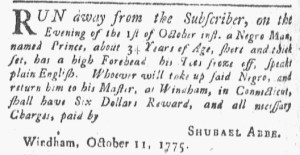
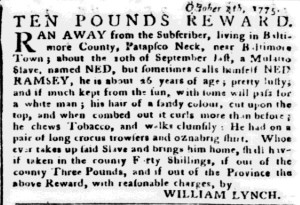
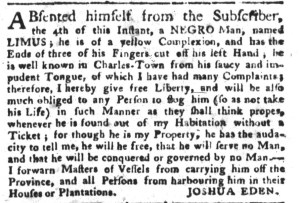
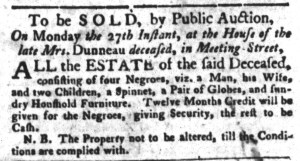
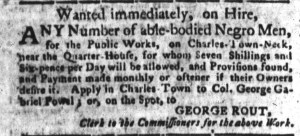
Slavery Advertisements Published November 11, 1775

GUEST CURATOR: Massimo Sgambati

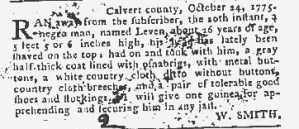
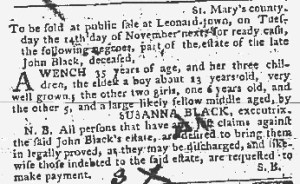
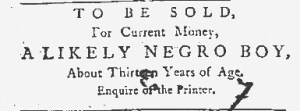
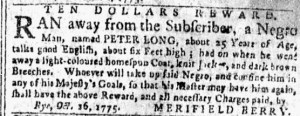
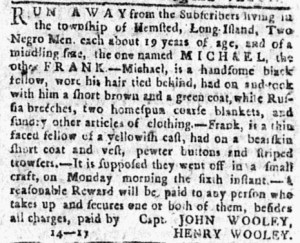
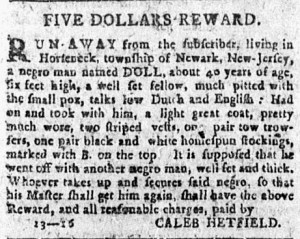
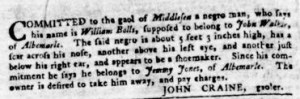
The Slavery Adverts 250 Project chronicles the role of newspaper advertising in perpetuating slavery in the era of the American Revolution. The project seeks to reveal the ubiquity of slavery in eighteenth-century life from New England to Georgia by republishing advertisements about enslaved people – for sale as individuals or in groups, wanted to purchase or for hire for short periods, runaways who liberated themselves, and those who were subsequently captured and confined in jails and workhouses – in daily digests on this site as well as in real time via the @SlaveAdverts250 Twitter feed, utilizing twenty-first-century media to stand in for the print media of the eighteenth century.

The project aims to provide modern audiences with a sense of just how often colonizers encountered these advertisements in their daily lives. Enslaved men, women, and children appeared in print somewhere in the colonies almost every single day. Those advertisements served as a constant backdrop for social, cultural, economic, and political life in colonial and revolutionary America. Colonizers who did not purport to own enslaved people were still confronted with slavery as well as invited to maintain the system by purchasing enslaved men, women, and children or assisting in the capture of so-called “runaways” who sought to free themselves from bondage. The frequency of these newspaper advertisements suggests just how embedded slavery was in colonial and revolutionary American culture in everyday interactions beyond the printed page.

These advertisements also testify to the experiences of enslaved men, women, and children, though readers must consider that those experiences have been remediated through descriptions offered by enslavers rather than enslaved people themselves. Often unnamed in the advertisements, enslaved men, women, and children were not invisible or unimportant in early America.

From compiling an archive of digitized eighteenth-century newspapers to identifying advertisements about enslaved men, women, and children in those newspapers to preparing images of each advertisement to posting this daily digest, Massimo Sgambati served as guest curator for this entry. He completed this work as part of the Summer Scholars Program, funded by a fellowship from the D’Amour College of Liberal Arts and Sciences at Assumption University in Worcester, Massachusetts, in Summer 2025.

These advertisements appeared in colonial American newspapers 250 years ago today.

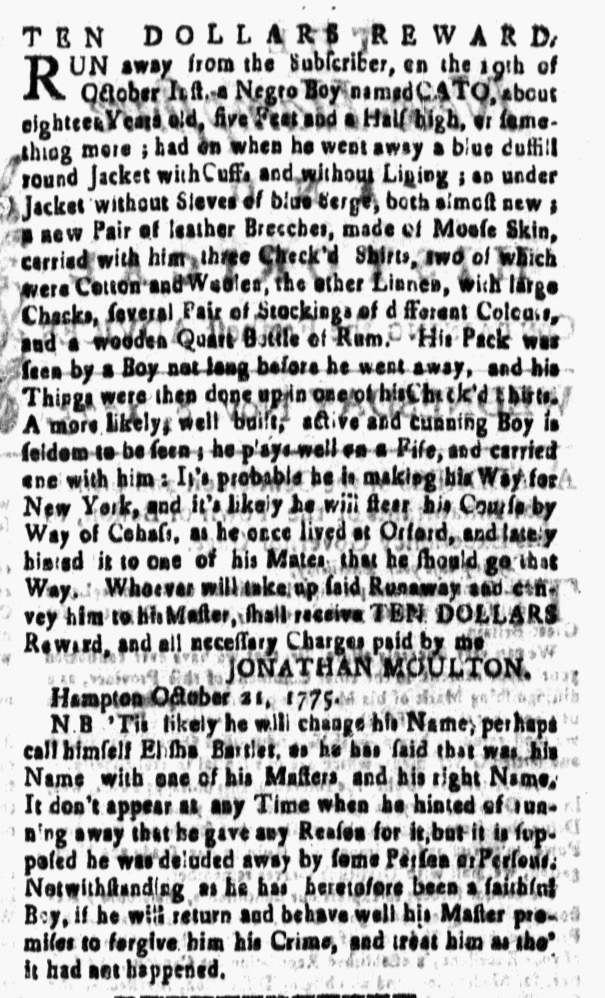
Providence Gazette (November 11, 1775)

**********

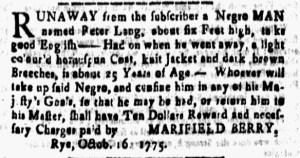
Providence Gazette (November 11, 1775)

**********

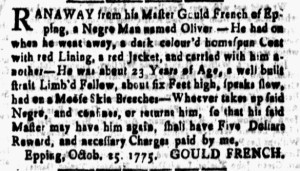
Virginia Gazette [Dixon and Hunter] (November 11, 1775)

**********

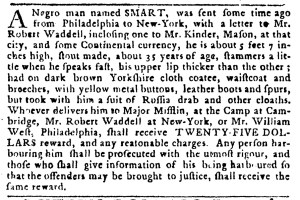
Virginia Gazette [Dixon and Hunter] (November 11, 1775)

**********

Virginia Gazette [Dixon and Hunter] (November 11, 1775)

**********

Virginia Gazette [Dixon and Hunter] (November 11, 1775)

**********

Virginia Gazette [Dixon and Hunter] (November 11, 1775)

**********

Virginia Gazette [Dixon and Hunter] (November 11, 1775)

November 10

What was advertised in a revolutionary American newspaper 250 years ago today?

Virginia Gazette (November 10, 1775).

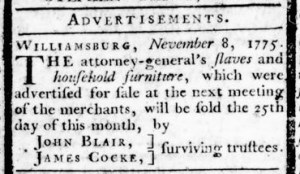
“JOHN BLAIR, JAMES COCKE, surviving trustees.”

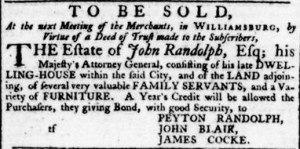
An advertisement about the upcoming sale of the “attorney-general’s slaves and household furniture” in the November 10, 1775, edition of Alexander Purdie’s Virginia Gazette was signed by John Blair and James Cocke, the “surviving trustees.”  Upon learning of the death of Peyton Randolph, one of the original trustees, they had updated an advertisement that had been running in that newspaper as well as John Pinkney’s Virginia Gazette and John Dixon and William Hunter’s Virginia Gazette for several weeks.  John Randolph, the King’s Attorney General for the colony and a loyalist, had departed for England, leaving his brother, Peyton, along with Blair and Cocke as trustees to oversee and sell his estate. Peyton, a patriot and the president of the First Continental Congress, was in Philadelphia representing Virginia in the Second Continental Congress when he unexpectedly died, leaving Blair and Cocke as the “surviving trustees.”

Among the printers in Williamsburg, Purdie published the news of Randolph’s death first, nearly a week ahead of the other two newspapers.  Given that each published a new issue once a week, the news spread ahead of it appearing in print.  All the same, Purdie supplemented the brief notice that he ran in the November 3 edition with extensive coverage in the next issue on November 10.  “LAST sunday died of an apoplectick stroke,” the report began, “the hon. PEYTON RANDOLPH, Esq; of Virginia, late President of the Continental Congress, and Speaker of the House of Burgesses of that colony.”  On the following Tuesday, “his remains were removed … to Christ church, where an excellent sermon on the mournful occasion was preached … after which the corpse was carried to the burial ground, and deposited in a vault until it can be conveyed to Virginia.”  The dignitaries in the funeral procession included John Hancock, then serving as president of the Second Continental Congress, other “members of the Congress,” members of the Pennsylvania Assembly, and the mayor of Philadelphia.  Elsewhere in that issue, Purdie printed a memorial to Randolph, an eighteenth-century version of an obituary.  He also inserted a notice from Williamsburg’s Masonic Lodge: “Ordered, THAT the members of this Lodge go into mourning, for six weeks, for the late honourable and worthy provincial grand master, Peyton Randolph, esquire.”  To honor Randolph, Purdie enclosed the contents of the entire issue within thick black borders that signaled mourning.  Those borders ran on either side of the updated advertisement placed by the “surviving trustees” of John Randolph’s estate.
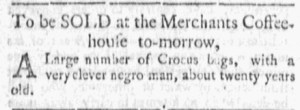
Slavery Advertisements Published November 10, 1775

GUEST CURATOR: Massimo Sgambati

The Slavery Adverts 250 Project chronicles the role of newspaper advertising in perpetuating slavery in the era of the American Revolution. The project seeks to reveal the ubiquity of slavery in eighteenth-century life from New England to Georgia by republishing advertisements about enslaved people – for sale as individuals or in groups, wanted to purchase or for hire for short periods, runaways who liberated themselves, and those who were subsequently captured and confined in jails and workhouses – in daily digests on this site as well as in real time via the @SlaveAdverts250 Twitter feed, utilizing twenty-first-century media to stand in for the print media of the eighteenth century.

The project aims to provide modern audiences with a sense of just how often colonizers encountered these advertisements in their daily lives. Enslaved men, women, and children appeared in print somewhere in the colonies almost every single day. Those advertisements served as a constant backdrop for social, cultural, economic, and political life in colonial and revolutionary America. Colonizers who did not purport to own enslaved people were still confronted with slavery as well as invited to maintain the system by purchasing enslaved men, women, and children or assisting in the capture of so-called “runaways” who sought to free themselves from bondage. The frequency of these newspaper advertisements suggests just how embedded slavery was in colonial and revolutionary American culture in everyday interactions beyond the printed page.

These advertisements also testify to the experiences of enslaved men, women, and children, though readers must consider that those experiences have been remediated through descriptions offered by enslavers rather than enslaved people themselves. Often unnamed in the advertisements, enslaved men, women, and children were not invisible or unimportant in early America.

From compiling an archive of digitized eighteenth-century newspapers to identifying advertisements about enslaved men, women, and children in those newspapers to preparing images of each advertisement to posting this daily digest, Massimo Sgambati served as guest curator for this entry. He completed this work as part of the Summer Scholars Program, funded by a fellowship from the D’Amour College of Liberal Arts and Sciences at Assumption University in Worcester, Massachusetts, in Summer 2025.

These advertisements appeared in colonial American newspapers 250 years ago today.

Connecticut Gazette (November 10, 1775)

**********

Virginia Gazette [Purdie] (November 10, 1775)

**********

Virginia Gazette [Purdie] (November 10, 1775)

**********

Virginia Gazette Supplement [Purdie] (November 10, 1775)

**********

Virginia Gazette Supplement [Purdie] (November 10, 1775)

**********

Virginia Gazette Supplement [Purdie] (November 10, 1775)

**********

Virginia Gazette Supplement [Purdie] (November 10, 1775)

**********

Virginia Gazette Supplement [Purdie] (November 10, 1775)

**********

Virginia Gazette Supplement [Purdie] (November 10, 1775)

**********

Virginia Gazette Supplement [Purdie] (November 10, 1775)

**********

Virginia Gazette Supplement [Purdie] (November 10, 1775)

**********

Virginia Gazette Supplement [Purdie] (November 10, 1775)

**********

Virginia Gazette Supplement [Purdie] (November 10, 1775)

**********

Virginia Gazette Supplement [Purdie] (November 10, 1775)

**********

Virginia Gazette Supplement [Purdie] (November 10, 1775)

November 9

What was advertised in a revolutionary American newspaper 250 years ago today?

Maryland Gazette (November 9, 1775).

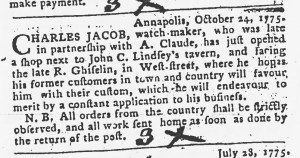
“All work sent home as soon as done by the return of post.”

After his partnership with Abraham Claude ended, watchmaker Charles Jacob opened his own shop in Annapolis in the fall of 1775.  He placed an advertisement in the Maryland Gazette in hopes that “his former customers in town and country will favour him with their custom,” though he also intended for the notice to draw the attention of new customers.  Mentioning both his partnership with Claude and the clientele they had established demonstrated to prospective new customers that Jacob had the experience to serve them well.  In addition, he pledged “constant application to his business” or, in other words, an industriousness that customers would find more than satisfactory.

For the convenience of customers who lived outside Annapolis, Jacob provided an eighteenth-century version of mail order service.  In a nota bene, he stated that “orders from the country shall be strictly observed, and all work sent home as soon as done by the return of the post.”  In other words, he gave the same attention to watches sent to him to clean or repair as if the customer had visited his shop.  He did not give priority to customers who resided in Annapolis, nor did he delay returning watches to their owners when he finished working on them.  Prospective customers did not need to worry that their watches might end up sitting on a workbench or tucked away in a drawer and forgotten while Jacob attended to other projects.  Instead, he ran an orderly shop.
Jacob may have occupied the same location where he and Claude previously kept shop.  In their earlier advertisements, including one in the October 1, 1773, edition of the Maryland Gazette, they gave their address as “opposite Mr. Ghiselin’s, in West-Street.  In his new advertisement, Jacob declared that he “has just opened a shop next to John C. Lindsey’s tavern, and facing the late R. Ghiselin, in West-street.”  A familiar location may have helped him retain some of the customers that frequented the shop when he ran it in partnership with Claude.

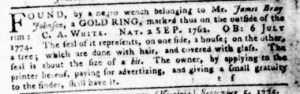
Slavery Advertisements Published November 9, 1775

GUEST CURATOR: Massimo Sgambati

The Slavery Adverts 250 Project chronicles the role of newspaper advertising in perpetuating slavery in the era of the American Revolution. The project seeks to reveal the ubiquity of slavery in eighteenth-century life from New England to Georgia by republishing advertisements about enslaved people – for sale as individuals or in groups, wanted to purchase or for hire for short periods, runaways who liberated themselves, and those who were subsequently captured and confined in jails and workhouses – in daily digests on this site as well as in real time via the @SlaveAdverts250 Twitter feed, utilizing twenty-first-century media to stand in for the print media of the eighteenth century.

The project aims to provide modern audiences with a sense of just how often colonizers encountered these advertisements in their daily lives. Enslaved men, women, and children appeared in print somewhere in the colonies almost every single day. Those advertisements served as a constant backdrop for social, cultural, economic, and political life in colonial and revolutionary America. Colonizers who did not purport to own enslaved people were still confronted with slavery as well as invited to maintain the system by purchasing enslaved men, women, and children or assisting in the capture of so-called “runaways” who sought to free themselves from bondage. The frequency of these newspaper advertisements suggests just how embedded slavery was in colonial and revolutionary American culture in everyday interactions beyond the printed page.

These advertisements also testify to the experiences of enslaved men, women, and children, though readers must consider that those experiences have been remediated through descriptions offered by enslavers rather than enslaved people themselves. Often unnamed in the advertisements, enslaved men, women, and children were not invisible or unimportant in early America.

From compiling an archive of digitized eighteenth-century newspapers to identifying advertisements about enslaved men, women, and children in those newspapers to preparing images of each advertisement to posting this daily digest, Massimo Sgambati served as guest curator for this entry. He completed this work as part of the Summer Scholars Program, funded by a fellowship from the D’Amour College of Liberal Arts and Sciences at Assumption University in Worcester, Massachusetts, in Summer 2025.

These advertisements appeared in colonial American newspapers 250 years ago today.

Maryland Gazette (November 9, 1775)

**********

Maryland Gazette (November 9, 1775)

**********

Maryland Gazette (November 9, 1775)

**********

Maryland Gazette (November 9, 1775)

**********

Maryland Gazette (November 9, 1775)

**********

Maryland Gazette (November 9, 1775)

**********

New-England Chronicle (November 9, 1775)

**********

New-York Journal (November 9, 1775)

**********

New-York Journal (November 9, 1775)

**********

Rivington’s New-York Gazetteer (November 9, 1775)

**********

Rivington’s New-York Gazetteer (November 9, 1775)

**********

Rivington’s New-York Gazetteer (November 9, 1775)

**********

Virginia Gazette [Pinkney] (November 9, 1775)

**********

Virginia Gazette [Pinkney] (November 9, 1775)

**********

Virginia Gazette [Pinkney] (November 9, 1775)

**********

Virginia Gazette [Pinkney] (November 9, 1775)

**********

Virginia Gazette [Pinkney] (November 9, 1775)

November 8

What was advertised in a revolutionary American newspaper 250 years ago today?

Pennsylvania Gazette (November 8, 1775).

“PROPOSALS FOR PRINTING BY SUBSCRIPTION, A TREATISE OF FORTIFICATION.”

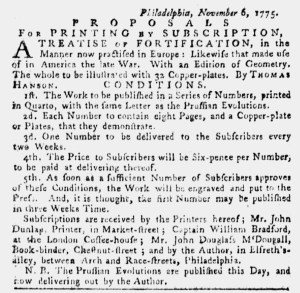
Thomas Hanson announced a new project in the November 8, 1775, editions of the Pennsylvania Gazette and the Pennsylvania Journal.  For several months he had been engaged in soliciting subscribers for his Prussian Evolutions in Actual Engagements, a military manual that garnered the support of both officers and politicians.  With that book “published … and now delivering out by the Author,” Hanson distributed subscription proposals for printing “A TREATISE OF FORTIFICATION, in the Manner now practiced in Europe: Likewise that made use of in America the late War.”  The Prussian Evolutions included thirty copperplate engravings; similarly, this new endeavor would be “illustrated with 32 Copper-plates.”

Hanson adopted a different method for publishing the proposed treatise than he had for the Prussian Evolutions.  Rather than produce a single volume, he planned for the “Work to be published in a Series of Numbers, printed in Quarto, with the same Letter as the Prussian Evolutions,” “Each Number to contain eight Pages, and a Copper-plate or Plates, that they demonstrate,” and “One number to be delivered to the Subscribers every two Weeks.”  Eighteenth-century readers would have been familiar with such “CONDITIONS” for publishing books.  Hanson planned to use the type (“same Letter”) as his first book, giving the two works a similar appearance.  Instead of taking the entire book to press at one time, Hanson planned to print and distribute two sheets (“eight Pages”) and the corresponding illustrations once every two weeks.  Each sheet would have four pages on it, creating a quarto sized book when folded by the printer, bookbinder, or subscriber.  Subscribers paid six pence “per Number” or set of eight pages with corresponding illustrations upon delivery.

Hanson declared that “the Work will be engraved and put to the Press” once “a sufficient Number of Subscribers approves of these Conditions.”  Why did he opt to publish his treatise on fortifications in smaller parts rather than all at once?  Perhaps Hanson had grown frustrated with the delays in publishing the Prussian Evolutions.  In an earlier advertisement, he noted that he first published subscription proposals on May 3, shortly after learning about the battles at Lexington and Concord.  In July, he thought that the book would be completed “in three or four weeks,” yet more than three months passed before the volume was published and ready for delivery.  Printing and distributing a new “Number” every two weeks would keep the project moving forward and the revenues collected upon delivery would likely help as well.  Hanson expected that “the first Number may be published in three Weeks Time,” but it seems that he was disappointed once again.  It does not appear that this proposed project met with the same success as the Prussian Evolutions.  Even if some “Numbers” went to press, no complete volume of the proposed treatise survives today.  Most likely, Hanson did not entice a “sufficient Number of Subscribers.”  According to the American Revolution Institute of the Society of the Cincinnati, he faced a lot of competition.  Presses in Philadelphia produced more than thirty works on military subjects in 1775 and 1776, including Hanson’s Prussian Evolutions.

Slavery Advertisements Published November 8, 1775

GUEST CURATOR: Massimo Sgambati

The Slavery Adverts 250 Project chronicles the role of newspaper advertising in perpetuating slavery in the era of the American Revolution. The project seeks to reveal the ubiquity of slavery in eighteenth-century life from New England to Georgia by republishing advertisements about enslaved people – for sale as individuals or in groups, wanted to purchase or for hire for short periods, runaways who liberated themselves, and those who were subsequently captured and confined in jails and workhouses – in daily digests on this site as well as in real time via the @SlaveAdverts250 Twitter feed, utilizing twenty-first-century media to stand in for the print media of the eighteenth century.

The project aims to provide modern audiences with a sense of just how often colonizers encountered these advertisements in their daily lives. Enslaved men, women, and children appeared in print somewhere in the colonies almost every single day. Those advertisements served as a constant backdrop for social, cultural, economic, and political life in colonial and revolutionary America. Colonizers who did not purport to own enslaved people were still confronted with slavery as well as invited to maintain the system by purchasing enslaved men, women, and children or assisting in the capture of so-called “runaways” who sought to free themselves from bondage. The frequency of these newspaper advertisements suggests just how embedded slavery was in colonial and revolutionary American culture in everyday interactions beyond the printed page.

These advertisements also testify to the experiences of enslaved men, women, and children, though readers must consider that those experiences have been remediated through descriptions offered by enslavers rather than enslaved people themselves. Often unnamed in the advertisements, enslaved men, women, and children were not invisible or unimportant in early America.

From compiling an archive of digitized eighteenth-century newspapers to identifying advertisements about enslaved men, women, and children in those newspapers to preparing images of each advertisement to posting this daily digest, Massimo Sgambati served as guest curator for this entry. He completed this work as part of the Summer Scholars Program, funded by a fellowship from the D’Amour College of Liberal Arts and Sciences at Assumption University in Worcester, Massachusetts, in Summer 2025.

These advertisements appeared in colonial American newspapers 250 years ago today.

New-Hampshire Gazette (November 8, 1775)

**********

New-Hampshire Gazette (November 8, 1775)

**********

New-Hampshire Gazette (November 8, 1775)

**********

Pennsylvania Journal (November 8, 1775)

**********

Pennsylvania Journal (November 8, 1775)

**********

Pennsylvania Journal (November 8, 1775)

**********

Pennsylvania Journal (November 8, 1775)

November 7

What was advertised in a revolutionary American newspaper 250 years ago today?

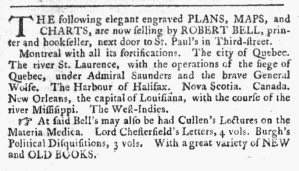
Pennsylvania Evening Post (November 7, 1775).

“MAPS … Montreal with all its fortifications.  The city of Quebec.”

Robert Bell, one of the most prominent American booksellers of the eighteenth century, also sold “PLANS, MAPS, and CHARTS” at his shop in Philadelphia.  In an advertisement in the November 7, 1775, edition of the Pennsylvania Evening Post, he promoted maps depicting “Montreal with all its fortifications.  The city of Quebec.  The river St. Laurence, with the operations of the siege of Quebec, under Admiral Saunders and the brave General Wolfe.  The Harbour of Halifax.  Nova Scotia.  Canada.  New Orleans, the capital of Louisiana, with the course of the river Mississippi.  [And] The West-Indies.”

Bell moved from north to south, generally, in listing the places depicted on the maps and charts that he stocked and sold, though he seemingly made a deliberate decision to list Montreal and Quebec before Halifax.  Current events likely influenced that choice.  For its first major military initiative, the Continental Army launched an invasion of Quebec in hopes of capturing the province and convincing its inhabitants to join the American cause.  That territory had been claimed by the French Empire for centuries, but only recently became part of the British Empire as part of the settlement that brought the Seven Years War to an end in 1763.  The Americans suspected that French speakers in Quebec had little loyalty to the British.

Two expeditions conducted a dual-pronged attack on the province.  In late August, an expedition authorized by the Second Continental Congress and commanded by General Richard Montgomery departed Fort Ticonderoga in New York, headed to Montreal.  Colonel Benedict Arnold, disappointed at being passed over to lead that expedition, convinced General George Washington to send another expedition to Quebec City.  Under Arnold’s command, that expedition departed Newburyport, Massachusetts, and made a harrowing journey up the Kennebec River.

At the time that Bell ran his advertisement, Montgomery’s expedition approached Montreal and Arnold’s expedition approached Quebec, though it would take some time for news to arrive in Philadelphia for readers of the Pennsylvania Evening Post.  Yet those readers did know that those expeditions were underway and that Montgomery began a siege of the town and fort of Saint-Jean in September.  Bell believed that some prospective customers were already interested in maps and plans of Montral and Quebec City and that he could incite demand among others by informing them of the items available at his shop.  The maps he sold supplement the news that colonizers read in the public prints.

Slavery Advertisements Published November 7, 1775

GUEST CURATOR: Massimo Sgambati

The Slavery Adverts 250 Project chronicles the role of newspaper advertising in perpetuating slavery in the era of the American Revolution. The project seeks to reveal the ubiquity of slavery in eighteenth-century life from New England to Georgia by republishing advertisements about enslaved people – for sale as individuals or in groups, wanted to purchase or for hire for short periods, runaways who liberated themselves, and those who were subsequently captured and confined in jails and workhouses – in daily digests on this site as well as in real time via the @SlaveAdverts250 Twitter feed, utilizing twenty-first-century media to stand in for the print media of the eighteenth century.

The project aims to provide modern audiences with a sense of just how often colonizers encountered these advertisements in their daily lives. Enslaved men, women, and children appeared in print somewhere in the colonies almost every single day. Those advertisements served as a constant backdrop for social, cultural, economic, and political life in colonial and revolutionary America. Colonizers who did not purport to own enslaved people were still confronted with slavery as well as invited to maintain the system by purchasing enslaved men, women, and children or assisting in the capture of so-called “runaways” who sought to free themselves from bondage. The frequency of these newspaper advertisements suggests just how embedded slavery was in colonial and revolutionary American culture in everyday interactions beyond the printed page.

These advertisements also testify to the experiences of enslaved men, women, and children, though readers must consider that those experiences have been remediated through descriptions offered by enslavers rather than enslaved people themselves. Often unnamed in the advertisements, enslaved men, women, and children were not invisible or unimportant in early America.

From compiling an archive of digitized eighteenth-century newspapers to identifying advertisements about enslaved men, women, and children in those newspapers to preparing images of each advertisement to posting this daily digest, Massimo Sgambati served as guest curator for this entry. He completed this work as part of the Summer Scholars Program, funded by a fellowship from the D’Amour College of Liberal Arts and Sciences at Assumption University in Worcester, Massachusetts, in Summer 2025.

These advertisements appeared in colonial American newspapers 250 years ago today.

Dunlap’s Maryland Gazette (November 7, 1775)

**********

South-Carolina Gazette (November 7, 1775)

**********

South-Carolina Gazette (November 7, 1775)

**********

South-Carolina Gazette (November 7, 1775)

**********

South-Carolina Gazette (November 7, 1775)

**********

South-Carolina Gazette (November 7, 1775)

**********

South-Carolina Gazette (November 7, 1775)

**********

South-Carolina Gazette (November 7, 1775)

**********

South-Carolina Gazette (November 7, 1775)