January 24

What was advertised in a revolutionary American newspaper 250 years ago today?
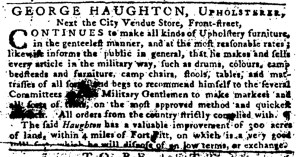
Pennsylvania Gazette (January 24, 1776).

“GEORGE HAUGHTON,, UPHOLSTERER … makes and sells every article in the military way.”

In January 1776, George Haughton, an upholsterer in Philadelphia, placed an advertisement in the Pennsylvania Gazetteto remind the public that he “CONTINUES to make all kinds of Upholstery furniture.”  A year earlier, he introduced himself as an “UPHOLSTERER, lately from LONDON,” in a notice in the January 30, 1775, edition of the Pennsylvania Journal.  Like other newcomers, he realized that prospective customers did not know him like reputation.  “He being a stranger,” Haughton declared, “has no recommendation but his skill in his profession, which he hopes the Public will give him an opportunity to shew.”  The upholsterer underscored that he “had the advantage of serving a regular apprenticeship to that trade in one of the most capital shop in London, and working in most of the others” distinguishing him from other upholsterers in Philadelphia.

In his new advertisement, Haughton tried a new marketing appeal.  He targeted customers who needed military equipment, proclaiming that he “makes and sells every article in the military way.”  That included “drums, colours [or flags and pennants], camp bedsteads and furniture, camp chairs, stools, tables, and mattrasses of all sorts.”  Fashion mattered, even during times of war, so Haughton assured prospective customers that he produced his wares “in the genteelest manner,” yet they did not overcharge.  He sold these items “at the most reasonable rates.”  Haughton addressed “the several Committees [of the] Military Gentlemen,” hoping to “recommend himself” to them to supply “markees [marquees (officers’ field tents)] and all sorts of tents, on the most approved method and quickest dispatch.”  Quality and efficiency mattered, as did providing officers and soldiers with exactly what they needed whether they appeared at his shop in person or sent orders from a distance.  “All orders from the country,” Haughton pledged, “strictly complied with.”  The Revolutionary War presented new business opportunities for some entrepreneurs.  Haughton hoped to turn the situation to his advantage with an advertisement in one of Philadelphia’s most popular newspapers.

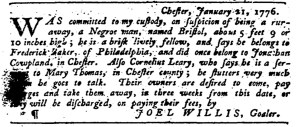
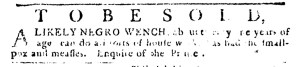
Slavery Advertisements Published January 24, 1776

The Slavery Adverts 250 Project chronicles the role of newspaper advertising in perpetuating slavery in the era of the American Revolution. The project seeks to reveal the ubiquity of slavery in eighteenth-century life from New England to Georgia by republishing advertisements about enslaved people – for sale as individuals or in groups, wanted to purchase or for hire for short periods, runaways who liberated themselves, and those who were subsequently captured and confined in jails and workhouses – in daily digests on this site as well as in real time via the @SlaveAdverts250 Twitter feed, utilizing twenty-first-century media to stand in for the print media of the eighteenth century.

The project aims to provide modern audiences with a sense of just how often colonizers encountered these advertisements in their daily lives. Enslaved men, women, and children appeared in print somewhere in the colonies almost every single day. Those advertisements served as a constant backdrop for social, cultural, economic, and political life in colonial and revolutionary America. Colonizers who did not purport to own enslaved people were still confronted with slavery as well as invited to maintain the system by purchasing enslaved men, women, and children or assisting in the capture of so-called “runaways” who sought to free themselves from bondage. The frequency of these newspaper advertisements suggests just how embedded slavery was in colonial and revolutionary American culture in everyday interactions beyond the printed page.

These advertisements also testify to the experiences of enslaved men, women, and children, though readers must consider that those experiences have been remediated through descriptions offered by enslavers rather than enslaved people themselves. Often unnamed in the advertisements, enslaved men, women, and children were not invisible or unimportant in early America.

Massimo Sgambati made significant contributions to this entry as part of the Summer Scholars Program, funded by a fellowship from the D’Amour College of Liberal Arts and Sciences at Assumption University in Worcester, Massachusetts, in Summer 2025.

These advertisements appeared in revolutionary American newspapers 250 years ago today.

Constitutional Gazette (January 24, 1776).

**********

Maryland Journal (January 24, 1776).

**********

Pennsylvania Gazette (January 24, 1776).

**********

Pennsylvania Journal (January 24, 1776).

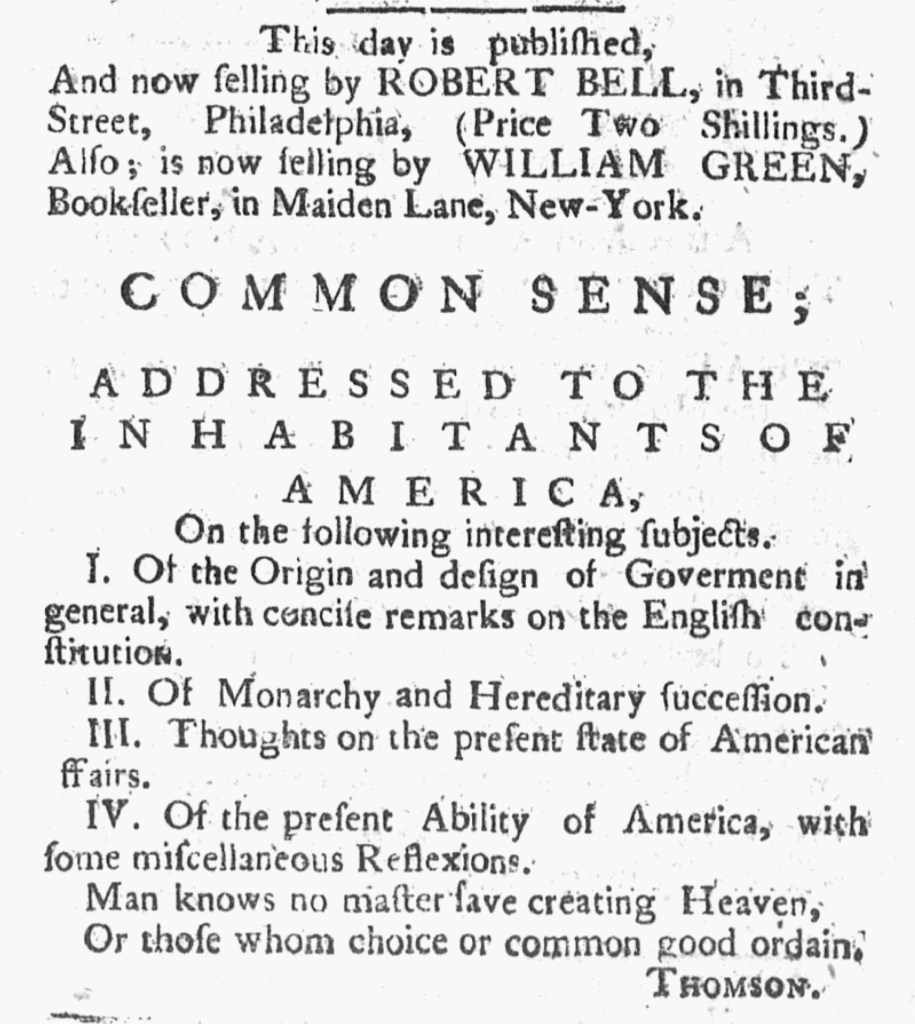
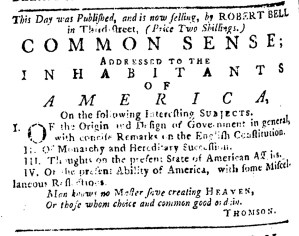
Advertisements for Common Sense Published January 24, 1776

Historians consider Thomas Paine’s Common Sense, published anonymously on January 9, 1776, the most influential political pamphlet that circulated in the colonies during the era of the American Revolution.  Written in plain language accessible to readers of all backgrounds, the pamphlet made a bold case for declaring independence at a time that many colonizers still sought a redress their grievances by George III and Parliament.  Paine’s pamphlet played a vital role in swaying public opinion in favor of declaring independence.

Common Sense was an eighteenth-century bestseller, though Paine wildly overestimated how many copies were published, claiming 150,000 circulated in 1776, and historians later made even more dubious claims that American printing presses produced as many as 500,000 copies.  Contrary to those exaggerations, American printers most likely published between 35,000 and 50,000 copies in 1776.  Scholars have identified twenty-five American editions, more than twice as many as any other American book or pamphlet published in the eighteenth century.

Colonizers certainly discussed Paine’s pamphlet … and printers, booksellers, and others advertised it widely.  As a special feature, the Adverts 250 Project chronicles those advertisements, starting with newspaper notices for Robert Bell’s first edition published in Philadelphia and then subsequent advertisements for that and other editions published and sold throughout the colonies.

These advertisements for Common Sense appeared in American newspapers 250 years ago today.

Constitutional Gazette (January 24, 1776).

**********

Constitutional Gazette (January 24, 1776).

January 23

What was advertised in a revolutionary American newspaper 250 years ago today?

Pennsylvania Evening Post (January 23, 1776).

“HARE’s BEST AMERICAN DRAUGHT PORTER.”

Brand recognition usually was not an element of eighteenth-century advertisements, yet there were exceptions.  Consumers knew a variety of patent medicines by name, in part from the frequency of advertisements in American advertisements.  For instance, retailers regularly ran notices that promoted Keyser’s Pills for treating venereal disease.  The same went for almanacs, such as “POOR WILL’s POCKET ALMANACK” advertised in the January 23, 1776, edition of the Pennsylvania Evening Post.  In the same issue, Edward Jollie, a tobacconist, advertised “IRISH SNUFF” and “SCOTS SNUFF,” but those monikers referred to the style rather than the producer.  Like most consumer goods, they did not have a brand name associated with them.

That newspaper, however, also featured advertisements for a product that had recently achieved brand recognition, at least in and near Philadelphia.  Lewis Nicola once again ran his advertisement for the “AMERICAN PORTER HOUSE” that he operated on Water Street.  He no doubt served “HARE’s BEST AMERICAN DRAUGHT PORTER,” the local brew that William Dibley, Patrick Meade, and Joseph Price all advertised that they served to “the sturdy friends of American freedom,” “the Associators of Freedom,” and “the SONS of AMERICAN LIBERTY” at their establishments.  Immediately to the left of Nicola’s advertisement, another local tavernkeeper announced that he also served porter produced at Robert Hare’s brewery.  Jeremiah Baker took to the pages of the Pennsylvania Evening Post to announce to “his friend and customers, that he has laid in a stock of HARE’s BEST AMERICAN DRAUGHT PORTER” at his tavern “at the sign of Noah’s Ark” on Front Street.  Baker pledged that he served the Hare’s porter “in its greatest purity,” signaling that he did not water down the drinks, but did not consider it necessary to say anything else about the porter.  The name, all in capital letters to attract attention, spoke for itself, an early example of brand recognition.

Slavery Advertisements Published January 23, 1776

The Slavery Adverts 250 Project chronicles the role of newspaper advertising in perpetuating slavery in the era of the American Revolution. The project seeks to reveal the ubiquity of slavery in eighteenth-century life from New England to Georgia by republishing advertisements about enslaved people – for sale as individuals or in groups, wanted to purchase or for hire for short periods, runaways who liberated themselves, and those who were subsequently captured and confined in jails and workhouses – in daily digests on this site as well as in real time via the @SlaveAdverts250 Twitter feed, utilizing twenty-first-century media to stand in for the print media of the eighteenth century.

The project aims to provide modern audiences with a sense of just how often colonizers encountered these advertisements in their daily lives. Enslaved men, women, and children appeared in print somewhere in the colonies almost every single day. Those advertisements served as a constant backdrop for social, cultural, economic, and political life in colonial and revolutionary America. Colonizers who did not purport to own enslaved people were still confronted with slavery as well as invited to maintain the system by purchasing enslaved men, women, and children or assisting in the capture of so-called “runaways” who sought to free themselves from bondage. The frequency of these newspaper advertisements suggests just how embedded slavery was in colonial and revolutionary American culture in everyday interactions beyond the printed page.

These advertisements also testify to the experiences of enslaved men, women, and children, though readers must consider that those experiences have been remediated through descriptions offered by enslavers rather than enslaved people themselves. Often unnamed in the advertisements, enslaved men, women, and children were not invisible or unimportant in early America.

Massimo Sgambati made significant contributions to this entry as part of the Summer Scholars Program, funded by a fellowship from the D’Amour College of Liberal Arts and Sciences at Assumption University in Worcester, Massachusetts, in Summer 2025.

These advertisements appeared in revolutionary American newspapers 250 years ago today.

Dunlap’s Maryland Gazette (January 23, 1776).

**********

Pennsylvania Evening Post (January 23, 1776).

**********

Pennsylvania Evening Post (January 23, 1776).

Advertisements for Common Sense Published January 23, 1776

Historians consider Thomas Paine’s Common Sense, published anonymously on January 9, 1776, the most influential political pamphlet that circulated in the colonies during the era of the American Revolution.  Written in plain language accessible to readers of all backgrounds, the pamphlet made a bold case for declaring independence at a time that many colonizers still sought a redress their grievances by George III and Parliament.  Paine’s pamphlet played a vital role in swaying public opinion in favor of declaring independence.

Common Sense was an eighteenth-century bestseller, though Paine wildly overestimated how many copies were published, claiming 150,000 circulated in 1776, and historians later made even more dubious claims that American printing presses produced as many as 500,000 copies.  Contrary to those exaggerations, American printers most likely published between 35,000 and 50,000 copies in 1776.  Scholars have identified twenty-five American editions, more than twice as many as any other American book or pamphlet published in the eighteenth century.

Colonizers certainly discussed Paine’s pamphlet … and printers, booksellers, and others advertised it widely.  As a special feature, the Adverts 250 Project chronicles those advertisements, starting with newspaper notices for Robert Bell’s first edition published in Philadelphia and then subsequent advertisements for that and other editions published and sold throughout the colonies.

These advertisements for Common Sense appeared in American newspapers 250 years ago today.

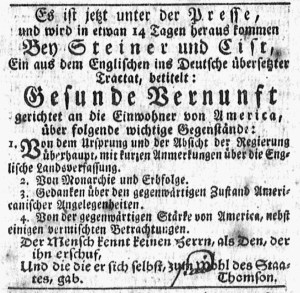
Henrich Millers Pennsylvanischer Staatsbote (January 23, 1776).

**********

Henrich Millers Pennsylvanischer Staatsbote (January 23, 1776).

**********

Pennsylvania Evening Post (January 23, 1776).

January 22

What was advertised in a revolutionary American newspaper 250 years ago today?

New-York Gazette and Weekly Mercury (January 22, 1776).

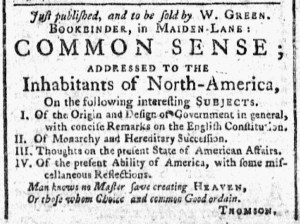
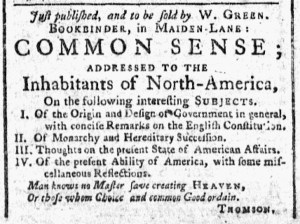
To be sold by W. GREEN … COMMON SENSE.”

Just days after an advertisement for Thomas Paine’s Common Sense made its first appearance in a newspaper beyond those published in Philadelphia, a second advertisement appeared in yet another newspaper.  The Constitutional Gazettecarried that first advertisement on January 20, 1776.  A variation ran in the New-York Gazette and Weekly Mercury on January 22.

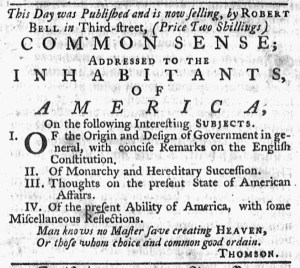
Both advertisements included the title of the political pamphlet, “COMMON SENSE,” though the version in the Constitutional Gazette indicated that it was “ADDRESS TO THE INHABITANTS OF AMERICA” while the one in the New-York Gazette and Weekly Mercury instead stated that it was “ADDRESSED TO THE Inhabitants of North-America.”  Both listed the “interesting SUBJECTS” contained within the pamphlet, offering four section headings that included “Of the Origin and Design of Government in general, with concise Remarks on the English Constitution” and “Thoughts on the present State of American Affairs.”  Both concluded with an epigraph from James Thomson’s poem, “Liberty” (1734): “Man knows no Master save creating HEAVEN, / Or those whom Choice and common Good ordain.”  Those lines previewed the arguments readers would encounter in the pamphlet.  These advertisements in newspapers printed in New York replicated those previously published in newspapers in Philadelphia.

The new advertisement in the New-York Gazette and Weekly Mercury did have one significant difference from the earlier advertisements.  It did not include the name of the publisher of the first edition, Robert Bell.  The introduction to the version in the Constitutional Gazette did mention the prominent printer and bookseller, advising readers that “ROBERT BELL, in Third-Street, Philadelphia,” sold the pamphlet and then also listing William Green, a “Bookseller, in Maiden Lane, New-York,” as a local purveyor of Common Sense.  The version in the New-York Gazette and Weekly Mercury, however, eliminated Bell and named Green as the sole vendor of the pamphlet: “Just published, and to be sold by W. GREEN.  BOOKBINDER, in MAIDEN-LANE.”  Eighteenth-century readers knew to separate the phrases “Just published” and “to be sold by.”  Only the latter referred to Green’s role in the production and distribution of the pamphlet.  The phrase “Just published” merely meant “now available.”  Green did not print Common Sense, but when he submitted copy for his advertisement to the New-York Gazette and Weekly Mercury’s printing office he privileged his role in making the incendiary new pamphlet available in that city.  As the pamphlet gained popularity, John Anderson, the printer of the Constitutional Gazette, published and advertised a local edition (and a second local edition), but for a short time Green was the only retailer in New York hawking the pamphlet in the public prints.  His marketing efforts contributed to the stir caused by Paine’s appeal to declare independence rather than continue to seek a redress of grievances within the imperial system.

Slavery Advertisements Published January 22, 1776

The Slavery Adverts 250 Project chronicles the role of newspaper advertising in perpetuating slavery in the era of the American Revolution. The project seeks to reveal the ubiquity of slavery in eighteenth-century life from New England to Georgia by republishing advertisements about enslaved people – for sale as individuals or in groups, wanted to purchase or for hire for short periods, runaways who liberated themselves, and those who were subsequently captured and confined in jails and workhouses – in daily digests on this site as well as in real time via the @SlaveAdverts250 Twitter feed, utilizing twenty-first-century media to stand in for the print media of the eighteenth century.

The project aims to provide modern audiences with a sense of just how often colonizers encountered these advertisements in their daily lives. Enslaved men, women, and children appeared in print somewhere in the colonies almost every single day. Those advertisements served as a constant backdrop for social, cultural, economic, and political life in colonial and revolutionary America. Colonizers who did not purport to own enslaved people were still confronted with slavery as well as invited to maintain the system by purchasing enslaved men, women, and children or assisting in the capture of so-called “runaways” who sought to free themselves from bondage. The frequency of these newspaper advertisements suggests just how embedded slavery was in colonial and revolutionary American culture in everyday interactions beyond the printed page.

These advertisements also testify to the experiences of enslaved men, women, and children, though readers must consider that those experiences have been remediated through descriptions offered by enslavers rather than enslaved people themselves. Often unnamed in the advertisements, enslaved men, women, and children were not invisible or unimportant in early America.

Massimo Sgambati made significant contributions to this entry as part of the Summer Scholars Program, funded by a fellowship from the D’Amour College of Liberal Arts and Sciences at Assumption University in Worcester, Massachusetts, in Summer 2025.

These advertisements appeared in revolutionary American newspapers 250 years ago today.

Dunlap’s Pennsylvania Packet (January 22, 1776).

**********

New-York Gazette and Weekly Mercury (January 22, 1776).

**********

New-York Gazette and Weekly Mercury (January 22, 1776).

**********

New-York Gazette and Weekly Mercury (January 22, 1776).

**********

New-York Gazette and Weekly Mercury (January 22, 1776).

**********

New-York Gazette and Weekly Mercury (January 22, 1776).

Advertisements for Common Sense Published January 22, 1776

Historians consider Thomas Paine’s Common Sense, published anonymously on January 9, 1776, the most influential political pamphlet that circulated in the colonies during the era of the American Revolution.  Written in plain language accessible to readers of all backgrounds, the pamphlet made a bold case for declaring independence at a time that many colonizers still sought a redress their grievances by George III and Parliament.  Paine’s pamphlet played a vital role in swaying public opinion in favor of declaring independence.

Common Sense was an eighteenth-century bestseller, though Paine wildly overestimated how many copies were published, claiming 150,000 circulated in 1776, and historians later made even more dubious claims that American printing presses produced as many as 500,000 copies.  Contrary to those exaggerations, American printers most likely published between 35,000 and 50,000 copies in 1776.  Scholars have identified twenty-five American editions, more than twice as many as any other American book or pamphlet published in the eighteenth century.

Colonizers certainly discussed Paine’s pamphlet … and printers, booksellers, and others advertised it widely.  As a special feature, the Adverts 250 Project chronicles those advertisements, starting with newspaper notices for Robert Bell’s first edition published in Philadelphia and then subsequent advertisements for that and other editions published and sold throughout the colonies.

These advertisements for Common Sense appeared in American newspapers 250 years ago today.

New-York Gazette and Weekly Mercury (January 22, 1776).

January 21

What was advertised in a revolutionary American newspaper 250 years ago this week?

Pennsylvania Evening Post (January 20, 1776).

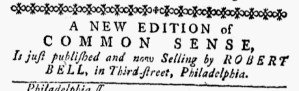
“A NEW Edition of COMMON SENSE is just published.”

On the same day that the first advertisement for Thomas Paine’s Common Sense appeared in a newspaper beyond Philadelphia, another advertisement for “A NEW Edition of COMMON SENSE” ran in both the Pennsylvania Evening Post and the Pennsylvania Ledger.  On January 9, 1776, the Pennsylvania Evening Post had been the first newspaper to carry an advertisement for the political pamphlet.  Within a week, Robert Bell, the publisher, inserted the advertisement in all six newspapers published in Philadelphia at the time.  The advertisement for the “NEW EDITION of COMMON SENSE” in the January 20 edition of the Pennsylvania Ledger was one of two for the pamphlet in that issue.  It also carried Bell’s original advertisement.  The printing office apparently included it on one of the first pages printed and later received the new notice to integrate into one of the last pages printed.

Pennsylvania Ledger (January 20, 1776).

These advertisements testify to the popularity of Common Sense immediately after its initial publication.  They also obscure a disagreement between Bell and Paine.  The author, who remained anonymous for nearly three months after publication of the first edition, did not authorize Bell to publish a second edition.  Paine wished to donate his share of the profits to purchase supplies for American soldiers participating in the invasion of Quebec, but he learned that Bell’s first edition did not generate any profits despite its popularity.  Disillusioned with their collaboration, Paine instructed Bell not to proceed with a second edition.  Instead, he intended to add appendices and other content and find a new publisher among the many printers in Philadelphia.  The author eventually worked with William Bradford and Thomas Bradford, the printers of the Pennsylvania Journal, though Bell moved forward with a second edition against Paine’s wishes.  Over the next several months, Bell and Paine engaged in an argument (even as the “Englishman” who penned Common Sense remained anonymous) in the public prints, both in letters and advertisements in the Pennsylvania Evening Post and other newspapers published in Philadelphia.  Advertisements became a means for promoting not only the political pamphlet but also the author’s preferred edition of it!