November 14

What was advertised in a revolutionary American newspaper 250 years ago today?
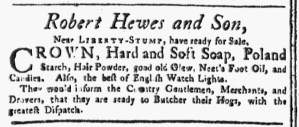
Independent Chronicle (November 14, 1776).

“Near LIBERTY-STUMP.”

When Robert Hewes and Son placed an advertisement for “CROWN, Hard and Soft Soap, Poland Starch, Hair Powder,” and other items in the November 14, 1776, edition of the Independent Chronicle, they advised prospective customers to find them “Near LIBERTY-STUMP,” the remnants of the former Liberty Tree, in Boston.  One of the elms in a grove near Boston Neck became known as the Liberty Tree after colonizers hung an effigy of Andrew Oliver, the proposed tax collector, in protest of the Stamp Act on August 14, 1765.  Oliver resigned from the position and Parliament repealed the Stamp Act in March 1766.  When news arrived in Boston, colonizers gathered at the elm to celebrate.  They “installed a copper sign designating it the Liberty Tree … and hung up 150 lanterns.”

The Liberty Tree became an important symbol to supporters of the American cause.  It also served as a landmark for advertisers to direct prospective customers to their businesses.  In March 1766, before Boston received news about the repeal of the Stamp Act, Adam Collson advertised fleece wool that he sold “Under the TREE of LIBERTY.”  In 1767, both John Gore, Jr., and John Greenlaw gave directions that featured the Liberty Tree in their advertisements.  Gore continued doing so in 1769 and 1770, emphasizing that he sold “North American Manufactures” rather than goods imported from Britain.  Quite appropriately, he paired the famous landmark with the nonimportation strategy that colonizers first adopted as economic leverage against the Stamp Act and then again against the duties on certain goods imposed by the Townshend Acts.  Even when the nonimportation agreements lapsed after Parliament repealed most of those duties, Gore continued to give his location as “Opposite LIBERTY-TREE” in an advertisement for a “large and general Assortment of English and India Goods.”  Similarly, Rosannah Moore advertised a “general Assortment of Wines, as are commonly imported to America,” that she sold “near LIBERTY TREE” in the spring of 1771.

During the siege of Boston that followed the battles at Lexington and Concord, the British occupied the city.  British soldiers cut down the Liberty Tree and used it for firewood, yet the stump remained and became an important symbol of resistance and resilience.  The tree was gone, but so were the British, who evacuated Boston in March 1776 when they determined that breaking the siege would be too costly.  They learned that lesson at the Battle of Bunker Hill.  Patriots reclaimed the city … and the stump remained.  The British had not removed the entire tree, so the portion that endured took on new significance.  The stump no longer remains today, but the city established Liberty Tree Plaza at its former site in 2018.  In 1776, just months after the British left, Robert Hewes and Son joined other Bostonians in reclaiming the Liberty Stump, foiling the attempts of British soldiers to remove a powerful symbol of revolution.

February 19

GUEST CURATOR: Shannon Holleran

What was advertised in a colonial American newspaper 250 years ago today?

feb-19-2191767-massachusetts-gazette
Massachusetts Gazette (February 19, 1767).

“At the Corner Shop East End of Faneuil-Hall Market … Lemmons by the Box.”

This advertisement caught my attention because of the location of the marketplace. I live less than an hour south of Boston and have visited Faneuil Hall many times. This landmark is an exciting and unique marketplace, one of the most famous spots in Boston. I found this advertisement especially interesting because Faneuil Hall served as a marketplace and a meeting hall for the colonists 250 years ago and it still serves as a marketplace, selling food and clothes to countless tourists and Bostonians. This historic spot was especially significant to the colonists during the Revolutionary era because it served as a meeting place to discuss important events, such as the Stamp Act, the Boston Massacre, and the Boston Tea Party.

In late 1767, after Parliament passed the Townshend Acts, “the Freeholders and other Inhabitants of the Town of Boston” held a meeting at Faneuil Hall, according to the headline for a broadside published for the Boston selectmen and printed by Edes and Gill. According to the Massachusetts Historical Society, this broadside “outlines why the colonists’ dependence on imported goods is a problem and what can be done. A petition is presented, a plan is laid out, it is unanimously endorsed and there is a way to ensure commitment from all those who endorse it, and communication with those who did not attend.” This broadside reveals how significant Faneuil Hall was for colonists in 1767. Not only did it serve as a market, but it also provided a place for patriots to meet to discuss plans for resistance to new acts and commercial regulations from Parliament.

**********

ADDITIONAL COMMENTARY: Carl Robert Keyes

Faneuil Hall was indeed an important gathering spot for colonists to discuss resistance during the years of the imperial crisis, including, as the broadside Shannon consulted outlined, the encouragement of American production of popular imported goods and, in turn, nonimportation of those goods via English ports. Faneuil Hall was also a landmark that merchant Thomas Webb realized potential customers would recognize without needing further directions beyond indicating that he occupied the “Corner Shop South East End.” A quarter of a millennium later, the marketplace still stands, inextricably bound into the history the American Revolution.

Yet revolution was a process. Neither the colonists who placed advertisements in the Massachusetts Gazette in February 1767 nor those who met in Faneuil Hall to protest the Townshend Acts later that year were ready to declare independence rather than seek redress of grievances. Thomas Webb’s advertisement for “Lemmons by the Box” and other grocery items appeared to the right of an announcement for a vendue sale of “twice-laid Cordage” slated to take place “at the Royal Exchange Tavern in King-Street.” That notice appeared immediately above two others that listed addresses that testified to colonists’ sense of British identity: “the Bunch of Grapes Tavern in King-Street” and “the British Coffee House in Boston.” Elsewhere in the same issue, John Mein promoted his “MASSACHUSETTS REGISTER With and ALMANACK for 1767,” which he sold “At the LONDON BOOK STORE North Side of KING-STREET, BOSTON.” That volume included valuable reference material, including lists of colonial officeholders, “the sittings of the Superior and Inferior Courts in the four Provinces of New England,” and a “Table of Interest at 6 perCent.” Mein led the advertisement, however, by noting that the Massachusetts Register listed the members of “the Royal Family of Great-Britain.” Several other advertisers, including shopkeeper Jolley Allen, emphasized that they sold goods “Just imported from LONDON.”

In terms of their landmarks and sense of spatial geography within the city of Boston, their print culture, and their consumer culture, colonists continued to think of themselves as Britons in 1767, even as they increasingly began to assert that they were Britons with unique American perspectives and needs within the empire. Eventually Bostonians and others throughout the new nation would rename streets, buildings, and other landmarks. Similarly, printers and authors of almanacs would replace the royal family with the president and other important officials. Yet colonists were not ready to do so in 1767. Revolution was a process, one that was underway but also one that would gain much more momentum over the course of the next decade.