January 17

What was advertised in a colonial American newspaper 250 years ago today?

Essex Gazette (January 17, 1774).

“ALL Persons who have … Subscription Papers … are desired immediately to return the same.”

Samuel Hall and Ebenezer Hall, the printers of the Essex Gazette, inserted a brief notice in the January 17, 1775, edition to request that “ALL Persons who have in their Hands any Subscription Papers for printing the Independent Whig … to return the same to the Printers hereof.”  They referred to a project that they had first announced more than fifteen months earlier on September 23, 1773, with another advertisement in their newspaper.  On that occasion, they confided that “A Number of the principal Gentlemen in this Town … encouraged the Publication” of the work that Thomas Gordon and John Trenchard first distributed as a weekly magazine in London in 1720.  For those not as familiar with that “celebrated Performance,” the printers gave the full title: “THE Independent Whig, Or, A Defence of primitive Christianity, and of our Ecclesiastical Establishment, against the extravagant Claims of fanatical and disaffected Clergymen.”

The Halls informed the public that they could subscribe to the work at their printing office in Salem.  Those not yet certain that they wished to reserve copies could examine the “Proposals.”  The printers eventually published subscription notices in the Massachusetts Spy in February 1774, hoping to reach even more prospective customers in Boston and other towns throughout the colony.  Yet the Halls apparently did not limit their marketing efforts to newspaper advertisements, choosing to circulate “Subscription Papers” that likely described the purpose of the book and the conditions for ordering copies.  They may have requested that friends and associates post the subscription proposals in their shops and offices, recruiting the assistance of local agents in other towns.  Such items often featured space for subscribers to sign their names, making their support of the project visible to others, though local agents sometimes compiled separate lists.  No copies of the “Subscription Papers” that the Halls mention in their newspaper advertisement survive, at least not any that have been identified and cataloged yet.  Their newspaper notice testifies to a more extensive culture of marketing media in early America than the collections in research libraries, historical societies, and private collections reveal.  How much advertising ephemera circulated that has been lost without any mention in the public prints?

September 18

What was advertised in a colonial American magazine 250 years ago this month?

Advertising wrapper enclosing Royal American Magazine, July 1774 (published September 15, 1774).

“A concise, but just, representation of the hardships and sufferings of the town of BOSTON.”

An advertisement in the September 15, 1774, edition of the Massachusetts Spy informed readers that “NUMBER VII of the ROYAL AMERICAN MAGAZINE” was “This day published” and “will be ready to be delivered, to-morrow, to the subscribers.”  The notice referred to the July edition.  Isaiah Thomas, the original publisher, had always been behind in circulating new issues of the magazine, putting Joseph Greenleaf, the new proprietor, in a position to catch up.  The July issue was his first, published just three weeks after the first announcement that he now oversaw the magazine.

Like other eighteenth-century magazines, the Royal American Magazine did not feature advertisements interspersed among its contents, yet that did not mean that it lacked advertising altogether.  First Thomas and then Greenleaf distributed each issue enclosed in blue paper wrappers that featured advertisements.  In the last quarter of the century, other magazine publishers did the same.  The wrappers protected each issue until subscribers had six of them bound into a volume, though bookbinders usually removed the wrappers and other advertising ephemera, such as trade cards, subscription proposals, and book catalogs, within them.  Bound volumes preserved in research libraries give the impression that advertising was not part of eighteenth-century magazines, yet intact individual issues demonstrate that was not the case at all.

Advertising wrapper enclosing Royal American Magazine, July 1774 (published September 15, 1774).

Over time, the kinds of advertisements on the wrappers evolved to include an array of goods and services, but in the 1770s they almost exclusively came from the book trades and, especially, the publisher of the magazine.  Such was the case with the Royal American Magazine.  The wrappers for the July 1774 issue had a message to the subscribers from Thomas, the same one that announced the change of publisher in the Massachusetts Spy, an advertisement for “A LETTER to a FRIEND: GIVING a concise, but just, representation of the hardships of the town of BOSTON” sold at Greenleaf’s printing office, and a list of books and printed blanks also available from the publisher of the magazine.  The wrappers for the June 1774 edition had included advertisers not affiliated with the magazine, yet still members of the book trades.  Benjamin Edes and John Gill, printers of the Boston-Gazette, advertised “OBSERVATIONS on the ACT of PARLIAMENT, commonly called the BOSTON PORT BILL,” the legislation that resulted in the “hardships of the town” outlined in the pamphlet Greenleaf promoted.  Nathaniel Mills and John Hicks, printers of the Massachusetts Gazette and Boston Post-Boy, advertised an array of books they stocked, while Bernard Romans outlined his “PROPOSALS For printing by Subscription, A CONCISE Natural HISTORY of EAST and WEST FLORIDA.”

The Adverts 250 Project has tracked newspaper advertisements concerning the Royal American Gazette from Thomas’s first mention of his intention to circulate subscription proposals through the publication of the first six issues and transferring the magazine to a new publisher.  That story, however, has not examined the Royal American Magazine as a delivery mechanism for advertising.  Subsequent entries will take a closer look at the advertisements that appeared on the magazine’s wrappers throughout its run.

August 24

What was advertised in a colonial American newspaper 250 years ago today?

Pennsylvania Journal (August 24, 1774).

“They neatly engrave: Shop Bills; Bills of Exchange; Bills of Lading.”

When John Norman, “ARCHITECT and LANDSCAPE-ENGRAVER, from London,” arrived in Philadelphia in May 1774, he introduced himself to prospective clients via an advertisement in the Pennsylvania Journal.  A few months later, he once again took to the pages of that publication, this time to announce that the partnership of Norman and Ward, “ENGRAVERS and DRAWING-MASTERS,” had opened a shop where they engraved a variety of items and sold “an assortment of Pictures and Frames … much cheaper than imported.”  In addition, they established “an Evening Drawing School” for teaching “that most noble and polite Art in all its various and useful Branches.”  Still a newcomer in the city, Norman devised multiple ways to earn his livelihood.

The various kinds of engraving that Norman and Ward proposed testified to the prevalence of advertising in early America, especially in urban ports.  They indicated that they could produce all sorts of items but could not list them all because they were “too tedious to mention in an Advertisement.”  Yet they named more than a dozen kinds of engraved items, leading their list with “Shop Bills.”  They likely meant both trade cards with an engraved image that filled the entire sheet and billheads that featured an engraved image at the top and blank space for recording purchases.  On occasion, merchants, shopkeepers, and artisans wrote receipts on the reverse side of trade cards.  Norman and Ward next named “Bills of Exchange; Bills of Lading; [and] Bills of Parcels.”  Those could have been simple printed blanks, but that would have defeated the purpose of ordering them from an engraver rather than acquiring those common business forms from printers who produced them in volume.  In this instance, the bills of exchange, bills of lading, and bills of parcels likely included engraved images, not solely text, that served as advertisements for the merchants who ordered them.  Later in the list, Norman and Ward considered “Devices for News-Papers” important enough to include rather than “too tedious to mention.”  Presumably they produced woodcuts in additional to copperplate engravings.  In addition to newspaper printers seeking images to adorn their mastheads and stock images for use elsewhere, the engravers offered their services to advertisers who desired unique images that represented their businesses exclusively.  Trade cards, billheads, and other advertising ephemera have not survived in the numbers that they were likely produced and circulated in early America, yet Norman and Ward’s advertisement suggests that they were part of everyday life as colonizers engaged in commerce and participated in consumer culture.

May 13

What might have been advertised in a colonial American newspaper 250 years ago today?

Handbill (recto) perhaps distributed with the South-Carolina and American General Gazette (May 13, 1774).

“WELLS’S REGISTER: TOGETHER WITH AN ALMANACK … For the Year of our LORD, 1774.”

Most colonial newspapers consisted of four pages created by printing two pages on each side of a broadsheet and folding it in half.  On occasion, printers issued supplements, postscripts, or extraordinaries, sometimes just two pages on a half sheet and other times another four pages.  Robert Wells, the printer of the South-Carolina and American General Gazette, took a different approach when he distributed additional content.  He printed additional pages without a masthead that designated them as part of a supplement.  Instead, they featured continuous numbering with the other pages in the issue, which continued the numbering from the previous edition, and no indication that they were not part of the standard issue for that week.  The May 13, 1774, edition of the South-Carolina and American General Gazetteincluded two extra pages, numbered 129 and 130.  When delivering the newspaper to subscribers, that additional half sheet would have been tucked inside the broadsheet portion, between pages 126 and 127.  Eighteenth-century readers understood the system for navigating such issues.

A broadsheet or handbill, likely printed on a smaller sheet, may have also accompanied that edition of the newspaper.  Accessible Archives, the database that provides the most complete coverage of newspapers from colonial South Carolina, includes an advertisement for “WELLS’S REGISTER: TOGETHER WITH AN ALMANACK … For the Year of our LORD, 1774.”  What seems certain is that the archive with the run of the South-Carolina and American General Gazette originally photographed for greater accessibility and eventually digitized by Accessible Archives has that handbill in its collection.  If the newspaper had been bound into a volume with other newspapers, by Wells or a subscriber or a collector, then the handbill was bound between the May 13 and May 20 issues.  Sometimes the binding is so tight that it distorts the image of the newspaper, especially the column nearest the binding.  While the images of the South-Carolina and American General Gazette in Accessible Archives suggest that the individual issues were part of a bound volume, they have been cropped in such a way as to hide the binding.  If the pages are indeed in a bound volume, the binding is not so tight that it resulted in distorted images when photographing the newspaper.  If the pages are not in a bound volume, then the handbill may have been tucked into the four-page broadsheet portion of the newspaper along with the additional half sheet of news.

Handbill (verso) perhaps distributed with the South-Carolina and American General Gazette (May 13, 1774).

That these items ended up together in an archive, however, does not necessarily mean that they were distributed together in 1774.  The middle of May seems rather late for Wells to distribute a handbill promoting an almanac and register for that year.  More than a third of the material in the almanac would not have much utility for readers, the months of January, February, March, and April having passed.  The register, on the other hand, with its lists of officials in Great Britain, Ireland, North America, Virginia, North Carolina, South Carolina, and Georgia and other information about local governance in the southern colonies, retained its full value.  Printers sometimes continued advertising almanacs well into the year, hoping to find buyers for surplus copies.  If Wells did happen to distribute this handbill in May 1774, then the handbill itself, proclaiming that “THIS DAY IS PUBLISHED … WELLS’S REGISTER,” was likely left over from previous marketing efforts.  The printer may have been trying to get both the handbill and remaining copies of the Register out of his shop.

The inclusion of this handbill as part of the May 13, 1774, edition of the South-Carolina and American General Gazetteraises questions about its production, distribution, and preservation.  While those questions do not have ready answers, that the handbill is part of the newspaper collection, regardless of how it ended up there, testifies to Wells’s use of media beyond newspaper notices to promote the Register.  Handbills and other advertising media, like broadsides and trade cards, were much more ephemeral than newspapers and, in turn, less likely to become part of collections that historians can examine.  They sometimes survived in quirky ways, such as a handbill tucked inside a newspaper.  Those instances suggest a much more vibrant culture of advertising than the scattered examples in research libraries, historical societies, and private collections.

September 28

What was advertised in colonial America 250 years ago today?

Handbill: Mr. Bates, “Horsemanship,” (Boston: [likely Nathaniel Mills and John Hicks], 1773). Courtesy American Antiquarian Society.

“He will perform on ONE, TWO, THREE, and FOUR HORSES.”

In the course of examining newspaper notices, the Adverts 250 Project also explores all sorts of advertising media that circulated in the eighteenth century, including trade cards, billheads, broadsides, handbills, magazine wrappers, subscription papers, and shop signs.  Those media likely circulated more widely in early America than the examples that survive in research libraries, historical societies, and private collections suggest.  Unlike newspapers that have been preserved in complete or nearly complete runs, other advertising media were much more ephemeral.  In addition, those available for study often lack dates, while the mastheads declare dates for newspaper notices.  Sometimes manuscript additions, such as a receipted bill on the back of Mary Symonds’s elegant trade card, testify to when an advertisement circulated, though additional research suggests that the trade card quite likely had been produced earlier.

Exceptions exist.  For instance, a broadside announcing the auction of enslaved men, women, and children in Charleston, South Carolina, bears the date the slave traders composed the copy, July 24, 1769, and the date of the sale, August 3, indicating the period that the broadside circulated.  Similarly, a handbill that advertised feats of horsemanship performed by Mr. Bates in Boston includes a date, “TUESDAY next the 28th. of September.”  Though lacking a year, the advertising copy corresponds to a series of newspaper notices that ran in several publications in the fall of 1773.  That makes this a rare occasion that the Adverts 250 Project presents an advertisement other than a newspaper notice that definitely circulated 250 years ago today.  As colonizers traversed the streets of Boston, they encountered Bates’s handbills.  They likely saw a variety of other advertising media, including broadsides posted around town, trade cards and billheads distributed by merchants, shopkeepers, and artisans, and signs that marked the locations of shops and taverns.  Bates’s handbill testifies to the presence of advertising beyond newspapers in the busy port on the eve of the American Revolution.

July 15

What was advertised in a colonial American newspaper 250 years ago today?

Maryland Gazette (July 15, 1773).

“Catalogues both of the library and the books he has for sale to be had at his shop.”

On July 15, 1773, William Aikman once again took to the pages of the Maryland Gazette to promote the circulating library that the bookseller and stationer recently opened in Annapolis.  He inserted the same advertisement that appeared in the previous issue, seeking subscribers for the library and hawking books, stationery, and writing supplies.  In addition to deploying the newspaper notice, Aikman used other forms of advertising.

For instance, he concluded his notice with a nota bene that advised, “Catalogues both of the library and the books he has for sale to be had at his shop.”  According to Robert Winans in A Descriptive Checklist of Book Catalogues Separately Printed in America, 1639-1800, the Maryland Historical Society has the only known copy of a book catalog that may have been the one that Aikman mentioned in his newspaper advertisement.  It contains “854 consecutively numbered medium and full author and title entries, arranged alphabetically,” falling short of the “1200 volumes” that Aikman tallied in his newspaper advertisement.  However, that sole copy lacks a title page and other evidence suggests that additional pages may have been lost as well.

Trade Card for William Aikman’s Circulating Library (Annapolis, 1773). Courtesy American Antiquarian Society.

In addition to publishing at least one book catalog, Aikman also distributed an item that may have served as a trade card, a bookplate, or membership card.  The copperplate engraving features an ornate border that encloses the words “W. AIKMAN’S Circulating Library” in the upper portion of the cartouche and an advertisement for his book and stationery shop in the lower portion: “All kinds of Books, Letter Cases, Message Cards, Gilt &Plain Paper, Wax, &c. Sold at his Shop, Annapolis, at the British Prices, for Cash Only.  Paper rul’d, Books bound in the neatest manner.”  The final portion of that advertisement echoed the services that Aikman listed in his newspaper advertisement.  Images of a globe and a pen and inkpot resting on two books outside the border testified to both the world of knowledge and the products available at Aikman’s circulating library and bookshop.  The upper portion of the cartouche also included “No” with space to write in a number.  The number “474” appears in manuscript on the copy in the collections of the American Antiquarian Society.  That number may have been associated with a book in the numbered catalog or a subscriber to the circulating library, depending on whether Aikman used the engraved card as a bookplate or a membership card.

Aikman’s marketing efforts extended beyond newspaper advertisements.  He also distributed book catalogs and engraved cards to draw attention to his bookshop and circulating library, joining other entrepreneurs who diversified the kinds of advertisements that circulated in the colonies during the era of the American Revolution.

January 31

What was advertised in a colonial American newspaper 250 years ago this week?

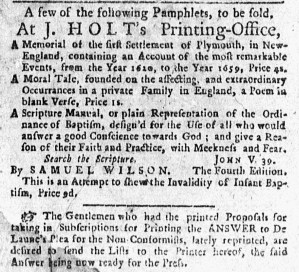
New-York Journal (January 28, 1773).

“Printed Proposals for taking in Subscriptions for Printing the ANSWER to De Laune’s Plea for the Non-Conformists.”

In addition to printing the New-York Journal, John Holt also sold imported books and printed and sold books and pamphlets.  Following the example of other printer-booksellers in the colonies, he inserted advertisements in his own newspapers.  Such was the case on January 28, 1773, when he advised readers of several pamphlets available at his printing office, including “A Memorial of the first Settlement of Plymouth in New-England.”

Holt also used that advertisement to pursue other business.  He planned to print “the ANSWER to De Laune’s Plea for the Non-Conformists,” a work that he indicated had been “lately reprinted.”  As part of that project, Holt distributed subscription notices that likely described the work, both its contents and the material aspects of the paper and type, and the conditions for subscribing, including prices and schedule for submitting payments.  He provided these “printed Proposals for taking in Subscriptions” to associates who assisted in recruiting customers who reserved copies in advance.  In some instances, subscribers made deposits as part of their commitment to purchasing a work once it went to press.  Holt’s associates may have distributed subscription notices in the form of handbills or pamphlets to friends, acquaintances, and customers or posted them in the form of broadsides in their shops.  Subscribers may have signed lists, perusing the names of other subscribers when they did so, or Holt’s associates may have recorded their names.  Holt’s reference to “printed Proposals for taking in Subscriptions” did not offer many particulars.

Like many broadsides, handbills, trade cards, and other advertising ephemera that circulated in eighteenth-century America, Holt’s “printed Proposals for taking in Subscriptions” were discarded when no longer of use.  Perhaps one or more copies have been preserved in research libraries or private collections, but they have not yet been cataloged.  For now (and probably forever), a newspaper advertisement that makes reference to a subscription notice that circulated in New York in the early 1770s constitutes the most extensive evidence of its existence.  As I have noted on several occasions, this suggests that early Americans encountered much more advertising, distributed via a variety of printed media, than historians previously realized … and much more than will ever be recovered.

October 28

What was advertised in a colonial American newspaper 250 year ago today?

Pennsylvania Gazette (October 28, 1772).

“A catalogue of new and old books … is given away gratis.”

William Woodhouse, a bookseller, stationer, and bookbinder in Philadelphia, regularly advertised in the public prints in the early 1770s.  For instance, he ran an advertisement in the October 28, 1772, edition of the Pennsylvania Gazette, advising consumers that he had recently received a shipment of new inventory from London.  Woodhouse provided some examples to entice prospective customer, starting with stationery items.  He stocked everything from “a large assortment of the best writing paper in all sizes” to “round pewter ink stands” to “sealing-wax, wafers, quills, [and] black and red pencils.”  Woodhouse also listed some of the “variety of new books” at his shop, including “Baskerville’s grand family folio bible, with cuts,” “Pope’s Young’s Swift’s Tillotson’s, Shakespear’s, Bunyan’s. and Flavel’s works,” and “Blackstone’s commentaries, 4 vols. 4to.”  The abbreviation “4to” referred to quarto, the size of the pages, allowing readers to imagine how they might consult or display the books.  Woodhouse even had “Newberry’s small books for children, with pictures” for his youngest customers.

The bookseller concluded his newspaper advertisement with a nota bene that invited consumers to engage with other marketing materials.  “A catalogue of new and old books, with the prices printed to each book,” the nota bene declared, “is given away gratis, by said Woodhouse.”  That very well may have been the “CATALOGUE OF A COLLECTION OF NEW AND OLD BOOKS, In all the Arts and Sciences, and in various Languages” that Woodhouse first promoted six weeks earlier in another newspaper, the Pennsylvania Packet.  That catalog also included “a large quantity of entertaining Novels, with the lowest price printed to each book.”  Most book catalogs, like newspaper advertisements, did not indicate prices.  Woodhouse apparently believed that stating his prices would help in convincing customers to purchase their books from him rather than from any of his many competitors in Philadelphia.  To draw attention to both the prices and his selection, he gave away the catalog for free.

This catalog may have been part of a larger advertising campaign that Woodhouse launched in the fall of 1772.  He might have also distributed handbills or posted broadsides.  In 1771, he circulated a one-page subscription proposal for “A Pennsylvania Sailor’s Letters; alias the Farmer’s Fall.”  A quarter of a century later, Woodhouse distributed a card promoting copies of “Constitutions of the United States, According to the Latest Amendments: To Which Are Annexed, the Declaration of Independence, and the Federal Constitution, with Amendments Thereto.”  It stands to reasons that Woodhouse used advertising media other than newspapers on other occasions, though such ephemeral items have not survived in the same numbers as newspaper advertisements.  I suspect that far more advertising circulated in early America than has been preserved and identified in historical societies, research libraries, and private collections.

March 11

What was advertised in a colonial American newspaper 250 years ago this week?

Pennsylvania Packet (March 9, 1772).

“Said EVITT prints Advertisements.”

In the early 1770s, William Evitt regularly placed advertisements in several newspapers published in Philadelphia to announce that he “PERFORMS PRINTING IN ALL ITS BRANCHES, With the utmost CARE and EXPEDITION.”  He did not provide much more detail in an advertisement in the March 9, 1772, edition of the Pennsylvania Packet, though he did include a nota bene about one of the “BRANCHES” of the printing business.  “Said EVITT,” he explained, “prints Advertisements, &c. at two hours notice, as usual.”  The “&c.” (an eighteenth-century abbreviation for et cetera) likely referred to printed blanks such as indentures, bills of lading, and other forms for legal agreements and commercial transactions.

Evitt did not print a newspaper, but he assisted colonizers in disseminating other kinds of advertising media.  The advertisements he printed “at two hours notice” probably included handbills, broadsides (or posters), trade cards (a combination of a handbill and business card), and billheads (a trade card with space for writing receipts by hand).  Each of those items consisted of a single sheet.  At the direction of his customers, Evitt may have embellished the advertising copy with ornamental type of the sort that ran across the top of his newspaper notice or woodcuts with visual images that he supplied.  To produce advertisements in such a short time, he quickly set the type and then worked with employees in operating a manual press.

In declaring that he printed advertisements “as usual,” Evitt suggested that handbills, broadsides, trade cards, billheads, and other items constituted a regular part of his business.  Marketing materials flowed off of his press into the hands of advertisers and, eventually, to colonizers in Philadelphia and beyond.  Compared to eighteenth-century newspapers and the advertisements that appeared in them, however, relatively few handbills, broadsides, trade cards, and billheads survive today.  I believe that historians have underestimated the extent that advertising media circulated in early America, especially in bustling port cities, as a result.  Evitt’s advertisement about printing advertisements suggests that colonizers encountered an array of marketing media on a daily basis.

January 6

What was advertised in a colonial American newspaper 250 years ago today?

Pennsylvania Gazette (January 3, 1771).

“Said EVITT prints advertisements, &c. at two hours notice.”

At first glance, many readers of the Pennsylvania Gazette may have thought that William Evitt’s notice in the January 3, 1771, edition was yet another advertisement for an almanac.  Such advertisements were common at the turn of the new year as printers attempted to sell surplus copies not purchased before the new year began.  David Hall and William Sellers, the printers of both the Pennsylvania Gazette and Poor Richard’s Almanack, inserted their own advertisement on the previous page.  The prologue to Evitt’s advertisement suggested that he would devote the entire notice to describing the contents of “THE UNIVERSAL and POOR ROBIN’S ALMANACKS, for the year 1771.”  Although he did promote those two publications, as well as “The GENTLEMAN and CITIZEN’S POCKET ALMANACK” with its “greater variety of useful lists, tables, &c. &c. &c. than any other almanack printed in America,” Evitt addressed a variety of other endeavors in the second half of his advertisement.  He informed customers that he sold books, stationery, and patent medicines, like many other printers, but he also carried other merchandise, including stockings, handkerchiefs, sieves, brushes, soap, and common grocery items.

Near the conclusion of his advertisement, Evitt returned to goods and services more closely associated with printers.  He advised prospective clients that he “prints advertisements, &c. at two hours notice.”  In other words, he did job printing.  Jobs included advertisements, broadsides (today known as posters), circular letters, and a vast array of printed blanks (or forms).  Clients submitted copy or, in the case of blanks, chose from among popular options, then Evitt set the type and produced the specified number of copies.  Evitt did not elaborate on the forms of advertising he printed, but they likely included handbills, catalogs, trade cards, bill heads, broadsides, and circular letters.  He produced them quickly, though the process of manually operating the press meant that he could produce only a limited quantity in that time.  Still, most orders were likely relatively small, in the range of a couple hundred copies.  Evitt considered job printing, especially advertisements, lucrative enough and potentially steady enough to merit mentioning alongside his other enterprises.  In emphasizing the speed of production, he suggested that he competed to provide a service already in demand.  It is quite likely that handbills, broadsides, and other advertisements that came off his press have been lost over time.  Evitt’s newspaper advertisement testifies to a more extensive circulation of other forms of advertising, each of them more ephemeral than newspapers systematically collected and preserved since the eighteenth century.  While newspaper advertising was by far the most common form of marketing in early America, colonists likely encountered other formats more regularly than the numbers of those that survive in research libraries, historical societies, and private collections suggest on their own.