January 10

What was advertised in a revolutionary American newspaper 250 years ago today?
Pennsylvania Gazette (January 10, 1776).

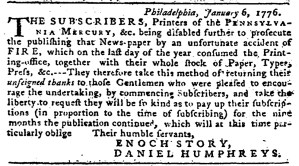
“Disabled further to prosecute the publishing that News-paper by an unfortunate accident of FIRE.”

As the imperial crisis intensified, Enoch Story and Daniel Humphreys launched the Pennsylvania Mercury (quickly renamed Story and Humphreys’s Pennsylvania Mercury) on April 7, 1775.  That newspaper joined two others founded earlier in the year, the Pennsylvania Evening Post on January 24 and the Pennsylvania Ledger on January 28, as well as Dunlap’s Pennsylvania Packet, the Pennsylvania Gazette, the Pennsylvania Journal, and the Wochentliche Pennsylvanische Staatsbote.  During the first four months of 1775, Philadelphia surpassed Boston in terms of the number of newspapers printed there.  With the outbreak of hostilities at Lexington and Concord on April 19 and the ensuing siege of Boston, several of Boston’s newspapers ceased publication or relocated to other towns.

Yet Boston was not the only major port city that saw one of its newspapers cease publication during the first year of the Revolutionary War.  Story and Humphreys’s Pennsylvania Mercury lasted less than a year, though disruptions caused by the war did not lead to its demise.  Unfortunately, “an unfortunate accident of FIRE … consumed the Printing-office, together with their whole Stock of Paper, Types, Press,” and other equipment on December 31.  The situation did not leave any possibility for the partners to recover and eventually resume publication.  “[B]eing disabled further to prosecute the publishing [of] that News-paper,” they announced in an advertisement in the Pennsylvania Gazette, they instead expressed “their unfeigned thanks” to the subscribers who had supported the venture and requested that they “will be so kind as to pay up their subscriptions (in proportion to the time of subscribing) for the nine months the publication continued.”  In other words, they expected customers to make prorated payments based on the number of issues they received.  Humphreys eventually tried again, but not until after the Revolutionary War.  On August 20, 1784, he commenced publishing a new Pennsylvania Mercury.

Even with the loss of Story and Humphreys’s Pennsylvania Mercury, Philadelphia still had more newspapers than any other city or town in the colonies.  As the war continued, not all of them survived.  Some closed permanently while others moved to other towns or suspended publication during the British occupation of Philadelphia.  Yet, as the “unfortunate accident of FIRE” at Story and Humphreys’s printing office demonstrated, disruptions caused by the war were not the only dangers that forced newspapers to fold.

January 5

What was advertised in a revolutionary American newspaper 250 years ago today?

Virginia Gazette [Purdie] (January 5, 1776).

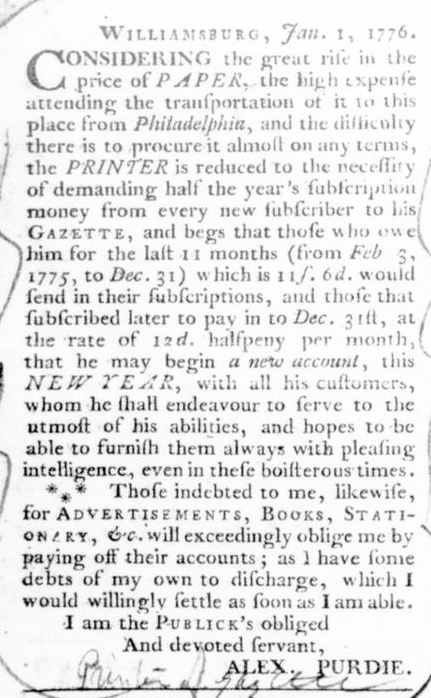
“The PRINTER is reduced to the necessity of demanding half the year’s subscription money.”

In the final issue of his Virginia Gazette for 1775, Alexander Purdie called on subscribers “to pay in their subscriptions, to enable me to lay in a stock of paper for the winter,” and “all persons indebted to me for BOOKS, STATIONARY, [and] ADVERTISEMENTS” to settle their accounts.  He asserted that it was “impossible to carry on such an expensive business, to the publick’s or his own satisfaction, without punctual payment.”

A week later, Purdie expressed even more alarm in a notice in the first edition of his Virginia Gazette for 1776.  “CONSIDERING the great rise in the price of PAPER, the high expense attending the transportation of it to this place from Philadelphia, and the difficulty there is to procure it almost on any terms,” he explained, “the PRINTER is reduced to the necessity of demanding half the year’s subscription money from every new subscriber to his GAZETTE.”  Newspaper subscribers often enjoyed generous credit, but Purdie made clear that was not a viable option.  He simultaneously renewed his call “that those who owe him for the last 11 months” since he commenced publication of hisVirginia Gazette “send in their subscriptions” and “those that subscribed later … pay in to Dec. 31st … that he may begin a new account, this NEW YEAR, with all his customers.”  Like many other printers, Purdie believed that he performed a valuable service for the public, “hop[ing] to be able to furnish them always with pleasing intelligence, even in these boisterous times.”  Many readers may have considered “boisterous” an understatement as they read news and editorials about the war that commenced at Lexington and Concord the previous April.

Where Purdie placed his advertisement within the issue testifies to its urgency.  Like other newspapers of the era, his Virginia Gazette consisted of four pages printed on a broadsheet and folded in half.  Printers usually printed the first and fourth pages on one side, let it dry, and then printed the second and third pages on the other side.  That meant that the news and advertisements that arrived in the printing office most recently appeared on the second and third pages, inside the folded newspaper.  Purdie’s Virginia Gazette had a heading for “ADVERTISEMENTS” in the final column of the third page.  He could have followed the example of other printers and given his notice a privileged place as the first item under that heading.  Instead, he made it the first item in the first column on the fourth page.  He placed his notice in the upper left corner of the final page, making it the first advertisement readers encountered then they turned to that page.  That also guaranteed a spot for the printer’s notice.  Purdie made it a priority rather than risking that news he had not yet received would be of such significance to justify crowding out his notice.  Purdie made a savvy decision in choosing where to place his notice calling on subscribers and other customers to settle accounts.

December 29

What was advertised in a revolutionary American newspaper 250 years ago today?

Virginia Gazette [Purdie] (December 29, 1775).

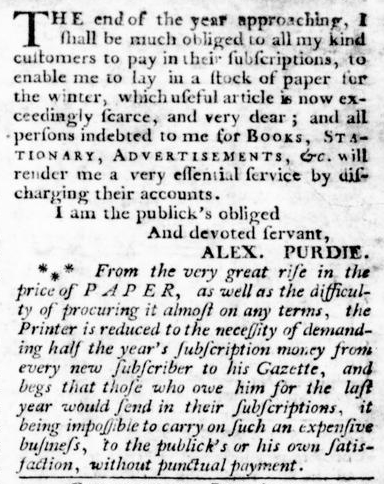
“All persons indebted to me for BOOKS, STATIONARY, ADVERTISEMENTS …”

As 1775 drew to a close, Alexander Purdie placed a notice in his own Virginia Gazette to tend to the business of running that newspaper.  A year earlier, he and his former partner, John Dixon, ended their partnership.  Dixon took a new partner, William Hunter, and continued printing the Virginia Gazette that he and Purdie had produced together for the last nine years.  Purdie immediately announced that he would commence printing a newspaper, that one also named the Virginia Gazette.  John Pinkney printed a third Virginia Gazette in Williamsburg.

Purdie’s experience and reputation apparently earned him enough customers to make his Virginia Gazette a viable enterprise, though he had to call on them to do their part by paying for the goods and services they purchased on credit.  “The end of the year approaching,” the printer explained, “I shall be much obliged to all my kind customers to pay in their subscriptions, to enable me to lay in a stock of paper for the winter, which useful article is now exceedingly scarce, and very dear.”  A variety of factors contributed to the scarcity of paper, including disruptions in trade with England due to the Continental Association and the outbreak of hostilities at Lexington and Concord in April.

Purdie did not call on subscribers alone to settle accounts.  Instead, he declared that “all persons indebted to me for BOOKS, STATIONARY, ADVERTISEMENTS, &c. will render me a very essential service by discharging their accounts.”  Yet, he placed the greatest emphasis on subscribers, adding a note that underscored the price and scarcity of paper.  “From the very great rise in the price of PAPER, as well as the difficulty of procuring it almost on any terms,” he proclaimed, “the Printer is reduced to the necessity of demanding half the year’s subscription money from every new subscriber to his Gazette.”  Such instructions deviated from the standard narrative about how early American printers ran their businesses.

Historians have often asserted that printers extended credit for subscriptions while requiring advertisers to pay in advance, recognizing advertising as the more significant revenue stream.  Throughout the colonies, many printers did frequent place notices asking, cajoling, and even threatening legal action in their effort to get subscribers to pay.  However, many also specified that subscribers were supposed to pay for half the year “upon entering.”  Difficult times forced Purdie to make that a condition for new subscribers.  He also seems to have extended credit for advertisements, though his notice did not make clear whether he meant newspaper notices or job printing (like handbills and broadsides) or both.  Even as printers followed standard practices, how they actually applied them varied from printing office to printing office.

April 12

What was advertised in a colonial American newspaper 250 years ago today?

Maryland Journal (April 12, 1775).

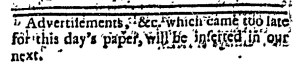
“Advertisements, &c. which came too late for this day’s paper, will be inserted in our next.”

Some advertisers and correspondents may have been frustrated when the content they submitted to the printing office did not appear in the April 12, 1775, edition of the Maryland Journal.  To mollify them, the printer, William Goddard, inserted a brief note advising that “Advertisements, &c. which came too late for this day’s paper, will be inserted in our next.”  No printer wished to disappoint advertisers who paid to run their notices nor correspondents who contributed the “FRESHEST ADVICES, both FOREIGN and DOMESTIC” that subscribers expected to find when they perused colonial newspapers.  In this instance, some material just had not arrived in time to set the type and integrate it into the issue, but Goddard pledged that it would appear in print the following week.

The placement of the printer’s notice at the bottom of the final column on the third page suggests that he made the decision to include it shortly before taking the issue to press.  Each edition of the Maryland Journal, like other colonial newspapers, consisted of four pages, two printed on each side of a broadsheet folded in half.  Printers typically printed the side with the first and fourth pages and then the side with the second and third pages.  As a result, the newest content, whether articles, letters, editorials, or advertisements, appeared “inside” the newspaper rather than on the front page. Goddard had just enough space for his notice to advertisers and correspondents when the compositor finished setting type and laying out the rest of the third page (the last page prepared for the press).

Many of the advertisements that did appear in that issue featured datelines, sometimes including both the town and date and other times just the date.  Most on the fourth page (the first prepared for the press) were from March, along with a couple from February and the most recent from April 1, April 3 and April 4.  All of them ran in the previous issue on April 5, so the compositor merely used type already set.  The advertisements immediately above Goddard’s notice on the third page were dated April 6 and April 10, further demonstrating that where advertisements appeared in an issue depended in part on when they arrived in the printing office.  Goddard did not play favorites or decide that some advertisements were more important than others.  Instead, time constraints prevented him from immediately printing every advertisement submitted to him.  Those advertisers could depend on their notices running in the next issue.

May 5

What was advertised in a colonial American newspaper 250 years ago today?

Massachusetts Gazette and Boston Weekly News-Letter (May 5, 1774).

“A very low State of Health, prevents his making Collection of Intelligence and Speculation.”

Printers often inserted notices about their own businesses immediately after any local news items they published, increasing the chances that readers would take note even if they did not closely examine the advertisements that followed.  Such was the case for a notice that Richard Draper placed in the May 5, 1774, edition of the Massachusetts Gazette and Boston Weekly News-Letter.  Right below news from Boston and Worcester, he declared, “The Publisher and Printer of this Paper being in a very low State of Health, prevents his making such Collection of Intelligence and Speculation, as his Customers must have expected to be given them.”  He especially lamented that he had been hampered in gathering news “since the arrival of the last Vessels,” acknowledging that ships arriving from London brought updates about Parliament’s reaction to the destruction of tea in Boston Harbor the previous December.  Colonial printers had to hustle to acquire the latest news and rumors from the other side of the Atlantic, learning what they could from captains and convincing merchants to share excerpts from the letters they received.

Even though a two-page supplement featuring “INTERESTING INTELLIGENCE” from London accompanied the May 5 edition, Draper did not consider himself up to the task of collecting and collating all the news flowing into the busy port.  That being the case, he addressed his subscribers, “beg[ging] their Indulgence till he recovers Strength, or till the Paper falls into other Hands.”  Planning for the latter, at least for the near future, he advised that a “Printer that understands collecting News, and carrying on a News Paper … may be concerned on very advantageous Terms” upon applying to Draper at his printing office.  His appeal met with success.  In the next issue he announced that he entered a “Co-Partnership with Mr. JOHN BOYLE, who was regularly brought up and has since carried on the Printing Business in this Town.”  Together, the partners would “Endeavor to support the Reputation the said Paper has had for many Years past.”  Draper alluded to the long publication history of the newspaper, established seventy years earlier.  In his History of Printing in America (1810), Isaiah Thomas described the Boston News-Letter (later the Massachusetts Gazette and Boston Weekly News-Letter) as “the first newspaper published in this country,” dismissing the single issue of Publick Occurences published in 1690.[1]  Thomas reported that Draper’s “ill health render[ed] him unable to attend closely to business” so Boyle “undertook the chief care and management of the newspaper.”[2]  A month later, Draper died.  Hs widow, Margaret, continued in partnership with Boyle for about a year, but they went their separate ways after the Revolutionary War began.  She then took John Howe as a partner, continuing to publish the newspaper “until the British troops left Boston in 1776.”  Thomas notes that it was the only newspaper “printed in Boston during the siege.”[3]  Despite Draper’s poor health and other turmoil, his newspaper lasted longer than any of the others published in Boston at the time he requested the “Indulgence” of his subscribers.

**********

[1] Isaiah Thomas, The History of Printing in America: With a Biography of Printers and an Account of Newspapers (1810; New York: Weathervane Book, 1970), 231.

[2] Thomas, History of Printing, 145.

[3] Thomas, History of Printing, 231.

April 17

What was advertised in a colonial American newspaper 250 years ago this week?

Virginia Gazette [Rind] (April 17, 1774).

“Advertisements, blanks, and many other kinds of printing work, she ardently hopes, may be discharged at the general courts.”

Clementina Rind printed the Virginia Gazette and operated the printing office following the death of her husband in August 1773.  That included keeping the books and calling on customers to settle accounts.  She issued such a notice in the April 14, 1774, edition of her newspaper, at the same time outlining improvements to the publication that payments would help support.  She asserted that she had “lately considerably enlarged her paper,” providing more content to subscribers and other readers.  In addition, she ordered and “expect[ed] shortly an elegant set of types from London, … together with all other materials relative to the printing business.”  Rind expressed pride in “the dignity of her gazette” while simultaneously noting that those who owed money had a role to play in her goal of “keeping it at a fixed standard.”

To that end, she called on subscribers to submit annual payments.  In the eighteenth century, many newspaper subscribers notoriously went for years without settling accounts with printers.  Advertising revenue offset those delinquent payments, yet not all printers demanded that advertisers pay for their notices in advance, contrary to common assumptions about how they ran their businesses.  Rind’s notice suggests that she may have published advertisements on credit but does not definitively demonstrate that was the case.  She requested that customers pay what they owed for “advertisements, blanks, and many other kinds of printing work … at the general courts.”  She may have meant newspaper notices, but “advertisements” could have also referred to handbills, broadsides, and other job printing for the purposes of marketing goods and services or disseminating information to the public.  The masthead listed prices for subscriptions (“12 s. 6 d. a Year”) and advertisements “of a moderate length” (“3 s. the first Week, and 2 s. each Time after”), while also promoting “PRINTING WORK, of every Kind,” which would have included blanks (or forms for legal and commercial transactions), handbills, and broadsides, but that does not clarify what Rind meant by “advertisements” in her notice.  That other printers sometimes allowed credit for newspaper advertisements leaves open the possibility that Rind may have done so as well.  If that was the case, it made it even more imperative that advertisers discharge their debts to “enable her the better to carry on her paper with that spirit which is so necessary to such an undertaking.”

Virginia Gazette [Rind] (April 14, 1774).

April 9

What was advertised in a colonial American newspaper 250 years ago today?

Providence Gazette (April 9, 1774).

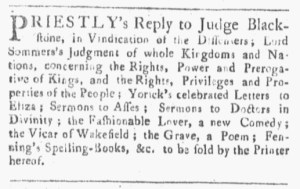
“… to be sold by the Printer hereof.”

Advertisements filled the final column on the third page and the entire last page of the April 9, 1774, edition of the Providence Gazette.  They generated significant revenue for John Carter, the printer, yet not all the advertisements were paid notices.  Like many other printers, Carter used his newspaper to disseminate his own advertisements.  He inserted five of the notices that appeared in that issue.

Those advertisements related to a variety of aspects of operating Carter’s printing office “at Shakespear’s Head, in Meeting-Street, near the Court-House.”  In one, he called on “ALL Persons indebted for this Gazette one Year, or more” and anyone else indebted to him for other services “to make immediate Payment.”  In another, Carter sought a “trusty and well-behaved Lad, about 13 or 14 Years of Age” as “an Apprentice to the Printing Business.”  Candidates needed to be able to “read well, and write tolerably.”  In yet another, a headline in a larger font than anything else in that issue, even the title of the newspaper in the masthead, proclaimed, “RAGS.”  Carter offered the “best Prices … for clean Linen Rags, of any Kind, and old Sail-Cloth, to supply the PAPER MANUFACTORY in Providence.”  The printer intended to recycle rags into paper that he would then use to publish subsequent editions of the Providence Gazette.

Providence Gazette (April 9, 1774).

Other advertisements promoted items for sale at the printing office.  Most printers also sold books.  A few came from their own presses or other colonial presses, but most were imported from England.  Carter listed several titles for readers with diverse interests, from “PRIESTLY’s Reply to Judge Blackstone, in Vindication of the Dissenters” to “the Fashionable Lover, a new Comedy” to “the Grave, a Poem” to “Fenning’s Spelling-Books.”  An “&c.” (an abbreviation for et cetera) indicated that he stocked many more books, pamphlets, and broadsides.  A shorter advertisement stated, “BLANKS of various Kinds to be sold by the Printer hereof.”  Carter printed and sold forms for common legal and commercial transactions.  Even the colophon doubled as an advertisement, informing readers that “all Manner of Printing-Work is performed with Care and Expedition.”

Carter took advantage of his access to the press to tend to the different parts of operating a busy printing office.  While his advertisements did not generate revenue in the same manner as the paid notices placed by merchants, shopkeepers, artisans, estate executors, lottery managers, and others, they supported his business in other ways and some likely resulted in revenue from the sale of books and blanks or the settling of accounts.  Collectively, they gave Carter a very visible presence in the pages of the Providence Gazette.

March 18

What was advertised in a colonial American newspaper 250 years ago today?

Connecticut Gazette (March 18, 1774).

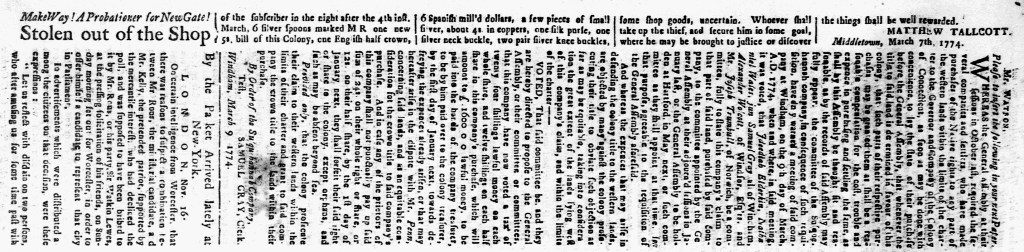
Make Way! A Probationer for NEW GATE!

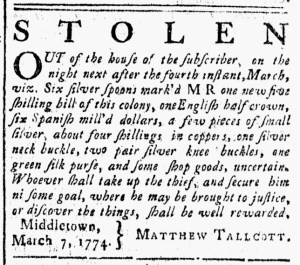
For Matthew Talcott, all was fine on the evening of March 4, 1774, but he woke up to discover a calamity the next morning.  Sometime during the night six silver spoons “marked M R,” “one silver neck buckle, two pair silver knee buckels,” quite a bit of cash, and “some shop goods, uncertain,” had been stolen from his shop in Middletown, Connecticut.  In response, Talcott turned to the public prints, running advertisements in hopes that someone “shall take up the thief, and secure him in some [jail], where he may be brought to justice.”  He also sought to recover the stolen items and money.  In addition to giving a reward, he invested in advertisements in three newspapers published in the colony.

Connecticut Journal (March 18, 1774).

Talcott’s advertisement first appeared in the Connecticut Gazette, published in New London, and the Connecticut Journal and New-Haven Post-Boy on March 11.  In each instance, a headline alerted readers to the contents of the rest of the advertisement.  The Connecticut Journal used “STOLEN” as the headline, while the Connecticut Gazette featured a more playful one that may have attracted even more attention: “Make Way! A Probationer for NEW GATE!”  The colony had recently opened a prison in a copper mine converted for that purpose in East Granby.  Someone in the printing office, rather than Talcott, may have devised the headline.

What suggests that was the case?  The two advertisements featured some variations.  The one in the Connecticut Gazette indicated that the theft took place “out of the Shop” while the Connecticut Journal stated it occurred “OUT of the house” of the unfortunate Talcott.  He likely worked where he resided.  Some of the stolen goods also appeared in slightly different order.  Talcott likely wrote the copy once for one newspaper and then copied it for the other, but was not exact in the process.  The compositor for the Connecticut Journal then used the first word as the headline, a common practice.  The editor or the compositor for the Connecticut Gazette, on the other hand, may have spotted an opportunity for creativity.

Connecticut Courant (March 15, 1774).

Consider that Talcott’s advertisement next ran in the Connecticut Courant, published in Hartford, on March 15.  It featured the same copy, including the snappy headline, that appeared in the Connecticut Gazette.  It also appeared in the margin on the final page, suggesting that the printing office received the advertisement at the last moment.  Type had already been set for the rest of the issue, but the compositor found a way to include Talcott’s notice.  Rather than Talcott submitting his advertisement directly to the Connecticut Courant, he may have made arrangements with the printer of the Connecticut Gazette to instruct his counterpart in Hartford to publish it, marking it in the copy sent as part of an exchange network of printers throughout the colony and the region.

While not conclusive, the circumstances collectively suggest that Talcott wrote the original copy, the Connecticut Gazetteembellished it with a provocative headline, and the Connecticut Courant reprinted it.  Several people played a role in creating the advertisement ultimately distributed to readers throughout the colony.

March 15

What was advertised in a colonial American newspaper 250 years ago today?

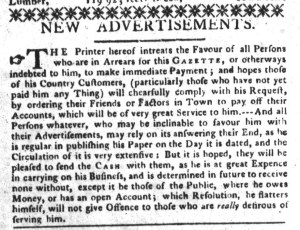
South-Carolina Gazette and Country Journal (March 15, 1774).

“All Persons whatever, who may be inclinable to favour him with their Advertisements, may rely on its answering their End.”

The “NEW ADVERTISEMENTS” in the March 15, 1774, edition of the South-Carolina Gazette and Country Journalbegan with a notice from the printer, Charles Crouch.  Like his counterparts throughout the colonies, Crouch occasionally issued a call for “all Persons who are in Arrear for this GAZETTE, or otherways indebted to him, to make immediate Payment.”  Recognizing that many of his subscribers lived outside Charleston, he requested that “his Country Customers … will cheerfully comply” by directing “their Friends or Factors in Town to pay off their Accounts.”  In particular, he pointedly suggested that “those who have not yet paid him any Thing” would tend to what they owed.  When they ran notices for similar purposes, some printers asserted that certain customers had not made payments for years, taking advantage of credit extended to them.

How did Crouch and other printers manage to stay in business under such circumstances.  Many, but not all, required advertisers to pay in advance, figuring that advertising generated enough revenue to offset shortfalls from subscriptions.  That was the case for Crouch and the South-Carolina Gazette and Country Journal.  He instructed advertisers “send the CASH” when they submitted copy to the printing office.  After all, “he is at great Expence in carrying on his Business.” Accordingly, Crouch was “determined in future to receive none without,” suggesting that perhaps he had accepted advertisements without “the CASH” in the past.  The printer made an exception for those he “owes Money, or has an open Account,” presumably counting new advertisements against his own debts.

In hopes of attracting new advertisers, Crouch commented on the effectiveness of inserting notices in his newspaper.  Advertisers could “rely on its answering their End” or serving their purpose, whether disseminating information or enticing customers or whatever other reason they had for advertising.  He competed against two other newspapers published in Charleston, the South-Carolina Gazette and the South-Carolina and American General Gazette.  Prospective advertisers should choose the South-Carolina Gazette and Country Journal, Crouch stated, because “the Circulation of it is very extensive.”  In other words, the newspaper reached many readers.  In addition, Crouch bragged that he was “regular in publishing his Paper on the Day it is dated,” taking a swipe at other competitors who sometimes delayed printing and distributing their weekly newspapers.  Advertisers could depend on their notices in the South-Carolina Gazette and Country Journal reaching readers in a timely manner.  At the same time, he tended to settling accounts with existing customers, Crouch sought additional customers who had reason to advertise.

February 11

What was advertised in a colonial American newspaper 250 years ago today?

Connecticut Gazette (February 11, 1774).

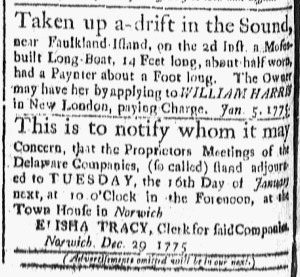
Several Pieces from our Correspondents, Advertisements, &c. which came to Hand too late for this Day’s Paper, will be in out next.”

Timothy Green, the printer of the Connecticut Gazette, inserted a brief notice in the February 11, 1774, edition to advise that “Several Pieces from our Correspondents, Advertisements, &c. which came to Hand too late for this Day’s Paper, will be in out next.”  In a few short lines, the printer aimed to manage his relationships with subscribers, advertisers, and anyone who submitted news, editorials, essays, or any other content for the newspaper.  He suggested to readers that he worked until the last possible moment to include the latest news.  He assured advertisers that their notices would indeed appear in print in the next issue.  He let those who provided content know that practical matters, not a lack of appreciation for their efforts, played the deciding role in why their submissions did not appear alongside a proclamation from the governor, resolutions from a “Town-Meeting of the Town of Providence” concerning a “Duty upon Tea” enacted by Parliament, and an account of events that resulted in the tarring and feathering of John Malcom, a customs officer, in Boston.

Green’s notice appeared at the bottom of the final column on the third page.  While that may seem like a curious place to modern readers, it made absolute sense to eighteenth-century readers, especially anyone familiar with the process for printing newspapers.  The Connecticut Gazette, like other newspapers of the era, consisted of four pages, created by printing two pages on each side of a broadside and folding it in half.  Workers in a printing office set the type for the first and fourth pages, printed the side of the broadsheet that featured those pages, and let the ink dry before printing the second and third pages on the other side.  That meant that type for the interior pages was set last, so news received most recently, regardless of its magnitude, appeared there rather than on the front page.  Whatever appeared at the end of the last column on the third page was the final bit of content that printers managed to fit in that issue.  That Green’s notice appeared there testified to his efforts to publish everything received in his printing office in New London up to the moment he had to take that issue to press and distribute the February 11 edition on schedule.