December 5

What was advertised in a revolutionary American newspaper 250 years ago today?

New-Hampshire Gazette (December 5, 1775).

“Shopkeepers are cautioned, not to advance on their Goods, which is contrary to the Resolves of the Continental Congress.”

The December 5, 1775, edition of the New-Hampshire Gazette consisted of only two pages rather than the usual four.  That limited the amount of news and advertising that the printer, Daniel Fowle, could disseminate to readers, yet that issue carried good news that the “Printing Press is now again removed from Greenland to Portsmouth.”  Fowle had moved his press to Greenland, about six miles from Portsmouth, to protect it from an anticipated British attack on New Hampshire’s most important port.  In early December, he moved his press back to Portsmouth, “into an old Building adjoining the late Printing-Office … where it is hop’d the Types will remain undisturb’d, as this Harbour is so well fortified that any Enemy must pass thro’ a Hell of Fire, intermix’d with Brimstone, Pitch Tar, Turpentine, and almost every Sort of Combustible Matter to make the Passage dreadful.”

Yet enemies to the American cause did not approach Portsmouth solely by sea.  Some enemies resided in the port and nearby towns, undermining efforts to resist British tyranny through their actions in the marketplace rather than on the battlefield.  At the bottom of the last column on the last page, Fowle concluded that issue of the New-Hampshire Gazettewith a warning published “By desire” of a correspondent that “Shopkeepers are cautioned, not to advance on their Goods, which is contrary to the Resolves of the Continental Congress.”  The correspondent invoked the ninth article of the Continental Association, a nonimportant agreement devised by the First Continental Congress that went into effect on December 1, 1774.  That article stated that “such as are Venders of Goods or Merchandise will not take Advantage of the Scarcity of Goods that may be occasioned by this Association, but will sell the same at the Rates we have been respectively accustomed to do for twelve months past.”  Some shopkeepers in and near Portsmouth apparently considered charging an “Advance” (or markup) on their wares, prompting the patriotic correspondent to remind them of the Continental Association and the consequences they faced.  That would be their only warning because “if they do [raise prices], their Names will be return’d to the Congress ad publish’d, without further Notice.”  Once that happened, the ninth article specified that “if any Venders of Goods or Merchandise shall sell any such Goods on higher Terms … no Person ought, nor will any of us deal with any such Person … at any Time thereafter, for any Commodity whatever.”  That issue carried only two advertisements from local retailers, yet the address applied to all the shopkeepers in the vicinity.

June 2

What was advertised in a revolutionary American newspaper 250 years ago today?

Story and Humphreys’s Pennsylvania Mercury (June 2 1775).

“Imported last summer and fall from London [and] Bristol … A VERY large and general assortment of Ironmongery [and] Cutlery.”

James Bringhurst advertised a variety of items available at “his Ware-house on the Bank, below Walnut-street,” in Philadelphia in the summer of 1775.  He stocked a “VERY large and general assortment of Ironmongery [and] Cutlery” that included “knives and forks with or without cases, roasting jacks, bake ovens, preserving pans with covers, sauce pans with ditto, teakettles, skillets, pots, kettles, [and] frying pans.”  He also carried “most sorts of tradesmens tools” along with “compleat Furniture both for house and ship building.”  In addition, his inventory included “sundry other articles too numerous to insert” in a newspaper advertisement.  Bringhurst’s “Ware-house” was an eighteenth-century precursor of a superstore that sold housewares to consumers and equipment and supplies to builders.

Before he gave or his location or presented his list of merchandise, Bringhurst noted when and where he received the goods he sold.  Many merchants and shopkeepers did so in the 1760s and 1770s yet doing so had a new kind of significance once the Continental Association went into effect on December 1, 1774.  The First Continental Congress devised the Continental Association, a nonimportation agreement, in response to the Coercive Acts, hoping to leverage the commercial boycott into political reform.  Colonizers who signed the Continental Association vowed to abide by it until Parliament repealed the Coercive Acts and other legislation that infringed on their rights that had been passed since the end of the Seven Years War.

Bringhurst sent an important signal to prospective customers and the entire community when he specified that his wares had been “Imported last summer and fall from London, Bristol,” and other English ports.  Under other circumstances, wholesalers and retailers would have been unlikely to acknowledge that they sold items that had been on the shelves or in the warehouse for so long; instead, they usually emphasized that they had just the received the newest goods and the newest fashions.  In this case, however, peddling merchandise that had been around for the better part of a year was a virtue.  Bringhurst abided by the Continental Association … and his customers could shop in good conscience knowing that they did so as well.

May 24

What was advertised in a revolutionary American newspaper 250 years ago today?

Pennsylvania Journal (May 24, 1775).

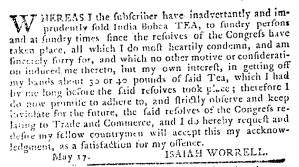
“I … have inadvertently and imprudently sold India Bohea TEA, to sundry persons and at sundry times.”

Isaac Worrell needed to do some damage control when others discovered that he had been selling tea in violation of the third article of the Continental Association in the spring of 1775.  That nonimportation agreement, devised by the First Continental Congress the previous fall, stated “we will not purchase or use any Tea imported on Account of the East India Company, or any on which a Duty hath been or shall be paid; and, from and after the first Dat of March next, we will not purchase or use any East India Tea whatever.”  Yet Worrell had not abided by those terms.

In an advertisement that first appeared in the May 17, 1775, edition of the Pennsylvania Journal and ran again the following week, Worrell confessed that he “imprudently sold India Bohea TEA, to sundry persons and at sundry times since the resolves of the Congress have taken place,” though he claimed that he had done so “inadvertently.”  Readers may have been skeptical that a prohibited act that occurred repeatedly happened “inadvertently.”  All the same, Worrell hoped that they would take note of his explanation for the infractions and accept his apology.  He asserted that he had “no other motive or consideration … but my own interest, in getting off my hands about 30 or 40 pounds of said Tea.”  He also contended that he acquired the tea “long before the said resolves took place,” hoping that would make his offense seem less serious.  At least he had not actively ordered or received new shipments.

Worrell assured his community that he had reformed.  “I do now promise to adhere to, and strictly observe and keep inviolate for the future,” he proclaimed, “the said resolves of the Congress relating to Trade and Commerce.”  He hoped that would be sufficient that “my fellow countrymen will accept this my accknowledgment, as a satisfaction for my offence.”  The Continental Association called for breaking off all ties, commercial and social, with those who violated it, yet Worrell hoped that his apology would outweigh his flimsy excuses to restore him to the good graces of the public. That he managed to sell “30 or 40 pounds of said Tea,” however, suggests that many others did not obey the terms of the Continental Association.  Loyalists accused Patriots of cheating, especially when it came to tea.  Worrell’s notice seems to support such allegations.

May 16

What was advertised in a revolutionary American newspaper 250 years ago today?

Dunlap’s Maryland Gazette (May 16, 1775).

“He will sell at smaller profits than usual … agreeable to the resolve of the Continental Congress.”

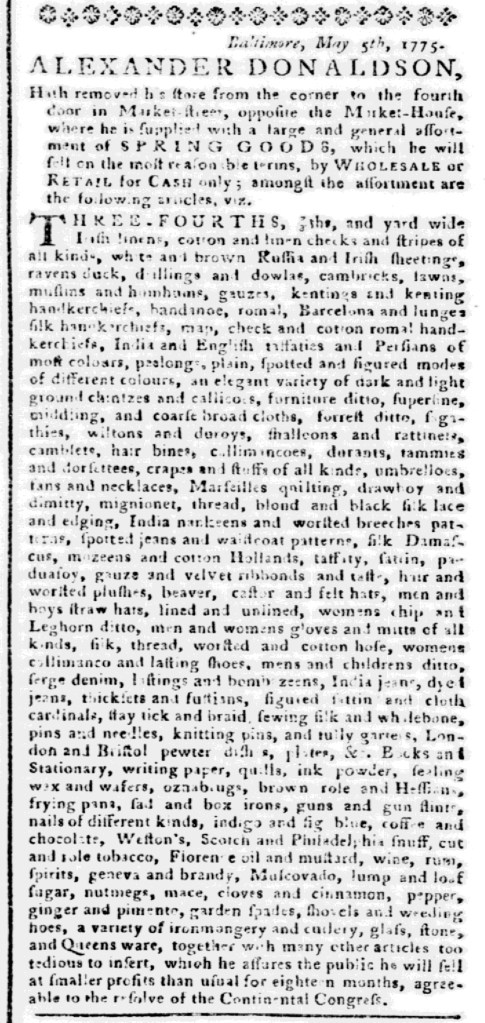
Alexander Donaldson advertised a “large and general assortment of SPRING GOODS” available at his store in Baltimore in Dunlap’s Maryland Gazette in the spring of 1775.  To entice prospective customers, he provided an extensive list of textiles, accessories, housewares, and other items.  His inventory included, for instance, “India and English taffaties and Persians of most colours,” “an elegant variety of dark and light ground chintzes and callicoes,” “umbrelloes, fans and necklaces,” “taffaty, sattin, paduasoy, gauze and velvet ribbonds,” “men and womens gloves and mitts of all kinds,” “London and Bristol pewter,” “a variety of ironmongery and cutlery,” and “writing paper, quills, ink powder, [and] sealing wax and wafers.”  Donaldson also stocked “many other articles too tedious to insert,” though his concern may have been the additional cost to catalog even more of his merchandise in an already-lengthy newspaper notice.

The merchant ended with a note that he “will sell at smaller profits than usual for eighteen months, agreeable to the resolve of the Continental Congress.”  In doing so, he invoked the ninth article of the Continental Association, a nonimportation, nonconsumption, and nonexportation agreement devised by the First Continental Congress in response to the Coercive Acts.  That article specified, “That such as are Venders of Goods or Merchandise will not take Advantage of the Scarcity of Goods thar may be occasioned by this Association, but will sell the same at the Rates we have been respectively accustomed to do for twelve Months last past.”  In other words, merchants and shopkeepers would not gouge customers by jacking up prices once the Continental Association went into effect on December 1, 1774.  The ninth article also spelled out the consequences: “if any Venders of Goods or Merchandise shall sell any Goods on higher Terms, or shall in any Manner, or by any Device whatsoever, violate or depart from this Agreement, no Person ought, nor will any of us deal with any such Person, or his or her Factor or Agent, at any Time thereafter, for any Commodity whatever.”

Considering such penalties, Donaldson very carefully explained that he set fair prices.  Even better, he offered bargains to his customers.  The Continental Association called for selling at the “Rates” or prices established during the year before it went into effect, yet Donaldson declared that he “will sell at smaller profits than usual.”  He did not indicate when his good arrived in the colonies, leaving it to readers to assume that since he abides by the price controls that he also observed the deadline for receiving imported goods.  The favorable “Rates” for his wares may have also distracted colonizers from asking too many questions about when Donaldson’s inventory had been ordered and shipped or when it arrived in an American port.  In addition, the merchant did not list tea, forbidden by the third article, alongside other popular beverages, coffee and chocolate, another indication that he adhered to the Continental Association.  Donaldson signaled to customers that they could shop at his store while still supporting the American cause.

April 27

What was advertised in a revolutionary American newspaper 250 years ago today?

Norwich Packet (April 27, 1775).

I am sorry that I have drank any Tea.”

Ebenezer Punderson had the misfortune of appearing in an advertisement placed in the Norwich Packet by the local Committee of Inspection in the issue that carried the first newspaper coverage of the battles of Lexington and Concord.  The committee accused him of drinking tea in violation of the Continental Association, disparaging the First Continental Congress, and refusing to meet with the committee to discuss his conduct.  In turn, the committee advised the public not to carry on any “Trade, Commerce, Dealings or Intercourse” with Punderson.

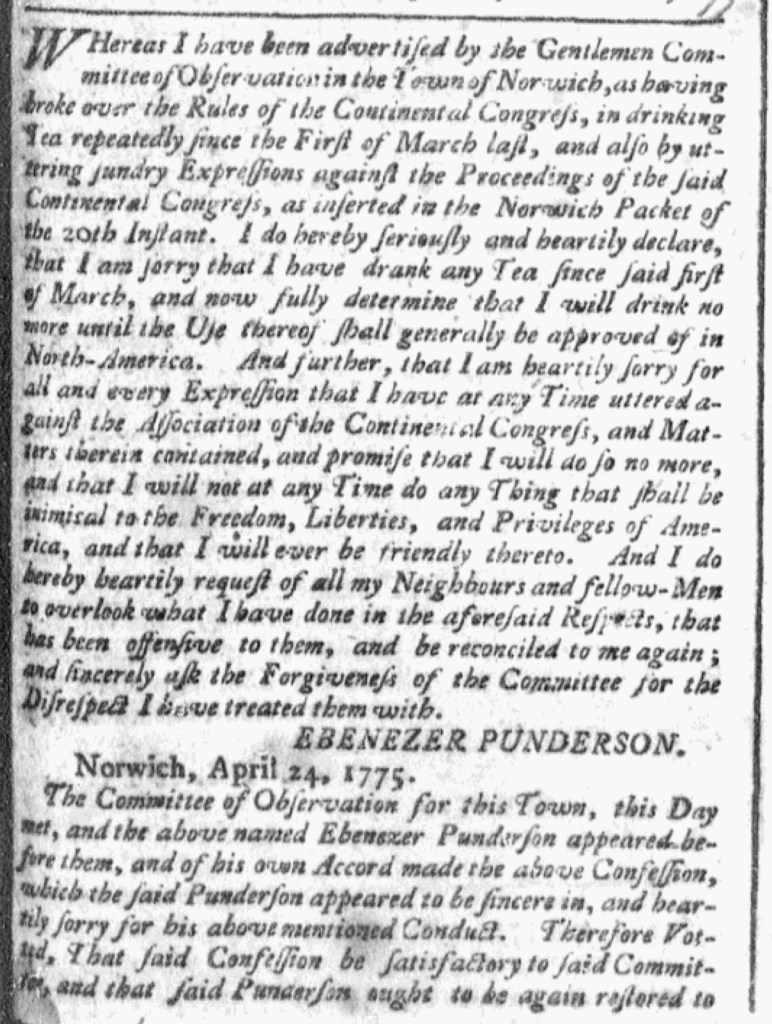
Perhaps Punderson would have weathered that sort of public shaming under other circumstances, but news of events at Lexington and Concord made his politics even more unpalatable and his situation more dire.  From what ran in the newspaper, it did not take him long to change his tune, meet with the committee, and publish an apology for his behavior.  In a missive dated four days after the committee’s advertisement, Punderson reiterated the charges against him and “seriously and heartily” declared the he was “sorry I have drank any Tea since the first of March” and “will drink no more until the Use thereof shall generally be approved in North-America.”  In addition, he apologized for “all and every Expression that I have at any Time uttered against the Association of the Continental Congress.”  Furthermore, Punderson pledged that he “will not at any Time do any Thing that shall be inimical to the Freedom, Liberties, and Privileges of America, and that I will ever be friendly thereto.”  He requested that his “Neighbours and fellow-Men to overlook” his transgression and “sincerely ask[ed] the Forgiveness of the Committee for the Disrespect I have treated them with.”

Norwich Packet (April 27, 1775).

Punderson apparently convinced the committee to give him another chance.  Dudley Woodbridge, the clerk, reported that Punderson “appeared before them, and of his own Accord made the above Confession” and seemed “heartily sorry for his … conduct.”  In turn, the committee voted to find Punderson’s confession “satisfactory” and recommended that he “be again restored to Favour” in the community.  The committee also determined that “the above Confession, with this Vote, be inserted in the Public Papers,” perhaps less concerned with restoring Punderson’s good name than the example his recantation set for other Tories.  When the notice appeared in the Norwich Packet, Punderson inserted an additional note that extended an offer to meet with anyone “dissatisfied with the above Confession” and asserted that he would “cheerfully submit” to any further decisions the Committee of Inspection made in response.

Yet what appeared in the Norwich Packet did not tell the whole story.  According to Steve Fithian, Punderson “attempted to flee to New York but was captured and returned to Norwich where he spent eight days in jail and only released after signing a confession admitting to his loyalist sympathies.”  He did not stay in Norwich long after that.  “Several weeks later he fled to Newport, Rhode Island and boarded a ship which took him to England where he remained for the entire Revolutionary War.”  Apparently, he convincly feigned the sincerity he expressed, well enough that the committee accepted it.  While imprisoned, Punderson wrote a letter to his wife about his ordeal.  After arriving in England, he published an account with a subtitle that summarized what he had endured: The Narrative of Mr. Ebenezer Punderson, Merchant; Who Was Drove Away by the Rebels in America from His Family and a Very Considerable Fortune in Norwich, in Connecticut.  Just as the Committee of Inspection used print to advance a version of events that privileged the patriot cause, Punderson disseminated his own rendering once he arrived in a place where he could safely do so.

**********

The Committee of Inspection’s notice appeared with the advertisements in the April 20, 1775, edition of the Norwich Packet.  Punderson’s confession, however, ran interspersed with news items in the April 27 edition.  It may or may not have been a paid notice, but it was certainly an “advertisement” in the eighteenth-century meaning of the word.  At the time, according to the Oxford English Dictionary, an advertisement was a “(written) statement calling attention to anything” and “an act of informing or notifying.”  Advertisements often delivered local news in early American newspapers.  Punderson definitely made news as the imperial crisis became a war.

April 20

What was advertised in colonial American newspaper 250 years ago today?

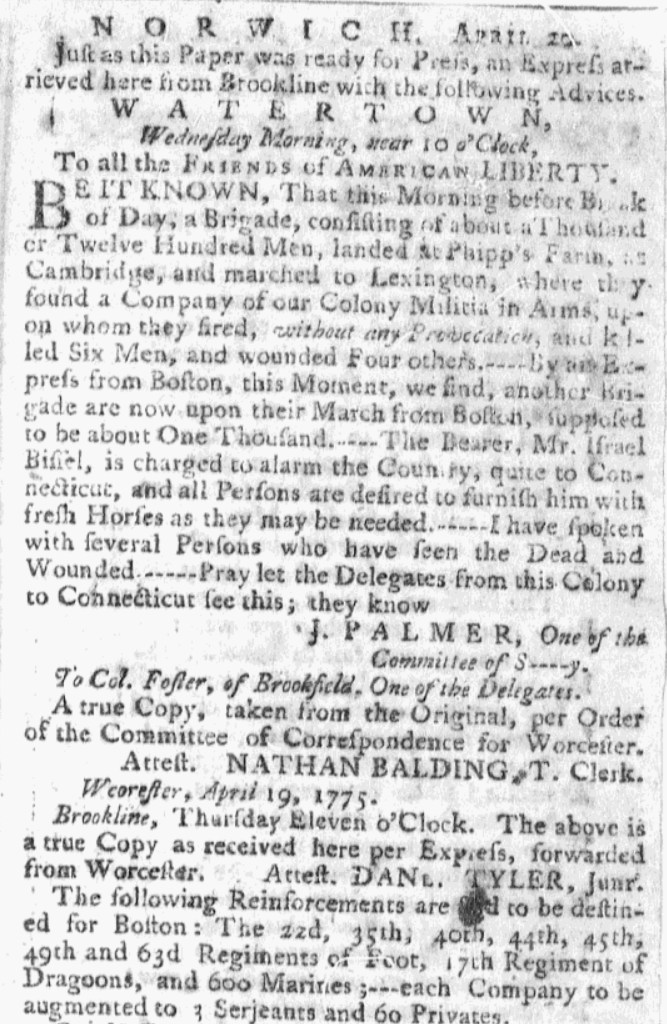
Norwich Packet (April 20, 1775).

“Ebenezer Punderson … has repeatedly drank Tea … in open Contempt and Defiance of the Continental Association.”

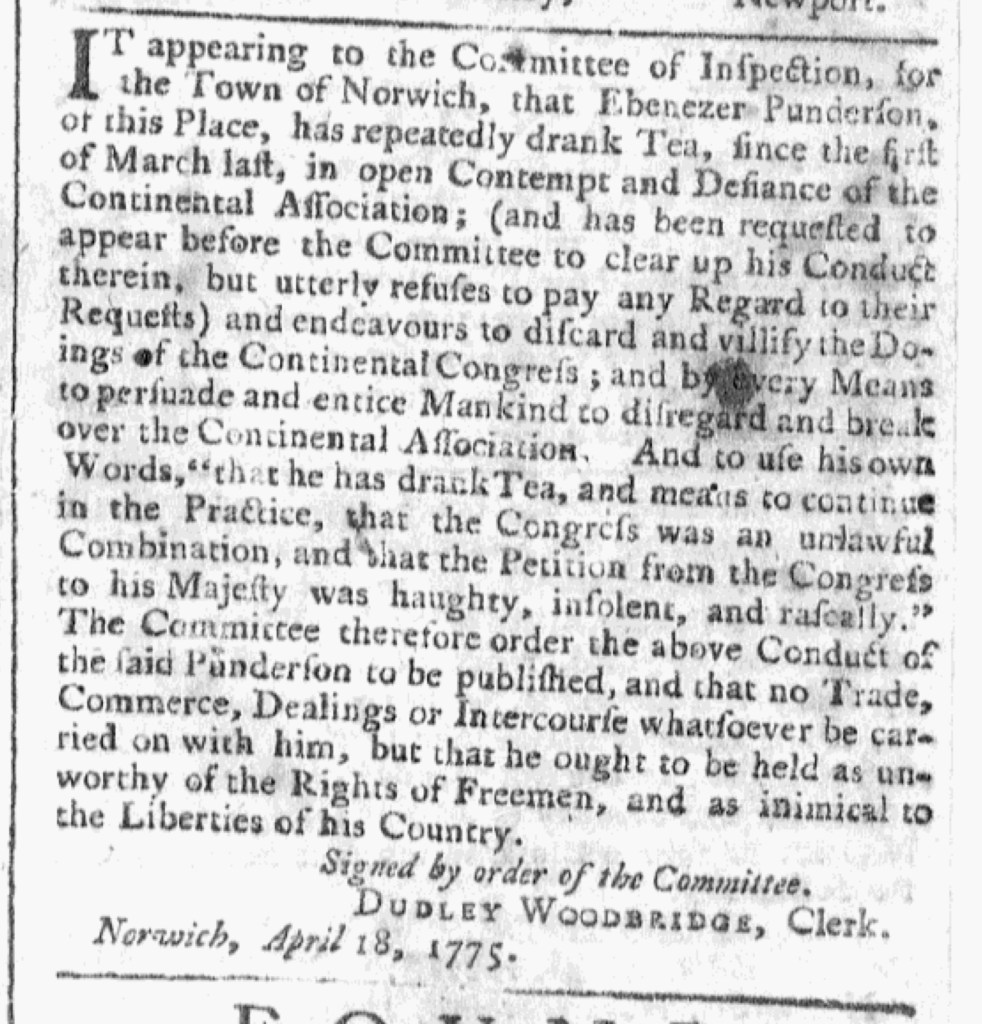
Ebenezer Punderson went too far and now it was time for consequences.  He brazenly and repeatedly violated the Continental Association, the nonimportation and nonconsumption agreement enacted by the Continental Congress in response to the Coercive Acts.  As a result of his actions, the Committee of Inspection in Norwich, Connecticut, placed an advertisement in the April 20, 1775, edition of the Norwich Packet to document his behavior and advise the community to shun Punderson.

The committee reported that Punderson “has repeatedly drank Tea … in open Contempt and Defiance of the Continental Association.”  When the committee sought to investigate the matter, he “utterly refuse[d] to pay any Regard to their Requests” to appear before it.  Even worse, he “endeavours to discard and vilify the Doings of the Continental Congress; and by every Means to persuade and entice Mankind to disregard and break over the Continental Association.”  His refusal to abide by the Continental Association damaged the movement and had the potential to do even more harm by inspiring others to ignore it as well.  In addition, he stridently declared that he had no intention of adhering to the agreement, insulting the Continental Congress in the process:  “to use his own words, ‘that he has drank Tea, and means to continue in that Practice, that the Congress was an unlawful Combination, and that the Petition from the Congress to his Majesty was haughty, insolent, and rascally.’”

The Committee of Inspection, in turn, determined that it was Punderson who was haughty, insolent, and rascally.  It ordered that the “Conduct of the said Punderson be published, and that no Trade, Commerce, Dealings or Intercourse whatsoever be carried on with him.”  Furthermore, the committee declared that “he ought to be held as unworthy of the Rights of Freemen, and as inimical to the Liberties of his Country.”  Punderson acted in opposition to the patriot cause.  The Committee of Inspection intended to see him pay for his transgressions.

Norwich Packet (April 20, 1775).

Punderson chose the wrong time to draw attention to himself.  Some of the first coverage of the battle at Lexington to appear in American newspapers ran at the top of the column that featured the advertisement about his offenses.  “Just as this Paper was ready for Press,” the printers declared, “an Express arrived here from Brookline with the following Advices” from J. Palmer, “One of the Committee of S[afet]y,” and dispatched to “Col. Foster, of Brookfield.”  The missive reported that before dawn on the morning of April 19 “a Brigade [of British troops] … marched to Lexington, where they found a Company of our Colony Militia in Arms, upon whom they fired, without any Provocation, and killed Six Men, and wounded Four others.”  Palmer stated that he had “spoken with several Persons who have seen the Dead and Wounded.”  He also relayed news that another Brigade “are now on their March from Boston.”  Israel Bissell carried the message, “charged to alarm the Country” in western Massachusetts all the way to Connecticut.  The printers published this account from a “true Copy, taken from the Original, per Order of the Committee of Correspondence for Worcester.”  The details were sparse, yet the “FRIENDS of AMERICAN LIBERTY” reading the Norwich Packet now knew that fighting had commenced near Boston.  That news quite likely had an impact on their attitude when they read about Punderson’s offenses further down the column.

April 10

What was advertised in a colonial American newspaper 250 years ago today?

New-York Gazette and Weekly Mercury (April 10, 1775).

“Turn them speedily into cash, before the trade opens with Great-Britain.”

In the spring of 1775, Samuel Loudon, a bookseller and stationer, took to the pages of the New-York Gazette and Weekly Mercury to promote his current inventory.  His advertisement included a catalog listing many of the titles currently in stock as well as “a Variety of Religious books too tedious to mention” and “a variety of History and Romance.”  He also carried writing supplies, including “Quills, Writing Paper, Blank Books, Wafers and Sealing Wax.”

Loudon hoped to make a deal with customers “who take a quantity,” whether for themselves or to retail at their own shops, offering to sell the books “nearly at prime cost” or just a small markup.  He stated that he wished to “turn them speedily into cash, before the trade opens with Great-Britain” because he wanted to be in a better position to “lay in a fresh assortment.”  Despite the volume of newspaper advertisements and subscription proposals for books and pamphlets published by American printers, most books purchased and read by colonizers were printed in England and imported to the colonies.  At that moment, however, Americans participated in a nonimportation agreement, the Continental Association, enacted in response to the Coercive Acts.  Loudon acknowledged that he did not currently have access to new books, yet he looked to the future with optimism and planned to place orders as soon as Parliament repealed the offensive legislation and trade returned to normal.

In that regard, his advertisement echoed the one that John Minshull placed for looking glasses and engravings in the New-York Journal a few days earlier, though Minshull, likely a Loyalist, may have adhered to the nonimportation agreement out of necessity rather than enthusiasm.  Loudon “was decidedly a whig,” according to Patriot printer Isaiah Thomas, so his support may the Continental Association could have been more genuine despite any frustration with the disruptions it caused for his business.  Not long after he placed his advertisement in the New-York Gazette and Weekly Mercury, he purchased “printing materials, and opened a printing house.”  He commenced publishing “a newspaper devoted to the cause of the country” in January 1776.[1]  Neither Loudon nor Minshull saw trade resume with Britain in the way they imagined.  They did not know when they submitted their advertisements to the printing offices that resistance would soon become revolution following the battles at Lexington and Concord in Massachusetts.

**********

[1] Isaiah Thomas, The History of Printing in America: With a Biography of Printers and an Account of Newspapers (1810; New York: Weathervane Books, 1970), 482.

February 24

What was advertised in a colonial American newspaper 250 years ago today?

New-Hampshire Gazette (February 24, 1775).

“All which were imported before the 1st Day of December.”

As February 1775 came to a close, Richard Wibirt Penhallow took to the pages of the New-Hampshire Gazette to advertise a variety of items he offered for sale “at the Warehouse on Long-Wharfe, (lately occupied by Mr. Jacob Sheafe jun.)” in Portsmouth.  He had nails, sugar, frying pans, blankets, twine, and fishing hooks, “together with many other Articles.”  Penhallow concluded his notice by informing readers that all his wares “were imported before the 1st Day of December.”

Why would prospective customers, readers of the New-Hampshire Gazette, or the public care when Penhallow imported the goods that he sold in February 1775?  In clarifying when he received his merchandise, Penhallow acknowledged current events, including the Continental Association that went into effect on December 1 and the imperial crisis that intensified as Parliament passed and enforced the Coercive Acts in response to the Boston Tea Party.  The Continental Association, a nonimportation, nonconsumption, and nonexportation agreement devised by the First Continental Congress and adopted throughout the colonies, called for boycotting imported goods until Parliament repealed the Coercive Acts.  Colonizers attempted to use economic means to achieve political ends.

Not wishing to run afoul of the local Committee of Inspection, Penhallow emphasized when he received the goods that he advertised.  He also indicated that he sold then “cheap for CASH only.”  In addition to alerting prospective customers that he would not extend credit in those troubling times, he also signaled that he abided by the provision of the Continental Association that prohibited merchants, shopkeepers, and others from engaging in price gouging.  “Venders of Goods or Merchandise,” the ninth article specified, “will not take Advantage of the Scarcity of Goods that may be occasioned by this Association, but will sell the same at the Rates we have been respectively accustomed to do for twelve Months last past.”  Those who did jack up their prices could expect consequences.  Supporters of the Association would not “deal with any such Person … at any Time thereafter, for any Commodity whatever.”

With a few carefully selected words in his advertisement, Penhallow communicated that he understood and abided by the Continental Association.  In turn, prospective customers could acquire merchandise from him without worrying that they violated the pact.  Similarly, he could remain in good standing in his community.

February 22

What was advertised in a colonial American newspaper 250 years ago today?

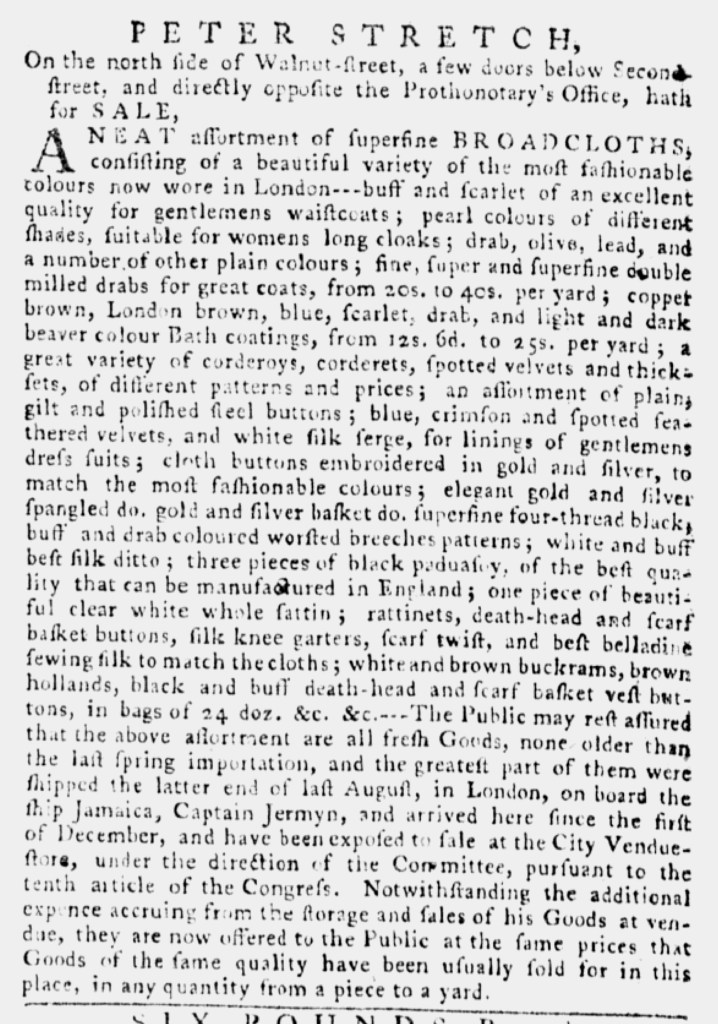
Pennsylvania Gazette (February 22, 1775).

“Goods … have been exposed to sale … under the direction of the Committee, pursuant to the tenth article of the Congress.”

Even as the imperial crisis intensified in February 1775, Peter Stretch expected that consumers in and near Philadelphia would respond to marketing appeals that connected the textiles and accessories that he imported and sold to current fashions in London.  Such had been the case for quite some time before the political situation became so troubled.  A transatlantic consumer revolution bound together England and the colonies in the eighteenth century, helping to fuel a process of Anglicization among subjects of the empire in British mainland North America.  When it came to advertising, it made sense to Stretch to open his notice in the February 22 edition of the Pennsylvania Gazette with a “NEAT assortment of superfine BROADCLOTHS, consisting of a beautiful variety of the most fashionable colours now wore in London.”

He anticipated such an appeal would resonate with prospective customers even with the Continental Association in effect.  The First Continental Congress enacted that nonimportation agreement in response to the Coercive Acts.  Yet Stretch acknowledged those circumstances as well.  He wanted consumers to know that he sold new merchandise rather than items that had lingered on the shelves or in the warehouse for years, so he assured readers that “the above assortment are all fresh Goods, one older than the last spring importation.”  He went into more detail, explaining that “the greatest part of them were shipped the latter end of last August, in London, on board the ship Jamaica, Captain Jermyn.”  That meant that his wares had been ordered and shipped before the First Continental Congress began its meetings in September and October 1774 and certainly before delegates devised the Continental Association.

However, the Jamaica “arrived here since the first of December,” the day the nonimportation agreement went into effect.  The tenth article made provisions for imports that arrived in December 1774 and January 1775, allowing merchants to refuse and return the goods, turn them over to a local committee to store while the pact remained in force, or entrust them to the committee to sell with the original costs returned to the importer and any profits designated to the relief of Boston where the harbor had been closed and blockaded since June 1774.  Stretch reported that he adhered to the Continental Association.  His wares “have been exposed to sale at the City Vendue-store, under the direction of the Committee, pursuant to the tenth article of the Congress.”  Having done its due diligence, the committee apparently returned items not sold at auction to Stretch, provided that he also observe the ninth article that prohibited price gouging or “tak[ing] Advantage of the Scarcity of Goods that may be occasioned by this Association.”  Stretch pledged that he offered his merchandise “at the same prices that Goods of the same quality have been usually sold for in this place.”  The merchant demonstrated to consumers that they could still acquire textiles “of the most fashionable colours now wore in London” without violating the Continental Association.

January 21

What was advertised in a colonial American newspaper 250 years ago today?

Providence Gazette (January 21, 1775).

“TO be Sold, by Order of the Committee of Inspection … sundry Merchandize.”

In December 1774 and January 1775, newspaper advertisements became records of compliance with the provisions of the Continental Association, a nonimportation, nonconsumption, and nonexportation agreement adopted by the First Continental Congress when it met in Philadelphia in September and October 1774.  The tenth article of the Continental Association made provisions for goods that arrived during the months December 1774 and January 1775, items that likely had been shipped before American merchants and shopkeepers could cancel orders previously dispatched across the Atlantic.  The importers could return those goods, turn them over to the local Committee of Inspection to store until the boycott ended, or have the committee sell them, reimburse the importer for costs, and designate any profits for relief of residents of Boston.  For the sake of both transparency and compliance, the tenth article also specified that “a particular Account [be] inserted in the publick Papers.”

Such was the case when James Angell, “Clerk of the Committee,” inserted an advertisement in the January 21, 1775, edition of the Providence Gazette.  That notice announced the upcoming sale of “sundry Merchandize, imported from Great Britain, via New-York.”  That included “6 Tierces [large barrels], 3 Barrels, 5 Bales, 2 Boxes, 1 Hamper, [and] 24 Crates” of unspecified goods as well as “1 Bundle, containing 2 Dozen of Frying Pans” and “8 Bundles, containing 4 Dozen of Iron Shovels.”  As was the case in similar advertisements in other newspapers, the Committee of Inspection did not provide the same extensive catalog of merchandise that merchants and shopkeepers often did to attract the attention of prospective customers when they composed their own newspaper notices.  The committee merely made clear that a notable quantity of items would go up for sale.  The goods “were shipped at Liverpool on board the Ship Daniel, Capt. Casey, the 15th of September, and arrived at New-York since the first Day of December last.”  That accounting made clear that the items had been ordered and shipped before the First Continental Congress agreed on the details of the Continental Association, yet since they arrived after that pact went into effect they fell under its jurisdiction.  On behalf of the Committee of Inspection, Angell decreed that the sale would occur “agreeable to the Association of the Continental Congress.”