March 14

What was advertised in a colonial American newspaper 250 years ago today?

Pennsylvania Evening Post (March 14, 1775).

“A FUND for establishing and carrying on an AMERICAN MANUFACTORY.”

The organizers of a “FUND for establishing and carrying on an AMERICAN MANUFACTORY, of LINEN, WOOLLEN,” and other textiles in Philadelphia and its hinterland called a meeting to rally support.  In an advertisement that first appeared in the March 11, 1775, edition of the Pennsylvania Evening Post, they announced that all “Subscribers” to that enterprise should meet “at the CARPENTERS HALL” on March 16 “to consider of a Plan for carrying the same into Execution.”  It was an especially appropriate place to meet considering that the organizers sought to put into effect one of the provisions of the Continental Association that the First Continental Congress had devised when the delegates held their meetings at Carpenters’ Hall in September and October 1774.  In addition to boycotting goods imported from Britain, the eighth article specified that colonizers should “encourage Frugality, Economy, and Industry; and promote Agriculture, Arts, and the Manufactures of this Country, especially that of Wool.”

Apparently, “general Proposals” had been printed and disseminated ahead of the meeting, perhaps by Benjamin Towne, the printer of the Pennsylvania Evening Post, or perhaps in the printing office operated by William Bradford and Thomas Bradford.  The notice stated that “one of the Subscription Papers [had been] left with WILLIAM BRADFORD, at the London Coffee-House.”  In addition, the Pennsylvania Journal, the newspaper printed by the Bradfords also carried the notice on the eve of the meeting.  No matter which printer produced the “Subscription Papers,” it was not too late for colonizers to sign their names and show their support for “this important and very interesting Undertaking” by becoming “Subscribers.”  They could visit the London Coffee House to add their names, but those who “may not have an Opportunity of Subscribing before the Day of meeting” could arrive early at Carpenters’ Hall to add their names.  For two hours before the meeting was scheduled to begin at three o’clock, some of the organizers would be present “for that Purpose.”  With subscription papers circulating, prospective supporters could examine who had already committed to the project.  That had the potential to inspire others to do so, provided colonizers actively engaged with printed materials that circulated in Philadelphia as the imperial crisis intensified.  Newspaper advertisements and subscription papers delivered news about the proposed “AMERICAN MANUFACTORY” that encouraged colonizers who encountered them to get involved by signing their names, attending meetings, and making donations.

March 8

What was advertised in a colonial American newspaper 250 years ago today?

Pennsylvania Gazette (March 8, 1775).

“The importation of Goods from Britain being stopped, obliges the said ACKEROYD to dispose of his stock on hand.”

With the Continental Association in effect throughout the colonies, John Ackeroyd decided that doing business in Philadelphia was no longer viable for him.  He concluded an advertisement in the March 8, 1775, edition of the Pennsylvania Gazette with a note that the “importation of Goods from Britain being stopped, obliges the said ACKEROYD to dispose of his stock on hand and return to England as soon as he can.”  To that end, he called on customers and associates to settle “all accounts past due to him.”  Ackeroyd did not reveal his own politics in his newspaper notice, but he made clear that he believed the Continental Association had a devastating effect on his business.  That he planned to return to England suggests that he may have favored the Tory perspective.

Whatever his views, Ackeroyd abided by the Continental Association, though he utilized a loophole to do so.  That nonimportation agreement went into effect on December 1.  Ackeroyd advertised that he sought to sell “the remainder of his GOODS, imported in the London Packet, Capt. Cook, from London.”  When the London Packet arrive in Philadelphia to deliver those goods?  The “INWARD ENTRIES” for the custom house in the December 12, 1774, edition of Dunlap’s Pennsylvania Packet included Cooke’s vessel.  That should have meant that importers had to refuse their shipments or surrender all goods aboard the London Packet to the local committee of inspection, according to the provisions of the tenth article of the Continental Association.  The entry, however, did not state that Cooke arrived from London.  Instead, it reported, “Ship London Packet, J. Cooke, Lewis on Del.”  The London Packet apparently landed the goods at Lewes, a town at the mouth of the Delaware Bay, before December 1 and then continued up the Delaware River to Philadelphia.  That technicality would have allowed Ackeroyd to accept and then sell “GOODS … from London” without involving the local committee of inspection.  Consumers may have embraced such cleverness … or found it violated the spirit of the Continental Association if not the letter of that pact.

March 4

What was advertised in a colonial American newspaper 250 years ago today?

Pennsylvania Evening Post (March 4, 1775).

“WATCH MAIN SPRINGS MADE in Philadelphia.”

The headline proclaimed, “WATCH MAIN SPRINGS.”  Matthia Eyre, “SPRING MAKER from London,” hoped that would draw attention to his advertisement in the March 4, 1775, edition of the Pennsylvania Evening Post.  He informed readers, especially “Watchmakers in this and the neighbouring Provinces,” that he sold spring he produced in the colonies at the house on Third Street in Philadelphia.  In addition, watchmaker John Wood also stocked Eyre’s watch springs at his shop on Front Street.

Eyre asserted that “Watchmakers and others may be supplied with any Quantity of Springs much cheaper than can be afforded when imported from England.”  The price in combination with the “good Quality of the Springs” prompted the “Manufacturer” to suggest that he merited the “Encouragement” of watchmakers who needed parts.  Eyre likely composed his advertisement with confidence that both prospective customers and the public would consider his appeals in the context of current events, including the nonimportation agreement currently in place to protest the Coercive Acts.

The First Continental Congress devised the Continental Association in the fall of 1774.  The first article of that pact prohibited importing “any such Goods, Wares, or Merchandise, as shall have been exported from Great Britain.”  The eighth article, in turn, called for “encourag[ing] Frugality, Economy, and Industry; and promot[ing] Agriculture, Arts, and the Manufactures of this Country.”  Eyre offered an alternative to the watch springs that colonizers were no longer supposed to import, making it easier for them to abide by the Continental Association.  They could do so without sacrificing the quality of the parts they used in their work.  In addition, they had a duty to support a local “Manufacturer” in those troubling times.

Yet those “Watchmakers in this and the neighbouring Provinces” were not the only colonizers who read Eyre’s advertisement.  The spring maker enhanced his reputation in his community while simultaneously providing an example of American industriousness that answered the challenges of that tense political moment.  Readers could hardly peruse Eyre’s notice without having the Continental Association in mind.  He signaled to them that he answered the call, one of many artisans prepared to serve the American cause through his efforts in his workshop.

March 1

What was advertised in a colonial American newspaper 250 years ago today?

Pennsylvania Journal (March 1, 1775).

“THE American Edition of Swan’s British Architect.”

Less than a year after arriving in Philadelphia from London, John Norman, an engraver, embarked on producing an “American Edition of Swan’s British Architect” in the spring of 1775.  He unveiled the project with an advertisement in the March 1 edition of the Pennsylvania Journal, advising the public that he was “Now PUBLISHING” the volume “by SUBSCRIPTION” and seeking supporters to reserve their copies.  He asked those who did so to make a deposit and pay the remainder “at the delivery of the book,” noting that the total price “is Ten Shillings less than the London edition.”

The Continental Association, a nonimportation, nonconsumption, and nonexportation agreement devised by the First Continental Congress in response to the Coercive Acts, was in effect at the time that Norman advertised his American edition of Swan’s British Architect.  His project adhered to the eighth article, which called for “promot[ing] Agriculture, Arts, and the Manufacturers of this Country,” while the subject matter, all sorts of architectural elements in fashion in England, suggested that colonizers continued to value transatlantic cultural ties and their identity as members of the British empire.  The dispute with Parliament had intensified, but most still hoped for a redress of grievances and return to amiable relations.

In addition to the newspaper advertisement, Norman printed more extensive “proposals, with a specimen of the plates and letter press,” that interested parties could view at his house.  Prospective subscribers could learn more about the project and assess the quality of the engravings before placing their orders.  To further entice them, Norman declared that the “names of the subscribers to this useful and ornamental work will be published.”  Just as disseminating subscription proposals was a common marketing strategy in eighteenth-century America, so was publishing the list of subscribers.  In other circumstances, the “gentlemen” who subscribed wanted to see their names alongside those of other genteel members of their community.  That was still the case for this book, yet they likely also wished to see their names in print as they for supporting for an American edition.  Norman offered an opportunity to simultaneously demonstrate their commitment to both the arts and the Continental Association.

February 22

What was advertised in a colonial American newspaper 250 years ago today?

Pennsylvania Gazette (February 22, 1775).

“Goods … have been exposed to sale … under the direction of the Committee, pursuant to the tenth article of the Congress.”

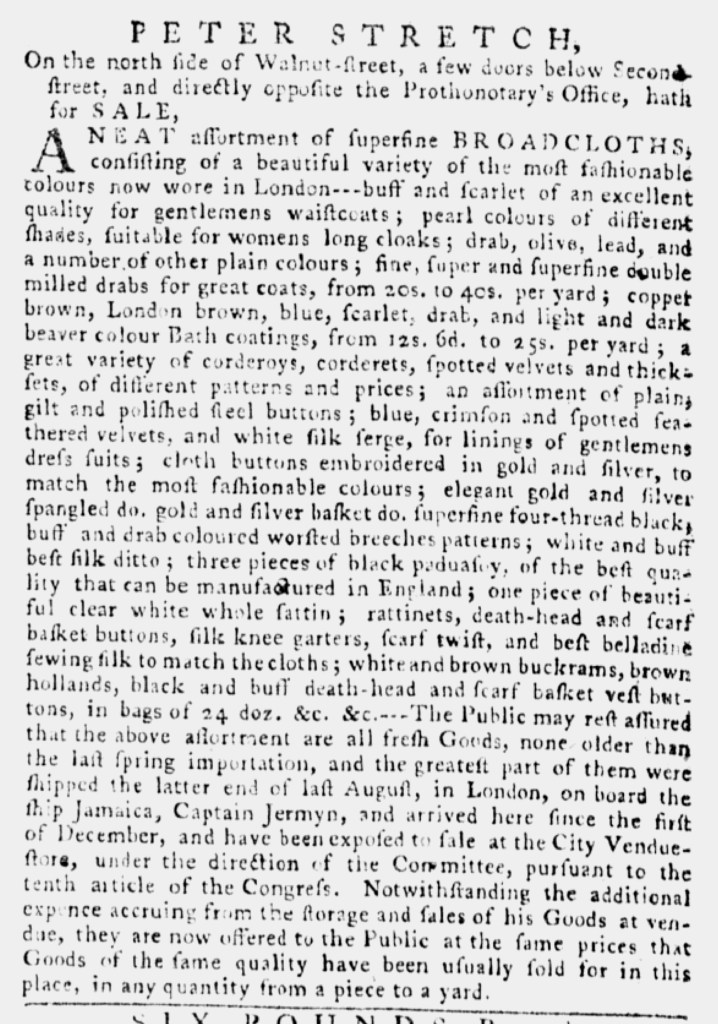
Even as the imperial crisis intensified in February 1775, Peter Stretch expected that consumers in and near Philadelphia would respond to marketing appeals that connected the textiles and accessories that he imported and sold to current fashions in London.  Such had been the case for quite some time before the political situation became so troubled.  A transatlantic consumer revolution bound together England and the colonies in the eighteenth century, helping to fuel a process of Anglicization among subjects of the empire in British mainland North America.  When it came to advertising, it made sense to Stretch to open his notice in the February 22 edition of the Pennsylvania Gazette with a “NEAT assortment of superfine BROADCLOTHS, consisting of a beautiful variety of the most fashionable colours now wore in London.”

He anticipated such an appeal would resonate with prospective customers even with the Continental Association in effect.  The First Continental Congress enacted that nonimportation agreement in response to the Coercive Acts.  Yet Stretch acknowledged those circumstances as well.  He wanted consumers to know that he sold new merchandise rather than items that had lingered on the shelves or in the warehouse for years, so he assured readers that “the above assortment are all fresh Goods, one older than the last spring importation.”  He went into more detail, explaining that “the greatest part of them were shipped the latter end of last August, in London, on board the ship Jamaica, Captain Jermyn.”  That meant that his wares had been ordered and shipped before the First Continental Congress began its meetings in September and October 1774 and certainly before delegates devised the Continental Association.

However, the Jamaica “arrived here since the first of December,” the day the nonimportation agreement went into effect.  The tenth article made provisions for imports that arrived in December 1774 and January 1775, allowing merchants to refuse and return the goods, turn them over to a local committee to store while the pact remained in force, or entrust them to the committee to sell with the original costs returned to the importer and any profits designated to the relief of Boston where the harbor had been closed and blockaded since June 1774.  Stretch reported that he adhered to the Continental Association.  His wares “have been exposed to sale at the City Vendue-store, under the direction of the Committee, pursuant to the tenth article of the Congress.”  Having done its due diligence, the committee apparently returned items not sold at auction to Stretch, provided that he also observe the ninth article that prohibited price gouging or “tak[ing] Advantage of the Scarcity of Goods that may be occasioned by this Association.”  Stretch pledged that he offered his merchandise “at the same prices that Goods of the same quality have been usually sold for in this place.”  The merchant demonstrated to consumers that they could still acquire textiles “of the most fashionable colours now wore in London” without violating the Continental Association.

February 21

What was advertised in a colonial American newspaper 250 years ago today?

Essex Gazette (February 21, 1775).

“GARDEN SEEDS.  Just imported … from LONDON.”

Each year the Adverts 250 Project chronicles the marketing efforts of women who sold garden seeds in Boston.  The appearance of their advertisements in the several newspapers published in that city heralded the changing of the seasons from winter to spring.  They participated in an annual ritual, not unlike printers who began advertising almanacs for the coming year each fall.  Their advertisements in the public prints signaled to readers that spring was indeed on its way.

Those advertisements sometimes appeared as early as the middle of February in years before the Continental Association went into effect on December 1, 1774.  The First Continental Congress devised that nonimportation agreement in response to the Coercive Acts.  By the end of the third week of February 1775, neither Susanna Renken, who was often the first to advertise garden seeds in the Boston press, nor any of her sister seed sellers published any advertisements.  In addition to the Continental Association constraining trade, the harbor had been closed to commerce because of the Boston Port Act since June 1, 1774.  In Salem, however, W.P. Bartlett advertised a “fresh Assortment of GARDEN SEEDS” in the February 21 edition of the Essex Gazette.

Bartlett reported that the seeds were “JUST IMPORTED, in the Venus, from LONDON.”  The “INWARD ENTRIES” from the custom house in the January 24 edition document the arrival of the Venus, establishing Bartlett received the shipment of seeds in the period between December 1, 1774, and February 1, 1775.  The tenth article of the Continental Association made provision for goods that arrived during that period, specifying that importers could refuse them, surrender them to the local Committee of Inspection to store while the nonimportation agreement remained in force, or transfer them to the committee to sell to recover the costs with any profits donated for the relief of Boston.

Some advertisements in the Essex Gazette and other newspapers indicated that importers opted for the third option, but other advertisements suggest that some disregarded the Continental Association.  In the same issue that carried Bartlett’s advertisement for garden seeds, Stephen Higginson hawked “English and India GOODS” that he “Just IMPORTED in the Venus … from London.”  That certainly defied the Continental Association.  What about the garden seeds that Bartlett peddled?  Did they deserve special consideration since they contributed to the “Frugality, Economy, and Industry” and promotion of “Agriculture, Arts, and the Manufactures of this Country” called for by the eighth article of the Continental Association?

February 17

What was advertised in a colonial American newspaper 250 years ago today?

Virginia Gazette [Purdie] (February 17, 1775).

“An encouragement for making COTTON and WOOL CARDS … in this colony.”

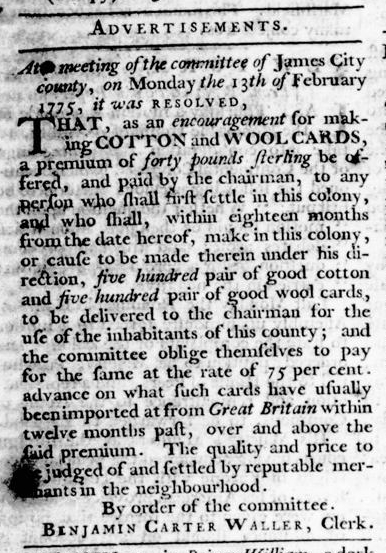
Residents of James City County took the Continental Association seriously, especially the eighth article.  When the First Continental Congress devised that nonimportation, nonconsumption, and nonexportation agreement in response to the Coercive Acts, they included an article that called for colonizers “in our several Stations, [to] encourage Frugality, Economy, and Industry; and promote Agriculture, Arts, and the Manufactures of this Country, especially that of Wool.”  In turn, the “committee of James City county” passed a resolution for the “encouragement for making COTTON and WOOL CARDS” at its meeting in February 1775.

Within days an advertisement appeared in Alexander Purdie’s Virginia Gazette and John Dixon and William Hunter’s Virginia Gazette to inform enterprising entrepreneurs that the committee offered “a premium of forty pounds sterling … to any person who shall first settle in this colony, and who shall, within eighteen months from the date hereof, make in this colony, or cause to be made therein under his direction, five hundred pair of good cotton and five hundred pair of good wool cards … for the use of the inhabitants of this county.”

Preparing wool and cotton for spinning involved separating and straightening the fibers using two cards or paddles with fine wire teeth.  That process made wool and cotton easier to spin; it also made the cards an essential tool for producing textiles as alternatives to imported fabrics.  While the committee assumed that men would make the cards, it would be women who used them.  That gave political meaning to the activities they undertook in carding, spinning, and weaving, just as women participated in politics when they refused to purchase imported cards, imported textiles, or any other imported goods.

Making cotton and wool cards in Virginia had the potential to be a profitable venture.  In addition to the premium, the committee offered a “75 per cent. advance on what such cards have usually been imported at from Great Britain within the twelve months past.”  In other words, the committee agreed to pay nearly twice what importers had recently paid for this important tool, another incentive for producing cards in the colony.

Supporters of the American cause had already mobilized in boycotting imported goods and producing alternatives.  This advertisement suggested one more means of contributing to those efforts, making cotton and wool cards in Virginia.  A successful venture would have ripple effects as women purchased those cards and used them in processing cotton and wool to produce homespun cloth rather than buying imported textiles.  The premium offered for making cotton and wool cards was part of a larger project with significant political implications.

February 13

What was advertised in a colonial American newspaper 250 years ago today?

Supplement to the New-York Gazette and Weekly Mercury (February 13, 1775).

“Orders for the West-Indies and elsewhere, compleated on the shortest notice.”

Samuel Prince, a cabinetmaker, produced furniture in his workshop “At the sign of the chest of drawers, in William-Street, near the North Church, in New-York” in the 1770s.  In February 1775, he took to the pages of the New-York Gazette and Weekly Mercury to promote a “parcel of the most elegant furniture, made of mahogany,” imported from the West Indies, “of the very best quality.”  In addition to the “chest of drawers, … desks and book cases of different sorts, [and] chairs of many different and new patterns” that he had on hand, Prince made “all sorts of cabinet work in the neatest manner, and on the lowest terms.”

While he certainly sought customers in New York, he also indicated that he accepted “Orders for the West-Indies and elsewhere” and shipped the furniture to his clients.  That Prince addressed prospective customers in the West Indies testified to the circulation of the New-York Gazette and Weekly Mercury and other colonial newspapers.  The cabinetmaker had a reasonable expectation that prospective customers in faraway places would see his advertisement.

Prince promised that he “completed” orders “on the shortest notice, an appeal with additional significance since the Continental Association went into effect.  Devised by the First Continental Congress, that nonimportation, nonconsumption, and nonexportation agreement was designed to use commerce as leverage for convincing Parliament to repeal the Coercive Acts.  The fourth article specified that the “earnest Desire we have not to injure our Fellow Subjects in Great Britain, Ireland, or the West Indies, induces us to suspend a Non-exportation until the tenth Day of September 1775.”  If Parliament did not take satisfactory action by that time, “we will not, directly or indirectly, export any Merchandise, or Commodity whatsoever, to Great Britain, Ireland, or the West Indies.”  In other words, Prince and prospective clients in the West Indies had a short window of opportunity for placing orders, producing the furniture, and shipping it.  Prince did not violate the provisions of the Continental Association, but he likely had that looming deadline in mind when he pledged to fill orders “on the shortest notice.”

February 1

What was advertised in a colonial American newspaper 250 years ago today?

Pennsylvania Journal (February 1, 1775).

“No advantage shall be taken on account of the troubles between Britain and America.”

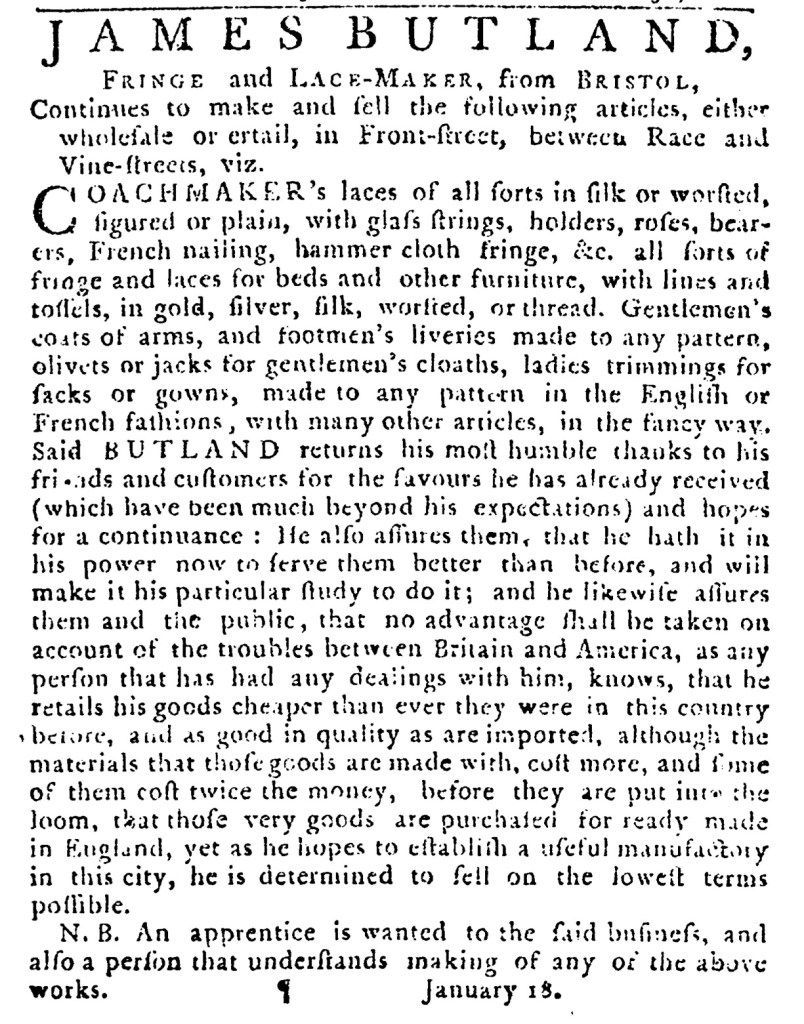
James Butland, a “FRINGE and LACE-MAKER, from BRISTOL,” set up shop in Philadelphia in the 1770s.  In an advertisement in the February 1, 1775, edition of the Pennsylvania Journal, he informed the public that he made and sold “COACHMAKER’s laces of all sorts in silk or worsted,” “all sorts of fringe and laces for beds and other furniture,” and other trimmings according to “any pattern in the English or French fashions.”

Colonizers observed the Continental Association, a nonimportation agreement enacted by the First Continental Congress in response to the Coercive Acts, at the time that Butland placed his advertisement.  Butland certainly had the Continental Association, in particular, and the imperial crisis, more generally, in mind when he made his pitch to prospective customers.  He made assurances to “the public, that no advantage shall be taken on account of the troubles between Britain and America.”  In other words, he would not raise prices on the fringe and lace he produced locally at a time that patriots refused to purchase imported goods.  Butland asserted that he had been in Philadelphia long enough that former customers knew his reputation on the matter: “any person that has had any dealings with him, knows, that he retails his goods cheaper than ever they were in this country before, and as good in quality as are imported.”  He did so even though “the materials that those goods are made with, cost more, and some of them twice the money, before they are put into the loom” compared to readymade alternatives from England.  That Butland offered such low prices under those circumstances suggested a significant markup on imported fringe and lace.

Butland did his part to satisfy consumers and to serve the American cause as the imperial crisis intensified.  Beyond his pledge not to gouge his customers with unreasonable prices during the boycott of imported goods, he sought to increase the inventory of locally produced fringes and laces available to them.  He planned “to establish a useful manufactory in this city,” vowing “to sell on the lowest terms possible.”  To that end, he sought an apprentice and an employee to assist him and aid in expanding his business.  As his advertisement made clear, Butland did his part as a producer to honor the Continental Association.  Readers now had a duty as consumers to do their part to support his endeavor.

January 29

What was advertised in a colonial American newspaper 250 years ago this week?

Massachusetts Spy (January 26, 1775).

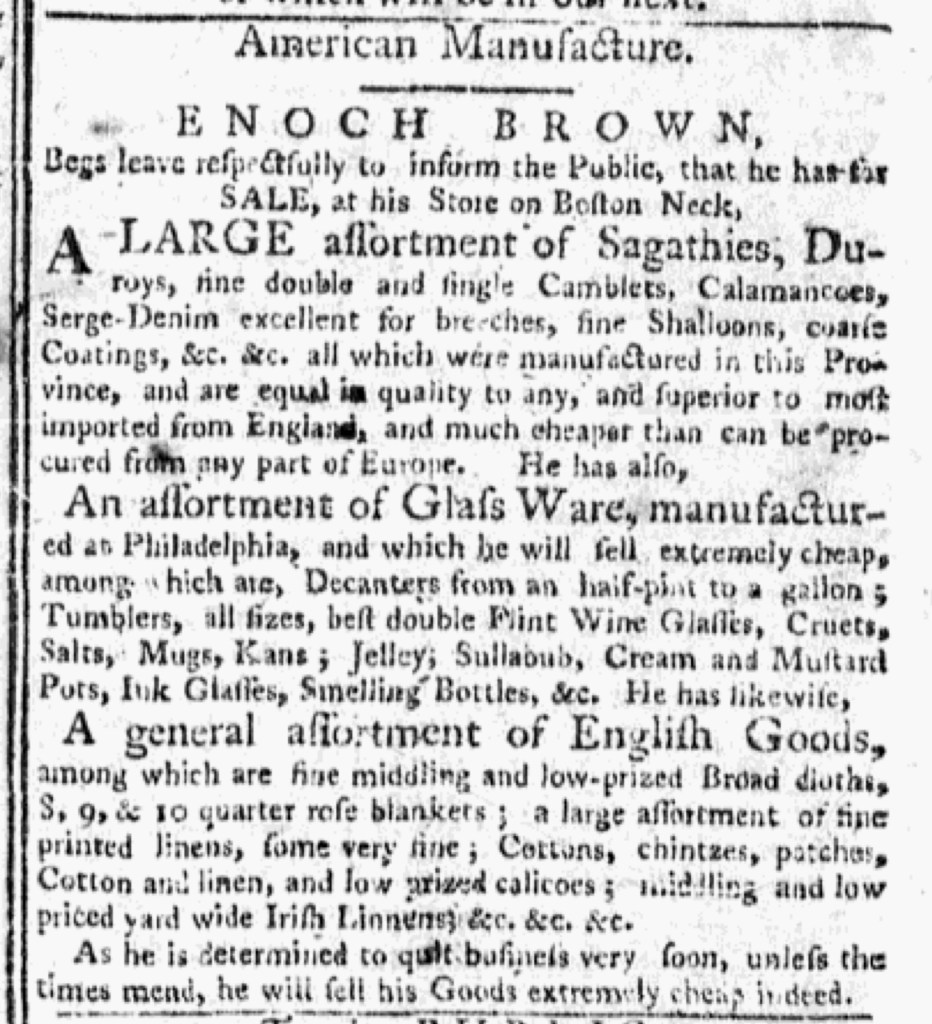
“American Manufacture.”

An advertisement in the January 26, 1775, edition of the Massachusetts Spy informed readers of “SUNDRY Goods, Wares and Merchandize Imported in the Brigantine Venus … from London” that would be “SOLD agreeable to The American Congress Association.”  That nonimportation agreement included provisions for selling goods imported between December 1, 1774, and February 1, 1775, yet it also called for encouraging “domestic manufactures” as alternatives to items acquired from Britain.

Enoch Brown emphasized such wares in his own advertisement in that same issue of the Massachusetts Spy.  The headline proclaimed, “American Manufacture.”  Brown reported that he stocked several kinds of textiles, a “LARGE assortment of Sagathies, Duroys, … Camblets, Calamancoes, Serge-Denim, [and] Shalloons … all which were manufactured in this Province.”  Like many other retailers who encouraged consumers to “Buy American” during the imperial crisis, Brown emphasized that his customers would not have to make sacrifices when it came to price or quality for the sake of abiding by their political principles.  These textiles, he insisted, “are equal in quality to any, and superior to most imported from England.”  In addition, customers could purchase them “much cheaper than can be procured from any part of Europe.”

Yet that was not the extent of Brown’s wares produced in the colonies.  He also stocked an “assortment of Glass Ware, manufactured at Philadelphia.”  Perhaps he stocked some of the “AMERICAN GLASS” advertised by John Elliott and Company in the Pennsylvania Journal just as the Continental Association went into effect at the beginning of December 1774.  Brown listed a variety of items, including decanters, wine glasses, and mustard pots, underscoring that “he will sell extremely cheap.”

Only after detailing products made in the colonies did Brown also mention a “general assortment of English Goods,” naming several textiles, such as “fine printed linens,” not included among those “manufactured in this Province.”  He likely attempted to liquidate inventory that had been on his shelves before the nonimportation agreement commenced, intending to “quite business very soon, unless the times mend.”  To that end, he vowed to “sell his Goods extremely cheap indeed.”  In the process, he gave priority to “American Manufacture” in his advertisement, directing readers to options that would allow them to be responsible consumers who did their part in support of the Continental Association and the American cause.