November 7

What was advertised in a revolutionary American newspaper 250 years ago today?
Pennsylvania Evening Post (November 7, 1775).

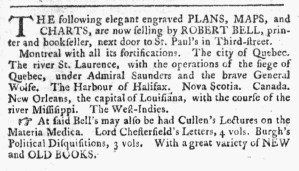
“MAPS … Montreal with all its fortifications.  The city of Quebec.”

Robert Bell, one of the most prominent American booksellers of the eighteenth century, also sold “PLANS, MAPS, and CHARTS” at his shop in Philadelphia.  In an advertisement in the November 7, 1775, edition of the Pennsylvania Evening Post, he promoted maps depicting “Montreal with all its fortifications.  The city of Quebec.  The river St. Laurence, with the operations of the siege of Quebec, under Admiral Saunders and the brave General Wolfe.  The Harbour of Halifax.  Nova Scotia.  Canada.  New Orleans, the capital of Louisiana, with the course of the river Mississippi.  [And] The West-Indies.”

Bell moved from north to south, generally, in listing the places depicted on the maps and charts that he stocked and sold, though he seemingly made a deliberate decision to list Montreal and Quebec before Halifax.  Current events likely influenced that choice.  For its first major military initiative, the Continental Army launched an invasion of Quebec in hopes of capturing the province and convincing its inhabitants to join the American cause.  That territory had been claimed by the French Empire for centuries, but only recently became part of the British Empire as part of the settlement that brought the Seven Years War to an end in 1763.  The Americans suspected that French speakers in Quebec had little loyalty to the British.

Two expeditions conducted a dual-pronged attack on the province.  In late August, an expedition authorized by the Second Continental Congress and commanded by General Richard Montgomery departed Fort Ticonderoga in New York, headed to Montreal.  Colonel Benedict Arnold, disappointed at being passed over to lead that expedition, convinced General George Washington to send another expedition to Quebec City.  Under Arnold’s command, that expedition departed Newburyport, Massachusetts, and made a harrowing journey up the Kennebec River.

At the time that Bell ran his advertisement, Montgomery’s expedition approached Montreal and Arnold’s expedition approached Quebec, though it would take some time for news to arrive in Philadelphia for readers of the Pennsylvania Evening Post.  Yet those readers did know that those expeditions were underway and that Montgomery began a siege of the town and fort of Saint-Jean in September.  Bell believed that some prospective customers were already interested in maps and plans of Montral and Quebec City and that he could incite demand among others by informing them of the items available at his shop.  The maps he sold supplement the news that colonizers read in the public prints.

October 18

What was advertised in a revolutionary American newspaper 250 years ago today?

Pennsylvania Journal (October 18, 1775).

“An Elegy to the memory of the American Volunteers who fell … April 19, 1775.”

During the era of the American Revolution, advertisements for almanacs frequently appeared in newspapers from New England to Georgia each fall.  Such was the case in the Pennsylvania Journal in 1775.  James Adams, a printer in Delaware, inserted a notice that announced that he “JUST PUBLISHED … The WILMINGTON and PENNSYLVANIA ALMANACKS, For the year of our LORD, 1776.”

Adams followed a familiar format for advertising almanacs.  He indicated that both editions included “the usual astronomical calculations” that readers would find in any almanac as well as a variety of other enticing contents.  The Pennsylvania edition included “Pithy Sayings” for entertainment and “Tables of Interest at six and seven per cent” for reference as well as the “Continuation of William Penn’s Advice to his Children” and the “Conclusion of Wisdom’s Call to the young of both sexes.”  Adams published a portion of those pieces in the almanac for the previous year, anticipating that readers would purchase the subsequent edition for access to the essays in their entirety.  The almanac for 1776 also suggested “Substitutes for Tea,” certainly timely considering that the Continental Association remained in effect. Colonizers sought alternatives while they boycotted imported tea.

Current events played an even more prominent role in the Wilmington Almanack.  It featured an “Elegy to the memory of the American Volunteers, who fell in the engagement between the Massachusetts-Bay Militia and the British Troops, April 19, 1775.”  Six months after the battles at Lexington and Concord, Adams memorialized the minutemen who had died for the American cause during the first battles of the Revolutionary War.  In addition, the almanac featured “The Irishman’s Epistle to the Officers and troops at Boston,” “Liberty-Tree,” and “A droll Dialogue between a fisherman of Poole, in England, and a countryman, relative to the trade of America, and proposed victory over the Americans.”  Adams did not elaborate on those items, perhaps intentionally.  Presenting the titles of the pieces without further elaboration was standard practice in advertisements for almanacs, but in this case the printer may have intended to stoke curiosity that would lead to more sales.  For both almanacs, a concern for current events and a burst of patriotism influenced the contents and their marketing.

October 5

What was advertised in a revolutionary American newspaper 250 years ago today?

Rivington’s New-York Gazetteer (October 5, 1775).

“THE Speeches of EDMUND BURKE, Esq; on American Taxation.”

James Rivington did not know it when he published the October 5, 1775, edition, nor did readers and the rest of the community, but he would soon discontinue printing Rivington’s New-York Gazetteer.  With hindsight, we know that less than two months later, on November 27, the Sons of Liberty would attack his printing office and destroy his press and type “because of his pronounced Tory sentiments.”[1]  It was not the first time.  His home and printing office had been attacked the previous May.  For a few weeks, he had sought refuge on a British ship in the harbor.  He had been hung in effigy.  After all that, the November 23, 1775, edition would be the last issue of Rivington’s New-York Gazetteer that he would print before departing for London.  The printer returned to New York in 1777, during the British occupation, and established Rivington’s New-York Loyal Gazette.  Today, historians consider it possible that Rivington spied on behalf of the American cause, but that would not have been public knowledge in the 1770s.

What was public knowledge was that the masthead of Rivington’s New-York Gazetteer featured the seal of Great Britain at a time when the mastheads for other newspapers did not have an image or chose some other device.  The “UNITE OR DIE” political cartoon depicting a severed snake, each segment representing a colony, even appeared in the masthead of the Pennsylvania Journal.  A few other newspapers did continue to include the seal of Great Britain in their masthead, but the printers did not have the same history of expressing positions that supported the officials considered enemies of American liberties.  Even with the seal of Great Britain in the masthead, the October 5, 1775, edition of Rivington’s New-York Gazetteer included an advertisement for “THE Speeches of EDMUND BURKE, Esq; on American Taxation, delivered April 19, 1774” and “His Speech on Moving his Resolutions of Conciliation with the Colonies, March 22d, 1775.”  Rivington printed and sold both speeches by a member of Parliament considered a friend to America.  The printer had a history of marketing “pamphlets on the Whig and Tory side” of “The American Controversy” and arguing for freedom of the press when it came to the contents of his newspaper and other items he printed and sold.  After the battles at Lexington and Concord, however, he discontinued advertising pamphlets that expressed the Tory perspective.  The advertisement for Burke’s speeches, pamphlets that he printed as well as promoted, starkly presented only one side of “THE AMERICAN CONTEST.”  Rivington seemingly changed his advertising strategy as the political situation in the colonies intensified once hostilities commenced in Massachusetts.

**********

[1] Clarence S. Brigham, History and Bibliography of American Newspapers, 1690-1820 (Worcester: American Antiquarian Society, 1947), 686.

September 28

What was advertised in a revolutionary American newspaper 250 years ago today?

New-York Journal (September 28, 1775).

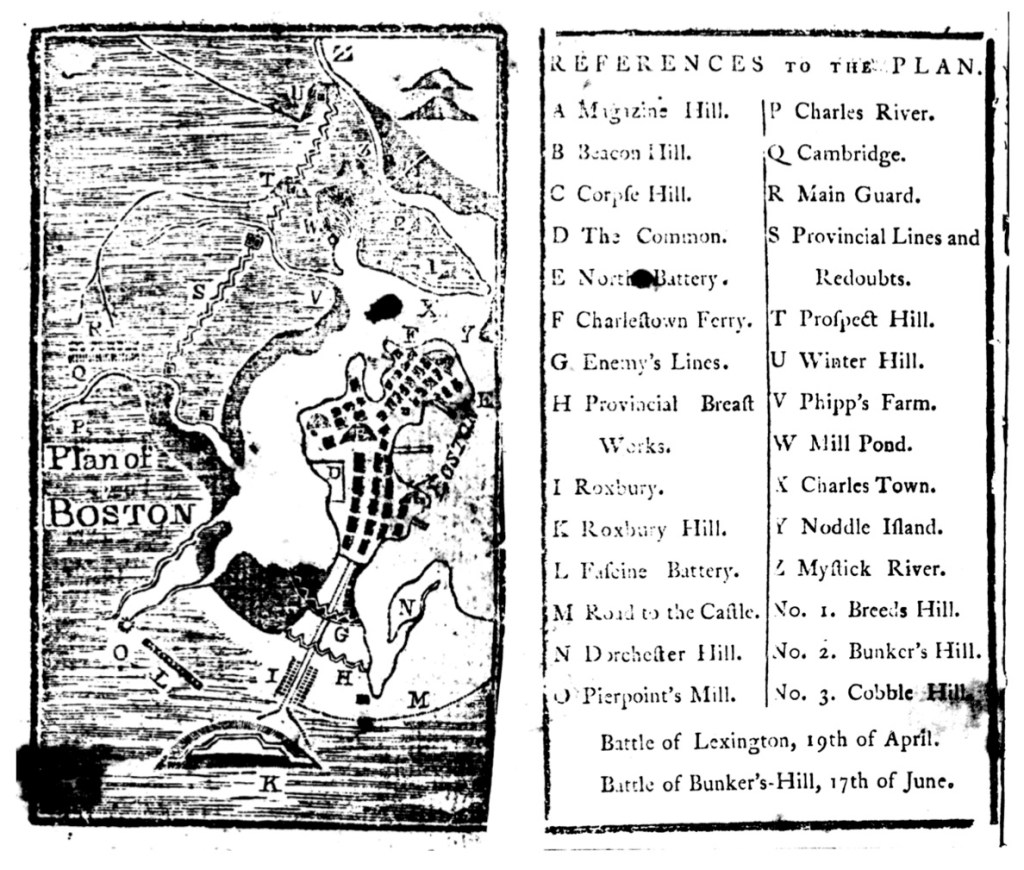
“The Words of Command used in the Manual Exercise, and an accurate Plan of Boston.”

Almost simultaneously with Hugh Gaine announcing in the New-York Gazette and Weekly Mercury that he had “Just PUBLISHED … HUTCHIN’s Improv’d; BEING AN ALMANACK … For the Year of our LORD 1776,” Frederick Shober and Samuel Loudon inserted an advertisement in the New-York Journal to alert the public that they had “Just published … The NEW-YORK and COUNTRY ALMANACK, For the Year of our Lord 1776.”  It included “all the necessary Articles usual in an Almanac, with the Addition of many curious Anecdotes, Receipts [or Recipes], [and] poetical Pieces.”  Unlike Gaine, Shober and Loudon did not provide an extensive list of the contents.  As printer of the New-York Gazette and Weekly Mercury, Gaine had access to as much space as he wished to devote to promoting an almanac he published.  Shober and Loudon, on the other hand, paid to run their advertisement in the New-York Journal.

The partners did, however, specify two items that they wanted prospective customers to know they would find in the New-York and Country Almanack: “the Words of Command used in the Manual Exercise, and an accurate Plan of Boston with the different Situations of the Provincials, and the Ministerial Armies.”  Both reflected current events.  The “REFERENCES TO THE PLAN” (or legend for the map of Boston) in the almanac highlighted the “Battle of Lexington, 19th of April,” and the “Battle of Bunker’s-Hill, 17th of June.”  For readers beyond Massachusetts who did not directly experience those battles, that helped solidify in their minds the dates that they occurred.  By the time that Shober and Loudon took their almanac to press, maps of Boston had circulated widely in the July issue of the Pennsylvania Magazine (and Loudon had been among the booksellers to advertise them).  Nicholas Brooks and Bernard Romans also collaborated on a map that they likely distributed by the end of summer.  Those may have served as models for the “Plan of Boston” that Sober and Loudon commissioned for their almanac.  Gaine also directed attention to the “beautiful Plan of Boston, and the Provincial Camp” in his almanac.  The “whole Process of making SALT PETRE, recommended by the Hon. the Continental Congress” and a “Method of making Gun-Powder” accompanied their map.  In Shober and Loudon’s almanac, the “Words of Command,” taken from the widely published Manual Exercise, supplemented the map.  In both cases, the events of the Revolutionary War inspired the contents of the almanacs and became selling points in marketing them.

“Plan of Boston” [left] and “References to the Plan” [right], in The New-York and Country Almanack for the Year of Our Lord 1776 (New York: Shober and Loudon, 1775). Courtesy American Antiquarian Society.

July 12

What was advertised in a revolutionary American newspaper 250 years ago today?

Pennsylvania Gazette (July 12, 1775).

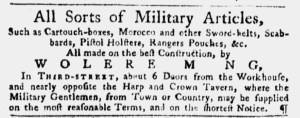
“All Sorts of Military Articles.”

It was a sign of the times.  The headline for Wolere Ming’s advertisement in the July 12, 1775, edition of the Pennsylvania Gazette proclaimed, “All Sorts of Military Articles.”  The brief notice listed some of the items the merchant stocked, such as “Cartouch-boxes [for carrying cartridges], Morocco and other Sword-belts, Scabbards, Pistol Holsters, [and] Rangers Pouches.”  Hostilities had commenced with the battles of Lexington and Concord less than three months earlier, followed by the siege of Boston and the Battle of Bunker Hill.  The Second Continental Congress convened in Philadelphia, appointed George Washington of Virginia as commander of the Continent Army, and dispatched him to Massachusetts.  Colonizers in New England, New York, Pennsylvania, and elsewhere mobilized as they followed the news, some of them heading to Massachusetts to lend their support and others preparing to defend their communities.

Responding to current events meant new opportunities for colonial entrepreneurs.  For instance, Charles Oliver Bruff, a goldsmith and jeweler in New York, advised “gentlemen who are forming themselves into companies in defence of their liberties” that they could purchase swords of various sorts at this shop in May 1775.  In Philadelphia, those seeking to outfit themselves for military service could do so very well at Ming’s shop “nearly opposite the Harp and Crown Tavern” where they selected among items “made on the best Construction” available “on the shortest Notice.”  Ming addressed a particular kind of consumer, the “Military Gentlemen, from Town or Country,” as he sought to leverage current events to establish revenue streams.  The headline for his advertisement played an important role in attracting the attention of prospective customers, especially considering that most newspaper advertisements did not have headlines of any sort.  Only one other in the issue of the Pennsylvania Gazette that carried Ming’s advertisement featured a headline that mentioned goods offered for sale, Thomas McGlathry’s notice for “IRISH LINENS, of various Prices.”  Merchants and shopkeepers who had been restrained by the Continental Association, a nonimportation agreement, since December 1774 now faced new circumstances that they could make work to their benefit if they shifted their marketing strategies accordingly.

July 8

What was advertised in a revolutionary American newspaper 250 years ago today?

Pennsylvania Evening Post (July 8, 1775).

“A SELF DEFENSIVE WAR lawful, Proved in a SERMON … before Captain Ross’s company of militia.”

An advertisement in the July 8, 1775, edition of the Pennsylvania Evening Post promoted a forthcoming pamphlet that would certainly be of interest to readers in Philadelphia and beyond.  John Dean, a bookbinder who ran a shop in Laetitia Court, aimed to encourage anticipation for “A SELF DEFENSIVE WAR lawful, Proved in a SERMON … By the Rev. JOHN CARMICHAEL.”  The pamphlet would soon be available for purchase since it was “in the press, and will be published in a few days.”  The advertisement suggested that Dean collaborated with Carmichael on the project.

Dean gave more details about both the origins and the physical attributes of the pamphlet.  Carmichael gave the sermon “at Lancaster, before Captain Ross’s company of militia, in the Presbyterian church on Sabbath morning, June 4th, 1775.”  By then, word of the battles at Lexington and Concord and the siege of Boston had reached the town of Lancaster.  One local militia company apparently appreciated the sermon so much that they wanted copies distributed more widely.  Perhaps some thought that they would purchase their own copies to review at their leisure or even consult it as a means of better rehearsing Carmichael’s arguments and evidence when they needed to explain why they believed a “self defensive war” was indeed lawful.  Francis Bailey, a printer in Lancaster, printed Carmichael’s sermon “for Captain Ross’s Company of Militia,” according to the imprint, and “at the request of said Company,” according to the subtitle.  The new edition, printed in Philadelphia, was “published at the request of the Author, and corrected by himself from the copy printed at Lancaster.”  In addition to being a more accurate rendering of the sermon, the Philadelphia edition would be “Printed on a good paper and type, octavo size.”

Dean and Carmichael envisioned a more extensive audience for the sermon than the Lancaster edition reached.  The advertisement stated that it was “Humbly offered to the perusal of the MILITARY ASSOCIATORS of the city, liberties and county of Philadelphia.”  The bookbinder-publisher and the author hoped to leverage patriotism and current events to sell more copies of the sermon, though they likely also wished to contribute to public discourse about whether military action was justified as the imperial crisis escalated and became a war.  Carmichael’s dedication in the Lancaster edition highlighted another purpose: “TO all the brave SONS of LIBERTY in North-America, but in particular, to the Company of MILITIA in the Borough of Lancaster, known by the name of ROSS’S COMPANY.”  The same dedication appeared in the Philadelphia edition, honoring all the “Officer and Soldiers” who defended American liberties throughout the colonies, especially the local men who did so.

July 7

What was advertised in a revolutionary American newspaper 250 years ago today?

North-Carolina Gazette (July 7, 1775).

“EXTRACTS from the Votes and Proceedings of the AMERICAN CONTINENTAL CONGRESS.”

When they perused the July 7, 1775, edition of the North-Carolina Gazette, readers encountered an advertisement that proclaimed, “JUST PUBLISHED, And to be sold at the Printing Office … EXTRACTS from the Votes and Proceedings of the AMERICAN CONTINENTAL CONGRESS, held at Philadelphia, on the Fifth Day of September, 1774.”  The Extracts, however, were not “JUST PUBLISHED,” though James Davis certainly had them for sale at the printing office in New Bern.  The Adverts 250 Project previously featured this advertisement’s appearance in the April 7, 1775, edition of the North-Carolina Gazette.  Few issues of that newspaper survive, preventing a complete reconstruction of when the advertisement ran.  Only seven issues, all from 1775, are available via America’s Historical Newspapers, the most comprehensive database of digitized eighteenth-century newspaper.  Davis’s advertisement for the Extracts did not run on March 24, but appeared on April 7, May 5, and May 12.  It was not in the June 30 issue, yet it returned for the July 7 and July 14 issues.

It is not clear how often the advertisement ran between May 12 and June 30, but Davis did not insert it in the issue immediately before the one that delivered several important updates that might have influenced him to believe that readers who had not yet purchased the Extracts would have increased interest in the “Bill of Rights, a List of Grievance, Occasional Resolves,” and “General Gage’s Answer to the Letter sent him by the General Congress.”  The Extractsdocumented the meeting of the First Continental Congress in the fall of 1774.  When the advertisement ran on July 7, 1775, the Second Continental Congress had been meeting for nearly two months.  That issue included an update that “By Letters from the Congress of the 19th of June, we are informed, that Col. Washington, of Virginia, is appointed General and Commander in Chief of all the American Forces.”  It also delivered news of the Battle of Bunker Hill, acknowledging that the account received in the printing office was “very imperfect, and must leave us in Suspence till a further Account of this most momentous Affair arrives.”  Indeed, that “imperfect” account inaccurately claimed that “General Burgoyne fell … and was interred in Boston with great Funeral Pomp.”  As he sorted through newspapers and letters arriving from the north, Davis apparently believed that the news he selected for publication would spark new interest in his remaining copies of the Extracts from the First Continental Congress.

As had been the case in the April 7 edition, that advertisement ran alongside another that described an enslaved man who liberated himself by running away from his enslaver.  In this instance, “a Negro Slave … named JEM,” was a fugitive from slavery who might have been “harboured or kept out by his Wife, named Rachel.”  James Biggleston, Jem’s enslaver, suspected that Jem was “lurking in the Neighborhood” of the plantation where Rachel was enslaved. Biggleston offered a reward for the capture and return of Jem in a nota bene at the end of the advertisement, though the main body of the notice consisted of a warrant signed by “Two of his Majesty’s Justices of the Peace” that authorized that “if the said Jem doth not surrender himself, and return home immediately … that any Person or Persons may kill and destroy the said Slave … without Impeachment or Accusation of any Crime or Offence … or without incurring any Penalty.”  Most readers of the North-Carolina Gazette and other newspapers compartmentalized the contents of those publications.  They did so to such an extent that the juxtaposition of colonizers demanding freedom from oppression and enslaved people seeking liberty did not register as a contradiction.

December 31

What was advertised in a colonial American newspaper 250 years ago today?

Providence Gazette (December 31, 1774).

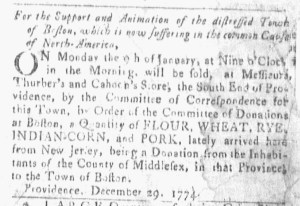
For the Support … of the distressed Town of Boston … suffering in the common Cause of North-America.”

As 1774 ended, readers of the Providence Gazette contemplated how they could aid the town of Boston where the harbor had been closed to commerce for seven months.  The Boston Port Act went into effect on June 1, retribution for the Boston Tea Party.  In turn, that inspired a variety of responses, including the meetings of the First Continental Congress in Philadelphia in September and October and the formation of relief efforts for Boston.  Local committees throughout the colonies started subscriptions for collecting food to send to the town, as Bob Ruppert documents in “The Winter of 1774-1775 in Boston.”

An advertisement in the December 31, 1774, edition of the Providence Gazette announced an upcoming sale of a “Quantity of FLOUR, WHEAT, RYE, INDIAN-CORN, and PORK” that would be held “For the Support and Animation of the distressed town of Boston, which is now suffering in the common Cause of North-America.”  Although Parliament aimed the Boston Port Act, the Massachusetts Government Act, and the other Coercive Acts at agitators in Massachusetts, that legislation prompted a unified response, a sense of a “common Cause” as other colonies realized that Parliament could just as easily target them.  The shipment of grains and pork that arrived in Providence came from New Jersey, “a Donation … to the Town of Boston.”  According to the advertisement, the Committee of Correspondence in Boston instructed the Committee of Correspondence in Providence to sell the grains and pork to raise funds rather than attempt to transport them to Boston.

John Carter, the printer of the Providence Gazette, gave that advertisement a privileged place both times that it ran in his newspaper.  The first time that it appeared, he inserted it immediately after local news and before other advertisements.  Readers likely experienced it as a continuation of news related to the imperial crisis, including updates about other “Donations … to the Town of Boston.”  When the advertisement ran a week later, two days before the sale, it was the first item in the first column on the first page, making it nearly impossible for readers to miss.  Through the choices he made about the layout of his newspaper, the printer made his own contribution in support of the “common Cause of North-America.”

December 4

What was advertised in a colonial American newspaper 250 years ago this week?

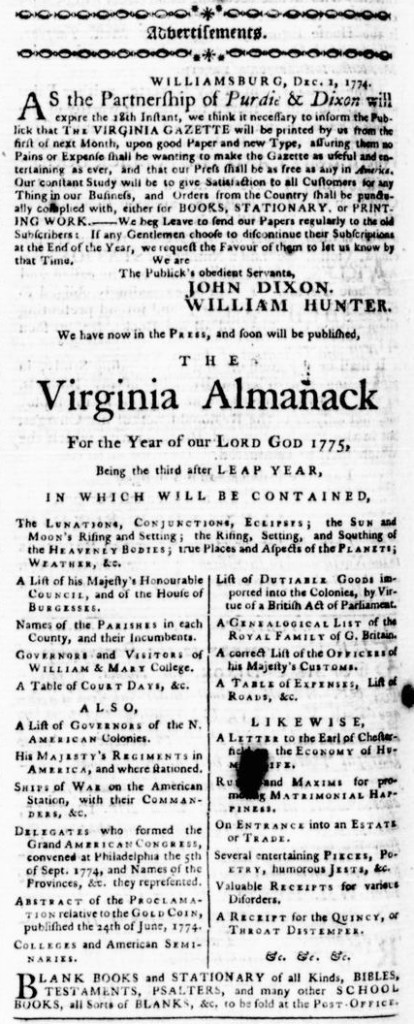
Virginia Gazette [Purdie and Dixon] (December 1, 1774).

“Our Press shall be as free as any in America.”

The first page of the December 1, 1774, edition of the Virginia Gazette featured two notices about the future endeavors of the partners who printed that newspaper.  In the first, Alexander Purdie announced his withdrawal from that partnership and outlined his plans to publish another newspaper on his own as soon as he garnered enough subscribers to make it a viable venture.  In the other, John Dixon expressed his appreciation for customers who had supported the partnership and revealed that he would continue to publish the Virginia Gazette with a new partner, William Hunter.

Although those were the only advertisements on the first page, they were not the only advertisements in that issue, nor the end of the notices inserted by the printers.  The remainder of the advertisements appeared after news and essays, commencing in the final column of the second page.  A notice placed by Dixon and Hunter led those advertisements, making clear that the new partnership would actively serve current and prospective customers.  They asserted that their newspaper “will be printed … upon good Paper and new Type.”  Beyond that investment that would benefit readers, Dixon and Hunter pledged that “no Pains or Expense shall be wanting to make this Gazette as useful and entertaining as ever.”  In other words, the newspaper would maintain the same quality that readers expected when the new management went into place.  Furthermore, they proclaimed that “our Press shall be as free as any in America.”  They hoped that would convince customers to continue their patronage, yet did not make assumptions.  “We beg Leave,” they declared, “to send put Papers regularly to the old Subscribers,” but recognized that some might not wish to renew.”  “If any Gentlemen choose to discontinue their Subscriptions at the end of the Year,” they instructed, “we request the Favour of them to let us know by that Time.”  The new partners also promoted other branches of their business, offering “BOOKS, STATIONARY, or PRINTING WORK” to residents of Williamsburg who visited their shop and customers in the country who sent orders.

That, however, did not conclude their advertisement.  Instead, Dixon and Hunter alerted readers that they would soon publish “THE Virginia Almanack For the Year of our LORD GOD 1775.”  The list of contents, intended to entice prospective customers, occupied more space than their announcement about upcoming changes in the partnership.  It contained the usual astronomical data and a selection of informative and “entertaining PIECES” along with several items related to current events.  Those included a list of “DELEGATES who formed the Grand AMERICAN CONGRESS convened at Philadelphia the 5th of Sept, 1774, and Names of the Provinces, &c. they represented,” a “List of DUTIABLE GOODS imported into the Colonies, by Virtue of a British Act of Parliament,” “His MAJESTY’S REGIMENT in AMERICA, and where stationed,” and “SHIPS of WAR on the American Station, with their COMMANDERS.”  The imperial crisis loomed large among the materials selected for inclusion in Dixon and Hunter’s almanac.  Before they began publishing the Virginia Gazette together, they disseminated information about the troubled relationship between the colonies and Britain in an almanac that customers would consult throughout the entire year of 1775.

November 25

What was advertised in a colonial American newspaper 250 years ago today?

South-Carolina and American General Gazette (November 25, 1774).

“EXTRACTS from the VOTES and PROCEEDINGS of the AMERICAN CONTINENTAL CONGRESS.”

As soon as the First Continental Congress adjourned near the end of October 1774, printers set about publishing, advertising, and selling “EXTRACTS from the VOTES and PROCEEDINGS of the AMERICAN CONTINENTAL CONGRESS, held at Philadelphia.”  William Bradford and Thomas Bradford, printers of the Pennsylvania Journal, were the first to advertise this political pamphlet, but other printers soon advertised that they produced local editions in their own towns, helping to disseminate the news far and wide.  Conveniently packaging “The BILL of RIGHTS, A List of GRIEVANCES, Occasional RESOLVES, The ASSOCIATION, An ADDRESS to the PEOPLE of GREAT-BRITAIN, and A MEMORIAL to the INHABITANTS of the BRITISH AMERICAN COLONIES” in one volume, this pamphlet supplemented coverage in newspapers.  Its format allowed for easier reference than saving and scouring issue after issue of newspapers that relayed some but not all the contents of the Extracts.  The pamphlet met with such demand that some printers quickly printed second editions.  In the November 24 edition of the Norwich Packet, for instance, Alexander Robertson, James Robertson, and John Trumbull advertised the “second Norwich EDITION” of the Extracts.

The Adverts 250 Project has examined the publication and dissemination of the Extracts in Pennsylvania, the neighboring colonies of Maryland and New York, and multiple towns in New England.  It took a little longer for printers in southern colonies to publish the pamphlet, but within a month of the First Continental Congress finishing its business Robert Wells, the printer of the South-Carolina and American General Gazette, advised readers that they could purchase the Extracts at his “GREAT STATIONARY & BOOK STORE.”  Unlike other printers who ran separate advertisements for the pamphlet, Wells included it among a list of half a dozen titles he sold.  He gave it a privileged place, first on the list, acknowledging its importance and likely interest among readers.  The other items included a couple of novels and a history of Ireland, but Wells concluded the list with “OBSERVATIONS on the Act of Parliament commonly called The Boston Port Bill, With Thoughts on Civil Society and Standing Armies.  By JOSIAH QUINCY, junior, Esq.”  Among the many volumes available at his bookstore, Wells chose to emphasize two concerning current events as the imperial crisis intensified.  Like so many other printers, he marketed items that supplemented the news he published in his newspaper.