July 7

What was advertised in a revolutionary American newspaper 250 years ago today?

North-Carolina Gazette (July 7, 1775).

“EXTRACTS from the Votes and Proceedings of the AMERICAN CONTINENTAL CONGRESS.”

When they perused the July 7, 1775, edition of the North-Carolina Gazette, readers encountered an advertisement that proclaimed, “JUST PUBLISHED, And to be sold at the Printing Office … EXTRACTS from the Votes and Proceedings of the AMERICAN CONTINENTAL CONGRESS, held at Philadelphia, on the Fifth Day of September, 1774.”  The Extracts, however, were not “JUST PUBLISHED,” though James Davis certainly had them for sale at the printing office in New Bern.  The Adverts 250 Project previously featured this advertisement’s appearance in the April 7, 1775, edition of the North-Carolina Gazette.  Few issues of that newspaper survive, preventing a complete reconstruction of when the advertisement ran.  Only seven issues, all from 1775, are available via America’s Historical Newspapers, the most comprehensive database of digitized eighteenth-century newspaper.  Davis’s advertisement for the Extracts did not run on March 24, but appeared on April 7, May 5, and May 12.  It was not in the June 30 issue, yet it returned for the July 7 and July 14 issues.

It is not clear how often the advertisement ran between May 12 and June 30, but Davis did not insert it in the issue immediately before the one that delivered several important updates that might have influenced him to believe that readers who had not yet purchased the Extracts would have increased interest in the “Bill of Rights, a List of Grievance, Occasional Resolves,” and “General Gage’s Answer to the Letter sent him by the General Congress.”  The Extractsdocumented the meeting of the First Continental Congress in the fall of 1774.  When the advertisement ran on July 7, 1775, the Second Continental Congress had been meeting for nearly two months.  That issue included an update that “By Letters from the Congress of the 19th of June, we are informed, that Col. Washington, of Virginia, is appointed General and Commander in Chief of all the American Forces.”  It also delivered news of the Battle of Bunker Hill, acknowledging that the account received in the printing office was “very imperfect, and must leave us in Suspence till a further Account of this most momentous Affair arrives.”  Indeed, that “imperfect” account inaccurately claimed that “General Burgoyne fell … and was interred in Boston with great Funeral Pomp.”  As he sorted through newspapers and letters arriving from the north, Davis apparently believed that the news he selected for publication would spark new interest in his remaining copies of the Extracts from the First Continental Congress.

As had been the case in the April 7 edition, that advertisement ran alongside another that described an enslaved man who liberated himself by running away from his enslaver.  In this instance, “a Negro Slave … named JEM,” was a fugitive from slavery who might have been “harboured or kept out by his Wife, named Rachel.”  James Biggleston, Jem’s enslaver, suspected that Jem was “lurking in the Neighborhood” of the plantation where Rachel was enslaved. Biggleston offered a reward for the capture and return of Jem in a nota bene at the end of the advertisement, though the main body of the notice consisted of a warrant signed by “Two of his Majesty’s Justices of the Peace” that authorized that “if the said Jem doth not surrender himself, and return home immediately … that any Person or Persons may kill and destroy the said Slave … without Impeachment or Accusation of any Crime or Offence … or without incurring any Penalty.”  Most readers of the North-Carolina Gazette and other newspapers compartmentalized the contents of those publications.  They did so to such an extent that the juxtaposition of colonizers demanding freedom from oppression and enslaved people seeking liberty did not register as a contradiction.
December 31

What was advertised in a colonial American newspaper 250 years ago today?

Providence Gazette (December 31, 1774).

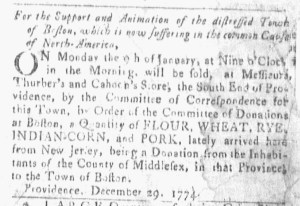
For the Support … of the distressed Town of Boston … suffering in the common Cause of North-America.”

As 1774 ended, readers of the Providence Gazette contemplated how they could aid the town of Boston where the harbor had been closed to commerce for seven months.  The Boston Port Act went into effect on June 1, retribution for the Boston Tea Party.  In turn, that inspired a variety of responses, including the meetings of the First Continental Congress in Philadelphia in September and October and the formation of relief efforts for Boston.  Local committees throughout the colonies started subscriptions for collecting food to send to the town, as Bob Ruppert documents in “The Winter of 1774-1775 in Boston.”

An advertisement in the December 31, 1774, edition of the Providence Gazette announced an upcoming sale of a “Quantity of FLOUR, WHEAT, RYE, INDIAN-CORN, and PORK” that would be held “For the Support and Animation of the distressed town of Boston, which is now suffering in the common Cause of North-America.”  Although Parliament aimed the Boston Port Act, the Massachusetts Government Act, and the other Coercive Acts at agitators in Massachusetts, that legislation prompted a unified response, a sense of a “common Cause” as other colonies realized that Parliament could just as easily target them.  The shipment of grains and pork that arrived in Providence came from New Jersey, “a Donation … to the Town of Boston.”  According to the advertisement, the Committee of Correspondence in Boston instructed the Committee of Correspondence in Providence to sell the grains and pork to raise funds rather than attempt to transport them to Boston.

John Carter, the printer of the Providence Gazette, gave that advertisement a privileged place both times that it ran in his newspaper.  The first time that it appeared, he inserted it immediately after local news and before other advertisements.  Readers likely experienced it as a continuation of news related to the imperial crisis, including updates about other “Donations … to the Town of Boston.”  When the advertisement ran a week later, two days before the sale, it was the first item in the first column on the first page, making it nearly impossible for readers to miss.  Through the choices he made about the layout of his newspaper, the printer made his own contribution in support of the “common Cause of North-America.”

December 4

What was advertised in a colonial American newspaper 250 years ago this week?

Virginia Gazette [Purdie and Dixon] (December 1, 1774).

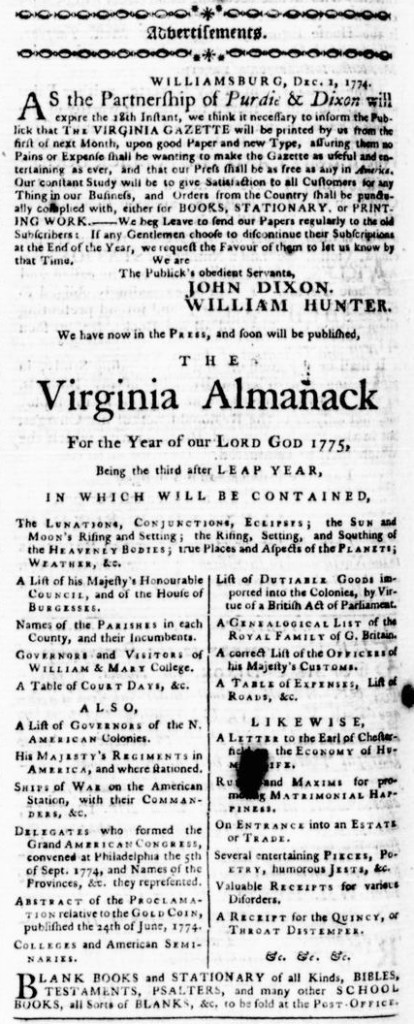
“Our Press shall be as free as any in America.”

The first page of the December 1, 1774, edition of the Virginia Gazette featured two notices about the future endeavors of the partners who printed that newspaper.  In the first, Alexander Purdie announced his withdrawal from that partnership and outlined his plans to publish another newspaper on his own as soon as he garnered enough subscribers to make it a viable venture.  In the other, John Dixon expressed his appreciation for customers who had supported the partnership and revealed that he would continue to publish the Virginia Gazette with a new partner, William Hunter.

Although those were the only advertisements on the first page, they were not the only advertisements in that issue, nor the end of the notices inserted by the printers.  The remainder of the advertisements appeared after news and essays, commencing in the final column of the second page.  A notice placed by Dixon and Hunter led those advertisements, making clear that the new partnership would actively serve current and prospective customers.  They asserted that their newspaper “will be printed … upon good Paper and new Type.”  Beyond that investment that would benefit readers, Dixon and Hunter pledged that “no Pains or Expense shall be wanting to make this Gazette as useful and entertaining as ever.”  In other words, the newspaper would maintain the same quality that readers expected when the new management went into place.  Furthermore, they proclaimed that “our Press shall be as free as any in America.”  They hoped that would convince customers to continue their patronage, yet did not make assumptions.  “We beg Leave,” they declared, “to send put Papers regularly to the old Subscribers,” but recognized that some might not wish to renew.”  “If any Gentlemen choose to discontinue their Subscriptions at the end of the Year,” they instructed, “we request the Favour of them to let us know by that Time.”  The new partners also promoted other branches of their business, offering “BOOKS, STATIONARY, or PRINTING WORK” to residents of Williamsburg who visited their shop and customers in the country who sent orders.

That, however, did not conclude their advertisement.  Instead, Dixon and Hunter alerted readers that they would soon publish “THE Virginia Almanack For the Year of our LORD GOD 1775.”  The list of contents, intended to entice prospective customers, occupied more space than their announcement about upcoming changes in the partnership.  It contained the usual astronomical data and a selection of informative and “entertaining PIECES” along with several items related to current events.  Those included a list of “DELEGATES who formed the Grand AMERICAN CONGRESS convened at Philadelphia the 5th of Sept, 1774, and Names of the Provinces, &c. they represented,” a “List of DUTIABLE GOODS imported into the Colonies, by Virtue of a British Act of Parliament,” “His MAJESTY’S REGIMENT in AMERICA, and where stationed,” and “SHIPS of WAR on the American Station, with their COMMANDERS.”  The imperial crisis loomed large among the materials selected for inclusion in Dixon and Hunter’s almanac.  Before they began publishing the Virginia Gazette together, they disseminated information about the troubled relationship between the colonies and Britain in an almanac that customers would consult throughout the entire year of 1775.

November 25

What was advertised in a colonial American newspaper 250 years ago today?

South-Carolina and American General Gazette (November 25, 1774).

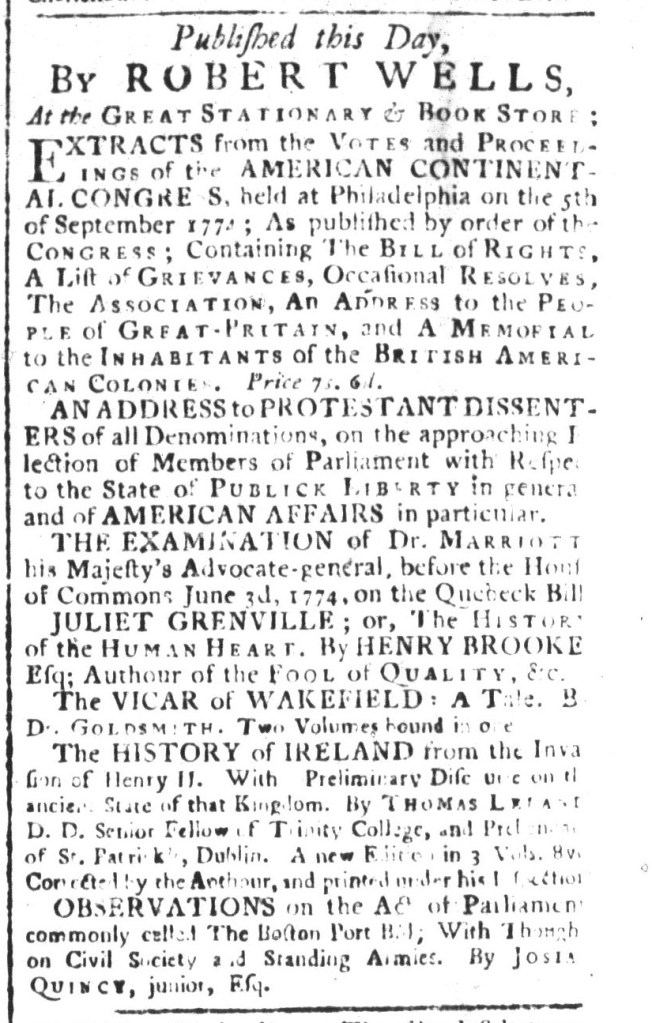
“EXTRACTS from the VOTES and PROCEEDINGS of the AMERICAN CONTINENTAL CONGRESS.”

As soon as the First Continental Congress adjourned near the end of October 1774, printers set about publishing, advertising, and selling “EXTRACTS from the VOTES and PROCEEDINGS of the AMERICAN CONTINENTAL CONGRESS, held at Philadelphia.”  William Bradford and Thomas Bradford, printers of the Pennsylvania Journal, were the first to advertise this political pamphlet, but other printers soon advertised that they produced local editions in their own towns, helping to disseminate the news far and wide.  Conveniently packaging “The BILL of RIGHTS, A List of GRIEVANCES, Occasional RESOLVES, The ASSOCIATION, An ADDRESS to the PEOPLE of GREAT-BRITAIN, and A MEMORIAL to the INHABITANTS of the BRITISH AMERICAN COLONIES” in one volume, this pamphlet supplemented coverage in newspapers.  Its format allowed for easier reference than saving and scouring issue after issue of newspapers that relayed some but not all the contents of the Extracts.  The pamphlet met with such demand that some printers quickly printed second editions.  In the November 24 edition of the Norwich Packet, for instance, Alexander Robertson, James Robertson, and John Trumbull advertised the “second Norwich EDITION” of the Extracts.

The Adverts 250 Project has examined the publication and dissemination of the Extracts in Pennsylvania, the neighboring colonies of Maryland and New York, and multiple towns in New England.  It took a little longer for printers in southern colonies to publish the pamphlet, but within a month of the First Continental Congress finishing its business Robert Wells, the printer of the South-Carolina and American General Gazette, advised readers that they could purchase the Extracts at his “GREAT STATIONARY & BOOK STORE.”  Unlike other printers who ran separate advertisements for the pamphlet, Wells included it among a list of half a dozen titles he sold.  He gave it a privileged place, first on the list, acknowledging its importance and likely interest among readers.  The other items included a couple of novels and a history of Ireland, but Wells concluded the list with “OBSERVATIONS on the Act of Parliament commonly called The Boston Port Bill, With Thoughts on Civil Society and Standing Armies.  By JOSIAH QUINCY, junior, Esq.”  Among the many volumes available at his bookstore, Wells chose to emphasize two concerning current events as the imperial crisis intensified.  Like so many other printers, he marketed items that supplemented the news he published in his newspaper.

November 18

What was advertised in a colonial American newspaper 250 years ago today?

Connecticut Journal (November 18, 1774).

“THE New-Haven Committee for soliciting Subscriptions for Relief of their suffering Brethren at Boston.”

Colonizers in Connecticut and other places rallied to support residents of Boston once the Boston Port Act went into effect on June 1, 1774.  In retaliation for the Boston Tea Party, Parliament passed legislation that closed and blockaded the harbor until the town made restitution for the property that had been destroyed.  As Bob Ruppert explains, “All shipping and commerce came to standstill.  Ships-of-war appeared in the harbor, army regiments arrived from England and only food was allowed to enter the town (by way of the town of Marblehead, sixteen miles to the north).”

As far away as South Carolina, patriots formed committees to aid Boston.  In Connecticut, the “New-Haven Committee for soliciting Subscriptions for Relief of their suffering Brethren at Boston” provided an update of their activities and invited readers to join their efforts in an advertisement in the November 18 edition of the Connecticut Journal.  It ran in the same column as advertisements for the “Votes & Proceedings Of the American CONTINENTAL CONGRESS” and a “likely Negro Girl, about 10 Years old,” for sale.  The committee advised their “generous Subscribers to being in their Grain, &c. [et cetera] on Thanksgiving Week, as they expect a Vessel will then be lying at the Long-Wharf for the purpose of taking in such Benefactions.”  In other advertisements, Josiah Burr hawked an “Assortment of GOODS suitable for the Season,” Jacob Daggett promoted a “fresh Assortment of Goods,” and Joseph Howell touted a “good Assortment of English and India GOODS,” making overtures to consumers.  In contrast, the Committee for the Relief of Boston put advertising to another purpose, alerting the public to an opportunity to play a part in current events and express their political principles.  Their notice also served as a news update, supplementing the content selected for inclusion by the printers of the Connecticut Journal.

July 12

What was advertised in a colonial American newspaper 250 years ago today?

Boston Evening-Post (July 12, 1773).

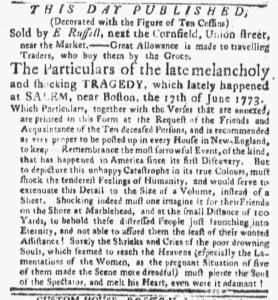
“The Particulars of the late melancholy and shocking TRAGEDY.”

Ripped from the headlines!  Just a few weeks after the “melancholy and shocking TRAGEDY, which lately happened at SALEM, near Boston, the 17th of June 1773,” Ezekiel Russell advertised a broadside commemorating the deaths of ten drowning victims, three men and seven women.  Compounding the tragedy, five of the women were pregnant, “two or three of them far advanced.”[1]  Several boats had departed from Salem’s harbor “on Parties of Pleasure,” including one boat that took its passengers to Baker’s Island, “where they went ashore, staid and dined.”  When the passengers boarded again, the boat sailed to another part of the island “for the Purpose of Fishing” and later anchored between Baker’s Island and Misery Island, “where they drank Tea.”

When the weather began to look threatening, they determined to try for Marblehead Harbour.”  As the wind intensified, the men recommended to William Ward, “the Commander of the Boat,” that he lower the sails, but Ward insisted that “the Boat would stand it.”  The passengers, “trusting his Judgment, thought proper to submit.”  The women huddled in the cabin, out of the wind and out of the way of the men attempting to get the boat to shore.  When a “sudden, smart Gust of Wind canted the Boat over on one Side,” one of the men, John Becket, had time to open the cabin door and warn the women that “they were all going to the Bottom.”  The Boat “instantly sunk.”  Becket and a “Lad about 15 Years old” were the only survivors.  Becket reported that heard the women shrieking in their last moments.  Observers on shore in Marblehead, about a mile distant, saw what happened and, “by their timely and vigorous Efforts,” launched a small schooner to retrieve Becket and the youth from the water, but it was too late to aid Ward and the women.

Russell presented an even more dramatic scene when he marketed the broadside, suggesting that the boat had been closer to shore than the newspaper accounts indicated.  “Shocking indeed must one imagine it for their Friends on the Shore at Marblehead, and at the small Distance of 100 Yards,” he proclaimed, “to behold these distressed People just launching into Eternity, and not able to afford them the least of their wonted Assistance!”  Ramping up his efforts to play on the emotions of prospective customers, Russell became even more melodramatic: “Surely the Shrieks and Cries of the poor drowning Souls, which seemed to reach the Heavens (especially the Lamentations of the Women, as the pregnant Situation of five of them made the Scene more dreadful) must pierce the Soul of the Spectator, and melt his Heart, even were it adamant!”  It was not Russell who was ghoulish in marketing this broadside, but rather readers who could learn of this “melancholy and shocking TRAGEDY” without it affecting them.  They could demonstrate that the events had indeed moved them by purchasing and displaying the broadside “Decorated with the Figure of Ten Coffins.”

The following day, colonizers from Salem and Marblehead located and raised the sunken boat.  They recovered the bodies of six of women, but did not find the bodies of Mrs. Diggadon and the three men.  They returned the bodies of the women to “the same Wharf from which so much Cheerfulness and Gaiety they departed the Day before.”  At the funerals, the “Solemnity of the several Processions drew together a vast Number of People” of “all Ranks” to mourn the victims of such a tragedy.

That account of the tragedy first appeared in the June 22 edition of the Essex Gazette, published in Salem.  Within the next ten days, the Boston Evening-Post reprinted the news on June 28 and the Massachusetts Gazette and Boston Weekly News-Letter did so on July 1.  Even if colonizers in Salem, Boston, and other towns did not read about the tragedy, they almost certainly heard about it given the way that local news, especially something as “melancholy and shocking” as these drownings, usually spread by word-of-mouth much more quickly than printers could set type.

Russell provided an opportunity for consumers to acquire a keepsake of the tragedy.  He anticipated that they would be eager to do so, offering “Great Allowance … to travelling Traders, who buy [the broadside] by the Groce [or Gross].”  In other words, peddlers who would disseminate the broadside throughout the countryside received a significant discount for purchasing by volume.  Russell claimed that he did not consider it macabre to advertise and sell the broadside, asserting that it was “printed in this Form at the Request of the Friends and Acquaintance of the Ten deceased Persons.”  To incite sales, whether at his shop or from itinerant peddlers, he suggested that it was “very proper to be posted up in every House in New-England, to keep in Remembrance the most sorrowful Event, of the kind, that has happened in America since its first Discovery.”  Even as Russell focused on the emotional response to such a harrowing story, he participated in the commodification of recent events, just as printers, booksellers, and others did following the Boston Massacre and the death of George Whitefield.

The Library of Congress makes an image of the broadside available to the public.

**********

[1] This narrative draws from the account in the Essex Gazette.  That account also appeared in the Boston Evening-Post and the Massachusetts Gazette and Boston Weekly News-Letter and on the broadside.

March 31

What was advertised in a colonial American newspaper 250 years ago today?

Essex Gazette (March 31, 1772).

“An interesting Anecdote of Sheehen’s Life, not before published.”

In addition to publishing the Essex Gazette, printers Samuel Hall and Ebenezer Hall devised others means of making money from covering current events.  For example, in the spring of 1772 their newspaper carried an advertisement for “A SERMON, preached at Salem, January 16, 1772, being the Day on which Bryan Sheehen was EXECUTED, for committing a RAPE, on the Body of ABIAL HOLLOWELL, the Wife of Benjamin Hollowell, of Marblehead.”  Most readers were probably already aware of the basic outline of the case.  As Margaret Kellow, explains, “The case attracted enormous attention.  Rape was a capital crime and no one had been executed in Salem” since the infamous witch trials in 1692.[1]  “Sheehan admitted that he was guilty of adultery,” Kellow notes, “but claimed that Mrs. Hollowell had consented to have intercourse with him, and thus he was innocent of rape.”  The judges believed Hallowell and several witnesses who testified against Sheehan.  They convicted him and sentenced him to hang in December 1771.  Still, some colonizers “clearly had doubts about Abiel Hollowell’s story.”  They questioned whether Hollowell rejected Sheehan’s advances.  The authorities delayed his execution twice, perhaps to give him a chance to finally confess, but he maintained his innocence “even on the scaffold” on the day of his execution.

James Diman, minister of the Second Church in Salem, delivered a sermon to the crowd that gathered to witness the hanging.  When he published the sermon, he appended “An interesting Anecdote of Sheehen’s Life, not before published, which, with some other Particulars and Observations, may account for his denying to the last, that he committed the Crime for which he was hanged.”  The Halls printed and sold Diman’s sermon.  According to Kellow, they also produced their own broadside.  “Eager to thrill their readers with details about the monster who lived among them,” the Halls “included explicit details of Mrs. Hollowell’s testimony in their broadside accompanied by a vivid sketch of Sheehan’s depraved career.”[2]  Printers in Boston and Portsmouth also published broadsides.  In addition, the Halls printed a short pamphlet, “The Life of Bryan Sheehen, Executed in Salem, in the 16th Day of January 1772, as Written by Himself.”  The lengthy title asserted that Sheehan gave a copy “in his own hand-writing … to one of the ministers of Salem, on the day of his execution, with a desire that it might not be made public until after his death.”  Even for colonizers familiar with the case, these publications offered new tidbits while also extending access to the trial and execution beyond attending them in person.  The Halls could have chosen to insert more coverage of Sheehan into the Essex Gazette.  They stood to generate greater revenue, however, by producing and marketing items related solely to the accusation, trial, and execution.

**********

[1] Margaret Kellow, “Bryan Sheehan: Servant, Soldier, Fisherman,” in The Human Tradition in Colonial America, eds. Ian Kenneth Steele and Nancy Lee Rhoden (Rowman and Littlefield, 1999), 288.

[2] Kellow, “Bryan Sheehan,” 289.

January 15

What was advertised in a colonial American newspaper 250 years ago today?

Essex Gazette (January 15, 1771).

“A POEM on the Execution of William Shaw.”

True crime!  News of the murder of Edward East circulated widely in New England.  The Massachusetts Gazette and Boston Weekly News-Letter was among the first publications that presented the news to the public.  A short article in its September 27, 1770, edition reported, “We hear from Springfield, that one Edward East, was murthered in the Gaol at that Place, by William Shaw and George French, who wounded him in several Parts, on the 17th of this [month], of which Wounds he died the next Day.”  As was common practice at the time, several newspapers reprinted this news over the course of several weeks.

On October 12, the Connecticut Journal provided updates in a longer story, reporting that a “jury by their verdict declared” Shaw “to be guilty” of murder, “whereupon the sentence of death was passed upon him.”  The execution was scheduled for November 8.  At the same time, the jury did not find enough evidence to convict French as an accomplice but instead “returned a verdict in his favour.”  On November 19, the Boston Evening-Post noted that Shaw’s execution was delayed until December 13, but did not provide an explanation.  The Connecticut Journal reported on Shaw’s execution in its December 18 edition.  “On which solemn occasion,” the editor declared, “an affecting sermon was delivered by the Rev. MOSES BALDWIN … to an audience of many thousands collected from all the adjacent towns as spectators of the awful scene.”  Newspapers in Connecticut, Massachusetts, New Hampshire, New York, and Rhode Island all reported on the execution.

Advertisements for commemorative items soon appeared as well, including one for “A POEM on the Execution of William Shaw” in the January 7, 1771, edition of the Boston Evening-Post.  On January 10, an advertisement in the Massachusetts Gazette and Boston Weekly News-Letter promoted another commemorative item, “A SERMON intitled, The Ungodly condemned in Judgment; Preached at Springfield, December 13th 1770.  On Occasion of the Execution of WILLIAM SHAW, for Murder, By MOSES BALDWIN.”  Printers and booksellers in other places also advertised and sold the poem and the sermon.  Samuel Hall, printer of the Essex Gazette in Salem, for instance, advertised the poem on January 15.  These advertisements helped to deliver news of current events while offering consumers opportunities to learn more.  For those who were not among the “many thousands” who heard the sermon and witnessed the execution, the commemorative items served as a proxy in addition to as supplement for coverage in newspapers.

October 9

What was advertised in a colonial American newspaper 250 years ago today?

Essex Gazette (October 9, 1770).

“A Hymn composed by the Rev. Mr. WHITEFIELD, and intended to be sung over his Corps.”

George Whitefield, one of the most influential ministers associated with the eighteenth-century religious revivals known as the Great Awakening, was a celebrity known throughout the American colonies.  Following his death in Newburyport, Massachusetts, on September 30, 1770, newspaper coverage radiated out from Boston.  The first reports appeared in the Boston Evening-Post, the Boston-Gazette, and the Massachusetts Gazette and Boston Post-Boy the following day.  The Massachusetts Spy, published in Boston, and the Essex Gazette, published in Salem, printed the news on October 2.  Two days later, the Massachusetts Gazette and Boston Weekly News-Letter reported Whitefield’s death and the Massachusetts Spy became the first newspaper to disseminate information about the event in more than one issue.  Coverage continued in other newspapers, many of them reprinting articles that first appeared in Boston’s newspapers.  On October 5, the Connecticut Journal and New-Haven Post-Boy, the New-Hampshire Gazette, and the New-London Gazette all carried the news, as did the Providence Gazette on October 6.  All three Boston newspapers that broke the story on October 1 expanded their coverage on October 8.  The same day, the Newport Mercury reprinted news that ran in the Boston-Gazette a week earlier.  The news also appeared in newspaper published outside New England for the first time.  The New-York Gazette and Weekly Mercury and the New-York Gazette or Weekly Post-Boy reprinted items from Boston’s newspapers.

On October 9, the Connecticut Courant, published in Hartford, carried news for the first time, while the Essex Gazetteand the Massachusetts Spy continued coverage.  In addition to news items about Whitefield’s death, the Essex Gazette ran an advertisement for “A Hymn composed by the Rev. Mr. WHITEFIELD, and intended to be sung over his Corps, if he had died in England, by a Number or Orphans.”  That hymn was collected together with “some Verses on the Death of that great Man,” perhaps gathered from the various newspapers that honored Whitefield with poetry in addition to news articles.  The advertisement informed readers that the hymn and verses “will be printed on a Half Sheet, and sold at the Printing-Office To-Morrow.”  Samuel Hall, the printer of the Essex Gazette, participated in the commodification of Whitefield’s death.  He simultaneously sought to honor the revered minister and profit from his demise.

Even though Hall was the first to publish an advertisement, he was not the first to introduce the commodification of Whitefield’s death to the public.  Coverage in the October 4, 1770, edition of the Massachusetts Gazette and Boston Weekly News-Letter included a short note about a similar (or perhaps the same) broadside:  “A FUNERAL HYMN, wrote by the Rev’d Mr. Whitefield:  Said to be designed to have been sung over his Corpse by the Orphans belonging to his Tabernacle in London, had he died there.  Sold at Green & Russell’s.”  This announcement appeared as part of an original news item about Whitefield’s death dated October 4, following a reprinted news item about his death dated October 1, and immediately before verses honoring the minister.  It was not separated from the coverage of Whitefield’s death as a distinct item, nor did it appear among the advertisements that ran elsewhere in that issue.  It was fully integrated into the reporting about Whitefield.  Just four days after the minister’s death, printers were already hawking memorabilia.  Not long after that, notices about commemorative items began appearing as advertisements rather than as part of the news coverage, underscoring the possibilities for generating revenue inherent in the commodification of Whitefield’s death.  Hall may have sold a broadside he printed or the one printed by Green and Russell, but either way he aimed to profit by leveraging the Whitefield’s celebrity and death.  Hall and other printers used current events to promote sales of commemorative items.

May 31

What was advertised in a colonial American newspaper 250 years ago today?

May 31 - 5:31:1770 Pennsylvania Journal
Pennsylvania Journal (May 31, 1770).

“The LIFE and CONFESSION of HERMAN ROSENCRANTZ; Executed in the city of Philadelphia.”

True crime!  James Chattin hoped to capitalize on interest in current events when he hired Joseph Crukshank to print The Life and Confession of Herman Rosencrantz.  An advertisement in the May 31, 1770, edition of the Pennsylvania Journal, presumably placed by Chattin, provided an overview of Rosencrantz’s story.  Just a few weeks earlier he had been “Executed in the city of Philadelphia, on the 5th day of May, 1770, for counterfeiting and uttering the bills of credit of the province of Pennsylvania.”  To incite greater interest and achieve a greater return on his investment, Chattin declared that the Confession was “Taken from his own mouth, in one of the cells of the goal [jail], a short time before he was executed,” the words of a man condemned to die for his crimes.  Chattin also asserted that he published the Confession, a short pamphlet, at Rosncrantz’s request “as a warning to all others.”

While that may have been Rosencrantz’s motivation for dictating his Confession, Chattin likely hoped to earn a profit by publishing and distributing this story of the consequences of a life misled.  He proclaimed that it was “SOLD by the Booksellers in Philadelphia” and had already gained such popularity, the “sale of 2000 of this interesting piece,” to require “that a new impression should be struck off.”  Chattin intended that “Hawkers, Pedlars, and others that buy to sell again” would acquire and distribute the new edition of the pamphlet.  He offered “good allowance,” a discount for purchasing by volume, to retailers and peddlers.  Chattin’s claim that 2000 copies had already sold was most likely inflated to suggest to prospective customers that they stood to miss out on something that had enthralled a good portion of their community.

Chattin also traded on the spectacle of the entire affair, from Rosencrantz’s life that led to his conviction for counterfeiting to his confession delivered in jail to his execution.  The pamphlet also included “an Account [of] his CONFEDERATES,” though much of that part of the narrative was pure imagination.  In The Death Penalty: An American History, Stuart Banner notes that “in a last-minute effort to gain favor” the condemned man “named so many innocent people as his accomplices that the publisher of his confession felt compelled to clear their names in an appendix.”[1]  The false accusations, an attempt to buy time, added to the spectacle.

Chattin aimed to create the eighteenth-century equivalent of a bestseller, trumpeting that he already sold 2000 copies of the account of this extraordinary event.  He invited hawkers and peddlers to disseminate the pamphlet even further beyond the city of Philadelphia, spreading Rosencrantz’s “warning to others” while generating greater revenues.

**********

[1] Stuart Banner, The Death Penalty: An American History (Cambridge: Harvard University Press, 2002), 61.