May 12

What was advertised in a revolutionary American newspaper 250 years ago today?

New-England Chronicle (May 12, 1775).

“We have removed our Printing-Office from Salem to this Place.”

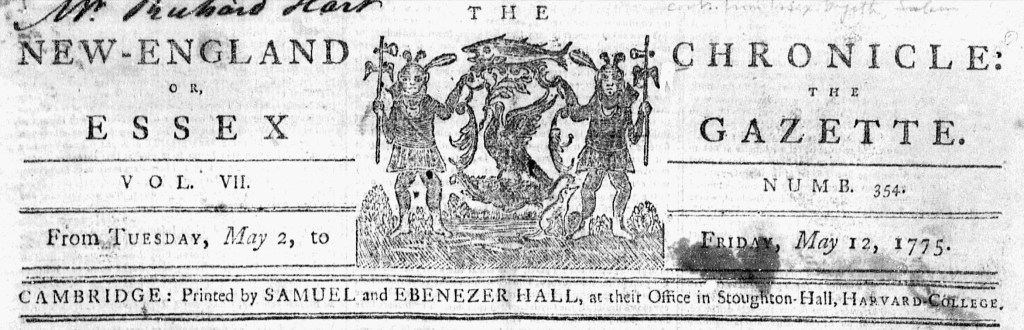
Sameul Hall and Ebenezer Hall printed the first issue of the New-England Chronicle: Or, the Essex Gazette “at their Office in Stoughton-Hall, HARVARD COLLEGE,” on May 12, 1775.  As they explained in a notice to readers, “we have removed our Printing-Office from Salem to this Place” after receiving encouragement from “many respectable Gentlemen, Members of the Honourable Provincial Congress, and others.”  They did so during the siege of Boston that followed the battles at Lexington and Concord on April 19.  The several newspapers previously published in Boston either ceased or suspended publication, leaving Salem’s Essex Gazette as one of the only newspapers in the colony.  The Provincial Congress, recognizing the value of having ready access to a press and a weekly newspaper, invited the Halls, already known as vigorous advocates of the patriot cause, to join them in Cambridge.  When the Halls commenced printing the New-England Chronicle, they continued the volume and numbering of the Essex Gazette.

Still, circumstances made the New-England Chronicle a new newspaper in the eyes of many readers and renewed the commitment of the printers “to conduct the Business [of printing] in general, and this Paper in particular, in such a Manner as will best promote the public Good.”  The Halls proclaimed that it was imperative that they do so “at this important Crisis — when the Property, the LIVES, and (what is infinitely more valuable) the LIBERTY, of the good People of this Country, are in Danger of being torn from them by the cruel Hands of arbitrary Power.”  The printers made their editorial perspective clear as they introduced the new New-England Chronicle to the public and solicited subscribers.  They hoped to continue providing subscriptions to residents of Salem who had previously supported them, yet they also had an opportunity to expand circulation to new subscribers interested in keeping up with current events, including those who previously read newspapers published in Boston.  The Halls published the New-England Chronicle in Cambridge for eleven months, Samuel maintaining the newspaper on his own following Ebenezer’s death in February 1776.  The last issue printed in Cambridge appeared on April 4, 1776.  Soon after the British evacuated Boston on March 17, 1776, Samuel Hall moved the New-England Chronicle to Boston, dropped the reference to the Essex Gazette in the extended title, and continued the volume and numbering.
New-England Chronicle (May 12, 1775).

May 2

What was advertised in a revolutionary American newspaper 250 years ago today?

Essex Gazette (May 2, 1775).

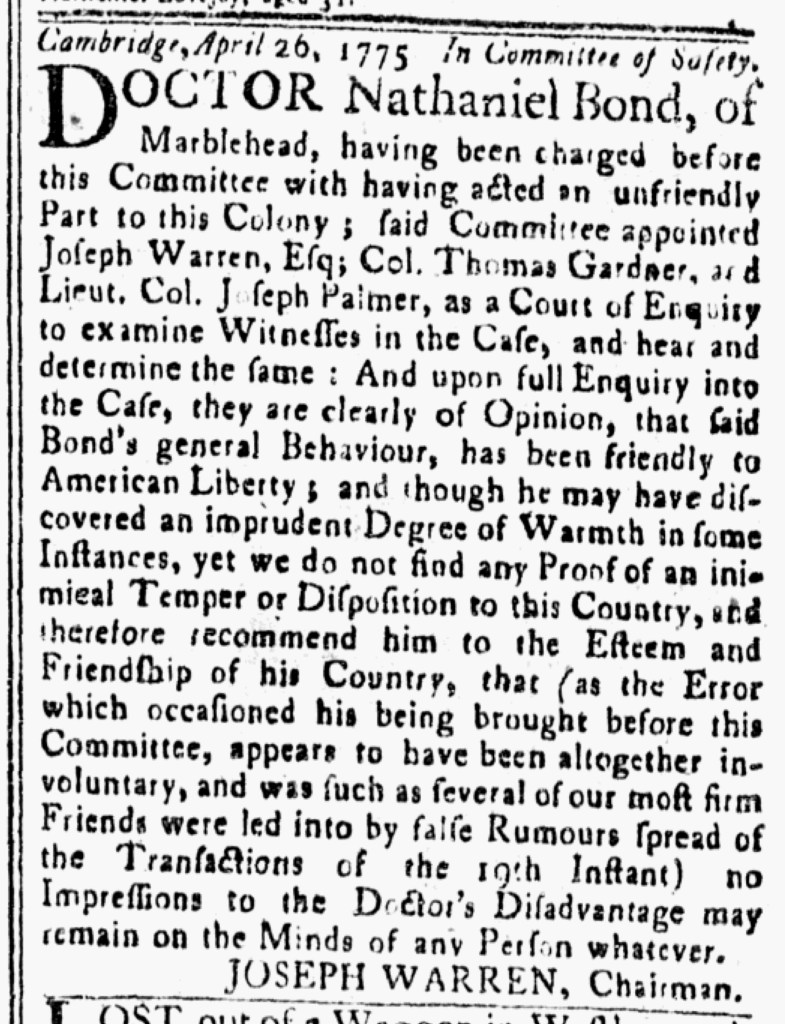
“We do not find any Proof of an inimical Temper or Disposition to this Country.”

Advertisements in early American newspapers often delivered local news beyond the items that printers selected to cover.  Such was the case for an advertisement placed by the Committee of Safety in the May 2, 1775, edition of the Essex Gazette.  Convening in Cambridge a week after the battles at Lexington and Concord, the committee considered the case of “DOCTOR Nathaniel Bond, of Marblehead,” who had been accused of “acting an unfriendly Part to this Colony.”  The committee appointed a “Court of Enquiry” consisting of Joseph Warren, then serving as president pro tem of the Massachusetts Provincial Congress, Colonel Thomas Gardner, and Lieutenant Colonel Joseph Palmer to “examine Witnesses in the Case.”

On behalf of the Committee of Safety, Warren declared that a “full Enquiry” led him, Gardner, and Palmer to the conclusion that “Bond’s general Behaviour, has been friendly to American Liberty; and though he may have discovered an imprudent Degree of Warmth in some Instance, yet we do not find any Proof of an inimical Temper or Disposition to this Country.”  Accordingly, the Committee of Safety “recommend him to the Esteem and Friendship of his Country, that … no Impressions to the Doctor’s Disadvantage may remain on the Minds of any Person whatever.”  Given that Boston’s newspapers “are all stopt, and no more will be printed for the present,” as the printer of the New-Hampshire Gazette put it, some sort of coverage in the Essex Gazette, whether an article or an advertisement, was one of the few remaining options for Bond to rehabilitate his reputation in the public prints in Massachusetts.

While Bond may have been pleased with the Committee of Safety’s notice to the public to accord him “Esteem and Friendship” rather than shun him, readers may have been disappointed that the advertisement did not carry as much news as they wanted.  Warren noted that “the Error which occasioned [Bond] being brought before this Committee, appears to have been altogether involuntary, and was such as several of our most firm Friends were led into by false Rumours spread of the Transactions of the 19th Instant.”  What happened that brought Bond to the attention of the committee in the wake of the “Transactions” at Lexington and Concord?  What had the “Error” been?  Providing such details was not necessary to achieve Warren’s purpose of clearing Bond of the charges, yet not giving a more complete accounting may have left readers wanting to know more about what had supposedly transpired.  For some, gossip likely filled in the gaps left by an incomplete narrative in the newspaper advertisement.

April 25

What was advertised in a revolutionary American newspaper 250 years ago today?

Essex Gazette (April 25, 1775).

“MEDICINES … at the Sign of the Lion and Mortar.”

Jonathan Waldo placed an advertisement for imported “DRUGS and MEDICINES” available at his shop on King Street in Salem, Massachusetts, in the Essex Gazette on April 11, 1775.  He presumably paid a fee that included setting the type and running the notice in three consecutive issues before discontinuing it, a standard arrangement according to the pricing schemes in the colophons of several early American newspapers.  That meant that his advertisement appeared again on April 18, the eve of the skirmishes at Lexington and Concord that started the Revolutionary War, and finally on April 25.  That issue included coverage of “the Troops of his Britannick Majesty commenc[ing] Hostilities upon the People of this Province.”  Samuel Hall and Ebenezer Hall would print only one more issue of the Essex Gazette in Salem before moving to Cambridge and continuing the newspaper as the New-England Chronicle.  What happened to Waldo during the war?  According to Donna Seger, the apothecary served as a major in the Salem Militia and his business “survived through the Revolution through a dual strategy of continuing to import apparently-contraband British medicine and concocting his own American substitutions.”

Seger describes Waldo as a savvy entrepreneur who diversified his business after the war, noting that “the Revolution seems to have inspired ‘innovation’ and reaped more profits” for the apothecary once he began marketing less expensive American versions of popular British patent medicines.  His advertisement from the spring of 1775 indicates that he also made shrewd decisions before the war began, including setting up shop “at the Sign of the Lion and Mortar, lately improved by Dr. KAST.”  Philip Godrid Kast was a well-known and successful apothecary who had marked his shop with “the Sign of the Lyon and Mortarfor many years.  It almost certainly became a familiar sight for residents of Salem as they traversed the streets of the town and attracted notice from visitors.  Kast even included an image of the sign on an engraved trade card dated to 1774, further associating the “Sign of the Lyon & Mortar” with his business when he distributed it to current and prospective customers.  Waldo apparently took possession of the sign when he moved into the shop previously occupied by Kast.  He could have commissioned a new device to represent his business.  Nathaniel Dabney, for instance, sold medicines “at the Head of HIPPOCRATES, in Salem,” and included an illustration of the bust of the physician from ancient Greece in some of his advertisements.  Yet the “Sign of the Lion and Mortar” was both appropriate for Waldo’s occupation and had a reputation associated with it that he wished to leverage.  Waldo likely hoped to gain some of Kast’s customers when he took over the shop.  Keeping the “Sign of the Lion and Mortar” on display testified to the continuity of service that he provided.

February 21

What was advertised in a colonial American newspaper 250 years ago today?

Essex Gazette (February 21, 1775).

“GARDEN SEEDS.  Just imported … from LONDON.”

Each year the Adverts 250 Project chronicles the marketing efforts of women who sold garden seeds in Boston.  The appearance of their advertisements in the several newspapers published in that city heralded the changing of the seasons from winter to spring.  They participated in an annual ritual, not unlike printers who began advertising almanacs for the coming year each fall.  Their advertisements in the public prints signaled to readers that spring was indeed on its way.

Those advertisements sometimes appeared as early as the middle of February in years before the Continental Association went into effect on December 1, 1774.  The First Continental Congress devised that nonimportation agreement in response to the Coercive Acts.  By the end of the third week of February 1775, neither Susanna Renken, who was often the first to advertise garden seeds in the Boston press, nor any of her sister seed sellers published any advertisements.  In addition to the Continental Association constraining trade, the harbor had been closed to commerce because of the Boston Port Act since June 1, 1774.  In Salem, however, W.P. Bartlett advertised a “fresh Assortment of GARDEN SEEDS” in the February 21 edition of the Essex Gazette.

Bartlett reported that the seeds were “JUST IMPORTED, in the Venus, from LONDON.”  The “INWARD ENTRIES” from the custom house in the January 24 edition document the arrival of the Venus, establishing Bartlett received the shipment of seeds in the period between December 1, 1774, and February 1, 1775.  The tenth article of the Continental Association made provision for goods that arrived during that period, specifying that importers could refuse them, surrender them to the local Committee of Inspection to store while the nonimportation agreement remained in force, or transfer them to the committee to sell to recover the costs with any profits donated for the relief of Boston.

Some advertisements in the Essex Gazette and other newspapers indicated that importers opted for the third option, but other advertisements suggest that some disregarded the Continental Association.  In the same issue that carried Bartlett’s advertisement for garden seeds, Stephen Higginson hawked “English and India GOODS” that he “Just IMPORTED in the Venus … from London.”  That certainly defied the Continental Association.  What about the garden seeds that Bartlett peddled?  Did they deserve special consideration since they contributed to the “Frugality, Economy, and Industry” and promotion of “Agriculture, Arts, and the Manufactures of this Country” called for by the eighth article of the Continental Association?

February 14

GUEST CURATOR:  Ashley Schofield

What was advertised in a colonial American newspaper 250 years ago today?

Essex Gazette (February 14, 1775).

“The great Misfortune of losing his House and Store by Fire, with almost every Thing in and about them.”

Peter Frye was a justice of the peace in Salem, Massachusetts, when the town had a fire on October 6, 1774. According to Donna Seger, Frye was a Tory. Tories were also known as Loyalists, colonists who remained loyal to the king and Parliament. In an advertisement that he placed four months after the fire, Frye points out his misfortune of losing his house, store, and belongings due to the fire. “He is now obliged to beg all of those who were then indebted to him by Bond, Note, or on Account” to pay him what they justly owed.

Frye called for sympathy amongst the people of Salem by stating his misfortune of losing his house, store, and belongings. He thought that some readers would hesitate to engage because he was a Tory, either overlooking or disregarding his plea. He knew he was asking a lot of the people to help him recover, so began by noting that he lost everything.

Advertisements calling on readers to settle accounts and debts were common, but most advertisements were due to regular business transactions, not due to fires. Additionally, he not only lost his house and store, but allegedly all that was in them. In this matter, Frye no longer had his ledgers and account books due to the fire, which meant he had no records to confirm who owed him and what amount.

Frye relied on the sympathy and the good consciences of the people of Salem to help him out in this time of tragedy to gain back what he had lost. As Donna Seger explains, “Frye had tried to find his way back to ‘friendship’ with his Salem neighbors, but they had never been able to forget his commercial and judicial dealings contrary to Patriot proclamations.” Due to his position as a Tory on the eve of the American Revolution, townspeople held a grudge against him. Seger notes that Frye left Salem, moving to Ipswich and then Britain.

**********

ADDITIONAL COMMENTARY: Carl Robert Keyes

I enjoyed working with Ashley on this entry for many reasons, including the confluence of primary and secondary sources that went into crafting it.  We began with negotiating whether I would approve Frye’s advertisement as Ashley’s selection for this project.  I encouraged students to choose advertisements about consumer goods and services to build on our readings and discussions about the consumer revolution, but I also told them that I would consider other kinds of advertisements if they made convincing cases for what they hoped to learn from them and why they should be included in the Adverts 250 Project.  Ashley convincingly argued that she did not previously know about the fire in Salem in 1774.   Frye’s advertisement offered an opportunity to learn about that piece of local history and its aftermath.

To fill in the details, she consulted Streets of Salem, a blog produced by Donna Seger, Professor of History at Salem State University.  Seger composes “[s]omewhat random but still timely posts about culture, history, and the material environment, from the perspectives of academia, Salem and beyond.”  In the nine years that I have been producing the Adverts 250 Project, I have consulted and linked to Streets of Salem on many occasions, so I was pleased that Ashley discovered that wonderful and engaging resource when researching Frye’s advertisement.  In the entry that gave so much information about Frye, Seger weaves together various primary sources, informed by Mary Beth Norton’s 1774: The Long Year of Revolution.  Ashley was already familiar with Norton from our discussions about the historiography of the American Revolution.  Seger’s post about “Tea, Fire and a new Congress” vividly illustrated how historians incorporate secondary sources into their research on primary sources, not only for background information but also in presenting an interpretation of what happened, why it mattered then, and why we consider it important now.

During the research, writing, and revision process, Ashley also had an opportunity to learn more about early American print culture and various kinds of advertisements, especially notices that called on colonizers to settle accounts.  As a result, she was able to make a distinction between the familiar and standard notices that so often appeared in the pages of early American newspapers and the appeal that Frye made as he attempted to recover from a fire that had devasted his household and business.  I sometimes select advertisements that deliver local news (including some that ran in the Essex Gazette right after the Salem fire) to feature on the Adverts 250 Project.  Ashley contributed to the project’s examination of those sorts of newspaper advertisements.

February 7

What was advertised in a colonial American newspaper 250 years ago today?

Essex Gazette (February 7, 1775).

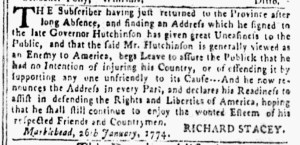
“He had no Intention of injuring his Country, or of defending any one unfriendly to its Cause.”

It was yet another public disavowal of an address honoring Thomas Hutchinson, the former governor of Massachusetts, that many colonizers signed when he returned to England.  This time, Richard Stacey inserted his recantation in the February 7, 1775, edition of the Essex Gazette.  Similar advertisements began appearing in that newspaper and sometimes newspapers printed in Boston as early as July 1774.  Stacey explained that he waited several months because he “just returned to the Province after long Absence” and only upon his arrival did he discover “an Address which he signed to the late Governor Hutchinson has given great Uneasiness to the Public.”  He further explained that the former governor “is generally viewed as an Enemy to America.”

That being the case, Stacey “begs Leave to assure the Publick that he had no Intention of injuring his Country, or of offending it by supporting any one unfriendly to its Cause.”  Accordingly, “he now renounces the Address in every Part, and declares his Readiness to assist in defending the Rights and Liberties of America.”  With such a proclamation, disseminated far and wide in the newspaper, Stacey desired “that he shall still continue to enjoy the wonted Esteem of his respected Friends and Countrymen.”  He considered the prospects of reconciling with friends, neighbors, and associates worth the expense of placing an advertisement in the Essex Gazette.

Was Stacey sincere?  Or did he merely seek to return to the good graces of his community and simply get along during difficult times?  That is impossible to determine from his advertisement.  It did differ from some that previously appeared in the public prints.  For instance, Stacey did not attempt to blame his error on having quickly read the address without considering its implications before signing it.  Instead, he did not comment on what had occurred at the time he signed the address but focused on the harm he had done by doing so.  Others offered lukewarm assurances that they did not truly support Hutchinson or the policies he had enforced, while Stacey proclaimed his “Readiness to assist in defending the Rights and Liberties of America.”  In addition, some signers published advertisements that clearly copied from the same script.  Stacey’s was entirely original.  That may have been the result of the time that had passed since others inserted their advertisement or the political situation deteriorating and thus requiring stronger assertions from signers of the address branded as Tories.  William Huntting Howell suggests that for some readers Stacey’s sincerity may have mattered much less than the fact that he felt compelled to express support for the “Cause” of “his Country” in print.[1]

**********

[1] William Huntting Howell, “Entering the Lists: The Politics of Ephemera in Eastern Massachusetts, 1774,” Early American Studies 9, no. 1 (Winter 2011): 191, 208-215.

January 17

What was advertised in a colonial American newspaper 250 years ago today?

Essex Gazette (January 17, 1774).

“ALL Persons who have … Subscription Papers … are desired immediately to return the same.”

Samuel Hall and Ebenezer Hall, the printers of the Essex Gazette, inserted a brief notice in the January 17, 1775, edition to request that “ALL Persons who have in their Hands any Subscription Papers for printing the Independent Whig … to return the same to the Printers hereof.”  They referred to a project that they had first announced more than fifteen months earlier on September 23, 1773, with another advertisement in their newspaper.  On that occasion, they confided that “A Number of the principal Gentlemen in this Town … encouraged the Publication” of the work that Thomas Gordon and John Trenchard first distributed as a weekly magazine in London in 1720.  For those not as familiar with that “celebrated Performance,” the printers gave the full title: “THE Independent Whig, Or, A Defence of primitive Christianity, and of our Ecclesiastical Establishment, against the extravagant Claims of fanatical and disaffected Clergymen.”

The Halls informed the public that they could subscribe to the work at their printing office in Salem.  Those not yet certain that they wished to reserve copies could examine the “Proposals.”  The printers eventually published subscription notices in the Massachusetts Spy in February 1774, hoping to reach even more prospective customers in Boston and other towns throughout the colony.  Yet the Halls apparently did not limit their marketing efforts to newspaper advertisements, choosing to circulate “Subscription Papers” that likely described the purpose of the book and the conditions for ordering copies.  They may have requested that friends and associates post the subscription proposals in their shops and offices, recruiting the assistance of local agents in other towns.  Such items often featured space for subscribers to sign their names, making their support of the project visible to others, though local agents sometimes compiled separate lists.  No copies of the “Subscription Papers” that the Halls mention in their newspaper advertisement survive, at least not any that have been identified and cataloged yet.  Their newspaper notice testifies to a more extensive culture of marketing media in early America than the collections in research libraries, historical societies, and private collections reveal.  How much advertising ephemera circulated that has been lost without any mention in the public prints?

December 27

What was advertised in a colonial American newspaper 250 years ago today?

Essex Gazette (December 27, 1774).

“THE Committee of Inspection for the Town of PLYMOUTH, hereby give Notice.”

Once the Continental Association went into effect on December 1, 1774, a new sort of advertisement began appearing in the Essex Gazette and other newspapers.  Rather than advertising and selling their own merchandise, importers surrendered those roles to local Committees of Inspection, “agreeable to the Tenth Article of the Association of the American Continental Congress.”  The First Continental Congress had devised the nonimportation agreement during its meetings in Philadelphia in September and October 1774 and then disseminated it throughout the colonies.

The tenth article of the Continental Association made provisions for goods imported between December 1, 1774, and February 1, 1775.  The importers could choose to return the merchandise or turn it over to the local Committee of Inspection.  If they chose the latter, they could opt for the committee to store the wares until the nonimportation agreement ended or sell them on behalf of the importer, in which case the importer recovered the cost of the items, but profits were designated for relief of Boston since it faced so much hardship once the Boston Port Bill closed and blockaded the harbor.  The tenth article also specified that “a particular Account of all goods so returned, stored, or sold, [was] to be inserted in the publick Papers.”

Such was the case in two advertisements that John Torrey, chairman of the Committee of Inspection in Plymouth, first placed in the Essex Gazette on December 20, 1774, and again in subsequent issues.  Those advertisements indicated which vessels transported the goods, but did not name the importers.  They gave straightforward lists of the merchandise offered for sale without incorporating any of the common appeals to price, quality, fashion, or consumer choice.  No marketing strategy nor turn of phrase (such as “very cheap” or “large Assortment”) sought to distinguish the merchandise in these advertisements from other goods available for sale.  With political principles as the primary focus, John Torrey and the Committee of Inspection had little motivation to craft the sort of lively advertisements that the importers might have placed on their own behalf under other circumstances.

December 20

What was advertised in a colonial American newspaper 250 years ago today?

Essex Gazette (December 20, 1774).

“I find the retaining said Commission is contrary to the Sentiments of the Publick in general.”

The December 20, 1774, edition of the Essex Gazette, published in Salem, carried three advertisements in which residents of Marblehead disavowed commissions granted to them by the former governor, Thomas Hutchinson.  Nathaniel Lindsey, for instance, declared, “I find the retaining said Commissions is contrary to the Sentiments of the Publick in general, as well as inconsistent with my private Opinion.”  He carefully asserted that his politics aligned with the principles espoused by Patriots, though such an assertion may have been performative rather than authentic.  Either way, Lindsey distanced himself from his affiliation with the unpopular former governor, proclaiming, “I will not act any farther under said Commission, neither will I receive any Commission or act under any Authority whatsoever, that proceeds from any Creature which appears to have two Faces.”  In other words, he did not find the current administration trustworthy to act in the interests of the colonies instead of Parliament.  “I am a Well-Wisher to my Country and Town,” Lindsey concluded.

Ebenezer Graves and Samuel Trevett published the other two notices with similar messages.  Indeed, their advertisements featured identical wording except for the first line.  Graves stated that he “some Time since received a military Commission from the late infamous Governor Hutchinson,” while Trevett similarly declared, “I was so unhappy as to receive a military Commission from the late infamous Governor Hutchinson.”  Each of them acknowledged that the “Commission has been continued by his successor,” General Thomas Gage.  Graves and Trevett used identical language throughout the remainder of their notices: “I hereby publish a full Resignation of said Commission, as I conceive it inconsistent with the Laws of God and the Welfare of my Country, to hold it under the Command of such an enemy of my Country’s Liberties.”  Hutchinson enforced the Coercive Acts, including the Boston Port Act, the Massachusetts Government Act, and the Quartering Act.

These advertisements resembled the apologies that many colonizers published to distance themselves from an address to Governor Hutchinson that they signed upon his departure for England.  They claimed that they signed in haste, not having carefully read or fully comprehended the document.  As William Huntting Howell has noted, many of the apologies featured identical language, leading him to argue that the signatories were not necessarily sincere but merely wanted to return to the good graces of their neighbors.  Furthermore, Howell argues, what mattered most to Patriots was the public expression of allegiance to their cause, finding that more important for shaping public opinion than the true conversion of any individual.  When Lindsay, Graves, and Trevett ran advertisements resigning their military commissions, they perhaps followed a similar path as their counterparts who apologized for signing the address to Hutchinson.

December 13

What was advertised in a colonial American newspaper 250 years ago today?

Essex Gazette (December 13, 1774).

“The WONDERFUL APPEARANCE of an Angel, Devil and Ghost.”

It resembled a Dickens story decades before Charles Dickens wrote “A Christmas Carol” or anything else!  In December 1775, John Boyle published and advertised “The WONDER of WONDERS! Or, the WONDERFUL APPEARANCE of an Angel, Devil and Ghost, To a Gentleman in the Town of BOSTON, in the Nights of the 14th, 15th, and 16th of October last.”  His advertisements first appeared in the Massachusetts Spy in early December and very soon after in other newspapers in Boston as well the Essex Gazette in Salem and the Essex Journal in Newburyport.

That gentleman, Boyle suggested in his advertisements, was apparently a Loyalist “To whom in some Measure may be attributed the Distresses that have of late fallen upon that unhappy Metropolis.”  The Boston Port Act had closed the harbor to commercial shipping, the Massachusetts Government Act had given the royally appointed governor more authority at the expense of the locally elected legislature and town meetings, and the Quartering Act provided for a greater presence of British soldiers.  The unnamed gentleman who supposedly experienced these visitations shared his experience with a neighbor and then agreed to their publication “as a solemn Warning to all those, who, for the sake of aggrandizing themselves and their Families, would entail the most abject Wretchedness upon Millions of their Fellow-Creatures.”  J.L. Bell, who has been chronicling Boston in the era of the American Revolution in a daily research blog for nearly two decades, notes, “All but the most credulous readers knew that this presentation was a sham designed to lend a wild cautionary tale some veneer of veracity.”

Bell examines “Wonder of Wonders” in three entries, the first introducing the pamphlet and its publication history, the second relaying the visitation by the angel, and the third recounting the visits by the devil and a ghost as well as interpreting the story in the context of how the imperial crisis unfolded in Boston.  Bell summarizes the pamphlet as purportedly an “account of a wealthy friend of the royal government whose sleep was disturbed by three supernatural visitors warning him to change his ways and start caring more about his neighbors.”  On the first night, the angel provides a warning to get back on the right path, a footnote explaining that the gentleman received compensation for his support of the officials dispatched to Boston from Britain but not specifying which services he provided.  The gentleman initially dismissed this visitor as “a delusion” until the devil visited the next night.  Their conversation covered “the previous nine years of conflict through Loyalist eyes.”  The editor conveniently provided an alternate interpretation of events in footnotes.  On the third night, the ghost of one of the gentleman’s ancestors appeared and chastised him for betraying principles that had been in place since the founding of the colony.  Colonizers settled New England, the ghost declared, “for the sake of enjoying that liberty which was denied them at home.”  The gentleman realizes the error of his way and vows to repent.

Bell wonders about the intended audience for the pamphlet, “Loyalists who needed converting” or Patriots “who enjoyed the sight of an opposing gentleman scared into submission.”  It very well could have been both, though describing it as “a solemn Warning” seemed to invite Loyalists to take heed.  The advertisement invited the curious of all political persuasions to purchase and read the pamphlet, supplementing the spectacular title with promises of four images that adorned the work.  Depictions of “THE DEVIL,” “AN ANGEL, with a Sword in one Hand, a Pair of Scales in the other,” “BELZEBUB, holding in his right Hand a folio Book, and in his left a Halter,” and “A GHOST, having on a white Gown, his Hair much dishevelled,” enhanced the story.  Whoever the intended audience may have been, Boyle aimed to generate revenue with the pamphlet by advertising widely and disseminating copies to local agents in other towns.

**********

Quotations not drawn from the advertisement come from J.L. Bell’s Boston 1775: History, Analysis, and Unabashed Gossip about the Start of the American Revolution in Massachusetts.