What was advertised in a colonial American newspaper 250 years ago today?
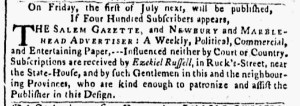
“Will be published … A Weekly, Political, Commercial, and Entertaining Paper.”
On June 21, 1774, the Essex Gazette carried an advertisement for a new newspaper that would become a competitor. At that time, Samuel Hall and Ebenezer Hall printed the first and only newspaper in Salem. Ezekiel Russell, however, wished to test the market to see if it would support the “SALEM GAZETTE, AND NEWBURY and MARKBLEHEAD ADVERTISER: A Weekly, Political, Commercial, and Entertaining Paper.” He proposed that the Salem Gazette would commence publication on “the first of July next … If Four Hundred Subscribers appears.” The enterprising printer hoped that a notice in the Essex Gazette would help generate subscribers, though that was not his only means of inciting interest. He distributed an unnumbered prospectus issue on June 24, hoping that the content and appearance would convince the public to subscribe (and advertisers to place to notices). Similarly, Isaiah Thomas and Henry-Walter Tynges gave out free copies of the first issue of the Essex Journal, the first newspaper printed in Newburyport, seven months earlier.
Whether or not Russell managed to attract four hundred subscribers by the appointed date, he did indeed publish the Salem Gazette on July 1. Isaiah Thomas provided a brief overview in his History of Printing in America (1810), describing it as “the second paper published in the town, … published weekly on Friday.” The Halls distributed the Essex Gazette on Tuesdays, so newspapers now circulated twice a week in Salem (in addition to those printed in other towns that made their way there). As Thomas further explained, “This Gazette was of short continuance; its circulation was confined to a few customers in Salem and the neighboring towns, which were inadequate to its support.”[1] The last known issue bears the date April 21, 1775, just two days after the skirmishes at Lexington and Concord. It was not the only newspaper printed in Massachusetts that experienced disruptions or folded when the Revolutionary War began. The Boston Evening-Post ceased publication on April 24, 1775, whole the last known issue of the Massachusetts Gazette and Boston Post-Boy appeared on April 17, 1775. In his advertisement, Russell stated that the Salem Gazette would be “Influenced neither by Court or Country,” indicating that it would not take a political stance in favor of patriots or loyalists as the imperial crisis intensified. Some prospective subscribers may have remembered that Russell previously published The Censor in Boston from November 1771 through May 1772. As Thomas recounted, that “paper was supported, during the short period of its existence by those who were in the interest of the British government.”[2] Perhaps Russell intended for the prospectus issue to demonstrate that this newspaper would not privilege one perspective over another.
Unfortunately, advertisements from the Salem Gazette will not be featured in the Adverts 250 Project. According to Clarence Brigham’s History and Bibliography of American Newspapers, 1690-1820, the British Museum has a complete run (with the exception of the prospectus) and various research libraries in Massachusetts have scattered issues, but the Salem Gazette has not yet been digitized for greater access. Although colonizers in Salem had access to yet another source of news and advertising for several months in 1774 and 1775, the availability of digitized primary sources largely determines the scope of the Adverts 250 Project.
**********
[1] Isaiah Thomas, The History of Printing in America: With a Biography of Printers and an Account of Newspapers (1810; New York: Weathervane Books, 1970), 275.
[2] Thomas, History of Printing, 153.