July 26

What was advertised in a revolutionary American newspaper 250 years ago today?

Pennsylvania Gazette (July 26, 1775).

“A SERMON, on the present Situation of American Affairs … to distribute … among the Military Associators.”

A few days ago, I examined an advertisement for “A sermon on the present Situation of American Affairs” by William Smith that ran in the July 21, 1775, edition of the South-Carolina and American General Gazette.  I concluded that Wells likely sold copies of the pamphlet printed by James Humphreys, Jr., in Philadelphia and shipped to his “GREAT STATIONARY & BOOK STORE” in Charleston.  An advertisement in the July 26, 1775, edition of the Pennsylvania Gazette suggests that was indeed the case.

That notice listed several printers who stocked the sermon.  It gave top billing to James Humphreys, Jr., and noted that “the other Printers in Philadelphia” also sold the sermon.  Radiating outward from the city, the list next named Matthias Slough and Francis Bailey in Lancaster and then Hugh Gaine, the printer of the New-York Gazette and Weekly Mercury, in New York.  The list concluded with “Mr. ROBERT WELLS, in Charlestown, South-Carolina.”  Humphreys apparently dispatched copies to associates both in his own city and in other towns and colonies.

Another aspect of that advertisement indicates that Wells most likely sold copies of the sermon printed by Humphreys in Philadelphia.  Wells did not mention the price in his advertisement, but Humphreys gave prices for a single copy and multiple copies: nine pence for one copy, six shillings for a dozen, and six dollars for one hundred copies.  That pricing structure concluded with a note that Humphreys intended the discount for purchasing in volume as a benefit “for such Persons as may desire to distribute them among the Military Associators.”  He encouraged officers and other Patriots to disseminate the sermon widely by making a gift of it to those who volunteered to defend American liberties.  Humphreys was not alone in envisioning that officers would give books and pamphlets about current affairs as gifts.  George Washington had recently ordered eight copies of Thomas Hanson’s Prussian Evolutions in Actual Engagements to distribute among his subordinates.

The details in Humphreys’s advertisement strengthen the case that Wells did not publish his own edition of Smith’s sermon but instead advertised and sold copies that Humphreys printed in Philadelphia and distributed to printers and booksellers in several cities and towns.  Doing so contributed to the creation of what Benedict Anderson terms an “imagined community” grounded in print.  Newspapers played an important role as printers reprinted news and editorials from one to another, yet colonizers also had access to pamphlets, tracts, and sermons that circulated widely.  They did not have to be present when Smith delivered his sermon to engage with the ideas and arguments that the minister offered for consideration.
August 26

What was advertised in a colonial American newspaper 250 years ago today?

Supplement to the Connecticut Journal (August 26, 1774).

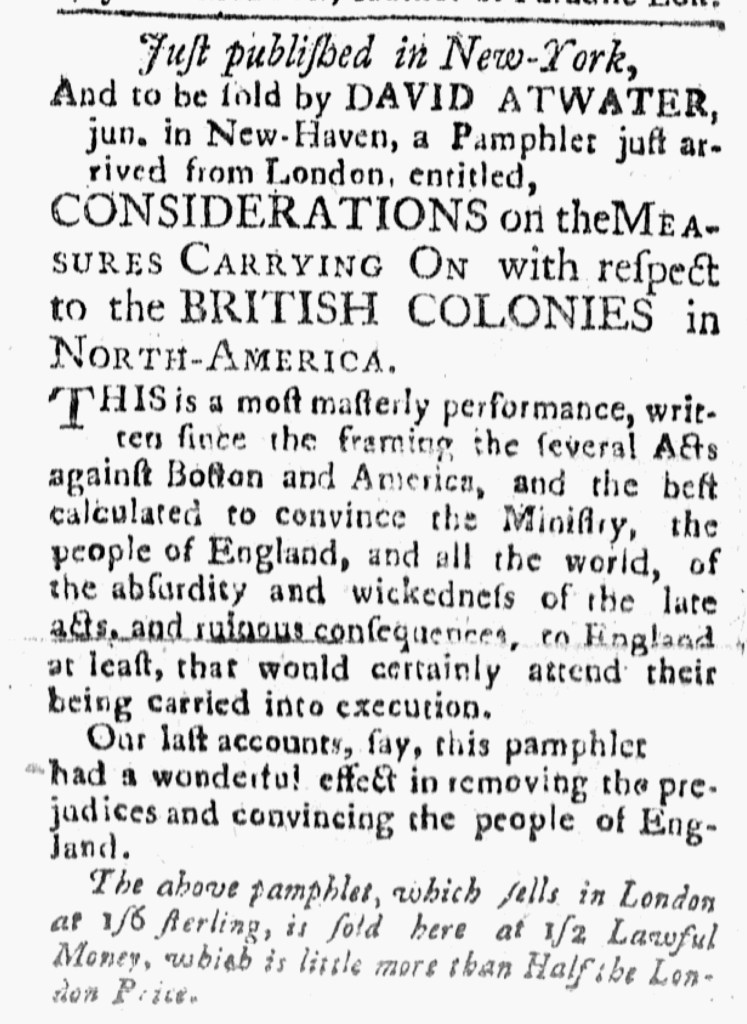
Just published in New-York, And to be sold … in New-Haven, a Pamphlet just arrived from London.”

Printers in several cities published American editions of Considerations on the Measures Carrying On with Respect to the British Colonies in North-America in 1774, including Benjamin Edes and John Gill in Boston, John Holt in New York, Benjamin Towne in Philadelphia, and Ebenezer Watson in Hartford.  The Adverts 250 Project has examined advertisements for this “Pamphlet just arrived from London” that Edes and Gill ran in their own Boston-Gazette and Holt ran in his own New-York Journal.  Both newspapers had reputations for ardently supporting the patriot cause, making it no surprise that their printers would publish and sell a tract outlining the “absurdity and wickedness” of the Coercive Acts that Parliament passed in retaliation for the Boston Tea Party.

Other colonizers joined those printers in their efforts to disseminate the pamphlet.  At the end of August, for instance, the Connecticut Journal carried an advertisement that promoted the edition “Just published in New-York” by Holt.  Readers could purchase it from David Atwater, Jr., in New Haven.  In addition to supplying Atwater with copies of the pamphlet, Holt also provided the copy for the advertisement.  After the introduction that listed Atwater as the local agent who sold the pamphlet, the main body of the advertisement featured copy identical to Holt’s advertisement.  It was the same copy that Edes and Gill appropriated for their advertisement.  Atwater made one small revision to the final note, adjusting the price to suit the currency in Connecticut.

That four printing offices published the pamphlet suggests that it circulated widely in New England, New York, and Pennsylvania.  However, printing and advertising the tract did not necessarily result in sales.  On the other hand, Edes and Gill produced multiple editions, suggesting that they did indeed find buyers for it.  Even if readers did not choose to purchase the pamphlet, they encountered the same rhetoric about the “ruinous consequences” of the Coercive Acts when they perused newspaper advertisements.  As short editorials, those notices buttressed the arguments made in news items and letters that were reprinted from newspaper to newspaper throughout the colonies.

May 25

What was advertised in a colonial American newspaper 250 years ago today?

South-Carolina Gazette and Country Journal (May 25, 1773).

“Other curious Tracts worthy of high Rank in every Gentleman’s Literary Repository.”

Robert Bell, one of the most influential booksellers and publishers in eighteenth-century America, had a memorably flamboyant style.  He often packed his newspaper advertisements and book catalogs with florid prose to attract the attention of prospective customers.  Such was the case in an advertisement that ran in several newspapers in May 1773, commencing in the Pennsylvania Chronicle and the Pennsylvania Packet at the beginning of the month and appearing in the South-Carolina Gazette and Country Journal by the end of the month.

Bell often opened his advertisements with an extravagant salutation.  In this instance, he addressed “THE SONS OF SCIENCE IN AMERICA,” advising them that they played an important role in the publication of “a decent American Edition of the splendid Judge BLACKSTONE’S COMMENTARIES on the LAWS of ENGLAND, in four Volumes.”  For nearly two years, Bell had been promoting the project throughout the colonies, including in an advertisement in the Providence Gazette that addressed the “Gentlemen of Rhode-Island, and all those who are animated by the Wish of seeing NATIVE FABRICATIONS flourish in AMERICA.”  The bookseller now reported that under the “auspicious Influence” of his supporters, those “SONS OF SCIENCE” and gentlemen who supported an American publishing industry, the fourth and final volume of Blackstone’s Commentaries went to press and “is now ready to be delivered to the Subscribers.”  Those who placed advance orders could expect to receive their books soon.

The “humble Providore to the Sentimentalists, and Hand Servant to the Friends of Literature” took the opportunity to promote another book that he marketed as “a fifth Volume to range uniformly with said Commentaries.”  That “New Edition” included “much esteemed Letters of the very respectable dissenting Divine Dr. FURNEAUX to Judge BLACKSTONE, with PRIESTLEY’S Remarks on the Commentaries, and some other curious Tracts worthy of high Rank in every Gentleman’s Literary Repository.”  Yet Bell did not confine sales of that book solely to gentlemen who purchased all four volumes of Blackstone’s Commentaries and had extensive libraries.  He presented a single volume with so many entries as an “Accommodation [for] the un-opulent, among whom are many firm Friends to the Exploration and Investigation of every Truth, in which Humanity or Christianity are inserted, who ardently wish to see the Foundation of civil and religious Liberty fully displayed, asserted and established, above and beyond the Reach of all Human Tyranny.”  A prospective buyer’s ideals, not his status, justified acquiring so many essays “in one Volume.”  Bell encouraged readers to think of themselves as part of community devoted to the highest ideals, a community that extended from New England to South Carolina.

May 7

What was advertised in a colonial American newspaper 250 years ago today?

Supplement to the South-Carolina Gazette and Country Journal (May 7, 1771).

“Booksellers in Boston, New-York, Philadelphia, or … Charles-Town.”

Like many other colonial printers, Charles Crouch also sold books, pamphlets, and broadsides.  In the pages of the South-Carolina Gazette and Country Journal, he advertised titles available at his “Great Stationary and Book Shop.”  He also acted as a local agent for printers and booksellers in other cities, publishing subscription notices and handling local sales.  He did so on behalf of Robert Bell, the flamboyant bookseller responsible for publishing a three-volume American edition of “ROBERTSON’s celebrated History of CHARLES the Fifth.”  Bell coordinated an advertising campaign that extended from New England to South Carolina.  Local agents simultaneously published his subscription notice inviting readers to participate in an “elegant XENOPHONTICK BANQUET” through purchasing his American edition.

When Wells inserted that advertisement in the South-Carolina Gazette and Country Journal and listed himself as a local agent, he contributed to the creation of a community that extended far beyond Charleston.  Yet settling in for the “XENOPHONTICK BANQUET” was not the only means of joining a larger community that Wells offered to readers and prospective customers.  He appended to Bell’s subscription notice a brief note that he also sold “The Trial of the Soldiers of the 29th Regiment, for the Murders committed at Boston,” printed by John Fleeming in Boston, and “A Funeral Sermon on the Death of the Rev. Mr. Whitefield, by the Rev. Mr. Zubly,” printed by James Johnston in Savannah.  Those two items commemorated two of the most significant events of 1770, the Boston Massacre on March 5 and the death of George Whitefield on September 30.  Both events received extensive coverage in the colonial press.  Both of them also generated commemorative items ranging from broadsides and prints to sermons and orations.

In a single advertisement, Wells linked consumers in South Carolina to geographically dispersed communities that shared common interests not defined by the places individual members resided.  Colonists from New England to Georgia mourned Whitefield, just as they expressed outrage over British soldiers firing into a crowd and killing several people in Boston.  Many colonists also sought to participate in genteel communities defined in part by the books they read, joining in the “grand Feast of historical Entertainment” that booksellers in Boston, New York, Philadelphia, Charleston, and other towns offered to them.  Wells did not merely advertise three titles available at his shop; he marketed a sense of community.

April 17

What was advertised in a colonial American newspaper 250 years ago today?

South-Carolina and American General Gazette (April 17, 1771).

“Grand Feast of Historical Entertainment … XENOPHONTICK BANQUET.”

Robert Bell advertised widely when he published an American edition of William Robertson’s History of the Reign of Charles the Fifth in 1771.  Though he printed the three-volume set in Philadelphia, he placed advertisements in newspapers from New England to South Carolina.  In seeking subscribers in advance of publication and buyers after the books went to press, Bell did not rely on the usual means of marketing books to consumers.  Instead, he adopted a more flamboyant style, an approach that became a trademark of his efforts to promote the American book trade in the late eighteenth century.

For instance, Bell announced “the Completion of the grand Feast of Historical Entertainment” with the imminent “Publication of the third Volume of Robertson’s celebrated History of Charles the Fifth” in an advertisement in the April 17, 1771, edition of the South-Carolina and American General Gazette.  He invited “all Gentlemen that possess a sentimental Taste” to participate in “this elegant XENOPONTICK BANQUET” by adding their names to the subscription list.  In continuing the metaphor of the feast, Bell invoked Xenophon of Athens, an historian and philosopher considered one of the greatest writers of the ancient world.  The phrase “XENOPHONTICK BANQUET” appeared in all capitals and a slightly larger font, as did “HISTORY,” the headline intended to draw attention to the advertisement.

Essex Gazette (April 16, 1771).

The previous day, a very similar advertisement ran in the Essex Gazette.  It featured “HISTORY” and “XENOPHONTIC BANQUET” in capital letters and larger font.  Most of the text was identical as well, though local printers adjusted the instructions for acquiring copies of the book.  The version in the South-Carolina and American General Gazette directed subscribers to “any of the Booksellers in Boston, New-York, Philadelphia, or to ROBERT WELLS,” bookseller and printer of the newspaper, “in Charlestown.”  The variant in the Essex Gazette also mentioned “Booksellers in Boston, New-York, [and] Philadelphia,” but also listed local agents in seven other towns, including Samuel Orne in Salem.  Wells also inserted a note that he sold writing paper and trunks in addition to the first and second volumes of Robertson’s History.

Published just a day apart in Charleston, South Carolina, and Salem, Massachusetts, these advertisements with such similar copy and format created a near simultaneous reading experience in towns located hundreds of miles distant.  Reprinting news accounts from one newspaper to another to another had a similar effect, though it took time to disseminate news in that manner.  Bell engineered an advertising campaign without the same time lapse as coverage of the “freshest Advices” among the news accounts.  Among the imagined community of readers and consumers in South Carolina and Massachusetts, the simultaneity of being encouraged to purchase an American edition of Robertson’s famed work was much less imagined than the simultaneity of keeping up with current events by reading the news.

February 3

What was advertised in a colonial American newspaper 250 years ago this week?

Maryland Gazette (January 31, 1771).

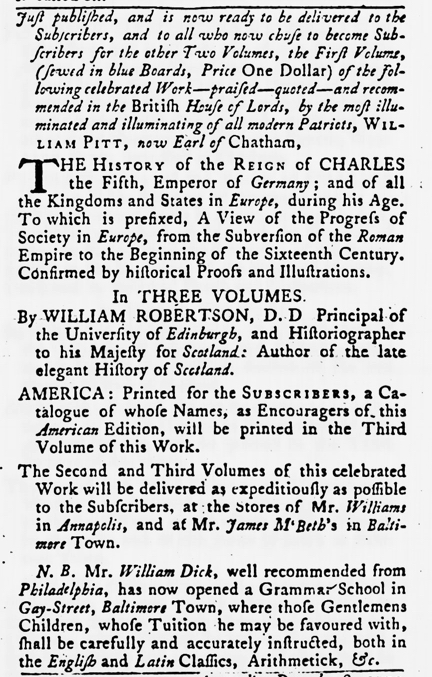
“AMERICA:  Printed for the SUBSCRIBERS.”

When Robert Bell published an American edition of “THE HISTORY of the REIGN of CHARLES the Fifth, Emperor of Germany” in 1771, he placed advertisements and subscription notices in multiple newspapers in several colonies.  Printer-publishers regularly adopted that strategy, especially prior to the American Revolution, because local markets did not necessarily support the publication of American editions as alternatives to imported ones.  To generate sufficient demand to make American editions viable ventures, Bell and his counterparts had to engage consumers across large regions rather than just in their own towns.

Bell, one of the most famous and influential American booksellers both before and after independence, made innovations to the practice of reprinting the same advertisements and subscription notices from one newspaper to another.  Rather than submitting identical copy to multiple newspapers, updating only the names of the local sellers and subscription agents, he devised a series of notices that varied from publication to publication.  Each contained some of the especially elaborate, even by eighteenth-century standards, language that became one of Bell’s trademarks.  He opened his advertisement in the January 31 edition of the Maryland Gazette, for instance, with a proclamation that he had “Just published … the following celebrated Work – praised – quoted – and recommended in the British House of Lords, by the most illuminated and illuminating of all modern Patriots, WILLIAM PITT, now Earl of Chatham.”  Pitt became popular among American colonists for defending their interests against attempts by Parliament to regulate commerce and other impositions.  In particular, he vigorously opposed the Stamp Act, arguing that it was unconstitutional to impose taxes on the colonies.  It was not merely Pitt’s testimonial regarding “THE HISTORY of the REIGN of CHARLES the Fifth, Emperor of Germany” that Bell expected would resonate with consumers but also his reputation as an advocate for the colonies.

Bell also included a version of the imprint in his advertisement: “AMERICA:  Printed for the SUBSCRIBERS, a Catalogue of whose Names, as Encouragers of this American Edition, will be printed in the Third Volume of this Work.”  He did not follow the usual practice of listing a city.  This was not, after all, a book printed in Philadelphia, but instead an American production that demonstrated the literary culture of the colonies considered collectively.  Bell worked to create a sense of community among subscribers who purchased copies, an imagined community, to use the phrase coined by Benedict Anderson, constructed with print and extending great distances.  Despite those distances, the subscribers had a common meeting place in the “Catalogue” of names printed in the final volume.  Publishing a list of subscribers who made a publication possible was not new, but Bell presented the opportunity for prospective buyers to be included as a testament to their patriotism and support for the American cause rather than merely an indication of their status and good taste.

The advertisement concluded with a quirky nota bene in which Bell recommended a schoolmaster from Philadelphia who recently moved to Baltimore, an endorsement seemingly unrelated to the remainder of notice.  It may have been less expensive for Bell to append the nota bene rather than insert a separate advertisement.  Whatever the reason, the nota bene fit well with Bell’s pattern of deviating from expectations and setting his own standards, both within his advertisements and in his eccentric behavior at book auctions.  His advertisement deployed familiar “Buy American” appeals, but did so in especially exuberant language, invited prospective subscribers to become part of a community of citizen-readers, and ended with a recommendation for a schoolmaster.  Bell presented consumers some of the appeals they came to expect from him as well as at least one surprise, a pattern for engaging with customers and audiences that he further developed over the next several decades.

April 1

What was advertised in a colonial American newspaper 250 years ago this week?

Apr 1 - 3:29:1770 South-Carolina Gazette
South-Carolina Gazette (March 29, 1770).

“ASSORTMENT of GOODS, Agreeable to the RESOLUTIONS.”

The partnership of Smith and Atkinson informed consumers in and around Boston that they stocked “A small Assortment of English Goods, (imported before the late Agreements of the Merchants)” in an advertisement in the March 29, 1770, edition of the Massachusetts Gazette and Boston Weekly News-Letter.  On the same day, James McCall took to the pages of the South-Carolina Gazette to announce that he carried an “ASSORTMENT of GOODS” imported in the Sea Venturefrom Bristol “Agreeable to the RESOLUTIONS.”  This marketing strategy was less common in the newspapers published in Charleston than in Boston, but not unknown.

In both cities, purveyors of goods believed that asserting that they acquired their goods according to the terms of nonimportation agreements adopted in protest of import duties Parliament imposed on paper, glass, lead, paint, and tea would incite demand.  They offered colonists the opportunity to continue participating in the consumer revolution without violating the political principles that inspired the “RESOLUTIONS” or the “late Agreements.”  Yet their newspaper notices did more than reassure prospective customers.  McCall intended to safeguard his own reputation, as did Smith and Atkinson.  They wanted all readers and, by extension, the entire community to know that they abided by the nonimportation agreements.  Making such declarations not only amounted to good business sense but also aided in maintaining their status and relationships.

In Charleston and Boston, both advertisers and prospective customers spoke a common language of consumption that was inflected with politics.  T.H. Breen makes in this argument in The Marketplace of Revolution:  How Consumer Politics Shaped American Independence.  At the nexus of consumer culture and print culture, newspaper advertisements for consumer goods and services played an important role in developing and propagating the language of consumption.  This yielded what Benedict Anderson termed imagined communities – communities of readers and communities of consumers – that made colonists in faraway places like Boston and Charleston feel as though they shared a common identity.

March 13

What was advertised in a colonial American newspaper 250 years ago today?

Mar 13 - 3:13:1770 South-Carolina Gazette and Country Journal
South-Carolina Gazette and Country Journal (March 13, 1770).

“A CHINA MANUFACTURE.”

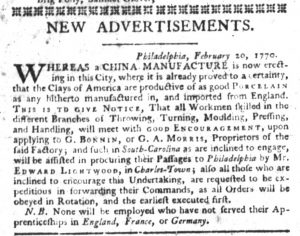
In January 1770 an advertisement for “New China Ware ran in the Pennsylvania Chronicle.  In it, the “CHINA PROPRIETORS in PHILADELPHIA” advised both retailers and consumers that they had set up production of porcelain “as good … as any heretofore manufactured at the famous factory in Bow, near London, and imported into the colonies.”  This enterprise aimed to provide colonists with alternatives to imported merchandise; both imported goods and “domestic manufactures” assumed new political significance when merchants and shopkeepers adopted nonimportation agreements to protest the duties levied on imported paper, glass, paint, lead, and tea in the Townshend Acts.

Two months later an advertisement about the “CHINA MANUFACTURE … now erecting” in Philadelphia appeared in the South-Carolina Gazette and Country Journal.  The proprietors, G. Bonnin and G.A. Morris, had two purposes in placing that notice:  recruiting workers and marketing their wares.  They reiterated the claims they made in the Pennsylvania Chronicle, proclaiming that “the Clays of America are productive of as good PORCELAIN as any hitherto manufactured in, and imported from England.”  Given those resources available to them, the proprietors also needed “Workmen skilled in the different branches of Throwing, Turning, Moulding, Pressing, and Handling.”  In a nota bene at the conclusion of the advertisement they proclaimed that “None will be employed who have not served their Apprenticeships in England, France, or Germany.”  Bonnin and Morris eschewed imported goods, but they still wished to draw on skills that had been learned on the other side of the Atlantic.  The quality of the “Clays of America” alone did not yield finished goods that competed with those produced in England.  To assist in acquiring the skilled workers they needed, the proprietors designated a local agent in Charleston.  They instructed “such in South-Carolina as are inclined to engage” that they would be “assisted in procuring their Passages to Philadelphia by Mr. EDWARD LIGHTFOOT.”

In addition to seeking workers, Bonnin and Morris made an appeal to prospective customers, “those who are inclined to encourage this Undertaking.”  They did not explicitly state that consumers had a duty to purchase goods produced in the colonies, but given the news and commentary that appeared elsewhere in the newspaper the proprietors likely depended on readers making such connections between consumption and politics.  Bonnin and Morris both invoked a sense of urgency and suggested existing demand for their wares, requesting customers “to be expeditious in forwarding their Commands” while also clarifying that “all Orders will be obeyed in Rotation” with “the earliest executed first.”  In so doing, they again repeated marketing strategies incorporated into their earlier advertisement in the Pennsylvania Chronicle.

Bonnin and Morris’s efforts to produce “domestic manufactures” and promote them to consumers were not merely local or even regional endeavors.  They looked far beyond Philadelphia and the Middle Colonies when recruiting workers and customers, further strengthening networks of both print and consumption that increasingly contributed to a sense of an imagined community that stretched from New England to Georgia.

January 23

What was advertised in a colonial American newspaper 250 years ago today?

Jan 23 - 1:23:1770 South-Carolina Gazette and Country Journal
South-Carolina Gazette and Country Journal (January 23, 1770).

“SUBSCRIPTIONS are taken in by the Printer of this Paper.”

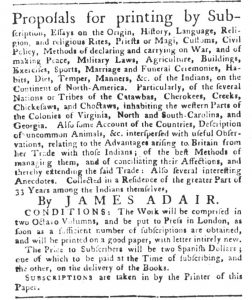
The many and various advertisements for consumer goods and services in the January 23, 1770, edition of the South-Carolina Gazette and Country Journal included a subscription notice for “Essays on … the Indians, on the Continent of North-America” by James Adair, who had resided “the greater Part of 33 Years among the Indians themselves.” Those essays focused “Particularly” on the Catawbas, Cherokees, Creeks, Chickasaws, and Choctaws “inhabiting the western Parts of the Colonies of Virginia, North and South-Carolina, and Georgia.” Given their proximity, the author or publisher expected that the proposed book would resonate with prospective subscribers in South Carolina … and in Georgia. The same subscription notice ran on several occasions in the Georgia Gazette in late 1769 and early 1770.

Charles Crouch, printer of the South-Carolina Gazette and Country Journal, and James Johnston, printer of the Georgia Gazette, acted as local agents on behalf of the author or publisher. The book would not go to press until enough “subscribers” expressed interest and confirmed their intention to buy it by putting down a deposit in advance. By enlisting local agents and seeking subscribers in South Carolina, Georgia, and likely other places as well, the author or publisher aimed to enlarge the market and make the proposed book a viable endeavor.

The advertisements in the two newspapers contained exactly the same copy (except for the final word, “Paper” instead of “Gazette”). The author or publisher may have written out the advertisement once and then carefully copied it into letters directed to multiple printing offices. Alternately, the subscription notice may have appeared once in one newspaper and then the author or publisher forwarded clippings along with requests to insert the notice in other newspapers when soliciting the cooperation of additional local agents. Depending on the sophistication of the marketing efforts, the author or publisher may even have distributed broadside subscription notices with space for subscribers to sign their names. The copy for newspaper advertisements could have been drawn directly from such broadsides.

Regardless of how the South-Carolina Gazette and Country Journal and the Georgia Gazette ended up publishing advertisements with identical copy, readers in the two colonies encountered the same subscription notice within a single week. This contributed to the creation of an imagined community among colonists, a common identity as readers and consumers, as the press presented the same news items, reprinted from one newspaper to another to yet another, and, sometimes, the same advertisements as well.

October 17

What was advertised in a colonial American newspaper 250 years ago today?

Oct 17 - 10:17:1769 Essex Gazette
Essex Gazette (October 17, 1769).

“JUST PUBLISHED … A Volume of Curious Papers.”

A brief advertisement in the October 17, 1769, edition of the Essex Gazette (published in Salem) announced that “A Volume of Curious Papers collected by His Honor the Lieutenant-Governor, which may serve as an Appendix to his History of Massachusets Bay” had gone to press and was “now ready to be delivered to the Subscribers by T. and J. FLEET, Printers in Boston.” This notice was a variation on advertisements that ran in newspapers throughout New England during the previous week. One variation ran in the New-Hampshire Gazette (published in Portsmouth) on Friday, October 13 and in the Providence Gazette on Saturday, October 14. The Fleets inserted a slightly different version in their own newspaper, the Boston Evening-Post, on Monday, October 16. That same day, variations ran in the Boston-Gazette, the Connecticut Courant (published in Hartford), and the Newport Mercury. Following publication in the Essex Gazette on October 17, a similar notice appeared in the Massachusetts Gazette and Boston Weekly News-Letter on Thursday, October 19. Over the course of a week, the Fleets inserted notices about the publication of this “Volume of Curious Papers” in eight newspapers printed in six cities and towns in four colonies.

This meant that readers in Boston, Hartford, Newport, Portsmouth, Providence, Salem, and beyond encountered similar advertisements for the same product, a book about the history of Massachusetts, as they perused their local newspapers. Although most advertisers were not so enterprising when it came to publishing notices in multiple colonies, members of the book trades often relied on subscription notices distributed widely as a means of creating markets for books they wished to publish. Printers published proposals in several newspapers and, later, published updates for subscribers who pre-ordered books, including, ultimately, announcements informing both subscribers and the general public when they published a proposed work.

These advertisements contributed to the formation of what Benedict Anderson termed “imagined communities” of geographically dispersed people drawn together through the experience of simultaneously reading the same content in newspapers. In the eighteenth century, most of this content consisted of news and editorials, especially since colonial printers liberally reprinted material from one newspaper to another. T.H. Breen has argued that colonists also formed imagined communities around consumption practices, demonstrating that the same sorts of goods appeared in newspaper advertisements from New England to Georgia. Subscription notices and subsequent advertisements, however, did not merely expose readers to similar wares. Like the news and editorials reprinted from one newspaper to another, they replicated content associated with particular products, in this case a “Volume of Curious Papers” about the history of Massachusetts. Print helped to knit together colonists in the era of the American Revolution, but the print that did so was not limited to newspaper reports or political pamphlets distributed far and wide. Sometimes advertising also contributed to the formation of imagined communities in early America.