September 22

What was advertised in a revolutionary American newspaper 250 years ago today?
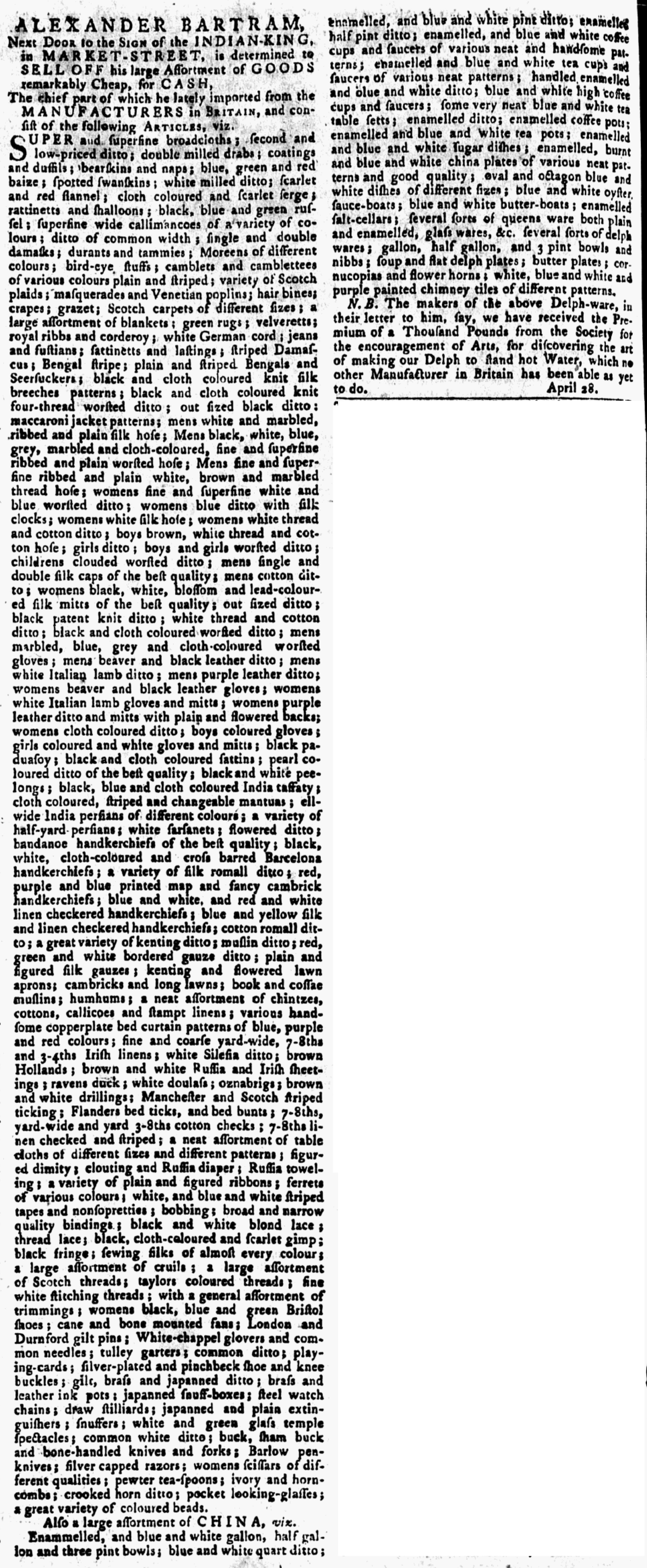
Story and Humphreys’s Pennsylvania Mercury (September 22, 1775).

“Determined to SELL OFF his large Assortment of GOODS remarkably Cheap.”

The pages of American newspapers had a different appearance after the Continental Association went into effect on December 1, 1774.  While adherence to prior nonimportation agreements had been scattered, this one attracted much greater compliance.  As a result, the advertisements that featured lengthy lists of imported merchandise to be sold by local merchants and shopkeepers appeared in the public prints less often, but they did not disappear completely.  Notices that listed a few dozen items continued to appear in some newspapers.

Even so, Alexander Bartram’s advertisement for goods “lately imported from the MANUFACTURERS in BRITAIN” seemed extraordinary because of its length.  It did not fill only a portion of a column in Story and Humphreys’s Pennsylvania Mercury; instead, it extended an entire column and overflowed into another column.  It cataloged dozens of items available at his shop “Next Door to the SIGN of the INDIAN-KING, in MARKET-STREET” in Philadelphia.  Dated April 28, Bartram’s advertisement first appeared in the newspaper on that day in 1775 and then again in the supplement the following week.  The shopkeeper declared his intention to “SELL OFF his large Assortment of GOODS remarkably Cheap.”  He apparently acquired his wares prior to December 1, though he did not make a point of asserting that was the case.  The boycott presented an opportunity to clear his shelves of older merchandise since he would not have to compete with new arrivals.

Five months later, his advertisement ran in Story and Humphreys’s Pennsylvania Mercury once again.  The compositor had not broken down the type in that time.  With the Continental Association still in effect, Bartram saw another opportunity to clear the shelves in his shop … but how many of the items listed in his advertisement remained after his prior attempts to sell them “remarkably Cheap” over the summer?  That likely mattered little to Bartram, especially if he believed that such an extensive list would get customers looking for bargains through the doors.  A month later, he took to the Pennsylvania Journal with a much shorter advertisement that promoted a “General assortment of MERCHANDIZE, suitable for the season.”  Dated October 25 and scheduled to run for six weeks, that notice advised that Bartram “proposes to leave the city in a short time.”  If he already planned to depart Philadelphia at the time he republished his lengthy advertisement in late September, he may have considered it worth the expense of taking up so much column space if it might result in significant sales to liquidate his merchandise.
September 19

What was advertised in a revolutionary American newspaper 250 years ago today?

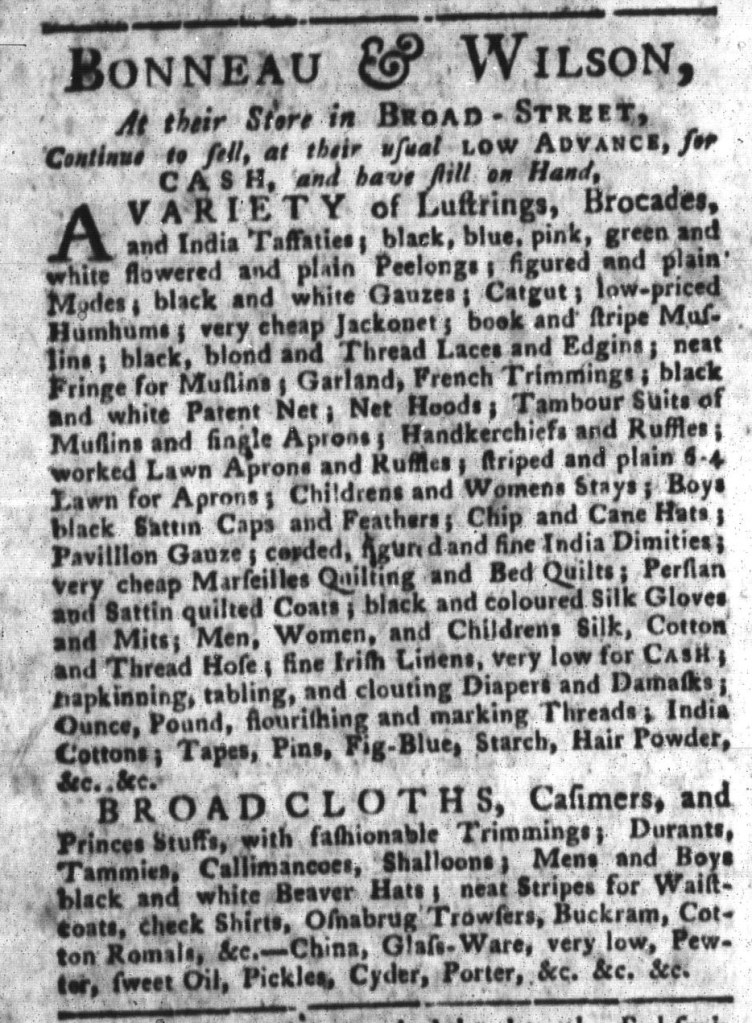
South-Carolina Gazette (September 19, 1775).

“Bonneau & Wilson … Continue to sell … fashionable Trimmings.”

It was the type of advertisement that often appeared in colonial newspapers from New England to Georgia during the middle third of the eighteenth century.  In the September 19, 1775, edition of the South-Carolina Gazette, Bonneau and Wilson listed an array of imported goods available at their store on Broad Street in Charleston.  They stocked everything from “Tambour Suits of Muslins and single Aprons” to “Persian and Sattin quilted Coats” to “black and coloured Silk Gloves and Mits” to “Men, Women, and Childrens Silk, Cotton and Thread Hose.”

The merchants did not indicate when they acquired those items, whether they had arrived before the Continental Association went into effect on December 1, 1774, but they did state that they “Continue to sell” them.  Perhaps they meant that they continued to sell goods received before the nonimportation agreement went into effect.  After all, the familiar format of their advertisement lacked some elements that often appeared in such notices.  It did not proclaim that they had just imported their merchandise on the latest vessels from English ports, nor did it name which ships had transported their wares so prospective customers could confirm that they stocked new items.

Neither did Bonneau and Wilson assure the public that they sold goods according to the provisions of the Continental Association.  They may not have believed it necessary considering the surveillance underway at the time.  Just a few days earlier Richard Lushington ran an advertisement in the South-Carolina and American General Gazette to defend his reputation against allegations by “some evil, malicious designed Person or Persons” to the “Committee of Charlestown” that he did not abide by the Continental Association.  In addition, no reader could have perused Bonneau and Wilson’s advertisement without keeping current events in mind, especially since the first page of that issue featured “A DECLARATION By the REPRESENTATIVES of the United Colonies of NORTH-AMERICA, now in General Congress, at PHILADELPHIA, setting forth the Causes and Necessity of their taking up Arms.”

Some aspects of Bonneau and Wilson’s advertisement suggested business as usual at their store, especially the extensive list of imported goods, yet missing elements, news items that accompanied their notice, and current events all indicated that both the merchants and their prospective customers thought about the marketplace differently than they had when similar advertisements ran in newspapers before the imperial crisis.

September 10

What was advertised in a revolutionary American newspaper 250 years ago this week?

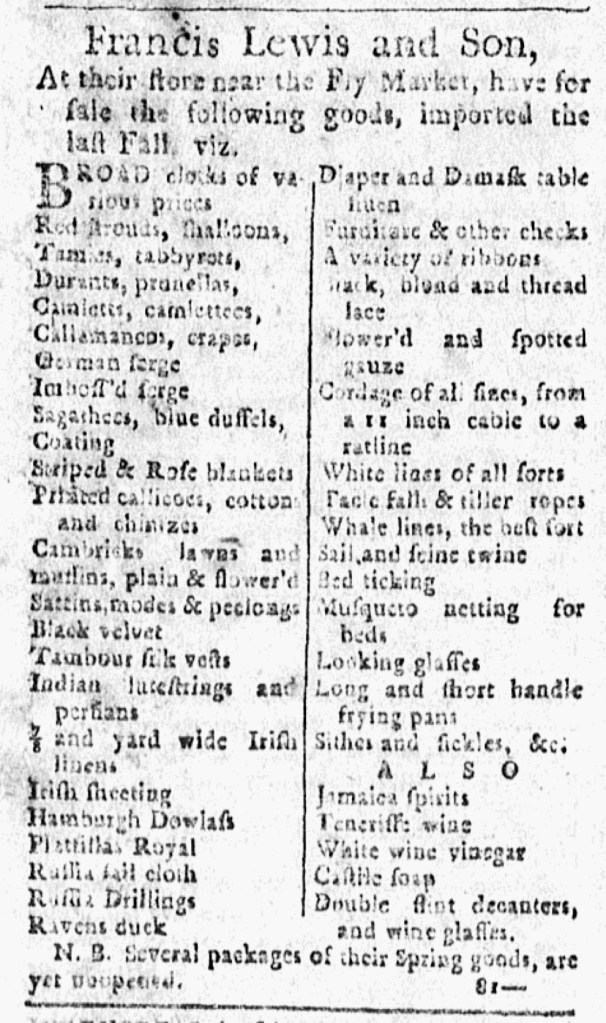
New-York Journal (September 7, 1775).

“Several packages of their Spring goods, are yet unopened.”

As fall arrived in 1775, Francis Lewis and Son took to the pages of the New-York Journal to advertise an array of imported goods that they stocked and sold at their store.  As many merchants and shopkeepers did, they demonstrated the choices they made available to consumers with a list of their inventory.  Their catalog featured two columns with one or two items per line, enumerating “Red strouds, shalloons,” “Printed callicoes, cotton and chintzes,” “A variety of ribbons,” “Musqueto netting for beds,” “Looking glasses,” and “Long and short handle frying pans.”  That popular format for newspaper advertisements did not appear with the same frequency once the Continental Association went into effect on December 1, 1774.  Recognizing that the nonimportation pact devised by the First Continental Congress in response to the Coercive Acts remained in place, Lewis and Son signaled that they abided by it.

The savvy entrepreneurs specified that their wares had been “imported last Fall.”  Under other circumstances, retailers did not boast that their merchandise had been on the shelves for nearly a year.  Instead, they emphasized how recently they received shipments from London and other English ports, sometimes even naming which vessels had transported the goods so readers who followed the shipping news could confirm that sold new items.  In this instance, however, Lewis and Son needed to assure the public, especially prospective customers, that they did not deviate from the Continental Association.  Patriots could not fault shopkeepers and consumers for selling and buying goods “imported the last Fall.” To underscore that they made a deliberate choice, Lewis and Son added a nota bene: “Several Packages of their Spring goods, are yet unopened.”  That note had even greater in significance in September 1775, following the outbreak of hostilities at Lexington and Concord, than it did when the advertisement first appeared in the March 23, 1775, edition of the New-York Journal.  Lewis and Son highlighted their own restraint in placing goods in the marketplace even as they suggested to prospective customers that they barely had to restrain themselves in their purchases because the shopkeepers offered so many choices.

May 16

What was advertised in a revolutionary American newspaper 250 years ago today?

Dunlap’s Maryland Gazette (May 16, 1775).

“He will sell at smaller profits than usual … agreeable to the resolve of the Continental Congress.”

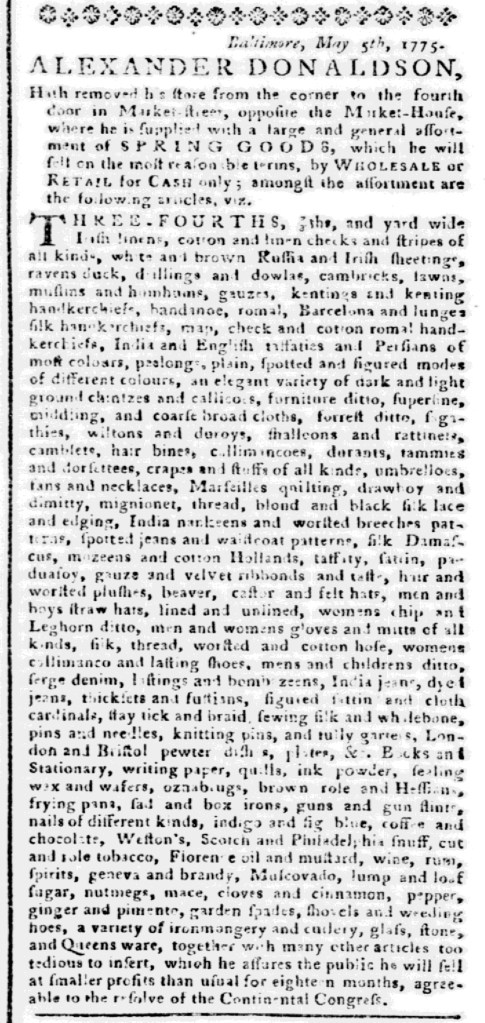
Alexander Donaldson advertised a “large and general assortment of SPRING GOODS” available at his store in Baltimore in Dunlap’s Maryland Gazette in the spring of 1775.  To entice prospective customers, he provided an extensive list of textiles, accessories, housewares, and other items.  His inventory included, for instance, “India and English taffaties and Persians of most colours,” “an elegant variety of dark and light ground chintzes and callicoes,” “umbrelloes, fans and necklaces,” “taffaty, sattin, paduasoy, gauze and velvet ribbonds,” “men and womens gloves and mitts of all kinds,” “London and Bristol pewter,” “a variety of ironmongery and cutlery,” and “writing paper, quills, ink powder, [and] sealing wax and wafers.”  Donaldson also stocked “many other articles too tedious to insert,” though his concern may have been the additional cost to catalog even more of his merchandise in an already-lengthy newspaper notice.

The merchant ended with a note that he “will sell at smaller profits than usual for eighteen months, agreeable to the resolve of the Continental Congress.”  In doing so, he invoked the ninth article of the Continental Association, a nonimportation, nonconsumption, and nonexportation agreement devised by the First Continental Congress in response to the Coercive Acts.  That article specified, “That such as are Venders of Goods or Merchandise will not take Advantage of the Scarcity of Goods thar may be occasioned by this Association, but will sell the same at the Rates we have been respectively accustomed to do for twelve Months last past.”  In other words, merchants and shopkeepers would not gouge customers by jacking up prices once the Continental Association went into effect on December 1, 1774.  The ninth article also spelled out the consequences: “if any Venders of Goods or Merchandise shall sell any Goods on higher Terms, or shall in any Manner, or by any Device whatsoever, violate or depart from this Agreement, no Person ought, nor will any of us deal with any such Person, or his or her Factor or Agent, at any Time thereafter, for any Commodity whatever.”

Considering such penalties, Donaldson very carefully explained that he set fair prices.  Even better, he offered bargains to his customers.  The Continental Association called for selling at the “Rates” or prices established during the year before it went into effect, yet Donaldson declared that he “will sell at smaller profits than usual.”  He did not indicate when his good arrived in the colonies, leaving it to readers to assume that since he abides by the price controls that he also observed the deadline for receiving imported goods.  The favorable “Rates” for his wares may have also distracted colonizers from asking too many questions about when Donaldson’s inventory had been ordered and shipped or when it arrived in an American port.  In addition, the merchant did not list tea, forbidden by the third article, alongside other popular beverages, coffee and chocolate, another indication that he adhered to the Continental Association.  Donaldson signaled to customers that they could shop at his store while still supporting the American cause.

April 15

What was advertised in a colonial American newspaper 250 years ago today?

Pennsylvania Ledger (April 15, 1775).

“MERCHANDIZE, imported [in] the last fall vessels from Europe.”

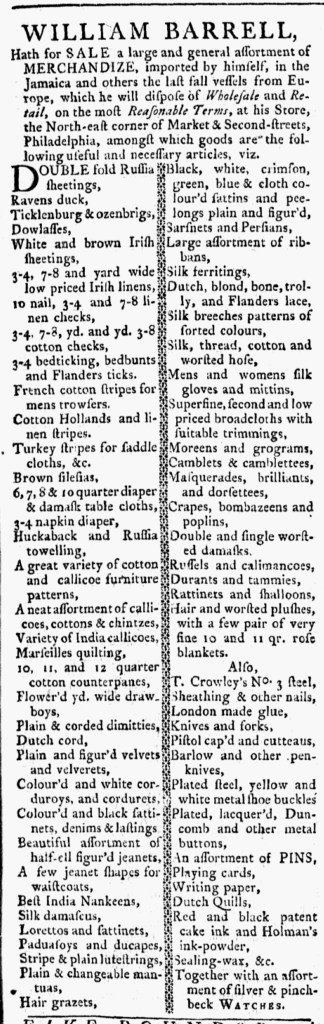
William Barrell’s advertisement in the April 15, 1775, edition of the Pennsylvania Ledger looked much like many of the advertisements that merchants and shopkeepers had been placing in American newspapers for the past couple of decades.  That was even though the Continental Association, a nonimportation agreement devised by the First Continental Congress, had been in effect since December 1, 1774.  Colonizers sought to use economic leverage to convince Parliament to repeal the Coercive Acts.

The notice filled most of the first column on the first page, making it difficult for readers to miss.  Barrell promoted a “large and general assortment of MERCHANDIZE.”  To demonstrate the choices available to consumers, he included an extensive catalog that accounted for most of the space occupied by the advertisement.  He did not opt for dense paragraphs of text, instead arranging with the compositor to divide the list of his inventory into two columns with a line comprised of printing ornaments running down the center.  One, two or three related items appeared on each line.  Barrell stocked all sorts of textiles, everything from “Ticklenburg & ozenbrigs” to “Colour’d and white corduroys, and cordurets” to Crapes, bombazeens and poplins.”  He also carried “Mens and womens silk gloves and mittins,” “Playing cards,” and “Plated, lacquer’d Duncomb and other metal buttons.”  Prospective customers had access to the same variety of goods as they did before the nonimportation agreement.

In his introduction to his list of “useful and necessary articles,” Barrell made a standard appeal to price, stating that he sold his wares “on the most Reasonable Terms.”  He also noted that he imported them via the “last fall vessels from Europe.”  The savvy merchant carefully alerted the public that he was not breaking the Continental Association by selling goods imported since December 1.  Instead, he continued to stock and sell only items that arrived in Philadelphia before the Continental Association went into effect.  In that regard, his advertisement did differ from those published at other times.  Merchants and shopkeepers often emphasized that they peddled new inventory that just arrived.  Customers could select from among the latest styles.  In this instance, however, Barrell realized that consumers would accept, even embrace, goods that had been on the shelves for a few months, especially if he emphasized that they had not been there for too long, just since the arrival of the “last fall vessels.”

April 5

What was advertised in a colonial American newspaper 250 years ago today?

Pennsylvania Journal (April 5, 1775).

“JOHN MITCHELL’s WINE, SPIRIT, RUM, and SUGAR STORES.”

John Mitchell operated an alcohol emporium in Philadelphia in the 1770s.  In April 1775, he advertised his “WINE SPIRIT, RUM, and SUGAR STORES” on Front Street, inviting customers in the city and its hinterland to purchase his wares and then retail them at their shops or taverns or enjoy imbibing them at home.  To entice prospective customers, he compiled a lengthy list of his current selection along with a pledge to “keep a constant supply of the above Articles” to avoid disappointments associated with selling out of any favorites.

His inventory included, for instance, “BEST Genuine Madeira Wines,” “Excellent bottled Claret,” “Genuine new and old Port Wine,” “Teneriffe and Fyal Wines,” “Red Lisbon Wine,” “Genuine old French Brandy,” “Shone’s, Ben. Kenton and Parker’s best London bottled Porter,” “Genuine Button and Taunton Ale,” and “West-India and New-England Rum,” along with many other choices.  For many items, Mitchell listed several sizes, indicating that customers could purchase the right amount for their home or business.  He sold Madeira by the gallon or in barrels of various sizes, including “by the pipe, hogshead, [and] quarter-cask.”  The bottled porters came “by the hogshead, hamper or dozen” to meet the budget and the convenience of his customers.

The format of Mitchell’s advertisement highlighted the choices.  Rather than list his wines and spirits in a dense paragraph, as many advertisers did when they sought to demonstrate the selection of goods they offered to consumers, Mitchell devoted one line to each item.  That made it easier for readers to peruse his catalog while also creating visual elements that differentiated his advertisement from news items and other notices that consisted of blocks of text justified on both the left and the right.  The variations in white space that resulted from centering each item on its own line made “Best Genuine Madeira Wines,” “Teneriffe and Fyal Wines,” “Genuine old French Brandy,” and “Spanish Brandy” even more visible within the advertisement.  Both the extensive accounting of wines and spirits and the design of Mitchell’s notice contributed to attracting the attention of prospective customers.

March 21

What was advertised in a colonial American newspaper 250 years ago today?

Pennsylvania Evening Post (March 21, 1775).

“Being resolved to decline his Retail Trade … he will sell his Stock of Goods on Hand at the very lowest Rates.”

George Bartram had been in business “At the Sign of the GOLDEN FLEECE’s HEAD” in Philadelphia for several years by the time he placed an advertisement in the March 21, 1775, edition of the Pennsylvania Evening Post.  He sometimes called his establishment the Woollen-Drapery and Hosiery WAREHOUSE and used visual elements to enhance his advertisements.  For instance, a decorative border enclosed the name of his business in some advertisements while others featured a woodcut that depicted that golden fleece’s head.  Earlier in his career, he kept shop “at the Sign of the Naked Boy.”  An even more elaborate woodcut replicated that sign with a naked boy holding a yard of cloth in a cartouche in the center, flanked by rolls of fabric on either side and the proprietor’s name below them.  Bartram was still using the golden fleece’s head woodcut to adorn his advertisements in Dunlap’s Pennsylvania Packet in March 1775, but he did not have a second one to use in the Pennsylvania Evening Post.

Instead, he relied on advertising copy in making his pitch to prospective customers.  As he had often done in previous newspaper notices, Bartram emphasized the array of choices he made available to consumers, promoting a “large and fresh Assortment of MERCHANDIZE.”  To demonstrate that was the case, he inserted a lengthy list of goods, such as “Broadcloaths, of the neatest and most fashionable Colours, with suitable Trimmings,” “beautiful buff and white Hair Shags,” “rich black Paduasoys and Satins,” and “handsome Silk and Worsted Stuff for Womens Gowns.”  His intended for those evocative descriptions to entice readers.  He played to both taste and imagination by making choice a theme throughout his catalog of merchandise: “Handkerchiefs of all Sorts,” “a Variety of Cambricks suitable for Gentlemen’s Ruffles and Stocks,” “a large Assortment of brown and white Russia Sheetings and Hessians,” “an elegant Assortment of the best Moreens,” “a Quantity of the best Rugs,” and “a large Assortment of Hosiery.”

In a final nota bene, Bartram announced that customers could acquire his wares at bargain prices because he was going out of business.  He “resolved to decline his Retail trade” and “assures his Friends and the Public that he will sell his Stock of Goods on Hand at the very lowest Rates.”  He also offered a discount “to those who purchase a Quantity,” hoping that would offer additional encouragement for prospective customers.  Bartram did not indicate why he was closing his business, though the Continental Association, a nonimportation agreement adopted throughout the colonies, may have presented an opportunity to liquidate his merchandise and get rid of items that had lingered on the shelves in his Woollen Drapery and Hosiery Warehouse.  Bartram was “SELLING OFF” his inventory, offering good deals on absolutely everything.

August 20

What was advertised in a colonial American newspaper 250 years ago today?

Providence Gazette (August 20, 1774).

Simpson’s Hard-Ware Store.”

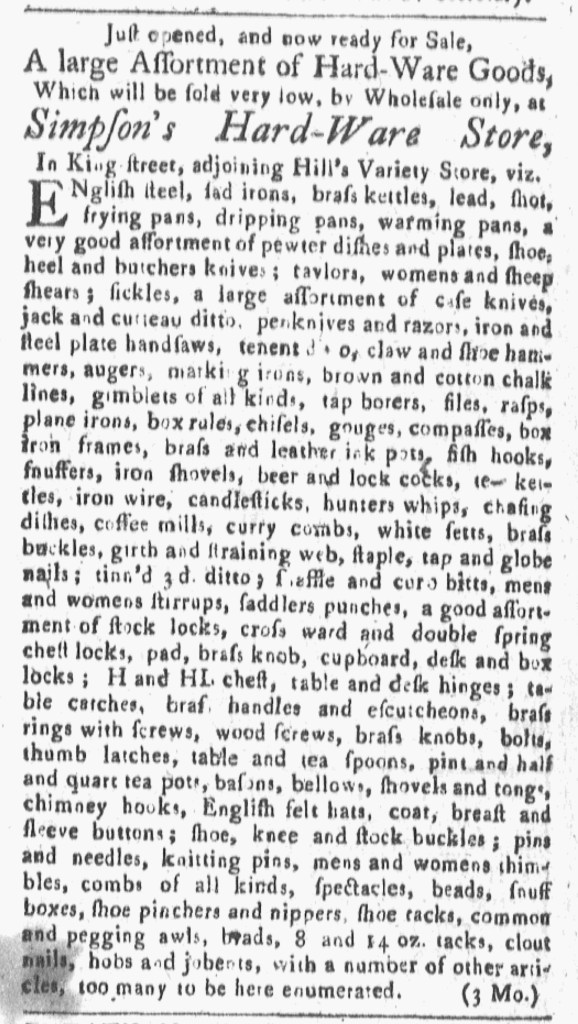
As fall approached in 1774, a new advertisement in the Providence Gazette alerted the public that “Simpson’s Hard-Ware Store” had “Just opened” and offered a “large Assortment of Hard-Ware Goods” for “Wholesale only.”  Shopkeepers seeking to replenish their inventories could acquire merchandise there rather than place orders with merchants who would then import those goods.  The speed and convenience may have been especially attractive considering that many colonizers anticipated a general boycott on importing textiles, hardware, and all sorts of other items from England in response to the Coercive Acts passed by Parliament.  Delegates were already enroute to Philadelphia or arrived there to discuss a united response at what would become known as the First Continental Congress.

Simpson did not make explicit mention of politics, but doing so would not have been necessary for readers to understand the context in which he marketed his wares.  Several articles in the August 20 edition of the Providence Gazette provided coverage, in addition to the conversations, debates, and anxious musings taking place in private and public spaces throughout town.  Simpson instead focused on demonstrating the many choices he made available, just as his neighbor, Hill’s Variety Store, had done for many months.  His “Hard-Ware Store” stocked everything from “claw and shoe hammers” to “a good assortment of stock locks, cross ward and double spring locks” to Taylors, womens and sheep shears” to “a very good assortment of pewter dishes and plates,” far more than just hardware.  In addition to the items included in the extensive catalog in his advertisement, Simpson also carried “a number of other articles, too many to be here enumerated.”  If prospective customers could not find what they desired at Hill’s Variety Store they needed to check the shelves right next door at the hardware store.

A notation that read “(3 Mo.)” appeared at the end of Simpson’s advertisement, indicating that he intended for it to run for three months from its first insertion in the August 12 edition of the Providence Gazette.  He hoped to part with as much merchandise as possible by then, yet the anticipated longevity of his advertisement also testified to his confidence in its effectiveness.  After all, he would not have agreed to pay to run the notice so many times if he did not expect a return on his investment.  Perhaps he had been inspired by his neighbor, Hill, or even received advice from him after seeing his advertisement week after week for six months.

February 15

What was advertised in a colonial American newspaper 250 years ago today?

Essex Gazette (February 15, 1774).

“He will sell … at so cheap as Rate as he doubts not will give Satisfaction to every Purchaser.”

George Deblois regularly advertised in the Essex Gazette.  On February 15, 1774, he placed a lengthy notice to promote a “fine Assortment of ENGLISH and HARD-WARE GOODS” that he “just received … from LONDON.”  He asserted that these items were “Suitable for the approaching Season,” encouraging consumers to purchase in advance or at least keep his shop in Salem in mind when they were ready to shop for in the coming weeks and months.  A catalog of his merchandise, divided into two paragraphs, accounted for most of the advertisement.  The first paragraph listed the “ENGLISH” goods, mostly textiles and accessories.  Deblois stocked “Scotch Plaids,” “Devonshire Kersies,” “stampt linen Handkerchiefs,” “a fine assortment of men’s worsted Stockings,” and “Hatter’s Trimmings of all sorts.”  He devoted the other paragraph to housewares and hardware, including the “best of London pewter Dishes,” “hardmetal Tea-Pots,” “steel and iron plate Saws of all sorts and sizes,” and “Brads, Tacks and Nails of all sorts.”

The merchant concluded his advertisement with two common appeals, one about consumer choice and the other about his prices.  The lengthy lists of goods already demonstrated the many choices available to his customers, but he insisted that he also stocked “a great Variety of other Articles, too tedious to enumerate in an Advertisement.”  Readers would have to visit his store to discover what else they might want or need that happened to be on his shelves.  No matter what they selected, his customers could depend on paying low prices.  Deblois declared that “he will sell by Wholesale and Retail … at so cheap a Rate as he doubts not will give Satisfaction to every Purchaser.”  Other advertisers frequently made a nod to low prices.  Elsewhere in the same issue of the Essex Gazette, for instance, John Appleton offered his wares “very cheap.”  Deblois embellished his appeal about prices, hoping to draw the attention of prospective customers and convince them that he offered the best deals.  They would depart his store not only pleased with the goods they acquired but also with a sense of “Satisfaction” about how much they paid.  Deblois encouraged consumers to visit his shop by setting favorable expectations for their shopping experiences.

January 3

What was advertised in a colonial American newspaper 250 years ago today?

Boston-Gazette (January 3, 1774).

“A large Assortment of Hard-Ware GOODS, Cutlery, Jewellery, Goldsmith’s, Clock and Watch Articles.”

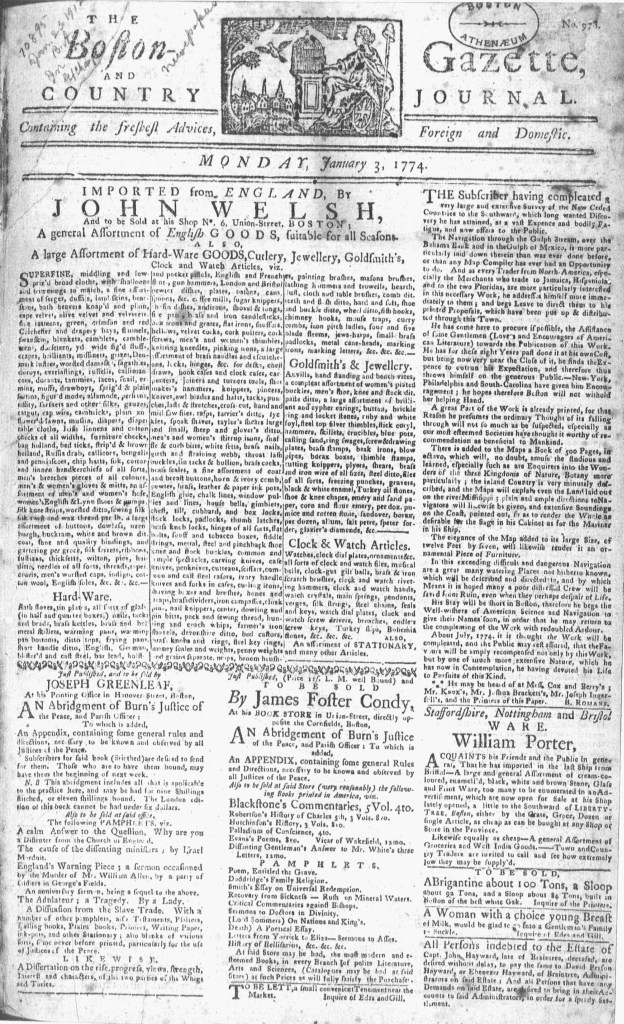
Readers almost certainly noticed John Welsh’s advertisement in the January 3, 1774, edition of the Boston-Gazette.  The shopkeeper announced that he imported and sold “A general Assortment of English GOODS, suitable for all Seasons” and “A large Assortment of Hard-Ware GOODS, Cutlery, Jewellery, Goldsmith’s, Clock and Watch Articles.”  To demonstrate the selection he offered to consumers, Welsh published an extensive list of his inventory.

The length of that list alone distinguished Welsh’s advertisement from others that ran in that issue of the newspaper.  More significantly, the format and placement made his notice notable.  Rather than extending in one column and continuing in the next, the advertisement spanned two of the regular columns, an unusual format in the Boston-Gazette or any other colonial newspaper.  Within the space occupied by the advertisement, the list of goods was divided into three columns with lines, but no space, separating them.  While that made the dense text more difficult to navigate, Welsh did provide some guidance with a series of headers.  The “English GOODS,” mostly textiles and accessories, that appeared first did not have a header, but “Hard-Ware,” “Goldsmith’s & Jewellery,” and “Clock & Watch Articles” each had headers that directed readers to items of interest.

The advertisement’s position on the page also enhanced its visibility.  It ran in the upper left corner on the first page, right below the masthead, making it the first item that readers saw when they perused the first issue of the Boston-Gazettepublished in 1774.  Even if readers who knew that the latest news often appeared on the second and third pages rather than the front page immediately flipped past the first page, they likely noticed Welsh’s advertisement as they skimmed to make sure they did not miss any news that might have appeared on the front page.  After all, the organization did vary from week to week depending on the amount of “intelligence” and advertisements submitted to the printing office.  Welsh’s advertisement dominated the first page, as it would have done on any page.  The unusual format underscored the wide selection of merchandise that he made available to customers.

Boston-Gazette (January 3, 1774).