What was advertised in a colonial American newspaper 250 years ago this week?
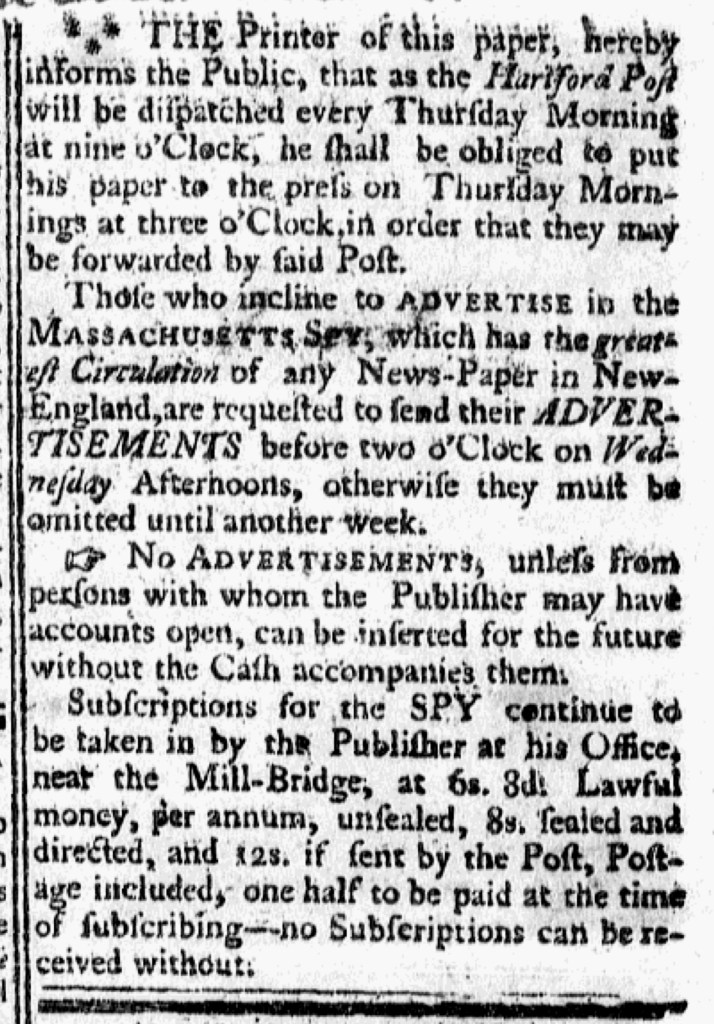
Massachusetts Spy (January 19, 1775).
“No ADVERTISEMENTS … can be inserted for the future without the Cash accompanies them.”
In a notice in the January 19, 1775, edition of the Massachusetts Spy, Isaiah Thomas, the printer, provided several important details about the practices he enacted for publishing his newspaper. He opened by noting that “the Hartford Post will be dispatched every Thursday Morning at nine o’Clock.” In order that that the Massachusetts Spy “may be forwarded by said Post,” Thomas “shall be obliged to put his paper to the press on Thursday Mornings at three o’Clock.” Calling attention to such early mornings not only testified to the industriousness of the printer but also alerted the public that he could publish updates that arrived at his printing office merely hours before he distributed the new issue of his weekly newspaper.
Thomas also advised “[t]hose who incline to ADVERTISE in the MASSACHUSETTS SPY … to send their ADVERTISEMENTS before two o”Clock on Wednesday Afternoons, otherwise they must be omitted until another week.” To convince them to advertise in in his newspaper, he proclaimed that it “has the greatest Circulation of any News-Paper in New-England.” That meant that advertisers were likely to experience the greatest return on their investment by placing notices in the pages of the Massachusetts Spy. Although compositors worked quickly, they did need some time to set type for individual advertisements and lay out all the news, editorials, advertisements, and other content for each issue. While Thomas might welcome “Articles of Intelligence” that arrived very shortly before taking his newspaper to press, he insisted that advertisements required more time to prepare for publication. Advertisers needed to plan accordingly.
In addition, Thomas declared, “No ADVERTISEMENTS, unless from persons with whom the Publisher may have accounts open, can be inserted for the future without the Cash accompanies them.” He also asserted that subscriptions for the newspaper required “one half [of the annual fee] to be paid time of subscribing” and “no Subscriptions can be received without.” Historians of the early American press often make general statements about printers extending generous credit to subscribers, expecting that some would never pay, because they understood that newspaper advertisements were a much more most significant revenue. According to such accounts, printers supposedly insisted on receiving payment for advertisements in advance of publishing them. While that may have been the case in some printing offices, several printers published notices indicating that they departed from such practices. That Thomas put in place such a policy “for the future” suggests that it may have been a new policy or one that he had not previously enforced. Similarly, Thomas joined other printers who extended credit yet also demanded that subscribers submit half of the annual fee in advance, updating the terms that he published in the colophon that appeared in each issue of the Massachusetts Spy.
Isaiah Thomas, patriot printer and founder of the American Antiquarian Society, was born on January 19 (New Style) in 1749 (or January 8, 1748/49, Old Style). It’s quite an historical coincidence that the three most significant printers in eighteenth-century America — Benjamin Franklin, Isaiah Thomas, and Mathew Carey — were all born in January.
Isaiah Thomas (January 30, 1739 – April 4, 1831). American Antiquarian Society.
The Adverts 250 Project is possible in large part due to Thomas’s efforts to collect as much early American printed material as he could, originally to write his monumental History of Printing in America. The newspapers, broadsides, books, almanacs, pamphlets, and other items he gathered in the process eventually became the initial collections of the American Antiquarian Society. That institution’s ongoing mission to acquire at least one copy of every American imprint through 1876 has yielded an impressive collection of eighteenth-century advertising materials, including newspapers, magazine wrappers, trade cards, billheads, watch papers, book catalogs, subscription notices, broadsides, and a variety of other items. Exploring the history of advertising in early America — indeed, exploring any topic related to the history, culture, and literature of early America at all — has been facilitated for more than two centuries by the vision of Isaiah Thomas and the dedication of the curators and other specialists at the American Antiquarian Society over the years.
Thomas’s connections to early American advertising were not limited to collecting and preserving the items created on American presses during the colonial, Revolutionary, and early national periods. Like Mathew Carey, he was at the hub of a network he cultivated for distributing newspapers, books, and other printed goods — including advertising to stimulate demand for those items. Sometimes this advertising was intended for dissemination to the general public (such as book catalogs and subscription notices), but other times it amounted to trade advertising (such as circular letters and exchange catalogs intended only for fellow printers, publishers, and booksellers).
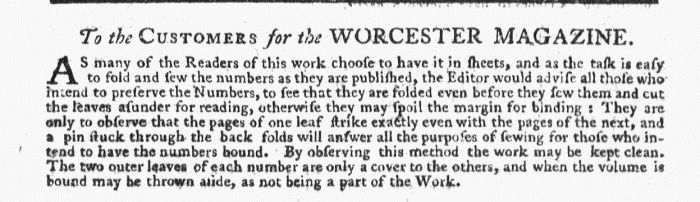
Thomas also experimented with advertising on wrappers that accompanied his Worcester Magazine, though he acknowledged to subscribers that these wrappers were ancillary to the publication: “The two outer leaves of each number are only a cover to the others, and when the volume is bound may be thrown aside, as not being a part of the Work.”[1]
Detail of Advertising Wrapper, Worcester Magazine (Second Week of April, 1786).
Thomas’s patriotic commitment to freedom of the press played a significant role in his decision to develop advertising wrappers. As Thomas relays in his History of Printing in America, he discontinued printing his newspaper, the Massachusetts Spy, after the state legislature passed a law that “laid a duty of two-thirds of a penny on newspapers, and a penny on almanacs, which were to be stamped.” Such a move met with strong protest since it was too reminiscent of the Stamp Act imposed by the British two decades earlier, prompting the legislature to repeal it before it went into effect. On its heels, however, “another act was passed, which imposed a duty on all advertisements inserted in the newspapers” printed in Massachusetts. Thomas vehemently rejected this law as “an improper restraint on the press. He, therefore, discontinued the Spy during the period that this act was in force, which was two years. But he published as a substitute a periodical work, entitled ‘The Worcester Weekly Magazine,’ in octavo.”[2] This weekly magazine lasted for two years; Thomas discontinued it and once again began printing the Spy after the legislature repealed the objectionable act.
Third Page of Advertising Wrapper, Worcester Magazine (Fourth Week of May, 1786).
Isaiah Thomas was not interested in advertising for its own sake to the same extent as Mathew Carey, but his political concerns did help to shape the landscape of early American advertising. Furthermore, his vision for collecting American printed material preserved a variety of advertising media for later generations to admire, analyze, ponder, and enjoy. Happy 276th birthday, Isaiah Thomas!
**********
[1] Isaiah Thomas, “To the CUSTOMERS for the WORCESTER MAGAZINE,” Worcester Magazine, wrapper, second week of April, 1786.
[2] Isaiah Thomas, The History of Printing in America: With a Biography of Printers, and an Account of Newspapers, vol. 2 (Worcester, MA: Isaac Sturtevant, 1810), 267-268.
What was advertised in a colonial American newspaper 250 years ago today?
Massachusetts Spy (December 29, 1774).
“*** The last Chance.”
Prospective customers needed to act quickly or risk missing out on the opportunity entirely. That was the message that Duncan Ingraham, Jr., emphasized in his advertisement for “A few ENGLISH GOODS, now remaining” in his store in Boston at the end of 1774. His notice featured a headline that proclaimed “The last Chance” that he hoped would entice readers to look more closely at the list of merchandise in stock. Unlike the headlines for other advertisements, Ingraham’s headline included three asterisks to help draw attention to the offer he made available for a limited time. That offer included low prices that he described as “terms wholly to the advantage of the purchaser.” Ingraham was so eager to liquidate his inventory that he passed along significant savings to consumers, but only if they acted quickly. He concluded his advertisement with a warning that those “who design purchasing must apply immediately.”
Those “few ENGLISH GOODS, now remaining” had been on hand for six months or more. The Boston Port Act closed the harbor on June 1, 1774. Parliament asserted that the harbor would remain blockaded to commerce until the town made restitution for the property destroyed during the Boston Tea Party in December 1773. As a result, merchants and shopkeepers did not receive shipments from their suppliers in England. Ingraham peddled goods, including “China Bowls, Cups and Saucers,” “a variety of silk mitts and gloves,” and “children’s cotton, thread and worsted hose,” that had been on his shelves for some time. Under other circumstances, advertisers often emphasized that they received their merchandise via the ships most recently arrived in port, anticipating that consumers would associate the newest goods with the most fashionables ones. Such appeals, however, no longer held sway in Boston in the wake of the Boston Port Act. Elsewhere in the colonies, similar appeals lost their effectiveness once the Continental Association, a nonimportation agreement enacted in response to the Boston Port Act and the other Coercive Acts, went into effect on December 1, 1774.
What was advertised in a colonial American newspaper 250 years ago today?
Massachusetts Spy (November 24, 1774).
“They hope that Gentlemen … that have been appointed into Office … will give the Editors immediate Notice.”
Nathaniel Mills and John Hicks, the printers of the Massachusetts Gazette and Boston Post-Boy, used crowdsourcing as one means of gathering information for their publications. To one extent or another, all colonial printers who published newspapers did so, seeking news from ship captains and travelers and reprinting items from one newspaper to another. They also regularly asked the public to submit news. In the colophon for the Massachusetts Gazette and Boston Post-Boy, Mills and Hicks noted that “Letters of Intelligence for this Paper are taken in” at their printing office. It was a familiar invitation. Isaiah Thomas declared that “Articles of Intelligence, &c. are thankfully received” at the printing office where he published the Massachusetts Spy.
Yet Mills and Hicks did not limit crowdsourcing to their newspaper. They also incorporated it into gathering information for almanacs and registers. In early October 1774, they placed an advertisement requesting that “if any new Houses of Entertainment have been opened, or if any were omitted” in that year’s edition of Bickerstaff’s Boston Almanack that “such Tavern Keepers … send their Names immediately” so they could be included in the almanac for 1775. An advertisement for that almanac in the November 24, 1774, edition of the Massachusetts Spy featured a list of contents, including “the best Houses for Travellers to put up at.” The printers presumably added any taverns that came to their attention because of their previous notice.
Immediately above that advertisement, they issued another call for the public to assist in compiling Mills and Hicks’s British and American Register for 1775. The commenced with expressing “their Thanks to such Gentlemen as furnished them with Lists for their REGISTER last Fall, and obligingly offered to assist in correcting the same for the ensuing Year (if published).” The 1774 edition had met with sufficient success, a “generous Reception,” that the printers did indeed feel “encouraged” to “put to the Press” a new Register for the coming year. To make it as accurate and comprehensive as possible, they declared that “they hope that Gentlemen (both in this and the neighbouring Governments) that have been appointed into Office, either Civil, Military or Ecclesiastical, will give the Editors immediate Notice, that their Names may be inserted in the same.” Mills and Hicks relied on the public, especially newspaper readers, to supply them with current information for their compendium of officials in New England.
What was advertised in a colonial American newspaper 250 years ago today?
Massachusetts Spy (November 17, 1774).
“To the whole is added, The ASSOCIATION of the Grand AMERICAN CONGRESS.”
Like many colonial printers, Isaiah Thomas generated significant revenue from publishing almanacs. From the most affluent to the most humble households in port cities and in the countryside, each year colonizers acquired these handy reference manuals that included all kinds of information. Thomas’s “NEW-ENGLAND ALMANACK, OR THE MASSACHUSETTS CALENDER, For the Year of our Lord Christ, 1775,” for instance, had everything from the tides or “Time of High Water” to a schedule of “the Superior and Inferior Courts setting in the four Governments of New-England” to poetry. Thomas “Embellished” the almanac with two images, “one representing an Antient Astrologer, the other a FEMALE SOLDIER.” The latter corresponded to the “LIFE and ADVENTURES of A FEMALE SOLDIER” that the printer promoted among the content of his almanac. Practically every almanac included the tides and many listed the dates for important meetings in Connecticut, Massachusetts, New Hampshire, and Rhode Island, so Thomas and other printers sought ways to distinguish their almanacs from others, including images and novel stories.
Thomas anticipated doing brisk business with the contents that he selected for his almanac. He announced that he sold it “by the Thousand, Hundred, Groce or Dozen, or Single,” offering peddlers, booksellers, and shopkeepers the opportunity to purchase in volume for resale. A single copy cost “Six Coppers,” yet Thomas promised that “Very great Allowances are made to those who buy to sell again.” In addition to turning a profit on his almanac, this patriot printer also wanted it disseminated widely because of a particular item that he inserted among the contents. His almanac included “The ASSOCIATION of the Grand AMERICAN CONGRESS.” He referred to the Continental Association, a nonimportation agreement recently adopted by the First Continental Congress when it met in Philadelphia in September and October 1774. The inclusion of the Continental Association distinguished Thomas’s almanac from others advertised in the same issue of the Massachusetts Spy, including “BICKERSTAFF’S BOSTON ALMANACK” published by Nathaniel Mills and John Hicks and “LOW’S ALMANACK” published by John Kneeland. That newspaper also featured advertisements for two different editions of “EXTRACTS from the Votes and Proceedings of the American Continental CONGRESS,” which included the Continental Association. Whether or not readers happened to purchase that political pamphlet, Thomas provided easy access to what they needed to know about the nonimportation agreement in an almanac that they would consult for a variety of purposes throughout the coming year. He asserted that the Continental Association “is absolutely necessary for every American to be acquainted with” … and since so many colonizers already planned to purchase an almanac for 1775 they might as well become acquainted with the Continental Association by purchasing Thomas’s almanac, the one that he sought to distribute “by the Thousand, Hundred, Groce or Dozen” to get into as many households as possible.
What was advertised in a colonial American newspaper 250 years ago today?
Massachusetts Spy (November 3, 1774).
“I am now sensible that my signing the said Address was altogether improper and imprudent.”
Yet another colonizer who signed “an Address to the late Governor Hutchinson, on his leaving this Province” took to the public prints to recant and apologize. Isaac Mansfield of Marblehead published his message to “my respectable Town and Countrymen” in the November 3, 1774, edition of the Massachusetts Spy. Like others who claimed that they regretted their actions, he asserted that he had endorsed the address “suddenly, and not sufficiently attending to its Impropriety and Tendency.” In other words, he had carelessly affixed his name without giving the contents or their implications much thought. Upon further reflection, realizing what he had done (and facing the consequences of giving “Offence”), he declared that he had no intention of “affronting any Individual” or, especially, “wounding the Constitution of my Country, the Rights and Liberties whereof I esteem it every one’s Duty to preserve and maintain, by all proper, laudable and lawful means.” Mansfield had strayed in expressing Tory sympathies, but he had seen the light. He described signing the address as improper and imprudent, following immediately with an apology and a request for the “Friendship and Regard of my Town and Countrymen.”
Similar disavowals and retractions had been appearing in newspapers in Massachusetts and neighboring colonies for some time. Much shorter versions by J. Fowle and John Prentice, both of Marblehead, that ran in three newspapers published in Boston and another in Salem during the past week also appeared in the November 3 issue of the Massachusetts Spy. Some printers treated them as letters to place among news items, while others placed them with advertisements, making unclear which genre these letter-advertisements represented and whether printers charged for inserting them in their newspapers. Isaiah Thomas, the printer of the Massachusetts Spy, ran the letter-advertisements from Fowle and Prentice below a letter to the editor from “A PROPRIETOR” and above Donald McAlpine’s advertisement for fencing lessons, similar to their placement in the Boston-Gazette three days earlier. Had the men from Marblehead submitted their letter-advertisements to Thomas’s printing office? Or had the patriot printer decided to reprint news from another newspaper? In this instance, the double line separating different kinds of content appeared above the letter-advertisements, signaling to readers that they had finished with the news and began the advertisements. The placement of Mansfield’s letter-advertisement was less ambiguous. It ran on the final page, embedded among advertisements. A notice from Silent Wilde, a post rider, appeared above it and an advertisement for William Hunter’s “Auction-Room” below it. Does that mean that Thomas charged for printing Mansfield’s letter-advertisement? Perhaps, though he may have been more interested in publicizing that another member of the community had seemingly come into conformity with patriot politics than generating revenue from Mansfield’s missive. Either way, readers encountered news about current events as they perused the portion of the Massachusetts Spy that contained advertisements.
What was advertised in a colonial American newspaper 250 years ago today?
Boston Evening-Post (September 26, 1774).
“NUMBER VII. of The Royal American Magazine.”
The Royal American Magazine experienced a disruption in publication during the summer of 1774. In a notice in the June issue, Isaiah Thomas, the founder of the magazine, reported that the “Distresses of the Town of Boston” that resulted from the Boston Port Act forced him to suspend publication for a few months. He hoped to resume once “the Affairs of this Country are a little better settled.” Not long after making that announcement, however, he took to the pages of his own newspaper, the Massachusetts Spy, to inform subscribers and the public that he transferred the magazine to Joseph Greenleaf. An address from Greenleaf appeared immediately below Thomas’s advertisement. They were the latest entries in a marketing campaign that commenced when Thomas first revealed his intention to circulate subscription proposals in May 1773 and subsequent newspaper advertisements in June, July, August, September, October, November, and December 1773 and January, February, March, April, May, and June 1774. The “Distresses” meant no newspaper advertisements for the magazine in July 1774, but they resumed with the notices from Thomas and Greenleaf in August.
Those notices each made four more appearances in September. Not surprisingly, the Massachusetts Spy accounted for three of them. For four weeks, Thomas used his own newspaper to advise subscribers and others of the change in publisher for the magazine. The companion notices also ran once in the Boston Evening-Post on September 5. Greenleaf’s address indicated that the July issue of the magazine “is now in the Press, and will be published without Delay.” On September 15, the last day that they ran in the Massachusetts Spy, that newspaper also carried a new advertisement from Greenleaf, one that declared, “THIS DAY PUBLISHED … NUMBER VII. of The Royal American Magazine.” The July issue finally became available in September! Greenleaf’s advertisement was brief and restrained compared to many that Thomas had inserted. It stated that the issue was “Embellished with an elegant Engraving,” but did not give a description or even a name for Paul Revere’s engraving of “Spanish Treatment at Carthagena,” nor did the advertisement incorporate an extensive list of the contents to entice readers. Instead, it succinctly noted that the magazine was “Printed and Sold at GREENLEAF’S Printing-Office … where Subscriptions continue to be taken in.” The new publisher hoped to expand the magazine’s circulation despite a less ambitious advertising strategy than Thomas sometimes deployed. The announcement about the July issue ran only once in the Massachusetts Spy. It appeared in the Boston Evening-Post for the first time in its next edition four days later and again the following week. Amid the “Distresses of the Town of Boston,” Greenleaf’s first issue of the Royal American Magazine had less fanfare than many of the issues that Thomas published.
**********
“To the Subscribers of the ROYAL AMERICAN MAGAZINE”
September 1 – Massachusetts Spy (second appearance)
September 5 – Boston Evening-Post (first appearance)
September 8 – Massachusetts Spy (third appearance)
September 15 – Massachusetts Spy (fourth appearance)
“To the PUBLIC, and in particular to the Subscribers”
September 1 – Massachusetts Spy (second appearance)
September 5 – Boston Evening-Post (first appearance)
September 8 – Massachusetts Spy (third appearance)
September 15 – Massachusetts Spy (fourth appearance)
“THIS DAY PUBLISHED … NUMBER VII”
September 15 – Massachusetts Spy (first appearance)
September 19 – Boston Evening-Post (first appearance)
September 26 – Boston Evening-Post (second appearance)
What was advertised in a colonial American newspaper 250 years ago this month?
Massachusetts Spy (August 25, 1774).
“Suspend the Publication of the Magazine for a few Months.”
For more than a year, the Adverts 250 Project has traced Isaiah Thomas’s advertising campaign for the Royal American Magazine, from his first announcement that he intended to circulate subscription proposals in May 1773 through the notices that ran in newspapers in June, July, August, September, October, November, and December 1773 and January, February, March, April,May, and June 1774. Last month, I noted that Thomas did not advertise the magazine in July 1774, that the sole marketing effort in the public prints was a poem “From the ROYAL AMERICAN MAGAZINE” that appeared in the “POETS CORNER” in the July 21, 1774, edition of the Massachusetts Spy, the newspaper that Thomas printed. I also commented that newspaper advertisements do not reveal when the June 1774 issue of the magazine became available to readers.
Further investigation, however, reveals that newspaper advertisements do indeed provide that information. The June 1774 issue of the Royal American Magazine was not published until August 1774. Eighteenth-century magazines commonly came out at the end of the month, unlike modern magazines issued in advance of the dates on their covers. Subscribers would have expected the June issue in late June or early July, but Thomas was more than a month late in distributing it. He had perpetually been behind the anticipated publication schedule since the first issue.
On Thursday, August 4, the Massachusetts Spy carried a notice that “Saturday next will be published … NUMBER VI. of THE ROYAL American Magazine.” To promote that issue, Thomas proclaimed that it would be “Embellished with elegant Engravings, I. The able Doctor, or America swallowing the bitter Draught. II. The Hooded Serpent.” Paul Revere produced both engravings. The “Able Doctor,” depicting America personified as an Indigenous woman being held down by members of Parliament and forced to drink tea, protested the Boston Port Act. It is now considered one of the most important examples of visual propaganda supporting the patriot cause produced during the imperial crisis.
By Monday, Thomas took the overdue issue to press. The August 8 edition carried a nearly identical advertisement with the headline updated to “THIS DAY PUBLISHED.” On August 11, an announcement received a prominent place in the Massachusetts Spy, running as the first item in the first column on the first page. Although delinquent in publishing the June issue, Thomas privileged promoting it when he could finally declare, “This day was published … NUMBER VI. of THE ROYAL American Magazine.” As he had done with previous issues, Thomas highlighted the engravings and provided a list of the contents to entice readers who were not already subscribers to purchase copies. The articles included a “Description of the Hooded Serpent” to accompany the second engraving.
The June issue included an address “To the PUBLIC” in which Thomas informed “all those Gentlemen and Ladies, in this and the other Provinces, who have favoured him with their Subscriptions” that current events forced him to suspend publication of the magazine. “The Distresses of the Town of Boston, by the shutting up of our Port,” Parliament’s response to the Boston Tea Party, had “throw[n] all Ranks of Men into Confusion,” including “those good Gentlemen … who kindly promised to assist the Editor with their various Lucrubrations.” Thomas had regularly published advertisements seeking original content for the magazine, but now those who had volunteered to contribute had found themselves overcome by other priorities. As a result, Thomas received “but few original Pieces.” He could not provide readers with “that Entertainment and Instruction, which they have a Right to expect.” Accordingly, he planned to suspend publication for a few months “until the Affairs of this Country are a little better settled” and his correspondents could once again turn their attention to supplying the magazine with content.
Not long after subscribers saw that notice in the June issue of the American Royal Magazine, Thomas took to the Massachusetts Spy with a new update on August 25. He reported that “a Number of Gentlemen have desired that it may not be suspended.” Not in a position to continue with the magazine at that time, Thomas “agreed with Mr. JOSEPH GREENLEAF, to carry on the Publication.” He assured subscribers that the new publisher “will continue it to general satisfaction.” He also instructed them to submit subscription fees for the first six issues to Greenleaf. A notice from Greenleaf “To the PUBLIC, and in particular to the Subscribers for the ROYAL AMERICAN MAGAZINE” immediately followed. He pledged to make the magazine “as entertaining and instructive as possible,” yet, like Thomas, needed the “Assistance of the learned and judicious in this and the neighbouring colonies.” He was on track to make good on his promise to subscribers, declaring that the next issue “is now in the Press, and will be published without Delay.” In addition, subscribers “may depend upon having the future Numbers published in good Season,” implicitly acknowledging that publication of previous issues had often been deferred longer than anticipated. The new publisher concluded with a request that current subscriber continue and new subscribers “add their Names,” either at his printing office or with any other printers in Boston.
The suspension could have been the end of the Royal American Magazine, but Greenleaf managed to publish new issues through February 1775. The Adverts 250 Project will continue to document advertisements for the magazine to compare Greenleaf’s marketing efforts to those of Thomas.
**********
“Saturday next will be published … NUMBER VI.”
August 4 – Massachusetts Spy (first appearance)
“THIS DAY PUBLISHED … NUMBER VI.”
August 8 – Boston Evening-Post (first appearance)
August 15 – Boston Evening-Post (second appearance)
“This day was published … NUMBER VI.” [with list of contents]
August 11 – Massachusetts Spy (first appearance)
“To the Subscribers of the ROYAL AMERICAN MAGAZINE”
August 25 – Massachusetts Spy (first appearance)
“To the PUBLIC, and in particular to the Subscribers”
What was marketed in a colonial American newspaper 250 years ago this month?
Massachusetts Spy (July 21, 1774).
“From the ROYAL AMERICAN MAGAZINE.”
Isaiah Thomas did not publish any newspaper advertisements for the Royal American Magazine in July 1774. When he first proposed the magazine and sought subscribers, he ran advertisements in newspapers from New Hampshire to Maryland, sometimes dozens of them a month, yet once he published and distributed the first issue the extensive advertising campaign tapered off and, eventually, went on hiatus. The Adverts 250 Project has tracked Thomas’s efforts to promote the Royal American Magazine from the first time he announced his intention to circulate subscription proposals in May 1773 through the advertisements in newspapers in June, July, August, September, October, November, and December 1773 and January, February, March, April,May, and June 1774.
In the eighteenth century, publishers typically distributed new issues at the end of the month, unlike today’s practice of circulating magazines in advance of the publication date. Readers considered the January 1774 issue, for instance, an overview of that month, expecting to receive it just as February arrived. Even by those standards, Thomas was perpetually behind in delivering the Royal American Magazine to subscribers. He published the January issue on February 7 following a delay in receiving new types ordered for the magazine. The May 1774 issue did not appear until June 17.
Newspaper advertisements do not reveal when the June 1774 issue became available to readers. Thomas did not place any advertisements for the Royal American Magazine in July 1774, not even in his own newspaper, the Massachusetts Spy. As Frank Luther Mott documents, Thomas did announce in the June issue that “he was under the necessity of suspending the publication of his magazine ‘for a few Months, until the Affairs of this Country are a little better settled.’”[1] He lamented “the Distresses of the Town of Boston, by the shutting up of our Port, and throwing all Ranks of Men into confusion.”[2] The Boston Port Act, one of the repercussions Parliament instituted following the Boston Tea Party, took its toll on the Royal American Magazine. The magazine resumed publication in September, though by then Joseph Greenleaf was at the helm.
Although Thomas did not advertise the Royal American Magazine in July 1774, it did not go unreferenced in the public prints. The “POETS CORNER,” a regular feature on the final pages of many colonial newspapers, in the July 21 edition of the Massachusetts Spy featured a poem by Bernard Romans “From the ROYAL AMERICAN MAGAZINE.” It filled nearly an entire column. On occasion, Thomas inserted excerpts from the magazine in the Massachusetts Spy or the Essex Journal, the newspaper that his junior partner, Henry-Walter Tinges, published in Salem. That gave readers who had not yet subscribed a glimpse of the magazine’s content. For previous issues, Thomas had also attempted to incited interest by including an extensive table of contents in his advertisements along with descriptions of the engravings that accompanied each issue. Yet the lack of advertising for the June 1774 issue meant that he did not promote the frontispiece, “The Able Doctor, or America Swallowing the Bitter Draught.” That political cartoon condemning the Boston Port Act, engraved by Paul Revere, fit with the politics of the magazine. It remains one of the most significant images advocating the patriot cause produced in the colonies during the imperial crisis. As savvy as Thomas was about publishing propaganda, he missed an opportunity to call attention to such a powerful image.
**********
[1] Frank Luther Mott, A History of American Magazines, 1741-1850 (Cambridge: Harvard University Press, 1939), 85.
[2] Quoted in Mott, History of American Magazines, 85.
What was advertised in a colonial American newspaper 250 years ago today?
Massachusetts Spy (July 15, 1774).
“She has removed from Fore-street, to a little above the Hay-Market.”
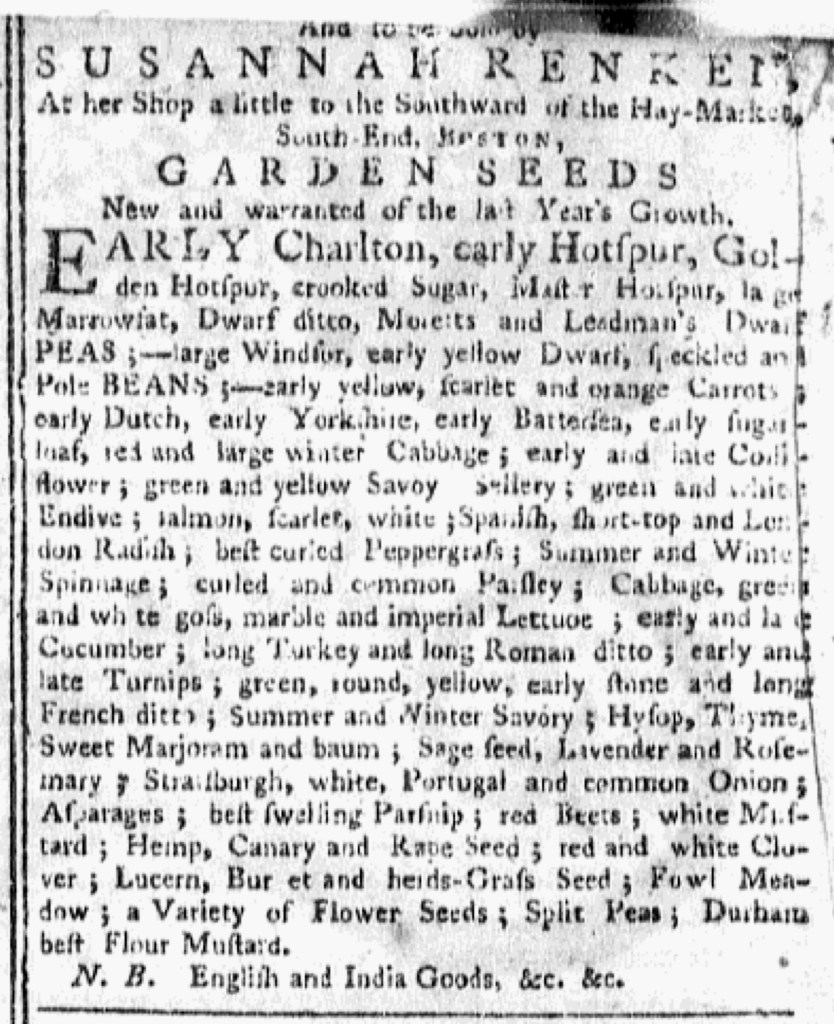
Susanna Renken achieved her greatest visibility in the public prints with the advertisements for garden seeds she inserted in several newspapers printed in Boston in the winter and spring. In several years, she was the first entrepreneur to advertise garden seeds, quickly joined by a sorority of seed sellers who sought their share of the market. Most of those female entrepreneurs did not place advertisements throughout the rest of the year, even those, like Renken, who mentioned that they also stocked “English and India Goods all which may be had cheap for Cash.”
In the summer of 1774, however, circumstances prompted Renken to advertise that “she has removed from Fore-street,” where she had been for many years, “to a little above the Hay-Market.” She reminded both current customers and the public that she “has for Sale, a variety of English and India GOODS, Groceries of all sorts, West-India and New-England Rum.” Renken did not go into as much detail about her wares as many other merchants and shopkeepers, confining her notice to announcing her new location so she could maintain (and perhaps expand) her clientele.
She also did not advertise as widely as she usually did when she promoted garden seeds. She usually placed notices in several newspapers printed in Boston and sometimes even in the Essex Gazette published in Salem. Of the five newspapers that served Boston in 1774, Renken opted to advertise in only two, the Boston-Gazette, printed by Benjamin Edes and John Gill, and the Massachusetts Spy, printed by Isaiah Thomas. Those printers and their publications were well known for their support of the Sons of Liberty and their critiques of a British government that encroached on the liberties of colonizers. Thomas had recently updated the masthead of the Massachusetts Spy to include an image of a snake, representing the colonies, defending itself against a dragon, representing Britain, with the declaration “JOIN OR DIE.” With the harbor closed to trade due to the Boston Port Act, perhaps Renken expressed her own political views in choosing which newspapers to carry her advertisement.