March 25

What was advertised in a colonial American newspaper 250 years ago today?

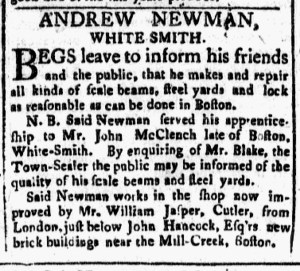
Massachusetts Spy (March 25, 1773).

“By enquiring of Mr. Blake, the Town-Sealer the public may be informed of the quality of his scale beams and steel yards.”

Andrew Newman offered his services as a whitesmith in an advertisement in the March 25, 1773, edition of the Massachusetts Spy.  In addition to the usual sort of work undertaken by that trade, such as filing, lathing, burnishing, and polishing iron and steel, Newman declared that he “makes and repair[s] all kinds of scale beams, steel years and lock[s].”  Furthermore, he confidently stated that customers would find the quality and prices for such work “as reasonable as can be done in Boston.”

Many artisans included some sort of reference to their credentials, whether formal training or long experience, in their newspaper notices.  Newman did so in a nota bene.  He advised the public that he “served his apprenticeship to Mr. John McClench late of Boston, White-Smith.”  Newman likely hoped that colonizers who previously patronized McClench or were familiar with his reputation would consider hiring McClench’s former apprentice.  Even for those who did not know of McClench, Newman figured that giving information about completing an apprenticeship in the city recommended him to prospective customers.

He also encouraged them to consult “Mr. Blake, the Town-Sealer,” for an endorsement.  According to Newman, “the public may be informed of the quality of his scale beams and steel yards” when speaking with that local official.  Prospective customers did not have to rely on Newman’s word alone; instead, they could learn more and ask questions of a third party that they might consider neutral and thus more trustworthy when it came to assessing the materials that Newman produced and sold.  Short of a testimonial inserted in his advertisement, Newman likely considered such referrals the next best option.

Throughout the colonies, artisans often highlighted their credentials in their advertisements.  In his efforts to bolster his business, Newman did so, incorporating two strategies.  First, he gave details about his apprenticeship, hoping that his training with McClench would resonate with prospective customers familiar with his former master’s work.  Then, he directed the public to a local official who could provide an endorsement of Newman’s own skill and the quality of the items he made in his workshop.  Invoking both McClench and Black enhanced Newman’s assertions about the quality of his work.

March 14

What was advertised in a colonial American newspaper 250 years ago this week?

Massachusetts Spy (March 11, 1773).

“The Fishermen who made trial of his Hooks last season, found them to correspond with his former advertisement.”

Even before thirteen colonies declared independence from Great Britain, entrepreneurs encouraged consumers to support American industry.  Abraham Cornish, for example, marketed “New England COD and MACKREL FISH HOOKS” produced at “his Manufactory at the head of Hutchinson’s wharf, North End, Boston” in the early 1770s.  When he commenced advertising in the Massachusetts Spy in March 1772, Cornish proclaimed that his hooks were “warranted in every respect equal to any, and superior to most.”  In particular, he singled out hooks “marked IP” to declare that every fisherman who tried his hooks and “every impartial person on examining” them “will soon discover their superiority.”  Nearly a year later, Cornish reported that “the Fishermen who made trial of his Hooks last season, found them to correspond with his former advertisement,” that they were indeed “superior to those imported from England.”

Cornish’s hooks, however, were not produced from start to finish in the colonies.  Instead, he imported the “best STEEL WIRE” from London and then used that material to make the hooks at his manufactory in Boston.  What mattered, Cornish asserted to prospective customers, was the final stage of production combined with the superior quality of his hooks and his low prices.  He confidently boasted that he made “the best Cod and Mackerel Hooks.”

In his effort to supply the fishing industry with hooks, Cornish simultaneously ran the same advertisement (with variations in spelling) in the Essex Gazette, promoting his product to prospective customers in Salem and other maritime communities served by that newspaper.  He added two notes, one identifying William Vans as the local agent who carried his hooks.  Customers did not need to visit or contact Cornish in Boston if they found it more convenient to deal with Vans in Salem.  Given that those buyers would not interact directly with Cornish, he advised that his hooks “are all marked A.C. on the Flat of the Stem of each Hook.”  That helped customers verify their authenticity when they acquired the hooks from sellers beyond Cornish’s manufactory.  Such maker’s marks served as perpetual advertisements for the hooks.

March 11

What was advertised in a colonial American newspaper 250 years ago today?

Massachusetts Spy (March 11, 1773).

“American Ink-Powder.”

Buy American!  That was the message that many advertisers presented to consumers during the imperial crisis, before the first shots were fired at Lexington and Concord.  It was the message that Samuel Norton of Hingham, who made ink powder, and Ann Norton of Boston, his broker in town, proclaimed to prospective customers in the March 11, 1773, edition of the Massachusetts Spy.  Other advertisers made similar appeals, including Abraham Cornish for his “New England COD and MACKEREL FISH HOOKS.”

For their part, the Nortons introduced their product with a headline for “American Ink-Powder” followed immediately by a secondary headline that declared, “Experienced and found to be equal, if not superior to any imported.”  Earlier in the week, Henry William Stiegel made similar assertions about the glassware he made in Manheim, Pennsylvania.  To entice colonizers to try the ink powder made in Hingham, the Nortons listed several of its “excellent qualities.”  They claimed that even when documents written with the ink were “exposed to extreme wet” the ink did not run; instead, it “alters not, but will remain as long as the paper endures.”  Furthermore, the ink powder contained an ingredient that “precents ink from becoming think and mouldy.”  These factors prompted the Nortons to proclaim that this ink powder “makes the best black writing-ink,” doubling down on the secondary headline about it being as good as, or even better than, imported alternatives.

The Nortons also offered practical advice for using the ink powder.  They considered it “very convenient for gentlemen, merchants, attornies and others that travel, it being not cumbersome and liable to those mischances that other ink is.”  Purchasers could choose to mix ink “in large or small quantities, as is most convenient,” and did not have to worry about it freezing if they used “a little brandy or other spirits not liable to freeze” instead of water.  In guiding prospective customers in how to use the product, the Nortons hoped to increase the chances that some of them would purchase their ink powder and follow their directions.

They also benefited from the compositor’s choice about where to place their advertisement within that issue of the Massachusetts Spy.  It appeared immediately below coverage of the annual commemoration of the Boston Massacre. Residents of Boston marked the third anniversary with an oration “on the dangerous tendency of standing armies being placed in free and populous cities” by Dr. Benjamin Church, a lantern with paintings that depicted soldiers firing on colonizers, and the tolling of bells.  The Nortons did not make arguments about consumers’ civic responsibility to practice politics in the marketplace by purchasing domestic manufactures, goods produced in the colonies, as explicitly as some other advertisers.  Given the commemoration of the Boston Massacre that just occurred and other news about current events that crowded the pages of the Massachusetts Spy, they did not necessarily need to do so.  Prospective customers very well understood the context in which the Norton’s hawked their “American Ink-Powder.”

January 28

What was advertised in a colonial American newspaper 250 years ago today?

Massachusetts Spy (January 28, 1773).

An EXTRAORDINARY … will be published To morrow.”

“Extra!  Extra!  Read all about it!”  That was Isaiah Thomas’s message to readers of the Massachusetts Spy.  The printer included an announcement in the January 28, 1773, edition, alerting subscribers and other readers that “An EXTRAORDINARY [No. 104, of the] Massachusetts SPY, or Thomas’s Boston Journal, will be published To morrow.”  Unlike the supplements and postscripts that sometimes accompanied early American newspapers, Thomas considered the extraordinary, distributed on a Friday, a separate issue.  As he noted in his announcement, it had its own number, 104, following “NUMB. 103,” distributed on Thursdays as usual for the Massachusetts Spy.  Thomas or a compositor who worked in his printing office updated the masthead to include “EXTRAORDINARY.”

The “extra” issue consisted of two pages, compared to four for the weekly standard issues of the Massachusetts Spy and other American newspapers published at the time.  It consisted almost entirely of a single item from the “HOUSE of REPRESENTATIVES” in Boston, along with half a column of news from Salem and one short advertisement for grocery items.  (In similar circumstances, other printers took the opportunity to insert advertisements about the goods and services available at their printing offices.)  The main item that prompted publication of the extraordinary was an “ANSWER to [Governor Thomas Hutchinson’s] SPEECH, to both Houses, at the opening of this session.”  Representatives “ORDERED” that a committee comprised of “Mr. Adams, Mr. Hancock, Mr. Bacon, Col. Bowes, Major Hawley, Capt. Darby, Mr. Philips, Col. Thayer, and Col. Stockbridge” compose that answer.  Members of the committee agreed with the governor that “the government at present is in a very disturbed state.”  They did not, however, identify the same causes.  “[W]e cannot ascribe it to the people’s having adopted unconstitutional principles,” as the governor claimed.  Instead, they believed that problems arose as a result of “the British House of Commons assuming and exercising a power inconsistent with the freedom of the constitution to give and grant the property of the colonists, and appropriate the same without their consent.”

When Thomas published the extraordinary, he already had a reputation as a printer devoted to principles espoused by the patriots.  The masthead for his newspaper described it as “A Weekly, Political, and Commercial PAPER:– Open to ALL Parties, but Influenced by None,” yet immediately below that sentiment appeared this message: “DO THOU Great LIBERTY INSPIRE our Souls,– And make our Lives in THY Possession happy,– Or our Deaths glorious in THY JUST Defence.”  Thomas likely had two reasons for quickly publishing the committee’s response as an extraordinary.  He scooped his competitors while also disseminating rhetoric that matched his own views.  (Most other newspapers printed in Boston included the response as part of their coverage when they distributed their next weekly edition, but that took several days or, in the case of the Massachusetts Gazette and Boston Weekly News-Letter, printed by Loyalist Richard Draper, an entire week.)  Thomas previously published the governor’s speech as an extraordinary, dated and distributed on the same day as the weekly issue on Thursday, January 7.  In so doing, he upheld his pledge that the Massachusetts Spy was “Open to ALL Parties,” yet publishing the governor’s speech also kept colonizers informed about the dangers they faced from the narrative of recent events that Hutchinson constructed.  Releasing the committee’s response as its own extraordinary on a day that no other newspapers were published in Boston and announcing his plans to issue that extraordinary may have garnered more attention more quickly to the version of events that matched Thomas’s own views.  Patriots and imperial officials vied over how to represent what was occurring in Boston and throughout the colonies.  Thomas may have considered getting the committee’s response to the governor in print as quickly as possible an important counteroffensive against the governor’s speech that he published three weeks earlier.

Massachusetts Spy Extraordinary (January 29, 1773).

January 21

What was advertised in a colonial American newspaper 250 years ago today?

Massachusetts Spy (January 21, 1773).

“The SECOND EDITION.”

Just a week after the Massachusetts Gazette and Boston Weekly News-Letter and the Massachusetts Spy carried advertisements announcing that An Oration on the Beauties of Liberty or the Essential Rights of the Americans was “Now in the press, and will be published in a few days” on January 14, 1773, both newspapers carried notices about the publication of a second edition.  John M. Bumsted and Charles E. Clark identify the author, “A British Bostonian,” as John Allen, a Baptist minister who migrated to New England in the early 1770s.  They consider the Oration “one of the best-selling pamphlets of the pre-Revolutionary crisis, passing through seven editions in four cities between 1773 and 1775.”[1]

The Oration very quickly went to a second edition.  Was that because the first edition sold out so quickly?  Or did other factors play a role.  The advertisement in the January 21 edition of the Massachusetts Spy implied that it was the former, that the popularity of the pamphlet prompted the printers, David Kneeland and Nathaniel Davis, to publish “The SECOND EDITION.”  In addition to the advertisements that ran on January 14, another advertisement appeared in the Boston-Gazette on January 18, helping to incite interest and demand in a pamphlet drawn from an address that many Bostonians heard several weeks earlier.  Word-of-mouth chatter about the Oration likely supplemented newspaper advertisements in promoting the pamphlet.

The advertisement in the January 21 edition of the Massachusetts Gazette and Boston Weekly News-Letter provided additional details. It featured two revisions to the original notice.  The headline now read “This Day Published” instead of “To-Morrow will be Published.”  In addition, a new line at the end of the notice advised prospective customers that they could purchase “The SECOND EDITION corrected.”  Did Kneeland and Davis sell out of the first edition?  Or did they take advantage of producing a second edition that corrected errors to suggest that such the first edition met with such success that it made the immediate publication of a second edition necessary?  Either way, the reception of the first two editions apparently convinced other printers in Boston, Hartford and New London in Connecticut, and Wilmington in Delaware, that they could generate revenues by publishing their own editions.  In so doing, they assisted in disseminating arguments that encouraged colonizers to move from resistance to revolution during the era of the imperial crisis that culminated in thirteen colonies declaring independence from Great Britain.

**********

[1] John M. Bumsted and Charles E. Clark, “New England’s Tom Paine: John Allen and the Spirit of Liberty,” William and Mary Quarterly, 3rd ser., 21, no. 4 (October 1964): 561.

Happy Birthday, Isaiah Thomas!

Isaiah Thomas, patriot printer and founder of the American Antiquarian Society, was born on January 19 (New Style) in 1749 (or January 8, 1748/49, Old Style).  It’s quite an historical coincidence that the three most significant printers in eighteenth-century America — Benjamin Franklin, Isaiah Thomas, and Mathew Carey — were all born in January.

isaiah_thomas1818
Isaiah Thomas (January 30, 1739 – April 4, 1831). American Antiquarian Society.

The Adverts 250 Project is possible in large part due to Thomas’s efforts to collect as much early American printed material as he could, originally to write his monumental History of Printing in America.  The newspapers, broadsides, books, almanacs, pamphlets, and other items he gathered in the process eventually became the initial collections of the American Antiquarian Society.  That institution’s ongoing mission to acquire at least one copy of every American imprint through 1876 has yielded an impressive collection of eighteenth-century advertising materials, including newspapers, magazine wrappers, trade cards, billheads, watch papers, book catalogs, subscription notices, broadsides, and a variety of other items.  Exploring the history of advertising in early America — indeed, exploring any topic related to the history, culture, and literature of early America at all — has been facilitated for more than two centuries by the vision of Isaiah Thomas and the dedication of the curators and other specialists at the American Antiquarian Society over the years.

Thomas’s connections to early American advertising were not limited to collecting and preserving the items created on American presses during the colonial, Revolutionary, and early national periods.  Like Mathew Carey, he was at the hub of a network he cultivated for distributing newspapers, books, and other printed goods — including advertising to stimulate demand for those items.  Sometimes this advertising was intended for dissemination to the general public (such as book catalogs and subscription notices), but other times it amounted to trade advertising (such as circular letters and exchange catalogs intended only for fellow printers, publishers, and booksellers).

Thomas also experimented with advertising on wrappers that accompanied his Worcester Magazine, though he acknowledged to subscribers that these wrappers were ancillary to the publication:  “The two outer leaves of each number are only a cover to the others, and when the volume is bound may be thrown aside, as not being a part of the Work.”[1]

jan-30-worcerster-magazine-april-1786
Detail of Advertising Wrapper, Worcester Magazine (Second Week of April, 1786).

Thomas’s patriotic commitment to freedom of the press played a significant role in his decision to develop advertising wrappers.  As Thomas relays in his History of Printing in America, he discontinued printing his newspaper, the Massachusetts Spy, after the state legislature passed a law that “laid a duty of two-thirds of a penny on newspapers, and a penny on almanacs, which were to be stamped.”  Such a move met with strong protest since it was too reminiscent of the Stamp Act imposed by the British two decades earlier, prompting the legislature to repeal it before it went into effect.  On its heels, however, “another act was passed, which imposed a duty on all advertisements inserted in the newspapers” printed in Massachusetts.  Thomas vehemently rejected this law as “an improper restraint on the press. He, therefore, discontinued the Spy during the period that this act was in force, which was two years. But he published as a substitute a periodical work, entitled ‘The Worcester Weekly Magazine,’ in octavo.”[2] This weekly magazine lasted for two years; Thomas discontinued it and once again began printing the Spy after the legislature repealed the objectionable act.

jan-30-advertising-wrapper-worcester-magazine-4th-week-may-1786
Third Page of Advertising Wrapper, Worcester Magazine (Fourth Week of May, 1786).

Isaiah Thomas was not interested in advertising for its own sake to the same extent as Mathew Carey, but his political concerns did help to shape the landscape of early American advertising.  Furthermore, his vision for collecting American printed material preserved a variety of advertising media for later generations to admire, analyze, ponder, and enjoy.  Happy 274th birthday, Isaiah Thomas!

**********

[1] Isaiah Thomas, “To the CUSTOMERS for the WORCESTER MAGAZINE,” Worcester Magazine, wrapper, second week of April, 1786.

[2] Isaiah Thomas, The History of Printing in America: With a Biography of Printers, and an Account of Newspapers, vol. 2 (Worcester, MA: Isaac Sturtevant, 1810), 267-268.

January 14

What was advertised in a colonial American newspaper 250 years ago today?

Massachusetts Spy (January 14, 1773).

“AN ORATION on the Beauties of Liberty.”

An advertisement in the January 14, 1773, editions of the Massachusetts Gazette and Boston Weekly News-Letter and the Massachusetts Spy announced the imminent publication and sale of a political pamphlet about “the Beauties of Liberty or the essential rights of the Americans.”  David Kneeland and Nathaniel Davis advised that the work was “Now in the press” and would be available in a few days.  The printers also noted that the pamphlet was “AN ORATION … Delivered at the second Baptist-Church in Boston, upon the last annual thanksgiving.”

Kneeland and Davis did not name the orator-author, perhaps expecting that many prospective customers already knew his identity as a result of having heard the sermon on liberty or heard about it from friends and acquaintances.  The title page attributed the Oration on the Beauties of Liberty to “A British Bostonian.”  The same author composed The American Alarm, published and advertised a few weeks earlier.  John M. Bumsted and Charles E. Clark identify both pamphlets as the work of John Allen, “a Baptist minister and recent émigré from England, politically disenchanted and personally discredited” for an incident involving a forged promissory note.[1]

According to Bumsted and Clark, the second of those pamphlets, the Oration, “proved to be one of the best-selling pamphlets of the pre-Revolutionary crisis, passing through seven editions in four cities between 1773 and 1775” and the “immense popularity of this fiery attack on British policy – specifically the appointment of the Commissioners of Inquiry into the burning of the Gaspee – marked the author as an agitator of considerable importance.”[2]  Advertising may have contributed to the popularity of the pamphlet, especially if Kneeland and Davis carefully chose which newspapers carried their notice.  Isaiah Thomas, the printer of the Massachusetts Spy, had a reputation as an agitator.  Benjamin Edes and John Gill, printers of the Boston-Gazette did as well.  Following the initial announcement about the pamphlet on January 14, Kneeland and Davis placed an advertisement in the Boston-Gazette on January 18, but opted not to insert notices in the other two newspapers published in the city that day, the Boston Evening-Post and the Massachusetts Gazette and Boston Post-Boy.  Their conceptions of the political sympathies of both the printers and readers of those newspapers may have played a role in selecting where to invest their limited funds for advertising.

**********

[1] John M. Bumsted and Charles E. Clark, “New England’s Tom Paine: John Allen and the Spirit of Liberty,” William and Mary Quarterly, 3rd ser., 21, no. 4 (October 1964): 562.

[2] Bumsted and Clark, “New England’s Tom Paine,” 561.

December 24

What was advertised in a colonial American newspaper 250 years ago today?

Massachusetts Gazette and Boston Weekly News-Letter (December 24, 1772).

There are some Almanacks with Dr. Ames’s Name thereto that are very erroneous.”

In the December 24, 1772, edition of the Massachusetts Gazette and Boston Weekly News-Letter, Richard Draper continued the efforts to inform the public about counterfeit editions of “AMES’s Almanack for 1773” that he, Thomas Fleet and John Fleet, printers of the Boston Evening-Post, and Benjamin Edes and John Gill, printers of the Boston-Gazette, began three days earlier.  According to a note from Nathaniel Ames, the author of the popular almanac, “The only True and Correct Almanacks from my Copy, are those printed by R. Draper, Edes & Gill and T. & J. Fleet.”

Draper expanded on the notice that previously appeared in other newspapers, advising readers and prospective customers that “there are some Almanacks with Dr. Ames’s Name thereto that are very erroneous.”  In particular, those counterfeits contained misinformation about “Roads and Stages,” but in the “true Almanack” those errors had been “corrected, amended and placed in a better Manner than in any Almanack heretofore published.”  Draper offered a justification not only for choosing Ames’s “true Almanack” over counterfeit editions but also for choosing it over any other almanacs advertised and sold in New England.

Isaiah Thomas, printer of the Massachusetts Spy, advertised some of those almanacs on the same day that Draper published the extended version of the advertisement about Ames’s “True and Correct Almanacks.”  Under a headline that simply declared, “ALMANACKS,” Thomas listed “AMES’s, Lowe’s, Gleason’s (or Massachusetts Calender) and Sterne’s ALMANACKS” available at his printing office.  Thomas did not note whether he sold Ames’s almanac printed by Draper, the Fleets, and Edes and Gill, but his newspaper was the only one in Boston that did not carry the notice from those printers that week.

Postscript to the Massachusetts Spy (December 24, 1772).

In addition, the supplement that accompanied that edition of the Massachusetts Spy contained just one advertisement.  It advised prospective customers about “AMES’s Almanack, for 1773, just published and to be sold by Russell & Hicks, in Union street, next the Cornfield.”  Whether or not Thomas sold the counterfeit almanac at his own shop, he did not seem to have any qualms about generating revenue by running advertisements placed by the printers who published the suspect edition.  Given that households from the most grand to the most humble acquired almanacs each year, those pamphlets were big business for printers.  Rivalries in printing, marketing, and selling almanacs became a regular feature of newspaper advertising each fall and into the winter months.

December 20

What was advertised in a colonial American newspaper 250 years ago this week?

Massachusetts Spy (December 17, 1772).

“It is requested that those thoughts may be published, at this alarming season.”

In November and December 1772, an author who identified himself as “A BRITISH BOSTONIAN” placed a newspaper advertisement addressed to “the Inhabitants of the Town of BOSTON” in which he proposed publishing “a concise Essay upon the Beauties of LIBERTY in its Political and Sacred branches.”  As a relative newcomer to the city, he considered it “very unpolite [for] a stranger to take this freedom” of publishing “The AMERICAN ALARM, Or, a Confirmation of the Boston Plea, for the Rights and Liberties of the People” without first requesting “the approbational leave of the Gentlemen of Boston.”  The “Gentlemen” of the city could demonstrate their approbation or support for the project by entering their names on the subscription lists kept by printers David Kneeland and Nathaniel Davis.

Although historians and bibliographers formerly attributed American Alarm to Isaac Skillman, the pastor at the Second Baptist Church of Boston, John M. Bumsted and Charles E. Clark convincingly demonstrate that John Allen, “a Baptist minister and a recent émigré from England, politically disenchanted and personally discredited,” penned both American Alarm and An Oration, Upon the Beauties of Liberty, Or the Essential Rights of the Americans.[1]  Kneeland and Davis printed these “small but inflammatory political pamphlets” in 1773, suggesting that the advertisement in the Boston-Gazette and the Massachusetts Spy helped in recruiting subscribers for American Alarm.[2]  Bumsted and Clark describe the Oration as “one of the best-selling pamphlets of the pre-Revolutionary crisis, passing through seven editions in four cities between 1773 and 1775.”[3]

They devote less attention to American Alarm, but do provide essential context for understanding events that would have resonated with newspaper readers and prospective subscribers to the pamphlet when they encountered the advertisement.  Allen wrote American Alarm in response to Governor Thomas Hutchinson’s announcements that the colonial legislature would no longer pay the salaries of the governor and judges.  Instead, those officers would receive their salaries from the Crown, an arrangement that many colonizers believed made the governor and judges beholden to the monarch and, especially, Parliament.  According to the British Bostonian, “The plan is laid, the foundation is fixed, to make them [the governor and judges] dependant for place and payment, upon the arbitrary will, and power of the British ministry; upon that power that has for years been seeking the destruction of your RIGHTS.”[4]

Bumsted and Clark describe Allen as “New England’s Tom Paine,” a counterpart to the author of the political pamphlet, Common Sense, widely considered to have had the most significant impact in convincing colonizers to declare independence.  Bumsted and Clark assert that some colonizers did not need as much pushing in that direction as their leaders.  The arguments made by the British Bostonian and the popularity of American Alarm and, especially, the Oration “suggest that in attitude if not in ideology, a large portion of the population may have been well in advance of its leadership” in 1772 and 1773.[5]  Those colonizers expressed their politics by buying the pamphlets and imbibing their contents.  Though he may have exaggerated how much support and encouragement he initially received, Allen asserted that after he delivered “my thoughts in public, upon the Beauties of LIBERTY” that listeners “requested that those thoughts may be published, at this alarming season.”

**********

[1] John M. Bumsted and Charles E. Clark, “New-England’s Tom Paine:  John Allen and the Spirit of Liberty,” William and Mary Quarterly, 3rd ser., 21, no. 4 (October 1964): 562.

[2] Bumsted and Clark, “New-England’s Tom Paine,” 561.

[3] Bumsted and Clark, “New-England’s Tom Paine,” 561.

[4] British Bostonian [John Allen], The American Alarm, or the Bostonian Plea, for the Rights, and Liberties of the People (Boston:  D. Kneeland and N. Davis, 1773), 17.

[5] Bumsted and Clark, “New-England’s Tom Paine,” 570.

October 18

What was advertised in a colonial American newspaper 250 years ago this week?

Massachusetts Spy (October 15, 1772).

“The least favours gratefully acknowledged.”

John Langdon deployed a variety of strategies for marketing his inventory at the “New Book-Store” in Boston in the fall of 1772.  Like many other retailers, he emphasized the choices that he provided for consumers.  In an advertisement in the October 15 edition of the Massachusetts Spy, the bookseller informed prospective customers that he recently imported a “LARGE and Grand Assortment of BOOKS in all Arts and Sciences.”  Those new titles supplemented those he already had in stock.  He confidently proclaimed that he now offered “as large a collection as is to be found at any Store in America.”  His selection supposedly rivaled what consumers would encounter in shops in urban ports like Charleston, New York, and Philadelphia as well as in the shops operated by local competitors.  Langdon intended for that bold claim to double as an invitation for prospective customers to browse in his shop and discover titles of interest among his extensive inventory for themselves.

In addition, thew bookseller made appeals to price and customer service.  He explained that he planned to depart for England in the spring.  As a result, he wished to sell his inventory over the course of the next several months.  To do so, he set low prices.  Langdon pledged that “every Gentleman who may please to favour him with their custom may depend on purchasing at a little more than the sterling cost and charges.”  In other words, he did not mark up the prices exorbitantly but instead sought to make only a small profit on each book he sold.  Langdon concluded his advertisement with a note that the “least favours [are] gratefully acknowledged.”  He appreciated any business, no matter how large or small the transaction.  Even though he had such a large inventory, no purchase … and no customer … was insignificant. Langdon intended to cultivate relationships with everyone who entered his shop.

Langdon’s advertisement for the New Book-Store was no mere announcement that he sold books.  Instead, he crafted a notice that incorporated multiple marketing strategies.  He emphasized the size of his inventory, his motivation for setting low prices, and the importance of every customer in his effort to encourage consumers to acquire books from him.