July 31

What was advertised in a colonial American newspaper 250 years ago today?
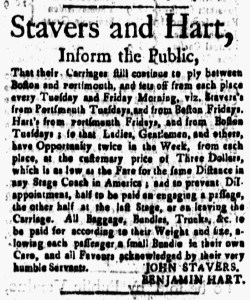
New-Hampshire Gazette (July 31, 1772).

“Allowing each passenger a small Bundle in their own Care.”

Advertisements in colonial newspapers aid in reconstructing transportation networks in early America.  A series of advertisements by Jonathan Brown and Nicholas Brown, for instance, gave details of a new stagecoach route between New York and Boston that they established in the summer of 1772.  They initially declared that they would undertake a “Trial” and if they “find Encouragement, they will perform the Stage once a Week.”  That trial apparently achieved sufficient success for them to continue the venture.  They continued to advertise in the July 30, 1772, edition of the New-York Journal.

By that time, John Stavers and Benjamin Hart had much more experience operating their own stagecoach service between Boston and Portsmouth.  In an advertisement in the August 8, 1771, edition of the Massachusetts Gazette and Boston Weekly News-Letter, Stavers stated that he had been in business “for Ten Years past.”  Stavers and Hart placed an advertisement in the July 31, 1772, edition of the New-Hampshire Gazette to “Inform the Public, That their Carriages still continue to ply,” having survived a challenge posed by a newcomer who set up a competing service the previous summer.  Thanks to Stavers and Hart and the Browns, colonizers could travel via stage between Portsmouth and New York, if they desired an alternative to sailing between the two ports.

In addition to providing their schedule, Stavers and Hart used their advertisement to promote various aspects of their service.  They charged “the customary price of Three Dollars,” asserting it was a good bargain and “as low as the Fare for the same Distance in any Stage Coach in America.”  They also advised prospective passengers that they needed to pay “half on engaging a passage, the other half at the last Stage, or on leaving the Carriage.”  They claimed they asked for half in advance “to prevent Disappointment.”  Such a means of securing a reservation worked in favor of both travelers and the stagecoach operators.  Passengers paid for “All Baggage, Bundles, [and] Trunks … according to their Weight and size.”  Stavers and Hart did not allow for any complimentary “checked items,” but they did permit “carryon items.”  Each passenger could board the coach with “a small Bundle in their own Care.”

Stavers and Hart, like other stagecoach operators, sought to make travel appear attractive to prospective customers.  They promised good customer service for passengers, pledging “all Favours acknowledged by their very humble Service.”  In giving their schedule, they promoted the convenience of traveling via their stagecoaches.  They also incorporated other appeals, proclaiming that they offered bargain prices and inviting passengers to board with personal items that did not require additional fees.  Over time, the travel industry refined marketing strategies already in use during the era of the American Revolution.

July 24

What was advertised in a colonial American newspaper 250 years ago today?

New-Hampshire Gazette (July 24, 1772).

“Those Persons who are Indebted for this PAPER, are desired to settle within the Month.”

Throughout the colonies, printers regularly placed notices in their newspapers calling on subscribers and other customers to settler accounts.  Thomas Green and Samuel Green, printers of the Connecticut Journal and New-Haven Post-Boy, ran such a notice on July 24, 1772.  The use of italics set their notice apart from others in the same issue drawing attention to their declaration that “The Subscribers to this paper, who are one year or more in arrear, and those who are in any other manner indebted to the printers, are requested to discharge their accounts immediately.”  Newspaper subscribers notoriously neglected to make payments.  Printers often threatened legal action, but usually did not follow through on those threats, perhaps because maintaining robust circulation, even among subscribers who did not pay, helped attract advertisements.  Advertising represented a significant revenue stream for many colonial printers.

On the same day that the Greens ran their notice, Daniel Fowle and Robert Fowle, placed a similar announcement in the New-Hampshire Gazette.  They advised that “Those Persons who are Indebted for this PAPER, are desired to settle within the Month of August next,—and as many pay off as can.—They who cannot pay the whole, may give their Notes for the Remainder, as there is a Necessity for a Settlement as soon as possible.”  The Fowles did not elaborate on what constituted a “Necessity,” nor did they make any threats against those who ignored their notice.  On other occasions, they warned that they would sue recalcitrant subscribers or even publish their names to shame them in front of the rest of the community.  No list of delinquent subscribers appeared in the New-Hampshire Gazette.  Like the Greens who placed their notes in italics, the Fowles devised a means of calling attention to their notice.  They enclosed it in a border composed of printing ornaments, the only item in that issue to receive such treatment.

Printers and subscribers engaged in an ongoing battle of wills in colonial America.  Subscribers did not pay for their newspapers, prompting printers to suggest that they would sue their customers.  They sometimes implied that they could not continue publication if they did not receive payments, which may have been what the Fowles intended when they referred to the “Necessity” of subscribers settling accounts.  Printers cajoled subscribers in a variety ways, their notices frequently receiving privileged treatment in the newspapers they published.

July 10

What was advertised in a colonial American newspaper 250 years ago today?

New-Hampshire Gazette (July 10, 1772).

“His Assortment as full and as cheap, as in the County.”

Many shopkeepers in smaller towns sought to convince prospective customers that they provided shopping experiences that matched what they would find elsewhere.  Such was the case with Edward Emerson when he placed an advertisement in the July 10, 1772, edition of the New-Hampshire Gazette.  He informed the public that he carried a “general Assortment of Hard Ware and English Piece GOODS” at his shop in York (then part of Massachusetts, now Maine).  He suggested that he made available as many choices as consumers would encounter in any other shop, but “to mention the Particulars would take too much room in the Paper” (and cost much more for Emerson to publish).  Instead, he assured “his good Customers and others (in Town or out,)” that when they visited his shop they would “find his Assortment as full and as cheap, as in the County.”  The shopkeeper expanded on his appeal emphasizing choice to incorporate price.  Elsewhere in his advertisement he pledged to sell goods “At a very low Rate.”  Customers would not find more choices or better bargains elsewhere.

Parker Emerson made similar claims about his store in Litchfield, New Hampshire, in the same issue of the New-Hampshire Gazette.  He stated that he imported a “large Assortment of English and West India Goods” as well as “NAILS, Window Glass of all sorts; a variety of Glass, Stone, and Delph Ware, and a compleat assortment of London Pewter.”  Repeating words and phrases like “variety,” “of all sorts,” and “compleat assortment” underscored that Emerson provided a range of choices even if he opted not to catalog his merchandise in a newspaper advertisement.  He also informed prospective customers that “he is determined to sell as cheap as any Store or Shopkeeper in the Country.”  In other words, Emerson would not be undersold.  Consumers in Litchfield, York, and other towns had the option of visiting shops in Portsmouth in search of more choices and lower prices, but advertisers like Edward Emerson and Parker Emerson aimed to persuade them that they did not need to do so.  They positioned their merchandise and prices as rivaling those consumers would encounter elsewhere, suggesting that colonizers in the countryside had equal access to the consumer revolution.

July 3

What was advertised in a colonial American newspaper 250 years ago today?

New-Hampshire Gazette (July 3, 1772).

The Printers will not Promise to exchange after the first of August next.”

Daniel Fowle and Robert Fowle, printers of the New-Hampshire Gazette, gave one of their advertisements a privileged place in the July 3, 1772, edition of their newspaper.  They positioned their notice about “Compleat Sets of the new and correct Law-Book, for the Province of New-Hampshire” at the top of the first full column of advertising, increasing the likelihood that readers would take note of it as they finished the news items even if they only quickly glanced at the advertisements.

To encourage sales of the new edition, the Fowles offered a deal to customers who owned copies of the previous edition.  They stated that they “will take the old ones of such Persons, as were subscribers for that Edition, and allow them one Dollar for the same.”  In other words, those customers received a discount when they traded in the outdated edition.  To convince customers that this was a good deal, the Fowles proclaimed that the previous edition was “not worth a Farthing” now that they published a “new and correct” edition, so customers might as well take advantage of their generosity in allowing “one Dollar” for it.

The Fowles also attempted to create a sense of urgency by making clear that this was a limited time offer.  They asserted that customers who wished to return the previous edition must “purchase a new Book now.”  They warned that “the Printers will not Promise to exchange after the first of August next.”  Customers had only four weeks to contemplate this offer before the Fowles potentially rescinded it.  In addition, the printers had “but few to dispose of in this Way,” or so they claimed.  That meant that interested readers needed to make the exchange while supplies lasted.

The Fowles deployed several savvy marketing strategies when they published a new and updated edition of the laws of the colony.  They offered discounts to former customers who traded in the old edition, simultaneously pressuring them to purchase the new volume soon by cautioning that they had limited supply and the offer expired soon.  Prospective customers needed to act quickly or risk missing out!

June 19

What was advertised in a colonial American newspaper 250 years ago today?

New-Hampshire Gazette (June 19, 1772).

“A Subscription … for the Amusement of the Public.”

The performance of “several serious and comic Pieces of Oratory, interspers’d with Music and Singing” first advertised in the June 5, 1772, edition of the New-Hampshire Gazette expanded into a series, even though the initial advertisement promoted an event for “This EVENING.”  The following week a similar advertisement appeared, with a few modifications.  It clarified that the performance would “begin at Eight o’Clock” and cautioned “No Person to be admitted without a Ticket.”  That implied that the previous performance had been so popular or had incited so much interest the next performance that colonizers interested in attending needed to secure admission in advance.

The advertisement ran in a third consecutive issue of the New-Hampshire Gazette, though greatly expanded with news that “the Exhibitor” had received such “great Encouragement” that he wished to satisfy “the natural Propensity the Ladies and Gentlemen seem to have [for] Dramatic Entertainments” that he created a subscription series to include “new and surprising Performances never seen in this Country, consisting of Italian Dances, and Pantomimical Interludes in Grotesque Characters, with elegant Scenes and Machinery and every other Decoration.”  The Exhibitor compared the elaborate productions to performances at the famous Sadler’s Wells Theater in London, suggesting that audiences would partake in similar cosmopolitan entertainments in Portsmouth, New Hampshire.

The Exhibitor, who also referred to himself as “the Projector,” listed ticker prices for both subscribers and non-subscribers.  He promised that “Tickets will be transferable,” encouraging colonizers to invest in subscriptions together if they were not interested in attending twelve performances or found the price for the entire series too exorbitant.  He assured readers that “Subscribing is only fixing the same Price,” but purchasing subscriptions had the advantage of making it possible “to put the Design in Execution.”  If the Projector did not receive “a certain Number” of subscriptions then he would not be able to stage the performances; he warned that he “cannot proceed till a sufficient Number is subscribed.”  Anyone interested in the proposed series needed to act quickly, especially since the Projector planned “to go Southward” in October.  He encouraged “Ladies and Gentlemen who are inclined to favour the above Scheme” to “be expeditious in signing.”

Residents of Portsmouth and nearby towns had an opportunity to attend a series of performances at which “no Expence will be spared to have every Decoration the Country can afford,” but only if enough of them purchased subscriptions to support the endeavor.  The advertisement’s decorative border, unique in the New-Hampshire Gazette, suggested that the Exhibitor fulfilled his promise of visual spectacles to amuse his audiences.  The Exhibitor also intended for his descriptions of upcoming acts and comparison to a renowned theater in London to incite interest in a subscription series, even among those who attended previous performances.  Today, theaters and performing arts centers market subscriptions to their patrons, but that method of selling tickets is not a recent innovation.  The practice was already in place in the eighteenth century.

June 12

What was advertised in a colonial American newspaper 250 years ago today?

New-Hampshire Gazette (June 12, 1772).

“Those Accomplishments which are so necessary for entring the World with Advantage.”

Many colonizers sought to demonstrate that they belonged to genteel society through their fashions, possessions, and comportment.  They participated in the consumer revolution, purchasing textiles, garments, accessories, and housewares according to the latest tastes in English cities, especially London.  They also concentrated on their comportment, putting into practice good manners and learning a variety of genteel skills, including dancing, fencing, speaking French, and playing musical instruments.  Merchants, shopkeepers, artisans, and tutors aided colonizers in acquiring both the things and the knowledge necessary for displaying their gentility.

This was not solely an urban phenomenon.  Far beyond the major port cities of Boston, Charleston, New York, and Philadelphia, purveyors of goods advertised their wares and consumers acquired them.  Similarly, colonizers in smaller towns had opportunities to take lessons in dancing, fencing, and other genteel pursuits.  As summer arrived in 1772, Monsieur Viart placed an advertisement in the New-Hampshire Gazette to inform the public, especially parents, that he taught “DANCING, FENCING, the FRENCH LANGUAGE, and the VIOLIN … in the most perfect and polite manner.”  He cautioned parents against overlooking the benefits of enrolling their children in his classes, arguing that his curriculum yielded “those Accomplishments which are so necessary for entring the World with Advantage.”  Even colonizers in Portsmouth, Viart declared, needed these skills.

Viart listed the tuition for each kind of lesson, both an initial entrance fee and additional payment for each quarter.  He also offered a discount if “a Scholar learns in two Branches,” encouraging pupils and their parents to sign up for more than one subject.  He anticipated the most interest in dancing and French, holding “School” for each at set times on Mondays, Thursdays, and Saturdays.  He may have also provided private tutoring, but he did not mention those lessons in his advertisement.  He gave fencing and violin lessons “at such times as may be convenient for his Scholars.”

Tutors like Viart attempted to entice colonizers to become even more immersed in the consumer revolution and the culture of gentility and cosmopolitanism often associated with it.  He expected that his pronouncement that learning to dance or speak French was “so necessary” in preparing children to successfully make their way in the world that it would resonate with parents and other readers in Portsmouth and nearby towns.  Such skills, he suggested, were not reserved for the gentry in New York and Philadelphia.

June 7

What was advertised in a colonial American newspaper 250 years ago this week?

New-Hampshires Gazette (June 5, 1772).

“This EVENING … will be Exhibited several serious and comic Pieces of Oratory.”

Newspaper advertisements testify to the entertainment and popular culture enjoyed in the colonies in the eighteenth century.  A notice in the June 5, 1772, edition of the New-Hampshire Gazette informed the public that they could attend “several serious and comic Pieces of Oratory, intersper’d with Music and Singing” at the “new Assembly-Room” in Portsmouth that evening.  The sponsors created a network for distributing tickets.  Those interested in the performance could purchase tickets in advance “at the Printing-Office, at Mr. Appleton’s Book-Store, and at Mr. Stavers’s Tavern.” The sponsors also included a nota bene to address potential concerns about the content of the performance: “the Public may be assured, that nothing will be delivered in the above Exhibition, but what is conducive to, and consistent with Politeness and Morality.”  Neither the “comic Pieces” nor the songs would be ribald or bawdy.

The design of the advertisement increased the chances that readers would take note of it, especially important for an “Exhibition” of oratory and music scheduled for the same day the newspaper that carried the advertisement was published.  The first line operated as a headline, announcing “This EVENING” in a font larger than any in the rest of the notice.  In addition, a decorative border, comprised of printing ornaments, encircled the advertisement, setting it apart from other content.  It was the only item in that issue, whether or news or advertising, that featured a border.  Furthermore, the printers rarely used borders in the New-Hampshire Gazette, making this advertisement even more noteworthy to regular readers.  Its placement on the page also encouraged attention.  It ran in the upper left column, the first item on the third page.  With limited time to sell tickets and attract an audience for the performance, the sponsors depended on both copy and innovative graphic design in their marketing efforts.

May 29

GUEST CURATOR: Julia Tardugno

What was advertised in a colonial American newspaper 250 years ago today?

New-Hampshire Gazette (May 29, 1772).

“The very best of BOHEA TEA.”

This advertisement immediately struck me because tea was such an important symbol during the time of the American Revolution. Parliament’s taxed tea was through the Indemnity Act of 1767, one of the notorious Townshend Acts. When the Townshend Acts went into place, the colonists were so furious that they resorted to nonimportation agreements in which they no longer purchased goods from Britain. On October 28, 1767, a town meeting took place at Faneuil Hall in Boston to discuss the Townshend Acts and their negative impact on the colonies. A broadside distributed after the meeting said that colonists decided to meet “That some effectual Measures might be agreed upon to promote Industry, Economy, and Manufacturers; thereby to prevent the unnecessary Importation of European Commodities, which threaten the Country with Poverty and Ruin.” This petition to start the nonimportation agreements was voted on unanimously and the residents of Boston listed the items that they vowed not to purchase imported goods. Instead, they would encourage “Manufacturers” in the colonies. That included “Labrador tea.” The colonists felt strongly about implementing the nonimportation agreements at first, but they put an end to the boycotts in 1770 after Parliament repealed most of the taxes on imports. The tax on tea remained. The colonists canceled the nonimportation agreements two years prior to William Elliot’s advertisement about Bohea tea, a popular consumer good. That did not mean that colonists stopped worrying about the taxes on tea. In 1773, they participated in the Boston Tea Party. Tea became an even more important symbol of the American Revolution as a result of the Boston Tea Party, but that is not the whole story.

**********

ADDITIONAL COMMENTARY: Carl Robert Keyes

William Elliot was not alone in marketing tea to readers of the New-Hampshire Gazette in the spring of 1772.  Jeremiah Libbey listed tea alongside two other beverages, coffee and chocolate, in an advertisement that also promoted an “Assortment of ENGLISH GOODS.”  In another advertisement, David Cutler and J. Cutler provided an extensive list of their “General Assortment of GOODS that came in the last Ships from London.”  The groceries they stocked included “Bohea Tea, Coffee, [and] Chocolate.”  John Penhallow published an even more extensive catalog of “GOODS … Just Imported from LONDON.”  Like his competitors, he sold “choice Bohea Tea.”  Colonizers in Portsmouth and other towns had plenty of options when it came to purchasing tea.  Throughout the colonies, merchants and shopkeepers supplemented their other inventory with tea.

The ubiquity of tea makes it an ideal commodity for examining a variety of interlocking topics in my Revolutionary America class.  We discuss trade and commerce; consumer culture and rituals that helped build a sense of community; and boycotts, politics, and protests.  I introduce students to the traditional narrative about tea and taxes, but we also take into consideration details that complicate that narrative.  As Julia notes, colonizers rescinded the nonimportation agreements when Parliament repealed the duties on most imported goods even though the tax on tea remained in place.  Some colonizers advocated for holding firm until they achieved all of their goals, but most merchants wanted to resume trade and bring an end to the disruption in transatlantic commerce.  We examine how women participated in politics as consumers, especially as consumers of tea, when they made decisions about whether they would purchase imported goods.  In October 1774, women in Edenton, North Carolina, formalized their position by signing a petition in which they resolved to boycott tea and other imported goods.  In response, engraver Philip Dawe created a print that critiqued those women who did not seem to know their place … and, by extension, their male relations incapable of exercising proper authority within their households.  We also read Peter Oliver’s account of the “Origins & Progress” of the American Revolution, including his accusation that women devised various strategies for gathering together to drink tea and cheating on the boycott.  In addition, we discuss T.H. Breen’s descriptions of colonizers destroying tea at public gatherings and enforcing compliance with boycotts.  Many students initially view tea as a quaint vestige of the eighteenth century, associating it primarily with the Boston Tea Party.  Throughout the semester, we repeatedly return to tea so they gain a better understanding of the intersection of colonial culture and politics during the era of the American Revolution.

May 8

What was advertised in a colonial American newspaper 250 years ago today?

New-Hampshire Gazette (May 8, 1772).

“A good Assortment of GOODS, / suitable for the Season, lately imported, / from Great-Britain and Ireland.”

When John McMasters and Company “removed from Col. Wallingford’s, to Mr. David Moore’s Store, North-End” in Portsmouth in the spring of 1772, they placed an advertisement in the New-Hampshire Gazette to inform current and prospective customers of their new location.  They incorporated a variety of marketing appeals into their notice.  They promoted their “good Assortment of GOODS,” suggesting plenty of choices for consumers, and then listed several of the items they imported from Great Britain and Ireland, including “Broad Cloths of different Prizes; A great Variety ofRIBBONS, Irish Linnens of all Prizes, Shalloons, Tammies, and Callamancoes.”  McMasters and Company set low prices and offered “short Credit.”  They also emphasized customer service, pledging that “their Customers in Town and Country … may depend on being as well used as they could be at any Warehouse in BOSTON.”  In making that assertion, McMasters and Company acknowledged that they operated in a regional marketplace rather than competing solely with local merchants and shopkeepers.  They realized that consumers looked to the bustling port of Boston for extensive selections of merchandise at bargain prices, but assured them that they did not need to travel or send away for the goods they wanted.

McMasters and Company made familiar appeals in their advertisement.  Purveyors of goods and services consistently mentioned consumer choice and low prices in their newspaper notices.  Many also highlighted customer service.  As a result, the format of McMaster and Company’s advertisement was its most distinctive feature.  Decorative type embellished John McMasters’s name, drawing attention to the advertisement.  Very few visual images appeared in the New-Hampshire Gazette, especially compared to newspapers published in larger port cities.  A crude woodcut depicting an enslaved man who “Deserted from his Master” adorned another advertisement in the May 8, 1772, edition, but otherwise no other notices included images or decorative type.  Each advertisement had a standard paragraph format, with the exception of McMasters and Company’s notice.  They opted to divide their copy into shorter lines and center each line to create a unique shape compared to the blocks of text in the news and other advertisements.  The innovative use of white space in combination with the decorative type likely attracted attention, increasing the chances that consumers saw McMasters and Company’s appeals to price, choice, and customer service.  Graphic design enhanced their marketing efforts.

May 1

What was advertised in a colonial American newspaper 250 years ago today?

New-Hampshire Gazette (May 1, 1772).

“Clocks & Watches Clean’d in the Cheapest and best Manner.”

Nathaniel Sheaff Griffith made brief appeals to price and quality in an advertisement that ran in the May 1, 1772, edition of the New-Hampshire Gazette.  He succinctly informed prospective customers that he “Clean’d” clocks and watches “in the Cheapest and best Manner” at his shop in Portsmouth.  In addition, he sold “Silver plated Shoe and Knee-Buckles” and other goods.

While this advertisement may not seem noteworthy when considered alone or alongside other notices that ran in the same issue, regular readers of the New-Hampshire Gazette likely remembered other advertisements placed by Griffith or that mentioned Griffith.  For a period of eighteen months, Griffith participated in a feud with another clock- and watch-maker, John Simnet, an exceptionally public disagreement undertaken in advertisements in the colony’s only newspaper.  Simnet had relocated to New Hampshire after several decades working in London.  Like many artisans who crossed the Atlantic, he attempted to leverage his training and experience in the cosmopolitan center of the empire to woo customers unfamiliar with his work.  His competitors, including Griffith, benefited from having established a reputation among local consumers.  Simnet adopted more aggressive tactics than most artisans, not only promoting his own credentials but also proclaiming that his rivals did inferior work that actually damaged the clocks and watches they pretended to repair.  He singled out Griffith in particular, eventually denigrating his character and intellect as well as his skill.  For his part, Griffith accused the newly-arrived Simnet of being an itinerant likely to abscond with the watches that colonizers entrusted to him.  In general, however, Griffith was much less abusive toward Simnet than Simnet was toward him, at least in the public prints.

After a year and a half in Portsmouth, Simnet relocated once again, this time to New York.  He placed fairly neutral advertisements in the newspapers published in the bustling port, at least at first, but eventually found himself embroiled in another argument with a competitor.  His advertisements became increasingly colorful as he devised new ways to denigrate clock- and watchmaker James Yeoman.

Back in Portsmouth and its environs, many readers of the New-Hampshire Gazette likely remembered the altercation between Griffith and Simnet when they encountered new advertisements from Simnet, no matter how brief or neutral.  Did those memories influence whether they hired Griffith?  Did they think about some of the insults that Griffith leveled at Simnet?  Did they put any stock in Simnet’s accusations against Griffith or dismiss the cantankerous rantings of the interloper?  Did they credit Griffith for the restraint he showed when he eventually decided that the best response to Simnet was to ignore him?  Did they recall being entertained by the vitriolic exchanges, even if they had no need to hire artisans to clean or repair their clocks and watches?  Griffith’s brief announcement published in the spring of 1772 was just one notice among a series of advertisements that likely shaped public perceptions of his business.