January 18

What was advertised in a revolutionary American newspaper 250 years ago today?
New-York Journal (January 18, 1775).

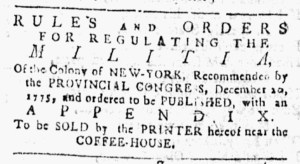
“RULES AND ORDERS FOR REGULATING THE MILITIA, Of the Colony of NEW-YORK.”

Advertisements for military manuals began appearing regularly in many American newspapers in 1775 and 1776.  They appeared most frequently in New England, where the first battles of the Revolutionary War occurred, and in Philadelphia, where the Second Continental Congress met, but not solely in those places.  On January 18, 1776, John Holt, the printer of the New-York Journal, ran an advertisement for “RULES AND ORDERS FOR REGULATING THE MILITIA, Of the Colony of NEW-YORK, Recommended by the PROVINCIAL CONGRESS, December 20, 1775, and ordered to be PUBLISHED, with an APPENDIX.”

That pamphlet presents a bibliographical mystery.  On September 24, 1775, the New-York Gazette and Weekly Mercurycarried the “RULES and ORDERS for regulating the Militia of the Colony of New-York, recommended by the Provincial Congress, August 22, 1775,” filling almost two columns on the first page and spilling onto the second page.  By then, Holt had been advertising a twelve-page pamphlet featuring the “RULES AND ORDERS” for nearly a month.  His first notice appeared in the August 31 edition of the New-York Journal.  He may not have appreciated Hugh Gaine’s decision to disseminate the same content for free, potentially undercutting sales of the pamphlet, yet the pamphlet offered a different format that readers, especially those who had cause the consult the manual regularly, likely found more convenient.  Gaine presented information as a service to the public, while Holt packaged the same content for practical use by officers and others.

The advertisements for Holt’s first edition of the “RULES AND ORDERS” did not mention an appendix.  That first appeared in his advertisement from January 18, 1776, along with an assertion that the “PROVINCIAL CONGRESS” adopted the “RULES AND ORDERS” on December 20, 1775, rather than August 22, 1775.  Had the provincial congress revisited the issue and recommended the same (or revised) “RULES AND ORDERS” after just four months?  Or did the new advertisement feature an error in the date?  What, if anything, did the appendix contain that was not part of the original pamphlet?  Unfortunately, no copy of a pamphlet with a title that includes the date December 20, 1775, survives.  Holt regularly inserted advertisements for it in the New-York Journal for three months, suggesting that he did indeed stock such a pamphlet (but not revealing how many he sold).  How and whether that pamphlet differed from the first one remains a mystery.

January 11

What was advertised in a revolutionary American newspaper 250 years ago today?

New-York Journal (January 11, 1776).

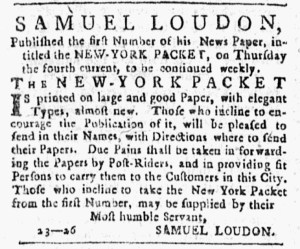
“SAMUEL LOUDON, Published the first Number of his News Paper, intitled the NEW-YORK PACKET.”

After spending several weeks distributing subscription proposals for a new newspaper, the New-York Packet, Samuel Loudon released the first issue on schedule on January 4, 1776.  On that day, Loudon’s notice that he planned to establish the newspaper appeared for the fourth and final time in the New-York Journal.  A week later, a new advertisement promoting the New-York Packet ran in the New-York Journal.  The notation at the end, “23-26” (corresponding to the issue numbers), indicated that Loudon planned for that notice to run for four consecutive weeks as well.

In it, the printer announced that he “Published the first Number of his News Paper … on Thursday the fourth current, to be continued weekly.”  He then provided an abbreviated version of the subscription proposal, stating that the New-York Packet “IS printed on large and good Paper, with elegant Types, almost new.”  For readers who did not subscribe in time to receive that “first Number,” it was not too late to start a subscription that included the first issue and all subsequent issues.  “Those who incline to encourage the Publication of it,” Loudon advised, “will be pleased to send in their Names, with Directions where to send their Papers.”  Loudon had disseminated the subscription proposals widely, including in the Connecticut Journal and the Pennsylvania Gazette.  He hoped to gain subscribers far beyond the city where he printed the New-York Packet.  To that end, he promised that “Due Pains shall be taken in forwarding the Papers by Post-Riders, and in providing fit Persons to carry them to the Customers in this City.”  That was a necessary part of satisfying both subscribers and advertisers.

Despite the fanfare around its founding, the New-York Packet last only eight months.  Loudon suspended the newspaper shortly before the British occupation of New York.  Unfortunately, surviving issues have not been digitized for greater access, so advertisements and other content from the New-York Packet will not appear in the Adverts 250 Project, though advertisements about the newspaper inserted in other publications testify to its short run at the beginning of the Revolutionary War.

December 21

What was advertised in a revolutionary American newspaper 250 years ago today?

New-York Journal (December 21, 1775).

“WILL BE PUBLISHED … A JOURNAL OF THE PROCEEDINGS OF THE CONTINENTAL CONGRESS.”

On Thursday, December 21, 1775, John Anderson, the printer of the Constitutional Gazette, ran an advertisement in the New-York Journal to stimulate interest in one of his forthcoming projects.  “On SATURDAY NEXT,” he announced, “will be published, by JOHN ANDERSON … A JOURNAL OF THE PROCEEDINGS OF THE CONTINENTAL CONGRESS.”  Just two weeks earlier, William Bradford and Thomas Bradford, the printers of the Pennsylvania Journal, advertised that they would soon publish the “JOURNAL OF THE PROCEEDINGS OF THE CONGRESS, HELD AT PHILADELPHIA, May 10, 1775.”  It appears that Anderson quickly acquired a copy and set about printing a local edition for the New York market, making him the first printer outside of Philadelphia to publish an overview of the Second Continental Congress when it convened after the battles at Lexington and Concord.  The volume that Anderson published had a slightly different title than what appeared in the advertisement: Extracts from the Votes and Proceedings of the American Continental Congress: Held at Philadelphia, 10th May, 1775.  In the rush to take it to press, the compositor introduced several errors in the page numbers, according to the American Antiquarian Society’s catalog.

Neither the Bradfords nor Anderson merely printed these collections of records of the Second Continental Congress and then advertised them.  Instead, both encouraged readers to anticipate their publication, making the eventual announcements that they were available for purchase even more enticing and persuasive.  On Saturday, December 23, Anderson’s own newspaper featured an advertisement promising that “This Day will be published by the Printer.  A Journal of the Proceedings of the Continental Congress.”  Eager customers could visit his printing office “at Beekman’s-Slip” to see if copies were ready for purchase.  By December 27, they were certainly available.  In the issue of the Constitutional Gazette distributed that day, Anderson described the volume as “Just published by the Printer” and listed three local agents who also sold it.  An updated advertisement also appeared in the New-York Journal on December 28, nearly identical to the one from the previous issue with the first two lines replaced with a single line.  Anderson’s advertisement began, “Just published, and to be sold by” instead of “On SATURDAY NEXT / WILL BE PUBLISHED, by.”  Using a series of advertisements in two of New York’s newspapers, Anderson announced the forthcoming publication of a local edition of “THE PROCEEDINGS OF THE CONTINENTAL CONGRESS” and kept the public informed of its progress and availability.

November 30

What was advertised in a revolutionary American newspaper 250 years ago today?

New-York Journal (November 30, 1775).

“A neat Mezzotinto Print of the Hon. JOHN HANCOCK, Esq.”

Richard Sause, a cutler in New York, became a purveyor of patriotic memorabilia during the Revolutionary War.  In October 1775, he advertised “ROMAN’s MAP OF BOSTON,” billing it as “one of the most correct that has ever been published.”  He described the cartographer, Bernard Romans, as “the most skilful Draughtsman in all America,” noting that he earned credibility because he “was on the spot at the engagements of Lexington and Bunker’s-Hill.”  Nicholas Brooks, a shopkeeper who specialized in prints, and Romans collaborated on the project in Philadelphia.  Sause acted as a local agent for marketing and distributing the map in New York.

That was not the only item commemorating current events that Sause advertised and sold.  At the end of November 1775, he took to the pages of the New-York Journal once again, informing the public that he sold a “neat Mezzotinto Print of the Hon. JOHN HANCOCK, Esq.”  The print depicting the merchant from Boston who served as president of the Second Continental Congress was another one of Brooks’s projects.  In addition, Sause also stocked “a view of the BATTLE at Charlestown” and “an accurate Map of the Present Seat of Civil War, taken by an able Draftsman.”  Sause seemingly worked closely with Brooks in acquiring the various prints and marketing them to patriots in New York, perhaps even providing him with advertising copy to adapt for his own notices.  The prints that Sause offered for sale appeared in the same order in his advertisement in the New-York Journal that they did in Brooks’s advertisement in Pennsylvania Journal.  Brooks may have sent a clipping along with the prints that he dispatched to the cutler in New York.

Although Sause had established himself as a cutler who also sold hardware and jewelry in a series of advertisements in New York’s newspapers, his activities in the marketplace in 1775 emphasized his commitment to the American cause.  Before he began selling prints, he promoted “SMALL SWORDS” to gentlemen who anticipated participating in the defense of their liberties and their city.  Even though he continued to advertise an “assortment of Jewellery, Cutlery, Hardware, and Haberdashery,” he made items related to the conflict with Parliament and British troops quartered in the colonies the focal point of his advertisements.

October 12

What was advertised in a revolutionary American newspaper 250 years ago today?

New-York Journal (October 12, 1775).

“I Acknowledge that I have at several times spoken in favour of the laws of Taxation.”

Lemuel Bower wanted to return to the good graces of his community in the fall of 1775.  Events that occurred since the previous April – the battles at Lexington and Concord, the siege of Boston, the Battle of Bunker Hill, the Second Continental Congress appointing George Washington as commander in chief of the Continental Army, an American invasion of Quebec – had intensified feelings about the imperial crisis and, apparently, made for a difficult situation for Bower since he had expressed Tory sentiments in the past.  In hopes of moving beyond that, he composed a statement that appeared in the October 12, 1775, edition of the New-York Journal.

“I Acknowledge,” Bower confessed, “I have at several times spoken in favour of the laws of Taxation, and against the measures pursued by America to procure Redress, and have thereby justly merited the displeasure of my country.”  To remedy that, “I beg forgiveness, and so solemnly promise to submit to the rules of the Continental and Provincial Congresses,” including abiding by the nonimportation and nonconsumption provisions in the Continental Association.  Furthermore, Bower pledged, “I never will speak or act in opposition to their order, but will conduct according to their directions, to the utmost of my power.”  He did not state that he had a change of heart, only that he would quietly act as supporters of the American cause were supposed to act rather than engage in vocal opposition.  As William Huntting Howell has argued, such compliance, especially when expressed in a public forum, may have been more important to most Patriots than whether Bower truly agreed with them.[1]  How he acted and what he said was more important than what he believed as long as he kept his thoughts to himself.

Bower did indeed express his regrets and his promise to behave better in a public forum.  He concluded his statement with a note that “this I desire should be published in the public prints.  When it appeared in the New-York Journal, it ran immediately below a notice from the Committee of Inspection and Observation in Stanford, New York, that labeled two Loyalists as “enemies to the liberties of their country” and instructed the public “to break off all commerce, dealings and connections with them.”  That was the treatment that Bower sought to avoid!  That notice appeared immediately below news from throughout the colony.  Bower’s statement ran immediately above paid advertisements.  The two statements concerning the political principles of colonizers thus served as a transition from news to advertising in that issue of the New-York Journal.  Did John Holt, the printer, treat them as paid notices?  Did he require Bower to pay to insert his statement?  Or did the Patriot printer publish one or both gratis?  Perhaps he printed the statement from the Committee of Inspection and Observation for free but made Bower pay to publish his penance.  Whatever the case, Bower’s statement was not clearly a news item nor an advertisement but could have been considered both simultaneously by eighteenth-century readers.

**********

[1] William Huntting Howell, “Entering the Lists: The Politics of Ephemera in Eastern Massachusetts, 1774,” Early American Studies 9, no. 1 (Winter 2011): 187-217.

September 28

What was advertised in a revolutionary American newspaper 250 years ago today?

New-York Journal (September 28, 1775).

“The Words of Command used in the Manual Exercise, and an accurate Plan of Boston.”

Almost simultaneously with Hugh Gaine announcing in the New-York Gazette and Weekly Mercury that he had “Just PUBLISHED … HUTCHIN’s Improv’d; BEING AN ALMANACK … For the Year of our LORD 1776,” Frederick Shober and Samuel Loudon inserted an advertisement in the New-York Journal to alert the public that they had “Just published … The NEW-YORK and COUNTRY ALMANACK, For the Year of our Lord 1776.”  It included “all the necessary Articles usual in an Almanac, with the Addition of many curious Anecdotes, Receipts [or Recipes], [and] poetical Pieces.”  Unlike Gaine, Shober and Loudon did not provide an extensive list of the contents.  As printer of the New-York Gazette and Weekly Mercury, Gaine had access to as much space as he wished to devote to promoting an almanac he published.  Shober and Loudon, on the other hand, paid to run their advertisement in the New-York Journal.

The partners did, however, specify two items that they wanted prospective customers to know they would find in the New-York and Country Almanack: “the Words of Command used in the Manual Exercise, and an accurate Plan of Boston with the different Situations of the Provincials, and the Ministerial Armies.”  Both reflected current events.  The “REFERENCES TO THE PLAN” (or legend for the map of Boston) in the almanac highlighted the “Battle of Lexington, 19th of April,” and the “Battle of Bunker’s-Hill, 17th of June.”  For readers beyond Massachusetts who did not directly experience those battles, that helped solidify in their minds the dates that they occurred.  By the time that Shober and Loudon took their almanac to press, maps of Boston had circulated widely in the July issue of the Pennsylvania Magazine (and Loudon had been among the booksellers to advertise them).  Nicholas Brooks and Bernard Romans also collaborated on a map that they likely distributed by the end of summer.  Those may have served as models for the “Plan of Boston” that Sober and Loudon commissioned for their almanac.  Gaine also directed attention to the “beautiful Plan of Boston, and the Provincial Camp” in his almanac.  The “whole Process of making SALT PETRE, recommended by the Hon. the Continental Congress” and a “Method of making Gun-Powder” accompanied their map.  In Shober and Loudon’s almanac, the “Words of Command,” taken from the widely published Manual Exercise, supplemented the map.  In both cases, the events of the Revolutionary War inspired the contents of the almanacs and became selling points in marketing them.

“Plan of Boston” [left] and “References to the Plan” [right], in The New-York and Country Almanack for the Year of Our Lord 1776 (New York: Shober and Loudon, 1775). Courtesy American Antiquarian Society.

September 24

What was advertised in a revolutionary American newspaper 250 years ago this week?

New-York Journal (September 21, 1775).

“EARTHENWARE … equal to the best of any imported from Philadelphia, or elsewhere.”

As fall arrived in 1775, Jonathan Durell took to the pages of the New-York Journal to advertised “EARTHENWARE” that he made locally and sold “at the well-known House called Katechemet’s Mead-House” on the outskirts of the city.  The potter offered a variety of items, including, “butter, water, pickle and oyster pots, porringers, milk pans of several sizes, jugs of several sizes, chamber pots,” and “a variety of other sorts of ware, too tedious to particularize.”  Durrel promoted these items as “far superior to the generality, and equal to the best of any imported from Philadelphia, or elsewhere.”  He also reported that he had migrated to New York from Philadelphia.

Mentioning Philadelphia twice in his advertisement was intentional.  When Durell compared the quality of his earthenware to items imported into New York, he did not refer only to goods arriving from English manufactories, though looking to alternatives would have been on the minds of consumers while the Continental Association remained in effect.  Colonizers who wished to purchase “domestic manufactures” in support of their political principles knew that Philadelphia was an important center for pottery production.  Deborah Miller, an archaeologist, notes that Philadelphia Style earthenware “became recognized across the colonies for its quality and durability” by the middle of the eighteenth century.  Citing Durell’s advertisement, Edwin Atlee Barber states that “it would appear that even before the Revolution the wares made in Philadelphia had acquired a reputation abroad for excellence.”[1]  Durell’s pottery was not made in Philadelphia, but he had resided there and presumably used the same techniques to produce his earthenware.  As both consumers and “city and country store-keepers” sought goods made in the colonies, he presented an attractive option.

To increase his chances of making sales, Durell mentioned the “reasonable rates” he charged for his earthenware and provided a convenient service.  In a nota bene, he declared, “The purchaser of twenty shillings, or upwards, may depend on having it delivered in any part of this city, without charge.”  The potter hoped that free delivery would entice customers to take a chance on earthenware that he asserted matched any others, including products from Philadelphia, in its quality.

**********

[1] Edwin Atlee Barber, The Pottery and Porcelain of the United States: An Historical Review of American Ceramic Art from the Earliest Times to the Present Day (New York: G.P. Putnam’s Sons, 1893).

September 14

What was advertised in a revolutionary American newspaper 250 years ago today?

New-York Journal (September 14, 1775).

“SMALL SWORDS … of various sorts.”

Richard Sause’s advertisement for “SMALL SWORDS” and other items available at his “Jewelery, Hardware, and Cutlery Store” became a familiar sight for readers of the New-York Journal in the summer of 1775.  The woodcut depicting a shop sign with Sause’s name and an array of cutlery, including a sword, made his notice even easier to spot.

On September 14, his notice happened to appear near the top of the left column on the final page of the newspaper, immediately below a regular feature called “POET’S CORNER.”  For that issue, John Holt, the printer, selected a short poem, “The Patriot’s Wish.”

OF private passions, all my soul divest,
and let my dearer country fill my breast,
To public good transfer each fond desire,
And clasp my country with a lover’s fire.
Well pleas’d her weighty burdens let me bear
Dispense all pleasure, and engross all care;
[ ] quick to [ ], to feel the public woes,
And wake, that millions may enjoy repose.

The strained verses were heartfelt even if not especially graceful or elegant.  Perhaps a reader submitted the poem as their way of contributing to the struggle that colonizers endured throughout the imperial crisis and then intensified with the outbreak of hostilities at Lexington and Concord the previous spring.  Sause aimed to make his own contribution by supplying “SMALL SWORDS and Cutteau de Chasse’s,” a type of sword, to the gentlemen of New York who prepared for the possibility that they would have to join the fight.  Although Sause’s advertisement appeared below “The Patriot’s Wish” almost certainly by coincidence, the cutler may have been pleased with the happy accident.  After all, the poem primed readers to think about their duty and to contemplate how to make their own contributions to the cause.  For many, that could have included outfitting themselves with weapons and other military equipment.

September 10

What was advertised in a revolutionary American newspaper 250 years ago this week?

New-York Journal (September 7, 1775).

“Several packages of their Spring goods, are yet unopened.”

As fall arrived in 1775, Francis Lewis and Son took to the pages of the New-York Journal to advertise an array of imported goods that they stocked and sold at their store.  As many merchants and shopkeepers did, they demonstrated the choices they made available to consumers with a list of their inventory.  Their catalog featured two columns with one or two items per line, enumerating “Red strouds, shalloons,” “Printed callicoes, cotton and chintzes,” “A variety of ribbons,” “Musqueto netting for beds,” “Looking glasses,” and “Long and short handle frying pans.”  That popular format for newspaper advertisements did not appear with the same frequency once the Continental Association went into effect on December 1, 1774.  Recognizing that the nonimportation pact devised by the First Continental Congress in response to the Coercive Acts remained in place, Lewis and Son signaled that they abided by it.

The savvy entrepreneurs specified that their wares had been “imported last Fall.”  Under other circumstances, retailers did not boast that their merchandise had been on the shelves for nearly a year.  Instead, they emphasized how recently they received shipments from London and other English ports, sometimes even naming which vessels had transported the goods so readers who followed the shipping news could confirm that sold new items.  In this instance, however, Lewis and Son needed to assure the public, especially prospective customers, that they did not deviate from the Continental Association.  Patriots could not fault shopkeepers and consumers for selling and buying goods “imported the last Fall.” To underscore that they made a deliberate choice, Lewis and Son added a nota bene: “Several Packages of their Spring goods, are yet unopened.”  That note had even greater in significance in September 1775, following the outbreak of hostilities at Lexington and Concord, than it did when the advertisement first appeared in the March 23, 1775, edition of the New-York Journal.  Lewis and Son highlighted their own restraint in placing goods in the marketplace even as they suggested to prospective customers that they barely had to restrain themselves in their purchases because the shopkeepers offered so many choices.

August 10

What was advertised in a revolutionary American newspaper 250 years ago today?

New-York Journal (August 10, 1775).

“Stockings made in the best manner, for those that bring their own stuff.”

In an advertisement that first ran in the August 10, 1775, edition of the New-York Journal, James Wallace informed the “Ladies and Gentry” of the city that he “makes and sells, black and white silk patent lace for ladies aprons, handkerchiefs, &c.” and “hoods, aprons and tippets, and several other things in that way.”  In addition, he made and sold “silk and thread gloves and mitts, the silk of which is American produce.”  On that point, Wallace made an additional pitch: “He therefore hopes to be honoured with the commands of those who wish to encourage their own manufacture.”  It was not clear whether the silk for his lace to adorn aprons, handkerchiefs and other items was produced in the colonies or just the lace for his gloves and mitts.

Either way, Wallace expected his marketing would resonate with prospective customers who certainly knew about the provisions of the Continental Association without him explicitly invoking it.  That nonimportation agreement also called on American producers to supply alternatives and American consumers to support their endeavors.  The eighth article stated, “That we will, in our several Stations, encourage Frugality, Economy, and Industry; and promote Agriculture, Arts, and the Manufactures of this Country.”  Wallace made it easy for the “Ladies and Gentry” of New York to do so.

Wallace also noted that he made stockings “in the best manner, for those that bring their own stuff.”  In other words, customers could reduce the prices they paid for stocking by supplying their own materials, paying only for the labor.  Once again, consumers had an opportunity to put their political principles into practice in the choices they made in the marketplace.  In supplying their “own stuff,” the “Ladies and Gentry” could opt for thread spun in their own homes, either by themselves or by servants, or for thread that they knew for certain had been produced in the colonies.  Wallace did not merely offer a chance to save money for customers who provided their own materials; he also signaled that they could support the American cause through their own industry in producing those materials.