December 29

What was advertised in a revolutionary American newspaper 250 years ago today?
Virginia Gazette [Purdie] (December 29, 1775).

“All persons indebted to me for BOOKS, STATIONARY, ADVERTISEMENTS …”

As 1775 drew to a close, Alexander Purdie placed a notice in his own Virginia Gazette to tend to the business of running that newspaper.  A year earlier, he and his former partner, John Dixon, ended their partnership.  Dixon took a new partner, William Hunter, and continued printing the Virginia Gazette that he and Purdie had produced together for the last nine years.  Purdie immediately announced that he would commence printing a newspaper, that one also named the Virginia Gazette.  John Pinkney printed a third Virginia Gazette in Williamsburg.

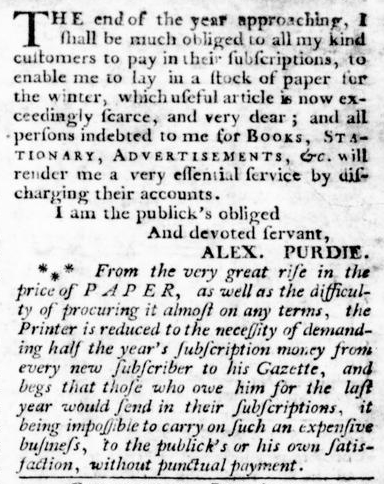
Purdie’s experience and reputation apparently earned him enough customers to make his Virginia Gazette a viable enterprise, though he had to call on them to do their part by paying for the goods and services they purchased on credit.  “The end of the year approaching,” the printer explained, “I shall be much obliged to all my kind customers to pay in their subscriptions, to enable me to lay in a stock of paper for the winter, which useful article is now exceedingly scarce, and very dear.”  A variety of factors contributed to the scarcity of paper, including disruptions in trade with England due to the Continental Association and the outbreak of hostilities at Lexington and Concord in April.

Purdie did not call on subscribers alone to settle accounts.  Instead, he declared that “all persons indebted to me for BOOKS, STATIONARY, ADVERTISEMENTS, &c. will render me a very essential service by discharging their accounts.”  Yet, he placed the greatest emphasis on subscribers, adding a note that underscored the price and scarcity of paper.  “From the very great rise in the price of PAPER, as well as the difficulty of procuring it almost on any terms,” he proclaimed, “the Printer is reduced to the necessity of demanding half the year’s subscription money from every new subscriber to his Gazette.”  Such instructions deviated from the standard narrative about how early American printers ran their businesses.

Historians have often asserted that printers extended credit for subscriptions while requiring advertisers to pay in advance, recognizing advertising as the more significant revenue stream.  Throughout the colonies, many printers did frequent place notices asking, cajoling, and even threatening legal action in their effort to get subscribers to pay.  However, many also specified that subscribers were supposed to pay for half the year “upon entering.”  Difficult times forced Purdie to make that a condition for new subscribers.  He also seems to have extended credit for advertisements, though his notice did not make clear whether he meant newspaper notices or job printing (like handbills and broadsides) or both.  Even as printers followed standard practices, how they actually applied them varied from printing office to printing office.
August 18

What was advertised in a revolutionary American newspaper 250 years ago today?

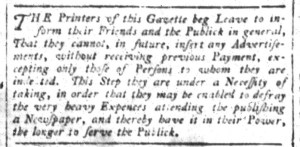
South-Carolina and American General Gazette (August 18, 1775).

They cannot … insert any Advertisements, without receiving previous Payment.”

The August 18, 1775, edition of the South-Carolina and American General Gazette included an update about how Robert Wells and Son would conduct business.  “THE Printers of this Gazette,” they stated, “beg Leave to inform their Friends and the Publick in general, That they cannot, in future, insert any Advertisements, without receiving Payments” in advance.  Wells and Son did make an exception for “persons to whom they are indebted.”  Why did they change their policy?  “This Stop they are under a Necessity of taking,” the printers explained, “in order that they may be enabled to defray the very heavy Expences attending the publishing a Newspaper, and therevy have it in their Power, the longer to serve the Publick.”  That warning carried even more weight when readers and “the Publick in general” considered that the South-Carolina Gazette and Country Journal, one of three newspapers published in Charleston during the last decade, “discontinued” publication just a few weeks earlier.

This notice indicates that a common assumption about how printers managed their newspapers may be more complex than historians of the early American press previously realized.  The usual narrative asserts that printers extended generous credit to subscribers, allowing them to go years without paying for their newspapers because the printers wanted to bolster their circulation numbers.  In turn, that meant that they could attract more advertisers … and advertisements provided the most important revenue stream, especially since printers supposedly required advertisers to pay for their newspaper notices in advance.  For several years, the Adverts 250 Project has tracked notices that seem to contradict that narrative, though references to “advertisements” in some of those notices may have referred to handbills, broadsides, and other media distributed separately rather than newspaper notices.  In this notice, however, Wells and Son clearly referred to inserting advertisement in their newspaper.  While they adopted a new policy of requiring payment for advertisements in advance, they previously extended credit to advertisers.  More printers mya have done so than historians have realized.

May 14

What was advertised in a revolutionary American newspaper 250 years ago this week?

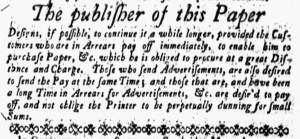
New-Hampshire Gazette (May 12, 1775).

Those who send Advertisements, are also desired to send the Pay at the same Time.”

On April 28, 1775, a little over a week after the battles at Lexington and Concord, Daniel Fowle, the printer of the New-Hampshire Gazette placed a notice calling on subscribers and other customers “to discharge what they may be in Arrears” and to do so “immediately, otherwise he shall be obliged to discontinue [the newspaper] for some Time.”  He added that all the newspapers published in Boston “are all stopt, and no more will be printed for the present.”  Fowle warned, “that must be done here unless the Customers attend to this call.”  He could not continue publishing the New-Hampshire Gazette without receiving payments for it.

Just two weeks later, he inserted another notice, declaring that he “Designs, if possible, to continue [the newspaper] a while longer, provided the Customers who are in Arrears pay off immediately, to enable him to purchase Paper, &c. which he is obliged to procure at a great Distance and Charge.”  This time he singled out advertisers, a cohort of customers that he had not explicitly mentioned in his previous notice.  “Those who send Advertisements,” Fowle instructed, “are also desired to send the Pay at the same Time.”  Furthermore, “those that are, and have been a long Time in Arrears for Advertisements, &c. are desir’d to pay off, and not oblige the Printer to be perpetually dunning for small Sums.”

In that notice, Fowle revealed an important aspect of his business practices.  Most printers extended credit to subscribers.  Fowle certainly did so, prompting his notices in late April and early May 1775, as well as other notices that he frequently inserted in the New-Hampshire Gazette over the years.  Many historians of the early American press posit that printers allowed for generous credit for subscriptions, permitting subscribers to avoid paying for years, because they generated significant revenue from advertisements.  Doing so, depended on advertisers having confidence in the circulation of newspapers, explaining why printers allowed some subscribers to fall years behind on making payments.  Accordingly, printers supposedly required advertisers to pay for their notices when they submitted them for publication.

Fowle’s notice in the May 12, 1775, edition of the New-Hampshire Gazette suggests that he did not demand payment before publishing advertisements in his newspaper.  The Adverts 250 Project has collected other notices in which printers called on customers to pay for advertisements, though in many cases the use of the word “advertisements” was ambiguous.  It could have meant newspapers notices or it could have referred to printing handbills and broadsides (especially for printers who asserted that they could print “advertisements” with only an hour’s notice).  In this case, however, it seems clear that Fowle meant newspaper notices when he stated, “Those who send Advertisements, are also desired to send the Pay at the same Time.”  Fowle and other printers very well may have adopted practices different from the usual narrative about printers uniformly requiring advertisers to pay in advance.

January 22

What was advertised in a colonial American newspaper 250 years ago this week?

Massachusetts Spy (January 19, 1775).

“No ADVERTISEMENTS … can be inserted for the future without the Cash accompanies them.”

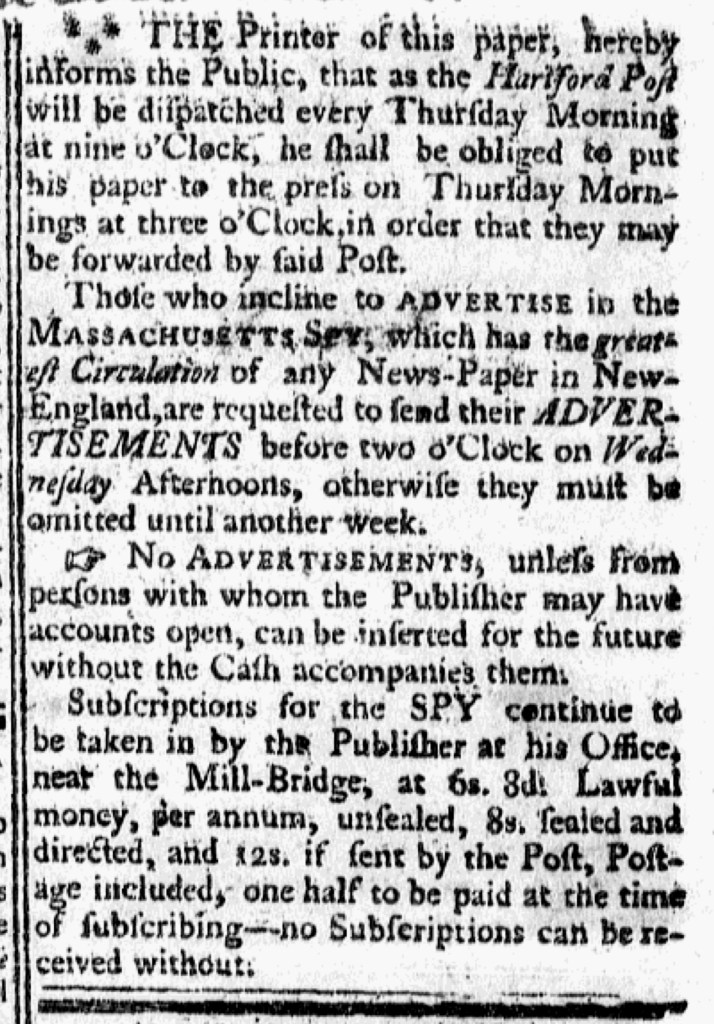
In a notice in the January 19, 1775, edition of the Massachusetts Spy, Isaiah Thomas, the printer, provided several important details about the practices he enacted for publishing his newspaper.  He opened by noting that “the Hartford Post will be dispatched every Thursday Morning at nine o’Clock.”  In order that that the Massachusetts Spy “may be forwarded by said Post,” Thomas “shall be obliged to put his paper to the press on Thursday Mornings at three o’Clock.”  Calling attention to such early mornings not only testified to the industriousness of the printer but also alerted the public that he could publish updates that arrived at his printing office merely hours before he distributed the new issue of his weekly newspaper.

Thomas also advised “[t]hose who incline to ADVERTISE in the MASSACHUSETTS SPY … to send their ADVERTISEMENTS before two o”Clock on Wednesday Afternoons, otherwise they must be omitted until another week.”  To convince them to advertise in in his newspaper, he proclaimed that it “has the greatest Circulation of any News-Paper in New-England.”  That meant that advertisers were likely to experience the greatest return on their investment by placing notices in the pages of the Massachusetts Spy.  Although compositors worked quickly, they did need some time to set type for individual advertisements and lay out all the news, editorials, advertisements, and other content for each issue.  While Thomas might welcome “Articles of Intelligence” that arrived very shortly before taking his newspaper to press, he insisted that advertisements required more time to prepare for publication.  Advertisers needed to plan accordingly.

In addition, Thomas declared, “No ADVERTISEMENTS, unless from persons with whom the Publisher may have accounts open, can be inserted for the future without the Cash accompanies them.”  He also asserted that subscriptions for the newspaper required “one half [of the annual fee] to be paid time of subscribing” and “no Subscriptions can be received without.”  Historians of the early American press often make general statements about printers extending generous credit to subscribers, expecting that some would never pay, because they understood that newspaper advertisements were a much more most significant revenue.  According to such accounts, printers supposedly insisted on receiving payment for advertisements in advance of publishing them.  While that may have been the case in some printing offices, several printers published notices indicating that they departed from such practices.  That Thomas put in place such a policy “for the future” suggests that it may have been a new policy or one that he had not previously enforced.  Similarly, Thomas joined other printers who extended credit yet also demanded that subscribers submit half of the annual fee in advance, updating the terms that he published in the colophon that appeared in each issue of the Massachusetts Spy.

January 9

What was advertised in a colonial American newspaper 250 years ago today?

Maryland Journal (January 9, 1775).

“ALL Persons indebted to the Printer … are earnestly requested to make immediate Payment.”

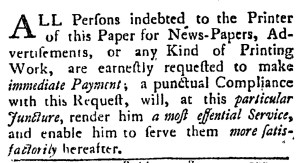
Among the advertisements that filled the first page of the January 9, 1775, edition of the Maryland Gazette, William Goddard inserted his own notice that requested “ALL Persons indebted to the Printer of this Paper for News-Papers, Advertisements, or any Kind of Printing Work … make immediate Payment.”  Printers often placed such notices calling on subscribers to settle accounts and, sometimes, incorporating overdue payments for other services.

The inclusion of “Advertisements” in Goddard’s notice raises questions about the business model usually associated with colonial printers.  Historians of the early American press have long asserted that printers extended credit for subscriptions while demanding payment in advance for advertisements.  Accordingly, advertising represented the real revenue in publishing newspapers.  Yet several printers periodically called on customers to pay for “Advertisements.”  Those notices, however, do not make clear what they meant by “Advertisements.”  They may have referred to paid notices that appeared in their newspapers, in which case some printers deviated from the (standard?) practice of requiring payment in advance, but they might have instead meant handbills, broadsides, and other advertising media that many printers stated that they could prepare on short notice.

In the colophon at the bottom of the final page, Goddard gave the location of his printing office in Baltimore, “where ADVERTISEMENTS, for ready Money only, and SUBSCRIPTIONS for this PAPER … are taken in.”  That suggests that Goddard did indeed have a policy of insisting on payment for advertisements before printing them in the Maryland Journal.  Does that definitively mean that “Advertisements” in his call for customers to pay their bills meant handbills and broadsides and not newspaper notices?  Not necessarily.  Goddard may have invoked a relatively new policy.  The colophon that asserted that he inserted advertisements “for ready Money only” had been in use for about three months, since October 1774, but prior to that he had used a streamlined version that did not mention any of the services he provided.  In its entirety, it read: “BALTIMORE: Printed by W. GODDARD, at his Printing-Office near the FOUNTAIN-INN, MARKET-STREET.”  Perhaps Goddard previously extended credit to advertisers but changed his policy when too many took advantage.  His notice and his colophons do not give a straightforward answer but instead suggest that the business practices of some printers may have been more complex than often assumed.

Maryland Journal (January 9, 1775).

August 7

What was advertised in a colonial American newspaper 250 years ago this week?

Connecticut Gazette (August 5, 1774).

“All Persons indebted to T. GREEN, either for News-Papers, Advertisements, or otherwise are requested to make immediate Payment.”

Among the many advertisements that appeared on the final page of the August 5, 1774, edition of the Connecticut Gazette, Timothy Green, the printer, inserted a brief notice calling on readers to settle accounts in his printing office in New London.  “All Persons indebted to T. GREEN, either for News-Papers, Advertisements, or otherwise,” it read, “are requested to make immediate Payment.”  The “otherwise” included books and pamphlets.  Green simultaneously advertised several including “POEMS on various SUBJECTS, RELIGIOUS AND MORAL, By PHILLIS WHEATLEY,” “A PLEA, In Vindication of the Connecticut Title to the contested Lands, lying West of the Province of New-York … By BENJAMIN TRUMBULL,” and “The JUDGMENT of whole Kingdoms and Nations … By Lord Somers.”  Green likely stocked stationery and writing supplies as well.  Many printers even peddled patent medicines for supplementary revenue.

Printers also did job printing, such as blanks (printed forms), broadsides, and handbills.  When Green called on those indebted to him for advertisements to submit payment, he may have meant customers who ordered broadsides, handbills, and other advertising ephemera.  That was sometimes what printers meant when they solicited advertisements.  Such was the case when Joseph Crukshank announced that he opened a printing office in Philadelphia in 1769.  “Particular care will be taken,” he pledged, “to do Advertisements, Blanks, &c. on very short notice.”  Isaiah Thomas was more specific in the colophon that regularly ran at the bottom of the final page of the Massachusetts Spy in the early 1770s: “Small HAND-BILLS at an Hour’s Notice.”  That may have been the kind of work that Green meant, but he may have also intended to include paid notices that appeared in the Connecticut Gazette.  If so, extending credit to newspaper advertisers did not align with the business practice traditionally identified by historians of the early American press: printers supposedly allowed credit for subscriptions yet demanded payment in advance for newspaper advertisements.  The revenue from advertising underwrote whatever subscribers neglected to pay.  Yet printers sometimes inserted notices that indicated they had published newspaper advertisements on credit.  Ebenezer Watson, printer of the Connecticut Courant, reconsidered that policy when he announced that “No Advertisements will for the future be published in this paper, without the money is first paid.”  Green may have allowed credit for advertisements in the Connecticut Gazette.  The wording in his notice does not definitively eliminate that possibility.

April 17

What was advertised in a colonial American newspaper 250 years ago this week?

Virginia Gazette [Rind] (April 17, 1774).

“Advertisements, blanks, and many other kinds of printing work, she ardently hopes, may be discharged at the general courts.”

Clementina Rind printed the Virginia Gazette and operated the printing office following the death of her husband in August 1773.  That included keeping the books and calling on customers to settle accounts.  She issued such a notice in the April 14, 1774, edition of her newspaper, at the same time outlining improvements to the publication that payments would help support.  She asserted that she had “lately considerably enlarged her paper,” providing more content to subscribers and other readers.  In addition, she ordered and “expect[ed] shortly an elegant set of types from London, … together with all other materials relative to the printing business.”  Rind expressed pride in “the dignity of her gazette” while simultaneously noting that those who owed money had a role to play in her goal of “keeping it at a fixed standard.”

To that end, she called on subscribers to submit annual payments.  In the eighteenth century, many newspaper subscribers notoriously went for years without settling accounts with printers.  Advertising revenue offset those delinquent payments, yet not all printers demanded that advertisers pay for their notices in advance, contrary to common assumptions about how they ran their businesses.  Rind’s notice suggests that she may have published advertisements on credit but does not definitively demonstrate that was the case.  She requested that customers pay what they owed for “advertisements, blanks, and many other kinds of printing work … at the general courts.”  She may have meant newspaper notices, but “advertisements” could have also referred to handbills, broadsides, and other job printing for the purposes of marketing goods and services or disseminating information to the public.  The masthead listed prices for subscriptions (“12 s. 6 d. a Year”) and advertisements “of a moderate length” (“3 s. the first Week, and 2 s. each Time after”), while also promoting “PRINTING WORK, of every Kind,” which would have included blanks (or forms for legal and commercial transactions), handbills, and broadsides, but that does not clarify what Rind meant by “advertisements” in her notice.  That other printers sometimes allowed credit for newspaper advertisements leaves open the possibility that Rind may have done so as well.  If that was the case, it made it even more imperative that advertisers discharge their debts to “enable her the better to carry on her paper with that spirit which is so necessary to such an undertaking.”

Virginia Gazette [Rind] (April 14, 1774).

February 8

What was advertised in a colonial American newspaper 250 years ago today?

Pennsylvania Chronicle (February 8, 1774).

“I have come to the Resolution of suspending the Publication of the PENNSYLVANIA CHRONICLE.”

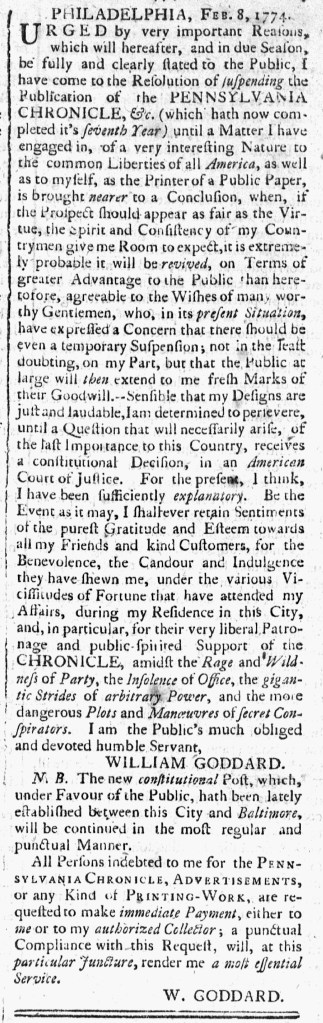
William Goddard published the final issue of the Pennsylvania Chronicle on February 8, 1774.  That newspaper commenced publication seven years earlier, on January 26, 1767.  The Adverts 250 Project tracked Goddard’s efforts to launch the Pennsylvania Chronicle, advertisements that ran in the first issues, and many more advertisements throughout its run.  Aside from news items, the final issue featured only three paid notices along with a letter from Goddard.

The printer explained that “very important Reasons” led him to “the Resolution of suspending the Publication of the PENNSYLVANIA CHRONICLE.”  He suggested that those reasons “will hereafter, and in due Season, be fully and clearly stated to the Public.”  He further hinted that he planned to revive the newspaper when “a Matter I have been engaged in, of a very interesting Nature to the common Liberties of all America, as well as to myself, as the Printer of a Public Paper, is brought nearer to a Conclusion.”  Goddard made other cryptic references, pronouncing that he had been “sufficiently explanatory.”  Still, he could not resist thanking his patrons for their support “amidst the Rage and Wildness of Party, the Insolence of Office, the gigantic Strides of arbitrary Power, and the more dangerous Plots and Manoeuvres of secret Conspirators.”

Many readers, especially those who had resided in Philadelphia for any amount of time, may have remembered that Goddard initially published the Pennsylvania Chronicle in partnership with Joseph Galloway and Thomas Wharton.  In his History of Printing in America (1810), Isaiah Thomas notes that the newspaper “was established under their influence and subject to their control, until 1770.”  At that time, Galloway and Wharton sold their share to Benjamin Towne, but Goddard soon “separated from his partners.”  After that, a “portion of [the newspaper] was … for a long time, devoted by Goddard to the management of a literary warfare which took place between him and his late partners.”[1]  In 1770, Goddard had also published a pamphlet, The Partnership, that put the enmity between himself and his former partners on full view for the public.  The lengthy subtitle testified to how much the relationship had deteriorated:  “The history of the rise and progress of the Pennsylvania Chronicle, &c.: Wherein the conduct of Joseph Galloway, Esq; speaker of the Honourable House of Representatives of the province of Pennsylvania; Mr. Thomas Wharton, Sen. and their man Benjamin Towne, my late partners, with my own, is properly delineated, and their calumnies against me fully refuted.”  In turn, Galloway and Wharton had Goddard imprisoned for debt for the following year.

As the Pennsylvania Chronicle declined, Goddard founded the Maryland Journal, the first newspaper published in Baltimore, in August 1773.  Goddard relocated to Baltimore after “suspending” the Pennsylvania Chronicle.  In a nota bene at the end of his letter in the final issue, he declared that the “new constitutional Post, which … hath been lately established between this City and Baltimore, will be continued in the most regular and punctual Manner.”  That was the first route in what became a much more expansive network of post offices operated independently of the British postal system, allowing colonizers to send letters and disseminate newspapers without interference from British officials.

As a last matter of housekeeping, Goddard called on “All Persons indebted to me for the PENNSYLVANIA CHRONICLE, ADVERTISEMENTS, or any Kind of PRINTING-WORK … to make immediate Payment.”  Printers and other entrepreneurs regularly placed notices with the intention of settling accounts.  Goddard’s notice merits special attention because he indicates that some customers owed for advertisements.  Many historians of the early American press assert that printers extended generous credit to subscribers while generating revenue by demanding that advertisers paid in advance.  Some printers, however, periodically ran notices calling on advertisers to make payment.  Goddard and some of his fellow printers apparently did not enforce a hard-and-fast policy when it came to paying for advertisement before publication.

Although the Pennsylvania Chronicle ceased publication in 1774, Goddard continued publishing the Maryland Journal and became involved in other projects, including the Constitutional Post, that became the subjects of news articles, editorials, and advertisements.  Undoubtedly, William Goddard will make additional appearances as the Adverts 250 Project continues examining advertising, print culture, and politics during the era of the American Revolution.

**********

[1] Isaiah Thomas, The History of Printing in America: With a Biography of Printers and an Account of Newspapers (1810; New York: Weathervane Books, 1970), 438.

November 7

What was advertised in a colonial American newspaper 250 years ago this week?

Providence Gazette (November 6, 1773).

“Those indebted for advertising, or in any other Manner, are likewise requested to pay.”

Like many other colonial printers, John Carter, the printer of the Providence Gazette, published advertisements in his own newspaper.  Many of those notices concerned additional revenue streams.  For instance, in the November 6, 1773, edition, Carter ran an advertisement that promoted “THE NEW-ENGLAND ALMANACK, OR LADY’S and GENTLEMAN’S DIARY, For the Year of our LORD, 1774,” offering to sell the popular pamphlet “in large or small Quantities.”  For many years, Benjamin West, a mathematician and astronomer, collaborated with Carter in publishing and marketing an almanac.  Another advertisement drew attention to a different project undertaken by Carter, a local edition of Daniel Fenning’s Universal Spelling-Book.  The printer proclaimed that he sold this reprint “Cheaper by the Dozen than any imported.”  A third advertisement hawked “BLANKS [or printed forms] of various Kinds,” another common source of revenue for printers.

In addition to notices about other goods and services available in their printing offices, printers also placed advertisements that tended to the business of publishing their newspapers.  In the same issue that carried advertisements for the almanac, the spelling book, and blanks, Carter inserted a notice to inform readers that “THIS DAY’s GAZETTE closes the Year with ALL the old Subscribers.”  That being the case, “the Printer therefore earnestly intreats of every one in Arrear to make immediate Payment.”  He did not, however, address only subscribers.  “Those indebted for advertising, or in any other Manner,” Carter continued, “are likewise requested to pay.”  That notice reveals an important aspect of how Carter ran his business.  Many historians of the early American press have asserted that printers extended to credit to subscribers, sometimes allowing them to fall behind in payments over several years, but insisted that advertisers had to pay for their notices in advance.  The advertising revenue supposedly amounted to more than the overdue subscriptions.  Yet some colonial printers published notices indicating that they did indeed allow credit for advertisements as well as subscriptions.  The Adverts 250 Project compiles such advertisements to demonstrate that practices in printing offices throughout the colonies varied when it came to paying upfront for advertisements.  Even if most printers did insist on payment in advance, a significant minority adopted other policies.

October 4

What was advertised in a colonial American newspaper 250 years ago today?

Pennsylvania Chronicle (October 4, 1773).

“The Printer of this Paper begs the Favour of ALL who are indebted to him for the Pennsylvania Chronicle, Advertisements, &c. to make IMMEDIATE PAYMENT.”

William Goddard exercised his prerogative as printer to place his notice first among the advertisements that appeared in the October 4, 1773, edition of the Pennsylvania Chronicle.  He placed it immediately below the shipping news from the customs house in Philadelphia, a strategy frequently deployed by colonial printers.  Even if readers only skimmed the remainder of the contents of that issue, the advertisements, once they determined that the portion devoted to news came to an end then they might give more attention to the first of the notices they encountered than any of the others.

Goddard participated in a familiar refrain among printers: “The Printer of this Paper begs the Favour of ALL who are indebted to him … to make IMMEDIATE PAYMENT.”  He made a special appeal to “his Customers who live in the Country,” whether in Pennsylvania or other colonies served by the Pennsylvania Chronicle, to “order Payment to be made in this City,” Philadelphia, “or remit the same by the first good Opportunity.”  Goddard pleaded for cooperation because “the Accounts are small and lie so wide of each other, that they cannot be collected without great Trouble and Expence.”  He implied that most overdue accounts were so small that customers would not experience any hardship in settling them, while also encouraging their cooperation in not making the process more onerous than necessary.  Stating that the accounts “lie so wide of each other” also suggested an extensive circulation for the Pennsylvania Chronicle, a factor for prospective advertisers to take into consideration when choosing which of the several newspapers published in Philadelphia should carry their notices.

Notably, Goddard addressed customers “indebted to him for the Pennsylvania Chronicle, Advertisements,” and anything else, such as books or job printing.  Historians have traditionally asserted that colonial printers struck a balance between extending credit to subscribers and requiring advertisers to pay before printing their notices, making advertising the more consistent and more significant source of revenue for printers who published newspapers.  Apparently, not all printers, however, adopted that business model.  Goddard was one of several printers who ran notices that called on both subscribers and advertisers to pay their bills.  Those printers may have been more selective in allowing credit for advertising than for subscriptions, yet their own notices indicated that they did allow credit for advertising for at least some customers. Advertising certainly had the potential to be lucrative, but only if printers required payment in advance or successfully collected payments after extending credit to advertisers.