December 26

What was advertised in a colonial American newspaper 250 years ago today?

Pennsylvania Chronicle (December 26, 1772).

Doctor GEORGE WEED … was a regular bred Physician, in New-England.”

George Weed, an apothecary, served patients in Philadelphia for decades in the middle of the eighteenth century.  In his advertisements, he styled himself as “Doctor GEORGE WEED.”  On occasion, he provided credentials to justify using that title.

For instance, in an advertisement hawking a variety of medicines in the December 26, 1772, edition of the Pennsylvania Chronicle, Weed provided an overview of his training before describing his “SYRUP of BALSAM” for coughs and colds, his “ROYAL BALSAM” for wounds, bruises, and sores, his “BITTER TINCTURE” for dizziness and upset stomach, and other medicines that he compounded at his apothecary shop.  Weed asserted that he “was a regular bred Physician, in New-England, and served his time with Ephraim Warner, a licenced Doctor.”  In other words, he received training from “one of the greatest and most successful Practitioners of Physic, in New England, in his day.”  Rather than ask the public to take his word for it, Weed concluded his advertisement with an affirmation from a minister.  Thomas Lewis declared, “That Doctor GEORGE WEED, living in Newtown Township, was under the Instructions and Directions of a judicious Practitioner of Physic, in New-England, for some Years, is certified by me.”  Careful readers may have noted that the affirmation was nearly two decades old, dated October 6, 1753.  Weed apparently believed that it served his purpose in helping to convince prospective patients to purchase his medicines.

To strengthen his pitch, Weed noted that he had “above 34 years successful practice,” including serving as “Apothecary to the Pennsylvania Hospital.”  He no longer held that position, instead operating his own shop on Market Street.  Through his long experience, he proclaimed, Weed “brought to perfection, some medicines, which have proved extraordinary in curing many diseases.”  Although the apothecary mentioned that he carried a “general assortment of Medicines,” he emphasized those that he made himself.  Other apothecaries, retailers, and even printers imported, advertised, and sold a variety of patent medicines produced in England.  Weed suggested to consumers in Philadelphia that the combination of his training and long experience serving patients in the colonies resulted in creating better products to cure common maladies.  They did not need remedies produced elsewhere when they could consult directly with a skilled apothecary who compounded medicines to order.
December 12

What was advertised in a colonial American newspaper 250 years ago today?

Pennsylvania Chronicle (December 12, 1772).

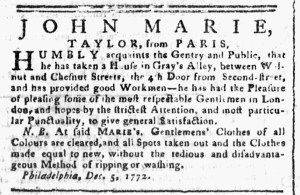
“He has had the Pleasure of pleasing some of the most respectable Gentlemen in London.”

John Marie, a tailor, wanted the better sort to know that he was well qualified to serve them at the shop he ran out of his house in Gray’s Alley in Philadelphia.  In an advertisement in the December 12, 1772, edition of the Pennsylvania Chronicle, he introduced himself as a “TAYLOR, from PARIS.”  He intended that his connection to one of the most cosmopolitan cities in Europe, a city where the fashionable often set tastes adopted in London, the most cosmopolitan city in the British Empire, would recommend him to genteel consumers in the largest and one of the most cosmopolitan cities in the colonies.  He made clear that he sought a particular kind of client by addressing “the Gentry and Public.”  Consumers and tailor would mutually benefit from their association as Marie enhanced the appearances of his clients and those clients gained the cachet of being dressed by a French tailor.

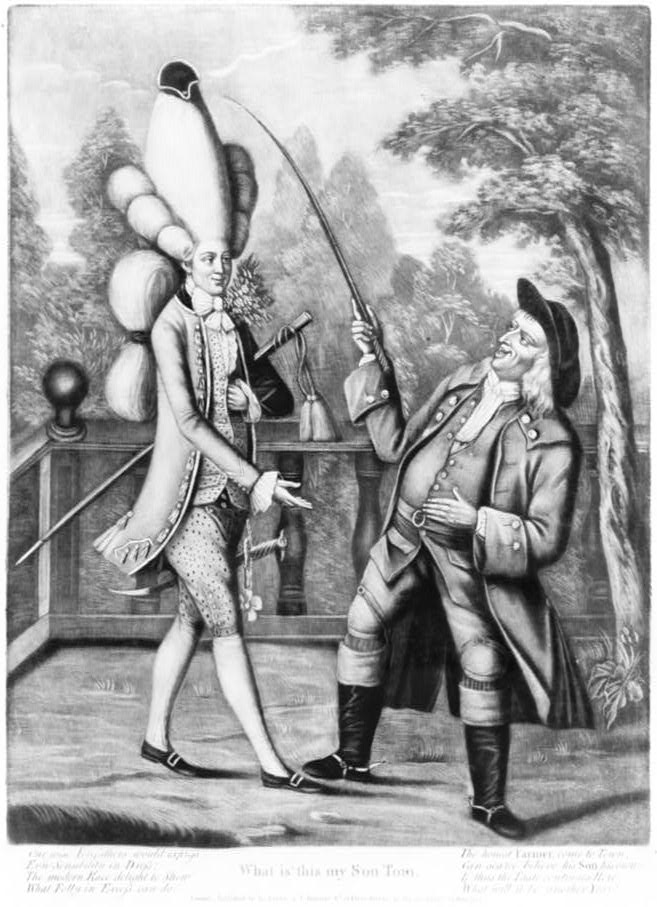
To demonstrate that he was prepared to work with the local gentry, Marie heralded his previous experience.  The tailor proclaimed that he “has had the Pleasure of pleasing some of the most respectable Gentlemen in London,” though he was too discreet to mention names.  That he served “respectable Gentlemen” suggested that he kept them outfitted according to the latest styles but did not resort to anything too frivolous or outrageous.  Prospective clients could depend on him dressing them well without transforming them into the macaronis who were the target of so much derision in both London and Philadelphia in the 1770s.  In “Fashion and the Culture Wars of Revolutionary Philadelphia,” Kate Haulman explains that the term macaroni “applied to elaborately powdered, ruffled, and corseted men of fashion” whose “suits were opulent and closely cut, with incredibly slim silhouettes.”[1]  A series of prints published in London depicted all sorts of men, “from farmers to barristers,” as macaronis.  Thus, Haulman argues, “macaroni could apply to any man who followed fashion to ape high status.”[2]  Marie suggested that he did not seek to serve such pretenders.  The gentry in Philadelphia could depend on him to dress them as “respectable Gentlemen,” just as he had done for his clients in London.

Print depicting a macaroni and his perplexed father. “What is this my Son Tom” (London: R. Sayer and J. Bennett, 1774). Courtesy Library of Congress.

[1] Kate Haulman, “Fashion and the Culture Wars of Revolutionary Philadelphia,” William and Mary Quarterly, 3rd ser., 62, no. 4 (October 2005): 635

[2] Haulman, “Fashion and the Culture Wars,” 636.

November 14

What was advertised in a colonial American newspaper 250 years ago today?

Pennsylvania Chronicle (November 14, 1772).

“BALTIMORE COFFEE-HOUSE and TAVERN.”

In the fall of 1772, William Goddard proposed publishing a newspaper in Baltimore as soon as he recruited enough subscribers.  Robert Hodge and Frederick Shober also announced their intention to establish a newspaper in Baltimore.  Hodge and Shober left the city just a couple of months later.  Goddard did not take the Maryland Journal and Baltimore Advertiser to press until August 1773.  Until then, the town did not have its own newspaper.  Instead, residents relied on the Maryland Gazette, published in Annapolis, and the various newspapers published in Philadelphia as their local newspapers.

That meant that advertisers in Baltimore sent their notices to printing offices in other towns.  Goddard, the printer of the Pennsylvania Chronicle, may have determined that Baltimore could support its own newspaper in part as a result of the number of advertisements he received from that town.  The November 14, 1772, edition of the Pennsylvania Chronicle, for instance, carried several advertisements that concerned Baltimore, including two on the front page.  In one, Sarah Chilton invited prospective patrons to the “BALTIMORE COFFEE-HOUSE and TAVERN,” an establishment she recently opened in a “large and commodious brick house” and kept stocked with “excellent liquors and other necessaries.”  In another, John Gordon described Robert Lewis, an indentured servant who ran away before his contract ended, and offered a reward for his capture and return to Gordon’s residence on Gay Street in Baltimore.  Recognizing both Lewis’s mobility and the reach of the Pennsylvania Chronicle, Gordon adjusted the award depending on whether Lewis was “within ten miles” of Baltimore, “out of the county,” or “out of the province.”  A third advertisement promoted a “STAGE from the city of Philadelphia to Baltimore-Town” and provided a schedule, including the transfers between the “stage-waggon” and the “stage-boat,” for travel in both directions.

Even if Baltimore had its own newspaper in 1772, each of these advertisements would have been of interest to many readers of the Pennsylvania Chronicle in Philadelphia and other towns.  The coffee house and the stage, however, also testified to the growth of Baltimore as a commercial center that had the potential to support its own newspaper, especially if a publisher could enlist merchants and shopkeepers to advertise their wares and other residents to submit the various kinds of notices that comprised a significant portion of the content of newspapers published in other cities and towns.

October 17

What was advertised in a colonial American newspaper 250 years ago today?

Pennsylvania Chronicle (October 17, 1772).

“It is needless to mention a long list of peoples’ names … [and] what great benefit they have received by the proper use of this Balsam.”

Advertisements for patent medicines frequently appeared in newspapers throughout the colonies.  The Pennsylvania Chronicle carried them, including a notice promoting “Dr. HILL’s American Balsam” on October 17, 1772.  William Young provided a brief and enthusiastic overview of the remedy’s effectiveness, boldly proclaiming that “IT is known, by experiment, that this Balsam is one of the most excellent medicines ever before prepared since the creation of the world, for colds, coughs, consumptions, swimming in the head, rheumatism, pain, gravel, sore throat,” and many other ailments.

Young indicated that he could have produced testimonials, but he considered doing so unnecessary given the reputation of Dr. Hill’s American Balsam.  He reported that “great numbers of people in this and the neighbouring provinces” who had “made trial” of the medicine could confirm its efficacy, yet be believed it “needless to mention a long list of peoples’ names and their residences, who have earnestly desired it might be published for the good of their fellow-creatures.”  Instead, Young underscored “what great benefit they have received by the proper use of this Balsam, when all other medicines have been used in vain.”

That strategy differed from the one deployed by Nicholas Brooks in promoting Maredant’s Drops in the Pennsylvania Gazette earlier in the year.  Brooks published the names of several people “cured by Maredant’s drops” as well as detailed testimonials written by two satisfied customers.  In contrast, Young suggested that there were so many customers whose symptoms had been alleviated by Dr. Hill’s American Balsam that listing their names would have been superfluous.  Whether or not he could have published such a list seemed less important to him than asserting how many people supposedly encouraged him to do so.  That left it prospective customers to imagine for themselves how many patients benefited from the medicine.  In choosing not to publish any specifics, neither names nor testimonials, Young invited readers to envision even grander stories about the effectiveness of Dr. Hill’s American Balsam than he could have compiled in a newspaper advertisement.

October 3

What was advertised in a colonial American newspaper 250 years ago today?

Pennsylvania Chronicle (October 3, 1772).

“To particularize the Articles, in an Advertisements, would be too extensive for Publication in a News-Paper.”

Lengthy advertisements often appeared in the pages of colonial newspapers.  Merchants and shopkeepers promoted the choices they made available to customers by listing many of the goods that they stocked.  In some cases, those lists were so extensive that they operated as catalogs embedded in newspapers.  For instance, George Bartram listed scores of items available at his “Woollen-Drapery and Hosiery WAREHOUSE” in an advertisement that ran in the Pennsylvania Chronicle several times in the fall of 1772.  It filled half a column.

Not every advertiser, however, adopted that strategy.  In their own advertisement in the October 3, 1772, edition of the Pennsylvania Chronicle, Hugh Roberts and George Roberts declared that they carried “Ironmongery and Brass Wares, In the most extensive Branches” as well as “A LARGE ASSORTMENT OF Copper Ware, India Metal Ware, Jappanned Ware, and Cutlery” at their “WARE-HOUSE” in Philadelphia.  Like Bartram, they oversaw a warehouse rather than a shop or store, such a name suggesting vast arrays of merchandise gathered in one place.  Unlike Bartram, the Robertses did not go into more detail about their merchandise.  Instead, they proclaimed that the “Ironmongery, Brass, and other Wares, at the said Warehouse, consist of so great a Variety of Sets, Patterns, and Workmanship, that, to particularize the Articles, in an Advertisement, would be too extensive for Publication in a News-Paper.”  Even an abbreviated list, like the one in Bartram’s advertisement immediately below the Robertses’ advertisement, would have been inadequate.

The Robertses challenged readers to imagine what they might encounter on a visit to their “WARE-HOUSE” to browse their “LARGE ASSORTMENT” and “extensive inventory,” hoping that would be as effective as publishing a lengthy list.  This clever strategy may have also been a means of saving money on advertising.  After all, advertisers paid by the amount of space their notices occupied.  The Robertses’ advertisement accounted for approximately a third as much space as Bartram’s notice.  Both strategies did more than merely announce the availability of goods.  They made consumer choice a central component of shopping at both warehouses in Philadelphia.

September 26

What was advertised in a colonial American newspaper 250 years ago today?

Pennsylvania Chronicle (September 26, 1772).

Woollen-Drapery and Hosiery WAREHOUSE, At the sign of the GOLDEN FLEECE’S HEAD.”

In the fall of 12772, George Bartram advertised a “very large assortment of MERCHANDIZE” recently imported via “the last vessels from Britain and Ireland.”  To entice prospective customers, he provided a list that included “Dark & light drabs or cloth colours, suitable for women’s cloaks,” “Cinnamon, chocolate and snuff colours, with a variety of mixed elegant coloured cloths,” “Scotch plaid, suitable for littler boys short cloths, gentlemen’s morning gowns,” “A COMPLETE assortment of man’s wove and knit silk, silk and worsted, worsted, cotton and thread HOSE,” and “Men & women’s silk, thread and worsted gloves.”  The extensive list, however, did not exhaust Bartram’s inventory.  He proclaimed that he carried “a great variety of other articles in the woollen and linen drapery, and hardware branches.”

With such an array of goods, Bartram did not purport to run a mere shop.  Instead, he promoted his business as a “Woollen-Drapery and Hosiery WAREHOUSE, At the sign of the GOLDEN FLEECE’S HEAD” on Second Street in Philadelphia.  The header for his advertisement in the September 26, 1772, edition of the Pennsylvania Chronicle had the appearance of a sign, with Bartram’s name and address within a border of decorative type.  The merchant already had a record of using visual devices to draw attention to the name he associated with his store.  In the January 22, 1772, edition of the Pennsylvania Packet, for instance, the words “GEORGE BARTRAM’s WOOLLEN DRAPERY AND HOSIERY WAREHOUSE” flanked a woodcut depicting a “GOLDEN FLEECE’S HEAD.”  He previously kept shop “at the Sign of the Naked Boy.”  Newspaper advertisements Bartram placed between 1767 and 1770 featured a woodcut of a shop sign with a naked boy holding a length of cloth in a cartouche in the center, rolls of textiles on either side, and “GEORGE” and “BARTRAM” flanking the bottom of the cartouche.

Many merchants and shopkeepers published lists of their merchandise.  Bartram enhanced such marketing efforts by associating a distinctive device, first the Naked boy and then the Golden Fleece’s Head, with his business, giving his shop an elaborate and memorable name, and using visual images, both woodcuts and decorative type, to distinguish his advertisements from others.  He did not merely announce goods for sale.  Instead, he experimented with marketing strategies.

September 19

What was advertised in a colonial American newspaper 250 years ago today?

Pennsylvania Chronicle (September 19, 1772).

“John White Stay-Maker”

Most advertisements in colonial newspapers did not feature visual images.  Those that did usually used a stock image provided by the printer, such as a ship at sea, a house, a horse, or an enslaved person liberating him- or herself by “running away.”  Never elaborate in the scenes depicted, such woodcuts could be used interchangeably in advertisements from the appropriate genre.  Some advertisers, however, commissioned images that corresponded to the shop signs that marked their locations or illustrated one or more items available among their merchandise.

Two such images appeared in the September 19, 1772, edition of the Pennsylvania Chronicle.  Robert Parrish once again included the woodcut depicting a “ROLLING SCREEN for cleaning wheat and flaxseed,” though he did not use a woodcut showing a Dutch fan or winnowing fan that previously appeared with it.  Perhaps he did not wish to incur the additional cost for the space required to publish two images.

Another entrepreneur, John White, adorned his advertisement with an image of a stay (or corset), the body and holes for the laces on the left and the laces on the right.  Readers would have easily recognized the garment and understood how it wrapped around and confined a woman’s body.  The words “John White” and “Stay-Maker” flanked the woodcut.  The image accounted for half of the space for the advertisement, an additional investment beyond commissioning the woodcut.

White announced that he moved to a new location where “he continues to carry on the Staymaking business as usual.”  He pledged “to give satisfaction to all who are pleased to employ him.”  He also solicited “orders from any part of the country” and provided mail order service, making it unnecessary for clients to visit his shop in Philadelphia.  Instead, they could send measurements “in respect to length and width of the Stays, both at top and bottom exactly, in the front and back parts.”  The staymaker warned that customers who opted for that convenience needed to pay postage for such orders rather than expect him to take responsibility for those charges.

The woodcut depicting a stay, its body and laces unfurled, almost certainly helped attract attention to White’s advertisement, his promises of customer satisfaction, and the option for submitting orders “by the post” rather than visiting his shop.  Most newspaper advertisements consisted solely of text, so any sort of visual enhancement, whether an image or decorative type, distinguished those advertisements from others.

August 29

What was advertised in a colonial American newspaper 250 years ago today?

Pennsylvania Chronicle (August 29, 1772).

“FISHING TACKLE.”

In the summer of 1772, Edward Pole advertised a variety of items available at his ‘GROCERY STORE” on Second Street in Philadelphia.  He stocked everything from wines and spirits to “Green, Bohea, Hyson and Soushong Teas” to raisins and currants to “mustard by the bottle or pound.”  Pole declared that he would “make it his chief study to merit” repeat business from his customers “by keeping an assortment of the best kind of GROCERIES, and selling them on the lowest terms.”

Yet Pole stocked more than just groceries.  His advertisement in the August 29 edition of the Pennsylvania Chronicle included a headline and a section for “FISHING TACKLE” available at his store.  He carried “Fishing rods of various kinds, best Kerby and common hooks of all sizes, artificial flies, wheels, silk, hair and trolling lines of every kind, length, and goodness, deapseas, casting, minnow and scoop nets,” and other items.  He made a point of promoting “the best kind of fish-hooks, made by ROBERT CARTER, fish-hook maker, from Trenton.”

Over time, the appropriately-named Pole placed greater emphasis on marketing fishing supplies.  By 1781, he was placing advertisements for “Fishing Tackle Of all sorts, for Use of either SEA or RIVER, MADE AND SOLD By Edward Pole” in the Pennsylvania Packet.  A woodcut depicting a fish adorned those advertisements.  He commissioned another woodcut of a fish, this one with a decorative border, for his advertisement in the March 24, 1784, edition of the Freeman’s Journal.  At about the same time, he made an even greater investment in a trade card engraved by David Tew.  A vignette showed two gentlemen fishing, one with a rod and the other with a net.  The gentleman with the rod had a fish on the line, its head sticking out of the water, while the gentleman with the net attempted to scoop up the fish.  An ornate cartouche, complete with fishing lures dangling from it, served as border for the text of this advertisement.  The trade card announced that “Edward Pole FISHING-TACKLE-MAKER … es & Sells all kinds of the best Fishing Tackle for the use of either Sea or River.”  A nota bene advised, “Gentlemen going on parties, in the Fishing Way Compleatly fitted out on the shortest notice.”

The headline for “FISHING TACKLE” in Pole’s newspaper advertisements published in 1772 foreshadowed the more extensive marketing efforts he launched in the 1780s.  He further enhanced newspaper notices with visual images as he increasingly specialized in fishing supplies.  He also distributed an engraved trade card that featured images that rivaled any on the hundreds of trade cards distributed in London in the eighteenth century, making his business all the more memorable to the gentlemen he aimed to serve.

Edward Pole, Trade Card, engraved by David Tew (Philadelphia, 1780s). Courtesy Historical Society of Pennsylvania.

August 22

What was advertised in a colonial American newspaper 250 years ago today?

Pennsylvania Chronicle (August 22, 1772).

“The APPENDIX is not in the London Edition.”

Henry Miller, printer of the Wöchentliche Pennsylvanische Staatsbote, published and advertised an American edition of A Complete German Grammar by John James Bachmair in 1772.  German-speaking colonizers constituted a significant portion of Pennsylvania’s population, prompting Miller, himself born in the principality of Waldeck on the Upper Rhine, to believe a local market existed for this book.  He informed prospective customers that he charged nine shillings for his edition, compared to fourteen shillings for the London edition.

In addition to declaring that he published the third edition, “greatly altered and improved,” Miller also promoted an Appendix that included “An Index of German Words similar in Sound, but of different Orthography and Signification,” “Names of the most common Occupations and Trades, as also the Names of the Materials and Implements, &c. thereto belonging,” and an “Explication of a German Proverb.”  In a nota bene, Miller underscored that all of those items were bonus materials not included in the London edition.  In addition to the lower price, the useful and entertaining supplemental materials likely made Miller’s American edition seem like an even better choice for colonizers interested in learning German.

Miller also deployed a blurb from the first edition in his efforts to market the book.  He quoted from the preface to the first edition, highlighting Bachmair’s assertion that “those who have a Mind to learn fundamentally the German Language, will find such plain and easy Instructions, that, even without a Master, they may at least attain to read and understand it.”  The blurb simultaneously offered encouragement and set expectations.  With some diligence, those who studied from the book could learn to read and understand German, even if they did not become fluent enough to speak and write the language.  They could achieve that level of proficiency studying on their own rather than working with tutors or schoolmasters.

Miller incorporated a variety of marketing strategies into advertisements for his American edition of Bachmair’s German Grammar.  He hawked supplementary materials that did not appear in the more expensive London edition, while also including a blurb in which the author gave encouragement and promised “plain and easy Instructions.”  In describing the contents of the appendix and inserting the blurb, Miller sought to help prospective customers imagine themselves learning German with greater ease than they previously anticipated.

August 8

Who was the subject of an advertisement in a colonial American newspaper 250 years ago today?

Pennsylvania Chronicle (August 8, 1772).

“My wife, HANNAH FREDERICK, did … elope from my bed and board.”

In the eighteenth century, aggrieved husbands often took to the pages of newspapers to warn others not to extend credit to misbehaving wives who “eloped” from them.  Readers regularly encountered “runaway wife” advertisements in newspapers published throughout the colonies.  Those notices continued to appear during the era of the American Revolution and, as Mary Beth Sievens demonstrates, well into the nineteenth century.[1]

Although most notices followed a pattern, each provided details specific to a particular household.  Wives usually “eloped” from their husbands on their own, but in an advertisement in the August 8, 1772, edition of the Pennsylvania Chronicle one husband reported that his wife, Hannah Frederick, “did … elope from my bed and board … with a certain Abraham Hudson.”  The husband believed that the two of them traveled “from Fish-Kills, in Duchess County, in New-York government … to Elizabeth-Town” in New Jersey “and from thence to Philadelphia.”  To aid readers in identifying his wife, the advertiser reported that her “maiden name was Hannah Coleman” and she “served her time,” likely as an indentured servant, “with John Taylor, at Tinicum-Island.”  He concluded with a formulaic statement cutting his wife off from his credit: “these are therefore to forewarn all persons from trusting her on my account, as I shall pay no debts of her contracting after the date hereof.”

Printers published such advertisements without offering commentary of their own, but, in this instance, William Goddard did insert a clarification.  “In the copy of the foregoing Advertisement, which was sent to the Printer,” he explained, “the Advertiser’s name was omitted.”  As a result, the husband’s name appeared as “———- FREDERICK.”  That being the case, how did Goddard handle payment for the advertisement?  Some printers required advertisers to pay in advance, even though they extended credit to subscribers.  After all, advertising comprised a lucrative revenue stream.  Occasional notices in eighteenth-century newspapers, however, make clear that some printers did allow credit for advertisements as well as subscriptions.  This husband may have submitted payment, but not his name, to the printing office … or Goddard may have taken a chance that he would settle up in a timely manner.  Even if that was the case, the printer’s trust only went so far.  The advertisement ran just twice (August 8 and 15), though most newspapers initially published advertisements for three or four weeks for a set fee before charging a lower fee for each insertion.  Goddard may have been carefully managing how much credit he extended to “———- FREDERICK” even as that husband attempted to exert control over his credit when it became clear his wife was beyond his influence.

**********

[1] Mary Beth Sievens, “Female Consumerism and Household Authority in Early National New England,” Early American Studies:  An Interdisciplinary Journal 4, no. 2 (Fall 2006):  353-371.