August 5

Who was the subject of an advertisement in a colonial American newspaper 250 years ago today?

Pennsylvania Gazette (August 5, 1772).

“Probably will endeavour to pass for a freeman.”

Jem, a “Mulattoe SLAVE,” made his escape during the night of July 15, 1772, liberating himself from Thomas May in Elk Forge, Maryland.  In his efforts to capture Jem and return him to enslavement, May ran an advertisement in which he described Jem as a “cunning ingenious fellow” who “probably will endeavour to pass for a freeman.”  Jem possessed several skills that may have helped him elude May, but those skills also made him even more valuable to the enslaver.  In addition to being able to read “pretty well” and speak Dutch, Jem was a “good workman in a forge, either in finery or chafery, can do any kind of smith’s or carpenter’s work, necessary about a forge, [and] can also do any kind of farming business.”  May also described the clothes that Jem wore when he liberated himself.  No doubt Jem would have offered other details had he been given an opportunity to publish his own narrative.  Even in Jem’s absence, May exerted control over his depiction in the public prints.

Wochentliche Pennsylvanische Staatsbote (August 4, 1772).

May also made decisions about how widely to disseminate advertisements describing Jem and offering “FIVE POUNDS REWARD” for capturing him.  His advertisement appeared in both the Pennsylvania Gazette and the Pennsylvania Journal on August 5.  Of the newspapers published in Philadelphia at the time, those had the longest publication history.  That likely gave May confidence that those newspapers circulated to many readers in Pennsylvania, Maryland, Delaware, and New Jersey.  Apparently, however, he did not consider that sufficient.  May was so invested in capturing and returning Jem to enslavement at the forge that he also placed advertisements in the Pennsylvania Chronicle on August 8 and the Pennsylvania Packet on August 10.  Considering the skills that Jem possessed, May probably thought it well worth the fees to place notices in all four English-language newspapers published in Philadelphia at the time.  He even took advantage of the translation services that Henry Miller, printer of the Wochentliche Pennsylvanische Staatsbote, offered to advertisers in a nota bene that appeared at the bottom of the masthead.  May’s advertisement describing Jem ran in that newspaper on August 4, further increasing the number of colonizers who might read it, carefully observe Black men they encountered, and participate in capturing the fugitive seeking freedom.  Thomas May expended significant money and effort in attempting to re-enslave Jem, using the power of the press to overcome the various advantages Jem sought to use to his own benefit.

July 25

What was advertised in a colonial American newspaper 250 years ago today?

Pennsylvania Chronicle (July 25, 1772).

“The BEST of AMERICAN HAIR-POWDER.”

In the summer of 1772, William Trautwine, a barber who ran a shop “at the sign of the Bleeding Lady and Barber’s Pole” in Philadelphia, took to the pages of the Pennsylvania Chronicle to advertise the “BEST of AMERICAN HAIR-POWDER.”  In an age when many entrepreneurs promoted domestic manufactures, goods produced in the colonies, as alternatives to imported items, hairdressers and barbers frequently joined the chorus.  For his part, Trautwine encouraged “those gentlemen and ladies who are wellwishers to their country” to “favour him with their custom.”  Such “wellwishers” might have had the commercial and economic interests of the colonies in mind, yet such appeals usually had a political valence as well.  Especially when colonizers enacted nonimportation agreements in protest of new regulations and taxes passed by Parliament, advertisers editorialists, and others encouraged colonizers to participate in both the production and consumption of domestic manufactures.  Such appeals continued during periods of relative calm.  Trautwine’s reference to “wellwishers to their country” would not have seemed out of place to readers in July 1772.

Like others who promoted goods produced in the colonies, the barber believed that he needed to convince prospective customers that his product was as good as any they might acquire from merchants and shopkeepers who imported their goods.  Consumers did not need to sacrifice quality when they supported domestic manufactures.  The barber made his hair powder from “the very best of materials.”  Trautwine also proclaimed that his customers “may depend on being supplied with Hair-Powder in quality not inferior to the best which is imported from Europe.”  Indeed, it was Trautwine himself who made sacrifices to supply consumers with the “BEST of AMERICAN HAIR-POWDER,” assuming “considerable expence, in providing himself with a mill for that purpose.”  He suggested that his investment in support of the political and economic interests of the colonies merited the patronage of consumers in Philadelphia and other readers of the Pennsylvania Chronicle.  Trautwine acted on his civic duty when he produced an American alternative to an imported item.  In turn, he suggested, consumers had an obligation to do the same by purchasing his product.

May 27

What was advertised in a colonial American newspaper 250 years ago this week?

Pennsylvania Chronicle (May 25, 1772).

“Shoemakers may be supplied with tools of every kind used in their business.”

A silhouette of a shoe adorned Robert Loosely’s advertisement in the May 25, 1772, edition of the Pennsylvania Chronicle, but it was not footwear that the “Shoe Maker” aimed to sell.  Instead, he hawked “Shoemakers Tools, A general assortment lately imported from London.”  His inventory included “BEST London made cast steel knives,” “Pincers of all sizes, Shoe rasps and files of the best kind, Hammers of all sizes,” “An assortment of awl blades and tacks,” “Bend soles,” and much more.  The “&c. &c. &c” (or “etc. etc. etc.”) at the end of his list indicated that he named only a portion of his merchandise.

Loosely leveraged his training and experience as a shoemaker to convince others who followed the occupation that he was indeed qualified to assert that he provided them with “the best goods, on the most reasonable terms.”  He explained that he “served his apprenticeship in England, and for some years carried on a considerable trade there.”  That made him familiar with the equipment and supplies required to make shoes and boots.  He drew on experience in selecting which “Shoemakers Tools” to import and sell, unlike merchants and shopkeepers who treated those tools as general merchandise alongside so many other items they stocked.  Loosely underscored that during his time working in England he “became acquainted with the most reputed manufacturers of tools and leather.”  As a result, he “flatters himself he has it in his power to serve those that please to apply to him.”

Artisans with training or experience in England frequently gave those credentials in their newspaper advertisements when they migrated to the colonies, but they usually did so to convince prospective customers to purchase their wares or prospective clients to engage their services.  Loosely adapted that strategy to his own purposes, signaling to fellow artisans that they could depend on him to supply them with the best tools and materials to use in their own workshops.

January 22

What was advertised in a colonial American newspaper 250 years ago this week?

Pennsylvania Chronicle (January 20, 1772).

“All sorts of Chymical and Galenical Medicines (truly prepared).”

When Townsend Speakman opened an apothecary shop on Market Street in Philadelphia in the early 1770s, he took to the pages of the Pennsylvania Chronicle to offer his services.  In an advertisement in the January 20, 1772, edition, he introduced himself as a “Chymist and Druggist, LATE FROM LONDON.”  Like many others who migrated across the Atlantic, he asserted his credentials as a means of establishing his reputation among prospective clients.  Speakman declared that he “served a regular apprenticeship to the business.”  In addition, he “had several years further experience therein, in a house of the first reputation in LONDON.”

That accrued additional benefits for his prospective clients beyond the expertise and experience the “Chymist and Druggist” gained during his apprenticeship and subsequent employment.  His connections to an apothecary shop “of the first reputation” meant that he could “procur[e] articles of the best quality” for the “most reasonable rates” for his customers.  He vowed to pass along the savings, promising to “sell on as low terms as any in this city.”  Speakman also emphasized quality elsewhere in his advertisement.  He assured readers that he sold “all sorts of Chymical and Galenical Medicines (truly prepared).”  That phrase suggested both his skill in compounding medications and the authenticity of the ingredients he used.  To underscore the point, Speakman pledged that “Family receipts [or remedies], and physical prescriptions, are carefully and correctly compounded.”  Furthermore, he carried “the best of Drugs [and] Patent Medicines.”

As a newcomer unknown to the prospective clients that he wished to engage, Speakman sought to convince readers that he merited their trust in preparing and providing medicines.  He emphasized both his formal training through an apprenticeship as well as his additional experience working in an apothecary shop “of the first reputation” in London.  He brought his expertise to Philadelphia, vowing to supply clients with “truly prepared” medicines of the best quality.  The apothecary achieved success in the Quaker City.  In the late 1780s, he supplemented his newspaper advertisements with an engraved billhead for writing receipts for customers.

Billhead, Townsend Speakman, 1789. Courtesy Historical Society of Pennsylvania.

October 21

What was advertised in a colonial American newspaper 250 years ago today?

Pennsylvania Chronicle (October 21, 1771).

“The newest fashionable muffs [and] tippets.”

A woodcut depicting a muff and tippet adorned the advertisements that the partnership of Fromberger and Siemon placed in the Pennsylvania Chronicle and the Pennsylvania Journal in the fall of 1771.  The advertisers did not rely on the image alone to market their “large assortment of Russia and Siberia fur skins” and garments made from those furs, but it almost certainly helped draw attention to their advertisements.  That woodcut also represented an additional expense.  Unlike the type used to print the copy in their notices, the woodcut belonged to the advertisers rather than the printers.  That being the case, Fromberger and Siemon collected their woodcut from one printing office and delivered it to another when they expanded their advertising campaign.

The furriers first inserted an advertisement in the September 26 edition of the Pennsylvania Journal.  It ran again the following week.  Nearly three weeks elapsed before the same advertisement appeared in the October 21 edition of the Pennsylvania Chronicle.  It featured identical copy, though the compositor made different decisions about line breaks, as well as the familiar woodcut that occupied nearly half the space allotted to the advertisement.  Careful examination of the image reveals that it was indeed the same woodcut, not a similar image.  Fromberger and Siemon commissioned only one woodcut, but they aimed to garner a greater return on their investment by disseminating it in more than one newspaper. For many readers of the Pennsylvania Chronicle, the image would have been new and novel when they encountered it.  Those who also happened to peruse the Pennsylvania Journal, however, would have recognized the woodcut.  The repetition of the image likely helped Fromberger and Siemon achieve greater visibility for their enterprise.  Had they published it more regularly, they might have encouraged readers to consider the image a trademark of sorts, but their notices appeared too sporadically.  Although Fromberger and Siemon did not seize the opportunity to further enhance their marketing efforts through consistent repetition of the image of the muff and tippet in the fall of 1771, they did devise advertisements that stood out from others because of the woodcut that accompanied them.

October 14

What was advertised in a colonial American newspaper 250 years ago today?

Pennsylvania Chronicle (October 14, 1771).

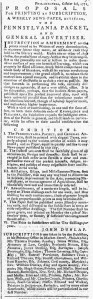
“PROPOSALS FOR PRINTING BY SUBSCRIPTION, A WEEKLY NEWS-PAPER.”

Philadelphia was the most populous city among Britain’s mainland colonies in the early 1770s, large enough that John Dunlap determined that the market could support an additional newspaper in the fall of 1771.  Local readers already had access to the Pennsylvania Chronicle, the Pennsylvania Gazette, the Pennsylvania Journal, and the Wochentliche Philadelphische Staatsbote, but in early October Dunlap began distributing subscription notices for another weekly newspaper, the Pennsylvania Packet and General Advertiser, to commence on November 25.

Like subscription notices for other publications, whether books, magazines, or newspapers, Dunlap’s notice included both an overview of the purpose and a list of conditions.  Those conditions specified subscription prices and advertising fees that many printers rarely published after launching their newspapers, though some regularly incorporated one or both into their colophon alongside other details of publication.  “The Price to Subscribers,” Dunlap informed readers, “will be Ten Shillings per year.”  In addition, “Advertisements, of a moderate length, will be inserted at Three Shillings each for one week, and One Shilling for each continuance.”  In that regard, Dunlap deviated from the standard pricing structure; most printers set the base price to include inserting advertisements for either three or four weeks before charging for “each continuance.”    Dunlap did adopt the familiar practice of charging more for longer advertisements, stating that “those of greater length” would appear “at such proportionable prices as may be reasonable.”

As was the case for other newspapers, advertisements for the Pennsylvania Packet were relatively expensive compared to subscriptions.  Three advertisements running for just one week cost nearly as much as a single subscription.  Paid notices represented significant revenue for most colonial printers who published newspapers.  That may have influenced Dunlap to list advertising fees ahead of subscription prices in the conditions in his subscription notice.  Although the advertisement ended with a list of local agents who accepted subscriptions on Dunlap’s behalf in several towns, he sought advertisers for his new endeavor as well as subscribers.  He needed both kinds of support for the Pennsylvania Packet to become a successful enterprise.

October 9

What was (not) advertised in a colonial American newspaper 250 years ago this week?

Pennsylvania Chronicle (October 9, 1771).

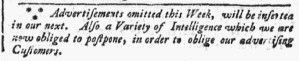
“Advertisements omitted this Week, will be inserted in our next.”

Nearly three dozen advertisements appeared in the October 7, 1771, edition of the Pennsylvania Chronicle, but William Goddard, the printer, did not have enough space to publish all of the notices submitted to his printing office on Arch Street in Philadelphia.  Neither did he have room for all of the news.  The final column of the third page concluded with a brief note advising that “Advertisements omitted this Week, will be inserted in our next.  Also a Variety of Intelligence which we are now obliged to postpone, in order to oblige our advertising Customers.”

Colonial newspapers generated revenue along two trajectories:  subscriptions and advertising.  Subscribers purchased access to the “freshest advices, foreign and domestic,” as the mastheads for many newspapers described the news. Advertisers, in turn, purchased access to readers.  They sought to place their notices before the eyes of as many readers as possible.  Printers sometimes commented on how many subscribers received their newspapers as a means of encouraging prospective advertisers to place notices.  In making decisions about what to publish, printers had to balance news and advertising in order to satisfy both subscribers and advertisers.  Displeasing one constituency or the other had the potential to negatively affect revenues.

Printers regularly informed readers that they postponed advertisements, a means of assuring advertisers that their notices would indeed soon appear.  Most printers, however, did not often explicitly comment on their endeavors to serve their advertisers, making Goddard’s note about “oblig[ing] our advertising Customers” all the more remarkable.  He revealed to readers, subscribers and advertisers alike, that publishing advertisements sometimes took priority over “a Variety of Intelligence” that he might otherwise have published.  While he framed this as a service to customers who placed notices, the revenues those advertisements represented could not have been far from his mind.  Goddard was willing to delay some advertisements until the next edition, but not too many of them as he aimed to please both subscribers and advertisers.

September 11

What was advertised in a colonial American newspaper 250 years ago this week?

Pennsylvania Chronicle (September 9, 1771).

“Lately imported from LONDON and BRISTOL, and to be Sold, on the cheapest Terms, by Daniel Benezet.”

Today, newspapers run the most consequential stories, the biggest news, on the front page.  Headlines provide brief summaries, prompting readers to learn more.  Images often accompany the articles.  That format has grown so familiar that it may seem strange to imagine other ways of organizing the content and delivering the news, yet the appearance of the modern newspaper has evolved significantly.  In the eighteenth century, printers made other choices about where content appeared in their newspapers.

Consider, for example, the September 9, 1771, edition of the Pennsylvania Chronicle.  Like other newspapers published throughout the colonies, it consisted of only four pages.  William Goddard printed two pages on each side of a broadsheet and then folded it in half before distributing it to subscribers.  The first item on the first page, immediately below the masthead, was an extensive advertisement placed by Daniel Benezet to promote an assortment of goods he “Lately imported from LONDON and BRISTOL.”  The shopkeeper enumerated hundreds of items, his advertisement filling the entire first column and overflowing into the second.  Three shorter advertisements completed that column, with news first appearing in the final column.  The first page included updates received from Warsaw and London.  News from London continued on the second page, supplemented with news from Salem, Boston, and New York on the third page.  Goddard inserted some local news from Philadelphia, including the shipping news from the customs house, on the third page.  Half of that page as well as the entire final page consisted of advertising.  Readers seeking news spent most of the time perusing the inside pages; as they held their newspapers aloft, observers glimpsed the masthead and a lot of advertising and only a little bit of news.

Overall, slightly less than six of the twelve columns in that issue contained news.  Paid notices occupied the rest of the space in the newspaper, underscoring that publications like the Pennsylvania Chronicle, or, noting its full title, the Pennsylvania Chronicle and Universal Advertiser were delivery mechanisms for advertising in eighteenth century America.  Printers organized newspapers differently in the eighteenth century than publishers do today.  In turn, readers approached them with different strategies for extracting the information they wanted or needed.

Pennsylvania Chronicle (September 9, 1771).

September 2

What was advertised in a colonial American newspaper 250 years ago today?

Pennsylvania Chronicle (September 2, 1771).

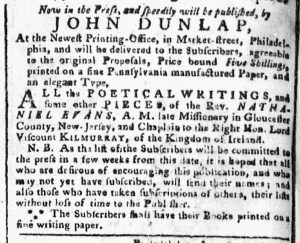
“Those who have taken subscriptions of others, [send] their lists … to the Publisher.”

In the course of just a few days late in the summer of 1771, readers in New England, New York, Pennsylvania, and South Carolina encountered the same advertisement in their local newspapers.  John Dunlap, a printer in Philadelphia, distributed subscription notices for his current project, “ALL THE POETICAL WRITINGS, AND SOME OTHER PIECES, of the Rev. NATHANIEL EVANS,” in order to entice customers in distant places to reserve copies of the forthcoming work.  On September 2, Dunlap’s advertisement ran in the New-York Gazette and Weekly Mercury, the Pennsylvania Chronicle, and the South-Carolina and American General Gazette.  Four days earlier, the same advertisement ran in the Massachusetts Gazette and Boston Weekly News-Letter and the Pennsylvania Journal.

With one exception, the advertisements featured identical copy with minor variations in format, the copy being the domain of the advertiser and decisions about design at the discretion of the compositor.  The exception concerned the directions issued to prospective subscribers for submitting their names.  In the newspapers published in Philadelphia, Dunlap requested “that all who are desirous of encouraging this publication, and who may not yet have subscribed, will send their names” to him directly.  In addition, he asked that “those who have taken subscriptions of others,” acting as agents on Dunlap’s behalf, dispatch “their lists without loss of time to the Publisher.”  In the advertisements in the other newspapers, however, he instructed subscribers to submit their names “to the Printer hereof.”  Newspaper printers in other cities served as his local agents, including Richard Draper in Boston and Hugh Gaine in New York.  Robert Wells, printer of the South-Carolina and American General Gazette, underscored that he was Dunlap’s local agents, revising the copy in his newspaper to instruct subscribers to “send in their Names, without Loss of Time, to ROBERT WELLS.”

Dunlap did not rely merely on generating demand among local customers when he published “THE POETICAL WRITINGS … of the Rev. NATHANIEL EVANS.”  Instead, he inserted subscription notices in newspapers published in the largest cities in the colonies, hoping to incite greater interest in the project and attract additional buyers.  In the process, he recruited other printers to act as local agents who collected subscriptions on his behalf.  He created a network of associates that extended from New England to South Carolina as part of his marketing campaign.

August 21

What was advertised in a colonial American newspaper 250 years ago this week?

Pennsylvania Chronicle (August 19, 1771).

“He hath to sell also, his Royal Balsam, which is made of American produce.”

Two advertisements for patent medicines appeared among the notices in the August 21, 1771, edition of the Pennsylvania Chronicle.  In an extensive advertisement that filled an entire column and overflowed into another, William Young promoted “Dr. HILL’S AMERICAN BALSAM.”  Further down that second column, George Weed hawked his own “Royal Balsam” as well as several other nostrums that he compounded to cure “the bloody flux,” coughs, and other maladies.  Weed’s advertisement was much shorter, but the apothecary indicated that he had the capacity to publish a notice just as lengthy as the one inserted by Young.  “He hath by him,” Weed proclaimed, “a considerable number of certificates of extraordinary cures by [his medicines], which he designs to publish in a short time.”  In other words, Weed claimed to have testimonials from actual patients to disseminate among the public.

While Weed supplied a variety of powders, syrups, and tinctures, Young devoted his entire advertisement to the American Balsam.  This remedy bore that name because a physician in London produced it from “American plants, sent to England by that ingenious gentleman Mr. William Young, of Pennsylvania, Botanist to their Majesties the King and Queen of Great-Britain.”  That botanist was the son of the advertiser, whom Hill “appointed the only capital vender of [his medicine] in all America” out of gratitude “to the young gentleman.”  Hill did allow that Young could appoint “whom he pleases under him” to sell the American Balsam.  The elder Young had an exclusive franchise, but appointed local agents in Philadelphia, Germantown, Lancaster, and Wilmington.

Weed divided his advertisement into two portions.  In the first half, he proclaimed that the American Balsam, an imported medicine, “is now so well known in Pennsylvania, Maryland, &c. &c. there is no need of any further recommendation” and then described its effective use among patients in great detail anyway.  The second half consisted of a letter from Hill in which the doctor described the afflictions the medicine cured, outlined the history of its creation and refinement, and endorsed Young as his American purveyor.  Weed did not resort to such a preponderance of prose for his Royal Balsam, produced locally, or invest nearly as much in placing his much shorter advertisement, though the “certificates of extraordinary cures” that he suggested he would soon publish likely rivaled Young’s advertisement in length.  Although  they chose different marketing strategies, Weed and Young both apparently considered their methods worth the expense of placing notices in the Pennsylvania Chronicle.