December 3

What was advertised in a revolutionary American newspaper 250 years ago this week?
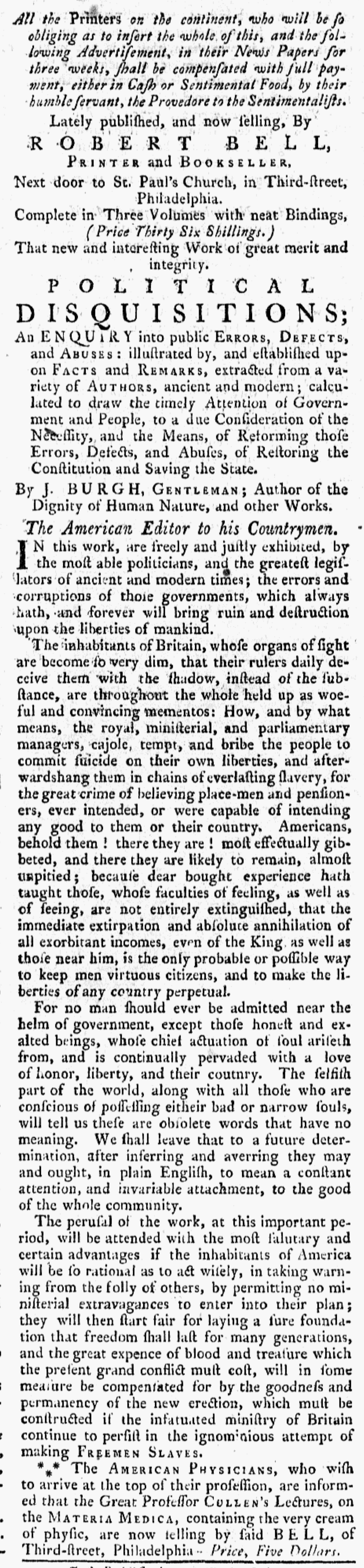
Pennsylvania Ledger (December 2, 1775).

All the Printers … shall be compensated with full payment, either in Cash or Sentimental Food.”

Robert Bell, one of the most prominent American printers and booksellers during the second half of the eighteenth century, frequently distributed subscription proposals for works he wished to publish far and wide.  Such was the case when he marketed an American edition of James Burgh’s Political Disquisitions in 1775.  The extensive secondary title provided an overview of the multi-volume work: “An ENQUIRY into public ERRORS, DEFECTS, and ABUSES: illustrated by, and established upon FACTS and REMARKS, extracted from a variety of AUTHORS, ancient and modern; calculated to draw the timely ATTENTION of Government and People, to a due Consideration of the Necessity, and the Means, of Reforming those Errors, Defects, and Abuses, of Restoring the Constitution and Saving the State.”

Upon publishing the work, Bell set about a new round of marketing.  Once again, he wished to advertise widely.  This time, he appended a note to his advertisement that appeared in the December 2 edition of the Pennsylvania Ledger.  Addressing “All the Printers on the continent,” Bell offered that those “who will be so obliging as to insert the whole of this, and the following Advertisement, in their News Papers for three weeks, shall be compensated with full payment, either in Cash or Sentimental Food, by their humble servant, the Provedore to the Sentimentalists.”  The “following Advertisement” consisted of three portions: a standard notice typical of others for books that appeared in the Pennsylvania Ledger and other newspapers, a lengthy address from “The American Editor to his Countrymen,” and a brief announcement that Bell also sold “the Great Professor CULLEN’s Lectures, on the MATERIA MEDICA” to “AMERICAN PHYSICIANS, who wish to arrive at the top of their profession.”  The standard advertisement included the name of the book and its author, the price (“Thirty Six Shillings”), a description of some of its material aspects (“Three Volumes with neat Bindings”), and where to purchase it.  In the address, Bell asserted, “The perusal of the work, at this important period, will be attended with the most salutary and certain advantages if the inhabitants of America will be so rational as to act wisely, in taking warning from the folly of others, by permitting no ministerial extravagances to enter into their plan.”  They could lay “a sure foundation that freedom shall last for many generations” instead of allowing the current British administration to make “FREEMEN [into] SLAVES.”

The entire advertisement was much longer than most subscription proposals or notices about books already published.  That may have been the reason that Bell appended the note to “All the Printers on the continent.”  In other instances, fellow printers may have published shorter advertisements gratis, but this one required significant space in weekly newspapers that consisted of only four pages.  To increase the chances that printers would reprint it when they saw the advertisement in newspapers that they received through their exchange networks, Bell made sure that they knew that he would compensate them “with full payment, either in Cash or Sentimental Food.”  In other words, he would supply copies of Political Disquisitions or other books he published to those who preferred them rather than cash.  The flamboyant Bell was already known as “the Provedore to the Sentimentalists” from his newspaper advertisements, broadsides, and book catalogs.  He sought to maintain the image he cultivated by including that language in his note to printers, yet he realized that his reputation alone would not convince them to publish such an extensive advertisement.  Accordingly, he promised payment in advance rather than expecting newspaper printers to publish his advertisement as a courtesy, no matter how well their politics might align with those in Bell’s address “to his Countrymen.”
December 2

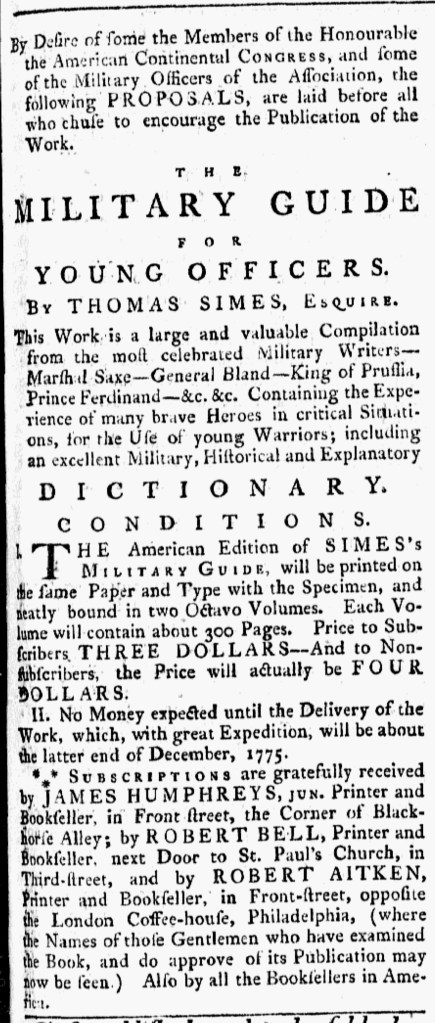
What was advertised in a revolutionary American newspaper 250 years ago today?

Pennsylvania Ledger (December 2, 1775).

“THE American Edition of SIMES’s MILITARY GUIDE.”

In December 1775, James Humphreys, Jr., Robert Bell, and Robert Aitken collaborated in advertising and publishing The Military Guide for Young Officers by Thomas Simes, making yet another military manual available to the public following the momentous events at Lexington and Concord the previous April.  More recent developments, both military and political, convinced printers that a market existed for military manuals.  According to the introduction to “Books in the Field: Studying the Art of War in Revolutionary America,” an exhibition sponsored by the American Revolution Institute of the Society of the Cincinnati, “a flood of printing began to appear from the American presses.  Much of this activity was centered in Philadelphia, where more than thirty works on military subjects were published in the years 1775 and 1776 alone.”

Of the three of the printer-booksellers who partnered in publishing Simes’s Military Guide, Humphreys was the only one who published a newspaper.  He gave their advertisement a privileged place at the top of the first column on the first page of the December 2, 1775, edition of the Pennsylvania Ledger.  Rather than advertising a book already available for sale, the printer-booksellers distributed subscription proposals, doing so, they claimed, “By Desire of some the Members of the Honourable American Continental CONGRESS, and some of the Military Officers of the Association.”  Readers who wished to reserve copies of the work became subscribers by submitting their names to any of those three printer-booksellers, though they also indicated that “SUBSCRIPTIONS are gratefully received … by all the Booksellers in America.”  Printers, authors, and others in the book trades had more than one reason for circulating subscription proposals.  They hoped to incite greater demand while also learning if sufficient interest existed to make a project viable and, if so, how many copies to produce.

This subscription proposal featured an overview of the contents of the military guide: “a large and valuable Compilation from the most celebrated Miliary Writers … Containing the Experience of many brave Heroes in critical Situations, for the Use of young Warriors” as well as “an excellent Military, Historical and Explanatory DICTIONARY.”  This “American Edition … will be printed on the same Paper and Type with the Specimen, and neatly bound in two Octavo Volumes.”  Apparently, Humphreys, Bell, and Aitken had specimens or samples of the paper and type on display at their printing offices so prospective subscribers could examine them and assess the material quality of the work for themselves before committing to ordering copies.  Printers often circulated specimens along with subscription proposals.  The partners planned to print some surplus copies, expecting that demand would warrant doing so, but encouraged subscribers with a discount.  Those who reserved their copies paid three dollars, but for “Non-subscribers, the Price will actually be FOUR DOLLARS.”  Subscribers did not need to part with their money “until the Delivery of the Work,” anticipated for “the latter end of December, 1775.”  Humphreys, Bell, and Aitken did not take the military manual to press as quickly as they expected.  The imprint on the title page gives the date of publication as 1776.  The partners made one final pitch in the subscription proposals, announcing that “the Names of those Gentlemen who have examined the Book, and do approve of its Publication may now be seen” at Aitken’s printing office.  These marketing efforts apparently helped the partners attract enough subscribers to publish the proposed work.  Not all subscription proposals met with such success.  Current events likely played a role in the outcome when Humphreys, Bell, and Aitken proposed an American edition of The Miliary Guide for Young Officers.

November 11

What was advertised in a revolutionary American newspaper 250 years ago today?

Pennsylvania Ledger (November 11, 1775).

“AN ORATION … to Commemorate the Bloody Tragedy … By the Hon. JOHN HANCOCK.”

In addition to printing The Prussian Evolutions for Thomas Hanson in the fall of 1775, John Douglass McDougall published and sold “AN ORATION, Delivered March 6, 1774, at the Request of the Inhabitants of the Town of Boston, to Commemorate the Bloody Tragedy of the fifth of March, 1770.  By the Hon. JOHN HANCOCK, Esquire.”  The bookbinder, bookseller, and stationer had only recently added printer to the occupations he pursued at his shop in Philadelphia.  For his first forays, he focused on works supporting the American cause, either because doing so aligned with his political principles or because he spotted an opportunity to enhance his earnings.  Such motivations were not necessarily mutually exclusive.

In 1771, the residents of Boston marked the first anniversary of the “Bloody Tragedy,” now known as the Boston Massacre, with an oration delivered by James Lovell.  It did not take long for local printers to market copies.  So began an annual tradition.  Each year, a prominent figure delivered an “ORATION” and printers published and marketed those addresses.  Following Lovell, Joseph Warren spoke in 1772, Benjamin Church in 1773, John Hancock in 1774, and Joseph Warren again in 1775, just a few months before being killed in action at the Battle of Bunker Hill.  The annual oration became a ritual in Boston, as did the marketing of copies of the latest address in Boston’s newspapers each spring.  Printers outside of Boston, however, did not publish local editions, nor did booksellers outside of New England advertise copies they acquired from Boston.  The “Bloody Tragedy” and the trials of the soldiers involved had certainly been reported far and wide in newspapers throughout the colonies, but the subsequent commemorations did not receive as much notice, at least not in terms advertisements encouraging consumers beyond New England to purchase their own copies of the most recent oration.

That made McDougall’s new edition of Hancock’s oration from 1774 an innovation in the local market.  Why did he opt to publish Hancock’s address rather than the one more recently delivered by Warren?  As president of the Second Continental Congress, Hancock achieved recognition throughout the colonies, whereas Warren, even though he had died for the American cause, may have been considered a figure associated primarily with Massachusetts and thus not having the same appeal in Philadelphia, where the Second Continental Congress met and McDougall printed and advertised Hancock’s oration.  Whatever the reason, the publication and marketing of Hancock’s oration in Pennsylvania testified to a transition taking place throughout the colonies in the wake of the Coercive Acts and the battles at Lexington and Concord.  More colonizers began to think of themselves as sharing a common cause rather than having interests aligned with their own province.  They began to think of themselves as an imagined community of Americans despite the local and regional differences that distinguished each colony from the others.

October 1

What was advertised in a revolutionary American newspaper 250 years ago this week?

Pennsylvania Ledger (September 30, 1775).

“Genteel Riding-Chairs … ready for Gentlemen as will give them good usage, on the shortest notice.”

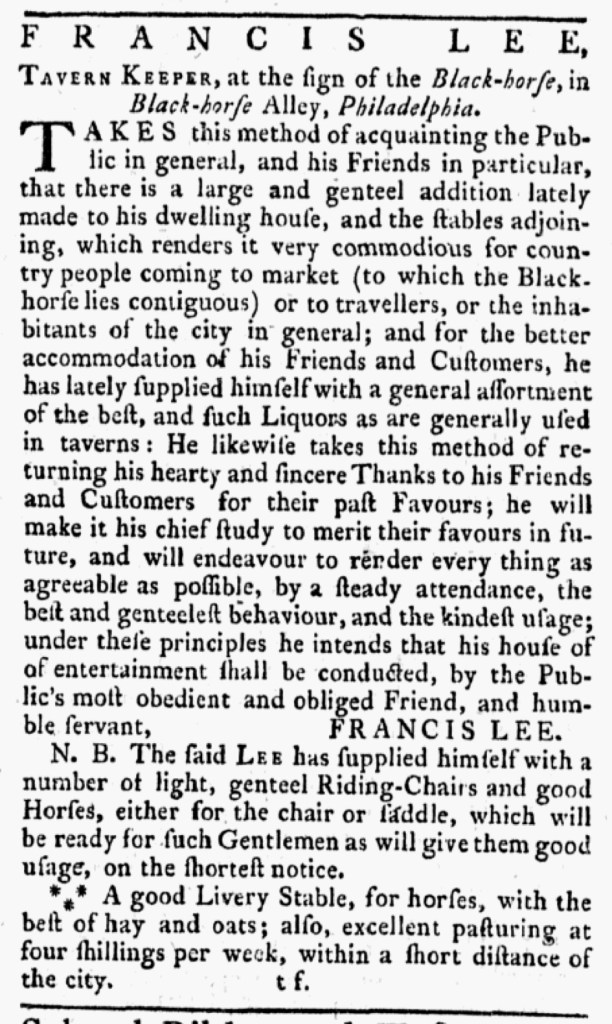
In the fall of 1775, Francis Lee operated a tavern “at the sign of the Black-horse, in Black-horse Alley, Philadelphia.”  In an advertisement in the September 30 edition of the Pennsylvania Ledger, he advised readers about a “large and genteel addition lately made to his dwelling house, and the stables adjoining, which renders it very commodious for country people coming to market.”  His tavern was conveniently located “contiguous” to the market.  In addition to those prospective patrons, Lee also wanted travelers and “the inhabitants of this city in general” to know about the improvements he made at his tavern.  He also promoted his “general assortment of the best, and such Liquors as are generally used in taverns.”  That was all part of providing a pleasant and enjoyable experience for his guests.

Lee also provided other services for the convenience of his “Friends and Customers.”  They included a “good Livery Stable, for horses, with the best of hay and oats” or pasturing by the week, just outside the city, for those staying for a length of time.  He also made a point of highlighting the “genteel Riding-Chairs and good Horses, either for the chair or saddle” that he made available “on the shortest notice.”  In other words, Lee offered an eighteenth-century version of car rentals.  His customers could borrow a horse to ride (the reference to “saddle”) or a horse and fashionable carriage (the “genteel Riding-Chairs”) to transport them to their destination.  Travelers who arrived in Philadelphia on foot, via stagecoach, or on a ship could avail themselves of this service for getting around the city.

The tavernkeeper may have been especially interested in attracting the attention of visitors in the city to attend the Second Continental Congress.  With delegates from throughout the colonies converging on Philadelphia, Lee likely hoped that some of them would visit his “house of entertainment” to enjoy the “best and genteelest behaviour, and the kindest usage” from their host while they enjoyed the amenities of the establishment.  Lee pledged “to render every thing as agreeable as possible” for his customers.  Why not continue discussions or just relax at Lee’s “commodious” tavern after a busy day of meetings to discuss the imperial crisis that had become a war?

September 30

What was advertised in a revolutionary American newspaper 250 years ago today?

Pennsylvania Ledger (September 30, 1775).

“To the surprise of myself and neighbours, found myself recovered to health.”

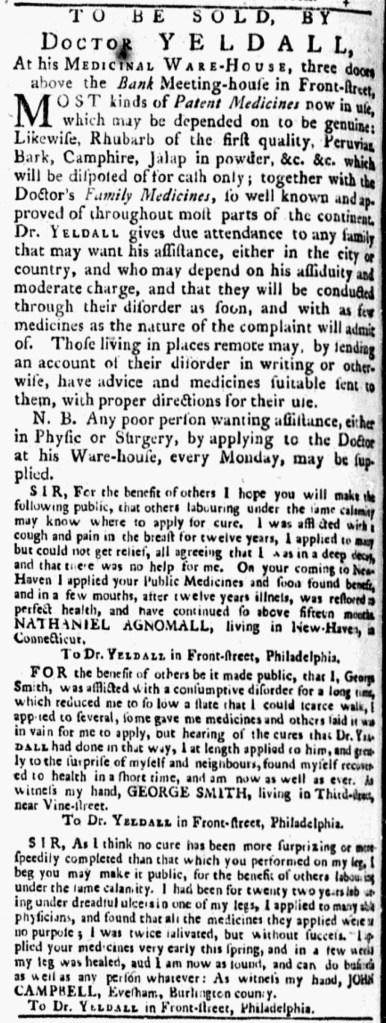
Doctor Yeldall apparently believed that testimonials worked.  In June 1775, he published an advertisement that included several testimonials from his patients.  Three months later, he once again promoted his “MEDICINAL WARE-HOUSE’ in Philadelphia with an advertisement that featured three new testimonials.  The notice gave the impression that the doctor had not solicited them, but instead merely published letters addressed “To Dr. YELDALL in Front-Street, Philadelphia” at the request of those who sent them.  “For the benefit of others I hope you will make the following public,” Nathan Agnomall’s testimonial began.  Similarly, John Campbell, who had suffered “dreadful ulcers in one of my leges,” implored the doctor: “I beg you may make it public, for the benefit of others labouring under the same calamity” that Yeldall’s medicines healed leg.

In his preamble to the testimonials, Yeldall described his “Doctor’s Family Medicines” as “so well known and approved of throughout most parts of the continent.”  Two of the testimonials did indeed come from beyond Philadelphia.  Campell listed his address as “Eversham, Burlington county,” in New Jersey, while Agnomall stated that he was “living in New-Haven, in Connecticut.”  The third testimonial, however, came from a resident of Philadelphia, George Smith, “living in Third-street, near Vine-street.”  Skeptics in that city could question the veracity of letters that supposedly arrived from other colonies, but they might know Smith or could seek him out to confirm what they saw printed in the newspaper advertisement.  Smith’s letter even revealed that he had been cured of a “consumptive disorder” and “to the surprise of myself and neighbours, found myself recovered to health.”  Many residents of Philadelphia living in Smith’s neighborhood could also testify to the efficacy of the Yeldall’s medicines, at least that was the inference in Smith’s letter.  Unlikely to attempt to track down Smith or interview any of his neighbors, prospective patients who had not found relief through any other means may have found this testimonial convincing enough to give Yeldall’s medicines a chance.  Even if they had doubts, the details in Smith’s letter gave them hope by encouraging them to believe something that was likely too good to be true.

September 3

What was advertised in a revolutionary American newspaper 250 years ago this week?

Pennsylvania Ledger (September 2, 1775).

“LETTERS, Written by the late Right Honourable, the Earl of Chesterfield, To his Son.”

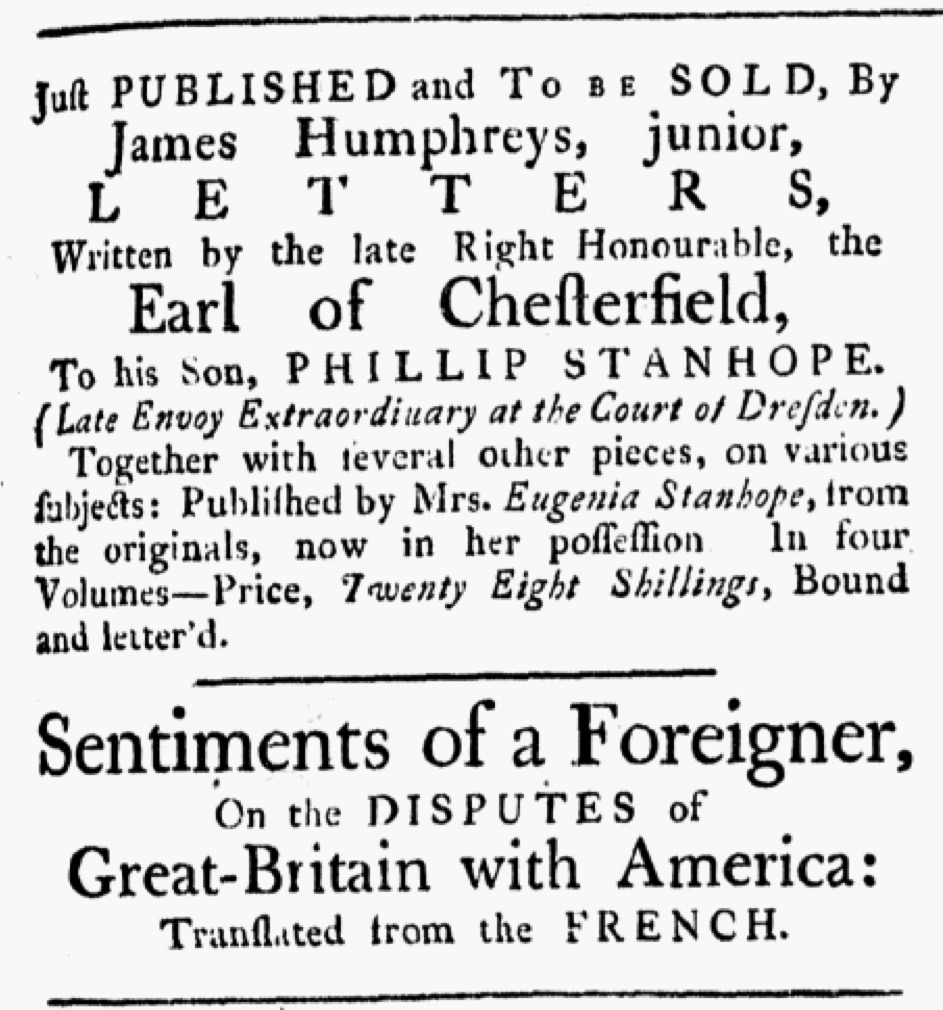
James Humphreys, Jr., led the September 2, 1775, edition of the Pennsylvania Ledger with an advertisement for Letters by the Late Right Honourable, the Earl of Chesterfield, to His Son, Phillip Stanhope.  Although the header proclaimed, “Just PUBLISHED and TO BE SOLD, By James Humphreys, junior,” the printer of the Pennsylvania Ledger merely sold copies of a book printed by others.  As was often the case, the phrase “Just PUBLISHED” meant that a book, pamphlet, print, or other items was now available for purchase, but advertisers expected readers to separate “Just PUBLISHED” and “TO BE SOLD.”  Only the latter applied to the advertiser.  In this case, Humphreys likely stocked copies of an American edition printed by Hugh Gaine and James Rivington in New York.

Prospective customers did not care nearly as much about who printed the book as they did about the contents.  The advertisement (drawn from the extended title of the work) indicated that it consisted of four volumes that contained the Earl of Chesterfield’s letters “Together with several other pieces, on various subjects: Published by Mrs. Eugenia Stanhope, from the original, now in her possession.”  The earl had written 448 letters to his son between 1737, when the boy was five, and his death in 1768.  At that time, the early learned that his son had been secretly wed for a decade and had two sons of his own.  The earl provided for his grandsons but did not support their mother.  In turn, she published the collection of letters.

The letters caused a stir in both Britain and America.  They presented a guide to manners for gentlemen to navigate aristocratic society, prompting colonizers concerned with demonstrating their own gentility to take note of the advice the earl offered to his son.  Yet readers did not universally celebrate the attitude and conduct the early advocated.  Some critiqued what they considered cynical and amoral values contained within the letters.  While Gaine and Rivington may have found eager audiences for the letters in New York and Humphreys in Philadelphia, readers from New England, the descendants of Puritans, were much more skeptical.  Gwen Fries notes that John Adams refused to send Abigail a copy in 1776, advising her that the letters were “stained with libertine Morals and base Principles.”  When she did read them a few years later, she agreed that they contained “the most immoral, pernicious and Libertine principals.”  In confining his advertising copy to the extended title of the work, Humphreys did not take a position.  He likely suspected that even those who had heard that the letters included some unsavory advice would be curious to assess what Chesterfield wrote for themselves.  Many others in Philadelphia, the largest and most cosmopolitan city in the colonies, may not have cared much at all about the sorts of objections raised by readers in Boston.

August 27

What was advertised in a revolutionary American newspaper 250 years ago this week?

Pennsylvania Ledger (August 26, 1775).

“ALL sorts of PLANES … as compleat as any made in London.”

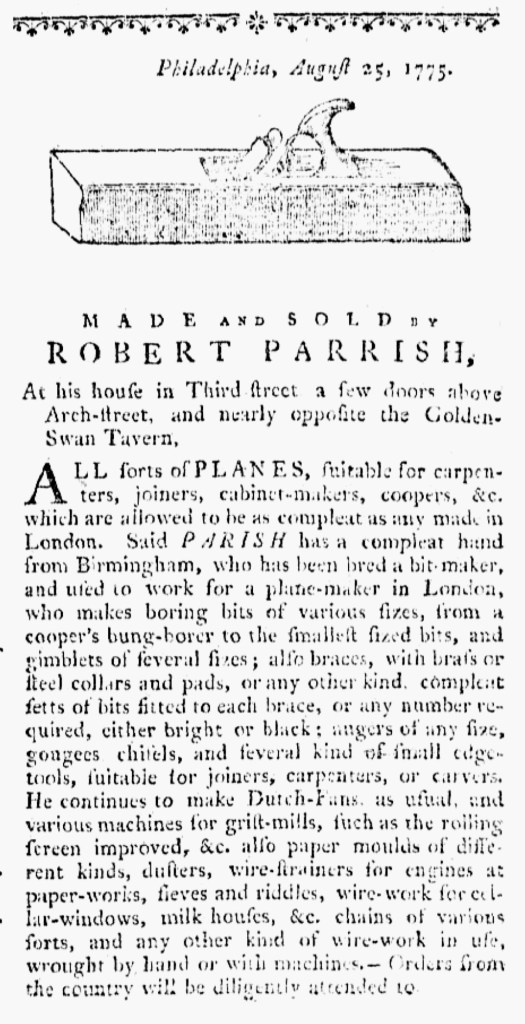
Robert Parrish inserted an advertisement in the August 26, 1775, edition of the Pennsylvania Ledger to advise the public that he made and sold “ALL sorts of PLANES, suitable for carpenters, joiners, cabinet-makers, coopers,” and other artisans at “his house in Third-street, a few doors above Arch-street, and nearly opposite the Golden-Swan Tavern” in Philadelphia.  Parrish was no stranger to advertising in the public prints.  He previously ran an advertisement for “DUTCH FANS” and “ROLLING SCREENS,” both used for separating wheat from chaff, in the Pennsylvania Chronicle.

That notice featured two images, one of each kind of equipment that Parrish made and sold.  A woodcut also accompanied his new advertisement, this one depicting a carpentry plane.  It almost certainly drew attention to his advertisement since it was the only image of any sort, except for the coat of arms of Great Britain that always appeared in the masthead, in that issue of the Pennsylvania Ledger.  Parrish stated that “continues to make Dutch-Fans, as usual, and various machines for grist-mills, such as the rolling screen improved,” yet he did not include either of the images that accompanied his previous advertisement.  Perhaps he never reclaimed them from the printing office when William Goddard ceased publishing the Pennsylvania Chronicle in 1774 … or maybe he considered it too expensive to purchase the necessary space to feature two images.  His copy, after all, was significantly longer than in that earlier advertisement.

Parrish insisted that the planes made and sold at his shop were “as compleat as any made in London,” an assurance that the quality of construction matched imported tools.  American artisans frequently made such claims, though such promises had even greater significance with the Continental Association in effect.  The First Continental Congress devised that nonimportation and nonconsumption agreement in response to the Coercive Acts.  It also called for producers and consumers to support domestic manufactures, goods produced in the colonies, as alternatives to imported items.  Parrish signaled that he did his part to support the American cause by supplying carpenters, joiners, cabinetmakers, and coopers with the tools they needed to earn their livelihoods.

August 19

What was advertised in a revolutionary American newspaper 250 years ago today?

Pennsylvania Ledger (August 19, 1775).

“Map of Boston … the engagements of Lexington and Bunker’s Hill.”

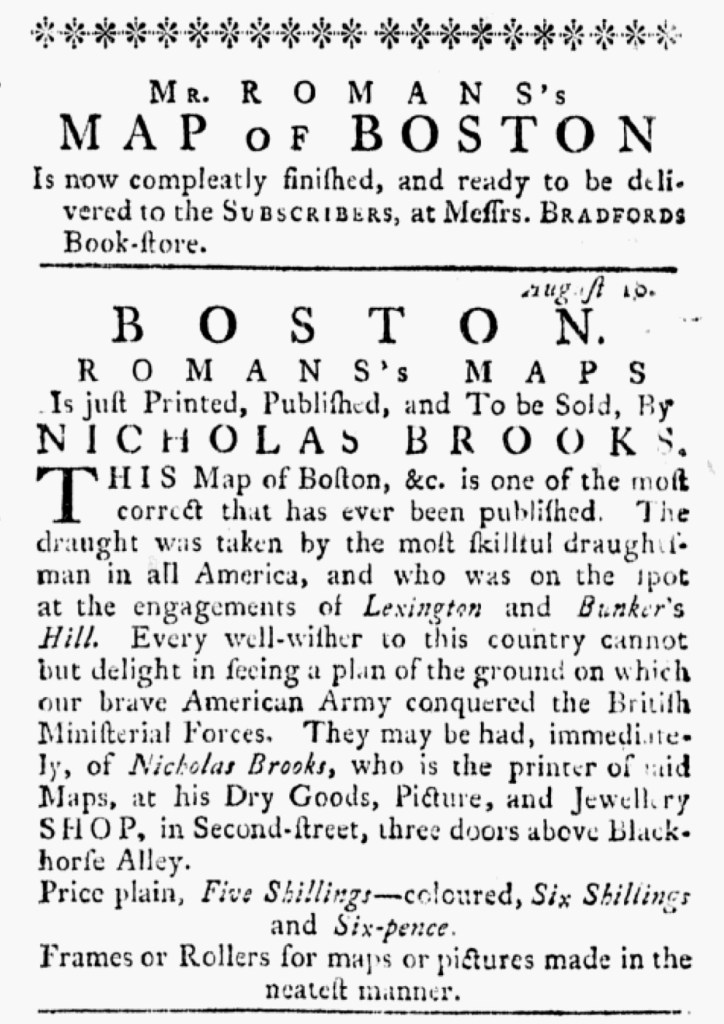
More advertisements for “MR. ROMANS’s MAP OF BOSTON” appeared in the August 19, 1774, edition of the Pennsylvania Ledger.  Bernard Romans, the cartographer who created a “MAP, FROM BOSTON TO WORCESTER, PROVIDENCE AND SALEM. Shewing the SEAT of the present unhappy CIVIL WAR in NORTH-AMERICA,” and Nicholas Brooks, the publisher, previously promoted the project with a broadside subscription proposal that began circulating in the middle of July and scattered references to the map at the end of advertisements in the Pennsylvania Ledger.  Two weeks earlier, for instance, Brooks ran an advertisement that featured an extensive list of merchandise available at his shop and added a nota bene of a single line: “Romans’s map of the seat of war near Boston, &c.”  Robert Aitken mentioned the map in a slightly longer nota bene when he advertised Military Instructions for Officers Detached in the Field.  An advertisement in Rivington’s New-York Gazetteer replicated the copy from the broadside.

Once the map was “completely finished, and ready to be delivered to the SUBSCRIBERS,” as William Bradford and Thomas Bradford put it in their advertisement, or “just Printed, Published, and To be Sold,” as Brooks proclaimed in his own notice, it received greater attention in newspaper notices.  Although many similar projects utilized subscription proposals in newspapers to generate demand attract orders in advance of publication, Romans and Brooks relied on their broadside subscription proposal during their first round of marketing and later added newspaper advertisements once the map was available for sale.

Just four months after the battles at Lexington and Concord, a remarkably short interval for such an endeavor, Brooks advertised copies of Romans’s map of Boston for sale at his “Dry Goods, Picture, and Jewellery SHOP” in Philadelphia.  He touted the quality of the map, declaring it “one of the most correct that has ever been published” and emphasiziong that the “draught was taken by the most skillful draughtsman in all America.”  As if that was not enough to sell it, Romans “was on the spot at the engagements of Lexington and Bunker’s Hill.”  Brooks marketed an eyewitness account of those important battles.  Furthermore, he asserted that consumers had a patriotic duty to examine the map, which they could do by purchasing it.  “Every well-wisher to this country,” Brooks trumpeted, “cannot but delight in seeing a plan of the ground on which our brave American Army conquered the British Ministerial Forces.”  Commemoration and commodification of the American Revolution occurred before the Continental Congress declared independence.

August 12

What was advertised in a revolutionary American newspaper 250 years ago today?

Pennsylvania Ledger (August 12, 1775).

“MILITARY INSTRUCTIONS FOR OFFICERS DETACHED IN THE FIELD.”

On August 12, 1775, Robert Aitken, a printer in Philadelphia, launched a new advertising campaign to promote his American edition of Military Instructions for Office Detached in the Field by Roger Stevenson.  He began with advertisements in the Pennsylvania Evening Post and the Pennsylvania Ledger.  Two days later, he placed the same advertisement in Dunlap’s Pennsylvania Packet and then in the Pennsylvania Gazette another two days after that. Aitken’s new advertisement significantly expanded on the notice that he had published in June.

This time, for example, the printer announced that his American edition was “Dedicated to His Excellency GEORGE WASHINGTON, Esq; General and Commander in Chief of the Army of the United Colonies of North-America.”  The book itself featured a short dedication essay that extended four pages.  In the new advertisement, Aitken promoted some of the usual qualities that printers, publishers, and booksellers often highlighted, noting that the book was printed “On fine Paper, [with] a beautiful new Type” and the “twelve useful Plates” or illustrations “of the Manœuvres” supplemented the text.  Each bound copy cost six shillings and six pence, though Aitken also marketed a “few copies on a superfine paper” for one dollar to those who desired even higher quality.  The price was a bargain, the printer noted, with a bound copy of the London edition selling for ten shillings.

Beyond those details, Aitken incorporated an address “TO THE PUBLIC” into this advertisement, though he did not generate the copy himself.  Instead, he borrowed liberally from the preface of the book, making minor revisions here and there.  In effect, he gave prospective customers a preview of what they would read once they purchased Military Instructions for Officers Detached in the Field.  In the preface, Stevenson lamented that “inferior officers have had no source from whence they could derive instruction on the duties of their sphere in the field,” but he aimed to remedy that with this volume.  He almost certainly had not intended, however, that it would be used by officers in the “Army of the United Colonies of North-America” as they defended their liberties in what would eventually become a war for independence.  Aitken saw an opportunity to generate revenues in the wake of the battles at Lexington and Concord.

In a nota bene, the printer added that he stocked “A complete and elegant MAP of the country, shewing the Seat of the present unhappy Civil War in North-America.”  Bernard Romans, a prominent cartographer, distributed broadside subscription proposals a month earlier, listing Aitken among the many local agents who collected names of subscribers who ordered copies in advance.   The printer gave details about the map not included in the broadside subscription proposal and that had not appeared in newspaper notices.  The map featured a “beautiful Draught of the Provincial CAMP: Likewise, A perspective View of BOSTON, and Gen. Gage’s LINE.”  Current events certainly shaped which items Aitken produced, advertised, and sold at his printing office in Philadelphia.

August 5

What was advertised in a revolutionary American newspaper 250 years ago today?

Pennsylvania Ledger (August 5, 1775).

“Romans’s map of the seat of war near Boston.”

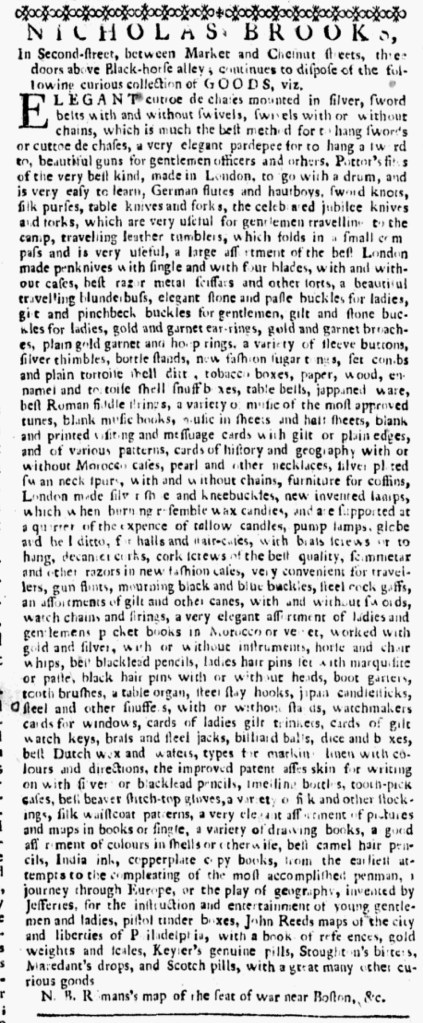
At the end of July 1775, Nicholas Brooks began running a new advertisement in the Pennsylvania Ledger.  It first appeared on July 29 and then again in the next two issues.  In it, Brooks hawked a “curious collection of GOODS” that he sold at his shop on Second Street in Philadelphia.  He listed everything from sword belts and “beautiful guns for gentlemen officers” and “gilt and stone buckles for ladies” to “razors in new fashion cases, very convenient for traveling” and “cork screws of the best quality” to “a very elegant assortment of ladies and gentlemans pocket books in Morocco velvet, worked with gold and silver” and “a variety of music of the most approved tunes.”  He also stocked “a very elegant assortment of pictures and maps in books or single.”  Brooks had already established “PRINTS and PICTURES” as a specialty.

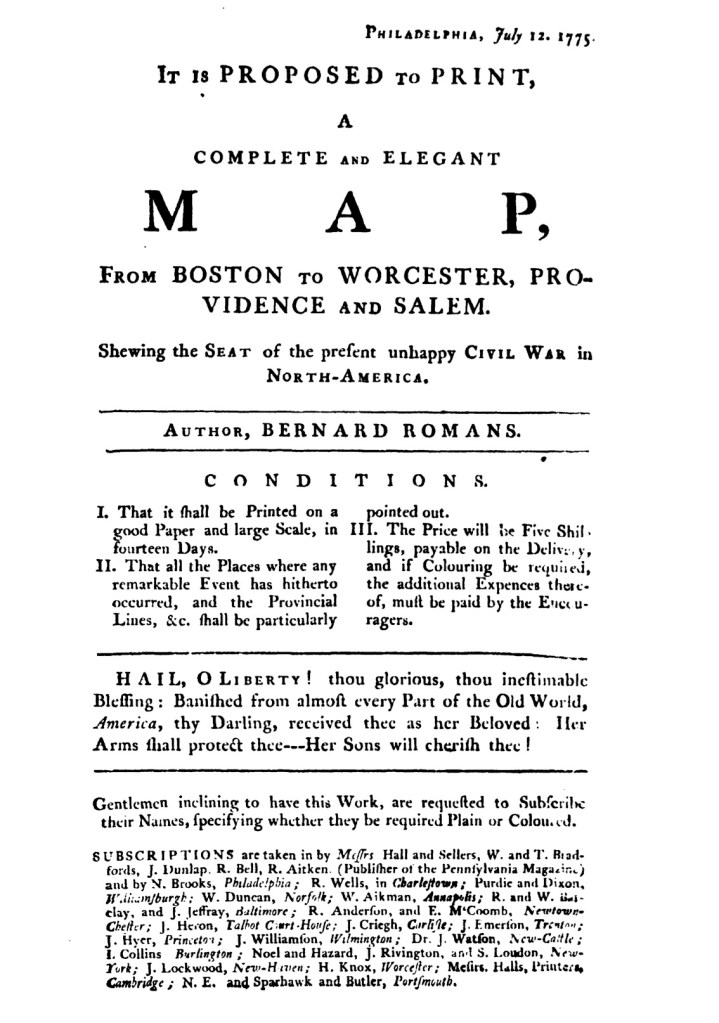
He concluded this advertisement with a nota bene that indicated he sold “Romans’s map of the seat of war near Boston,” but he did not say anything more about that item.  In addition, neither Brooks nor Bernard Romans, the cartographer and “AUTHOR” of the map, previously advertised the project in the Pennsylvania Ledger or any of the other newspapers printed in Philadelphia at the time.  Perhaps Brooks expected that readers were familiar with a broadside subscription proposal, dated July 12, that had been circulating or posted around town and beyond.  The subscription proposal featured the same copy as the advertisement for the map that ran in the August 3 edition of Rivington’s New-York Gazetteer, though the newspaper notice listed only local agents while the broadside gave a much more extensive list of printers, booksellers, and others who collected subscriptions in towns from New England to South Carolina.  James Rivington apparently adapted the broadside rather than composing copy for the advertisement when he inserted it in his newspaper.  That broadside documented a sophisticated network for inciting demand for the map and distributing it to subscribers.  In addition to the five printers and booksellers who collected subscriptions in Philadelphia, twenty-two local agents in eighteen towns in ten colonies collaborated with Brooks and Romans.  That list represented an “imagined community,” a concept developed by Benedict Anderson, of readers and consumers near and far who simultaneously examined the same map “Shewing the SEAT of the present unhappy CIVIL WAR in NORTH-AMERICA.”

Brooks did not limit his marketing of the map to the broadside subscription proposal and the nota bene at the end of an advertisement that cataloged dozens of items available at his shop.  He eventually ran newspaper advertisements devoted exclusively to the map, seeking to generate more interest and demand for such a timely and important work.

Broadside Subscription Proposal: “It Is Proposed to Print, A Complete and Elegant Map” (Philadelphia, 1775). Courtesy Library Company of Philadelphia.

**********

The Massachusetts Historical Society has digitized Romans’s map, accompanied by a brief overview of its significance and a short essay about Romans and other cartographers active during the era of the American Revolution.