September 3

What was advertised in a revolutionary American newspaper 250 years ago this week?
Pennsylvania Ledger (September 2, 1775).

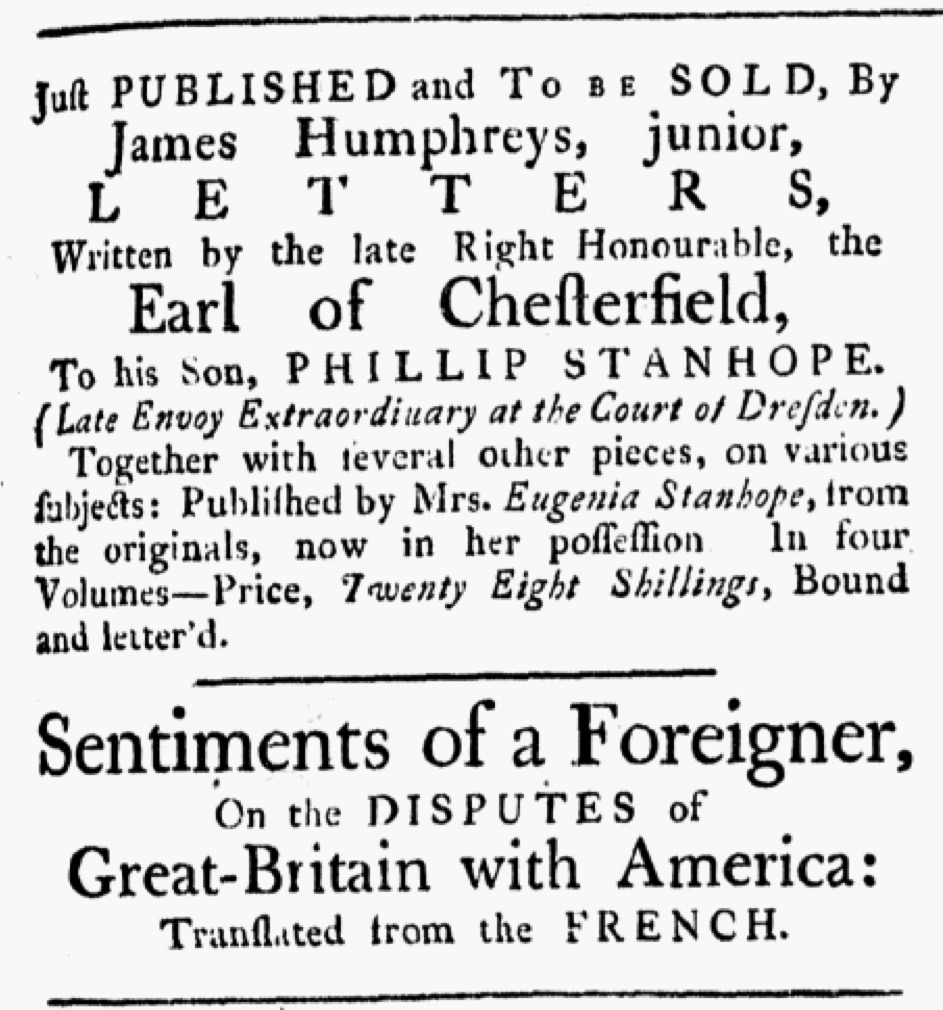
“LETTERS, Written by the late Right Honourable, the Earl of Chesterfield, To his Son.”

James Humphreys, Jr., led the September 2, 1775, edition of the Pennsylvania Ledger with an advertisement for Letters by the Late Right Honourable, the Earl of Chesterfield, to His Son, Phillip Stanhope.  Although the header proclaimed, “Just PUBLISHED and TO BE SOLD, By James Humphreys, junior,” the printer of the Pennsylvania Ledger merely sold copies of a book printed by others.  As was often the case, the phrase “Just PUBLISHED” meant that a book, pamphlet, print, or other items was now available for purchase, but advertisers expected readers to separate “Just PUBLISHED” and “TO BE SOLD.”  Only the latter applied to the advertiser.  In this case, Humphreys likely stocked copies of an American edition printed by Hugh Gaine and James Rivington in New York.

Prospective customers did not care nearly as much about who printed the book as they did about the contents.  The advertisement (drawn from the extended title of the work) indicated that it consisted of four volumes that contained the Earl of Chesterfield’s letters “Together with several other pieces, on various subjects: Published by Mrs. Eugenia Stanhope, from the original, now in her possession.”  The earl had written 448 letters to his son between 1737, when the boy was five, and his death in 1768.  At that time, the early learned that his son had been secretly wed for a decade and had two sons of his own.  The earl provided for his grandsons but did not support their mother.  In turn, she published the collection of letters.

The letters caused a stir in both Britain and America.  They presented a guide to manners for gentlemen to navigate aristocratic society, prompting colonizers concerned with demonstrating their own gentility to take note of the advice the earl offered to his son.  Yet readers did not universally celebrate the attitude and conduct the early advocated.  Some critiqued what they considered cynical and amoral values contained within the letters.  While Gaine and Rivington may have found eager audiences for the letters in New York and Humphreys in Philadelphia, readers from New England, the descendants of Puritans, were much more skeptical.  Gwen Fries notes that John Adams refused to send Abigail a copy in 1776, advising her that the letters were “stained with libertine Morals and base Principles.”  When she did read them a few years later, she agreed that they contained “the most immoral, pernicious and Libertine principals.”  In confining his advertising copy to the extended title of the work, Humphreys did not take a position.  He likely suspected that even those who had heard that the letters included some unsavory advice would be curious to assess what Chesterfield wrote for themselves.  Many others in Philadelphia, the largest and most cosmopolitan city in the colonies, may not have cared much at all about the sorts of objections raised by readers in Boston.

August 27

What was advertised in a revolutionary American newspaper 250 years ago this week?

Pennsylvania Ledger (August 26, 1775).

“ALL sorts of PLANES … as compleat as any made in London.”

Robert Parrish inserted an advertisement in the August 26, 1775, edition of the Pennsylvania Ledger to advise the public that he made and sold “ALL sorts of PLANES, suitable for carpenters, joiners, cabinet-makers, coopers,” and other artisans at “his house in Third-street, a few doors above Arch-street, and nearly opposite the Golden-Swan Tavern” in Philadelphia.  Parrish was no stranger to advertising in the public prints.  He previously ran an advertisement for “DUTCH FANS” and “ROLLING SCREENS,” both used for separating wheat from chaff, in the Pennsylvania Chronicle.

That notice featured two images, one of each kind of equipment that Parrish made and sold.  A woodcut also accompanied his new advertisement, this one depicting a carpentry plane.  It almost certainly drew attention to his advertisement since it was the only image of any sort, except for the coat of arms of Great Britain that always appeared in the masthead, in that issue of the Pennsylvania Ledger.  Parrish stated that “continues to make Dutch-Fans, as usual, and various machines for grist-mills, such as the rolling screen improved,” yet he did not include either of the images that accompanied his previous advertisement.  Perhaps he never reclaimed them from the printing office when William Goddard ceased publishing the Pennsylvania Chronicle in 1774 … or maybe he considered it too expensive to purchase the necessary space to feature two images.  His copy, after all, was significantly longer than in that earlier advertisement.

Parrish insisted that the planes made and sold at his shop were “as compleat as any made in London,” an assurance that the quality of construction matched imported tools.  American artisans frequently made such claims, though such promises had even greater significance with the Continental Association in effect.  The First Continental Congress devised that nonimportation and nonconsumption agreement in response to the Coercive Acts.  It also called for producers and consumers to support domestic manufactures, goods produced in the colonies, as alternatives to imported items.  Parrish signaled that he did his part to support the American cause by supplying carpenters, joiners, cabinetmakers, and coopers with the tools they needed to earn their livelihoods.

August 19

What was advertised in a revolutionary American newspaper 250 years ago today?

Pennsylvania Ledger (August 19, 1775).

“Map of Boston … the engagements of Lexington and Bunker’s Hill.”

More advertisements for “MR. ROMANS’s MAP OF BOSTON” appeared in the August 19, 1774, edition of the Pennsylvania Ledger.  Bernard Romans, the cartographer who created a “MAP, FROM BOSTON TO WORCESTER, PROVIDENCE AND SALEM. Shewing the SEAT of the present unhappy CIVIL WAR in NORTH-AMERICA,” and Nicholas Brooks, the publisher, previously promoted the project with a broadside subscription proposal that began circulating in the middle of July and scattered references to the map at the end of advertisements in the Pennsylvania Ledger.  Two weeks earlier, for instance, Brooks ran an advertisement that featured an extensive list of merchandise available at his shop and added a nota bene of a single line: “Romans’s map of the seat of war near Boston, &c.”  Robert Aitken mentioned the map in a slightly longer nota bene when he advertised Military Instructions for Officers Detached in the Field.  An advertisement in Rivington’s New-York Gazetteer replicated the copy from the broadside.

Once the map was “completely finished, and ready to be delivered to the SUBSCRIBERS,” as William Bradford and Thomas Bradford put it in their advertisement, or “just Printed, Published, and To be Sold,” as Brooks proclaimed in his own notice, it received greater attention in newspaper notices.  Although many similar projects utilized subscription proposals in newspapers to generate demand attract orders in advance of publication, Romans and Brooks relied on their broadside subscription proposal during their first round of marketing and later added newspaper advertisements once the map was available for sale.

Just four months after the battles at Lexington and Concord, a remarkably short interval for such an endeavor, Brooks advertised copies of Romans’s map of Boston for sale at his “Dry Goods, Picture, and Jewellery SHOP” in Philadelphia.  He touted the quality of the map, declaring it “one of the most correct that has ever been published” and emphasiziong that the “draught was taken by the most skillful draughtsman in all America.”  As if that was not enough to sell it, Romans “was on the spot at the engagements of Lexington and Bunker’s Hill.”  Brooks marketed an eyewitness account of those important battles.  Furthermore, he asserted that consumers had a patriotic duty to examine the map, which they could do by purchasing it.  “Every well-wisher to this country,” Brooks trumpeted, “cannot but delight in seeing a plan of the ground on which our brave American Army conquered the British Ministerial Forces.”  Commemoration and commodification of the American Revolution occurred before the Continental Congress declared independence.

August 12

What was advertised in a revolutionary American newspaper 250 years ago today?

Pennsylvania Ledger (August 12, 1775).

“MILITARY INSTRUCTIONS FOR OFFICERS DETACHED IN THE FIELD.”

On August 12, 1775, Robert Aitken, a printer in Philadelphia, launched a new advertising campaign to promote his American edition of Military Instructions for Office Detached in the Field by Roger Stevenson.  He began with advertisements in the Pennsylvania Evening Post and the Pennsylvania Ledger.  Two days later, he placed the same advertisement in Dunlap’s Pennsylvania Packet and then in the Pennsylvania Gazette another two days after that. Aitken’s new advertisement significantly expanded on the notice that he had published in June.

This time, for example, the printer announced that his American edition was “Dedicated to His Excellency GEORGE WASHINGTON, Esq; General and Commander in Chief of the Army of the United Colonies of North-America.”  The book itself featured a short dedication essay that extended four pages.  In the new advertisement, Aitken promoted some of the usual qualities that printers, publishers, and booksellers often highlighted, noting that the book was printed “On fine Paper, [with] a beautiful new Type” and the “twelve useful Plates” or illustrations “of the Manœuvres” supplemented the text.  Each bound copy cost six shillings and six pence, though Aitken also marketed a “few copies on a superfine paper” for one dollar to those who desired even higher quality.  The price was a bargain, the printer noted, with a bound copy of the London edition selling for ten shillings.

Beyond those details, Aitken incorporated an address “TO THE PUBLIC” into this advertisement, though he did not generate the copy himself.  Instead, he borrowed liberally from the preface of the book, making minor revisions here and there.  In effect, he gave prospective customers a preview of what they would read once they purchased Military Instructions for Officers Detached in the Field.  In the preface, Stevenson lamented that “inferior officers have had no source from whence they could derive instruction on the duties of their sphere in the field,” but he aimed to remedy that with this volume.  He almost certainly had not intended, however, that it would be used by officers in the “Army of the United Colonies of North-America” as they defended their liberties in what would eventually become a war for independence.  Aitken saw an opportunity to generate revenues in the wake of the battles at Lexington and Concord.

In a nota bene, the printer added that he stocked “A complete and elegant MAP of the country, shewing the Seat of the present unhappy Civil War in North-America.”  Bernard Romans, a prominent cartographer, distributed broadside subscription proposals a month earlier, listing Aitken among the many local agents who collected names of subscribers who ordered copies in advance.   The printer gave details about the map not included in the broadside subscription proposal and that had not appeared in newspaper notices.  The map featured a “beautiful Draught of the Provincial CAMP: Likewise, A perspective View of BOSTON, and Gen. Gage’s LINE.”  Current events certainly shaped which items Aitken produced, advertised, and sold at his printing office in Philadelphia.

August 5

What was advertised in a revolutionary American newspaper 250 years ago today?

Pennsylvania Ledger (August 5, 1775).

“Romans’s map of the seat of war near Boston.”

At the end of July 1775, Nicholas Brooks began running a new advertisement in the Pennsylvania Ledger.  It first appeared on July 29 and then again in the next two issues.  In it, Brooks hawked a “curious collection of GOODS” that he sold at his shop on Second Street in Philadelphia.  He listed everything from sword belts and “beautiful guns for gentlemen officers” and “gilt and stone buckles for ladies” to “razors in new fashion cases, very convenient for traveling” and “cork screws of the best quality” to “a very elegant assortment of ladies and gentlemans pocket books in Morocco velvet, worked with gold and silver” and “a variety of music of the most approved tunes.”  He also stocked “a very elegant assortment of pictures and maps in books or single.”  Brooks had already established “PRINTS and PICTURES” as a specialty.

He concluded this advertisement with a nota bene that indicated he sold “Romans’s map of the seat of war near Boston,” but he did not say anything more about that item.  In addition, neither Brooks nor Bernard Romans, the cartographer and “AUTHOR” of the map, previously advertised the project in the Pennsylvania Ledger or any of the other newspapers printed in Philadelphia at the time.  Perhaps Brooks expected that readers were familiar with a broadside subscription proposal, dated July 12, that had been circulating or posted around town and beyond.  The subscription proposal featured the same copy as the advertisement for the map that ran in the August 3 edition of Rivington’s New-York Gazetteer, though the newspaper notice listed only local agents while the broadside gave a much more extensive list of printers, booksellers, and others who collected subscriptions in towns from New England to South Carolina.  James Rivington apparently adapted the broadside rather than composing copy for the advertisement when he inserted it in his newspaper.  That broadside documented a sophisticated network for inciting demand for the map and distributing it to subscribers.  In addition to the five printers and booksellers who collected subscriptions in Philadelphia, twenty-two local agents in eighteen towns in ten colonies collaborated with Brooks and Romans.  That list represented an “imagined community,” a concept developed by Benedict Anderson, of readers and consumers near and far who simultaneously examined the same map “Shewing the SEAT of the present unhappy CIVIL WAR in NORTH-AMERICA.”

Brooks did not limit his marketing of the map to the broadside subscription proposal and the nota bene at the end of an advertisement that cataloged dozens of items available at his shop.  He eventually ran newspaper advertisements devoted exclusively to the map, seeking to generate more interest and demand for such a timely and important work.

Broadside Subscription Proposal: “It Is Proposed to Print, A Complete and Elegant Map” (Philadelphia, 1775). Courtesy Library Company of Philadelphia.

**********

The Massachusetts Historical Society has digitized Romans’s map, accompanied by a brief overview of its significance and a short essay about Romans and other cartographers active during the era of the American Revolution.

July 29

What was advertised in a revolutionary American newspaper 250 years ago today?

Pennsylvania Ledger (July 29, 1775).

“All Letters Post free, and small bundles not exceeding eight ounces, carried gratis for any Subscriber.”

As the Revolutionary War commenced, Thomas Sculley, a post rider, followed a route that connected several towns in Delaware to Philadelphia.  At noon on every Wednesday, he departed from William Dibley’s Fountain Tavern on Chestnut Street and made for Lewis Town (now Lewes).  He stopped at Middletown, Dover, and other towns along the way, delivering letters, newspapers, and packages.  That took three days.  Sculley arrived at Lewis Town by noon on Saturday and started the return trip later the same day.  Presumably he made it to Philadelphia on Tuesday, giving customers an opportunity to consult with him at the Fountain Tavern.

Sculley placed an advertisement for his services in the July 29, 1775, edition of the Pennsylvania Ledger.  Like some other post riders, he did not charge solely by the letter, package, or newspaper subscription but instead marketed a subscription service.  Subscribers paid a set fee on a regular basis whether they made use of the service or not.  In return, they could post as many letters as they wished as well as send “small bundles not exceeding eight ounces.”  Anything else incurred additional charges.  Even if customers did not use Sculley’s service every time he rode between Philadelphia and Lewes, the subscription fee could have been a bargain compared to paying for each letter or package each time.  In addition, Sculley intended for subscriptions, if paid on time, to yield steady income that made serving his route possible. Prospective customers who wanted to make sure that a post rider was available when they desired needed to support the enterprise with their subscriptions, not just when they had letters and packages to send.

Sculley also accepted subscriptions for the Pennsylvania Ledger.  He may have also delivered other newspapers printed in Philadelphia at the time, including Dunlap’s Pennsylvania Packet, the Pennsylvania Evening Post, the Pennsylvania Gazette, and the Pennsylvania Journal.  Subscriptions to his service also supported dissemination of news about the imperial crisis, the hostilities that had recently commenced in Massachusetts, the meeting of the Second Continental Congress in Philadelphia, and reactions from throughout the colonies.  Post riders like Thomas Sculley played an important role in the communications infrastructure that disseminated news during the era of the American Revolution.

June 17

What was advertised in a revolutionary American newspaper 250 years ago today?

Pennsylvania Ledger (June 17, 1775).

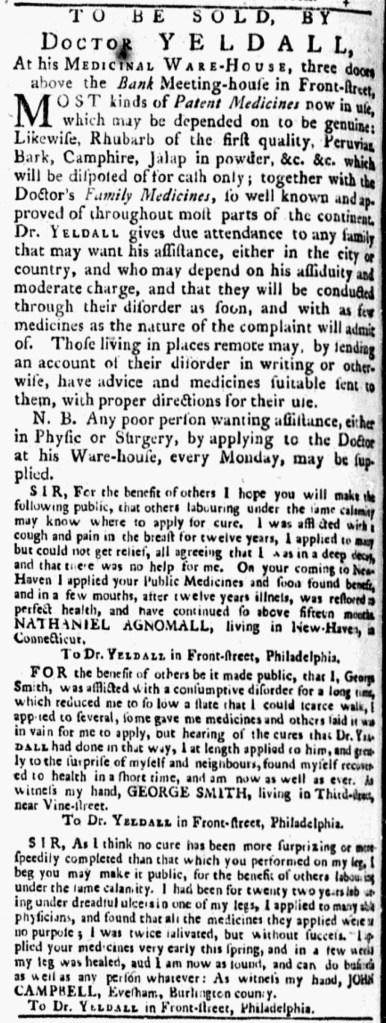
“I applied to Doctor YELDALL’S PUBLIC MEDICINES, which, in a short time, restored me to perfect health.”

An advertisement placed by “DOCTOR YELDALL” in the June 17, 1775, edition of the Pennsylvania Ledger advised the public that he sold “MOST kinds of medicines” at his “MEDICINAL WARE-HOUSE” on Front Street in Philadelphia.  He carried “most patent medicines now in use” as well as his own line of “the Doctor’s Family Medicines,” which, he claimed, “are well known in most parts of the continent.”  Customers residing in the country could send orders for Yeldall to fill, while those in the city could arrange to “be waited on at their houses, and due attendance given through the cure of their disorder.”  The doctor did not charge for consultations, nor did he commence treatment except “where there is a probability of success.”  He attempted to build trust with prospective patients in his advertisement.

To that end, he also published a series of testimonials, hoping that former patients would prove even more convincing than his own description of his services.  Each started with the same phrase, “FOR the benefit of other be it made public,” suggesting that Yeldall solicited the testimonials and assisted in drafting them (or perhaps even wrote them himself).  In one, John Musgrove, who lived near Marcus Hook, Pennsylvania, reported that he “was afflicted for a long time with a violent cough, spitting and fever” to the point that he “could scarce stand or walk.”  He sought assistance “but to no purpose, until [he] applied to Doctor YELDALL’S PUBLIC MEDICINES.”  They quickly restored him to “perfect health.”  Alexander Martin “of Kings-woods county, New-Jersey” similarly declared that he “was afflicted with a consumptive disorder for upwards of three years,” during which time he “applied to every man of skill that [he] could, but to no purpose.”  He even entered the “hospital at Philadelphia” and stayed for three months, enduring “a course of mercury” and “tried many other things in vain.”  Only after his discharge from the hospital did Martin seek aid from Yeldall, who “in a short time recovered me to my perfect health.”  According to Martin and Musgrove, the doctor’s methods were both fast and effective.

In addition to prescribing the right medicines to treat his patients’ maladies, Yeldall also performed medical procedures.  In one testimonial, Mary Irons of Queen’s County, Maryland, declared that she “was afflicted with blindness for many years.”  She “applied to several, but could obtain no relief until I applied to Doctor YELDALL, who brought me to the sight of one eye in a minute’s time, by taking off the film.”  John Dunbar “of the city of Philadelphia” told of a surgeon who unsuccessfully treated his daughter.  She had “the deformity of a Hare-Lip” that “broke open” after the surgeon “cut” it.  Dunbar then took his daughter to Yeldall, “who, to my satisfaction, did the operation in one minute, by the watch, and completed the cure in four days.”  Yeldall added a note that others with “the above mentioned deformity” did not need to “dispair,” no matter how “large or frightful, or hav[ing] been cut so often before,” because his procedure “will be done in one minute, and the cure completed in four days” or else he did not charge for his services.  Perhaps the focus on how quickly the doctor performed these operations was meant to reassure prospective patients that they would not experience prolonged discomfort during a procedure.

Yeldall’s promises seemed too good to be true … and they almost certainly were.  Yet the “DOCTOR” realized that some prospective patients were likely desperate for any sort of treatment that they could hope for a different outcome.  As they searched for hope, he expected that his own promises and, especially, testimonials supposedly composed by his former patients would convince the afflicted to give him a chance to restore them to health.

May 27

What was advertised in a revolutionary American newspaper 250 years ago today?

Pennsylvania Ledger (May 27, 1775).

“Essays, Articles of News, Advertisements, &c. are gratefully received and impartially inserted.”

Among newspapers published during the era of the American Revolution, those that included a colophon usually featured it at the bottom of the final page.  A few, including the Pennsylvania Ledger, incorporated the colophon into the masthead.  James Humphreys, Jr., the printer, also used the colophon as a perpetual advertisement for subscriptions and advertisements.  After all, the full title of the newspaper was the Pennsylvania Ledger: Or the Virginia, Maryland, Pennsylvania, & New Jersey Weekly Advertiser.  Accordingly, the colophon gave more than just place of publication and the name of the printer (“Philadelphia: Printed by JAMES HUMPHREYS, junr. in Front-street, at the Corner of Black-horse Alley”); it also informed readers that “Essays, Articles of News, Advertisements, &c. are gratefully received and impartially inserted” and “Subscriptions are taken in for this Paper, at Ten Shillings per Year.”  The enhanced colophon did not, however, give prices for advertising, though Humphreys stated that he set “the same terms as is usual with the other papers in the city” in the subscription proposals he distributed in January 1775.

What did Humphreys mean when he declared that he “impartially inserted” essays (or editorials), news, and advertisements?  In the proposals t, he asserted that “a number of worthy and reputable Gentlemen” in Philadelphia had encouraged him “to establish a Free and Impartial NEWS PAPER, open to All, and influenced by None.”  Furthermore, he proclaimed that he was “determined to act on the most impartial principles, and not render himself liable to be influenced by any party whatever.”  Such idealism stood in stark contrast to the partisanship of most newspapers as the imperial crisis intensified.  Humphreys’s determination to print essays and news from various perspectives amounted to sufficient proof for many Patriots that the printer was a Loyalist since he did not uniformly promote the American cause.  Decades later, Isaiah Thomas, the patriot printer who published the Massachusetts Spy at the same time Humphreys published the Pennsylvania Ledger, took a more evenhanded approach in his History of Printing of America: “The publisher announced his intention to conduct his paper with political impartiality; and perhaps, in times more tranquil than those in which it appeared, he might have succeeded in his plan.  …  The impartiality of the Ledger did not comport with the temper of the times.”[1]  Thomas seemed to consider Humphreys’s commitment to freedom of the press authentic rather than a rationalization for printing Loyalist views.  He was not so kind in his descriptions of other printers whose politics did not align with his own.

Still, the “temper of the times” likely prompted Humphreys to adjust his own advertising for political pamphlets available at his printing office.  When it came to “impartially insert[ing]” advertisements submitted by others, he gave assurances that he neither took an editorial stance when it came to the information they disseminated nor gave some more prominent placement on the page than others.  He did not rank newspapers notices but instead gave advertisers equal access to his press.

**********

[1] Isaiah Thomas, The History of Printing in America: With a Biography of Printers and an Account of Newspapers (1810; New York: Weathervane Books, 1970), 439-440.

May 20

What was advertised in a revolutionary American newspaper 250 years ago today?

Pennsylvania Ledger (May 20, 1775).

“POLITICAL PAMPHLETS, ON Both Sides of the Question.”

When he launched the Pennsylvania Ledger in the winter of 1775, James Humphreys, Jr., distributed proposals declaring that it would be a “Free and Impartial News Paper, open to All, and Influenced by None.”  With high hopes for operating an impartial press as the imperial crisis intensified, he soon advertised “POLITICAL PAMPHLETS … on Both Sides of the Question” in February 1775.  Several months later, he ran a notice advising that “POLITICAL PAMPHLETS, ON Both Sides of the Question, May be had of the Printer hereof” in the May 20 edition.  Doing so required both courage and commitment, especially considering recent events.

Humphreys published that advertisement a month after the battles at Lexington and Concord.  The siege of Boston continued, yet he did not allow news of the battles or the siege to dissuade him from hawking pamphlets on “Both Sides of the Question.”  Perhaps more significantly, James Rivington, the printer who also published pamphlets “on both sides, in the unhappy dispute with Great-Britain” at his “OPEN and UNINFLUENCED PRESS” in New York, had been hung in effigy in New Brunswick, New Jersey, by colonizers dissatisfied with what they considered his Loyalist sympathies.  Rivington covered that event in his newspaper, Rivington’s New-York Gazetteer, even including a woodcut depicting the scene.  Given that printers exchanged newspapers with their counterparts in other cities and towns, Humphreys likely read about the effigy; even if he did not, he almost certainly heard about it.  Even more recently, Rivington published a notice in which he acknowledged that “many Publications have appeared from my Press which have given great Offence … to many of my Fellow Citizens,” asserted that “Nothing which I have ever done, has proceeded from any Sentiments in the least unfriendly to the Liberties of this Continent,” and pledged “to conduct my Press upon such Principles as shall not give Offence to the Inhabitants of the Colonies.”  Despite his effort to clarify that he had not pursued a political agenda but instead followed his “duty as a Printer” to encourage “the Liberty of the Press,” the Sons of Liberty attacked his home and office on May 10.  Rivington took refuge on a British naval vessel.  Assistants continued publishing the newspaper, inserting his notice about his true intentions twice more.  Rivington had already discontinued advertising political pamphlets representing both sides of what he had previously called “The American Controversy” and “THE AMERICAN CONTEST.”

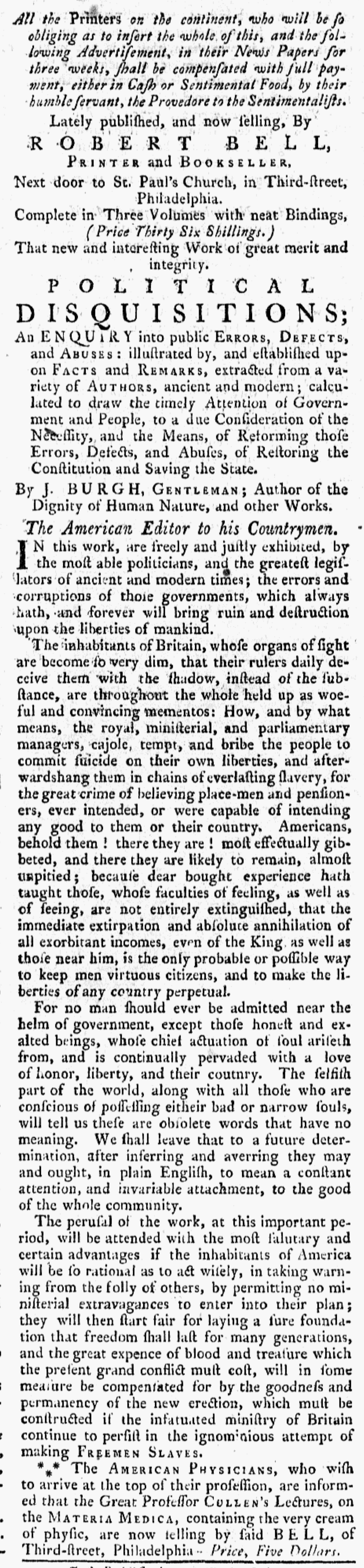
Although Humphreys advertised political pamphlets from “Both Sides” on May 20, word of what happened to Rivington may have prompted him to reconsider his courage in the weeks and months that followed.  He discontinued that advertisement.  In the next issue, he marketed only one pamphlet for sale at his printing office, The Group, a satire by Mercy Otis Warren that depicted a “SCENE AT BOSTON.”  That publication unabashedly supported the American cause.  A week later, that advertisement appeared on the first page of the Pennsylvania Ledger (as it had in the May 20 edition that carried the advertisement for political pamphlets on the final page), next to an advertisement for a multi-volume set of Political Disquisitions recommended for “all the friends of Constitutional Liberty, whether Britons or Americans.”  Still, the editorial perspective of the Pennsylvania Ledger, according to Isaiah Thomas, “was under the influence of the British government” and Humphreys eventually “refused to bear arms in favor of his country, and against the government of England.”[1]  He experienced sufficient difficulty that he suspended the newspaper at the end of November 1776.  In May 1775, a year and a half earlier, he grappled with what kinds of publications he would promote among the advertisements in his newspaper, first forging ahead with notices for pamphlets representing multiple perspectives and then emphasizing those that supported the American cause, perhaps doing so in hopes of avoiding the treatment that Rivington received.

**********

[1] Isaiah Thomas, The History of Printing in America: With a Biography of Printers and an Account of Newspapers (1810; New York: Weathervane Books, 1970), 398.

May 13

What was advertised in a revolutionary American newspaper 250 years ago today?

Pennsylvania Ledger (May 13, 1775).

“Any that will be wanted for REGIMENTALS, he will cut at the wholesale price.”

After word of the battles at Lexington and Concord arrived in Philadelphia, Philip Marchinton took to the pages of the Pennsylvania Ledger to “acquaint his Friends and the Public, that he hath a very large Quantity of … London BROWN CLOTHS … and a large Quantity of superfine London Brown Forest Cloths” for sale at his shop.  He listed the prices for each type of textile, also noting that “Any that will be wanted for REGIMENTALS, he will cut at the wholesale price.”  In other words, he offered a discount to customers who purchased cloth to make uniforms.

Doing so made good business sense, but it did not necessarily reveal Marchinton’s politics at that moment or the decisions he would make once the colonies declared independence.  Although he set prices that favored American patriots just after the war began, Marchinton ultimately identified as a Loyalist and migrated to Nova Scotia.  According to the Dictionary of Canadian Biography, Marchinton was born in England around 1736, served a “commercial apprenticeship” before migrating to Philadelphia in 1771, and “established himself as a general merchant.”  He tried to remain neutral, even “agreeing to serve in the local militia but refusing to renounce his allegiance to the crown” during the early stages of the war.  Marchinton later “declared himself a loyalist during Philadelphia’s occupation by British forces” in 1777 and 1778, leaving him “no choice but to leave the city when the army abandoned it in June 1778.”  He spent the rest of the war in British-occupied New York, leaving in November 1783.  After spending a few months in Bermuda, he settled in Halifax, Nova Scotia, became a prosperous merchant, and held public office.

Marchinton had experience with using favorable prices as a marketing strategy.  In October 1773, he placed an advertisement in the Pennsylvania Gazette and the Pennsylvania Journal, declaring that “it is in his power to sell” all sorts of textiles “as low as any shop or store in the city.”  Responding to current events in the spring of 1775 provided an opportunity for the merchant to devise a promotion aimed at men who needed fabric for uniforms, a gesture that he likely expected would garner good will among the public and draw customers to his shop to make other purchases as well.  Like many colonizers, Marchinton apparently supported resistance aimed at securing a redress of grievances, but over time he found that he could not endorse independence.  His advertisement in the Pennsylvania Ledger testified to his entrepreneurial ingenuity rather than his deeply held political beliefs.