May 13

What was advertised in a revolutionary American newspaper 250 years ago today?

Pennsylvania Ledger (May 13, 1775).

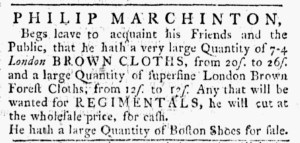
“Any that will be wanted for REGIMENTALS, he will cut at the wholesale price.”

After word of the battles at Lexington and Concord arrived in Philadelphia, Philip Marchinton took to the pages of the Pennsylvania Ledger to “acquaint his Friends and the Public, that he hath a very large Quantity of … London BROWN CLOTHS … and a large Quantity of superfine London Brown Forest Cloths” for sale at his shop.  He listed the prices for each type of textile, also noting that “Any that will be wanted for REGIMENTALS, he will cut at the wholesale price.”  In other words, he offered a discount to customers who purchased cloth to make uniforms.

Doing so made good business sense, but it did not necessarily reveal Marchinton’s politics at that moment or the decisions he would make once the colonies declared independence.  Although he set prices that favored American patriots just after the war began, Marchinton ultimately identified as a Loyalist and migrated to Nova Scotia.  According to the Dictionary of Canadian Biography, Marchinton was born in England around 1736, served a “commercial apprenticeship” before migrating to Philadelphia in 1771, and “established himself as a general merchant.”  He tried to remain neutral, even “agreeing to serve in the local militia but refusing to renounce his allegiance to the crown” during the early stages of the war.  Marchinton later “declared himself a loyalist during Philadelphia’s occupation by British forces” in 1777 and 1778, leaving him “no choice but to leave the city when the army abandoned it in June 1778.”  He spent the rest of the war in British-occupied New York, leaving in November 1783.  After spending a few months in Bermuda, he settled in Halifax, Nova Scotia, became a prosperous merchant, and held public office.

Marchinton had experience with using favorable prices as a marketing strategy.  In October 1773, he placed an advertisement in the Pennsylvania Gazette and the Pennsylvania Journal, declaring that “it is in his power to sell” all sorts of textiles “as low as any shop or store in the city.”  Responding to current events in the spring of 1775 provided an opportunity for the merchant to devise a promotion aimed at men who needed fabric for uniforms, a gesture that he likely expected would garner good will among the public and draw customers to his shop to make other purchases as well.  Like many colonizers, Marchinton apparently supported resistance aimed at securing a redress of grievances, but over time he found that he could not endorse independence.  His advertisement in the Pennsylvania Ledger testified to his entrepreneurial ingenuity rather than his deeply held political beliefs.

April 15

What was advertised in a colonial American newspaper 250 years ago today?

Pennsylvania Ledger (April 15, 1775).

“MERCHANDIZE, imported [in] the last fall vessels from Europe.”

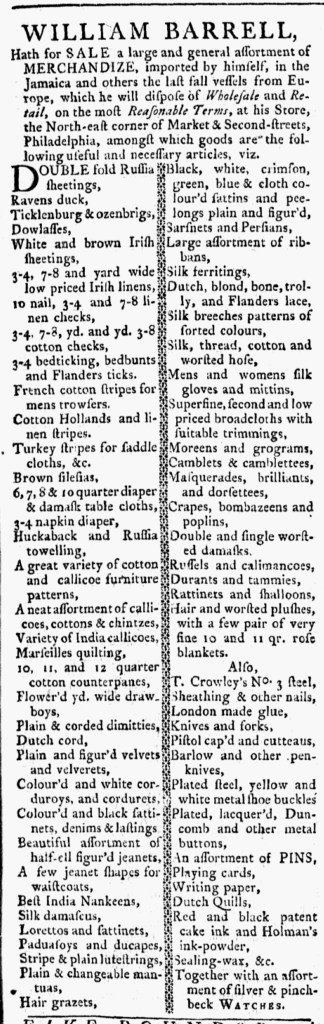
William Barrell’s advertisement in the April 15, 1775, edition of the Pennsylvania Ledger looked much like many of the advertisements that merchants and shopkeepers had been placing in American newspapers for the past couple of decades.  That was even though the Continental Association, a nonimportation agreement devised by the First Continental Congress, had been in effect since December 1, 1774.  Colonizers sought to use economic leverage to convince Parliament to repeal the Coercive Acts.

The notice filled most of the first column on the first page, making it difficult for readers to miss.  Barrell promoted a “large and general assortment of MERCHANDIZE.”  To demonstrate the choices available to consumers, he included an extensive catalog that accounted for most of the space occupied by the advertisement.  He did not opt for dense paragraphs of text, instead arranging with the compositor to divide the list of his inventory into two columns with a line comprised of printing ornaments running down the center.  One, two or three related items appeared on each line.  Barrell stocked all sorts of textiles, everything from “Ticklenburg & ozenbrigs” to “Colour’d and white corduroys, and cordurets” to Crapes, bombazeens and poplins.”  He also carried “Mens and womens silk gloves and mittins,” “Playing cards,” and “Plated, lacquer’d Duncomb and other metal buttons.”  Prospective customers had access to the same variety of goods as they did before the nonimportation agreement.

In his introduction to his list of “useful and necessary articles,” Barrell made a standard appeal to price, stating that he sold his wares “on the most Reasonable Terms.”  He also noted that he imported them via the “last fall vessels from Europe.”  The savvy merchant carefully alerted the public that he was not breaking the Continental Association by selling goods imported since December 1.  Instead, he continued to stock and sell only items that arrived in Philadelphia before the Continental Association went into effect.  In that regard, his advertisement did differ from those published at other times.  Merchants and shopkeepers often emphasized that they peddled new inventory that just arrived.  Customers could select from among the latest styles.  In this instance, however, Barrell realized that consumers would accept, even embrace, goods that had been on the shelves for a few months, especially if he emphasized that they had not been there for too long, just since the arrival of the “last fall vessels.”

March 25

What was advertised in a colonial American newspaper 250 years ago today?

Pennsylvania Ledger (March 25, 1775).

“Certificates of its success shall be speedily inserted in this and the other Papers on the continent.”

William Drewet Smith, “Chemist and Druggist,” ran an apothecary shop “At HIPPOCRATES’s Head, in Second-street” in Philadelphia in the 1770s.  He expected that prospective customers would associate Hippocrates, the ancient Greek physician known as the “Father of Medicine,” with the “general Assortment of Drugs and patent medicines, surgeons instruments, [and] shop furniture” that he sold.  Yet those were not the only items that Smith peddled.

The apothecary ran an advertisement for “Baron Van Haake’s royal letter pattent composition, for manuring land” in the March 25, 1775, edition of the Pennsylvania Ledger.  In addition to medicines for treating the body, the Smith sold this compound for nurturing soil and raising crops.  For those not familiar with its use, the chemist explained that the “valuable composition has been tried in England with the greatest success.”  In addition, “a number of gentlemen of this province are giving it a fair trial here.”  Trials demonstrated that the treatment “is not only fit for arable, meadow, and pasture land, but is also excellent for hop, turnip, tobacco grounds and vineyards” as well as “kitchen gardens and nurseries.”  In other words, any farmer, any gardener, or anybody else who raised crops or plants of any kind needed to try Varon Van Haake’s composition to see for themselves its positive impact on their endeavors.

Smith stated that he included “printed Directions for its use” free with every sale.  He also planned to insert “Certificates of its success” (or testimonials from satisfied customers) “in this and the other Papers on the continent,” suggesting that he was already in possession of such endorsements.  To further entice prospective customers, he offered a “five per cent discount” to customers who “take two hundred pounds weight at a time, or upwards.”  He also mentioned that he imported this product from England “last fall,” signaling to readers that he acquired it before the Continental Association went into effect so they could purchase it with a clear conscience.

Elsewhere in the same issue of the Pennsylvania Ledger, Smith published a lengthy advertisement for “Baron SCHOMBERG’s Grand Prophylactic LINIMENT” that supposedly prevented and cured “most venerial complaints.”  He included a statement from the “ingenious” chemist responsible for the liniment and noted that he provided printed directions “for its particular use.”  When it came to advertising Baron Van Haake’s composition for treating soil, Smith applied marketing strategies already familiar from the patent medicines that he sold.

March 3

What was advertised in a colonial American newspaper 250 years ago today?

South-Carolina and American General Gazette (March 3, 1775).

“PENNSYLVANIA LEDGER … His First Number may be seen at all the Printing Offices in Charlestown.”

When James Humphreys, Jr., launched the Pennsylvania Ledger in 1775, he sought local subscribers by placing the proposals for his “Free & Impartial WEEKLY NEWSPAPER” in other newspapers published in Philadelphia.  Given the extended title – Pennsylvania Ledger, Or, the Maryland, Pennsylvania, and New-Jersey Weekly Advertiser (in the proposals) or Pennsylvania Ledger: Or the Virginia, Maryland, Pennsylvania, and New-Jersey Weekly Advertiser (on the masthead) – it made sense to promote the newspaper to prospective subscribers and advertisers in towns in Pennsylvania and neighboring colonies.  After all, colonial newspapers served vast regions.

Yet they circulated even more widely than the expansive title of the Pennsylvania Ledger suggested.  Realizing that was the case, Humphreys sent the proposals for the Pennsylvania Ledger to R. Wells and Son, the printers of the South-Carolina and American General Gazette, in Charleston.  Dated “Philadelphia, January 2, 1775,” the proposals ran in the February 24 and March 3 editions.  By that time, Humphreys had already commenced publication of his newspaper.  A note at the end of the advertisement acknowledged that was the case: “Since the above PROPOSALS were published, the Encouragement the Printer has met with has enabled him to proceed in the Undertaking.  His First Number,” published on January 28, “may be seen at all the Printing Offices in Charlestown, where Subscriptions are received.”  Wells and Son acted as local agents for Humphreys, a common practice among eighteenth-century printers who also participated in exchange networks for sharing newspapers and reprinting content.

Another note directed to readers of the South-Carolina and American General Gazette advised, “Those Gentlemen in South-Carolina who shall be pleased to encourage [Humphreys] with their Subscriptions, may be assured that their Papers will be regularly sent them by every Opportunity.”  That the January 28 edition was available for inspection at a local printing office by February 24 testified to Humphreys’s commitment to delivering newspapers to distant subscribers in a timely manner.  While he certainly welcomed individual subscribers, the printer likely hoped that his newspaper would attract the attention of the proprietors of establishments where merchants and others gathered to do business.  Coffeehouses, for instance, often supplied newspapers from near and far for patrons to peruse news about current events and consult the shipping news for updates about commerce in the British Atlantic world.  Humphreys had a reasonable expectation that publishing proposals for the Pennsylvania Ledger would yield subscribers in South Carolina.

February 25

Who was the subject of an advertisement in a colonial American newspaper 250 years ago today?

Pennsylvania Ledger (February 25, 1775).

“A HEALTHY strong young Negro [Woman] … with her male child, one year old.”

Five issues.  It took only five issues for an advertisement offering enslaved people for sale to appear in the Pennsylvania Ledger.  James Humphreys, Jr., launched the newspaper on January 28, 1775.  Four weeks later, he printed an advertisement about a “HEALTHY strong young Negro [Woman], about twenty-four years of age,” to be sold “with her male child, one year old.”  The Pennsylvania Ledger was still such a new publication when it carried this advertisement that the proposals and conditions for subscribing appeared as the first item in the first column on the first page.  An advertisement for a political pamphlet ran immediately below the proposals, followed by the advertisement for the enslaved young woman and her child.  Readers encountered them before news reprinted from the Maryland Gazette or any of the other content in that issue.

Humphreys did not merely print and disseminate the advertisement.  He also acted as a broker in the sale.  The notice instructed interested parties to “apply to the Printer.”  What role Humphreys would play when someone did “apply” to him was not apparent in the advertisement.  He may have referred prospective buyers to the advertiser, he may have provided more details about the sale, including price and credit, or he may have been empowered to agree to a sale should a buyer meet the terms specified by the enslaver who offered the woman and child for sale.  Whatever role he played, Humphreys was actively involved in the sale beyond printing the advertisement in his newspaper.

He may have even consulted with the advertiser in composing the advertisement, though it was formulaic enough that an enslaver looking to sell human property likely did not need such assistance.  After all, such “enquire of the printer” advertisements appeared regularly in newspapers published during the era of the American Revolution.  The anonymous advertiser noted that the enslaved woman “has had the small-pox and measles,” a guarantee of her health in the future since she would not contract those diseases again, and “can be well recommended fort her honesty and sobriety.”  In addition, she was a “plain cook.”  Such language was just as common in advertisements for enslaved people as directions to “apply to the Printer” who would act as a broker in the sale.

For more on such advertisements, see Jordan Taylor’s “Enquire of the Printer: The Slave Trade and Early American Newspaper Advertising.”

February 18

What was advertised in a colonial American newspaper 250 years ago today?

Pennsylvania Ledger (February 18, 1775).

“The Fountain and Three Tuns, … [an] old accustomed and commodious tavern.”

When William Dibley, an experienced tavernkeeper, became the proprietor of the Fountain and Three Tuns in Philadelphia in February 1775, he placed an advertisement in the Pennsylvania Ledger to promote some of the amenities available at his new location.  He hoped that a variety of conveniences would encourage prospective patrons to visit the Fountain and Three Tuns.

Dibley made some of the most common appeals that appeared in advertisements for inns and taverns during the era of the American Revolution.  He highlighted the hospitality that he offered to guests, pledging that they would receive “the most civil treatment.”  He served “the best of liquors and provisions” in a “commodious tavern” that he had “considerably improved” or renovated for the comfort of his patrons.

Those improvements included updating the stables to accommodate sixty horses.  Travelers who visited Philadelphia could expect to find space for their horses in Dibley’s stables while they enjoyed their time at the Fountain and Three Tuns.  Those stables had easy access to the streets of Philadelphia via a “convenient passage either from Market or Chesnut streets.”  For affluent patrons, the tavernkeeper also had a “house for carriages.”

The tavernkeeper provided other services to entice merchants and others to visit the Fountain and Three Tuns, including messengers dispatched to other towns every Wednesday.  One “goes through Newark [in Delaware] to Nottingham [in Maryland],” carrying “packages and orders” to colonies to the south.  The other headed to the west, going “through Goshen to Strasburg, in Lancaster County.”  In addition, the “Virginia and Baltimore posts also call at the said inn every week.”  Dibley positioned the Fountain and Three Tuns at the center of networks for conducting commerce.

Dibley certainly hoped that his reputation would attract former customers and “his Friends in particular” who knew him from the Cross Keys on Chestnut Street.  His advertisement advised them that they could expect the same level of service at his new location.  Yet the tavernkeeper did not merely wish to transfer his current clientele from one establishment to another.  His extensive advertisement notified both locals and travelers of the many reasons they should choose the Fountain and Three Tuns over other inns and taverns in Philadelphia.

February 11

What was advertised in a colonial American newspaper 250 years ago today?

Supplement to the Pennsylvania Ledger (February 11, 1775).

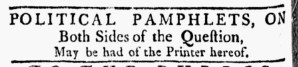
“POLITICAL PAMPHLETS … on Both Sides of the Question.”

As the imperial crisis intensified in late 1774 and early 1775, most American newspapers became increasingly partisan, even those that claimed that they did not take a side in the contest between Patriots and Parliament.  Printers sometimes ran advertisements for pamphlets that did not align with the principles most often espoused in their publications, but few made a point of declaring that they did so.  James Rivington, printer of Rivington’s New-York Gazetteer and a noted Loyalist, took the most strident approach in a series of advertisements for “POLITICAL PUBLICATIONSwritten on the Whig and the Tory Side of the Question.”  Sporting headlines like “The American Contest” and “The American Controversy,” those advertisements listed several pamphlets, many of them written in response to others also advertised.

Yet Rivington was not alone.  In the supplement that accompanied the third issue of the new Pennsylvania Ledger, James Humphreys, Jr., the printer, inserted a short notice that announced, “Most of the POLITICAL PAMPHLETS That have been published, on Both Sides of the Question, May be had of the Printer hereof.”  On the first page, he once again ran the proposals for the newspaper, stating that he established a “Free and Impartial News Paper, open to All, and Influenced by None.”  Despite that assertion, “[i]t was supposed that Humhreys’s paper would be in the British interest,” according to Isaiah Thomas in his History of Printing in America (1810).[1]  He further explained that “in times more tranquil than those in which it appeared, [Humphreys] might have succeeded in his plan” to “conduct his paper with political impartiality.”[2]

When it came to marketing strategies for political pamphlets, printers associated with supporting the Tory “Side” took the more evenhanded approach of drawing attention to their commitment to selling and disseminating work on “Both Sides of the Question.”  In Rivington’s case, doing so was a matter of generating revenue as much as operating an impartial press and bookstore.  For Humphreys, on the other hand, doing so seemed to fall in line with the commitment he made in his proposals for the Pennsylvania Ledger.  Even taking those motivations into account, both printers may have considered it necessary to profess that they sold pamphlets on “Both Sides” to justify how many titles they sold that argued from the Tory perspective.

**********

[1] Isaiah Thomas, The History of Printing in America: With a Biography of Printers and an Account of Newspapers (1810; New York: Weathervane Books, 1970), 399.

[2] Thomas, History of Printing, 439.

February 4

What was advertised in a colonial American newspaper 250 years ago today?

Pennsylvania Ledger (February 4, 1775).

“Numbers have promised they would subscribe that have not sent in their names.”

The second issue of the Pennsylvania Ledger began with the same notice from the printer, James Humphreys, Jr., that appeared as the first item in the first column on the first page of the inaugural issue a week earlier.  He apparently considered it worth running again, especially since the new publication had not yet achieved as wide a circulation as he hoped.  Humphreys’s message to “his kind and benevolent fellow Citizens” thus bore repeating to reach as many readers (and prospective subscribers) as possible as copies of Philadelphia’s newest newspaper found their way into coffeehouses and taverns or passed from hand to hand.

In that address, the printer “repeat[ed] the assurances he has already given” in proposals for the newspaper “that it shall be conducted with the utmost Freedom and Impartiality; and that no Pieces shall be refused a place in the Pennsylvania Ledger, that are written with decency, and void of all reflections upon particular persons, or religious societies.”  Printers often asserted that their publications would represent multiple perspectives when they addressed the public in the decade before the Revolutionary War, though many did not follow through on that promise.  Some privileged their own political views while others responded to what they perceived to be the overwhelming sense (or the most vocal voices) in the communities where they operated their printing presses.  In his subscription proposals, Humphreys promoted a “FREE and IMPARTIAL” newspaper.  In his monumental History of Printing in America (1810), Isaiah Thomas acknowledged that Humphreys purported to publish an impartial newspaper, yet “[i]t was supposed that Humphrey’s paper would be in the British interest” and the Pennsylvania Evening Post, founded by Benjamin Towne at the same time, “took the opposite ground.”[1]  In his address, Humphreys proclaimed that he considered “Liberty of the Press … one of the most valuable blessings of the government under which he lives,” though his ideas about what constituted “Liberty of the Press” may have differed from that of other colonizers.  As the imperial crisis intensified, more and more newspapers became associated with either Patriots or Loyalists.

Still, Humphreys wanted to make a go of it with the Pennsylvania Ledger.  In that second issue, he inserted the proposals immediately below his address to the public, filling the remainder of the column.  He explained in even more detail that “the general Design of this News Paper is both to amuse and instruct” so “every Article of News, and all other Matters of Importance will be faithfully inserted.”  In billing his newspaper as “Free and Impartial,” Humphreys may have intended to make a point that readers should expect to encounter pieces representing a variety of views, but, as Thomas suggested, many were suspicious of Humphreys’s intentions when it came to disseminating content from the Tory perspective.  That could have contributed to a note that the printer added to the proposals.  He claimed that he received enough “encouragement … to proceed in the Undertaking,” but “numbers have promised they would subscribe that have not sent in their names.”  As they learned more about the positions the Pennsylvania Ledger would likely take, some prospective subscribers apparently decided they did not wish to support the newspaper.

**********

[1] Isaiah Thomas, The History of Printing in America: With a Biography of Printers and an Account of Newspapers (1810; New York: Weathervane Books, 1970), 399.

January 28

What was advertised in a colonial American newspaper 250 years ago today?

Pennsylvania Ledger (January 28, 1775).

POULSON’s AMERICAN INK-POWDER.”

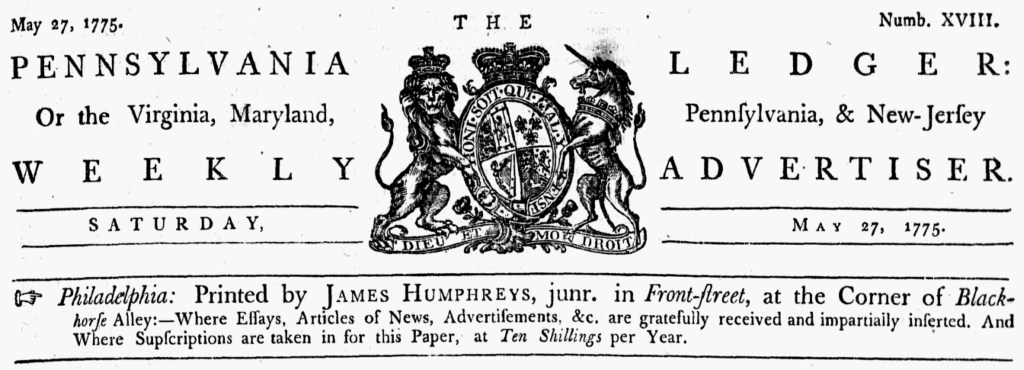
Just four days after Benjamin Towne launched the Pennsylvania Evening Post, James Humphreys, Jr., commenced publication of the Pennsylvania Ledger on January 28, 1775.  In less than a week, the number of English-language newspapers printed in Philadelphia increased from three to five, rivaling the number that came off the presses in Boston.  No other city in the colonies had as many newspapers.  Humphreys incorporated the colophon into the masthead, advising that he ran his printing office “in Front-street, at the Corner of Black-horse Alley:– Where Essays, Articles of News, Advertisements, &c. are gratefully received and impartially inserted.”

Unlike the first issue of the Pennsylvania Evening Post, the inaugural edition of the Pennsylvania Ledger carried advertisements.  Humphreys placed some of them, one hawking “POLITICAL PAMPHLETS … on Both Sides of the Question,” another promoting an assortment of books he sold, and a final one seeking “an APPRENTICE to the Printing Business.”  Nine other advertisers placed notices, all of them for consumer goods and services.  They took a chance that the new newspaper had sufficient circulation to merit their investment in advertising in its pages.

Among those advertisers, Zachariah Poulson marketed “POULSON’s AMERICAN INK-POWDER.”  He asserted that “most of the Printers, Bookseller, and Stationers, in Philadelphia” stocked that product.  Customers just needed to request it.  With the deteriorating political situation in mind, especially the boycott of imported goods outlined in the Continental Association, Poulson called on “all Lovers of American Manufacture” in Pennsylvania and “in the neighbouring provinces and colonies” to choose his ink powder over any other.

Detail from Edward Pole’s Advertisement in the Pennsylvania Ledger (January 28, 1775).

Edward Pole inserted the lengthiest advertisement (except for Humphreys’s notice cataloging the books he sold).  It filled half a column, the first portion devoted to the merchandise available “at his GROCERY STORE, in Market-street” and the rest to “FISHING TACKLE of all sorts,” “FISHING RODS of various sorts and sizes,” and other fishing equipment.  In advertisements in several newspapers published in Philadelphia (and, later, with ornate trade cards that he distributed), Pole regularly marketed himself as a sporting goods retailer.  For the first issue of the Pennsylvania Ledger, he adorned his advertisement with a woodcut depicting a fish that previously appeared in his notices in Dunlap’s Pennsylvania Packet in May and June 1774.

Humphreys provided residents of Philadelphia and other towns greater access to news and editorials with the Pennsylvania Ledger, but that was not all.  The publication of yet another newspaper in Philadelphia increased the circulation of advertising in the city and region, disseminating messages to consumers far and wide.  Not long after Humphreys published that first issue, advertisers took to the pages of the Pennsylvania Ledger to publish notices for a variety of purposes, supplementing the information the editor selected for inclusion.

January 25

What was advertised in a colonial American newspaper 250 years ago today?

Pennsylvania Ledger (January 25, 1775).

“PROPOSALS For Printing by Subscription, a FREE and IMPARTIAL WEEKLY NEWS-PAPER.”

As the imperial crisis intensified, the number of newspapers published in Philadelphia, the largest city in the colonies, grew significantly.  Throughout the early 1770s, readers had access to Dunlap’s Pennsylvania Packet, the Pennsylvania Gazette, and the Pennsylvania Journal.  Until February 1774, the Pennsylvania Chronicle had also circulated in Philadelphia.  Less than a year after that newspaper folded, Benjamin Towne commenced publication of the Pennsylvania Evening Post, the first tri-weekly newspaper attempted in that city, on January 24, 1775, and James Humphrey, Jr., distributed the first issue of the Pennsylvania Ledger four days later.  Enoch Story and Daniel Humphreys also advertised plans for another newspaper, the Pennsylvania Mercury.  They published their inaugural issue in April 1775, two weeks before the battles at Lexington and Concord.

On January 25, the Pennsylvania Journal carried the proposals for both the Pennsylvania Ledger and the Pennsylvania Mercury, placing them side by side on the final page.  As was customary, the printers gave an overview of why they wished to publish their newspapers, explained what subscribers could expect among the contents, and listed the conditions for subscribing.  Among the various purposes the Pennsylvania Mercury would serve, Story and Humphreys included, “To communicate advertisements of every kind.”  The printers of both proposed newspapers sought advertisements, an essential revenue stream for any printer publishing a newspaper.  After noting the prices for subscriptions to the Pennsylvania Ledger, Humphreys indicated, “Advertisements to be inserted on the same terms as is usual with the other papers in this city.”  For the Pennsylvania Mercury, Story and Humphreys declared, “The Rates of the Paper and Advertisements will be the same with those now printed in this City.”  Dunlap’s Pennsylvania Packet and the Pennsylvania Journal both gave the price for subscriptions – “Ten Shillings per Annum” – in their colophons, but none of the newspapers then printed in Philadelphia regularly published what they charged for advertising.  Apparently, according to the proposals for the Pennsylvania Ledger and the Pennsylvania Mercury, none offered better deals than others.

Story and Humphreys did give a bit more attention to advertising in their proposals.  “All Advertisements,” they promised, “shall be inserted in order as they come in, and shall appear in a fair and conspicuous manner.”  They did not mean that paid notices would literally appear one after the other in the order received at the printing office but rather that a compositor would set type in that order and integrate them into the layout of the newspaper without privileging any later arrivals over those submitted sooner.  After all, newspaper printers sometimes inserted notes that advertisements had been omitted due to lack of space.  Story and Humphreys signaled that they would not take anything into consideration beyond the order that advertisers delivered their notices when delaying publication of some.  They also acknowledged that compositors arranged content to make pieces of different lengths complete columns and fill pages.  During that process, they would not privilege any advertisements over others, displaying each “in a fair and conspicuous manner.”  With such appeals, Story and Humphreys solicited the trust of prospective advertisers who wanted a good return on the money they invested in disseminating information in the Pennsylvania Mercury.

Neither of these proposals for new newspapers discussed advertising extensively, but each did seek advertisers along with subscribers.  Whatever goals they expressed for circulating news as the political situation deteriorated, the viability of pursuing their ideals of publishing “improving, instructive and entertaining” information depended in large part on recruiting advertisers as well as enlisting subscribers.