July 14

What was advertised in a colonial American newspaper 250 years ago today?
Rivington’s New-York Gazetteer (July 14, 1774).

“At this critical and alarming juncture … set up the business of REED-MAKING.”

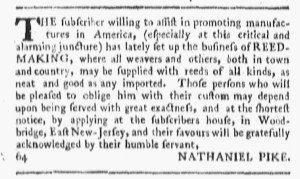
Nathaniel Pike testified that he wished to do his part to support the American cause in an advertisement in the July 14, 1774, edition of Rivington’s New-York Gazetteer.  He informed the public that he was “willing to assist in promoting manufacturers in America, (especially at this critical and alarming juncture)” and, accordingly, “lately set up the business of REED-MAKING.”  Eighteenth-century readers familiar with weaving knew that reeds were the “part of a loom consisting of a set of evenly spaced wires known as dents (originally slender pieces of reed or cane) fastened between two parallel horizontal bars used for separating, or determining the spacing between, the warp threads, and for beating the weft into place.”[1]  Pike pledged that “weavers and others, both in town and country, may be supplied with reeds of all kinds, as neat and good as any imported.”

Although Pike did not name the Boston Port Act or any of the other Coercive Acts passed by Parliament in retaliation for the Boston Tea Party, readers certainly understood the context for his reference to “this critical and alarming juncture.”  From New England to Georgia, colonizers discussed how to respond, many of them advocating for a new round of nonimportation agreements like the ones enacted in response to the Stamp Act and the duties imposed on certain goods in the Townshend Acts.  That meant that “domestic manufactures” or goods produced in the colonies would become important alternatives to imported goods.  Pike offered his own product made in the colonies, those reeds that matched imported ones in quality, yet his enterprise also facilitated greater production of textiles in the colonies.  Every stage of producing cloth took on greater significance in the face of boycotting fabrics imported from England, from farmers raising sheep for their wool to women participating in spinning bees that put their patriotism on display to consumers choosing and wearing homespun cloth out of allegiance to their political principles.  By supplying weavers with reeds for their looms, Pike served a vital role in protests against the abuses perpetrated by Parliament.  He expected that current events would help in marketing his product.

**********

[1] Oxford English Dictionary, II.11.a.

July 13

What was advertised in a colonial American newspaper 250 years ago today?

Pennsylvania Journal (July 13, 1774).

“OBSERVATIONS on the ACT of PARLIAMENT commonly called the BOSTON PORT-BILL … BY JOSIAH QUINCY, junior.”

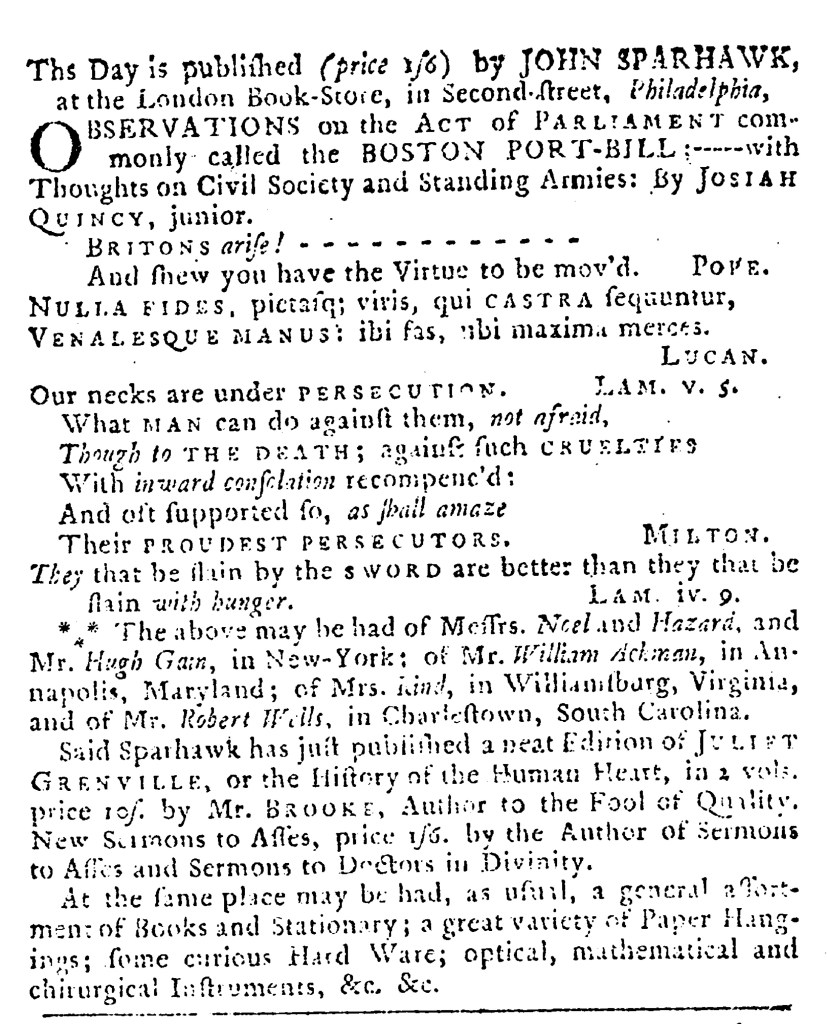
In the spring of 1774, Josiah Quincy, Junior, of Boston, a prominent lawyer and noted patriot, penned Observations on the Act of Parliament Commonly Called the Boston Port-Bill: With Thoughts on Civil Society and Standing Armies.  In it, Quincy encouraged colonizers to unite in opposition to abuses perpetrated by Parliament, continuing work he had undertaken in 1773 when he visited South Carolina to strengthen ties among patriots in northern and southern colonies.  He had also published political essays in the Boston-Gazette, known for its support of the patriot cause, for several years. According to Daniel R. Coquillette and Neil Longley York, the editors of his major political and legal papers, the pamphlet “was the culmination of his thinking and writing about the problem of balancing imperial authority and colonial liberty.”

Benjamin Edes and John Gill printed the tract and advertised it in their newspaper, the Boston-Gazette, a publication known for advocating the patriot cause.  Soon, advertisements appeared widely in other newspapers published in Boston as well as newspapers in other towns in New England.  In general, they were brief announcements that merely named the title and author; Quincy’s reputation as writer, orator, and political philosopher was so well established that printers and booksellers did not consider it necessary to elaborate on what he had written to convince colonizers to purchase copies of the Observations.  Quincy’s pamphlet experienced even greater dissemination when John Sparhawk, a bookseller in Philadelphia, published an edition there and advertised it in the Pennsylvania Journal.  In addition to stocking it at his “London Book-Store,” Sparhawk advised readers that they could acquire copies from local agents, most of them printers and booksellers, in New York, Annapolis, Williamsburg, and Charleston.  That distribution network certainly made Quincy’s Observations more accessible to colonizers beyond New England, helping to explain how his “attempt to define and defend American rights” became, as Coquillette and York assert, “an essential part of the debate over rights in the empire.”

July 5

What was advertised in a colonial American newspaper 250 years ago today?

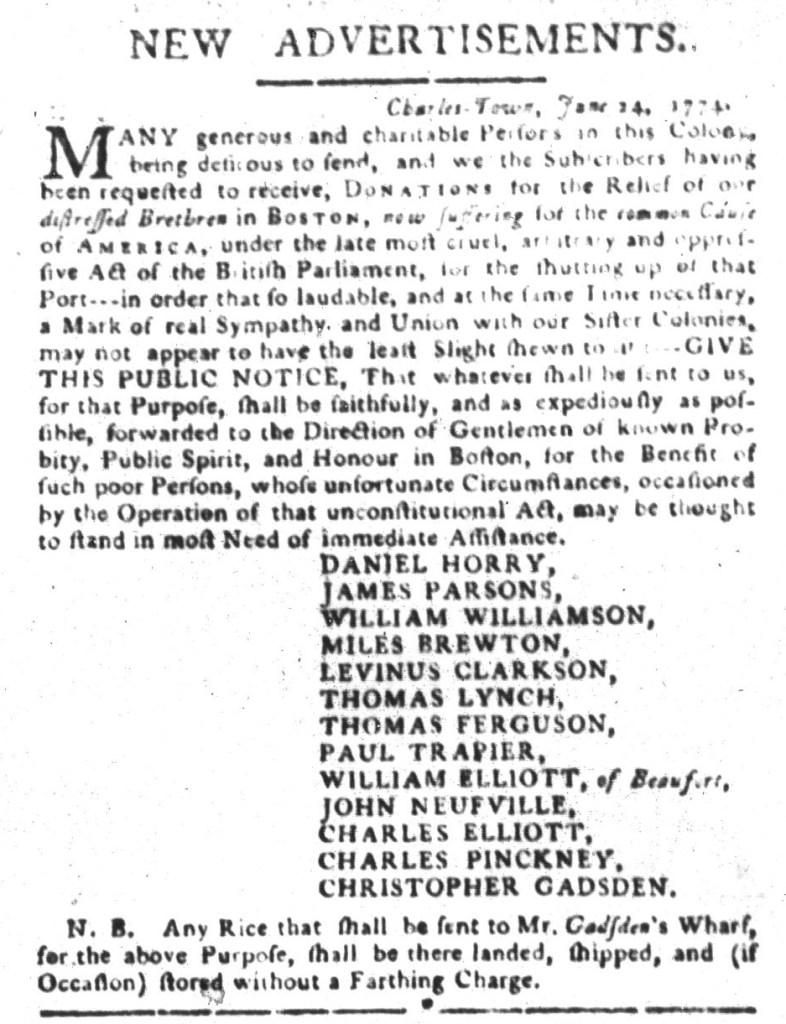
South-Carolina Gazette and Country Journal (July 5, 1774).

“DONATIONS for the Relief of our distressed Brethren in BOSTON, now suffering for the common Cause of AMERICA.”

Parliament intended to punish Boston when it closed and blockaded the harbor, effective June 1, 1774, as punishment for the destruction of the tea the previous December, yet colonizers from New England to Georgia protested what some described as “that unconstitutional Act.”  The Boston Port Act halted trade in what had been a bustling port city.  In early July, a dozen prominent residents of Charleston and other towns in South Carolina published an advertisement that outlined their plans to send aid to Massachusetts.  They described how “MANY generous and charitable Persons in this Colony” were “desirous to send … DONATIONS for the Relief of our distressed Brethren in BOSTON, now suffering for the common Cause of AMERICA.”  Parliament had miscalculated if it believed that other colonies would not react to the Boston Port Act and the other Coercive Acts.  As many colonizers mobilized to protest, contemplating measures that included nonimportation agreements, some directed their attention to assisting the people of Boston whose patriotic spirit put them in the position of enduring Parliament’s retribution.  Bostonians had acted in the interests of all colonizers, so they had earned the support of colonizers near and far.

The committee that collected donations in Charleston described the Boston Port Act as the “most cruel, arbitrary and oppressive Act of the British Parliament.”  As they explained in their advertisement, it prompted them to organize a “laudable” and “necessary” plan to collect donations “for the Benefit of such poor Persons, whose unfortunate Circumstances, occasioned by the Operation of that unconstitutional Act, may be through to stand in most Need of immediate Assistance.”  The committee encouraged other to participate in this endeavor as “a Mark of real Sympathy and Union with our Sister colonies.”  They made that appeal at the same time that John Holt incorporated a “JOIN OR DIE” emblem into the masthead of the New-York Journal, another testament to belief in the “common cause of AMERICA.”  The committee pledged to “faithfully, and as expediously as possible” send donations to “Gentlemen of known Probity, Public Spirit, and Honour in Boston” to distribute as they deemed appropriate.  One member of the committee, Christopher Gadsden, even offered to store and ship rice donated in support of the people of Boston, likely hoping that gesture would inspire others to similar generosity.

News coverage of reactions to the Boston Port Act appeared elsewhere in the July 5 edition of the South-Carolina Gazette ad Country Journal, though the appeal from the committee ran among “NEW ADVERTISEMENTS.”  Throughout the imperial crisis, advertisements often relayed news and opinion that supplemented articles and editorials.  In this instance, the committee collecting aid for Boston made a forceful argument about politics and attempted to shape public opinion concerning current events.  Their advertisement bolstered commentary that readers encountered throughout the newspaper, not solely in the portion for “freshest Advices, both Foreign and Domestic” selected by the printer.

June 16

What was advertised in a colonial American newspaper 250 years ago today?

Massachusetts Spy (June 16, 1774).

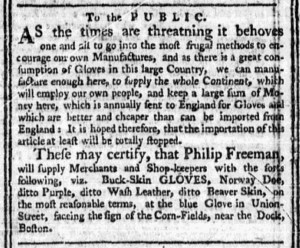
“It is hoped therefore, that the importation of this article at least will be totally stopped.”

Current events informed Philip Freeman’s marketing strategy as he attempted to sell gloves in the summer of 1774.  As colonizers from New England to Georgia discussed how to respond to Parliament closing Boston Harbor and other legislation passed following the Boston Tea Party, many proposed a new round of nonimportation agreements.  American merchants previously participated in boycotts to protest the Stamp Act and duties on several commodities imposed in the Townshend Acts, believing that disruptions to commerce served as an effective political tool.  Parliament relented, repealing the Stamp Act and duties on glass, lead, paint, and paper (but doubled down on tea with a new Tea Act in 1773).  A variety of other factors, including petitions and popular protests, played a role, so nonimportation agreements may not have had as much of an influence as intended.  Still, colonizers believed that boycotting goods imported from Britain effectively achieved their political goals.

Freeman believed that was the case and encouraged prospective customers of its veracity.  “As times are threatning,” he declared, “it behoves one and all to go into the most frugal methods to encourage our own Manufactures.”  He recognized “a great consumption of Gloves in this large Country,” yet proposed that “we can manufacture enough here, to supply the whole Continent.”  Such industry would have multiple benefits: it “will employ our own people, and keep a large sum of Money here, which is annually sent to England for Gloves.”  Furthermore, Freeman asserted that the gloves he made “are better and cheaper than can be imported from England.”  Not willing to wait for any sort of official nonimportation agreement enacted in Boston or throughout the colony or in cooperation with other colonies, Freeman implored that “the importation of this article at least will be totally stopped.”  In common cause, Freeman and his competitors in the colonies could meet demand without having to resort to imported gloves.  He did not direct his advertisement to consumers but rather the “Merchants and Shop-keepers” that he could supply with several different kinds of gloves “on the most reasonable terms.”  Working in concert, Freeman envisioned that glovemakers, retailers, and consumers could participate in politics via the decisions they made about production, consumption, and importing goods, starting immediately and informally with gloves and perhaps extending to other items through formal agreements as colonizers continued to organize in opposition to the Boston Port Act.

June 13

What was advertised in a colonial American newspaper 250 years ago today?

Supplement to the Newport Mercury (June 13, 1774).

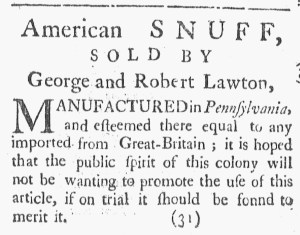
“American SNUFF … MANUFACTURED in Pennsylvania.”

George Lawton and Robert Lawton advertised “American SNUFF” in the Newport Mercury as colonizers from New England to Georgia discussed how to respond to the Boston Port Act, legislation that closed the harbor as punishment for the destruction of tea in December 1773.  Simultaneously, newspapers covered other abuses perpetrated by Parliament.  The June 13, 1774, edition of the Newport Mercury, for instance, featured “A BILL for better regulating the Government of the Province of the Massachusetts-Bay, in North-America” and “A BILL for the impartial Administration of Justice in the Cases of Persons questioned for any Acts, done by them in the Execution of the law, or for the Suppression of Riots & Tumults in the Province of the Massachusetts-Bay, in New-England.”  Although neither had yet been passed when the ship that carried them departed from Bristol more than five weeks earlier, the printer, Solomon Southwick, noted “there is no doubt of their having passed before this time.”  In colorful commentary, he added that “the — [devil] himself can suggest nothing too horrid to be expected from the present administration.”  Another note followed the second bill: “God save the PEOPLE from such Laws!

It was in that context that the Lawtons marketed “American SNUFF … MANUFACTURED in Pennsylvania” as an alternative to snuff imported from Great Britain.  They asserted that consumers in Pennsylvania “esteemed” this snuff “equal to any imported,” so customers did not have to sacrifice quality in their support of “domestic manufacturers,” goods produced in the colonies.  The Lawtons presented trying this snuff as the patriotic duty of consumers who had concerns about current events.  “[I]t is hoped,” they implored, “that the public spirit of this colony will not be wanting to promote the use of this article, if on trial it should be fo[u]nd to merit it.”  In other words, the Lawtons encouraged prospective customers to try the snuff, taking into account the endorsements from colonizers in Pennsylvania, and see for themselves if they liked it as much as imported snuff.  If they did, their subsequent purchases could serve two purposes: acquiring a product they enjoyed while putting political principles into practice.  In many places, colonizers already discussed another round of nonimportation agreements, drawing on a strategy deployed in response to the Stamp Act and the Townshend Acts.  Immediately above the Lawtons’ advertisement, the resolutions from “a town meeting held at Providence” called for “an universal stoppage of all trade with Great-Britain, Ireland, Africa, and the West-Indies” until Parliament opened Boston Harbor once again.  Colonizers sought to use commerce for political leverage.  Similarly, decisions about which products to consume had political implications.  Even with no boycott currently in place, the Lawtons encouraged consumers to think about how they could support the colonies in their contest against Parliament.

May 21

What was advertised in a colonial American newspaper 250 years ago today?

Providence Gazette (May 21, 1774).

ENGLISH LIBERTIES, Or, The free-born Subject’s Inheritance.”

Like the issue of the Connecticut Journal and New-Haven Post-Boy published the previous day, the May 21, 1774, edition of the Providence Gazette devoted much less space to advertising than in most issues.  News items, especially those concerning the Boston Port Act, accounted for almost all the content, leaving room for six brief advertisements in the final column on the third page and two in the bottom right corner on the last page.  The “Substance of the DEBATES on the BOSTON PORT-BILL” filled the entire front page and spilled over onto the next.  Other news from London, followed by updates from Philadelphia and Boston followed.  Updates from Boston continued on the third page, eventually giving way to coverage of a “Town-Meeting held a Providence, on the 17th Day of May.”  A speech delivered in Parliament in opposition to the Boston Port Act and calling for the “immediate REPEAL OF THE TEA DUTY” comprised most of the final page.  John Carter, the printer, included a brief note about the paucity of advertising in that issue: “To make Room for the interesting Advices in this Day’s Gazette, we are obliged to omit several Advertisements.”

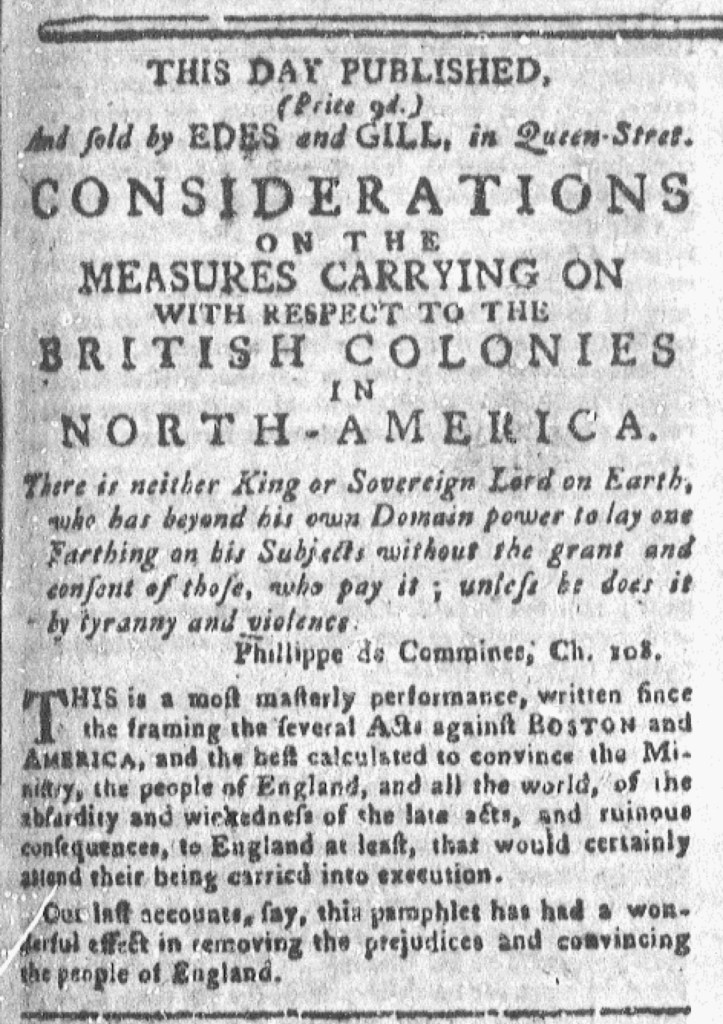
Carter did not choose to omit his own advertisement about publishing “ENGLISH LIBERTIES, Or, The free-born Subject’s Inheritance” by subscription.  For a year and a half, the printer had circulated subscription papers, advertised in the Providence Gazette and other newspapers published in New England, and encouraged colonizers to reserve copies of a book that became even more timely as the imperial crisis intensified.  The Boston Port Act served as an advertisement for the volume, as did the speech warning against its passage and other news that Carter included in the May 21 edition of the Providence Gazette.  Coverage of the recent town meeting in Providence included resolutions that the residents “will heartily join with the Province of the Massachusetts Bay, and the other Colonies, in such Measures as shall be generally agreed on by the Colonies, for the protecting and securing their invaluable Natural Rights and Privileges.”  Furthermore, the resolutions called on the “Committee of Correspondence of this Town … to assure the Town of Boston, that we consider ourselves greatly interested in the present alarming Conduct of the British Parliament towards them.”  They went on to recommend a “Stoppage of all Trade” until the repeal of the Boston Port Act, using commerce as political leverage.

Carter’s advertisement for English Liberties did not merely appear in proximity to all this news.  He very intentionally gave it a privileged position.  It appeared on the final page, immediately after the speech against the Boston Port Act, the news item seamlessly leading into the advertisement for a book that provided justification for colonizers demanding their rights.  Yet its placement on the page had even more significance considering the methods for producing eighteenth-century newspapers.  Like other newspapers, the Providence Gazette consisted of four pages created by printing two pages on each side of a broadsheet and folding it in half.  That meant that printers typically set the type and printed the first and last pages before the second and third pages.  That Carter’s advertisement for English Liberties ran in the bottom right corner of the fourth page indicates that he gave it priority over all other advertisements.  Considering the other news flowing into his printing office, he did not know how much space he might have for advertisements on the second and third pages, so he made sure that his advertisement appeared on the first side of the broadsheet that went to press.  It turned out that he had room for half a column of advertising on the third page, but Carter did not wait to find out whether that would be the case.  Like many other printers, he simultaneously used current events to sell books and pamphlets about political philosophy and he published those items to influence current events.

March 20

What was advertised in a colonial American newspaper 250 years ago this week?

New-York Journal (March 17, 1774).

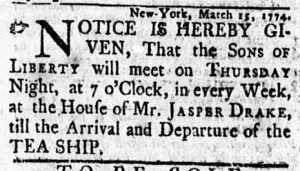
“The SONS OF LIBERTY will meet on THURSDAY Night … till the Arrival and Departure of the TEA SHIP.”

It was a call to action.  An advertisement in the March 17, 1774, edition of the New-York Journal proclaimed, “NOTICE IS HEREBY GIVEN, That the SONS OF LIBERTY will meet on THURSDAY Night, at 7 o’Clock, in every Week, at the House of Mr. JASPER DRAKE, till the Arrival and Departure of the TEA SHIP.”  That advertisement ran in the column next to an anonymous address “TO THE PUBLICK” that anticipated “the TEA-SHIP, which has been long expected, is near at hand.”  The address asserted, “Our sister colonies have gloriously defended the common cause of this country,” referring to the destruction of several shipments of tea in Boston the previous December and colonizers in Philadelphia had managed to prevent the Polly from landing its tea there.  In turn, the address called on colonizers in New York “to stand our ground, and as the day of tryal is now come, that we shall convince the whole American world that we are not slack and indolent, nor in the least degree unworthy, of being registered as a genuine sister province.”  It was a call to match the resolve and resistance already demonstrated in Boston and Philadelphia.

The “TEA SHIP” in these advertisements referred to the Nancy.  As James R. Fichter explains in Tea: Consumption, Politics, and Revolution, 1773-1776, the consignees of the tea aboard the Nancy “hoped to land and store this tea (but not sell it), which was initially acceptable to local Patriots.”[1]  But that was in November.  On December 1, 1773, even before the Boston Tea Party, the consignees “gave up their role in the tea and asked Governor Tryon to take over.”  The governor initially intended to land and store the tea, emboldened by support from British troops, but reconsidered that plan when Patriots in New York decided they could no longer endorse that plan and, especially, after the colony received word about the destruction of the tea in Boston.  That news encouraged Patriots in their position while convincing Tryon that “‘the Peace of Society’ and ‘good Order,’ trumped landing the tea, and the best he could hope for was an outcome like at Philadelphia (where the ship was turned around).”  The governor engineered a plan for the Nancy to land at Sandy Hook, outside New York City’s customs area, where it could be resupplied to return to Boston while evading any legal obligation to unload its cargo.  Yes, as Fichter notes, the governor “could not formally condone smuggling around His Majesty’s customs, even if it would maintain order.  So Tryon made no official announcement.”  Instead, he made sure that Patriots overheard conversations about this plan when they gathered at one of the coffeehouses in the city.

In the meantime, the Nancy continued making its way across the Atlantic, sheltering in Antiqua in February 1774 following a storm.  The ship made then its way to British mainland North America, arriving at Sandy Hook on April 18, a month after the Sons of Liberty advertised their weekly meetings at Drake’s house.  Conveniently, the governor was away from the city at the time.  Local Patriots observed the Nancy receiving supplies for its return to London, intervening only to prevent sailors who did not wish to continue on a ship further damaged in another storm from coming ashore.  The Nancy needed a crew to return to London without lingering in the waters near New York or inciting any sort of disorder that the carefully orchestrated plan had avoided so far.  As the Son of Liberty’s advertisement in the New-York Journal demonstrates, tea remained a flashpoint for resistance after the Boston Tea Party.  They achieved their goal of the “Arrival and Departure of the TEA SHIP.”

**********

[1] For quotations and a more extensive overview of the Nancy, see James R. Fichter, Tea: Consumption, Politics, and Revolution, 1773-1776 (Ithaca: Cornell University Press, 2023), 88-93.

February 20

What was advertised in a colonial American newspaper 250 years ago this week?

Massachusetts Spy (February 17, 1774).

“Pointing out the names of several persons concerned in destroying the Tea.”

Two months after what has become known as the Boston Tea Party, tea continued to occupy the minds of colonizers in that port city and beyond.  In the February 17, 1774, edition of the Massachusetts Spy, Joseph P. Palmer once again ran his advertisement for “GRANADA RUM” with a nota bene that emphatically proclaimed, “NO TEA.”  Immediately above it, Jeremiah Cronin placed a notice in which he attempted to disassociate himself from any sort of political position concerning the recent dumping of tea into the harbor, hoping to reduce unwanted and, he claimed, unwarranted attention.

Cronin reported that on a morning early in February he discovered that “an Advertisement appeared posted up at the North-End of this town, signifying that I the subscriber, have been active in taking minutes, and pointing out the names of several persons concerned in destroying the Tea, and tarring and feathering.”  He likely feared the ire of patriots who believed that he undermined their cause and planned to inform on them to the authorities.  Yet, Cronin declared, he had no such intentions!  “I hereby beg leave to inform the Public,” he pleaded, “that so far from being active and busy on any such occasions, I have neither directly or indirectly concerned myself with public affairs.”  Instead, he promised, “I have always kept myself within doors when any disturbance happened in the town.”  Just as he did not want patriots looking too closely at him, Cronin aimed to avoid trouble with the authorities and the loyalists who supported them.  He ran his advertisement to declare his neutrality.  To buttress his effort to convince the public that was the case, he appended a declaration by a justice of the peace, Joseph Gardner, who affirmed that Cronin “made solemn oath to the whole of the above declaration.”

Massachusetts Spy (February 17, 1774).

The politics of tea also received attention in the upper left corner of the page that carried Cronin’s notice and Palmer’s advertisement.  The “POETS CORNER” for that issue featured “A Lady’s Adieu to her TEA-TABLE.”  Perhaps written by a woman, perhaps not, the poem said “FArewel [to] the tea board and its equipage” and the “many a joyous moment” of “Hearing the girls tattle” and “the old maids talk scandal” while drinking “hyson, congo, and best double fine” tea.  “No more shall I dish out the once lov’d liquor,” the lady asserted, considering tea “now detestable.”  Consuming tea was no longer a diversion or a treat, but instead a vice: “Its use will fasten slavish chains upon my country, / And Liberty’s the goddess I would choose / To reign triumphant in AMERICA.”  The lady’s “Adieu to her TEA-TABLE” suggested, even more forcefully than Palmer’s proclamation of “NO TEA,” that Cronin might not much longer have the luxury of taking a neutral position in “public affairs.”  When it came down to tea or liberty, when decisions about consumption had political meaning, when neighbors and acquaintances observed decisions that fellow colonizers made in the marketplace, Cronin would find it increasingly difficult to avoid taking a side in the trouble that was brewing.

November 28

What was advertised in a colonial American newspaper 250 years ago this week?

Pennsylvania Packet (November 22, 1773).

“The following advertisements … may serve as models for some of your correspondents.”

At a glance, they looked like authentic advertisements in the first column on the first page of the Pennsylvania Packet, but on closer examination readers discovered that an anonymous correspondent submitted a series of notices “extended to more of the different arts, professions, wants, losses, &c. of mankind.”  The author explained that he or she had recently read “a little essay upon NEWS-PAPERS” and realized “the public benefit of ADVERTISEMENTS” among “other advantages of these periodical papers.”  While some people engaged in “complaining of [advertisements] being so common in all business,” a testament to the dissemination of broadsides, handbills, trade cards, billheads, and catalogs in addition to newspapers, “S.T.” wished to see advertising applied to other purposes.  To that end, he or she composed nineteen advertisements “as models for some of [the printer’s] correspondents who have more leisure and inclination to pursue this valuable branch of public intelligence.”

Some of those advertisements commented on everyday events or misfortunes familiar to readers.  For instance, one declared, “WAS LOST, A MEMORY.  The person who met with this misfortune has received innumerable benefits which he cannot recollect so as to thank his benefactors for them.”  Readers could have interpreted that notice as bittersweet, but the one above it was certainly more pointed: “WAS LOST, A FRIEND.  He disappeared immediately after asking a favour of him.”

Others mocked or critiqued women.  Playing on both runaway wife advertisements and notices about enslaved people who liberated themselves, the headline for one proclaimed, “MADE THEIR ESCAPE.”  The remainder of the counterfeit advertisement explained, “AN husband’s affections.  They disappeared immediately after seeing his wife with her face and hands unwashed at breakfast.”  Another offered even more strident commentary about the role women were supposed to fill in the household.  “WERE LOST,” it alerted readers, “THE seven last years of a lady’s life.  They were seen frequently in the Play-house—in the stress—an in the Assembly room.”  Rather than tending to her home and family, this imaginary lady frivolously spent her leisure time at the theater and exposed to all sorts of vices on the street as she went from shop to shop and, perhaps worst of all, attempting to usurp the authority of husbands and fathers within and beyond the household by taking an active interest in politics.  Despite such denunciations, the roster of counterfeit advertisements included a lewd “WANTED” notice for “AN house-keeper for a batchelor—She must understand housewifery perfectly well, and be able to turn her hand to any thing.”  Readers could imagine for themselves what “any thing” meant.

Pennsylvania Packet (November 22, 1773).

 The last two advertisements trenchantly commented on the imperial crisis.  Modeled after formulaic runaway wife advertisements, the first one, signed by “LOYALTY,” addressed the public: “WHERAS my wife AMERICAN LIBERTY, hath lately behaved in a very licentious manner, and run me in debt; this is to forwarn all persons from trusting her, as I will pay no debts of her contracting from the date hereof.”  Women who were the subjects of actual runaway wife advertisements only occasionally had the resources to respond.  In contrast, “AMERICAN LIBERTY” published an even longer rebuttal than the allegations made in the first advertisement.  “WHEREAS my husband Loyalty hath, in a late advertisement, forwarned all persons form trusting me on his account,” the aggrieved American Liberty asserted, “this is to inform the public that he derived all his fortune from me; and that by our marriage articles, he has no right to proscribe me from the use of it.—My reason for leaving him was because he behaved in an arbitrary and cruel manner, and suffered his domestic servants, grooms, foxhunters, &c. to direct and insult me.”  Astute readers recognized the allegory and the parallels to the charges that colonizers made against Great Britain as Parliament attempted to take a more active role in regulating commerce throughout the empire.  Anticipating arguments that Thomas Paine would advance in Common Sense, American Liberty claimed that Loyalty (Great Britain) needed American Liberty (the colonies) more than American Liberty (the colonies) needed Loyalty (Great Britain).  The colonies represented the most significant of the empire’s (the marriage’s) “fortune.”  Furthermore, through charters and other practices, a long history of “marriage articles” gave colonies the right to oversee their own affairs.

These counterfeit advertisements ran in columns next to advertisements promoting “HAMILTON AND LEIPER, TOBACCONISTS,” “FRANCIS, DANCING MASTER,” “KEYER’s FAMOUS PILLS,” and “JAMES LOUGHEAD’s VENDUE” or Auction.  Other advertisements included one from Frederick Weaker instructing the public not to extend credit to his wife because she “eloped from him without any just cause” and another in which Samuel Finch described “a negro man called JACK” and offered a reward for his capture and return to enslavement.  The models proposed by the anonymous correspondence took formats quite familiar to readers of the Pennsylvania Packet and other newspapers, demonstrating that advertising was so widespread and many of its conventions so broadly recognized that colonizers could adapt advertising to deliver satirical and political messages about everyday life and current events.

July 29

What was advertised in a colonial American newspaper 250 years ago today?

Massachusetts Spy (July 29, 1773).

“ROYAL AMERICAN MAGAZINE … will never be GUIDED or INFLUENCED by any PARTY.”

As Isaiah Thomas attempted to entice enough subscribers to launch the Royal American Magazine, at a time that no magazines were published anywhere in the colonies, he found himself in the position of defending against rumor about what kind of content the publication would feature.  On July 29, 1773, he once again ran the subscription proposals as the first item in the front page of his newspaper, the Massachusetts Spy.  On the third page, the inserted another notice with the headline “ROYAL AMERICAN MAGAZINE” to comment on the gossip.  “WHEREAS it has been reported, (notwithstanding the declaration of the intended publisher, in his proposals),” Thomas stated, “that the Royal American Magazine will be influence by a PARTY; this may serve to acquaint the public, that notwithstanding what might be reported, whenever this intended work shall make its appearance, it will never by GUIDED or INFLUENCED by a PARTY, whatever, while published by “I. THOMAS.”  In other words, some meddling colonizers suggested that Thomas, known for the critiques of the British government that he published in his newspaper, would deploy the new magazine for the same purpose.

As Thomas reminded readers, the proposals did indeed preemptively address any suspicions on that count.  Immediately before listing the conditions, such as price and publication dates, in the proposals, Thomas devoted a paragraph to that very question.  “The public may be assured,” the printer pledged, “that the Royal American Magazine, is not by any means to be a Party affair, or any ways tend to defame or lessen private characters.”  That being the case, he “therefore begs no one would conceive an unfavourable opinion of it, as his design is to render it acceptable to ALL honest men, of whatever religious or political principles they may be.”  Colonists in and near Boston could choose from among five newspapers printed in the city, some, like the Boston-Gazette and the Massachusetts Spy, known for their support of the Sons of Liberty and others, like the Boston Post-Boy and the Massachusetts Gazette and Boston Weekly News-Letter, known for their Loyalist sympathies.  With only one magazine to serve all the colonies, however, Thomas aimed to select content that would make the publication “acceptable to ALL honest men.”

Whatever his intentions may have been (and whether or not he accurately represented them to prospective subscribers and the public), the Royal American Magazine did seem “GUIDED or INFLUENCES by a PARTY” when Thomas began publishing it at the end of January 1774.  In A History of American Magazines, 1741-1850, Frank Luther Mott notes that “propaganda for the patriot cause was prominent.”[1]  Perhaps “ALL honest men” included only those patriots who shared Thomas’s perspective, any others not honest at all in his view.

**********

[1] Frank Luther Mott, A History of American Magazines, 1741-1850 (Cambridge: Harvard University Press, 1939), 84.