February 20

What was advertised in a colonial American newspaper 250 years ago this week?

Massachusetts Spy (February 17, 1774).

“Pointing out the names of several persons concerned in destroying the Tea.”

Two months after what has become known as the Boston Tea Party, tea continued to occupy the minds of colonizers in that port city and beyond.  In the February 17, 1774, edition of the Massachusetts Spy, Joseph P. Palmer once again ran his advertisement for “GRANADA RUM” with a nota bene that emphatically proclaimed, “NO TEA.”  Immediately above it, Jeremiah Cronin placed a notice in which he attempted to disassociate himself from any sort of political position concerning the recent dumping of tea into the harbor, hoping to reduce unwanted and, he claimed, unwarranted attention.

Cronin reported that on a morning early in February he discovered that “an Advertisement appeared posted up at the North-End of this town, signifying that I the subscriber, have been active in taking minutes, and pointing out the names of several persons concerned in destroying the Tea, and tarring and feathering.”  He likely feared the ire of patriots who believed that he undermined their cause and planned to inform on them to the authorities.  Yet, Cronin declared, he had no such intentions!  “I hereby beg leave to inform the Public,” he pleaded, “that so far from being active and busy on any such occasions, I have neither directly or indirectly concerned myself with public affairs.”  Instead, he promised, “I have always kept myself within doors when any disturbance happened in the town.”  Just as he did not want patriots looking too closely at him, Cronin aimed to avoid trouble with the authorities and the loyalists who supported them.  He ran his advertisement to declare his neutrality.  To buttress his effort to convince the public that was the case, he appended a declaration by a justice of the peace, Joseph Gardner, who affirmed that Cronin “made solemn oath to the whole of the above declaration.”

Massachusetts Spy (February 17, 1774).

The politics of tea also received attention in the upper left corner of the page that carried Cronin’s notice and Palmer’s advertisement.  The “POETS CORNER” for that issue featured “A Lady’s Adieu to her TEA-TABLE.”  Perhaps written by a woman, perhaps not, the poem said “FArewel [to] the tea board and its equipage” and the “many a joyous moment” of “Hearing the girls tattle” and “the old maids talk scandal” while drinking “hyson, congo, and best double fine” tea.  “No more shall I dish out the once lov’d liquor,” the lady asserted, considering tea “now detestable.”  Consuming tea was no longer a diversion or a treat, but instead a vice: “Its use will fasten slavish chains upon my country, / And Liberty’s the goddess I would choose / To reign triumphant in AMERICA.”  The lady’s “Adieu to her TEA-TABLE” suggested, even more forcefully than Palmer’s proclamation of “NO TEA,” that Cronin might not much longer have the luxury of taking a neutral position in “public affairs.”  When it came down to tea or liberty, when decisions about consumption had political meaning, when neighbors and acquaintances observed decisions that fellow colonizers made in the marketplace, Cronin would find it increasingly difficult to avoid taking a side in the trouble that was brewing.

November 28

What was advertised in a colonial American newspaper 250 years ago this week?

Pennsylvania Packet (November 22, 1773).

“The following advertisements … may serve as models for some of your correspondents.”

At a glance, they looked like authentic advertisements in the first column on the first page of the Pennsylvania Packet, but on closer examination readers discovered that an anonymous correspondent submitted a series of notices “extended to more of the different arts, professions, wants, losses, &c. of mankind.”  The author explained that he or she had recently read “a little essay upon NEWS-PAPERS” and realized “the public benefit of ADVERTISEMENTS” among “other advantages of these periodical papers.”  While some people engaged in “complaining of [advertisements] being so common in all business,” a testament to the dissemination of broadsides, handbills, trade cards, billheads, and catalogs in addition to newspapers, “S.T.” wished to see advertising applied to other purposes.  To that end, he or she composed nineteen advertisements “as models for some of [the printer’s] correspondents who have more leisure and inclination to pursue this valuable branch of public intelligence.”

Some of those advertisements commented on everyday events or misfortunes familiar to readers.  For instance, one declared, “WAS LOST, A MEMORY.  The person who met with this misfortune has received innumerable benefits which he cannot recollect so as to thank his benefactors for them.”  Readers could have interpreted that notice as bittersweet, but the one above it was certainly more pointed: “WAS LOST, A FRIEND.  He disappeared immediately after asking a favour of him.”

Others mocked or critiqued women.  Playing on both runaway wife advertisements and notices about enslaved people who liberated themselves, the headline for one proclaimed, “MADE THEIR ESCAPE.”  The remainder of the counterfeit advertisement explained, “AN husband’s affections.  They disappeared immediately after seeing his wife with her face and hands unwashed at breakfast.”  Another offered even more strident commentary about the role women were supposed to fill in the household.  “WERE LOST,” it alerted readers, “THE seven last years of a lady’s life.  They were seen frequently in the Play-house—in the stress—an in the Assembly room.”  Rather than tending to her home and family, this imaginary lady frivolously spent her leisure time at the theater and exposed to all sorts of vices on the street as she went from shop to shop and, perhaps worst of all, attempting to usurp the authority of husbands and fathers within and beyond the household by taking an active interest in politics.  Despite such denunciations, the roster of counterfeit advertisements included a lewd “WANTED” notice for “AN house-keeper for a batchelor—She must understand housewifery perfectly well, and be able to turn her hand to any thing.”  Readers could imagine for themselves what “any thing” meant.

Pennsylvania Packet (November 22, 1773).

 The last two advertisements trenchantly commented on the imperial crisis.  Modeled after formulaic runaway wife advertisements, the first one, signed by “LOYALTY,” addressed the public: “WHERAS my wife AMERICAN LIBERTY, hath lately behaved in a very licentious manner, and run me in debt; this is to forwarn all persons from trusting her, as I will pay no debts of her contracting from the date hereof.”  Women who were the subjects of actual runaway wife advertisements only occasionally had the resources to respond.  In contrast, “AMERICAN LIBERTY” published an even longer rebuttal than the allegations made in the first advertisement.  “WHEREAS my husband Loyalty hath, in a late advertisement, forwarned all persons form trusting me on his account,” the aggrieved American Liberty asserted, “this is to inform the public that he derived all his fortune from me; and that by our marriage articles, he has no right to proscribe me from the use of it.—My reason for leaving him was because he behaved in an arbitrary and cruel manner, and suffered his domestic servants, grooms, foxhunters, &c. to direct and insult me.”  Astute readers recognized the allegory and the parallels to the charges that colonizers made against Great Britain as Parliament attempted to take a more active role in regulating commerce throughout the empire.  Anticipating arguments that Thomas Paine would advance in Common Sense, American Liberty claimed that Loyalty (Great Britain) needed American Liberty (the colonies) more than American Liberty (the colonies) needed Loyalty (Great Britain).  The colonies represented the most significant of the empire’s (the marriage’s) “fortune.”  Furthermore, through charters and other practices, a long history of “marriage articles” gave colonies the right to oversee their own affairs.

These counterfeit advertisements ran in columns next to advertisements promoting “HAMILTON AND LEIPER, TOBACCONISTS,” “FRANCIS, DANCING MASTER,” “KEYER’s FAMOUS PILLS,” and “JAMES LOUGHEAD’s VENDUE” or Auction.  Other advertisements included one from Frederick Weaker instructing the public not to extend credit to his wife because she “eloped from him without any just cause” and another in which Samuel Finch described “a negro man called JACK” and offered a reward for his capture and return to enslavement.  The models proposed by the anonymous correspondence took formats quite familiar to readers of the Pennsylvania Packet and other newspapers, demonstrating that advertising was so widespread and many of its conventions so broadly recognized that colonizers could adapt advertising to deliver satirical and political messages about everyday life and current events.

July 29

What was advertised in a colonial American newspaper 250 years ago today?

Massachusetts Spy (July 29, 1773).

“ROYAL AMERICAN MAGAZINE … will never be GUIDED or INFLUENCED by any PARTY.”

As Isaiah Thomas attempted to entice enough subscribers to launch the Royal American Magazine, at a time that no magazines were published anywhere in the colonies, he found himself in the position of defending against rumor about what kind of content the publication would feature.  On July 29, 1773, he once again ran the subscription proposals as the first item in the front page of his newspaper, the Massachusetts Spy.  On the third page, the inserted another notice with the headline “ROYAL AMERICAN MAGAZINE” to comment on the gossip.  “WHEREAS it has been reported, (notwithstanding the declaration of the intended publisher, in his proposals),” Thomas stated, “that the Royal American Magazine will be influence by a PARTY; this may serve to acquaint the public, that notwithstanding what might be reported, whenever this intended work shall make its appearance, it will never by GUIDED or INFLUENCED by a PARTY, whatever, while published by “I. THOMAS.”  In other words, some meddling colonizers suggested that Thomas, known for the critiques of the British government that he published in his newspaper, would deploy the new magazine for the same purpose.

As Thomas reminded readers, the proposals did indeed preemptively address any suspicions on that count.  Immediately before listing the conditions, such as price and publication dates, in the proposals, Thomas devoted a paragraph to that very question.  “The public may be assured,” the printer pledged, “that the Royal American Magazine, is not by any means to be a Party affair, or any ways tend to defame or lessen private characters.”  That being the case, he “therefore begs no one would conceive an unfavourable opinion of it, as his design is to render it acceptable to ALL honest men, of whatever religious or political principles they may be.”  Colonists in and near Boston could choose from among five newspapers printed in the city, some, like the Boston-Gazette and the Massachusetts Spy, known for their support of the Sons of Liberty and others, like the Boston Post-Boy and the Massachusetts Gazette and Boston Weekly News-Letter, known for their Loyalist sympathies.  With only one magazine to serve all the colonies, however, Thomas aimed to select content that would make the publication “acceptable to ALL honest men.”

Whatever his intentions may have been (and whether or not he accurately represented them to prospective subscribers and the public), the Royal American Magazine did seem “GUIDED or INFLUENCES by a PARTY” when Thomas began publishing it at the end of January 1774.  In A History of American Magazines, 1741-1850, Frank Luther Mott notes that “propaganda for the patriot cause was prominent.”[1]  Perhaps “ALL honest men” included only those patriots who shared Thomas’s perspective, any others not honest at all in his view.

**********

[1] Frank Luther Mott, A History of American Magazines, 1741-1850 (Cambridge: Harvard University Press, 1939), 84.

March 4

What was advertised in a colonial American newspaper 250 years ago today?

Massachusetts Gazette and Boston Weekly News-Letter (March 4, 1773).

“AN ESSAY Concerning the true original Extent and End of CIVIL GOVERNMENT.”

In 1773, Benjamin Edes and John Gill, printers of the Boston-Gazette, published an American edition of John Locke’s Essay Concerning the True Original Extent and End of Civil Government, the second of the political philosopher’s Two Treatises of Government.  The printers promoted the book in their own newspaper and in the Massachusetts Gazette and Boston Weekly News-Letter.

Edes and Gill exercised their prerogative as printers to give their advertisement a privileged place in the Boston-Gazette.  It appeared as the first item in the first column on the first page of the March 1 edition, immediately below the masthead.  The lengthy advertisement filled the entire column and overflowed into the next.  Even as Edes and Gill proclaimed that studying Locke’s treatise “will give to every Intelligent Reader a better View of the Rights of Men and of Englishmen” they published an advertisement offering an enslaved woman for sale in the lower right corner of the same page.  In addition to generating revenue from that advertisement, they served as brokers.  The anonymous advertiser instructed interested parties to “Inquire of Edes & Gill.”  Their advertisement in the March 4 edition of the Massachusetts Gazette and Boston Weekly News-Letter did not benefit from so prime a placement, running in the center column on the fourth page.  Consisting of the same copy that ran in the Boston-Gazette, it extended nearly an entire column.

In their efforts to convince colonizers to purchase the book, Edes and Gill asserted, “IT is well known among the Learned, that Mr. Locke’s two Treatise’ on Government, of which this is the Principal and by far the most Valuable, contributed more essentially to the establishing the Throne of our Great Deliverer King William, and consequently to the securing the Protestant Succession, than the Battle of the Boyne, or indeed all the Victories since obtained.”  They acknowledged that Locke’s “first Discourse has also been of great Use, as it is a most thorough Refutation of the Errors of Sir Robert Filmer,” known for defending the divine right of kings.  In a postscript, the printers explained why they opted not to publish both treatises.  Even though both had been “lately published together in England, and universally read and admired by all Lovers of Liberty there,” Edes and Gill did not consider the first treatise as essential for colonizers, in part because “few of [Filmer’s disciples] are yet to be found in this Country.”  That decision also made the book less expensive and more accessible to consumers since the second treatise was not “incumbered with the prolix Confutation of Filmer.”

Edes and Gill argued that all colonizers had a duty to read Locke’s work and discuss it with others.  They declared, “It should be early and carefully explained by every Father to his Son, by every Preceptor to his Pupils, and by every Mother to her Daughter.”  Just as many colonizers encouraged women to participate in politics through the decisions they made as consumers, the printers envisioned a role for women in educating their children about civic virtue.  In so doing, they drew upon the example of “Roman Ladies, especially those of the first Rank and Fashion” who “not only taught their Daughters, but their Sones, the first Rudiments of Learning.”  They achieved significant results; those “noble Matrons by their Sense and Virtue, contributed in this and a Thousand other Instances, no less toward the building up their glorious Republic than the Wisdom and Valour of the greatest Captain’s.”  Edes and Gill anticipated the notion of republican motherhood that citizens, male and female, embraced during the era of the early republic that followed the American Revolution.

Why did Edes and Gill publish and promote Locke’s Essay Concerning the True Original Extent and End of Civil Government?  Historians disagree about the motivations of printers, publishers, and booksellers who produced and sold political treatises during the imperial crisis.  Did they align with the ideology in the books and pamphlets they published and sold, hoping to convert other colonizers to share their perspective?  Or did they merely seek to generate revenues?  Such motivations are not necessarily mutually exclusive.  By the time they published an American edition of Locke’s Essay, Edes and Gill already established their reputation as patriot printers.  They very likely considered printing, promoting, and selling this treatise a political act … but that did not mean they did not also seek to make money.  For Richard Draper, the printer of the Massachusetts Gazette and Boston Weekly News-Letter, running an advertisement for Locke’s Essay may have been more about generating revenues, especially considering that he tended to support British officials.  Edes and Gill may have chosen to advertise in his newspaper as a means of reaching readers less likely to peruse newspapers published by patriot printers, exposing them to some of Locke’s reasoning in the lengthy advertisement even if they opted not to purchase or read the Essay.

January 28

What was advertised in a colonial American newspaper 250 years ago today?

Massachusetts Spy (January 28, 1773).

“An EXTRAORDINARY … will be published To morrow.”

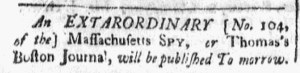
“Extra!  Extra!  Read all about it!”  That was Isaiah Thomas’s message to readers of the Massachusetts Spy.  The printer included an announcement in the January 28, 1773, edition, alerting subscribers and other readers that “An EXTRAORDINARY [No. 104, of the] Massachusetts SPY, or Thomas’s Boston Journal, will be published To morrow.”  Unlike the supplements and postscripts that sometimes accompanied early American newspapers, Thomas considered the extraordinary, distributed on a Friday, a separate issue.  As he noted in his announcement, it had its own number, 104, following “NUMB. 103,” distributed on Thursdays as usual for the Massachusetts Spy.  Thomas or a compositor who worked in his printing office updated the masthead to include “EXTRAORDINARY.”

The “extra” issue consisted of two pages, compared to four for the weekly standard issues of the Massachusetts Spy and other American newspapers published at the time.  It consisted almost entirely of a single item from the “HOUSE of REPRESENTATIVES” in Boston, along with half a column of news from Salem and one short advertisement for grocery items.  (In similar circumstances, other printers took the opportunity to insert advertisements about the goods and services available at their printing offices.)  The main item that prompted publication of the extraordinary was an “ANSWER to [Governor Thomas Hutchinson’s] SPEECH, to both Houses, at the opening of this session.”  Representatives “ORDERED” that a committee comprised of “Mr. Adams, Mr. Hancock, Mr. Bacon, Col. Bowes, Major Hawley, Capt. Darby, Mr. Philips, Col. Thayer, and Col. Stockbridge” compose that answer.  Members of the committee agreed with the governor that “the government at present is in a very disturbed state.”  They did not, however, identify the same causes.  “[W]e cannot ascribe it to the people’s having adopted unconstitutional principles,” as the governor claimed.  Instead, they believed that problems arose as a result of “the British House of Commons assuming and exercising a power inconsistent with the freedom of the constitution to give and grant the property of the colonists, and appropriate the same without their consent.”

When Thomas published the extraordinary, he already had a reputation as a printer devoted to principles espoused by the patriots.  The masthead for his newspaper described it as “A Weekly, Political, and Commercial PAPER:– Open to ALL Parties, but Influenced by None,” yet immediately below that sentiment appeared this message: “DO THOU Great LIBERTY INSPIRE our Souls,– And make our Lives in THY Possession happy,– Or our Deaths glorious in THY JUST Defence.”  Thomas likely had two reasons for quickly publishing the committee’s response as an extraordinary.  He scooped his competitors while also disseminating rhetoric that matched his own views.  (Most other newspapers printed in Boston included the response as part of their coverage when they distributed their next weekly edition, but that took several days or, in the case of the Massachusetts Gazette and Boston Weekly News-Letter, printed by Loyalist Richard Draper, an entire week.)  Thomas previously published the governor’s speech as an extraordinary, dated and distributed on the same day as the weekly issue on Thursday, January 7.  In so doing, he upheld his pledge that the Massachusetts Spy was “Open to ALL Parties,” yet publishing the governor’s speech also kept colonizers informed about the dangers they faced from the narrative of recent events that Hutchinson constructed.  Releasing the committee’s response as its own extraordinary on a day that no other newspapers were published in Boston and announcing his plans to issue that extraordinary may have garnered more attention more quickly to the version of events that matched Thomas’s own views.  Patriots and imperial officials vied over how to represent what was occurring in Boston and throughout the colonies.  Thomas may have considered getting the committee’s response to the governor in print as quickly as possible an important counteroffensive against the governor’s speech that he published three weeks earlier.

Massachusetts Spy Extraordinary (January 29, 1773).

December 20

What was advertised in a colonial American newspaper 250 years ago this week?

Massachusetts Spy (December 17, 1772).

“It is requested that those thoughts may be published, at this alarming season.”

In November and December 1772, an author who identified himself as “A BRITISH BOSTONIAN” placed a newspaper advertisement addressed to “the Inhabitants of the Town of BOSTON” in which he proposed publishing “a concise Essay upon the Beauties of LIBERTY in its Political and Sacred branches.”  As a relative newcomer to the city, he considered it “very unpolite [for] a stranger to take this freedom” of publishing “The AMERICAN ALARM, Or, a Confirmation of the Boston Plea, for the Rights and Liberties of the People” without first requesting “the approbational leave of the Gentlemen of Boston.”  The “Gentlemen” of the city could demonstrate their approbation or support for the project by entering their names on the subscription lists kept by printers David Kneeland and Nathaniel Davis.

Although historians and bibliographers formerly attributed American Alarm to Isaac Skillman, the pastor at the Second Baptist Church of Boston, John M. Bumsted and Charles E. Clark convincingly demonstrate that John Allen, “a Baptist minister and a recent émigré from England, politically disenchanted and personally discredited,” penned both American Alarm and An Oration, Upon the Beauties of Liberty, Or the Essential Rights of the Americans.[1]  Kneeland and Davis printed these “small but inflammatory political pamphlets” in 1773, suggesting that the advertisement in the Boston-Gazette and the Massachusetts Spy helped in recruiting subscribers for American Alarm.[2]  Bumsted and Clark describe the Oration as “one of the best-selling pamphlets of the pre-Revolutionary crisis, passing through seven editions in four cities between 1773 and 1775.”[3]

They devote less attention to American Alarm, but do provide essential context for understanding events that would have resonated with newspaper readers and prospective subscribers to the pamphlet when they encountered the advertisement.  Allen wrote American Alarm in response to Governor Thomas Hutchinson’s announcements that the colonial legislature would no longer pay the salaries of the governor and judges.  Instead, those officers would receive their salaries from the Crown, an arrangement that many colonizers believed made the governor and judges beholden to the monarch and, especially, Parliament.  According to the British Bostonian, “The plan is laid, the foundation is fixed, to make them [the governor and judges] dependant for place and payment, upon the arbitrary will, and power of the British ministry; upon that power that has for years been seeking the destruction of your RIGHTS.”[4]

Bumsted and Clark describe Allen as “New England’s Tom Paine,” a counterpart to the author of the political pamphlet, Common Sense, widely considered to have had the most significant impact in convincing colonizers to declare independence.  Bumsted and Clark assert that some colonizers did not need as much pushing in that direction as their leaders.  The arguments made by the British Bostonian and the popularity of American Alarm and, especially, the Oration “suggest that in attitude if not in ideology, a large portion of the population may have been well in advance of its leadership” in 1772 and 1773.[5]  Those colonizers expressed their politics by buying the pamphlets and imbibing their contents.  Though he may have exaggerated how much support and encouragement he initially received, Allen asserted that after he delivered “my thoughts in public, upon the Beauties of LIBERTY” that listeners “requested that those thoughts may be published, at this alarming season.”

**********

[1] John M. Bumsted and Charles E. Clark, “New-England’s Tom Paine:  John Allen and the Spirit of Liberty,” William and Mary Quarterly, 3rd ser., 21, no. 4 (October 1964): 562.

[2] Bumsted and Clark, “New-England’s Tom Paine,” 561.

[3] Bumsted and Clark, “New-England’s Tom Paine,” 561.

[4] British Bostonian [John Allen], The American Alarm, or the Bostonian Plea, for the Rights, and Liberties of the People (Boston:  D. Kneeland and N. Davis, 1773), 17.

[5] Bumsted and Clark, “New-England’s Tom Paine,” 570.

May 6

What was advertised in a colonial American newspaper 250 years ago this week?

Massachusetts Gazette and Boston Post-Boy (May 4, 1772).

“The elegant POEM, which the Committee of the Town of Boston had voted unanimously to be Published with the ORATION.”

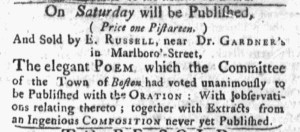
The May 4, 1772, edition of the Massachusetts Gazette and Boston Post-Boy carried a brief advertisement for “The elegant POEM, which the Committee of the Town of Boston had voted unanimously to be Published with the ORATION.”  The “ORATION” referred to the address that Dr. Joseph Warren delivered on the second anniversary of the Boston Massacre, an address already published and advertised in several newspapers in Boston and beyond.  Why, if “the Committee of the Town of Boston had voted unanimously” to publish it with Warren’s oration, had that not occurred?

The advertisement did not name the author of the poem, but many readers knew that James Allen wrote it.  Both the American Antiquarian Society and the Massachusetts Historical Society state that the poem “was suppressed due to doubts about Allen’s patriotism and later was republished by Allen’s friends, with extracts from another of his poems, as ‘The Retrospect.’”  That narrative draws on commentary that accompanied the poems as well as Samuel Kettell’sSpecimens of American Poetry (1829) and Evert A. Duyckinck and George L. Duyckinck’s Cyclopaedia of American Literature (1856).  More recently, Lewis Leary argues that Allen’s “friends” had motives other than commemorating the Bloody Massacre in King Street or demonstrating Allen’s patriotism in the wake of the committee composed of Samuel Adams, John Hancock, and other prominent patriots reversing course about publishing the poem in the wake of chatter that called into question Allen’s politics.

According to Leary, Allen’s poem about the Boston Massacre and “The Retrospect” must be considered together, especially because “the extracts from ‘The Retrospect’ are unabashedly loyalist, praising Britain’s military force, her selfless defense of her colonies, and benevolent rule over them.”  Furthermore, the commentary by Allen’s supposed friends “does indeed clear ‘the authors character as to his politics’ and exhibits his ‘political soundness,’ but that character and that soundness are loyalist, not patriot.”[1]

Postscript to the Censor (May 2, 1772).

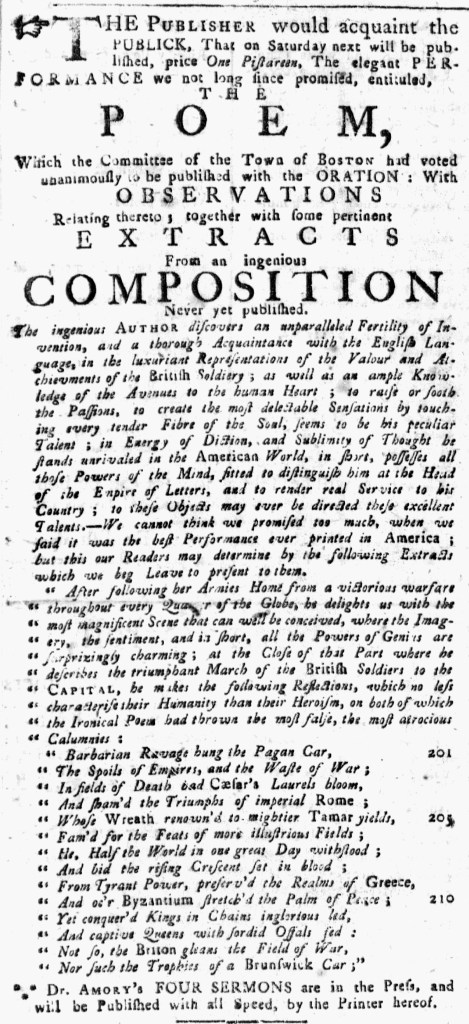
Significantly, Ezekiel Russell published the pamphlet that contained Allen’s poem, “The Retrospect,” and commentary from Allen’s “friends.”  He also published the Censor, a weekly political magazine that supported the British government and expressed Tory sympathies.  The Postscript that accompanied the final issue of the Censor included a much more extensive advertisement for Allen’s poem, one that included extracts from both the commentary and “The Retrospect.”  The portion of the commentary inserted in the advertisement describes how Allen “describes the triumphant March of the British Soldiers to the CAPITAL” and then “makes the following Reflections, which no less characterise their Humanity than their Heroism” in “The Retrospect.”  The advertisement praises the “ingeniousAUTHOR” for his “luxuriant Representations of the Valour and Achievement of the British Soldiery.”

Leary argues that Allen’s “friends” sought to discredit Adams, Hancock, and other patriots for being so easily fooled by his poem about the Boston Massacre that seemed to say what they wanted to hear.  In that regard, the “publication of his Poem and its antithetical counterpart seems to have been one among many minor skirmishes in the verbal battles between Tories and Patriots on the eve of the Revolution, in which skirmish Allen seems to have been more pawn than participant.”  To that end, the “purpose of his ‘friends’ seems clearly to have been to discomfit the committee for its vacillation on the publication of the poem and to expose patriot leaders in Boston as men who could be duped by a skillful manipulator of words.”  Allen’s “friends,” according to Leary, did seek to clarify his politics, but with the intention of “certify[ing] him, certainly to his embarrassment, a Loyalist clever enough to mislead his patriot townspeople.”[2]

Still, that may not tell the entire story.  Leary argues that “what evidence is available suggests that James Allen as a younger man, like many colonials, had been enthusiastically a loyal British subject, grateful for Britain’s protection of her colonies, but that after the horror of the massacre in Boston on March 5, 1770, had become at thirty-six a patriot who could bitterly challenge the British.”[3]  In 1785, Allen’s poem about the Boston Massacre appeared in a collection of orations that commemorated the event, including Warren’s address.  By then, the editors who compiled the anthology recognized that Allen wrote the poem “when his feelings, like those of every other free-born American were alive at the inhuman murders of their countrymen.”[4]  The controversy had passed, Allen’s poem no longer questioned as an insincere lamentation belied by his earlier work.

**********

[1] Lewis Leary, “The ‘Friends’ of James Allen, or, How Partial Truth Is No Truth at All,” Early American Literature 15, no. 2 (Fall 1980): 166-167.

[2] Leary, “‘Friends’ of James Allen,” 168-169.

[3] Leary, “‘Friends’ of James Allen,” 168.

[4] Quoted in Leary, “‘Friends’ of James Allen,” 170.

April 15

What was advertised in a colonial American newspaper 250 years ago today?

Boston-Gazette (April 15, 1771).

“The most strict Compliance with the Non-Importation Agreement.”

Colonial merchants and shopkeepers often included introductory remarks about the origins of their imported goods in their newspaper advertisements.  In the April 15, 1771, edition of the Boston-Gazette, for instance, William Jones advertised goods “JUST IMPORTED In the Ship LYDIA, JAMES SCOTT, Master, from LONDON.”  Similarly, Hugh Tarbett marketed goods “Imported in the Snow Jenny, Hector Orr, Master, from Glasgow.”  Both followed a format familiar to both advertisers and readers.  Samuel Eliot did so as well, announcing that he carried goods that he “has now IMPORTED in the Ships just arrived from LONDON.”  Eliot added an additional note that he sold those goods “after a long Suspension of Business by his strict Adherence to the late Non Importation Agreement.”  John Hancock did the same.  Like Jones and several others who advertised in that issue, Hancock received goods via the Lydia.  He proclaimed that he offered those items to customers “after the most strict Compliance with the Non-Importation Agreement during its Continuance.”

Eliot and Hancock both signaled their support of the patriot cause and suggested that consumers should purchase goods from them, now that trade with Britain commenced again, because they had faithfully obeyed the boycotts enacted in protest of duties imposed on certain imported goods by the Townshend Acts.  Hancock’s version of events, however, did not match coverage in the Boston Chronicle in the summer of 1769.  The committee of merchants who oversaw compliance with the nonimportation agreement singled out John Mein, loyalist printer of the Boston Chronicle, for continuing to import and sell British goods.  In turn, Mein published an exposé of prominent merchants who publicly claimed to support the nonimportation agreement yet continued to receive goods from Britain.  On August 21, 1769, he listed the cargoes of several ships, the owners of those vessels, and the merchants who ordered and received the goods.  That coverage included a “Manifest of the Cargo of the Brigantine Last Attempt, … Owner, JOHN HANCOCK,” a “Manifest of the Cargo of the Brigantine Lydia, … Owner, JOHN HANCOCK,” and a “Manifest of the Cargo of the Brigantine Paoli, … Owner JOHN HANCOCK.”  Mein called on the “PATRIOTIC GENTLEMAN” who owned those vessels to provide the public with more information.  Over the next two months, Mein continued his critique of Hancock and other patriot leaders.  In late October, he published character sketches that included one for “Johnny Dupe,” a jab at Hancock for duping the public by continuing to profit from importing goods despite claiming to support the boycott.  Not long after that, a mob attacked Mein.  He fled Boston, leaving the Boston Chronicle in the hands of his partner, John Fleeming.  The newspaper folded less than a year later.

Hancock’s claim that he sold an “Assortment of Goods” received from London only after “the most strict Compliance with the Non-Importation Agreement during its Continuance” was a polite fiction, at best.  He attempted to deploy patriotism as part of his marketing strategy, asking supporters of the American cause to endorse his version of events despite evidence to the contrary published in the Boston Chronicle two years earlier.  After all, that incident resulted in the disgrace and flight of a loyalist printer, not the prominent merchant and vocal supporter of the patriot cause.  When it came to marketing, image mattered, perhaps even more than reality.

**********

The Massachusetts Historical Society provides access to the August 21, 1769, edition of the Boston Chronicle via their online collections.

March 24

What was advertised in a colonial American newspaper 250 years ago this week?

South-Carolina Gazette (March 21, 1771).

“Encouragement from those who are Well-wishers to the MANUFACTURES of THIS Province.”

In an advertisement that appeared in the March 21, 1771, edition of the South-Carolina Gazette, Thomas You described himself as a “WORKING SILVERSMITH” who ran a workshop “AT THE SIGN OF THE GOLDEN CUP” on Queen Street in Charleston.  That he was a working silversmith, as opposed to a purveyor of imported wares, was important to both You’s identity as an artisan and his marketing efforts.  He declared that he “carried on the GOLD and SILVERSMITH’s Business in their different Branches,” making claims about his expertise in his craft.  He also confided that “his Dependance is entirely in the working Part.”  In other words, he earned his livelihood through making what he sold, a shift in his marketing compared to his earlier advertisements that incorporated goods imported from England.

For readers of the South-Carolina Gazette, that proclamation resonated with the politics of the period.  Gary Albert traces You’s advertising over several years, noting that before the Stamp Act crisis, the silversmith “advertised six times that he sold goods ‘just imported from London,’” but “You did not advertise recently imported British goods from the enactment of the Stamp Act in the fall of 1765 through the repeal of the Townshend Acts in 1770.”  Albert underscores that You embedded politics in his advertisements in the late 1760s and early 1770s:  “On six occasions during the term of the Townshend Acts You made a point to tell his customers that his shop was manufacturing silversmith products, not retailing imported goods.”

In so doing, You challenged consumers to practice politics when making choices in the marketplace.  He stated that he “hopes he may meet with Encouragement from those who are Well-wishers to the MANUFACTURES of THIS Province.”  He argued that he did his part for the American cause as a “WORKING SILVERSMITH,” but his efforts as a producer required recognition by consumers and commitment on their part in selecting domestic manufactures as alternatives to imported goods.  In making that proposition, he echoed appeals made in newspaper advertisements throughout the colonies as artisans, shopkeepers, and others encouraged consumers to “Buy American” several years before the skirmishes at Lexington and Concord.

March 14

What was advertised in a colonial American newspaper 250 years ago today?

Massachusetts Gazette and Boston Weekly News-Letter (March 14, 1771).

“Near LIBERTY TREE, BOSTON.”

Purveyors of goods and services in Boston used a variety of means to specify their locations in 1771.  William Taylor and Peter Hughes merely listed King Street as their addresses.  Similarly, Andrew Brimmer stated that his shop was located in the “South-End, BOSTON,” but did not elaborate beyond that.  Joshua Gardner sold “a Fine Assortment of ENGLISH GOODS … at his Shop in Cornhill, just above the Post-Office.”  John Hunt carried a variety of merchandise at his shop “next door Northward to the Heart and Crown,” the printing office where Thomas Fleet and John Fleet published the Boston Evening-Post.  Bartholomew Kneeland also used that printing office as a landmark, giving his location as “the Fourth to the Northward of School-Street, and nearly opposite to the Heart & Crown in Cornhill.”  Samuel Franklin sold razors and a variety of cutlery at the Sign of the Razor and Crown.  Ziphion Thayer stocked paper hangings (or wallpaper) at the Sign of the “Golden Lyon.”  George Leonard hawked grains and chocolate at “the New Mills, near the Mill-Bridge.”  Bethiah Oliver peddled seeds at her shop “opposite the Old South Meeting-House.”  John Coleman sold beer and operated a “House of Entertainment” at “the Sign of the General Wolfe, North-side Faneuil-Hall Market.”

Massachusetts Gazette and Boston Weekly News-Letter (March 14, 1771).

All of these descriptions for locations appeared in advertisements on the third page of the March 14, 1771, edition of the Massachusetts Gazette and Boston Weekly News-Letter.  Some of the shop signs invoked British identity and celebrated being part of the empire, especially those that included crowns.  The Sign of the General Wolfe honored one of the heroes of the Seven Years War who gloriously died on the battlefield after breaking the siege of Quebec in 1759.  Some advertisers expressed pride in other aspects of British history and culture in the directions they gave to their shops.  John Gore, Jr., sold a variety of goods “Opposite LIBERTY-TREE, Boston.”  Rosannah Moore stocked a “general Assortment of Wines” at “her Wine-Cellar near LIBERTY TREE, BOSTON.”  These retailers invoked traditional English liberties while simultaneously commemorating recent abuses perpetrated against colonists by Parliament and soldiers quartered in Boston.  The Liberty Tree stood as a symbol of resistance to the Stamp Act, the duties on imported goods in the Townshend Acts, and the murder of colonists during the Boston Massacre.  Gore and Moore both choose to associate their businesses with that recent history of resistance.  As the variety of means of giving directions in other advertisements demonstrate, Gore and Moore could have formulated many other means for instructing customers how to find their shops.  They purposefully selected the Liberty Tree, their advertisements for consumer goods resonating with political overtones as a result.