December 22

What was advertised in a colonial American newspaper 250 years ago today?
Dec 22 - 12:22:1767 South-Carolina Gazette and Country Journal
South-Carolina Gazette and Country Journal (December 22, 1767).

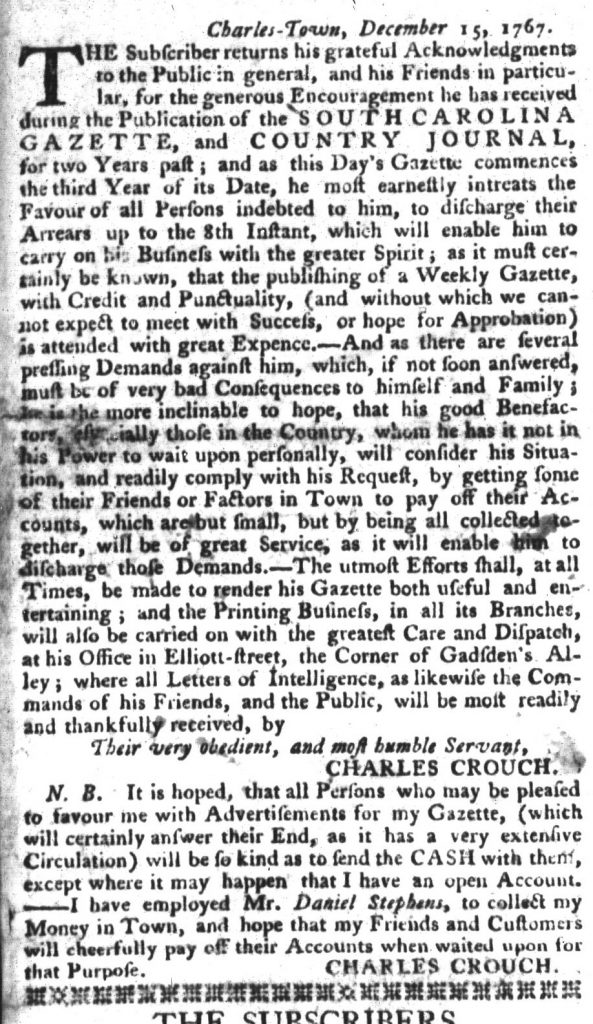
“He most earnestly intreats the Favour of all Persons indebted to him, to discharge their Arrears.”

Charles Crouch, the printer of the South-Carolina Gazette and Country Journal, marked the completion of the second year of publication with an advertisement that called on subscribers and other “Persons indebted to him” to settle accounts so he, in turn, could pay down his own debts. His notice first appeared in the December 15, 1767, issue. It ran for four weeks, appearing immediately below the masthead as the first item in the first column on the first page in the final three issues of 1767 and the first issue of 1768. Crouch invoked his privilege as the printer to determine his advertisement’s placement on the page, choosing the spot likely to garner the most notice by those he wished to see his message and follow through on his request for payment.

The printer resorted to several tactics to encourage his debtors to “discharge their Arrears.” He emphasized that he assumed “great Expence” in publishing such a “useful and entertaining” newspaper “with Credit and Punctuality.” He offered a service to the public, and did so with competence, but that potentially put “himself and Family” at risk of “very bad Consequences” if those who owed him money did not pay as soon as possible. He also sought to downplay the amount of any particular debt, asserting that if many made small payments that the total would be sufficient for him “to discharge those Demands” against him. Considering these various appeals together, Crouch implicitly argued that the value of his newspaper amounted to much more than the small costs subscribers, advertisers, and others incurred when they did business with him.

Crouch also addressed advertisers in particular, attaching a nota bene about inserting advertisements in subsequent issues of his newspaper. First, he underscored their efficacy, assuring those who contemplated placing notices that advertising in his gazette “will certainly answer their End, as it has a very extensive Circulation.” The South-Carolina Gazette and Country Journal was one of three newspapers published in Charleston at the time, so Crouch needed to convince advertisers to select his newspaper instead of, or along with, the others. He also made a request for new advertisers to “be so kind as to send the CASH” when they submitted their copy, though this was not necessary if he already happened to have “an open Account.”

The continuation of advertising, along with the inclusion of other “useful and entertaining” content, depended in part on an advertisement published by the printer of the South-Carolina Gazette and Country Journal. Even as he instructed potential advertisers that inserting notices in his gazette “will certainly answer their End,” Crouch depended on that being the case for his own advertisement, trusting that it would induce his debtors to settle their accounts.

June 26

What was advertised in a colonial American newspaper 250 years ago today?

Jun 26 - 6:26:1767 New-London Gazette
New-London Gazette (June 26, 1767).

The Subscribers are desired speedily to send for their Books.”

It took some time for Timothy Green to publish Joseph Fish’s book of nine sermons inspired by Matthew 26:18, but much of the responsibility for the delay belonged to the author. Fish continued to write, revise, and add material to the manuscript “After the Proposals for Printing these Sermons by Subscription, were sent abroad.” Six months before announcing that the book had been “JUST PUBLISH’D,” Green issued an advertisement requesting that those who accepted subscriptions forward their lists to him so he could determine how many copies to print.

In the interim, the book expanded. That, in turn, raised the cost of production and, ultimately, the retail price, even for subscribers. Earlier subscription notices marketed the book for 1 shilling and 10 pence, but the additional material made it necessary to increase the price by 4 pence to a total of 2 shillings and 2 pence if “stitch’d in blue Paper.” Reader who desired a volume “bound in Leather” rather than the basic wrapper could pay an additional shilling. Green catered to different tastes and price points.

He also realized that it was problematic to raise the price of Fish’s Sermons by nearly 20% after customers subscribed at a lower cost. To counter objections, he argued that “even with that Addition they will be uncommonly Cheap, as the Book contains upwards of 200 Pages.” (The reverend Fish might have been dismayed that the printer made an appeal to quantity over the quality of the contents.) In addition, Green reported that many others who had not previously subscribed were so keen on acquiring the book that they stood ready to purchase it at the higher price. The printer gave subscribers an opportunity to opt out by requesting that they send for their books soon. Any not claimed, he warned, would be sold to others who eagerly stood ready to purchase any surplus copies. Rather than apologize for raising the price and breaking the conditions set forth in the subscription notices, Green instead lectured subscribers. Even considering the higher price, they could hardly argue with the value, he admonished. After all, other prospective customers certainly acknowledged that this was a good deal. The original subscribers needed to obtain their copies as quickly possible or else risk losing out as others swooped in and claimed their books.

March 10

What was advertised in a colonial American newspaper 250 years ago today?

Mar 10 - 3:10:1767 South-Carolina Gazette and Country Journal Page 6
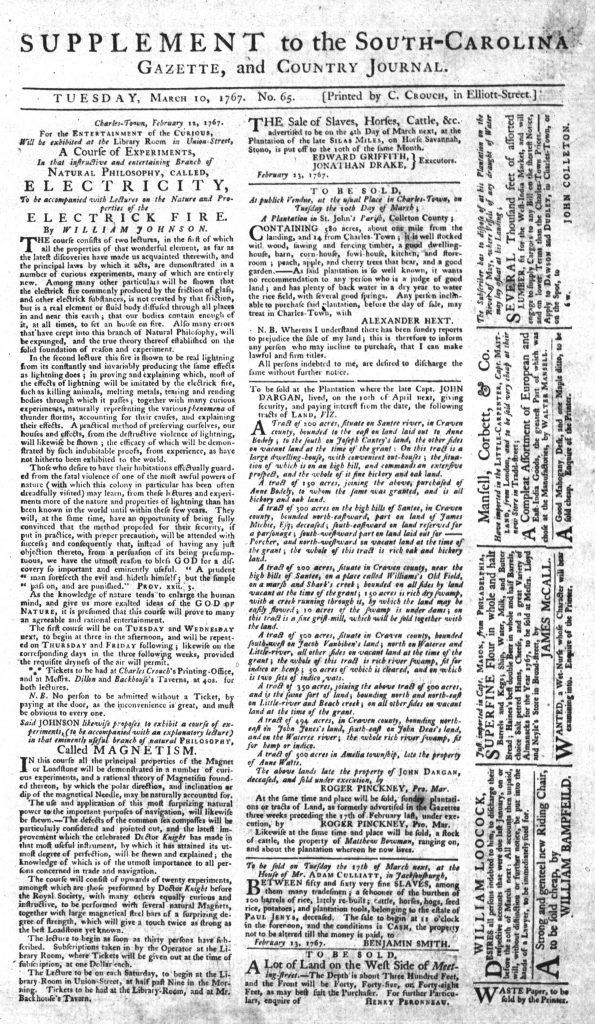
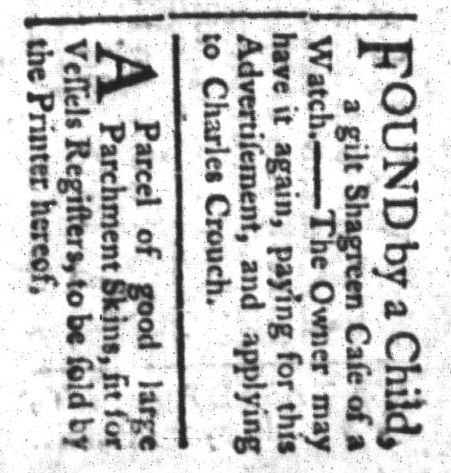
This is the orientation of these advertisements in the Supplement to the South-Carolina Gazette and Country Journal (March 10, 1767).

“A Parcel of good large Parchment Skins, for for Vessels Registers, to be sold by the Printer hereof.”

Advertising supplements were a fairly common feature of newspapers in the 1760s, especially publications printed in the largest American cities. Between news items, commercial notices, and paid announcements of various sorts, printers frequently ran out of space in the standard four-page issue. It made a lot of sense to distribute two-page supplements comprised solely of advertisements since it was advertising, rather than subscription fees, which really paid the bills.

Still, printers had to be careful in allocating resources to the advertising supplements. They had to weight the labor, time, and supplies they would expend against how quickly for frequently they published advertisements. Sometimes printers had more material than would fit in the standard issue but not enough to justify devoting an entire half sheet to a supplement. In such instances, they could opt to print the supplement on smaller sheets.

Mar 10 - South-Carolina Gazette and Country Journal Page 5
First page of Supplement to the South-Carolina Gazette and Country Journal (March 10, 1767).

Such appears to have been the case with the Supplement to the South-Carolina Gazette and Country Journal from March 10, 1767. It is impossible to say so definitively based solely on digitized images of the newspaper from Accessible Archives. No provider of digital surrogates of eighteenth-century newspapers includes metadata concerning the dimensions of the page or columns relative to individual images. Doing so would be time consuming and prohibitively expensive, resulting in scholars and others having significantly less access to digitized sources at all.

Although I do not have access to original copies of the South-Carolina Gazette and Country Journal from 1767, the layout of the March 10 supplement contains all the indications of a smaller sheet that I have been able to confirm when working between digital surrogates and original copies of other newspapers. The regular issue contains three columns, but the supplement has two columns along with a third column of advertisements rotated to fit in the remaining space. The rotated advertisements are the same width as the others, indicating that type had not been reset, nor would it need to be reset to move any of the advertisements back into future editions of the regular issue.

Mar 10 - South-Carolina Gazette and Country Journal Page 6
Second Page of the Supplement to the South-Carolina Gazette and Country Journal (March 10, 1767).

In this instance, however, Charles Crouch engaged in even greater economy of space than his counterparts who adopted this trick in other newspapers. Rather than provide space between the rotated advertisements in the third column, he squeezed them together in order to fit in very short advertisements. On the front of the supplement, this resulted in a two-line advertisement oriented in a different direction than the others in the third column. On the other side, where he did not have to take space for the masthead into consideration, Crouch found room for two advertisements rotated in the same direction as the others in the additional column.

Charles Crouch worked to fill the March 10 supplement of his newspaper with as much advertising as he could possible fit on its pages. In so doing, he made room to promote products he sold (“WASTE Paper” and “good large Parchment Skins”) that otherwise would not have fit in the regular issue or the supplement.

December 28

What was advertised in a colonial American newspaper 250 years ago this week?

dec-28-12271766-new-york-journal-supplement
Supplement to the New-York Journal (December 27, 1766).

“A Variety of Books and Stationary.”

Like many other colonial American printers, John Holt inserted his own advertisements into the newspaper he published. The two-page supplement to the New-York Journal from December 27, 1766, for instance, included three advertisements for “the Printing-Office near the Exchange.” None of them included Holt’s name, but that may have been less important than providing sufficient direction for current and prospective customers to make their way to Holt’s printing shop. Besides, many readers likely would have already known Holt as “the Printer at the Exchange.” For those who did not, the masthead of regular issues of the New-York Journal proclaimed that it was “PRINTED AND PUBLISHED BY JOHN HOLT, NEAR THE EXCHANGE.”

Each of Holt’s advertisements in the December 27 issue addressed a different aspect of his business. One attempted to drum up new business, succinctly announcing “A Variety of Books and Stationary, to be sold at the Printing-Office near the Exchange.” Between subscriptions and advertisements, publishing the New-York Journal generated revenue, but Holt, like many others in his occupation, also acted as bookseller. This yielded an additional flow of income to keep the entire operation running.

dec-28-12271766-ad-2-new-york-journal-supplement
Supplement to the New-York Journal (December 27, 1766).

Another advertisement solicited supplies necessary for the New-York Journal to continue publication. “READY MONEY,” it announced, “given for clean Linen RAGS, of any Kind, at the Printing-Office near the Exchange.” Printers throughout the colonies frequently placed such notices. They printed their newspapers on paper made of linen. Rags were essential to their business; they were recycled and reused as paper. Holt placed this particular advertisement in the upper right corner of the second page. Except for the masthead, it included the largest font in that issue, increasing the likelihood that readers would see and take note of it.

dec-28-12271766-ad-3-new-york-journal-supplement
Supplement to the New-York Journal (December 27, 1766).

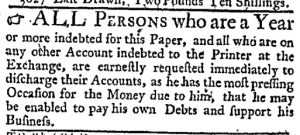
Holt’s third advertisement addressed prior operations of his business as well as its future. In the final issue of the New-York Journal for 1766, he called on former customers to settle accounts: “ALL PERSONS who are a Year or more indebted for this Paper, and all who are on any other Account indebted to the Printer at the Exchange, are earnestly requested immediately to discharge their Accounts.” Once again, similar notices appeared in newspapers printed throughout the colonies. Subscribers notoriously fell behind in paying for their newspapers. Printers extended credit for subscriptions, advertisements, and job printing of various sorts as well as the books and stationery they sold. In designing the layout for this supplemental issue, the crafty Holt placed this advertisement second, immediately after a notice listing the winning numbers for a recent lottery. He may have hoped to capture readers’ attention as they eagerly examined nearly two columns of winning tickets and moved directly to the next item.

The December 27 supplement of the New-York Journal included relatively little news. Of its six columns, only the third and fourth were given over to news items. Holt devoted the remainder of the supplement to advertising, including three advertisements that either promoted his own printing shop or saw to its general maintenance.

December 8

What was advertised in a colonial American newspaper 250 years ago today?

dec-8-1281766-new-york-mercury
New-York Mercury (December 8, 1766).

“BOOKS and STATIONARY … to be sold by Hugh Gaine.”

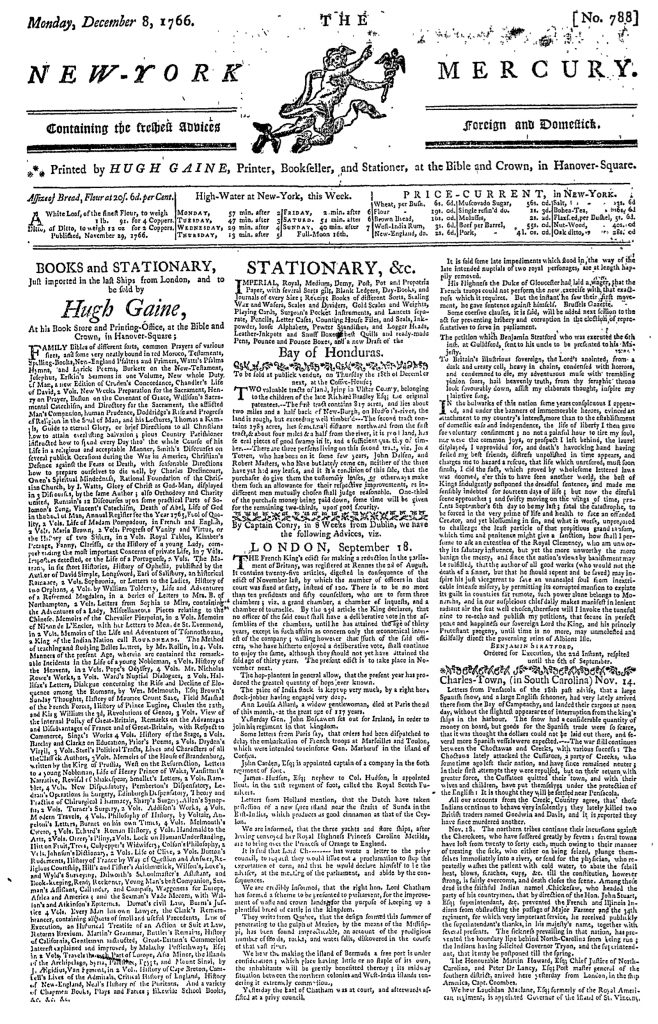
Hugh Gaine’s advertisement for “BOOKS and STATIONARY, Just imported in the last Ships from London” occupied a place of privilege in the December 8, 1766, issue of the New-York Mercury. It appeared in the first column (and extended into the second) on the first page, the first item below the masthead and charts for high tides and prices current. Just to make sure that readers noticed this advertisement, several words were printed in the largest fonts that appeared anywhere in that issue: “Hugh Gaine” in a size that rivaled the title of newspaper in the masthead and “BOOKS and STATIONARY” (at the top of the first column) and “STATIONARY, &c.” (at the top of the second column) in sizes nearly as large.

Gaine did not have to pay extra or engage in any sort of negotiations with the printer of the New-York Mercury in order for his advertisement to receive such extraordinary treatment. As the masthead announced, he printed the newspaper! That certainly gave him the authority and ability to design his own advertisement and lay out the issue in ways that best served his own interests. He used one of his products, his newspaper, to promote the assortment of books, stationery, and other goods he sold “at the Bible and Crown, in Hanover-Square.” Sometimes the layout of advertising in colonial newspapers was haphazard. Printers often moved type already set from previous issues into other columns in subsequent issues or changed the order of advertisements in order to insert other items. In this case, however, the placement of Gaine’s advertisement was not merely fortuitous; it was intentional.

dec-8-1281766-first-page-new-york-mercury
First Page of New-York Mercury (December 8, 1766).

On the third page, an advertisement for “HUTCHINS’s Improved: BEING AN ALMANACK AND EPHEMERIS Of the Motions of the SUN & MOON” had similarly large font for some of the key words, distinguishing it from the other advertisements and news items on the same and facing pages. Not surprisingly, the almanac was sol “at HUGH GAINE’s Book-Store and Printing-Office, in Hanover-Square.”

In contrast, a relatively short advertisement announcing that James Rivington had just imported “sundry new Books” appeared on the fourth page. Rivington’s name appeared in all capital letters in a font the same size as the names of other advertisers. Gaine published advertisements from his competitors, but he made sure that his own marketing notices overshadowed them in significant ways. Such was the power of the printer!

July 23

What was advertised in a colonial newspaper 250 years ago today?

Jul 23 - 7:23:1766 Georgia Gazette
Georgia Gazette (July 23, 1766).

“Most Kinds of BLANKS to be sold at the Printing-Office.”

Eighteenth-century printers often inserted advertisements for their own wares and services in the newspapers they published. They hoped to generate additional revenues, but they may have also strategically placed their own advertisements as a means of generating content that would fill space. Unlike other advertisers who usually purchased “squares” of advertising, thus paying by the length of the advertisement, printers who promoted their own enterprises did not have to factor the length of their advertisements into their calculations. That sometimes resulted in lengthy advertisements or multiple notices in a single issue.

In this case, however, printer James Johnston inserted a very brief advertisement, a single line announcing, “Most Kinds of BLANKS to be sold at the Printing-Office.” (By blanks, Johnston meant a variety of forms, including indentures.) The advertisement appeared at the bottom of the second and final column on the last page of the newspaper, nestled right above the colophon. Johnston needed one more line of text to complete the column. This one had the added benefit of drawing attention to one of the services he provided.

Jul 23 - 7:23:1766 Colophon Georgia Gazette
Georgia Gazette (July 23, 1766).

Like many other eighteenth-century printers, Johnston also used the colophon (the space devoted to publication information, including printer and location, at the end of the newspaper) to promote both the newspaper and other parts of his business. In addition to noting that the Georgia Gazette was “Printed by JAMES JOHNSTON, at the Printing-Office in Broughton-Street” in Savannah, it also announced that he sold subscriptions and advertisements. Furthermore, he did job printing (like the blanks) “at the shortest Notice,” including handbills and other forms of advertising (such as broadsides, trade cards, or circular letters).

Throughout the eighteenth century, Johnston and other printers creatively shaped newspaper colophons to do more than provide basic publication information. They use them to promote other services available in their printing shops.

June 30

What was advertised in a colonial newspaper 250 years ago today?

Jun 30 - 6:30:1766 New-York Mercury
New-York Mercury (June 30, 1766).

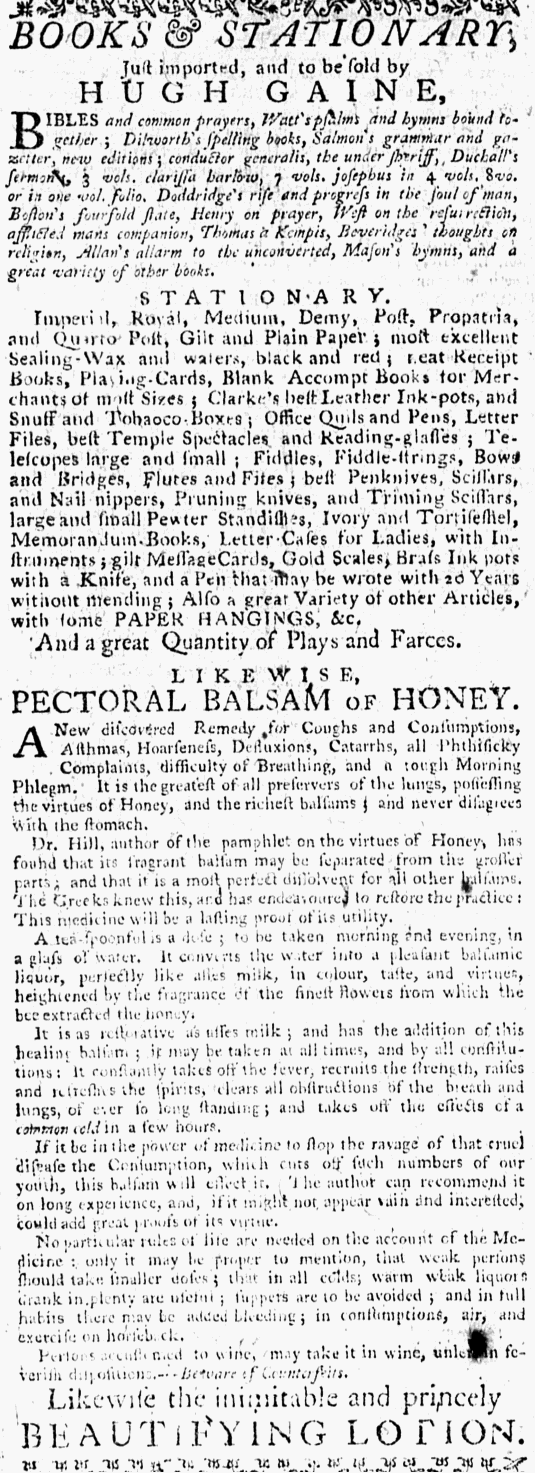
“BOOKS & STATIONARY, Just imported, and to be sold by HUGH GAINE.”

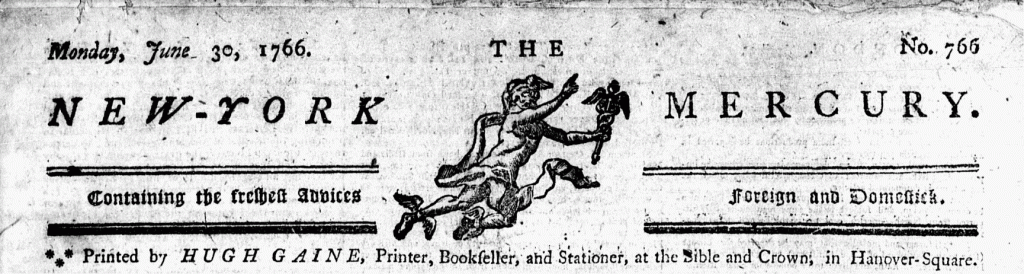
Hugh Gaine printed the New-York Mercury, though it is clear from the masthead that he considered himself more than just a printer. He listed his occupations as “Printer, Bookseller, and Stationer.” In that regard, Gaine was not much different from other printers who published newspapers in colonial America. They often supplemented the income from operating the newspaper by selling a variety of other products and services associated broadly with the book trades.

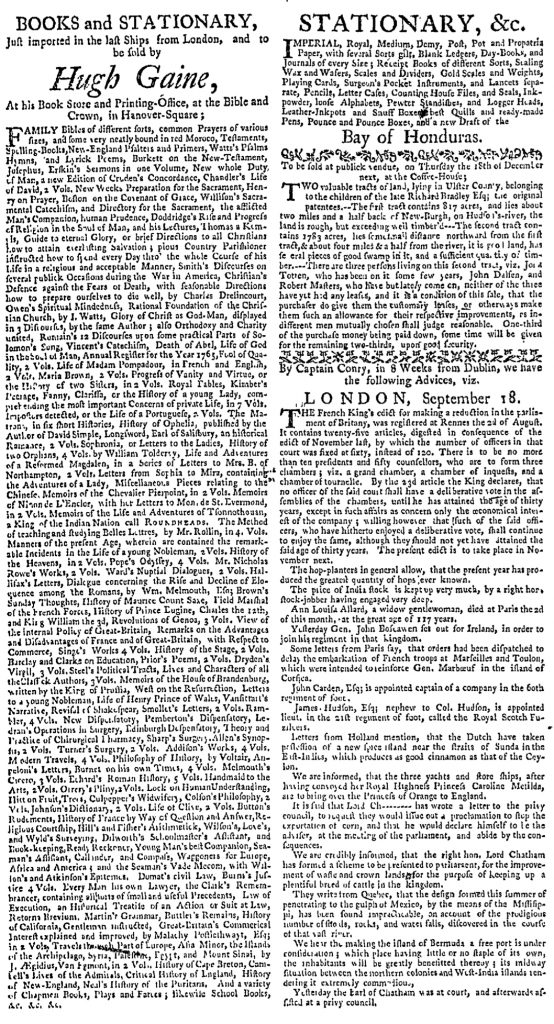
Gaine devised a headline for his advertisement, which was not a standard practice but also not unknown. He announced that he sold “BOOKS & STATIONARY,” merchandise associated with the book trades. Upon closer examination of his advertisement, however, potential customers would have discovered that in addition to books, stationery, and writing supplies (including “Leather Ink-pots,” “most excellent Sealing-Wax,” and “Office Quils and Pens”), he also sold “a great Variety of other Articles,” including musical instruments, telescopes, and paper hangings (what we would today call wallpaper). Gaine stocked a good deal of merchandise beyond the newspaper he printed.

Setting aside those items, half of his lengthy advertisement promoted a patent medicine, the pectoral balsam of honey, and concluded with a “BEAUTIFYING LOTION.” (One of the benefits of printing the newspaper must have been inserting his own advertisements of whatever length he wished.) Gaine may or may not have written the copy for this portion of the advertisement; he may have copied it directly from other promotional materials sent to him by the suppliers of this remedy. It may seem strange today that a “Printer, Bookseller, and Stationer” peddled patent medicines in the eighteenth century, but Gaine was certainly not the only one who did so. A variety of printers and booksellers included a few lines devoted to patent medicines in their book catalogues, demonstrating that they really diversified the merchandise they offered to customers.

Jun 30 - 6:30:1766 Masthead New-York Mercury
Masthead for the New-York Mercury (June 30, 1766).

January 10

What was advertised in a colonial newspaper 250 years ago today?

Jan 10 - 1:10:1766 New-Hampshire Gazette
New-Hampshire Gazette (January 10, 1766)

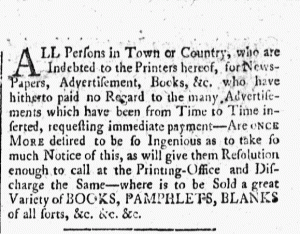
“ALL Persons … Indebted to the Printers hereof, for News-Papers, Advertisement, Books, &c. … Are ONCE MORE desired … to call at the Printing-Office.”

Historians of print culture have long contended that selling subscriptions did not make publishing newspapers profitable for colonial printers.  Instead, the real money was in charging for the advertisements!  I do not doubt the veracity of this claim, especially given how carefully so many other scholars have scrutinized the account books, ledgers, and other records of colonial printers.

However, I suspect that we sometimes overestimate the amount of revenue generated by newspaper advertising if we assume, when printers’ records are no longer extant to confirm that this was indeed the case, that each time an advertisement appeared in a new issue that the printer received payment.  In this instance, the printers of New-Hampshire Gazette placed their own advertisement to call on delinquent advertisers to pay for services rendered.  On many other occasions, some advertisements repeat for weeks or months, suggesting that printers sometimes used them for filler even without remuneration.