What was advertised in a revolutionary American newspaper 250 years ago today?
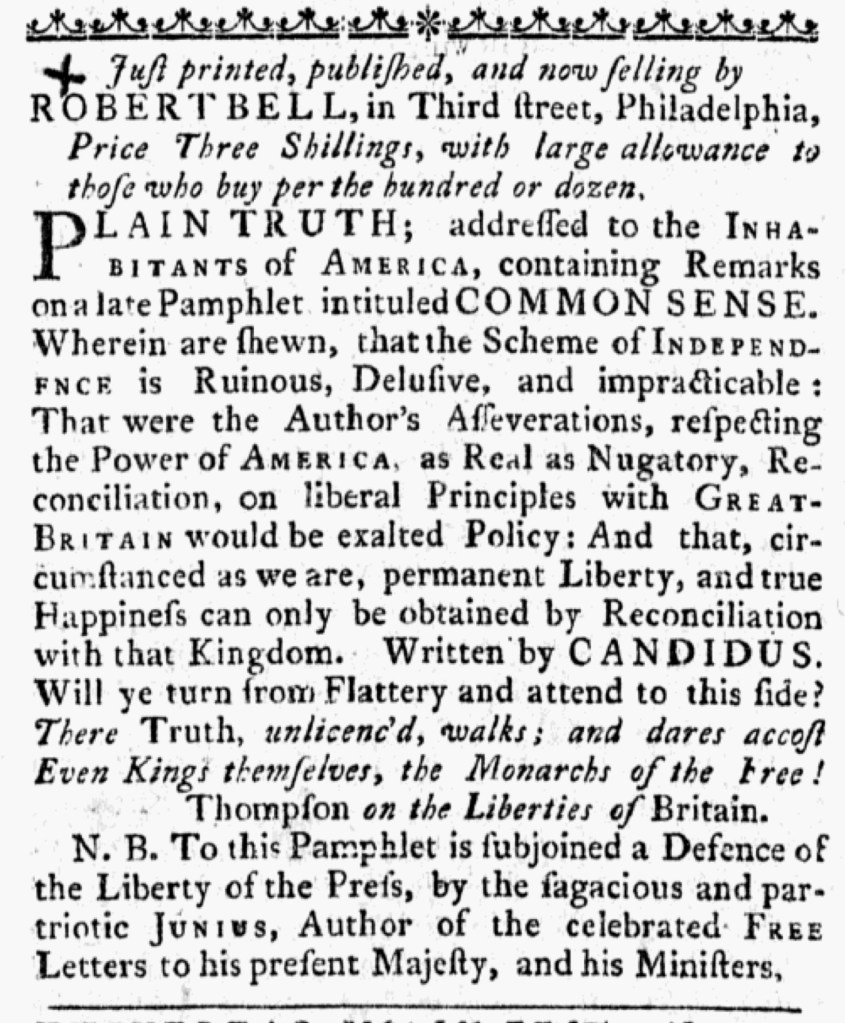
“PLAIN TRUTH … containing Remarks on a late Pamphlet intituled COMMON SENSE.”
Robert Bell published the first edition of Thomas Paine’s Common Sense on January 9, 1776, and not long after that he published a response, “PLAIN TRUTH; addressed to the INHABITANTS of AMERICA, containing Remarks on a late Pamphlet intituled COMMON SENSE.” As was often the case in eighteenth-century advertisements for books and pamphlets, Bell used the extensive subtitle as the copy for marketing the volume: “Wherein are shewn, that the Scheme of INDEPENDENCE is Ruinous, Delusive, and impracticable: That were the Author’s Asseverations, respecting the Power of AMERICA, as Real as Nugatory, Reconciliation, on liberal Principles with GREAT-BRITAIN would be exalted Policy: And that, circumstances as we are, permanent Liberty, and true Happiness can only be obtained by Reconciliation with that Kingdon.”
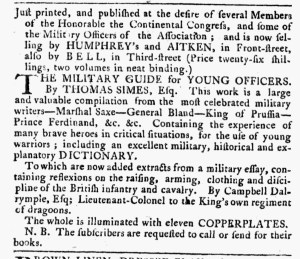
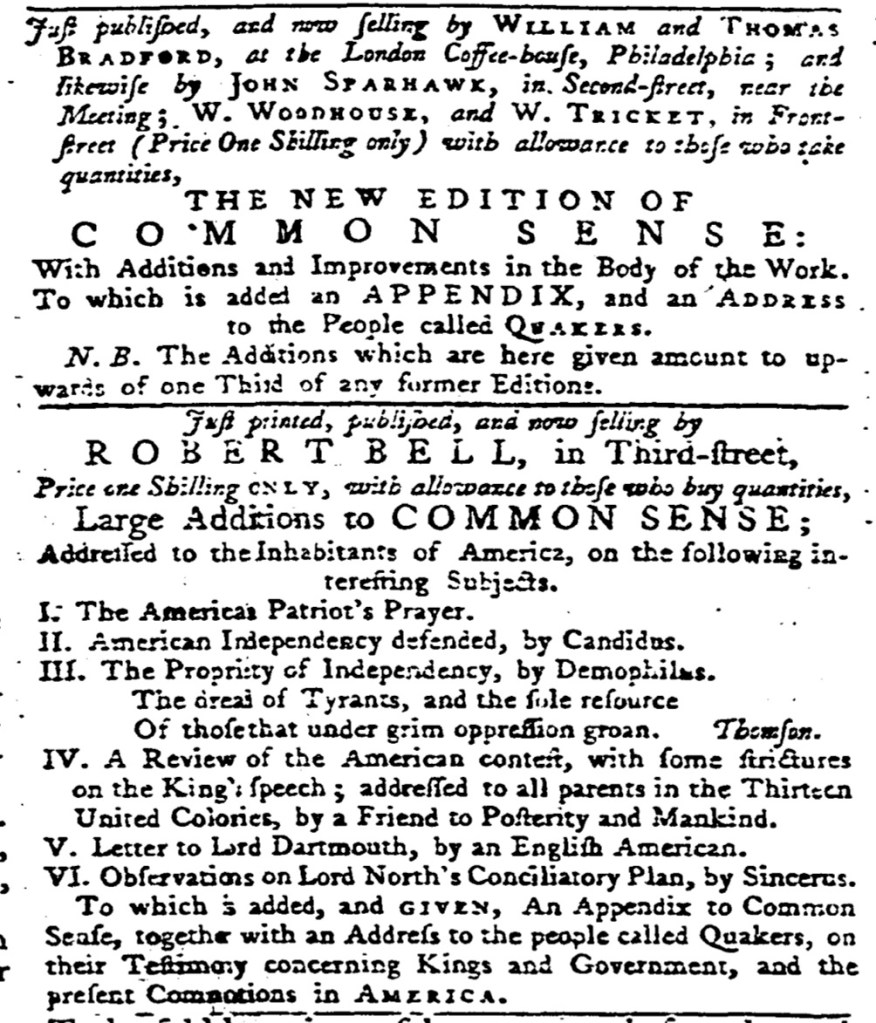
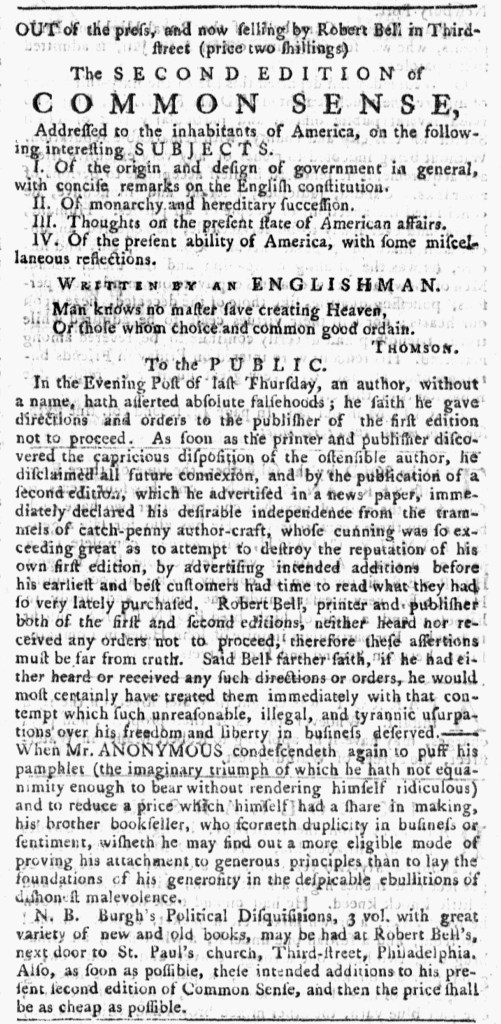
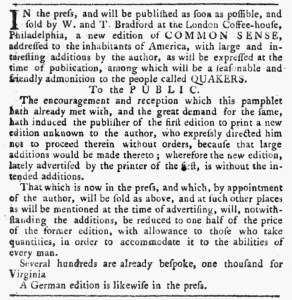
According to Thomas R. Adams, only two pamphlets answered Common Sense in the six months between its publication in January and the Continental Congress declaring independence in July. Robert Bell first advertised Plain Truth in the Pennsylvania Gazette on March 13. Near the end of May, James Humphreys, Jr., published The True Interest of America Impartially Stated in Certain Strictures on a Pamphlet Intitled Common Sense.[1] Bell quickly placed advertisements in other newspapers printed in Philadelphia, including the Pennsylvania Evening Post on March 14 and the Pennsylvania Ledger on March 16. In each advertisement, he set the price at three shillings for a single copy “with large allowance to those who buy per the hundred or dozen.” In other words, Bell offered a significant discount for buying in volume, hoping to make the pamphlet more attractive to consumers who might buy a dozen to share with friends and retailers who might buy a hundred to sell in their own shops in Philadelphia and beyond. He may not have anticipated that Plain Truth would achieve the same popularity as Common Sense, yet he was still a savvy entrepreneur who aimed to generate revenue from the debate over declaring independence. “To this Pamphlet is subjoined,” a nota bene at the end of the advertisement informed readers, “a Defence of the Liberty of the Press.” Adams asserts that Bell “pleaded for the right to present both sides of the question. No doubt he hoped thereby to increase the sales of both pamphlets.”[2] James Rivington had done the same in advertisements with headlines like “THE AMERICAN CONTEST” and “The American Controversy” that promoted pamphlets “on both sides, in the unhappy dispute with Great-Britain.” Humphreys, who eventually published The True Interest of America Impartially Stated, also ran advertisements for “POLITICAL PAMPHLETS, ON Both Sides of the Question.” Such pamphlets educated colonizers and helped them understand and formulate their own positions, yet they also presented opportunities for printers to generate revenue from current events.
**********
[1] Thomas R. Adams, “The Authorship and Printing of Plain Truth by ‘Candidus,’” Papers of the Bibliographical Society of America 49, no. 3 (1955): 230-231.
[2] Adams, “Authorship and Printing,” 235.