December 20

What was advertised in a revolutionary American newspaper 250 years ago today?

Pennsylvania Journal (December 20, 1775).

“Any person desirous of information concerning the character … of Mrs. Brodeau, may apply to … B. FRANKLIN.”

When she arrived in Philadelphia, “Mrs. BRODEAU, from England,” placed advertisements in the Pennsylvania Gazette and the Pennsylvania Journal as a means of “acquainting her friends and the public in general, that she has opened a boarding school in Walnut-street.”  She sought pupils of a certain status, pledging that “young ladies will be genteelly boarded, and taught to read and speak the French and English language; the tambour embroidery, and every kind of useful and ornamental needle work.”  In addition to the curriculum, Brodeau promoted her supervision of her charges, stating that she “hopes to prove by her assiduity and attention to the morals and behaviour of these ladies entrusted to her care, that she in some measure merits the recommendations she has been favoured with from her native country.”  Like many other schoolmasters and schoolmistresses who advertised in Philadelphia’s newspapers during the era of the American Revolution, Brodeau emphasized moral development as well as curriculum.[1]

The parents and guardians of prospective students did not have to take Brodeau’s word for it.  Instead, she inserted a testimonial from Robert Morris, the influential merchant, and Benjamin Franklin, the retired printer turned politician and diplomat.  “Any person desirous of information concerning the character and recommendations of Mrs. Brodeau,” they stated, “may apply to either of us.”  According to Claude-Anne Lopez, associated editor of the Papers of Benjamin Franklin, that was, “so far as we know, the only time that Franklin backed an enterprise of that kind with his name.”[2]  Lopez further explains that Anna Brodeau “suddenly and rather mysteriously appeared in Philadelphia with a baby daughter in her arms,”[3] yet “[n]othing is known about a Mr. Brodeau.”  If residents of Philadelphia had any concerns about Brodeau’s background, the endorsement from Franklin and Morris likely countered their concerns.  Still, the advertisement apparently did not garner as much response as Brodeau hoped when she placed it in the December 6 edition of the Pennsylvania Gazette, the newspaper that Franklin formerly printed.  Two weeks later she placed the same advertisement in the Pennsylvania Journal.  Those efforts helped launch her boarding school.  By the end of the Revolutionary War, Franklin’s daughter, Sarah Bache, wrote to her father that Brodeau “has made a handsome fortune.”  Despite the disruptions of the war, she established her boarding school and her reputation.  Lopez chronicles other accolades for Brodeau that appeared in print, including a poem by an anonymous contributor to the Columbian Magazine in 1786 and her obituary in the National Intelligencer in 1836.  With words of support from Franklin and Morris, Brodeau soon “attracted students from the best families in Philadelphia.”[4]  Her marketing incorporated the eighteenth-century version of a celebrity endorsement.

**********

[1] Carl Robert Keyes, “Selling Gentility and Pretending Morality: Education and Newspaper Advertisements in Philadelphia, 1765-1775,” Pennsylvania Magazine of History and Biography 141, no. 3 (October 2017): 245-274.

[2] Claude-Anne Lopez, “Benjamin Franklin and William Dodd: A New Look at an Old Vause Célèbre,” Proceedings of the American Philosophical Society 129, no. 3 (September 1985): 262.

[3] Lopez, “Benjamin Franklin and William Dodd,” 262, 263.

[4]Lopez, “Benjamin Franklin and William Dodd,” 263.
September 12

What was advertised in a revolutionary American newspaper 250 years ago today?

Dunlap’s Maryland Gazette (September 12, 1775).

“Mrs. TAYLOR’s BOARDING SCHOOL … [for] young LADIES.”

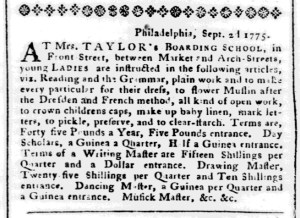
The first advertisement in the September 12, 1775, edition of Dunlap’s Maryland Gazette, published in Baltimore, promoted “Mrs. TAYLOR’s BOARDING SCHOOL” for “young LADIES” on Philadelphia, apparently an elite institution based on the tuition.  The headmistress charged forty-five pounds per year along with an initial entrance fee of five pounds.  Taylor advised the parents and guardians of prospective pupils that they would be taught “Reading and the Grammar, plain work and to make every particular for their dress, to flower Muslin after the Dresden and French method, all kind of open work, to crown childrens caps, make up baby linen, mark letters, to pickle, preserve, and to clear-starch.”  The standard curriculum combined practical skills that prepared young women to run a household with some leisure activities that testified to their status.

Yet that was not the extent of the instruction that took place at Taylor’s boarding school.  For additional fees, her charges could opt for additional lessons taught by tutors that Taylor hired.  Students learned to form their letters from a “Writing Master” for fifteen shillings each quarter.  They learned their steps from a “Dancing Master” for a guinea (or twenty-one shillings) each quarter.  Although Taylor did not say so, those students presumably learned to dance with grace rather than focusing exclusively on the mechanics of minuets and other popular dances.  Lessons from a “Drawing Master” cost twenty-five shillings per quarter.  Taylor also listed a “Musick Mater &c. &c.” but did not note their rates.  Repeating the common abbreviation for et cetera twice suggested that other tutors taught painting, French, and other genteel pursuits in addition to singing and playing instruments.  Taylor operated her boarding school in the largest and most cosmopolitan city in the colonies.  For pupils aspiring to gentility, she could arrange for access to all sorts of instructors, allowing her students and their families to choose which kinds of lessons they needed or desired in addition to the standard curriculum.  For the gentry in Baltimore, a port growing in size and importance on the eve of the American Revolution, Taylor’s boarding school for young ladies may have looked very attractive indeed.

June 13

What was advertised in a revolutionary American newspaper 250 years ago today?

South-Carolina Gazette and Country Journal (June 13, 1775).

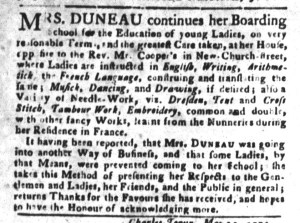
“MRS. DUNEAU continues her Boarding School for the Education of young Ladies.”

In an advertisement in the June 13, 1775, edition of the South-Carolina Gazette and Country Journal, Mrs. Duneau assured the public that she “continues her Boarding School for the Education of young Ladies … at her House, opposite to the Rev. Mr. Cooper’s in New-Church-street” in Charleston.  She may have intended to suggest that her proximity to the minister contributed to the “greatest Care” that she took of her pupils.  The schoolmistress also provided an overview of the curriculum at her school: “English, Writing, Arithmetic, the French Language, construing and translating the same; Musick, Dancing, and Drawing.”  The education they received from Duneau helped in forming her students into genteel young ladies.  In addition, they learned a “Variety of Needle-Work,” likely intended to demonstrate their devotion to leisurely pursuits rather prepare them occupations to support themselves.  Those included “Dresden, Tent and Cross Stitch, Tambour Work, [and] Embroidery, common and double,” along with “other fancy Works” that Duneau “learnt from the Nunneries during her Residence in France.”

Although advertisements for boarding schools regularly appeared in newspapers published in Charleston on the eve of the American Revolution, Duneau may have considered it especially necessary to insert this notice to attract students.  “It having been reported,” she stated, “that Mrs. DUNEAU was going into another Way of Business, … some Ladies, by that Means, were prevented coming to her School.”  What kinds of reports had circulated?  Who was responsible for suggesting that she planned to pursue another occupation, perhaps putting her skill with a needle to use in the marketplace?  Had a rival schoolmistress spread rumors as a means of undercutting Duneau and enrolling students who otherwise would have attended her school?  Duneau did not provide further details in her advertisement.  Instead, she focused on “presenting her Respects to the Gentlemen and Ladies, her Friends, and the Public in general,” expressing her gratitude for “the Favours she has received” when entrusted with students in the past and requesting “the Honour of acknowledging more.”  Whatever readers may have heard about whether Duneau continued to operate her school, she wanted the parents of prospective students to know that she was prepared to teach their daughters.

March 31

What was advertised in a colonial American newspaper 250 years ago today?

South-Carolina and American General Gazette (March 31, 1775).

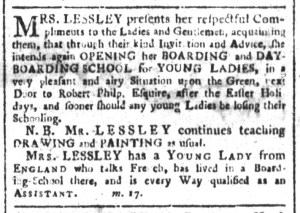
“She intends again OPENING her BOARDING and DAY-BOARDING SCHOOL.”

Mrs. Lessley ran a “BOARDING and DAY-BOARDING SCHOOL for YOUNG LADIES” in Charleston in the 1770s. She closed the school for a while, as schoolmasters and schoolmistresses often did for various reasons, but, as spring arrived in 1775, she took to the pages of the South-Carolina and American General Gazette to announce that she planned on “again OPENING” her school “after the Easter Holiday.”  She decided to do so, she stated, at the “kind Invitation and Advice” of “Ladies and Gentlemen” familiar with her school, offering an implicit endorsement she hoped would convince prospective pupils and their families.

Lessley also gave information about others who worked at her school.  “MR. LESSLEY continues teaching DRAWING and PAINTING as usual,” enriching the curriculum offered by his wife.  Readers, especially former students, may have assumed that was the case, but they did not necessarily know about a new employee.  The schoolmistress reported that she “has a YOUNG LADY from ENGLAND who talks French, has lived in a Boarding-School there, and is every Way qualified as an ASSISTANT.”  Those cosmopolitan skills and experiences enhanced the education that Lessley provided for her charges.  Her assistant aided in teaching a language considered a marker of gentility among the gentry and those who aspired to join their ranks.  Perhaps she even served as the primary instructor for that subject.  She may have consulted with Lessley on replicating an English boarding school without students having to cross the Atlantic while also serving as a role model for how “YOUNG LADIES” should comport themselves at such a school.

The schoolmistress gave less attention to the amenities at her school, though she did mention that it was located “in a very pleasant and airy Situation upon the Green.”  With classes slated to begin sometime after April 16, she assured prospective students and their families that they would live and learn in a comfortable environment.  She also indicated that she would commence lessons “sooner should any young Ladies be losing their Schooling.”  In other words, if other schoolmasters and schoolmistresses closed or suspended their schools, Lessley would gladly accept their students.  She hoped that these additional appeals in combination with her description of those who taught at her school would help in encouraging prospective pupils and their families to enroll.

March 22

What was advertised in a colonial American newspaper 250 years ago today?

Essex Journal (March 22, 1775).

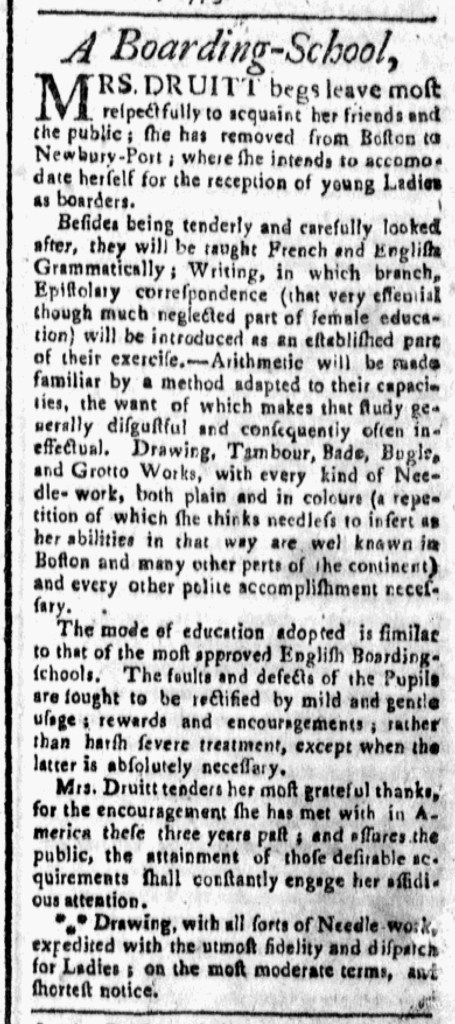
“The mode of education adopted is similar to that of the most approved English Boarding-schools.”

When Eleanor Druitt moved to Newburyport from Boston in the spring of 1775, she placed an advertisement in the local newspaper, the Essex Journal, to announce that she planned to open a boarding school for “young Ladies.”  According to her notice, she had been in the colonies for just three years, yet in that time she had established a reputation for educating young women that she hoped would serve her well in her new town.  Druitt provided a “mode of education … similar to that of the most approved English Boarding-schools,” offering pupils in Massachusetts the same benefits.

The schoolmistress gave an overview of the curriculum, emphasizing that students would learn “French and English Grammatically” and “Writing, in which branch, Epistolary correspondence (that very essential though much neglected part of female education) will be introduced as an established part of their exercise.”  In other words, she taught young women how to write polite letters that would serve them well in maintaining relationships with family and friends in other cities and towns.  Her students also learned arithmetic, “made familiar by a method adapted to their capacities, the want of which makes that study generally disgustful and consequently often ineffectual.”  Druitt had a much higher estimation of young women’s aptitude for drawing, embroidery, and other kinds of decorative “Needle-work,” asserting that she “thinks needless to insert” a longer description “as her abilities in that way are well known in Boston and many other parts of the continent.”  The families of prospective pupils may have seen some of the advertisements she ran in Boston’s newspapers over the past three years since those publications circulated in Newburyport and other towns in Massachusetts and New Hampshire.  In general, her curriculum focused on “polite accomplishment[s]” to distinguish the “young Ladies” that she “tenderly and carefully looked after.”

To that end, Druitt declared that the “faults and defects of the pupils [will] be rectified by mild and gentle usage.”  That meant “rewards and encouragement; rather than harsh severe treatment.”  Parents did not need to worry about the treatment their daughters would receive when boarding with Druitt, though she did state that she would adopt some of those stricter methods as a last resort when “absolutely necessary.”  The schoolmistress suggested that she established just the right balance of encouragement and discipline that allowed pupils at her boarding school to thrive.  Families had a variety of concerns as the imperial crisis intensified in the spring of 1775, but they need not worry about the “reception” their daughters would experience at Druitt’s boarding school.

February 10

What was advertised in a colonial American newspaper 250 years ago today?

South-Carolina and American General Gazette (February 10, 1775).

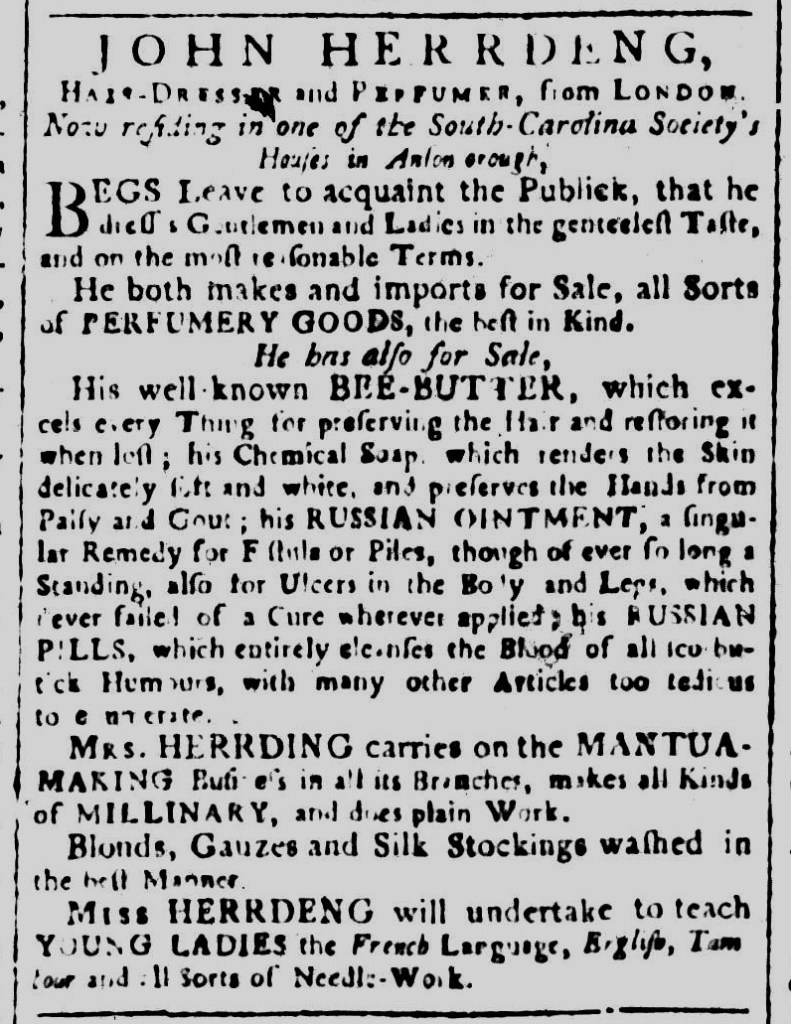
“JOHN HERRDENG, HAIR-DRESSER and PERFUMER.”

“MRS. HERRDING carries on the MANTUA-MAKING Business.”

“MISS HERRDENG will undertake to teach YOUNG LADIES the French Language.”

At a glance, the headline for an advertisement in the February 10, 1775, edition of the South-Carolina and American General Gazette promoted goods and services provided by John Herrdeng, a “HAIR-DRESSER and PERFUMER, from LONDON,” yet when they perused it more closely readers discovered that the notice also included entrepreneurial activities undertaken by other members of the Herrdeng household.  Descriptions of “PERFUMERY GOODS” and medicines that Herrdeng made and sold accounted for the first two thirds of the advertisements.  The final third outlined Mrs. Herrdeng’s “MANTUA-MAKING Business” and Miss Herrdeng offering lessons in French, English, and Needlework to the “YOUNG LADIES” of Charleston.

On occasion, the Adverts 250 Project has examined newspaper advertisements jointly placed by husbands and wives, brothers and sisters, or other relations residing in the same household.  This unusual advertisement, however, featured three family members who each pursued their own occupations.  As was often (but not always) the case, the man of the household received top billing.  Not only did the description of John Herrdeng’s goods and services take up the most space in the advertisement, his name, in larger font, appeared as the headline.  The order that the other members of the household appeared indicated their status and, likely, their experience.

Mrs. Herrdeng and Miss Herrdeng were not the only female entrepreneurs who advertised in that issue of the South-Carolina and American General Gazette.  Ann Fowler ran an advertisement for paper hangings and textiles that she also placed in the South-Carolina Gazette and Country Journal.  It filled almost as much space as the Herrdengs’ notice.  At the top of the column, Jane Thomson, a milliner, encouraged consumers to avail themselves of her services.  These advertisements made Fowler’s and Thomson’s presence in the marketplace much more visible in the public prints than Mrs. Herrdeng and Miss Herrdeng.  The Herrdengs made different decisions about how to depict themselves as entrepreneurs, yet their advertisement testifies to the contributions they made to their household beyond assisting a husband and father in his occupation.  The Herrdeng women practiced their own trades, engaged with their own clients, and resorted to advertising to facilitate their work.

June 18

What was advertised in a colonial American newspaper 250 years ago today?

Providence Gazette (June 18, 1774).

“Mrs. Phillips comes well recommended from several Gentlemen that have employed her in New-London.”

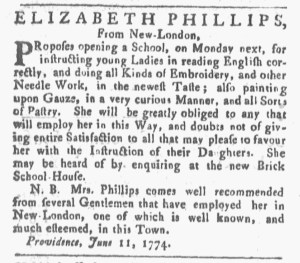
References upon request.  That was part of the marketing strategy deployed by Elizabeth Phillips when she relocated from New London to Providence.  Upon her arrival in Rhode Island, she placed an advertisement in the Providence Gazette to inform her new neighbors that she “PRoposes opening a School … for instructing young Ladies in reading English correctly, and doing all Kinds of Embroidery, and other Needle Work, in the newest Taste.”  Her curriculum also included “painting upon Gauze, in a very curious Manner, and [making] all Sorts of Pastry.”  Her pupils learned a variety of feminine arts.

The schoolmistress declared that she “will be greatly obliged to any that will employ her in this Way, and doubts not of giving entire Satisfaction to all that may please to favour her with the Instruction of their Daughters.”  Yet the newcomer realized that the public in Providence did not know her and lacked familiarity with her reputation for running a school. Phillips sought to counter that with a nota bene in which she claimed that she “comes well recommended from several Gentlemen that have employed her in New-London.”  Parents of prospective students did not have to take her word for it since “one of which is well known, and much esteemed, in this Town.”  Phillips did not reveal the identity of this gentleman in the public prints, but readers could learn more “by enquiring at the new Brick School-House.”  When they did, that gave the schoolmistress opportunities to share examples of the embroidery and painting she taught in addition to revealing who could speak on her behalf.  She likely supposed that engaging with the parents of prospective students in person would garner enrollments just as effectively as recommendations from previous employers, so offering references on request served as a means of initiating those interactions.

October 31

What was advertised in a colonial American newspaper 250 years ago today?

South-Carolina and American General Gazette (October 31, 1770).

“MRS. SWALLOW begs Leave to inform the Publick.”

Newman Swallow and Mrs. Swallow, presumably husband and wife, both ran newspaper advertisements in late October and early November 1770.  Newman advised prospective clients that he “proposes carrying on the FACTORAGE BUSINESS,” serving as a broker in Charleston.  Mrs. Swallow planned to open a boarding school for “young Ladies” at a new house “next Door to his Honour the Lieutenant-Governour’s” in Broad Street.  Their advertisements first appeared, one above the other, in the October 30, 1770, edition of the South-Carolina Gazette and Country Journal.  The following day both advertisements also ran, again one above the other, in the South-Carolina and American General Gazette.  The November 1 edition of the South-Carolina Gazette included both notices, once again one above the other.  In the course of three consecutive days, the Newmans disseminated their advertisements in all three newspapers published in Charleston, maximizing exposure for their enterprises among readers throughout the busy port and the rest of the colony.

Careful examination of their advertisements reveals differences in format but not content.  The Newmans submitted the same copy to the three printing offices in Charleston, but the compositors who set type for the newspapers exercised discretion over typography and other aspects of graphic design.  Variations in font sizes, font styles, words appearing in all capital letters or italics, and the use of ornaments all testified to the role of the compositor in making decisions about how each advertisement would look on the page.  In two of the newspapers, “NEWMAN SWALLOW” and “MRS. SWALLOW” served as headlines, but not in the third.  Similar examples appeared in newspapers published in Boston, New York, Philadelphia, and Williamsburg during the era of the American Revolution.  In towns large enough to support more than one newspaper, advertisers frequently placed notices in two, three, or more publications.  The copy remained consistent across newspapers, but the graphic design varied.  This demonstrated an important division of labor in the production of newspaper advertisements in eighteenth-century America.  Advertisers dictated the contents, but usually asserted little control over the format.  Compositors exercised creativity in designing how the copy appeared on the page, influencing how readers might engage with advertisements when they encountered them in the public prints.

March 9

What was advertised in a colonial American newspaper 250 years ago today?

Mar 9 - 3:9:1770 New-Hampshire Gazette
New-Hampshire Gazette (March 9, 1770).

“She will endeavour to Teach young MISSES the various Arts and Branches of NEEDLE WORK.”

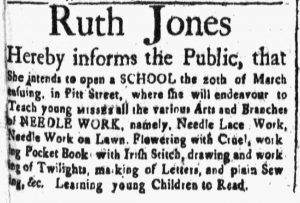
When Ruth Jones prepared to open a school in Portsmouth in 1770, she placed an advertisement in the New-Hampshire Gazette to inform the community of her intent as well as attract students.  Given the curriculum, Jones restricted her pupils to girls or, as she put it, “young MISSES” who desired to learn “all the various Arts and Branches of NEEDLE WORK.”  She planned to teach “Needle Lace Work, Needle Work on Lawn, Flowering with Cruel, working Pocket Book with Irish Stitch, drawing and working of Twilights, marking of Letters, and plain Sewing.”  She added “&c.” (the eighteenth-century abbreviation for et cetera) to the end of the list to indicate that she possessed skills in other “Arts and Branches” of needlework that she could also transmit to pupils in her charge.  She depicted herself as much as an artisan as a schoolmistress, replicating the language of “Arts and Branches” of a trade that frequently appeared in newspaper advertisements placed by artisans of all sorts.

Jones supplemented her “NEEDLE WORK” curriculum with teaching “young Children to Read,” though she did not mention writing and arithmetic nor any advanced subjects that schoolmasters and many schoolmistresses included in their advertisements.  While she covered a vast array of techniques for using the needle, her curriculum was otherwise narrow and specialized.  She delivered instruction primarily in a homosocial environment.  Presumably any boys among her pupils learning to read were quite young rather than adolescents.  Parents of “young MISSES” did not need to worry about distractions caused by young men at Jones’s school.  The advertisement suggested that they would be able to focus on their stitches, interacting with each other but not the opposite sex.

Jones advanced two primary appeals in her advertisement.  She underscored her own expertise in needlework, listing the many “Arts and Branches” of the trade that she had mastered and could pass on to pupils.  She also sketched a homosocial learning environment in which young women could master the various stitches free from interruptions by young men.  She did not explicitly make the same appeals about tending to the manners and comportment of her female charges as other schoolmistresses made in their advertisements, but parents of prospective pupils may have considered that implied in Jones’s notice.

August 9

What was advertised in a colonial American newspaper 250 years ago today?

Aug 9 - 8:9:1769 Georgia Gazette
Georgia Gazette (August 9, 1769).

“A BOARDING SCHOOL in Savannah, for the education of young ladies.”

In the summer of 1769 Elizabeth Bedon proposed opening a boarding school “for the education of young ladies” in Savannah, but only if she “meets with the proper encouragement” from other colonists. She inserted an advertisement in the Georgia Gazette that provided an overview of the curriculum (“Reading, Writing, Arithmetick, and all kinds of Needle Work”) and the tuition for day scholars, day boarders, night boarders, and students who wished to attend only the lessons on needlework.

Bedon used her advertisement to undertake rudimentary market research, much like printers used subscription notices to determine whether publishing a particular book would be a sound investment of their time and resources. She identified the enterprise she wished to pursue, but made opening the school contingent on receiving encouragement from the parents and guardians of prospective pupils. Bedon stated that “it does not suit her to open school until she can engage such a number of scholars as will render it worth her while.” To that end, she invited “those who intend to intrust their children under her care” to send a message. Once she had a sufficient number of students she would open her school, just as printers took books to press once they achieved a sufficient roster of subscribers. On the other hand, if she could not enroll enough students to make her school a viable venture she was not obligated to instruct any who had indicated interest, just as printers did not publish books for an inadequate number of subscribers.

Printers most often used advertising – both newspaper notices and separate subscription papers – to conduct market research and estimate demand for particular products in eighteenth-century America, but members of other occupational groups sometimes adopted similar methods to better determine their prospects for success before launching a new endeavor. Elizabeth Bedon, for instance, used the public prints to present a proposal for a boarding school for young ladies to colonists in Georgia. She anticipated using the results derived from this minor investment to determine her next step.