September 7

What was advertised in a revolutionary American newspaper 250 years ago today?

Massachusetts Gazette and Boston Weekly News-Letter (September 7, 1775).

“At the Sign of the Unicorn and Mortar … the best and freshest drugs and medicines.”

An unsigned advertisement in the September 7, 1775, edition of the Massachusetts Gazette and Boston Weekly News-Letter promoted “ALL kinds of the best and freshest drugs and medicines” available “At the Sign of the Unicorn and Mortar in Marlborough Street.”  Silvester Gardiner advertised “Drugs and Medicines, both Chymical and Galenical,” and “Doctor’s Boxes” and “Surgeon’s Chests” for ships that he sold “at the Sign of the Unicorn and Mortar inMarlborough-Street” in the Boston Evening-Post as early as June 18, 1744.  He continued running advertisements that featured both his name and his shop sign for seven years, but by the middle of the 1750s advertisements that directed prospective customers to the Unicorn and Mortar no longer included the name of the proprietor.  Perhaps Gardiner believed that his name had become synonymous with the image that branded his shop.  If so, he may have been the apothecary who placed the advertisement in the fall of 1775.  On the other hand, another entrepreneur may have acquired the shop and the sign at some point and determined that it made good business sense to continue selling medicines at a familiar location marked with a familiar image.

The Unicorn and Mortar was a popular device among apothecaries in colonial America.  Just as Boston had a shop “At the Sign of the Unicorn and Mortar,” so did Hartford, New York, Philadelphia, Providence, and Salem.  The partnership of Gardiner and Jepson sold a “complete Assortment” of medicines “at the Sign of the Unicorn and Mortar, in Queen-Street, HARTFORD,” according to advertisements in the May 5, 1759, edition of the Connecticut Gazette, published in New Haven, and the March 21, 1760, edition of the New-London Summary.  Hartford did not have its own newspaper until 1764, so Gardiner and Jepson resorted to newspapers published in other towns to encourage the public to associate the Unicorn and Mortar with their business.  The experienced Silvester Gardiner may have taken William Jepson as a junior partner to run the shop in Hartford.  A few years later, Jepson, “Surgeon and Apothecary, at the Unicorn and Mortar, in Queen Street, Hartford,” ran advertisements on his own, starting with the December 21, 1767, edition of the Connecticut Courant.  Within a decade, Hezekiah Merrill, “APOTHECARY and BOOKSELLER,” advertised his own shop “at the Sign of the Unicorn and Mortar, a few Rods South of the Court-House in Hartford.”  He ran a full-page advertisement in the December 21, 1773, edition of the Connecticut Courant and many less extensive advertisements in other issues.  When Merrill opened his “New STORE” he did not refer to it as the Unicorn and Mortar.  Perhaps he eventually acquired the sign from Jepson, whose advertisements no longer appeared, and hoped to leverage the familiar image at a new location.  Residents of Hartford recognized the Unicorn and Mortar and associated it with medicines no matter who ran the shop, whether Gardiner and Jepson, Jepson alone, or Merrill.

Apothecaries in other towns also marked their locations with the Unicorn and Mortar.  Patrick Carryl announced that he moved “to the Sign of the Unicorn and Mortar” in the May 23, 1748, edition of the New-York Gazette.  He ran advertisements for more than a decade, always associating his name with his shop sign.  John Prince ran an advertisement in the February 6, 1764, edition of the Boston Post-Boy to announce that “he has lately Opened his Shop at the Sign of the Unicorn and Mortar, near the Town-House in Salem.”  John Sparhawk operated his own apothecary shop “At the Unicorn and Mortar, in Market-Street, near the Coffee-House,” in Philadelphia, according to his advertisement in the December 18, 1766, edition of the Pennsylvania Gazette.  By the time he advertised in the Pennsylvania Chronicle on March 4, 1771, he gave the full name as the “London Book-store, and Unicorn and Mortar.”  In that notice and others, he promoted a “NEAT edition of TISSOT’s Advice to the People respecting their Health” in addition to “Drugs and Medicines of all kinds as usual.”  Building his brand, Sparhawk placed many newspaper advertisements that mentioned the Unicorn and Mortar over the course of several years.  Benjamin Bowen and Benjamin Stelle sold “MEDICINES … at the well-known Apothecary’s Shop … at the Sign of the Unicorn and Mortar,” according to their advertisement in the August 25, 1770, edition of the Providence Gazette.  Apothecaries in other towns likely marked their locations with a sign depicting the Unicorn and Mortar.  It became a familiar emblem that consumers easily recognized by the time that the anonymous advertiser ran a notice in the Massachusetts Gazette and Boston Weekly News-Letter in the fall of 1775.

April 11

What was advertised in a colonial American newspaper 250 years ago today?

South-Carolina Gazette and Country Journal (April 11, 1775).

“The Sign of the NEGRO BOY.”

The April 11, 1775, edition of the South-Carolina Gazette and Country Journal carried seventeen advertisements about enslaved people.  Several offered enslaved people for sale.  Jacob Valk, a broker who regularly advertised, noted that “NEGROES of different Qualifications” were “daily for SALE” at his office.  Valentine Lynn sought to sell “Seven healthy, stout NEGROES,” including “a good boatman,” a “handy” domestic servant, and five “field slaves.”  Robert Goudey announced that he “will dispose of, by private contract,” nearly three dozen enslaved people, “among whom are carpenters, coopers, wagon drivers, plough men, and house” maids.  Prospective purchasers could presumably examine those enslaved people, just as they could examine any of the eleven Black men and women “Brought to the Workhouse” and imprisoned there until their enslavers claimed them.

Other advertisements certainly enlisted readers in examining Black bodies closely to determine if they matched the descriptions of enslaved people who liberated themselves by running away from their enslavers.  William Stitt, for instance, asked readers to take note of any Black women they encountered who might be Lydia, “about 40 years of age, of a yellowish complexion.”  William Roberts described Tena, who “had on when she went away, a blue negro cloth gown, and osnaburgs apron.”

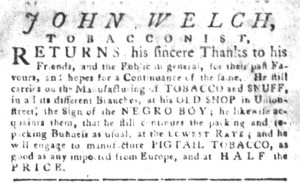
Yet these were not the only instances of Black bodies on display in Charleston.  In a notice asking others to settle accounts before he left the city for a while, John Welch, a tobacconist, advised his “Friends and Customers” that associates would conduct business “as usual” at his “SHOP in Union-street, the Sign of the NEGRO BOY.”  He may have chosen that emblem to represent the laborers who cultivated the tobacco he sold.  By the time Welch ran his advertisement in the spring of 1775 the sign that marked his shop was a familiar sight to those who traversed the streets of Charleston.  He referenced it in an advertisement the previous summer, so it had been in place for the better part of a year and probably longer, especially considering that he also referred to that location as his “old SHOP.”  Welch’s commercial enterprise appropriated the labor the enslaved men and women who raised the tobacco he sold, but that was not the extent of his use of Black bodies in earning his livelihood.  He also deployed an image of a Black boy as the emblem of his business and the device that confirmed customers arrived at the right location to purchase tobacco and snuff.

March 15

What was advertised in a colonial American newspaper 250 years ago today?

Essex Journal (March 15, 1775).

The Sign of the GOLDEN EAGLE.”

In an era before standardized street numbers, colonizers used a variety of methods for giving directions and marking locations.  For instance, the colophon for the Essex Gazette noted that Ezra Lunt and Henry-Walter Tinges ran their printing office in “KING-STREET, opposite to the Rev. Mr. PARSONS’s Meeting-House” in Newburyport.  Some of the advertisements in the March 15, 1775, edition of their newspaper also gave directions in relation to other locations.  Robert Fowle, a stonecutter from Boston, advised prospective customers that he now had a workshop “next to Mr. Jonathan Titcomb’s store, near Somersby’s Landing,” places that he believed were familiar to local readers.  John Vinal ran a school “nearly opposite Mr. Davenport’s Tavern.”  Thomas Mewse gave even more elaborate directions to the site where he “CUTS Stamps and prepares a Liquid for Marking” textiles with the names of the owners, stating that he “may be spoke with at Mr. Jacksons, next door to Dr. Coffin’s, in Rogers’s-street, Newbury-Port.”

Another advertiser relied on a shop sign to mark the location where customers could purchase “English CHEESE,” “A good Assortment of English and Piece Goods, Iron-mongery, Cutlery and Braziery Ware,” and other merchandise: “the Sign of the GOLDEN EAGLE, Near the Court House.”  References to shop signs did not appear in advertisements in the Essex Journal as often as in advertisements inserted in newspapers published in Boston, New York, and Philadelphia, in part because that newspaper carried fewer paid notices than the others.  In addition, Newburyport was a smaller town with fewer businesses that relied on such devices to mark their locations.  Yet an advertisement that directed readers to “the Sign of the GOLDEN EAGLE” demonstrates that shop signs became part of the visual culture that colonizers encountered as they traversed the streets of smaller ports, not just major urban centers.  Few shop signs from the colonial era survive today.  Newspaper advertisements testify to the existence of this method that merchants, shopkeepers, and artisans used to establish commercial identities and mark their locations.

July 12

What was advertised in a colonial American newspaper 250 years ago today?

South-Carolina Gazette and Country Journal (July 13, 1774).

“The Sign of the NEGRO BOY.”

When John Welch, a tobacconist, advertised in the July 12, 1774, edition of the South-Carolina Gazette and Country Journal, he invited “his Friends, and the Public in general” to “his OLD SHOP in Union-street, the Sign of the NEGRO BOY.”  That emblem linked the commodity that Welch’s customers consumed to the enslaved men, women, and children who played such a significant role in producing it.  While Welch emphasized his role in the final stage of “the Manufacturing of TOBACCO and SNUFF, in all its different Branches” to make those items available on the market, the “Sign of the NEGRO BOY” merely hinted at the enslaved labor that raised tobacco on plantations.

South-Carolina Gazette and Country Journal (July 12, 1774).

Welch’s sign was one more instance of putting Black bodies on display in the colonies during the era of the American Revolution.  At auctions and as they went about their daily lives, the bodies of enslaved people were scrutinized by colonizers.  Advertisements that provided descriptions of enslaved people who liberated themselves by running away from their enslavers and offered rewards for their capture and return encouraged even more careful observation of Black bodies.  Other advertisements announcing enslaved people for sale incorporated images of Black bodies.  Those woodcuts, stock images supplied by printers, were nondescript and interchangeable, further dehumanizing the people they represented in a system that treated them as commodities.  An image of a Black man accompanied an advertisement about “A CARGO OF ONE HUNDRED & TWENTY PRIME NEGROES … directly from SIERRA-LEON, a Rice Country, on the Windward Coast of AFRICA” in the same column as Welch’s advertisement.

Variations of the “Sign of the NEGRO BOY” marked the locations of shops in other towns.  In March 1766, August Deley advertised tobacco “At the Sign of the Black Boy … in Hartford” in the Connecticut Courant.  Jonathan Russell peddled a “NEW and FRESH Assortment of English and India GOODS … at the Sign of the BLACK-BOY” in Providence in May 1767.  In December 1768, he gave a different description, “the Sign of the Black Boy and Butt.”  Perhaps he had a new sign that incorporated a large barrel along with the boy, though he may have added a detail that he did not mention in his previous advertisement.  Several months later, Samuel Young promoted an “Assortment of European, East and West-India GOODS” in stock at his store at “the Sign of the Black Boy” in Providence.  Four years after that, he continued business “At the Sign of the Black Boy” in May 1773.  Jonathan Williams gave his location as “the Black Boy and Butt in Cornhill” in the Massachusetts Gazette and Boston Weekly News-Letter in September 1770 and in the Boston Evening-Post in April 1771.  Advertisers in northern colonies as well as southern ones deployed images of Black bodies in marking their locations.

Colonizers appropriated the labor of enslaved men, women, and children in producing commodities for market throughout the Atlantic world and beyond, but that was not the extent of the appropriation that took place.  They also appropriated images of Black bodies to market goods, to sell Black people they treated as commodities, and to encourage surveillance of Black people to determine whether they were fugitives for freedom who liberated themselves from their enslavers.

May 18

What was advertised in a colonial American newspaper 250 years ago today?

Pennsylvania Gazette (May 18, 1774).

“At the Sign of the SCYTHE and SICKLE.”

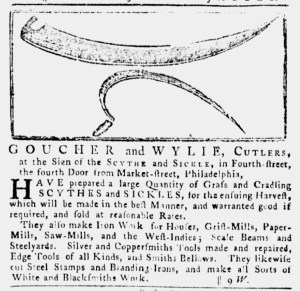
For marking the location of their workshop and for adorning their newspaper advertisements, Goucher and Wylie, cutlers, used an image closely associated with their trade.  In an advertisement that ran in the Pennsylvania Gazette for several weeks in the spring and summer of 1774, they advised prospective customers that they made and sold all kinds of cutlery “at the Sign of the SCYTHE and SICKLE.”  The woodcut that accompanied their notice depicted a scythe and a sickle within a rectangular border, perhaps replicating their shop sign or perhaps merely evoking the same symbols.  Either way, the image made their advertisement more visible to readers while simultaneously prompting them to think of Goucher and Wylie when they glimpsed scythes and sickles.

Yet they were not the only cutlers to operate at the Sign of the Scythe and Sickle in Philadelphia in the early 1770s.  Stephen Paschall and his son, also named Stephen, previously ran advertisements that gave their location as “the Sign of the Scythe and Sickle, in Market-street, between Fourth and Fifth-streets,” the most recent appearing a year before Goucher and Wylie published their notice.  In the longer version of their location, Goucher and Wylie directed customers to “the Sign of the SCYTHE and SICKLE, in Fourth-street, the fourth Door from Market-street.”  In other words, Goucher and Wylie were just around the corner from the Paschalls.  Did both businesses use the same device in such close proximity?  Or had the Paschalls closed shop, leaving the Sign of the Scythe and Sickle up for grabs for any cutlers who wished to appropriate it (and perhaps benefit from the reputation already associated with that image)?  Alternately, the Paschalls might have transferred the Sign of the Scythe and Sickle to Goucher and Wylie.

Let’s examine the evidence for that last possibility.  In June 1770, Samuel Wheeler advertised that he kept shop “at the sign of the Scythe, Sickle and Brand-iron” at the same time that Stephen Paschall ran notices that gave his location as “the sign of the Scythe and Sickle, in Market-street.”  Wheeler carefully added an item to his sign to distinguish his business from Paschall’s.  Had the elder and younger Paschall still been in business around the corner in 1774, Goucher and Wylie may have hesitated to duplicate their sign and, by extension, the name of their business.  In May 1768, Stephen Paschall and Benjamin Humphreys placed a joint advertisement that featured an image of a scythe and sickle enclosed in a rectangular border.  Both items bore the name “HUMPHREYS.”  That woodcut appears identical to the one in Goucher and Wylie’s advertisement that ran six years later, with the exception of “HUMPHREYS” being removed.  Perhaps Paschall had retained the woodcut when his association with Humphreys ended but had not made use of it.  He could have passed along the woodcut to Goucher and Wylie when transferring the Sign of the Scythe and Sickle to them.  If this scenario did occur, it suggests that some artisans carefully curated the names and images associated with their businesses in colonial Philadelphia.

March 28

What was advertised in a colonial American newspaper 250 years ago today?

Supplement to the New-York Gazette and Weekly Mercury (March 28, 1774).

“The Sign of the SUN and BREECHES.”

Cornelius Ryan, “LEATHER DRESSER and BREECHES MAKER,” pursued his trade at “the Sign of the SUN and BREECHES, IN THE BROADWAY” in New York.  Residents and visitors to the busy port likely glimpsed his sign as they traversed the streets of the city.  Readers of the New-York Gazette and Weekly Mercury almost certainly noticed the woodcut that adorned the advertisements he ran in that newspaper.  It included the same elements as the sign that marked his location, a sun above a pair of breeches.  The sun had a face that stared directly at readers as well as eight rays enclosed within a corona.  In addition, the initials “CR,” for Cornelius Ryan, appeared between the legs of the breeches.  The woodcut may or may not have replicated Ryan’s sign; at the very least, it strengthened the association that the leather dresser and breeches maker wanted consumers to have with his business and visual representations of it.

To achieve that, Ryan invested in commissioning a woodcut stylized for his exclusive use.  Most entrepreneurs did not go to such lengths when they advertised in colonial newspapers, though Smith Richards, who kept shop “At the Tea canister and two sugar loaves,” once again included a woodcut depicting those items in his notice in the same supplement that carried Ryan’s advertisement.  Nesbitt Deane advertised hats he “Manufactured,” but did not adorn his notice with the image of a tricorne hat and his name within a banner that he had included in other notices on several occasions over the years.  Since advertisers paid by the amount of space their notices occupied rather than the number of words, woodcuts amounted to significant additional expense beyond the costs of producing them.  For Ryan, the woodcut accounted for nearly half of his advertisement, doubling the cost of running it in the New-York Gazette and Weekly Mercury.  He may very well have considered it worth the investment if the striking image prompted prospective customers to read the copy more closely.  The visual image served as a gateway for the appeals to skill, quality, price, consumer choice, and customer satisfaction that followed.

March 5

What was advertised in a colonial American newspaper 250 years ago today?

Providence Gazette (March 5, 1774).

“The Advertiser once had a small Sign of a Sugarloaf affixed to his little Shop.”

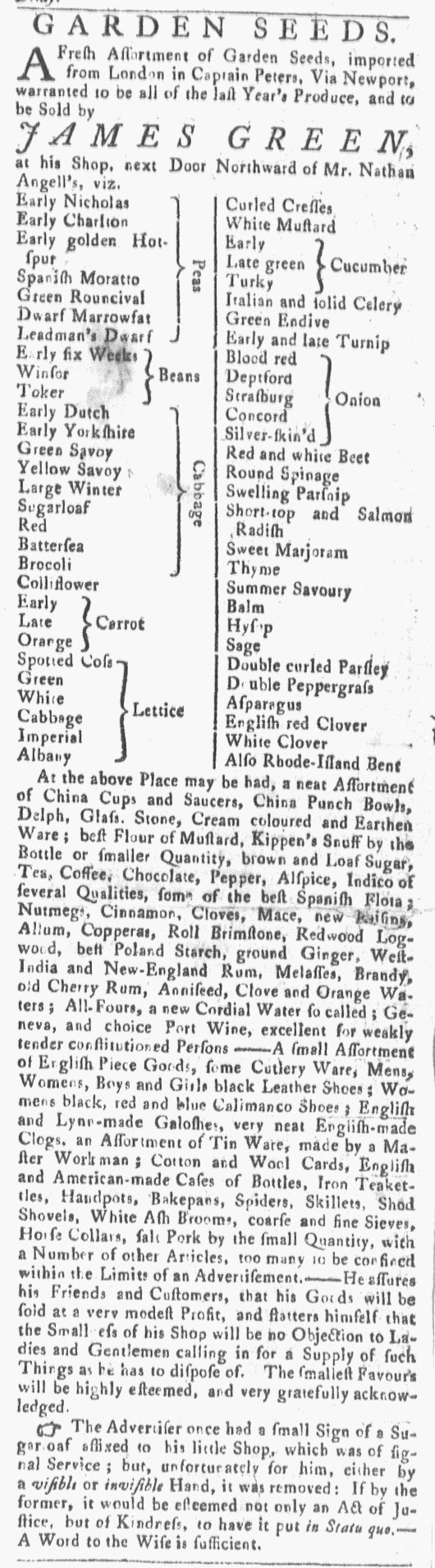
As spring approached in 1774, advertisements for “GARDEN SEEDS” appeared in newspapers in New England.  John White was the first to advertise in Boston, soon joined by Susanna Renken, Elizabeth Clark, Elizabeth Greenleaf, Elizabeth Nowell, and other women who annually announced they sold seeds in the city’s newspapers.  As Abel Buell hawked firearms in the Connecticut Journal, Nathan Beers promoted “Garden Seeds, Both of English and American Growth.”  In Rhode Island, James Green placed an extensive advertisement for a “Fresh Assortment of Garden Seeds” in the Providence Gazette, as he had done the previous year.  The format distinguished it from other notices, the various types of peas, beans, cabbage, carrot, lettuce, cucumber, and onion clustered together and labeled by category.

Unlike most other seed sellers, Green also marketed all sorts of housewares, garments, and groceries in his advertisement.  That significantly contributed to the length of a notice that extended more than two-thirds of a column.  Green stocked everything from “a neat Assortment of China Cups and Saucers” and “Womens black, red and blue Calimanco Shoes” to “best Four of Mustard” and “Kippen’s Snuff by the Bottle or smaller Quantity.”  Yet that was not all.  He asserted that his inventory included “a Number of other Articles, too many to be confined within the Limits of an Advertisement.”  A newspaper notice could not contain all the choices Green made available to consumers!  The shopkeeper also made an appeal to price, “assur[ing] his Friends and Customers, that his Goods will be sold at a very modest Profit.”  Conversationally, he confided that he “flatters himself that the Smallness of his Shop will be no Objection to Ladies and Gentlemen calling in for a Supply of such Things he has to dispose of.”

All of that was standard for advertisements in newspapers published throughout the colonies.  A final note, however, discussed unusual circumstances that agitated the shopkeeper.  “The Advertiser once had a small Sign of a Sugarloaf affixed to his little Shop,” Green noted.  In marking his location, it “was of signal Service.”  Yet the sign no longer adorned his shop: “unfortunately for him, either by a visible or invisible Hand, it was removed.”  Perhaps bad weather, an “invisible Hand, had carried it away, but if that was not the case, if some prankster had taken it then Green petitioned for its return: “it would be esteemed not only an Act of Justice, but of Kindness, to have it put in Status quo.”  Using an eighteenth-century version of “no questions asked,” he declared that “A Word to the Wise is sufficient.”  If anyone knew what had happened to the sign, he hoped that they would encourage whoever had it to put it back where it belonged.  Green was not interested in the details of where his sign had been or who took it, only its return to its rightful place as the emblem designating his place of business.  The shopkeeper made an aside in his newspaper advertisement to tend to other forms of marketing associated with his shop in Providence.

March 1

What was advertised in a colonial American newspaper 250 years ago today?

Essex Gazette (March 1, 1774).

“To be SOLD at the Six Sugar Loaves.”

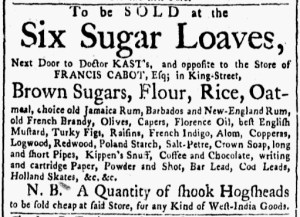
It was an unusual headline for an advertisement.  The name of the store served as the headline, distinguishing it from the other notices in the March 1, 1774, edition of the Essex Gazette.  In newspapers throughout the colonies, the name of the merchant, shopkeeper, or artisan often appeared as the headline.  Such was the case for advertisements placed by John Appleton, Benjamin Coats, George Deblois, John Prince, and Nathaniel Sparhawk in that issue of the Essex Gazette.  Sometimes the merchandise, product, or service served as the headline, as in Walter P. Bartlett’s notice promoting “Garden Seeds,” Ezekiel Price’s advertisement for “INSURANCE,” and auctioneer W.P. Bartlett’s notice about an upcoming “PUBLIC VENDUE.”

In contrast, an unnamed advertiser advised readers of the Essex Gazette that he or she sold a variety of groceries and other wares “at the Six Sugar Loaves … in King-Street.”  No doubt the name of the shop matched the image on a sign that marked its location.  Other advertisements did not mention shop signs and only a couple made any reference to anything like a shop name.  Price gave his location as “the Insurance-Office” and Appleton stated that his store was located “next Door above the PRINTING-OFFICE.”  In both instances, the name described the primary enterprise undertaken at each business.  The “Six Sugar Loaves” suggested only one of the many commodities sold in that shop.  The inventory in the advertisement led with “Brown Sugars” yet also included “Flour, Rice, Oatmeal,” a variety of spirits, olives, “Turkey Figs, Raisins,” “Coffee and Chocolate,” and even soap, pipes, and “Powder and Shot.”  The sign that gave its name to the store depicted one kind of merchandise sold there.

Appearing in a large font, the “Six Sugar Loaves” may have been as prominently visible on the page of the Essex Gazetteas the sign it represented was on King Street in Salem.  Its inclusion in a newspaper advertisement testifies to the visual landscape of commerce and consumer culture that colonizers encountered as they traversed the streets of port cities on the eve of the American Revolution.  Very few of those signs survive today, but advertisements catalog their extensive use in early America.

January 23

What was advertised in a colonial American newspaper 250 years ago this week?

Dunlap’s Pennsylvania Packet (January 17, 1774).

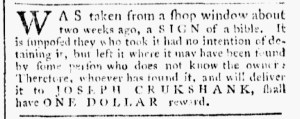
“WAS taken from a shop window … a SIGN of a bible.”

Joseph Crukshank ran a printing office and sold books at the “SIGN of a bible” in Philadelphia … some of the time.  According to an advertisement that he placed in the January 17, 1774, edition of Dunlap’s Pennsylvania Packet, his sign went missing sometime around the beginning of the year.  When he started in the trade, Crukshank did an apprenticeship with Andrew Steuart “at the Bible-in-Heart.”[1]  Perhaps he chose a similar device to mark his location as a means of encouraging an association in the minds of prospective customers familiar with his former master’s work.

“WAS taken from a shop window about two weeks ago,” Crukshank stated, “a SIGN of a bible.”  In that notice, the printer and bookseller provided information that testified to the visual culture of advertising that colonizers encountered when they traversed the streets of Philadelphia.  Although some eighteenth-century trade cards depict shop signs hanging from poles, presumably outside and perhaps perpendicular to the building so pedestrians could see them from a distance, Crukshank apparently positioned his sign in a window, facing into the street.  That gave it less visibility, but likely required less maintenance by protecting it from the weather.  Unfortunately, Crukshank did not indicate the size of the sign, though it must have been small enough for whoever took it to carry away without attracting notice.

The printer and bookseller did not believe that the culprit kept the sign but instead played a trick by abandoning it somewhere.  “It is supposed they who took it had no intention of detaining it,” he declared, “but left it where it may have been found by some person who does not know the owner.”  With that statement, Crukshank confessed the limits of deploying an image to represent his business.  Colonizers who lived in his neighborhood almost certainly recognized the “SIGN of a bible” that identified his shop, as did many others who had resided in the city for some time.  Yet he did not consider the image universally known among the denizens of the busy port.  His advertisement may have aided to establish a connection between Crukshank’s shop and his sign in the minds of those readers, a helpful bit of branding if he managed to recover the sign or replaced it.

**********

[1] Isaiah Thomas, The History of Printing in America: With a Bibliography of Printers and an Account of Newspapers (1810; New York: Weathervane Books, 1970), 386.

October 5

What was advertised in a colonial American newspaper 250 years ago today?

Connecticut Courant (October 5, 1773).

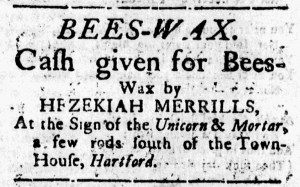
“At the Sign of the Unicorn & Mortar.”

Hezekiah Merrill ran an apothecary shop in Hartford in the early 1770s.  In October 1773, he placed advertisements in the Connecticut Courant to promote the variety of patent medicines that he sold, including Bateman’s Drops and Cordials, Turlington’s Balsam of Life, and Hooper’s Female Pills.  Each of those remedies would have been as familiar to eighteenth-century readers as popular over-the-counter medications are to modern consumers.  Merrill, like others who sold the same patent medicines, did not believe that they required descriptions when advertising them.  The apothecary also stocked books at his shop.

Merrill marked the location of his shop with “the Sign of the Unicorn & Mortar,” an appropriate image for an apothecary, and further advised prospective customers that they could find it “a few rods south of the Town-House.” Residents of Hartford regularly passed the shop and its sign, making it a familiar sight in their daily routines.  For visitors from the countryside, the sign made Merrill’s location unmistakable as they navigated town.  The apothecary encouraged consumers to associate the image of the Unicorn and Mortar with his business, treating it as a logo of sorts.  He inserted two advertisements in the October 5, 1773, edition of the Connecticut Courant, both of them invoking his shop sign.  A longer one on the first page listed the patent medicines and other merchandise, while a shorter one on the third page solicited beeswax in exchange for cash.  Just as residents of Hartford frequently glimpsed the sign, readers of the Connecticut Courant encountered “the Sign of the Unicorn & Mortar” more than once when they perused that issue.

Today, those advertisements testify to some of the sights that colonizers saw as they traversed the streets of colonial Hartford.  According to Thomas Hilldrup’s advertisement in the same issue of the Connecticut Courant, “the sign of the Dial” adorned the shop where he cleaned and repaired watches near the court house.  Other purveyors of goods and services in Hartford almost certainly displayed signs, contributing to the visual landscape of commercial activity in the town.  Few of those signs survive today, except for the descriptions of them in newspaper advertisements.