The Slavery Adverts 250 Project chronicles the role of newspaper advertising in perpetuating slavery in the era of the American Revolution. The project seeks to reveal the ubiquity of slavery in eighteenth-century life from New England to Georgia by republishing advertisements about enslaved people – for sale as individuals or in groups, wanted to purchase or for hire for short periods, runaways who liberated themselves, and those who were subsequently captured and confined in jails and workhouses – in daily digests on this site as well as in real time via the @SlaveAdverts250 Twitter feed, utilizing twenty-first-century media to stand in for the print media of the eighteenth century.
The project aims to provide modern audiences with a sense of just how often colonizers encountered these advertisements in their daily lives. Enslaved men, women, and children appeared in print somewhere in the colonies almost every single day. Those advertisements served as a constant backdrop for social, cultural, economic, and political life in colonial and revolutionary America. Colonizers who did not purport to own enslaved people were still confronted with slavery as well as invited to maintain the system by purchasing enslaved men, women, and children or assisting in the capture of so-called “runaways” who sought to free themselves from bondage. The frequency of these newspaper advertisements suggests just how embedded slavery was in colonial and revolutionary American culture in everyday interactions beyond the printed page.
These advertisements also testify to the experiences of enslaved men, women, and children, though readers must consider that those experiences have been remediated through descriptions offered by enslavers rather than enslaved people themselves. Often unnamed in the advertisements, enslaved men, women, and children were not invisible or unimportant in early America.
These advertisements appeared in colonial American newspapers 250 years ago today.
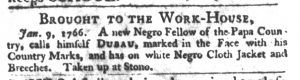
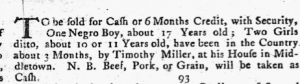
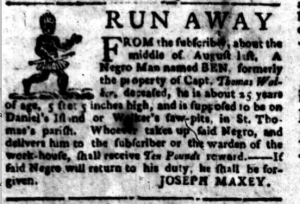
South-Carolina Gazette and Country Journal (October 7, 1766).
**********
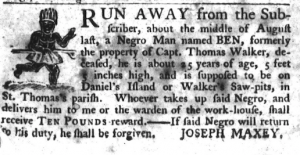
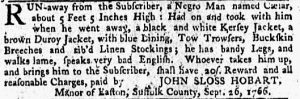
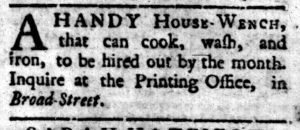
South-Carolina Gazette and Country Journal (October 7, 1766).
**********
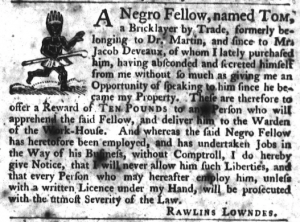
South-Carolina Gazette and Country Journal (October 7, 1766).
**********
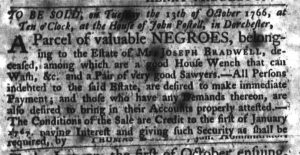
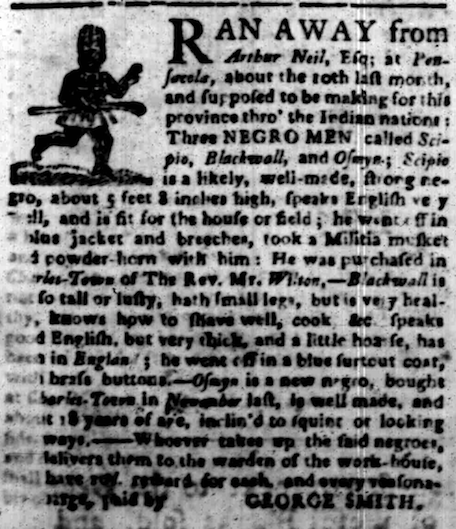
Supplement to the South-Carolina Gazette, and Country Journal (October 7, 1766).
**********
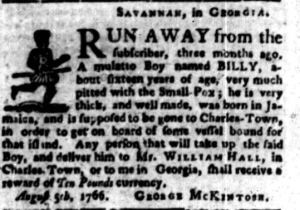
Supplement to the South-Carolina Gazette, and Country Journal (October 7, 1766).
**********
Supplement to the South-Carolina Gazette, and Country Journal (October 7, 1766).
**********
Supplement to the South-Carolina Gazette, and Country Journal (October 7, 1766).
What was advertised in a colonial American newspaper 250 years ago today?
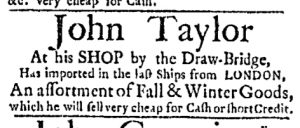
Boston Evening-Post (October 6, 1766).
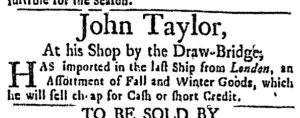
“John Taylor At his SHOP by the Draw-Bridge.”
I originally picked this advertisement from the Boston Evening-Post because John Taylor’s shop was in close proximity to a drawbridge that I researched for an entry last semester. Then this particular advertisement became more interesting when I found it in a second newspaper, the Boston-Gazette, printed on the same day by a rival publisher. As I did more research on the people and places in Boston, I learned about the printers of the Boston Evening-Post and the Boston-Gazette.
Boston-Gazette (October 6, 1766).
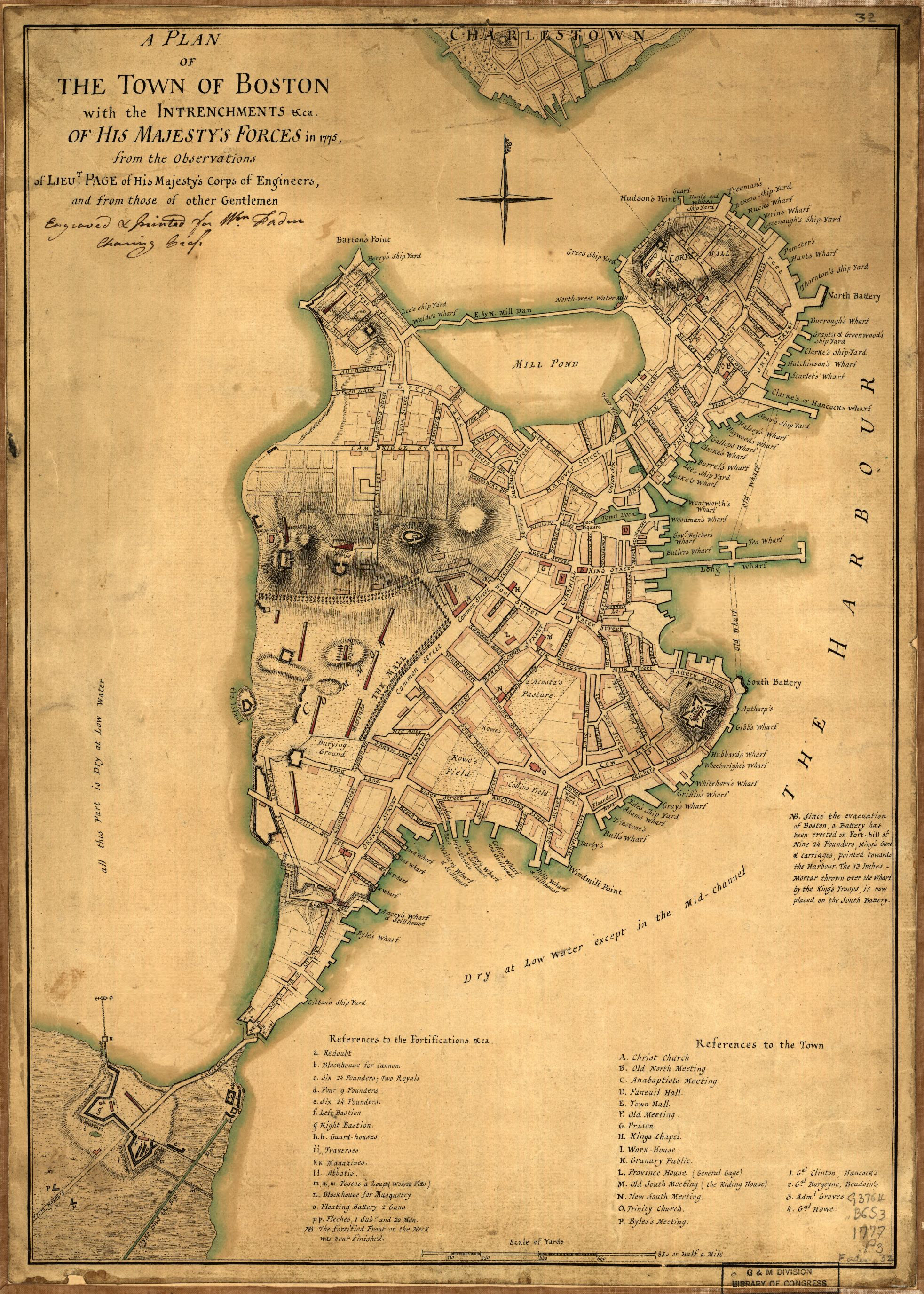
Printers have an interesting role in early American history, especially in colonial Boston. They were the ones who provided various types of entertainment and, more importantly, news and communication to the populace. Printers T. and J. Fleet at the Heart and Crown printed many items other than newspapers. They operated their shop on Cornhill Street, which was laid out in 1708 and ran from Water Street to Dock Square. (In 1789 it was renamed Washington Street.) Even from its earliest days Cornhill Street was full of intellectuals and publishers and printers. The Fleet family lived on Cornhill and ran their print shop beneath their residence.
Detail of A Plan of the Town of Boston.A Plan of the Town of Boston with the Intrenchments &ca. of His Majesty’s Forces in 1775, from the Observations of Lieut. Page of His Majesty’s Corps of Engineers, and from Those of Other Gentlemen (1777?). Library of Congress.
Thomas and John Fleet were prominent printers during the 1760s. In addition to newspapers, they sold broadsides and other important printed items that spread news and information. According to the Massachusetts Historical Society, their father started the newspaper that became the Boston Evening-Post, which they continued to print until 1776.
Benjamin Edes and John Gill printed the Boston-Gazette. These partners would over time get themselves in trouble with British authorities because of what they printed. J. L. Bell has written about many examples of the printers of the Boston-Gazette closely walking the line of legal and illegal; for an example, see “Henry Bass Spills the Beans on a Political Protest.” Edes and Gill had a large circulation and may have been the Boston Evening-Post’s biggest competition. One reason that they may have had such a large circulation and got in to trouble often was Benjamin Edes was a member of the Loyal Nine, which was a secret group of patriots, nine “young business men” who planned a protest of the Stamp Act in 1765.
**********
ADDITIONAL COMMENTARY: Carl Robert Keyes
Elizabeth brings a sense of excitement to the research she does for the Adverts 250 Project. I’m continuously impressed with the primary and secondary sources she consults and incorporates into her analysis of the advertisements she has selected. As we work through revising and refining her first drafts, often we determine that some material should be eliminated in the interest of producing a concise entry that addresses one major theme. I know from experience how difficult and disappointing it can be to jettison portions of my own research and writing when certain parts of it just don’t work out. Unfortunately, that’s one of the hard lessons that Elizabeth and the other guest curators learn as we work collaboratively through the writing, revision, and publication process.
I appreciate the way that Elizabeth has used today’s advertisement as a jumping off point for examining the printers who produced newspapers and the advertisements they contained. However, she contemplated an alternate analysis of John Taylor’s advertisement that appeared in the October 6, 1766, issue of the Boston Evening-Post. Elizabeth located the same advertisement in the Boston-Gazette, prompting her to think about how “marketing and exposure were key to drawing in consumers, even in colonial America.” This is the third week that Elizabeth has been a guest curator for the Adverts 250 Project. With that statement from her first draft, she demonstrated that she really understands some of the questions that I find most interesting about the ongoing project.
Since this is a collaborative effort, I picked up Elizabeth’s research by consulting the other two newspapers printed in Boston in 1766. John Taylor’s advertisement also appeared later in the week in the October 9, 1766, issue of the Massachusetts Gazette, furthering strengthening Elizabeth’s suspicion that Taylor was being savvy by marketing his wares in multiple newspapers, increasing his shop’s exposure to as many readers as possible. The October 6, 1766, issue of the Boston Post-Boy did not carry Taylor’s advertisement. That does not mean that he did not attempt to place it in that publication. News items and other advertisements may have squeezed out Taylor’s advertisement in that particular issue.
Massachusetts Gazette (October 9, 1766).
At the very least, Elizabeth and I have identified three newspapers that carried Taylor’s advertisement 250 years ago this week, demonstrating that the shopkeeper did calculate the benefits of increased exposure from multiple publications. As we saw in June, Jolley Allen pursued a similar strategy, placing the same advertisement in all four newspapers printed in Boston. Were these two advertisers outliers? Answering that question will require a lot more roll-up-the-sleeves research.
The Slavery Adverts 250 Project chronicles the role of newspaper advertising in perpetuating slavery in the era of the American Revolution. The project seeks to reveal the ubiquity of slavery in eighteenth-century life from New England to Georgia by republishing advertisements about enslaved people – for sale as individuals or in groups, wanted to purchase or for hire for short periods, runaways who liberated themselves, and those who were subsequently captured and confined in jails and workhouses – in daily digests on this site as well as in real time via the @SlaveAdverts250 Twitter feed, utilizing twenty-first-century media to stand in for the print media of the eighteenth century.
The project aims to provide modern audiences with a sense of just how often colonizers encountered these advertisements in their daily lives. Enslaved men, women, and children appeared in print somewhere in the colonies almost every single day. Those advertisements served as a constant backdrop for social, cultural, economic, and political life in colonial and revolutionary America. Colonizers who did not purport to own enslaved people were still confronted with slavery as well as invited to maintain the system by purchasing enslaved men, women, and children or assisting in the capture of so-called “runaways” who sought to free themselves from bondage. The frequency of these newspaper advertisements suggests just how embedded slavery was in colonial and revolutionary American culture in everyday interactions beyond the printed page.
These advertisements also testify to the experiences of enslaved men, women, and children, though readers must consider that those experiences have been remediated through descriptions offered by enslavers rather than enslaved people themselves. Often unnamed in the advertisements, enslaved men, women, and children were not invisible or unimportant in early America.
These advertisements appeared in colonial American newspapers 250 years ago today.
What was advertised in a colonial American newspaper 250 years ago this week?
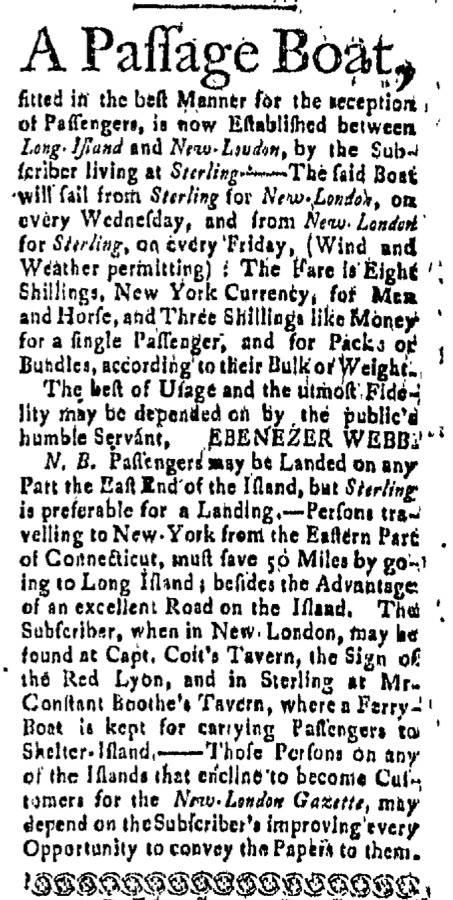
New-London Gazette (October 3, 1766).
“A Passage Boat … is now Established between Long-Island and New-London.”
A “Passage Boat” between New London, Connecticut, and Long Island, New York, was a quicker way of travelling than by over land. Ebenezer Webb pointed out that passengers would save fifty miles when they traveled to New York. Webb also developed a schedule and a system of rates, which allowed passengers to be able to plan their passage. Printing the schedule in an advertisement allowed prospective customers to save it if needed for future reference. Webb also made sure to include where he could be found at both locations; he gave the locations of the taverns and which days he would be in what area. He also let potential customers know that if they would like to become customers of the New-London Gazette, he would drop them off on any of the islands off the coast of Long Island. Those islands included Shelter Island, Plum Island, and Gardiners Island. Another courtesy that passengers in Sterling could enjoy was a “Ferry-Boat” for carrying them to Shelter Island. Webb listed three different rates, which needed to be paid in New York currency. The different rates included “Man and Horse” for eight shillings, a “single Passenger” for three shillings, and for “Packs or Bundles” of goods it depended on their weight.
**********
ADDITIONAL COMMENTARY: Carl Robert Keyes
Today’s advertisement provides important information about ferry service between Connecticut and Long Island during the colonial period, reminding us that the most efficient forms of travel in the eighteenth century differed from modern conveniences made possible by a much more complex transportation infrastructure. As Elizabeth notes, colonists who needed to travel from New London to New York could shave fifty miles off their journey, plus benefit from “the excellent Road on the Island,” if they opted for Webb’s “Passage Boat” service rather than traveling via a land route. In comparison, ferry service today does not seem to offer the same advantages, given the conveniences of travel by car, bus, and train.
I found the final portion of this advertisement to be especially interesting for what it suggests about the business practices and distribution of the New-London Gazette. Webb noted that he would deliver the newspaper to “Those Person on any of the Islands that encline to become Customers.” Despite the distance between New London and those islands (and their separation by Long Island Sound), the New-London Gazette would have been a local newspaper for residents of the islands, at least as much of a local newspaper as those printed in New York. The printer of the New-London Gazette certainly welcomed opportunities to increase distribution to paying subscribers and would have approved of Webb’s efforts to deliver newspapers to Shelter Island and other locales. Given that they were associates in that regard, might the printer have given Webb a discount on advertisements for the ferry service? After all, Webb’s success could also drum up additional business for the New-London Gazette, a mutually beneficial relationship.
What was advertised in a colonial American newspaper 250 years ago today?
Providence Gazette (October 4, 1766).
“To be sold at Public Vendue … One Joseph Hart!”
This advertisement announced “One Joseph Hart” would be sold into servitude for three years as punishment for stealing “sundry goods from Mr. Obadiah Sprague.” After an auction at the Providence jail, Hart would give up a few years of his life to someone else to work off his crimes as a convict servant. The second half of the advertisement included a brief physical description and a description of the crimes that he committed. This way that the person who purchased and brought him into their service would know what type of person that they were bringing into their home. This also allowed them to see what type of jobs he would be able to do. Since he was “a stout able-bodied active man,”,Hart would have been able to do or assist with any job that his future master bought him for. These possible jobs could have ranged from blacksmith to carpentry to farming.
The court systems in colonial America had varied punishments. Today some of them would seem cruel, but then they were commonplace consequences. According to James A. Cox in “Bilboes, Brands, and Branks: Colonial Crimes and Punishments,” sometimes criminals had an ear nailed to the pillory, were dragged along from the stern of a boat, or branded on the hand for stealing, as well as many other punishments that today would be considered cruel and inhumane. As we see with Joseph Hart, another common form of “paying” for crimes was through a form of indentured servitude. Vengeance and humiliation were the background idea for many of these punishments. The public and the punished would remember and hopefully not do it again. In colonial America, the factor of shame was added because punishments took place in public so that anyone could see. In addition, placing an advertisement in the newspaper was a very public way to shame Hart and his family, as was the public auction for someone to “buy” his time. Becoming a convict servant would have been embarrassing, but Hart may have seen it as a preferred way to avoid bodily harm as punishment.
**********
ADDITIONAL COMMENTARY: Carl Robert Keyes
In selecting this notice about a “Public Vendue” to auction off “One Joseph Hart” as a convict servant for a period of three years, Elizabeth chose an advertisement that looks quite different from most featured by the Adverts 250 Project. I briefly contemplated asking her to choose a different advertisement, one that more explicitly demonstrated how entrepreneurs used advertising to incite demand and fuel the consumer revolution of the eighteenth century. However, I would not have dissuaded her from selecting advertisements in which people were treated as commodities. Quite the contrary, I have encouraged all the guest curators to grapple with advertisements that sought to buy and sell indentured servants and enslaved men, women, and children. This announcement about an auction for a convict servant – a punishment doled out by the Superior Court as punishment for the crimes Joseph Hart committed – further demonstrates how easily and casually people could be bought and sold in eighteenth-century America, regardless of their nationality, ethnicity, race, or color of their skin.
That was reason enough to approve this advertisement when Elizabeth presented it, but the nature of Hart’s crime confirmed that this advertisement merited inclusion in the Adverts 250 Project. What crime had Hart committed that prompted the Superior Court to order that he be “sold at Public Vendue” in order to “satisfy the damages and costs of his prosecution and conviction?” Hart was guilty of “stealing sundry goods from Mr. Obadiah Sprague.” Not all colonists participated in the consumer revolution in the same manner. They certainly did not have the same access to the myriad of goods produced and exchanged throughout the Atlantic world. Other advertisements that appeared in the same issue of the Providence Gazette encouraged potential customers to visit local shops and purchase an assortment of products, many of them imported from faraway places. Many colonists, however, did not have the resources to shop in those establishments. Many purchased used goods at auctions or estate sales, but others participated in an informal economy that included trading stolen goods. It appears that Joseph Hart was eager to get his hands on “sundry goods,” stealing them rather than buying them. In the end, Hart was offered for sale himself.
The Slavery Adverts 250 Project chronicles the role of newspaper advertising in perpetuating slavery in the era of the American Revolution. The project seeks to reveal the ubiquity of slavery in eighteenth-century life from New England to Georgia by republishing advertisements about enslaved people – for sale as individuals or in groups, wanted to purchase or for hire for short periods, runaways who liberated themselves, and those who were subsequently captured and confined in jails and workhouses – in daily digests on this site as well as in real time via the @SlaveAdverts250 Twitter feed, utilizing twenty-first-century media to stand in for the print media of the eighteenth century.
The project aims to provide modern audiences with a sense of just how often colonizers encountered these advertisements in their daily lives. Enslaved men, women, and children appeared in print somewhere in the colonies almost every single day. Those advertisements served as a constant backdrop for social, cultural, economic, and political life in colonial and revolutionary America. Colonizers who did not purport to own enslaved people were still confronted with slavery as well as invited to maintain the system by purchasing enslaved men, women, and children or assisting in the capture of so-called “runaways” who sought to free themselves from bondage. The frequency of these newspaper advertisements suggests just how embedded slavery was in colonial and revolutionary American culture in everyday interactions beyond the printed page.
These advertisements also testify to the experiences of enslaved men, women, and children, though readers must consider that those experiences have been remediated through descriptions offered by enslavers rather than enslaved people themselves. Often unnamed in the advertisements, enslaved men, women, and children were not invisible or unimportant in early America.
These advertisements appeared in colonial American newspapers 250 years ago today.
What was advertised in a colonial American newspaper 250 years ago today?
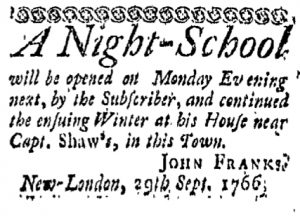
New-London Gazette (October 3, 1766).
“A Night-School will be opened on Monday Evening.”
Evening schools allowed children and adults who would not have normally attained an education to get the opportunity. In my Education class, Schools and American Society (taught by Prof. Casey Handfield), we discussed educational disparity in colonial America.[1] Children’s formal education in the colonies was limited, often to a select group of middling and elite white males. However, there were many other forms of education that took place in the colonies, such as apprenticeship, indentured servitude, and dame schools. Apprenticeship was a way for many children to learn a skill over time; although their formal education may have been limited, they learned a skill that provided them with a livelihood once they were older and finished the apprenticeship. Some forms of indentured servitude also allowed for learning a skill from the master. At dame schools, children learned basic skills from women (usually childless or older and widowed). However, most of these women had little formal schooling themselves, but would teach based on religious ideals.
Evening schools were another important form of education in colonial times, as I learned from also consulting Robert Francis Seybolt’s Evening School in Colonial America.[2] Some of the colonists sent their apprentices or indentured servants to night school during the winter months. Because the days were shorter, less light meant fewer work hours. This allowed some apprentices and servants to learn a skill during the day and then go to an evening school to learn basic writing, reading, and math skills. Apprentices and servants who got to go to evening schools would have been very lucky to learn both a skill that would provide them with a livelihood and the skills to make their future business successful.
Evening schools in the colonies originated in the Dutch colony of New Netherland in 1661. Once that colony became part of the New York in 1674, the evening schools were slowly taken over by English night schools. In Boston, the first mention of an evening school was in 1724 in the Boston Gazette. According to Seybolt, these two port cities, New York and Boston, were the first to establish this sort of schools, with inland towns and villages getting them later.
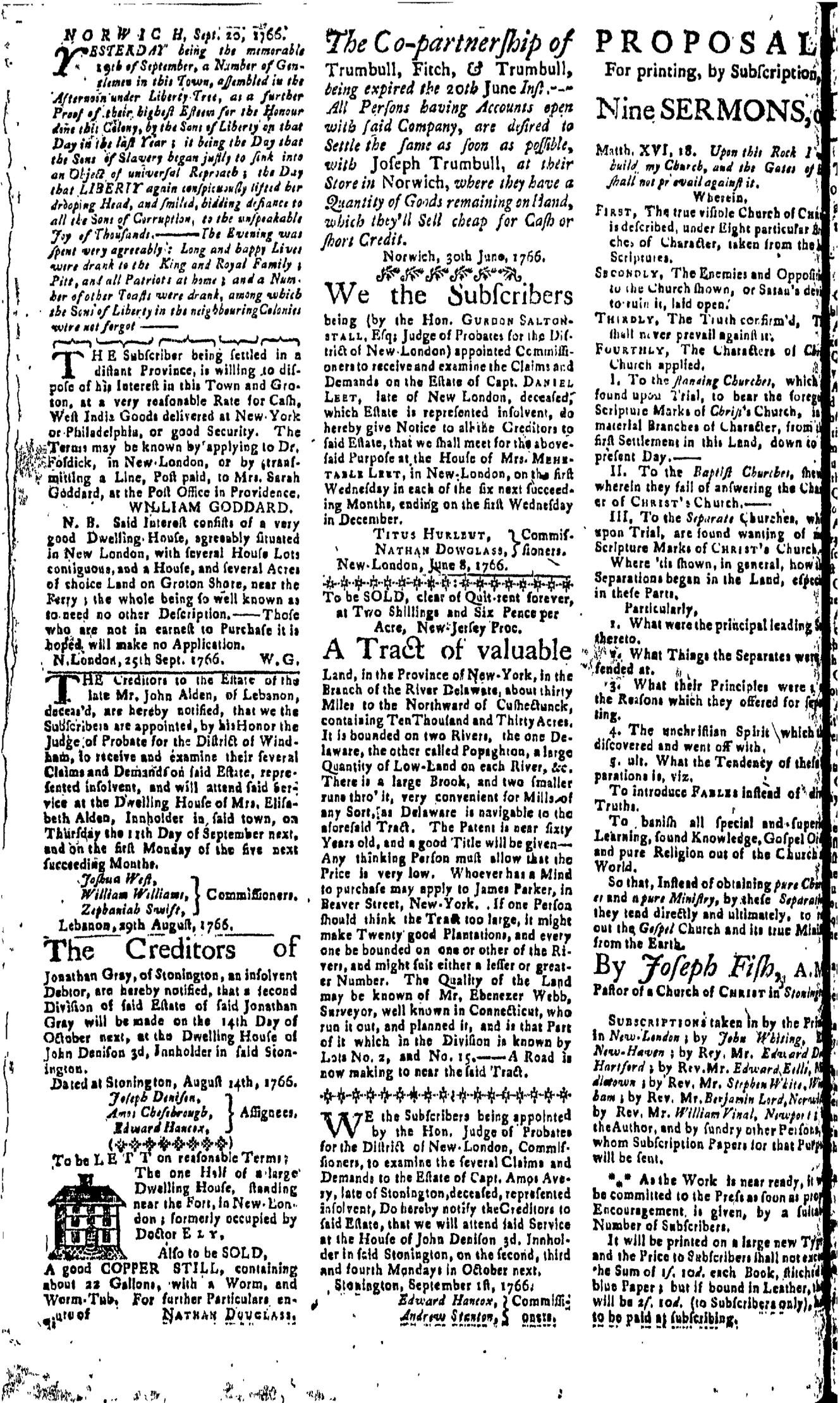
John Franks advertised his school in the New-London Gazette. He taught it in his home. Starting the classes in October and continuing every Monday for the whole of winter provided Franks’ students ample time for work during the week and then once darkness fell and the work day was done they could go to class.
**********
ADDITIONAL COMMENTARY: Carl Robert Keyes
Elizabeth is a veteran guest curator for the Adverts 250 Project, having already taken on these responsibilities for two weeks as part of my introductory Public History course last spring. As a result, she came to the project this time already possessing familiarity with the advantages and disadvantages of working with digitized sources. Rather than using my additional commentary to elaborate on her analysis of the advertisement she selected for today, I’ve decided instead to discuss one of the challenges inherent in using digital surrogates for the New-London Gazette.
Third Page of New-London Gazette (October 3, 1766).Fourth Page of New-London Gazette (October 3, 1766).
First, it’s necessary to understand the material aspects of the original October 3, 1766, issue of this newspaper. Like other colonial newspapers, each issue consisted of four pages created by printing on both sides of a broadsheet and then folding it in half. While some surviving issues have remained separate, many others have been gathered together, arranged chronologically, and bound into large volumes, either by printers or subscribers in the eighteenth century or by archivists and librarians at some point since. As a result, when historians consult eighteenth-century newspapers, they often work what look like oversized books that must be supported in special wooden cradles in order to preserve the bindings and avoid damage to the individual issues.
As a result of binding so many newspapers together, sometimes it is difficult to read the material in the column printed closest to the fold. Without sufficient space devoted to the margin that could later be used by the bookbinder, the binding draws the pages too close together to read (or photograph or digitize) all of the printing on the page. On the other hand, the distinctive appearance of a newspaper in a tightly bound volume makes it easy to determine at a glance which were even- and odd-numbered pages when reading the newspaper on microfilm or a computer screen. Both media eliminate other aspects of the material text that readers would otherwise use when working with an original issue. Have a look at the third and fourth pages of the issue that included today’s advertisement.
It is easy to tell which side of the page was adjacent to the binding, which also makes it easy to determine which was an even-numbered page and which was an odd-numbered page. Note that the advertisement Elizabeth chose appeared far away from the original fold of the newspaper and, thus, far away from the binding of the bound volume. This helped to make it legible when it was photographed and digitized. On the other hand, news items and advertisements that appeared close to the binding have been partially obscured. It is difficult to read them. Keyword searches using current technologies do not effectively “read” those items either. Readers working with the original bound volume of newspapers can shift position to view the page from a slightly different angle or carefully open the volume just a little wider, but these options are not available to researchers using microfilm or digital surrogates. The image of the page as it appears is the only possible image available to them.
As I have argued many times, digitization is wonderful, but it is not perfect. Sometimes it introduces new problems or eliminates possible solutions that working with original documents would allow. As an Education and History major, Elizabeth is especially interested in advertisements about colonial education. That John Franks’ advertisement for “A Night-School” was is legible for Elizabeth and other historians to consult is a wonderful circumstance that was in no way guaranteed by the historical and technological processes that have contributed to the production, preservation, and dissemination of the original documents.
**********
[1] See also Joel Spring, American Education, 16th ed. (McGraw Hill, 2013)
[2] Robert Francis Seybolt, The Evening School in Colonial America (Urbana: University of Illinois, 1925).
The Slavery Adverts 250 Project chronicles the role of newspaper advertising in perpetuating slavery in the era of the American Revolution. The project seeks to reveal the ubiquity of slavery in eighteenth-century life from New England to Georgia by republishing advertisements about enslaved people – for sale as individuals or in groups, wanted to purchase or for hire for short periods, runaways who liberated themselves, and those who were subsequently captured and confined in jails and workhouses – in daily digests on this site as well as in real time via the @SlaveAdverts250 Twitter feed, utilizing twenty-first-century media to stand in for the print media of the eighteenth century.
The project aims to provide modern audiences with a sense of just how often colonizers encountered these advertisements in their daily lives. Enslaved men, women, and children appeared in print somewhere in the colonies almost every single day. Those advertisements served as a constant backdrop for social, cultural, economic, and political life in colonial and revolutionary America. Colonizers who did not purport to own enslaved people were still confronted with slavery as well as invited to maintain the system by purchasing enslaved men, women, and children or assisting in the capture of so-called “runaways” who sought to free themselves from bondage. The frequency of these newspaper advertisements suggests just how embedded slavery was in colonial and revolutionary American culture in everyday interactions beyond the printed page.
These advertisements also testify to the experiences of enslaved men, women, and children, though readers must consider that those experiences have been remediated through descriptions offered by enslavers rather than enslaved people themselves. Often unnamed in the advertisements, enslaved men, women, and children were not invisible or unimportant in early America.
These advertisements appeared in colonial American newspapers 250 years ago today.
What was advertised in a colonial American newspaper 250 years ago today?
Massachusetts Gazette (October 2, 1766).
“Just Published … The Examination of Doctor BENJAMIN FRANKLIN, before an AUGUST ASSEMBLY.”
In the eighteenth century and today, most people agree that Benjamin Franklin significantly influenced colonial American politics and commerce. Some count him as an honored founding father, but if you ask my seven-year-old nephew he’ll declare that Franklin was his favorite president (despite my repeated attempts to tell him that, no, Mr. (or Dr.) Franklin was in fact not a president). Franklin made many contributions to early America history and life.
One of his most significant contributions was his delegation to England on behalf of Pennsylvania and other colonies. On February 13, 1766, he testified before Parliament about repealing the Stamp Act. On March 18, 1766, Parliament did in fact repeal the Stamp Act, although on that same day they voted in the Declaratory Act. News of the repeal reached the colonies around six weeks later, around the start of May.
As I was reading this advertisement I wondered, “Why would this be an August Assembly?” I found myself needing to know more, and went to J.L. Bell’s blog, Boston 1775. There I learned that Parliament’s proceedings were very secretive. Actions that Parliament took were made public, but the debates and arguments were private. Speaking about conversations held within either of the two houses was considered a breach of privilege and punishable by both houses.
To protect Franklin, his previous printing partner (and now owner of the Pennsylvania Gazette), David Hall changed the story. By saying that Franklin simply had spoken at an “August Assembly,” Franklin and Hall were attempting to get around the legality of publishing Franklin’s “Examination,” which discussed the flow of the questions and testimony and even recalled some speakers in Parliament by name. Publishing the testimony was a big deal, not only because many times colonists heard news months later, but also because this kept them better informed about Parliament, which met very far away from them.
**********
ADDITIONAL COMMENTARY: Carl Robert Keyes
Elizabeth introduces the curious history of “The Examination of Doctor BENJAMIN FRANKLIN, before an AUGUST ASSEMBLY, relating to the Repeal of the Stamp-Act.” The colonists were certainly hungry for information, which meant that advertisements for this pamphlet did not have to offer much in the way of marketing other than announcing that it was “Just Published … And Sold” by local printers and booksellers.
Indeed, members of the book trades in multiple cities produced, distributed, and sold pamphlets about Franklin’s testimony before “an AUGUST ASSEMBLY.” The American Antiquarian Society’s catalog indicates that at least five editions were printed in British mainland North America in 1766. As Elizabeth indicates, the original edition came off the presses of Hall and Sellers in Philadelphia, but that did not prevent other printers from producing their own editions. In each instance, politics and profit overlapped as printers and booksellers simultaneously sought to keep colonists informed about what was taking place in Parliament and generate revenues for themselves in the process.
Still, even with the subterfuge involved in allusions to “an AUGUST ASSEMBLY,” printers took on some risk when they decided to reprint their own copies of this pamphlet. The edition printed in New York did not list a printer, though bibliographers have associated James Parker with this imprint. An edition from New England listed neither printer nor city, but book historians believe Edes and Gill, printers of the Boston-Gazette, produced it. The title page of an edition from Virginia stated that it had been “Printed and sold by William Rind, opposite the Capitol” in Williamsburg. Back in Philadelphia, Heinrich Miller printed a German translation, which should come as little surprise considering the large population of German settlers in Pennsylvania. Timothy Green did not bother with printing another separate edition in Connecticut; instead, he reprinted the pamphlet in the New-London Gazette, beginning with the October 10, 1766, issue. In addition to being a treat for his readers and keeping them better informed, this stunt may have attracted new subscribers.
Today’s advertisement suggests that politics and a desire to keep colonists informed of Parliament’s machinations sometimes trumped competition among colonial printers. Note that the pamphlet was sold by “T. and J. Fleet, at the Heart & Crown in Cornhill,” yet the advertisement appeared in a newspaper “PUBLISHED by RICHARD DRAPERS, Printer to the Governor and Council, and by SAMUEL DRAPER, At their Printing Office in Newbury-Street.” In other words, the printers of Boston Evening-Post stocked and sold a pamphlet most likely produced by the printers of the Boston-Gazette and placed advertisements for it in the Massachusetts Gazette. This suggests cooperation and coordination rather than competition among the printers in Boston, all of whom faced a challenge to their livelihoods when the Stamp Act was in force.
Elizabeth Curley is a junior at Assumption College. She is an Elementary Education and History double major, with the goal of becoming a sixth grade social studies teacher. When it comes to history her favorite topics are colonial America, the American Revolution, and the Industrial Revolution. Beyond the classroom, she enjoys learning about different world cultures and cooking. You can follow her Public History Twitter account: @WomenOfAC. She has previous public history and digital humanities experience, including using T-PEN to transcribe and tag ballads for the Isaiah Thomas Broadside Ballads Project at the American Antiquarian Society. She was previously guest curator of the Adverts 250 Project during the weeks of February 14 to 20 and March 20 to 26, 2016. She is returning for the week of October 2 to 8, as well as curating the Slavery Adverts 250 Project during the week of October 30 to November 5, 2016.