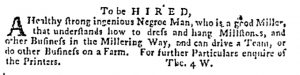
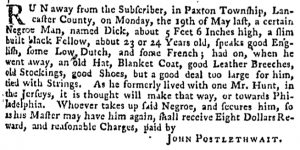
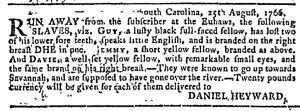
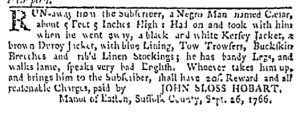
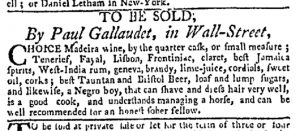
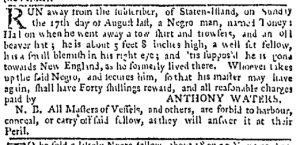
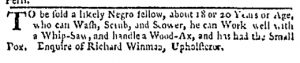
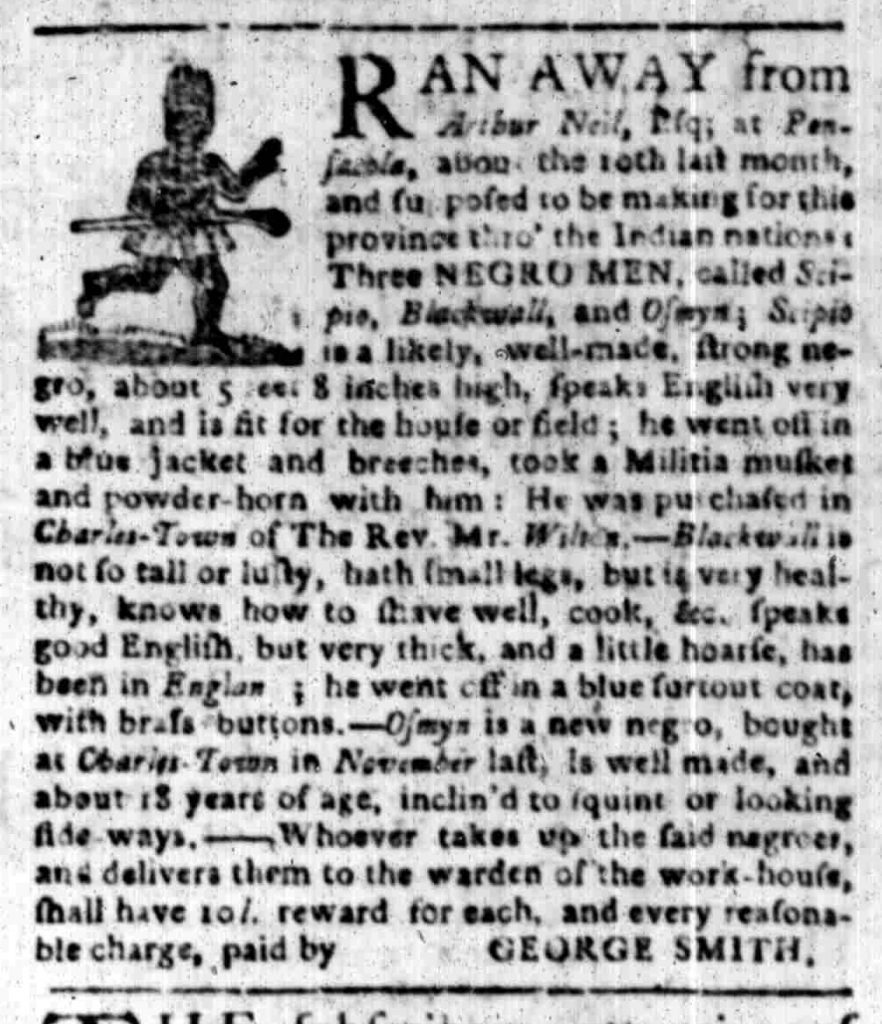
The Slavery Adverts 250 Project chronicles the role of newspaper advertising in perpetuating slavery in the era of the American Revolution. The project seeks to reveal the ubiquity of slavery in eighteenth-century life from New England to Georgia by republishing advertisements about enslaved people – for sale as individuals or in groups, wanted to purchase or for hire for short periods, runaways who liberated themselves, and those who were subsequently captured and confined in jails and workhouses – in daily digests on this site as well as in real time via the @SlaveAdverts250 Twitter feed, utilizing twenty-first-century media to stand in for the print media of the eighteenth century.
The project aims to provide modern audiences with a sense of just how often colonizers encountered these advertisements in their daily lives. Enslaved men, women, and children appeared in print somewhere in the colonies almost every single day. Those advertisements served as a constant backdrop for social, cultural, economic, and political life in colonial and revolutionary America. Colonizers who did not purport to own enslaved people were still confronted with slavery as well as invited to maintain the system by purchasing enslaved men, women, and children or assisting in the capture of so-called “runaways” who sought to free themselves from bondage. The frequency of these newspaper advertisements suggests just how embedded slavery was in colonial and revolutionary American culture in everyday interactions beyond the printed page.
These advertisements also testify to the experiences of enslaved men, women, and children, though readers must consider that those experiences have been remediated through descriptions offered by enslavers rather than enslaved people themselves. Often unnamed in the advertisements, enslaved men, women, and children were not invisible or unimportant in early America.
These advertisements appeared in colonial American newspapers 250 years ago today.
Being able to participate in the Adverts 250 Project was a truly eye-opening experience. This project not only provided a window into a week in colonial America, but also a look into what many historians do every day. Arguably the most interesting part of the project was getting a glimpse at day-to-day life in the colonies. I learned a lot not only from the advertisements I selected, but also in just scouring through the newspapers. It was through these newspapers I was able to get the sense what it was like to be a colonist.: seeing what goods were commonly for sale, realizing which goods were readily available or were not as regularly imported, and even seeing what was considered newsworthy. Items such as clothing and textiles were included in nearly every advertisement I saw, yet others were more specific and offered hardware, tools, or medicines.
This was my third opportunity to partake in a community service or digital humanities project in which the process was not that of a standard history course. Hoping to find my way into a career as an historian, it is refreshing to look at the profession in new ways, specifically using the digital humanities to research nearly any historical topic imaginable, and getting to look at firsthand accounts from that specific period. As the project moved closer and closer, it was intimidating for sure, as finding advertisements from 250 ago seemed like an extremely tall task. However, being able to access the immense collection of authentic historical materials using the American Antiquarian Society as well as the Early American Newspapers database was a real treat. Each of these facilitated nearly every aspect of this project.
Despite the American Antiquarian Society and online databases making the hunt for advertisements dramatically easier, by far the most difficult part for me was writing the blog posts. It was clear after my first drafts of the first three days that I had never written a blog before. Every one of my drafts was all over the place, and basically just a summary of what the advertisement contained without any additional analysis. Writing a blog is much different than writing an essay, I’ve learned. I really had to work to eliminate passive voice, as well as speak in the first person when appropriate. To improve my first drafts I worked with Prof. Keyes to focus on one aspect of each advertisement that was especially significant and stood out. I then added in my own thoughts and opinions and was able to find my voice.
The blogs were fairly short but the tweets even shorter, and being able to compress a lengthy advertisement down into 140 characters was tricky as well. Each advertisement contained so many goods that whenever I omitted something I was concerned that I had left out a significant part. Using Twitter to expand the audience of the project was intriguing because social media is one of the best ways available in today’s society to spread the word and engage others. Seeing other historians “liking” and “re-tweeting” posts related to this project was awesome, as it showed that the work I was putting in was being seen and read by more people than I had expected. It showed that people are truly interested in the project, and that reinforcement, though miniscule, shows me that my work had a purpose, which makes all of the hard work worth it.
What was advertised in a colonial American newspaper 250 years ago today?
Georgia Gazette (October 1, 1766).
“MARY HUGHES, Takes this Method to inform the Ladies.”
My final post as guest curator introduces the first advertisement by a female entrepreneur I saw in the newspapers I read through. In the Georgia Gazette, Mary Hughes “Takes this Method to inform the Ladies” that she offered an extensive list of goods specifically for women, notably wax and pearl earrings, garnet necklaces, ribbons, “stomachers” (which were “the early ancestors of the corset” and “essential part of a woman’s wardrobe”), and much more. Despite other advertisements catering primarily to men, with a few products aimed for women included, Mary Hughes’ advertisement was aimed solely at women.
This short advertisement ended with Hughes explaining that “she proposes to carry on the millenary business.” A milliner specialized in making women’s hats. Based on the goods listed in her advertisement, it seemed she had all the imported materials necessary to become a continued success! To make that happen, she needed customers. Hughes’ message went on to explain that she would be “very much obliged to those ladies who will grant her their favours.” To me, it seems that this last invitation had a sense of desperation. Perhaps that was not the case; perhaps it is just the formal language that makes it so much different from modern advertisements. Today, I believe this would sound more like a request for charity rather than generating business for her shop.
**********
ADDITIONAL COMMENTARY: Carl Robert Keyes
I’m both surprised and not surprised that this was the first advertisement for consumer goods and services that Nick encountered during his week as guest curator. I’m not surprised because such advertisements by female entrepreneurs were often rare. They certainly appeared in disproportionately low numbers compared to the number of women that historians know operated their own shops or provided other services in eighteenth-century America, especially in urban ports.
On the other hand, advertisements placed by women were present in colonial newspapers. That Nick did not encounter any others earlier in the week says something about what often comes down to serendipity in the research process. Women did place newspaper advertisements in the 1760s, but they were less likely to do so than their male counterparts. As a result, some issues occasionally featured greater numbers of advertisements by women, while others were completely devoid of marketing efforts conducted by women. Chance, as much as any other factor, explains why Nick did not encounter advertisements by women in any of the other newspapers he consulted this week.
Historians have to work with the sources available to us. We tell the stories that the documents allow us to tell, not always the stories that we would like to tell or that we wish the documents would allow us to tell. Uncovering the history of women in the colonial marketplace and, especially, the history of women in eighteenth-century advertising requires special attention and effort. As often as possible, I select advertisements placed by women to feature on the Adverts 250 Project, both as a matter of principle and as an informal part of my methodology. Women’s participation in the marketplace as producers and retailers was already underrepresented in the public prints in the eighteenth century. I do not wish to compound the problem by overlooking their commercial notices when they did appear.
As a result, I especially appreciate that Nick selected Mary Hughes’ advertisement to feature and analyze. He certainly had other choices for today, but by telling a story that he had not yet told he joined other historians in the endeavor to include women in our narratives of the past.
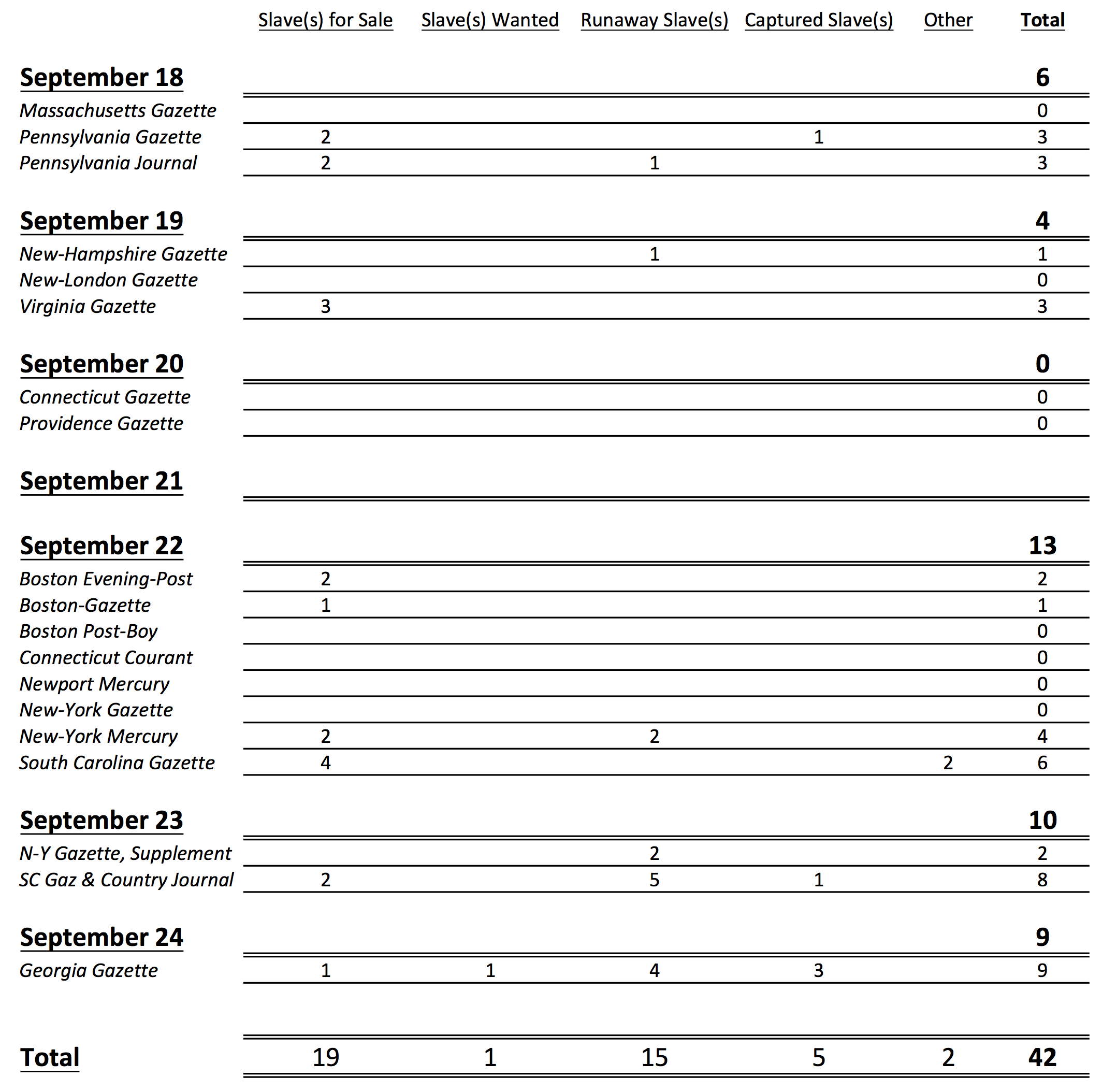
These tables indicate how many advertisements for slaves appeared in colonial American newspapers during the week of September 25 – October 1, 1766.
Note: These tables are as comprehensive as currently digitized sources permit, but they may not be an exhaustive account. They includes all newspapers that have been digitized and made available via Accessible Archives, Colonial Williamsburg’s Digital Library, and Readex’s America’s Historical Newspapers. There are several reasons some newspapers may not have been consulted:
Issues that are no longer extant;
Issues that are extant but have not yet been digitized; and
Newspapers published in a language other than English (including the Wochentliche Philadelphische Staatsbote).
**********
Slavery Advertisements Published September 25 – October 1, 1766: By Date
**********
Slavery Advertisements Published September 25 – October 1, 1766: By Region
The Slavery Adverts 250 Project chronicles the role of newspaper advertising in perpetuating slavery in the era of the American Revolution. The project seeks to reveal the ubiquity of slavery in eighteenth-century life from New England to Georgia by republishing advertisements about enslaved people – for sale as individuals or in groups, wanted to purchase or for hire for short periods, runaways who liberated themselves, and those who were subsequently captured and confined in jails and workhouses – in daily digests on this site as well as in real time via the @SlaveAdverts250 Twitter feed, utilizing twenty-first-century media to stand in for the print media of the eighteenth century.
The project aims to provide modern audiences with a sense of just how often colonizers encountered these advertisements in their daily lives. Enslaved men, women, and children appeared in print somewhere in the colonies almost every single day. Those advertisements served as a constant backdrop for social, cultural, economic, and political life in colonial and revolutionary America. Colonizers who did not purport to own enslaved people were still confronted with slavery as well as invited to maintain the system by purchasing enslaved men, women, and children or assisting in the capture of so-called “runaways” who sought to free themselves from bondage. The frequency of these newspaper advertisements suggests just how embedded slavery was in colonial and revolutionary American culture in everyday interactions beyond the printed page.
These advertisements also testify to the experiences of enslaved men, women, and children, though readers must consider that those experiences have been remediated through descriptions offered by enslavers rather than enslaved people themselves. Often unnamed in the advertisements, enslaved men, women, and children were not invisible or unimportant in early America.
These advertisements appeared in colonial American newspapers 250 years ago today.
What was advertised in a colonial American newspaper 250 years ago today?
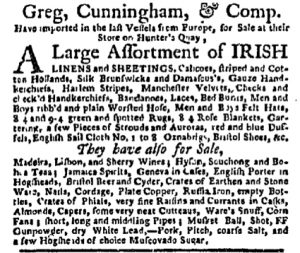
Occasional Supplement to W. Weyman’s Gazette of Yesterday [New-York Gazette] (September 30, 1766).“LINENS and SHEETINGS, … Russia Iron, … Ware’s Snuff.”
Today’s advertisement features Greg, Cunningham, & Company and their vast assortment of all different types of goods recently “imported in the last Vessels from Europe.” Fairly unlike any other advertisements I have looked at this week, this shop offered more than a surplus of different textiles and clothing materials, such as “LINENS and SHEETINGS,” laces, velvets, and handkerchiefs, Greg, Cunningham, and Company also carried products that would be found in a modern hardware and sporting goods store. Materials like “Russia Iron,” gunpowder and musket balls were available as well as “Plate Copper” and “dry White Lead.” I had not seen these products advertised before; they stood out because they show that colonists needed supplies that allowed for expansion, growth, and opportunities for new development. From the hardware products to clothing to even a selection of medicines, Greg, Cunningham, and Company offered a diverse selection of goods to consumers.
The advertisement also listed “Ware’s Snuff.” Since it was listed with “middling pipes” and different alcoholic beverages, at first glance I assumed “Ware’s Snuff” was just another pleasure for adults. In fact snuff was extremely popular among men, not only as a product to enjoy, but as a social measure as well. According to Edwin Tunis, “Nearly every man carried the most expensive [snuff box] he could afford.” Some had a different box for every day. Even women took advantage of the readily available product, but only in private.[1] However, after researching further, I found that “Ware’s Snuff” was actually used as a cure for some sicknesses as well. Taking this up the nose would often lead to “a very large discharge of mucus.”[2]
**********
ADDITIONAL COMMENTARY: Carl Robert Keyes
Nick focused on the content of the advertisement he selected for today, but I am also interested in the context in which it appeared. Today’s advertisement was included in a half sheet Occasional Supplement to W. Weyman’s Gazette of Yesterday. Like nearly half of colonial American newspapers published in 1766, William Weyman distributed the New-York Gazette on Mondays – and, usually, only Mondays. Typically, each issue consisted of four pages, two printed on each side of a broadsheet that was then folded in half. In most cases, that was the extent of the news and advertising made available by any particular newspaper during any particular week.
At this time the Pennsylvania Gazette did provide a notable departure. It frequently inserted an additional half sheet in its standard four-page issue, bringing the entire issue to a total of six pages. Even with this additional content, however, the Pennsylvania Gazette did not attempt to distribute additional full issues more than once a week. In the 1770s some newspapers experimented with printing two or three issues per week, but it was not until after the Revolution that newspapers in the largest cities began daily publication.
This brings us back to Greg, Cunningham, and Company’s advertisement and the Occasional Supplement to the New-York Gazette in which it appeared. Why deviate from the usual publication schedule? Considering the amount of labor involved in producing an additional half sheet, why have an Occasional Supplement appear just one day after Monday’s regular issue, rather than later in the week? The “Subject of the Day is quite altered,” the first line of the Occasional Supplement proclaimed, due to “the Arrival of the Lord Hyde Packet” and the news it carried “with regard to the Change in the Ministry.” At the end of July, Lord Rockingham had been dismissed as prime minister. The king instructed William Pitt the Elder to form a government and granted him a title, making him the first Earl of Chatham. Pitt was popular among American colonists, both for his incisive leadership during the Seven Years War and, especially, for his opposition to the Stamp Act. Yet the Occasional Supplement noted that in Britain “there is pro and con, for and against Mr. PITT.” Weyman selected excerpts from letters that arrived on the packet ship “to give both Sides a Chance, and must leave our Readers to judge for themselves.” This news was too significant to wait an entire week to report it in the next issue of the New-York Gazette, hence Weyman’s decision to rush to press with an Occasional Supplement.
This news filled almost the entire first page of the Occasional Supplement, but the other side featured advertisements (including Greg, Cunningham, and Company’s advertisement) exclusively. Sometimes supplements and additional half sheets (like those that accompanied the Pennsylvania Gazette in 1766) were mechanisms for distributing additional advertising, the demand for advertising space exceeding the what was available in regular issues. In this case, however, we see that political reporting opened an opportunity to distribute greater numbers of advertisements. Weyman and others who worked in his shop could have cut their work in half by printing a broadside that reported the news, but instead chose to print advertising on the other side before distributing the Occasional Supplement on September 30, 1766.
**********
[1] Edwin Tunis, Colonial Craftsmen and the Beginnings of American Industry (New York: World Publishing Company, 1965), 53.
[2] Thomas John Graham, Modern Domestic Medicine (London: Published for the Author, 1827), 369.
The Slavery Adverts 250 Project chronicles the role of newspaper advertising in perpetuating slavery in the era of the American Revolution. The project seeks to reveal the ubiquity of slavery in eighteenth-century life from New England to Georgia by republishing advertisements about enslaved people – for sale as individuals or in groups, wanted to purchase or for hire for short periods, runaways who liberated themselves, and those who were subsequently captured and confined in jails and workhouses – in daily digests on this site as well as in real time via the @SlaveAdverts250 Twitter feed, utilizing twenty-first-century media to stand in for the print media of the eighteenth century.
The project aims to provide modern audiences with a sense of just how often colonizers encountered these advertisements in their daily lives. Enslaved men, women, and children appeared in print somewhere in the colonies almost every single day. Those advertisements served as a constant backdrop for social, cultural, economic, and political life in colonial and revolutionary America. Colonizers who did not purport to own enslaved people were still confronted with slavery as well as invited to maintain the system by purchasing enslaved men, women, and children or assisting in the capture of so-called “runaways” who sought to free themselves from bondage. The frequency of these newspaper advertisements suggests just how embedded slavery was in colonial and revolutionary American culture in everyday interactions beyond the printed page.
These advertisements also testify to the experiences of enslaved men, women, and children, though readers must consider that those experiences have been remediated through descriptions offered by enslavers rather than enslaved people themselves. Often unnamed in the advertisements, enslaved men, women, and children were not invisible or unimportant in early America.
These advertisements appeared in colonial American newspapers 250 years ago today.
Occasional Supplement to W. Weyman’s Gazette of Yesterday (September 30, 1766).
**********
Occasional Supplement to W. Weyman’s Gazette of Yesterday (September 30, 1766).
**********
South-Carolina Gazette and Country Journal (September 30, 1766).
**********
South-Carolina Gazette and Country Journal (September 30, 1766).
**********
South-Carolina Gazette and Country Journal (September 30, 1766).
**********
South-Carolina Gazette and Country Journal (September 30, 1766).
**********
Supplement to the South-Carolina Gazette, and Country Journal (September 30, 1766).
**********
Supplement to the South-Carolina Gazette, and Country Journal (September 30, 1766).
**********
Supplement to the South-Carolina Gazette, and Country Journal (September 30, 1766).
**********
Supplement to the South-Carolina Gazette, and Country Journal (September 30, 1766).
What was advertised in a colonial American newspaper 250 years ago today?
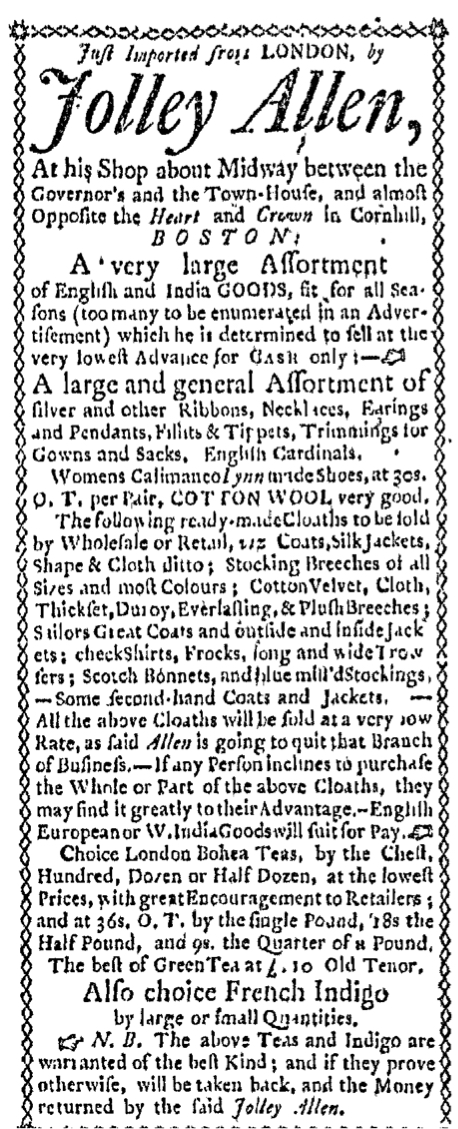
Boston Evening-Post (September 29, 1766).
“Warranted of the best Kind; and if they prove otherwise, will be taken back, and the Money returned.”
Jolley Allen’s lengthy advertisement from the Boston Evening-Post features countless common products seen in numerous other advertisements, including tea, silks, textiles, and jewelry. In addition to a long list of merchandise, this one had something else included at the end. Many of the advertisements I have looked at claimed to be selling their assortment of goods the cheapest, and they promised the highest quality products around. However, Allen is the first one I have seen who actually backed it up. This advertisement concluded with a guarantee that if the “Teas and Indigo” were not of the “best Kind,” they “will be taken back, and the Money returned by the said Jolley Allen.”
Allen put his name and reputation on the line. He displayed his character in a way favorable to consumers. With the expansion of consumer culture in the colonies, it would have been easy for shopkeepers to make all sales final, yet with more shops opening, consumers could take their business elsewhere. Allen was committed to his name, his shop, and his goods, and made it a point for his shop to stand out from the rest. After further research, however, I also learned that Allen was a Loyalist entrepreneur; it’s interesting that he became a successful businessman regardless of his controversial political views.
**********
ADDITIONAL COMMENTARY: Carl Robert Keyes
Jolley Allen operated his business in an increasingly politicized colonial marketplace. His own politics, however, were not apparent in this particular advertisement. That he was a Loyalist, we learn from other sources from the period.
That’s not to say, however, that all newspaper advertisement published during the imperial crisis of the 1760s and 1770s lacked a political valence. As soon as the colonists learned of the Stamp Act, many advertisers made explicitly partisan appeals as part of their marketing messages, often promoting domestic manufactures or condemning the effects that Parliament’s actions would have on commerce. After the Stamp Act was repealed, some entrepreneurs inserted their own brief celebratory proclamations into their advertisements; even when they did not directly connect the Stamp Act to the merchandise they advertised, they assumed that their political views would influence potential customers to visit their shops.
As a Loyalist, Jolley Allen certainly did not condemn Parliament nor celebrate the demise of the Stamp Act in his advertisements. The advertisements he published in 1766 were devoid of politics, yet Boston was not so large that his political views would have been unfamiliar to friends, neighbors, and potential customers. Perhaps that played a role in inspiring some of the innovative aspects of his advertisements: he needed to overcome suspicions of his allegiances and used distinctive marketing to do so. Nick identified Allen’s reputation and stature as an honest trader as one means of promoting his shop “Opposite the Heart and Crown in Cornhill, BOSTON.” Although not the first colonial advertiser to offer some form of money-back guarantee, he did make an offer that was not a standard part of eighteenth-century advertising. In addition, his advertisements consistently featured distinctive graphic design elements, namely a decorative border, intended to draw more eyes than competitors’ advertisements that appeared elsewhere on the page. Allen also advertised extensively, placing the same advertisement in all four newspapers published in Boston in 1766, thus reaching the largest possible audience of potential customers despite the political leanings of any particular newspaper or its printer.
The Slavery Adverts 250 Project chronicles the role of newspaper advertising in perpetuating slavery in the era of the American Revolution. The project seeks to reveal the ubiquity of slavery in eighteenth-century life from New England to Georgia by republishing advertisements about enslaved people – for sale as individuals or in groups, wanted to purchase or for hire for short periods, runaways who liberated themselves, and those who were subsequently captured and confined in jails and workhouses – in daily digests on this site as well as in real time via the @SlaveAdverts250 Twitter feed, utilizing twenty-first-century media to stand in for the print media of the eighteenth century.
The project aims to provide modern audiences with a sense of just how often colonizers encountered these advertisements in their daily lives. Enslaved men, women, and children appeared in print somewhere in the colonies almost every single day. Those advertisements served as a constant backdrop for social, cultural, economic, and political life in colonial and revolutionary America. Colonizers who did not purport to own enslaved people were still confronted with slavery as well as invited to maintain the system by purchasing enslaved men, women, and children or assisting in the capture of so-called “runaways” who sought to free themselves from bondage. The frequency of these newspaper advertisements suggests just how embedded slavery was in colonial and revolutionary American culture in everyday interactions beyond the printed page.
These advertisements also testify to the experiences of enslaved men, women, and children, though readers must consider that those experiences have been remediated through descriptions offered by enslavers rather than enslaved people themselves. Often unnamed in the advertisements, enslaved men, women, and children were not invisible or unimportant in early America.
These advertisements appeared in colonial American newspapers 250 years ago today.
What was advertised in a colonial American newspaper 250 years ago this week?
Providence Gazette (September 27, 1766).
“Said Greene, wants … Flax-Seed, for which he will pay Cash, or any of the above Goods.”
Caleb Greene posted not only what items he had to sell, but also certain commodities he wanted to acquire. This stood out to me because most of the advertisements I have examined simply listed the various goods offered at a certain shop, most of them having just been imported. However, Greene’s advertisement showed his role as a consumer; he hoped to barter for “a Quantity of good and well-cleaned Flax-Seed.” As we have seen in many other advertisements, many shopkeepers only dealt with cash, but Greene noted that he was willing to trade his freshly imported goods.
This process was widely known as barter. Although it was common, the practice of barter was often much more difficult and sometimes more costly. According to David T. Flynn in “Credit in the Colonial American Economy,” what made bartering so much more complicated was a need for a “double coincidence of wants,” which was essential for the barter to take place. In other words, “For exchange to occur in a barter situation each party must have the good desired by its trading partner.”
**********
ADDITIONAL COMMENTARY: Carl Robert Keyes
Colonists resorted to a variety of mechanisms for payment in their financial transactions. Sometimes they paid in cash, other times they relied on credit, and on many occasions they bartered one sort of goods for another. The first two types of transactions appeared most often in newspapers advertisements during the eighteenth century. Many shopkeepers and others who provided goods and services specified that they sold their wares “for ready Money,” as Caleb Greene did in the advertisement Nick selected for today. Sometimes they specified that they accepted cash only, signaling to potential customers that credit was not an option. The consumer revolution, however, occurred in part because merchants, shopkeepers, and customers became enmeshed in networks of credit that often originated in England and crossed the Atlantic to the colonies, extending to urban ports, towns and villages, and the colonial frontier. Advertisements sometimes specified that potential customers could purchase goods “on short credit” or offered the options of cash or credit.
To what extent did proposals to barter appear in eighteenth-century advertisements? Shopkeepers and other suggested barter less often than cash or credit, but not so infrequently that barter would have been considered uncommon or extraordinary. (See advertisements previously featured on February 7, February 22, March 1, May 19, July 14, and August 4.) Financial ledgers from the period, as well as household accounts, also suggest that many colonists continued to resort to bartering throughout much of the eighteenth century, even given the advantages offered by both cash and credit. Nick has already indicated that bartering required a “double coincidence of wants” that would have made such exchanges less attractive than cash or credit. In this advertisement, for instance, Greene did not offer to barter for just any commodities. He offered to trade “any of the above Goods” specifically for “a Quantity of good and well-cleaned Flax-Seed.” Only prospective customers in possession of that commodity were invited to barter with Greene. Despite that obstacle, placing an advertisement in the Providence Gazette increased the likelihood that Greene would indeed encounter a bartering partner who possessed the commodity he desired. Although Greene’s primary purpose in placing his advertisement was to sell a variety of goods, it may have also resulted in obtaining the “Flax-Seed” he wanted thanks to a successful bartering transaction.