September 27

GUEST CURATOR: Nicholas Commesso

What was advertised in a colonial American newspaper 250 years ago today?
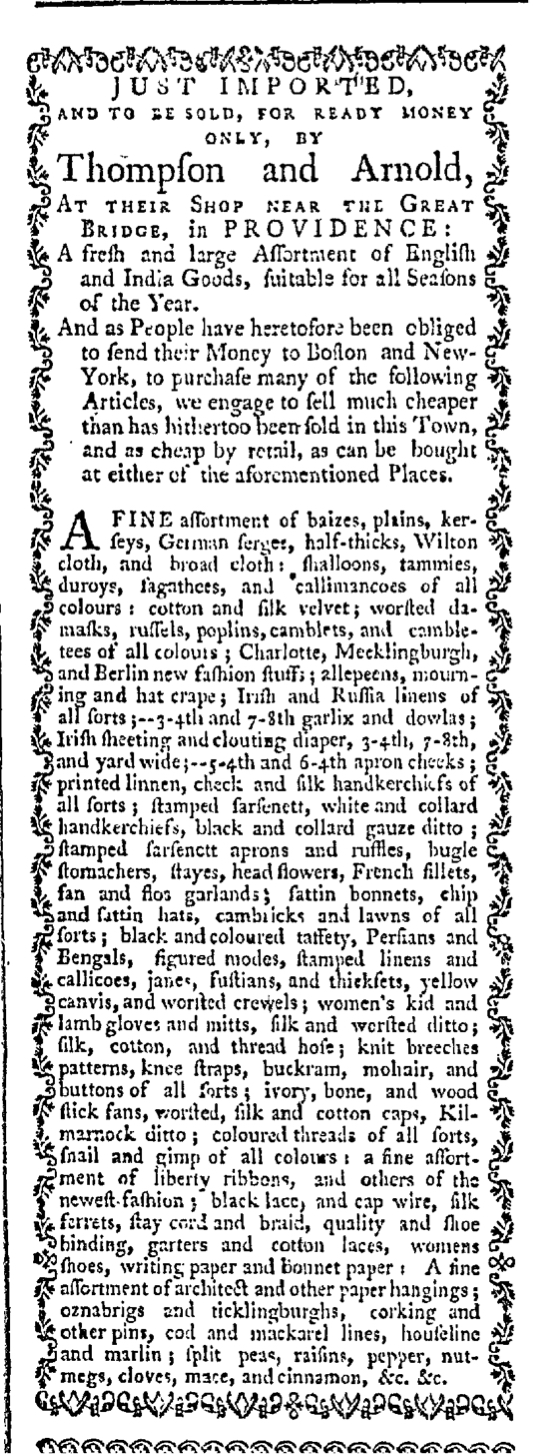
sep-27-9271766-providence-gazette
Providence Gazette (September 27, 1766).

“A fresh and large Assortment of English and India Goods.”

This advertisement in the Providence Gazette features a lengthy list of newly imported goods at the shops of Thompson and Arnold. “TO BE SOLD, FOR READY MONEY ONLY,” these goods had been imported from both from England and India. Included in this “FINE assortment” were different textiles, clothing, and related items, such as “Irish and Russia linens of all sorts,” satin bonnets, shalloons, tammies, “colored threads of all sorts,” and countless other products. Why was importation so important? Business for the British was truly booming in colonial America. As T.H. Breen notes, newspapers “carried more and more advertisements for consumer goods,” and all Americans were a part of this “consumer revolution.”[1]

This shop clearly emphasized fashion, as they offered many different options in terms of colors and materials, which especially interested women. For women, shopping was an exhibition of liberty, and “with choice came a measure of economic power.” They had choices of products and choices of shops to visit. A variety of options allowed customers to gain leverage as they asked questions and made demands. Additionally, Breen argues, choice “reinforced the Americans’ already strong conviction of their own personal independence.”[2]

**********

ADDITIONAL COMMENTARY: Carl Robert Keyes

I originally intended to feature this advertisement a week ago today, but when Nick submitted the same advertisement (printed a week later) for approval I decided to hold off for a week. I figured that the chances were quite probable that he and I would approach the advertisement from very different perspectives, that discussion of this advertisement would be enhanced from both of us examining it.

That turned out to be the case. I initially selected this advertisement because I wanted to discuss its format. In some regards it looks quite similar to an advertisement previously published by Thompson and Arnold (which appeared for the first time in the August 9, 1766, issue of the Providence Gazette and then many more times in subsequent issues.) The original iteration of this advertisement deployed graphic design in several unique ways. It surely caught the attention of readers and potential customers.

This version of the advertisement reverted to some of the more standard aspects of eighteenth-century newspaper advertisements. In particular, it inhabited a single column within the issue, whereas the earlier version spanned two columns. The previous version also used three columns to delineate Thompson and Arnold’s merchandise, but in today’s advertisement their inventory collapsed into a dense list instead. This did not have the same visual resonance, nor did it make it as easy for potential customers to locate specific products of interest.

Still, the updated version of Thompson and Arnold’s advertisement featured design elements intended to continue drawing the eyes of readers. Like the previous version, it retained a decorative border made of printing ornaments. Very few newspaper advertisements in the 1760s had such borders (though we have previously seen that Jolley Allen made sure that his advertisements in Boston’s newspapers were easily identified by their borders). In addition, Thompson and Arnold’s advertisement was much longer than most that appeared in the Providence Gazette. Its size alone merited notice. Finally, today’s advertisement appeared in the first column of the first page of the Providence Gazette, right below the masthead. In design, layout, and location, there was no way for readers to overlook Thompson and Arnold’s updated advertisement.

**********

[1] T.H. Breen, “An Empire of Goods: The Anglicization of Colonial America, 1690-1776,” Journal of British Studies 25, no. 4 (October 1986): 486-487.

[2] Breen, “Empire of Goods,” 489.

September 26

GUEST CURATOR: Nicholas Commesso

What was advertised in a colonial American newspaper 250 years ago today?

sep-26-9261766-new-hampshire-gazette
New-Hampshire Gazette (September 26, 1766).

An Assortment of MEDICINES and GROCERIES.”

Stephen Little’s advertisement displaying “An Assortment of MEDICINES and GROCERIES” did not waste much space.” Not only did Little’s advertisement offer a diverse selection of common goods and medicines, he also claimed they were indeed the best and the cheapest around. Accepting cash only, Little offered everything from a variety of seasonings, like cinnamon, pepper, and allspice, to beverages, like wine, brandy, “French Hungary Water in Bottles,” and tea.

Little’s shop seems like a modern day drug store, advertising an array of different remedies and other products. Included were “Casteel Soap” and “Turlington’s Balsom of LIFE,” along with “Stoughton’s Elixer – Lockyer’s Pills – Dr. Ward’s Essence for Head-Ach.” T.H. Breen has discussed how advertisements like this one were able to “inflame customer desire” by offering so many goods to potential customers.[1]

After researching some of these products, I learned that “Lockyer’s Pills” were one of the most well, widely sold across London and the colonies. The pills have been described as “cure-alls.” They especially worked to relieve intestinal issues and kidney stones. In addition, this hopefully decreased doctor visits over the year.[2]

**********

ADDITIONAL COMMENTARY: Carl Robert Keyes

When Nick decided to investigate “Lockyer’s Pills” in greater detail, I decided to do the same, but our research took us in different directions. I visited another digital humanities project and one of my favorite research blog: The Recipes Project: Food, Magic, Art, Science, and Medicine, conducted by “an international group of scholars interested in the history of recipes, ranging from magical charms to veterinary remedies.”

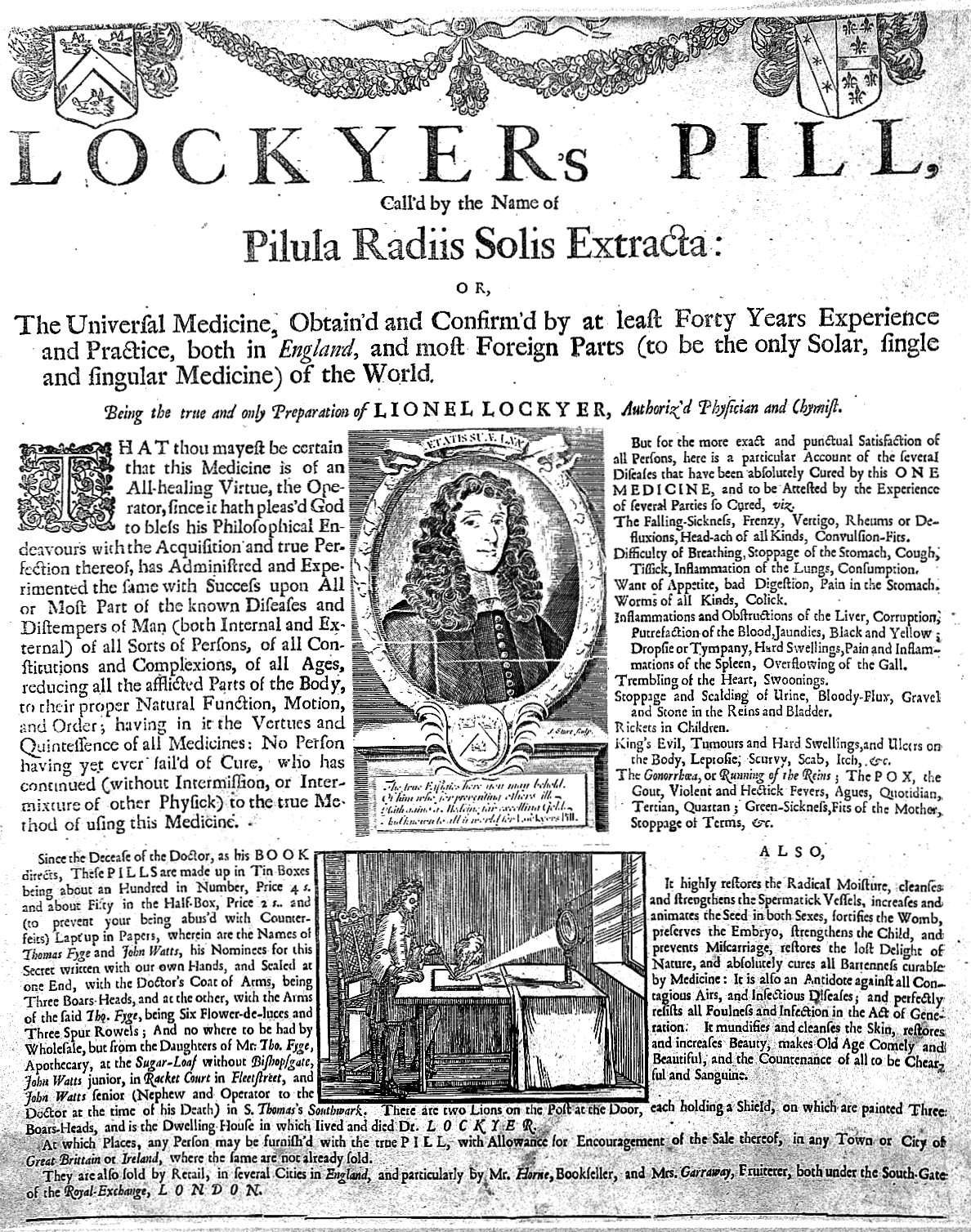
L0002420 Broadsheet advertsing L.Lockyer's patent medicine
Broadsheet Advertising Lockyer’s Pills. Wellcome Library, London.

In an entry devoted to “Medicinal Compounds, Efficacious in Every Case,” Lisa Smith concluded with a few words about Lockyer’s Pills, but she first offered insights that help to better understand Little’s advertisement. Little and his customers did not divide all of his wares between the categories of “MEDICINES” and “GROCERIES.” Instead, they believed that many of the grocery items possessed medicinal qualities, especially the mace, cloves, and nutmegs listed at the beginning of his current inventory. Consulting early modern herbals and pharmacopoeias, Smith states, “reveals that herbs like nutmegs, cloves, mace, aniseeds, lavender and rosemary (for example) had warming and drying properties.” This would have been important to doctors, apothecaries, and patients who believed that the hot, cold, wet, and dry properties of bodily humors needed to be balanced to achieve good health. Little offered several medicines already prepared for clients, but some likely bought what we would today consider grocery items to use in compounding their own remedies.

Smith concludes by noting that “not all cure-alls were created equal – and there were some weird ones out there,” especially the pills marketed by Lionel Lockyer. Those remedies supposedly contained an extract of the sun! For patients interested in medicines with warming and drying qualities, what could have been better?! To my delight, Smith also included an image of a broadsheet advertisement for Lockyer’s Pills.

**********

[1] T.H. Breen, “An Empire of Goods: The Anglicization of Colonial America, 1690-1776,” Journal of British Studies 25, no. 4 (October 1986): 476.

[2] Andrew Wear, Knowledge and Practice in English Medicine, 1550-1680 (Cambridge University Press, 2000): 425-436.

Slavery Advertisements Published September 26, 1766

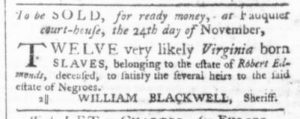
The Slavery Adverts 250 Project chronicles the role of newspaper advertising in perpetuating slavery in the era of the American Revolution. The project seeks to reveal the ubiquity of slavery in eighteenth-century life from New England to Georgia by republishing advertisements about enslaved people – for sale as individuals or in groups, wanted to purchase or for hire for short periods, runaways who liberated themselves, and those who were subsequently captured and confined in jails and workhouses – in daily digests on this site as well as in real time via the @SlaveAdverts250 Twitter feed, utilizing twenty-first-century media to stand in for the print media of the eighteenth century.

The project aims to provide modern audiences with a sense of just how often colonizers encountered these advertisements in their daily lives. Enslaved men, women, and children appeared in print somewhere in the colonies almost every single day. Those advertisements served as a constant backdrop for social, cultural, economic, and political life in colonial and revolutionary America. Colonizers who did not purport to own enslaved people were still confronted with slavery as well as invited to maintain the system by purchasing enslaved men, women, and children or assisting in the capture of so-called “runaways” who sought to free themselves from bondage. The frequency of these newspaper advertisements suggests just how embedded slavery was in colonial and revolutionary American culture in everyday interactions beyond the printed page.

These advertisements also testify to the experiences of enslaved men, women, and children, though readers must consider that those experiences have been remediated through descriptions offered by enslavers rather than enslaved people themselves. Often unnamed in the advertisements, enslaved men, women, and children were not invisible or unimportant in early America.

These advertisements appeared in colonial American newspapers 250 years ago today.

sept-26-new-hampshire-gazette-slavery-1
New-Hampshire Gazette (September 26, 1766).

**********

sept-26-virginia-gazette-slavery-1
Virginia Gazette (September 26, 1766).

**********

sept-26-virginia-gazette-slavery-2
Virginia Gazette (September 26, 1766).

**********

sept-26-virginia-gazette-slavery-3
Virginia Gazette (September 26, 1766).

September 25

GUEST CURATOR: Nicholas Commesso

What was advertised in a colonial American newspaper 250 years ago today?

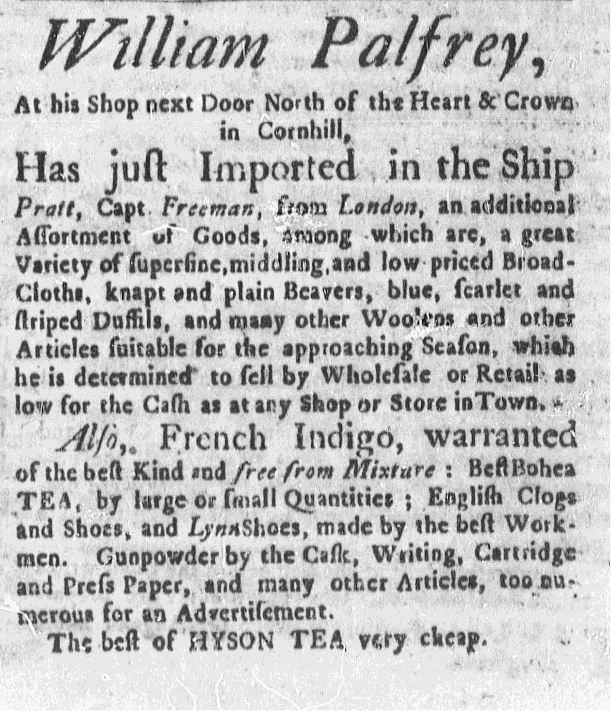
sep-25-9251766-massachusetts-gazette
Massachusetts Gazette (September 25, 1766).

“Woolens and other Articles suitable for the approaching Season.”

By beginning with the location of his shop, William Palfrey’s advertisement for his “Assortment of Goods” was able to attract fresh clientele that were unfamiliar with his establishment. He made a point to put the location directly following his name, and, interestingly enough, what his shop was next to: “next Door North of the Heart & Crown a well known emblem for the print shop where the Boston Evening-Post was printed.

Also, consider the significance of including where the goods had originated — in this case, London — alluding to the fact that many of these goods were not manufactured in the colonies at this time. According to T.H. Breen, “British goods flooded English colonies,” starting in the 1740s.[1] Palfrey adds that the varieties of “Broad-Cloths,” “Duffils,” and “other Woolens” would be very suitable for the upcoming changing of the seasons. Nearly every New England advertisement I examined mentioned the changing seasons, suggesting that the colonists adjusted their purchases to the varying conditions of the local climate. The changing weather conditions may not have been as extreme in the southern colonies, where the seasonal adjustments were not as significant. The advertisement prompted consumers to prepare for the upcoming change to a chillier fall and a cold winter.

**********

ADDITIONAL COMMENTARY: Carl Robert Keyes

Nick identifies an important aspect of William Palfrey’s advertisement in his examination of the section that promoted “many other Woolens and other Articles suitable for the approaching Season.” The autumnal equinox occurred just a few days before this advertisement was published. Fall had arrived. Colonists in Boston certainly would have been aware that seasons were changing, but Palfrey used his advertisement to draw potential customers into his shop by reminding them that they would soon need different sorts of clothing and other goods. Some readers would have stored fall and winter apparel during the spring and summer seasons, but Palfrey realized there was a good chance that even those who were most prepared likely needed replacements and supplements.

Nick raises a question about regional differences in advertising, noting that many advertisements that appeared in New England newspapers deployed appeals that stressed the goods for sale were appropriate for the season. This was also true of advertisements published in Philadelphia, a city that also experienced significant changes in weather throughout the year. Advertisements published there often used the phrase “suitable for the season” to describe the merchandise. Was that an appeal commonly used in other regions, especially the Chesapeake and the Lower South? I’m not certain. This project originated as a case study of advertising in Philadelphia, the largest city in the American colonies at the time of the Revolution and one of the centers of printing. I have not yet examined newspaper advertisements from southern colonies in the same depth. In his analysis of today’s advertisement, Nick has presented a question that merits further research as this project continues.

**********

[1] T.H. Breen, “An Empire of Goods: The Anglicization of Colonial America, 1690-1776,” Journal of British Studies 25, no. 4 (October 1986): 486.

Welcome, Guest Curator Nicholas Commesso

Nicholas Commesso is a senior at Assumption College, majoring in History with minors in Psychology and French. He is the goalie for the ice hockey team and a member of the Assumption College Young Conservatives Club. Raised in Marshfield, Massachusetts, he takes pride in graduating from The Governor’s Academy, the oldest boarding school in America (founded by bequest of Governor Dummer in 1763). Commesso has previous experience working with public history and digital humanities. For his Vocations in Public History course, he researched and created a video documenting the Higgins Armory Museum, a building on Preservation Worcester’s most endangered list. He has also contributed to the Isaiah Thomas Broadside Ballads Project at the American Antiquarian Society, using T-PEN to transcribe and tag a ballad, as part of his Revolutionary America course. He has also made presentations at the Assumption College Undergraduate Symposium. He will be guest curator for the Adverts 250 Project during the week of September 25 to October 1, 2016, as well as curator of the Slavery Adverts 250 Project during the week of October 16 to 22.

Welcome, Nicholas Commesso!

Slavery Advertisements Published September 25, 1766

The Slavery Adverts 250 Project chronicles the role of newspaper advertising in perpetuating slavery in the era of the American Revolution. The project seeks to reveal the ubiquity of slavery in eighteenth-century life from New England to Georgia by republishing advertisements about enslaved people – for sale as individuals or in groups, wanted to purchase or for hire for short periods, runaways who liberated themselves, and those who were subsequently captured and confined in jails and workhouses – in daily digests on this site as well as in real time via the @SlaveAdverts250 Twitter feed, utilizing twenty-first-century media to stand in for the print media of the eighteenth century.

The project aims to provide modern audiences with a sense of just how often colonizers encountered these advertisements in their daily lives. Enslaved men, women, and children appeared in print somewhere in the colonies almost every single day. Those advertisements served as a constant backdrop for social, cultural, economic, and political life in colonial and revolutionary America. Colonizers who did not purport to own enslaved people were still confronted with slavery as well as invited to maintain the system by purchasing enslaved men, women, and children or assisting in the capture of so-called “runaways” who sought to free themselves from bondage. The frequency of these newspaper advertisements suggests just how embedded slavery was in colonial and revolutionary American culture in everyday interactions beyond the printed page.

These advertisements also testify to the experiences of enslaved men, women, and children, though readers must consider that those experiences have been remediated through descriptions offered by enslavers rather than enslaved people themselves. Often unnamed in the advertisements, enslaved men, women, and children were not invisible or unimportant in early America.

These advertisements appeared in colonial American newspapers 250 years ago today.

sept-25-pennsylvania-gazette-slavery-1
Pennsylvania Gazette (September 25, 1766).

**********

sept-25-pennsylvania-gazette-slavery-2
Supplement to the Pennsylvania Gazette (September 25, 1766).

**********

sept-25-pennsylvania-gazette-slavery-3
Supplement to the Pennsylvania Gazette (September 25, 1766).

**********

sept-25-pennsylvania-journal-slavery-1
Pennsylvania Journal (September 25, 1766)

**********

sept-25-pennsylvania-journal-slavery-2
Supplement, to the Pennsylvania Journal (September 25, 1766).

**********

sept-25-pennsylvania-journal-slavery-3
Supplement, to the Pennsylvania Journal (September 25, 1766).

September 24

What was advertised in a colonial American newspaper 250 years ago today?

sep-24-9241766-georgia-gazette
Georgia Gazette (September 24, 1766).

“May be had at the Printing-Office … A SERMON.”

James Johnston, the printer of the Georgia Gazette, advertised the second edition of “A SERMON Preached in the Meeting at Savannah in Georgia, June 25th, 1766.” Although he did not specify the topic of this sermon, the four lines from Galatians that concluded the advertisement suggested that it addressed the uneasy relationship between the colonies and Great Britain that had been occasioned by Parliament’s attempts to regulate commerce within the empire, especially within its North American colonies. “Brethren, ye have been called unto liberty,” the biblical verses began, but concluded with a warning to “take heed that ye not be consumed one of another.” Johnston apparently presumed that potential customers/readers were so familiar recent political events, in general, and this sermon, in particular, that he did not need to state explicitly that it addressed the Stamp Act.

Johnston was certainly advertising John Joachim Zubly’s “The Stamp Act Repealed: A Sermon.” The title page of the second edition of that thirty-page duodecimo pamphlet included the same verses and other information that also appeared in the advertisement, including the assertion that it had been “First published at the Request and Expence of the Hearers.” The second edition was simultaneously published in Charleston by Peter Timothy and in Philadelphia by Heinrich Miller.

sep-24-pamphlet-cover
John Joachim Zubly, The Stamp-Act Repealed:  A Sermon (Savannah, GA:  James Johnston, 1766).  American Antiquarian Society.

In an introduction to the “Sermon,” Randall M. Miller notes that Zubly “captured the feelings of other prominent Georgians in 1766 who had recoiled from the strong words and threats of the Stamp Act crisis but also who had resented Parliament’s encroachment on American rights.” The sermon “stressed obedience to law and the reciprocal obligations of both Christian rulers and subjects to honor law and order.”[1]

By the time the second edition was published, colonists had known for several months that the Stamp Act had been repealed (which had led to Zubly preaching this sermon for a day of thanksgiving). One crisis had been averted, but colonists continued to grapple with their relationship to Britain, especially in the wake of the Declaratory Act. Still, few colonists were prepared at that time to sever ties with Britain. Johnston marketed a sermon that might assist readers in maintaining their identity as Britons while acknowledging that they had been slighted by Parliament. “We seemed like people that had been apprehensive of being shipwrecked and happily made a harbour,” Zubly proclaimed.[2] In publishing, marketing, and selling a second edition of the sermon, Johnston and his counterparts in Charleston and Philadelphia amplified that message to greater numbers of colonists.

**********

[1] Randall M. Miller, “A Warm & Zealous Spirit”: John J. Zubly and the American Revolution, A Selection of His Writings (Macon, GA: Mercer University Press, 1982), 31.

[2] John Joachim Zubly, The Stamp-Act Repealed: A Sermon (Savannah, GA: James Jonhnson, 1766), 28.

Summary of Slavery Advertisements Published September 18-24, 1766

These tables indicate how many advertisements for slaves appeared in colonial American newspapers during the week of September 18-24, 1766.

Note:  These tables are as comprehensive as currently digitized sources permit, but they may not be an exhaustive account.  They includes all newspapers that have been digitized and made available via Accessible Archives, Colonial Williamsburg’s Digital Library, and Readex’s America’s Historical Newspapers.  There are several reasons some newspapers may not have been consulted:

  • Issues that are no longer extant;
  • Issues that are extant but have not yet been digitized; and
  • Newspapers published in a language other than English (including the Wochentliche Philadelphische Staatsbote).

**********

Slavery Advertisements Published September 18-24, 1766:  By Date

slavery-adverts-table-by-date-sept-18

**********

Slavery Advertisements Published September 18-24, 1766:  By Region

slavery-adverts-table-by-region-sept-18

Slavery Advertisements Published September 24, 1766

The Slavery Adverts 250 Project chronicles the role of newspaper advertising in perpetuating slavery in the era of the American Revolution. The project seeks to reveal the ubiquity of slavery in eighteenth-century life from New England to Georgia by republishing advertisements about enslaved people – for sale as individuals or in groups, wanted to purchase or for hire for short periods, runaways who liberated themselves, and those who were subsequently captured and confined in jails and workhouses – in daily digests on this site as well as in real time via the @SlaveAdverts250 Twitter feed, utilizing twenty-first-century media to stand in for the print media of the eighteenth century.

The project aims to provide modern audiences with a sense of just how often colonizers encountered these advertisements in their daily lives. Enslaved men, women, and children appeared in print somewhere in the colonies almost every single day. Those advertisements served as a constant backdrop for social, cultural, economic, and political life in colonial and revolutionary America. Colonizers who did not purport to own enslaved people were still confronted with slavery as well as invited to maintain the system by purchasing enslaved men, women, and children or assisting in the capture of so-called “runaways” who sought to free themselves from bondage. The frequency of these newspaper advertisements suggests just how embedded slavery was in colonial and revolutionary American culture in everyday interactions beyond the printed page.

These advertisements also testify to the experiences of enslaved men, women, and children, though readers must consider that those experiences have been remediated through descriptions offered by enslavers rather than enslaved people themselves. Often unnamed in the advertisements, enslaved men, women, and children were not invisible or unimportant in early America.

These advertisements appeared in colonial American newspapers 250 years ago today.

sep-24-georgia-gazette-slavery-1
Georgia Gazette (September 24, 1766).

**********

sep-24-georgia-gazette-slavery-2
Georgia Gazette (September 24, 1766).

**********

sep-24-georgia-gazette-slavery-3
Georgia Gazette (September 24, 1766).

**********

sep-24-georgia-gazette-slavery-4
Georgia Gazette (September 24, 1766).

**********

sep-24-georgia-gazette-slavery-5
Georgia Gazette (September 24, 1766).

**********

sep-24-georgia-gazette-slavery-6
Georgia Gazette (September 24, 1766).

**********

sep-24-georgia-gazette-slavery-7
Georgia Gazette (September 24, 1766).

**********

sep-24-georgia-gazette-slavery-8
Georgia Gazette (September 24, 1766).

**********

sep-24-georgia-gazette-slavery-9
Georgia Gazette (September 24, 1766).

**********

sep-24-georgia-gazette-slavery-10
Georgia Gazette (September 24, 1766).

**********

sep-24-georgia-gazette-slavery-11
Georgia Gazette (September 24, 1766).

September 23

What was advertised in a colonial American newspaper 250 years ago today?

sep-23-9231766-south-carolina-gazette-and-country-journal
South-Carolina Gazette and Country Journal (September 23, 1766).

“Small Beer, Cyder and Perry.”

Today’s advertisement features a product that was common in the eighteenth century but has declined in popularity in the years since (though it seems to be enjoying a bit of a resurgence recently). The context made it apparent that “Perry” was a beverage, presumably containing alcohol, that some colonists might prefer instead of (or in addition to!) “small Beer and Cyder.” Beer and cider continue to be marketed to the masses and consumed widely in America. But what was this perry promoted in today’s advertisement?

I learned that perry is indeed an alcoholic beverage, made (as the name suggests) from pears, using a process similar to making cider from apples. Perry making became common in western England in the sixteenth and seventeenth centuries, but the beverage hit the high point of its popularity in the eighteenth century. Consumption of perry had spread to other parts of England following the English Civil War as the result of soldiers billeted in the Three Counties (Gloucestershire, Herefordshire, and Worcestershire) developing a taste for it. They may not have missed the fighting, but after being exposed to new food and drink during the conflict they incorporated that portion of their wartime experiences into their everyday lives. Perry also became more popular in England during the eighteenth century due to ongoing conflicts with France disrupting merchants’ ability to import wine from across the English Channel. Perry became a substitute. It comes as little surprise, then, that English colonists in Charleston and its hinterland imported and consumed perry along with small beer and cider.

In anticipation of writing today’s entry, I visited nearby Nashoba Valley Winery and Bolton Beer Works last Sunday to sample some perry, all in the name of research. I was pleasantly surprised to discover that the drink was more subtle than I anticipated, the taste of pears apparent but not overwhelming. In the absence of reliable sources of potable water, I can understand why colonists saw perry as a welcome addition to the small beer and cider they consumed.