November 8

What was advertised in a colonial American newspaper 250 years ago this week?
Nov 8 - 11:5:1767 Massachusetts Gazette
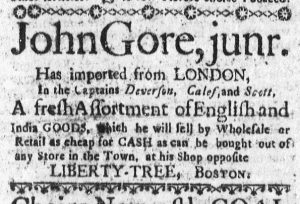
Massachusetts Gazette (November 5, 1767).

“At his Shop opposite LIBERTY-TREE, BOSTON.”

John Gore, Jr., sold a “fresh assortment of English and India GOODS … at his Shop opposite LIBERTY-TREE” in Boston in the late 1760s. By November 1767, Gore had been referencing the Liberty Tree in his advertisements for more than two years, a practice that he began during the Stamp Act crisis. Other advertisers had used the Liberty Tree as a landmark to direct consumers to their businesses while the Stamp Act was in effect, but Gore was the only shopkeeper in Boston who consistently invoked the Liberty Tree in his commercial notices after Parliament relented and repealed the Stamp Act. Doing so suggested his politics to potential customers. He asserted the appropriate relationship between England and the colonies even as he continued to import and sell English goods.

Making that pitch became more complicated in the fall of 1767. Colonists in Boston accused English merchants of draining the province of hard currency through an imbalance of trade. For several years colonists had imported more from Britain than they exported. Add to that the imposition of new legislation, the Townshend Acts, that assessed new taxes on certain imported goods, set to take effect on November 20, 1767. Residents of Boston determined that they needed to take action. At a town meeting on October 28, 1767, Bostonians pledged “to promote Industry, Oeconomy, and Manufactures, and by this Means prevent the unnecessary Importation of European Commodities, the excessive Use of which threatens the Country with Poverty and Ruin” (according to the report on the first page of the Massachusetts Gazette that carried Gore’s advertisement invoking the Liberty Tree). To that end, Bostonians “VOTED, That this Town will take all prudent and legal Measures to encourage the Produce and Manufactures of this Province.” Furthermore, they promised “that we will encourage the Use and Consumption of all Articles manufactured in any of the British Colonies.” To underscore their resolve, Bostonians voted to institute a new non-importation and non-consumption agreement effective on December 31. The Boston Evening-Post, the Boston-Gazette, and the Boston Post-Boy all carried this news on November 2. Similarly, the Massachusetts Gazette inserted it on November 5. The Boston Post-Boy called special attention to these measures with a rare headline: “Save your MONEY, and you Save your COUNTRY!”

Gore found himself in a difficult position. For the past two years he had used his shop’s proximity to the Liberty Tree to identify his business, encouraging patrons to associate his enterprise with resistance to Parliament’s attempts to unjustly tax the colonies. Now, however, his friends and neighbors called for an outright boycott of his imported merchandise. One of his primary appeals to prospective customers, familiar due to its steady repetition in the public prints, suddenly became much less powerful. Would it matter that Gore’s shop was located “opposite LIBERTY-TREE” if he stocked an array of goods imported from London?

November 7

What was advertised in a colonial American newspaper 250 years ago today?

Nov 7 - 11:7:1767 Providence Gazette
Providence Gazette (November 7, 1767).

“WILLIAM RUSSELL is just arrived from London.”

Joseph Russell and William Russell frequently placed advertisements in the Providence Gazette after Sarah Goddard and her partners revived that publication in the late 1760s. The Russells ran advertisements innovative for both their appeals and their length, including a full-page advertisement that inspired other local shopkeepers to publish their own full-page advertisements. Yet the boldness and creativity of the Russells’ marketing efforts seemed to decline over time, possibly indicating that they might not have considered the returns worth the investment when it came to developing and paying for cutting-edge newspaper advertisements.

Then they once again published a full-page advertisement in the November 7, 1767, edition of the Providence Gazette. Like their earlier full-page advertisements, it invited prospective customers to visit “their STORE, the Sign of the GOLDEN EAGLE, near the Court-House” and promised low prices for a “large, neat, and compleat Assortment of English, India and Hard-Ware GOODS.”

Yet this advertisement featured one significant difference compared to all of their previous paid notices in the local newspaper. It informed consumers that “WILLIAM RUSSELL is just arrived from London,” where he had personally selected the merchandise now stocked at the Sign of the Golden Eagle. Given the time required to cross the Atlantic (twice!), William had been away from Providence for at least three months. He presumably spent some time in London, meeting with business associates and getting a sense of current tastes in the cosmopolitan center of the empire as well as visiting friends or relatives.

In William’s absence, Joseph oversaw their enterprises in Providence, including their advertising. This may explain why their advertisements became less bold and distinctive, if William was the partner more gifted and willing to take risks when it came to marketing. Joseph could have been a caretaker when it came to that aspect of their business, advertising only when necessary and following the standards already well established for advertisements in eighteenth-century newspapers. William, on the other hand, may have infused new vigor into their marketing when he returned from his long trip. Taking out a full-page advertisement in a four-page publication was a bold way to announce his homecoming and draw attention to the family business.

November 6

What was advertised in a colonial American newspaper 250 years ago today?

Nov 6 - 11:6:1767 New-Hampshire Gazette
New-Hampshire Gazette (November 6, 1767).

“Care will be taken to have all the English and American News Papers, Magazines, and political Pamphlets.”

In the fall of 1767 Robert Calder informed residents of Portsmouth, New Hampshire, and its environs that “he has open’d a COFFEE HOUSE, opposite the South Side of the Reverend Mr. HAVEN’s Meeting House.” He catered to his clients, promising that he served the most popular beverages – coffee, tea, and chocolate – “in the best and most agreeable Manner.” Calder, “LATE FROM LONDON,” paid special attention to cultivating an ambiance of sophistication for his patrons. In his other line of work as a hairdresser for both ladies and gentlemen, he adhered to the “genteelest Fashions.” Those who visited his coffeehouse could expect the same atmosphere as they sipped their drinks and conversed with friends and acquaintances. After all, the proprietor promised that “every other Means [would be] assiduously pursued to give Satisfaction.”

Yet Calder’s coffeehouse was more than just a place to gather for pleasant conversation over a pot of a hot beverage on a brisk fall day. It was also a place where the public could keep themselves informed about events taking place in the colony and, especially, other colonies and other places throughout the Atlantic world and beyond. Calder announced, “Care will be taken to have all the English and American News Papers, Magazines, and political Pamphlets, as early as possible.” Even though the issue of the New-Hampshire Gazette that carried this advertisement included news from Boston, Newport, New York, London, and Algiers, publishers Daniel Fowle and Robert Fowle did not have sufficient space to reprint all the news from faraway places. The variety of newspapers available at Calder’s coffeehouse would allow colonists to keep up to date on current events, a prospect that likely loomed large considering that the Townshend Act was scheduled to go into effect in just two weeks. Realizing that prospective patrons wanted to keep informed, Calder provided magazines and political pamphlets as well. At his coffeehouse the public had access to printed materials that many colonists might not otherwise have had the means or the money to procure on their own.

In eighteenth-century America, coffeehouses were an important counterpart to printing shops that doubled as post offices. Both were places for disseminating and obtaining information via multiple media. Printers published and distributed the news, but coffeehouse proprietors facilitated delivering the news to even broader audiences. They offered an important service that benefited the civic life of their communities.

Slavery Advertisements Published November 6, 1767

The Slavery Adverts 250 Project chronicles the role of newspaper advertising in perpetuating slavery in the era of the American Revolution. The project seeks to reveal the ubiquity of slavery in eighteenth-century life from New England to Georgia by republishing advertisements about enslaved people – for sale as individuals or in groups, wanted to purchase or for hire for short periods, runaways who liberated themselves, and those who were subsequently captured and confined in jails and workhouses – in daily digests on this site as well as in real time via the @SlaveAdverts250 Twitter feed, utilizing twenty-first-century media to stand in for the print media of the eighteenth century.

The project aims to provide modern audiences with a sense of just how often colonizers encountered these advertisements in their daily lives. Enslaved men, women, and children appeared in print somewhere in the colonies almost every single day. Those advertisements served as a constant backdrop for social, cultural, economic, and political life in colonial and revolutionary America. Colonizers who did not purport to own enslaved people were still confronted with slavery as well as invited to maintain the system by purchasing enslaved men, women, and children or assisting in the capture of so-called “runaways” who sought to free themselves from bondage. The frequency of these newspaper advertisements suggests just how embedded slavery was in colonial and revolutionary American culture in everyday interactions beyond the printed page.

These advertisements also testify to the experiences of enslaved men, women, and children, though readers must consider that those experiences have been remediated through descriptions offered by enslavers rather than enslaved people themselves. Often unnamed in the advertisements, enslaved men, women, and children were not invisible or unimportant in early America.

These advertisements appeared in colonial American newspapers 250 years ago today.

Nov 6 - South-Carolina and American General Gazette Slavery 1
South-Carolina and American General Gazette (November 6, 1767).

**********

Nov 6 - South-Carolina and American General Gazette Slavery 2
South-Carolina and American General Gazette (November 6, 1767).

**********

Nov 6 - South-Carolina and American General Gazette Slavery 3
South-Carolina and American General Gazette (November 6, 1767).

**********

Nov 6 - South-Carolina and American General Gazette Slavery 4
South-Carolina and American General Gazette (November 6, 1767).

**********

Nov 6 - South-Carolina and American General Gazette Slavery 5
South-Carolina and American General Gazette (November 6, 1767).

**********

Nov 6 - South-Carolina and American General Gazette Slavery 6
South-Carolina and American General Gazette (November 6, 1767).

November 5

What was advertised in a colonial American newspaper 250 years ago today?

Nov 5 - 11:5:1767 New-York Gazette Weekly Post-Boy
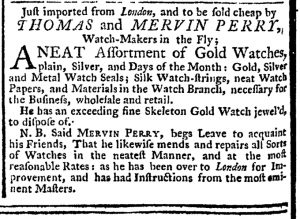
New-York Gazette: Or, the Weekly Post-Boy (November 5, 1767).

“He has been over to London for Improvement.”

In their advertisements, artisans who had migrated across the Atlantic frequently asserted their origins as part of their attempt to attract customers. For instance, Joseph Beck promoted himself as a “Stay-Maker, from LONDON” in the November 5, 1767, edition of the New-York Gazette: Or, the Weekly Post-Boy. Establishing a connection to London laid the foundation for making other appeals to consumers. It often suggested some sort of specialized training in a trade (and some artisans explicitly noted that they had served out an apprenticeship with a master in London). It also signaled familiarity with the current fashions in the cosmopolitan center of the empire. Artisans sought to allay anxieties that the items they made and sold in the colonies were inferior in quality or taste when compared to the wares available in London.

Not all colonial artisans, however, could proclaim that they migrated “from LONDON” in their advertisements. Many had been born and received their training in the colonies. Such was probably the case for Thomas Perry and Mervin Perry, “Watch-Makers in the Fly” in New York.  Like many of their competitors in New York and their counterparts in other cities and towns, the Perrys not only made and repaired watches but also imported them from London. Yet they realized they could acquire more cachet among consumers if they established other connections to London. It was not sufficient merely that they acquired their merchandise from London.

To that end, the watchmakers inserted a nota bene that informed potential customers that Marvin Perry had “been over to London for Improvement, and has had Instructions from the most eminent Masters.” Although he did not undertake a complete apprenticeship in London, Perry had supplemented his training and presumably improved his skills. He implied that readers could expect that the “Instructions from the most eminent Masters” improved the quality of Perry’s work. This additional training also confirmed that he performed his work “in the neatest Manner.”

Slavery Advertisements Published November 5, 1767

The Slavery Adverts 250 Project chronicles the role of newspaper advertising in perpetuating slavery in the era of the American Revolution. The project seeks to reveal the ubiquity of slavery in eighteenth-century life from New England to Georgia by republishing advertisements about enslaved people – for sale as individuals or in groups, wanted to purchase or for hire for short periods, runaways who liberated themselves, and those who were subsequently captured and confined in jails and workhouses – in daily digests on this site as well as in real time via the @SlaveAdverts250 Twitter feed, utilizing twenty-first-century media to stand in for the print media of the eighteenth century.

The project aims to provide modern audiences with a sense of just how often colonizers encountered these advertisements in their daily lives. Enslaved men, women, and children appeared in print somewhere in the colonies almost every single day. Those advertisements served as a constant backdrop for social, cultural, economic, and political life in colonial and revolutionary America. Colonizers who did not purport to own enslaved people were still confronted with slavery as well as invited to maintain the system by purchasing enslaved men, women, and children or assisting in the capture of so-called “runaways” who sought to free themselves from bondage. The frequency of these newspaper advertisements suggests just how embedded slavery was in colonial and revolutionary American culture in everyday interactions beyond the printed page.

These advertisements also testify to the experiences of enslaved men, women, and children, though readers must consider that those experiences have been remediated through descriptions offered by enslavers rather than enslaved people themselves. Often unnamed in the advertisements, enslaved men, women, and children were not invisible or unimportant in early America.

These advertisements appeared in colonial American newspapers 250 years ago today.

Nov 5 - Massachusetts Gazette Slavery 1
Massachusetts Gazette (November 5, 1767).

**********

Nov 5 - Massachusetts Gazette Slavery 2
Massachusetts Gazette (November 5, 1767).

**********

Nov 5 - Pennsylvania Gazette Slavery 1
Pennsylvania Gazette (November 5, 1767).

**********

Nov 5 - Pennsylvania Gazette Supplement Slavery 1
Supplement to the Pennsylvania Gazette (November 5, 1767).

**********

Nov 5 - Virginia Gazette Slavery 1
Virginia Gazette (November 5, 1767).

**********

Nov 5 - Virginia Gazette Slavery 2
Virginia Gazette (November 5, 1767).

**********

Nov 5 - Virginia Gazette Slavery 3
Virginia Gazette (November 5, 1767).

**********

Nov 5 - Virginia Gazette Slavery 4
Virginia Gazette (November 5, 1767).

**********

Nov 5 - Virginia Gazette Slavery 5
Virginia Gazette (November 5, 1767).

**********

Nov 5 - Virginia Gazette Slavery 6
Virginia Gazette (November 5, 1767).

**********

Nov 5 - Virginia Gazette Slavery 7
Virginia Gazette (November 5, 1767).

**********

Nov 5 - Virginia Gazette Slavery 8
Virginia Gazette (November 5, 1767).

**********

Nov 5 - Virginia Gazette Slavery 9
Virginia Gazette (November 5, 1767).

November 4

What was advertised in a colonial American newspaper 250 years ago today?

Nov 4 - 11:4:1767 Georgia Gazette
Georgia Gazette (November 4, 1767).

“They … carry on the ART of SURVEYING.”

In the November 4, 1767, edition of the Georgia Gazette, James Anderson and Samuel Savery placed an advertisement “to inform the Publick” that they had formed a partnership and “carr[ied] on the ART of SURVEYING in all its branches.” While Anderson and Savery referred to their work as an art, it was also a technical skill that required both expertise and special equipment. Surveyors needed to understand trigonometry and other mathematics more advanced than most colonists mastered. Given the stakes involved in their work, they also needed to cultivate trust. Anderson and Savery asserted that they drew up plans that were “neatly and accurately done” and did so “with punctuality and dispatch.” They sought to convince potential clients that they were dependable and professional.

Anderson and Savery offered their services to “Gentlemen who desire plans of their islands or estates,” but many other surveyors worked for the colonial government. Their work was essential in transferring land from the crown to the private owners. From the founding of the colony in 1732 until 1752, a Board of Trustees governed Georgia. Throughout most of the period the Trustees designated a public surveyor. On the recommendation of the Lords Commissioners of Trade and Plantations, George II placed the colony under royal authority and established a civil government that consisted of a governor, an assemble, and other necessary offices. This included the surveyor general, an official responsible for administering land grants and public land surveys. According to Ferris W. Cadle, “In time, the duties of this office increased to such an extent that the surveyor general performed very little of the actual surveying, the office having become primarily administrative with the fieldwork left to deputies.”[1]

Anderson and Savery may have worked on behalf of the colonial government at some point in their careers, but in the late 1760s they advertised a different service. They offered to help landholders gain an even better understanding of their property beyond whatever initial surveys had been conducted. Like other surveyors in colonial America, they contributed to imposing order on a frontier.

**********

[1] Ferris W. Cadle, Georgia Land Surveying History and Law (Athens: University of Georgia Press, 1991), 29.

Summary of Slavery Advertisements Published October 29 – November 4, 1767

These tables indicate how many advertisements for slaves appeared in colonial American newspapers during the week of October 29 – November 4, 1767.

Note:  These tables are as comprehensive as currently digitized sources permit, but they may not be an exhaustive account.  They includes all newspapers that have been digitized and made available via Accessible Archives, Colonial Williamsburg’s Digital Library, and Readex’s America’s Historical Newspapers.  There are several reasons some newspapers may not have been consulted:

  • Issues that are no longer extant;
  • Issues that are extant but have not yet been digitized (including the Pennsylvania Journal); and
  • Newspapers published in a language other than English (including the Wochentliche Philadelphische Staatsbote).

**********

Slavery Advertisements Published October 29 – November 4, 1767:  By Date

Slavery Adverts Tables 1767 By Date Oct 29

**********

Slavery Advertisements Published October 29 – November 4, 1767:  By Region

Slavery Adverts Tables 1767 By Region Oct 29

Slavery Advertisements Published November 4, 1767

The Slavery Adverts 250 Project chronicles the role of newspaper advertising in perpetuating slavery in the era of the American Revolution. The project seeks to reveal the ubiquity of slavery in eighteenth-century life from New England to Georgia by republishing advertisements about enslaved people – for sale as individuals or in groups, wanted to purchase or for hire for short periods, runaways who liberated themselves, and those who were subsequently captured and confined in jails and workhouses – in daily digests on this site as well as in real time via the @SlaveAdverts250 Twitter feed, utilizing twenty-first-century media to stand in for the print media of the eighteenth century.

The project aims to provide modern audiences with a sense of just how often colonizers encountered these advertisements in their daily lives. Enslaved men, women, and children appeared in print somewhere in the colonies almost every single day. Those advertisements served as a constant backdrop for social, cultural, economic, and political life in colonial and revolutionary America. Colonizers who did not purport to own enslaved people were still confronted with slavery as well as invited to maintain the system by purchasing enslaved men, women, and children or assisting in the capture of so-called “runaways” who sought to free themselves from bondage. The frequency of these newspaper advertisements suggests just how embedded slavery was in colonial and revolutionary American culture in everyday interactions beyond the printed page.

These advertisements also testify to the experiences of enslaved men, women, and children, though readers must consider that those experiences have been remediated through descriptions offered by enslavers rather than enslaved people themselves. Often unnamed in the advertisements, enslaved men, women, and children were not invisible or unimportant in early America.

These advertisements appeared in colonial American newspapers 250 years ago today.

Nov 4 - Georgia Gazette Salvery 8
Georgia Gazette (November 4, 1767).

**********

Nov 4 - Georgia Gazette Slavery 1
Georgia Gazette (November 4, 1767).

**********

Nov 4 - Georgia Gazette Slavery 2
Georgia Gazette (November 4, 1767).

**********

Nov 4 - Georgia Gazette Slavery 3
Georgia Gazette (November 4, 1767).

**********

Nov 4 - Georgia Gazette Slavery 4
Georgia Gazette (November 4, 1767).

**********

Nov 4 - Georgia Gazette Slavery 5
Georgia Gazette (November 4, 1767).

**********

Nov 4 - Georgia Gazette Slavery 6
Georgia Gazette (November 4, 1767).

**********

Nov 4 - Georgia Gazette Slavery 7
Georgia Gazette (November 4, 1767).

**********

Nov 4 - Georgia Gazette Slavery 9
Georgia Gazette (November 4, 1767).

**********

Nov 4 - Georgia Gazette Slavery 10
Georgia Gazette (November 4, 1767).

November 3

What was advertised in a colonial American newspaper 250 years ago today?

Nov 3 - 11:3:1767 South-Carolina Gazette and Country Journal
South-Carolina Gazette and Country Journal (November 3, 1767).

“One for their TOWN and one for their STONO STORE.”

Atkins and Weston placed an advertisement in the November 3, 1767, edition of the South-Carolina Gazette and Country Journal to “Inform their friends and customers, that by the ship Nancy, Captain Jordan, from London” they had just imported a variety of new merchandise. The shipping news, fortuitously printed immediately to the left of the advertisement, confirmed that Jordan and the Nancy had entered the port two weeks earlier on October 20. Atkins and Watson had been expecting this shipment for quite some time. They previously attempted to drum up demand for their new inventory even before it arrived; in September they published an advertisement designed to incite anticipation among their “friends and customers” and other readers of the newspaper throughout the colony.

In both advertisements Atkins and Weston underscored that they operated stores at two locations, one in Charleston and the other in Stono, a smaller settlement to the southwest across the Ashley River. Potential customers who lived in the vicinity of Stono did not have to travel to the colony’s major port to make their purchases at Atkins and Weston’s main store. Instead, they could shop at the local branch. The advertisers made clear that customers at both locations would choose from among the same selection and experience the same treatment. They announced that the recent shipment on the Nancy included “TWO very LARGE and COMPLEAT ASSORTMENTS of GOODS” that “consist of almost every article usually imported.” They were so certain of this that they did not publish a detailed list but instead argued it was “needless to descend to particulars.” They did not privilege customers in Charleston, pledging “to keep both their stores well supplied.” In addition, they assured prospective customers in both locations that they “may place a fixed confidence in their selling on as reasonable terms as any people in the province.”

Atkins and Weston offered options to consumers who did not reside in the colony’s major port, one of the largest and most cosmopolitan urban centers in the colonies in the late 1760s. Colonists who lived in Charleston’s hinterland could have the same shopping experiences at a local outlet in Stono as if they made the journey into the city because Atkins and Weston stocked both stores with the same goods. The merchandise at their second location was neither secondhand nor second best.